
Talent Management In BFSI Market Size and Share
Market Overview
| Study Period | 2020 - 2031 |
|---|---|
| Market Size (2026) | USD 2.65 Billion |
| Market Size (2031) | USD 4.55 Billion |
| Growth Rate (2026 - 2031) | 11.45 % |
| Fastest Growing Market | Asia-Pacific |
| Largest Market | North America |
| Market Concentration | Medium |
Major Players *Disclaimer: Major Players sorted in no particular order Image © Mordor Intelligence. Reuse requires attribution under CC BY 4.0. | |
Talent Management In BFSI Market Analysis by Mordor Intelligence
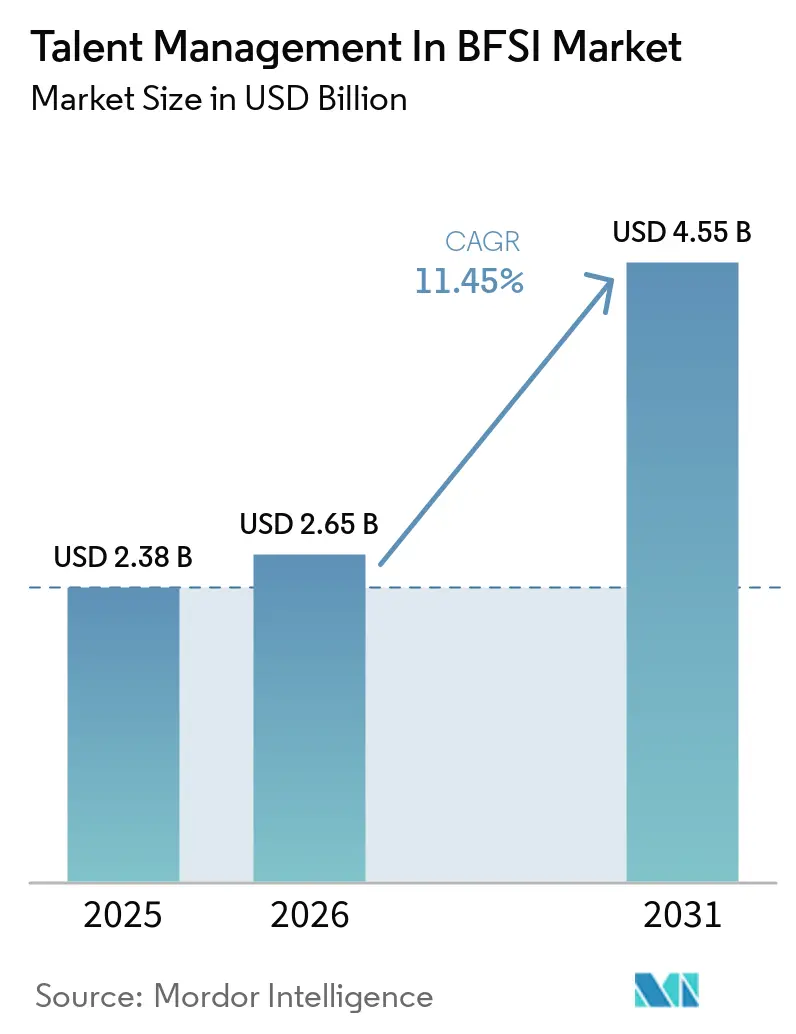
The talent management in BFSI market size was USD 2.38 billion in 2025 and is forecast to reach USD 4.55 billion by 2031, advancing at a CAGR of 11.45% over 2026-2031. The market is moving from separate HR tools toward integrated platforms that connect hiring, performance, learning, compensation, and compliance records into a single operating layer. Agentic AI is raising the value of continuous skills mapping, attrition monitoring, and role-readiness tracking, especially as banks and insurers compete for digital, risk, and data talent. Workforce pressure is coming from several directions at once, including retiring specialist cohorts, limited AI-ready talent pools, and tighter accountability requirements across regulated functions. Buyers are also placing more weight on governance, audit trails, and cross-border data controls, which is changing how vendors position their platforms. Competition remains moderately consolidated, with broad enterprise vendors defending large accounts while niche AI specialists expand through targeted use cases and faster product cycles.
Key Report Takeaways
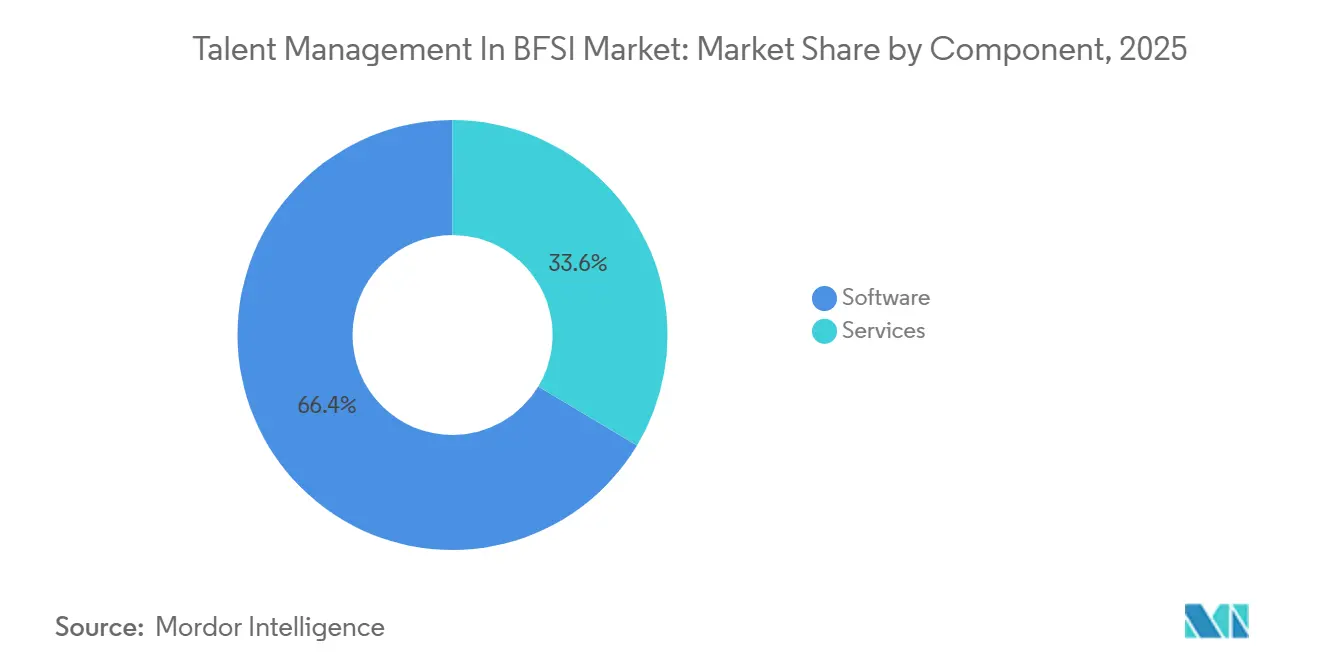
- By component, software led with a 66.41% share of the Talent Management in BFSI Market in 2025, while services is projected to expand at a 13.92% CAGR through 2031.
- By application, performance management held a 23.14% share of the Talent Management in BFSI Market in 2025, while learning and development is forecast to grow at a 12.77% CAGR through 2031.
- By deployment, on-premise accounted for a 67.89% share in 2025, while cloud is expected to advance at a 14.67% CAGR through 2031.
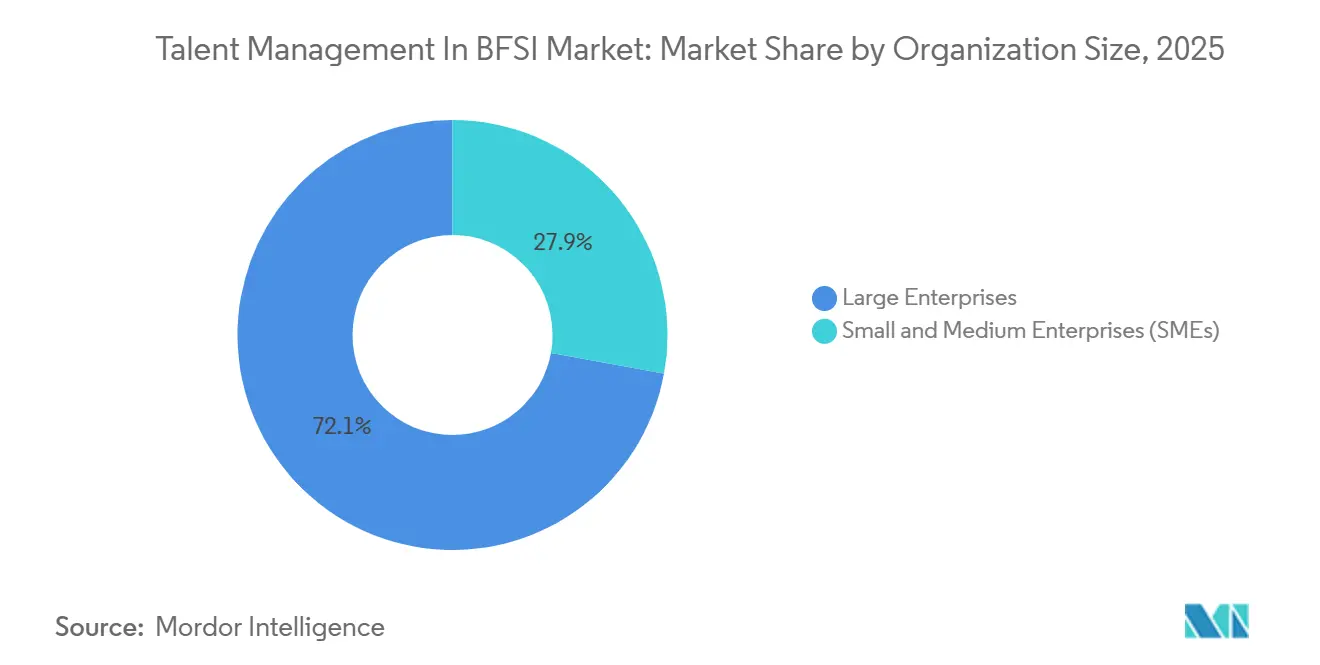
- By organization size, large enterprises captured a 72.13% share in 2025, while SMEs are projected to expand at a 14.23% CAGR through 2031.
- By end user, banking held a 51.28% share in 2025, while fintech and other non-bank financial institutions are forecast to grow at a 13.51% CAGR through 2031.
- By geography, North America held a 36.11% share of the Talent Management in BFSI Market in 2025, while Asia-Pacific is projected to expand at a 13.09% CAGR through 2031.
Note: Market size and forecast figures in this report are generated using Mordor Intelligence’s proprietary estimation framework, updated with the latest available data and insights as of January 2026.
Market Trends and Insights
Drivers Impact Analysis of Talent Management In BFSI Market*
| Driver | (~) % Impact on CAGR Forecast | Geographic Relevance | Impact Timeline |
|---|---|---|---|
| Rising Adoption of AI-Driven Talent Analytics | +3.2% | Global, with early gains concentrated in North America and Asia-Pacific | Medium term (2-4 years) |
| Growing Digital-First Hiring Practices | +2.8% | Global, with accelerated adoption in North America, Europe, and Asia-Pacific core | Short term (≤ 2 years) |
| Increasing Regulatory Pressure on Workforce Compliance | +2.0% | North America and EU, with spillover to APAC through Basel and DORA frameworks | Medium term (2-4 years) |
| Expansion of BFSI Operations in Emerging Markets | +1.5% | APAC core, spillover to Middle East and Africa and South America | Long term (≥ 4 years) |
| Intensifying Competition for Niche Tech Talent | +1.0% | Global, with acute pressure in North America and EU financial centers | Short term (≤ 2 years) |
| Shift Toward Skills-Based Internal Mobility Frameworks | +0.7% | Global, with early-mover advantage in North America, the UK, and Singapore | Medium term (2-4 years) |
| Source: Mordor Intelligence | |||
Rising Adoption of AI-Driven Talent Analytics
AI-driven analytics has become one of the clearest differentiators in the talent management market in BFSI in 2026, enabling HR teams to move from periodic reporting to continuous workforce monitoring. Deloitte found that only 18% of senior executives at large U.S. financial services institutions were implementing generative AI in talent functions in 2024, compared with 47% in marketing and sales, underscoring the significant adoption room in HR workflows. Accenture reported that leading BFSI institutions using AI-supported HR programs achieved 45% gains in HR productivity, a 30% improvement in priority skills proficiency, and a 40% increase in internal fill rates. As these tools mature, banks and insurers are using them to connect performance signals, engagement indicators, and labor market changes into a single view, enabling more immediate flight-risk detection and workforce planning. That shift matters because AI and data roles are expanding inside finance faster than many firms can hire, so the talent management in BFSI market is seeing stronger demand for skills graphs, internal mobility tools, and evidence-based development workflows. The result is greater demand across succession planning, compensation benchmarking, learning, and role-readiness tracking as BFSI employers try to retain scarce talent within the organization for longer.
Growing Digital-First Hiring Practices
Digital-first hiring is changing how the talent management in BFSI market handles recruitment speed, candidate reach, and screening quality. Accenture reported that HSBC's AI-enabled talent acquisition transformation, built on SAP SuccessFactors and Eightfold.ai, reduced operating expenses by 18%, generated USD 28.5 million in savings, and improved time-to-hire by 35%. This model shifts hiring away from resume-only filters and toward workflow-based assessments that can incorporate behavioral signals, skill patterns, and job-fit indicators earlier in the process. It also supports expansion beyond major financial hubs because mobile-first funnels can reach candidates in smaller cities where branch, operations, and service roles are growing faster than traditional recruiter coverage. Wolters Kluwer noted in 2026 that more than 33% of financial services firms ranked talent scarcity as their main barrier to AI deployment, which links hiring effectiveness directly to each institution's broader transformation pace.
Increasing Regulatory Pressure on Workforce Compliance
Regulatory pressure is creating a separate demand stream for the talent management in BFSI market because workforce records now sit closer to governance and control functions than before. PwC reported in its Global Compliance Survey 2025 that 90% of financial services respondents said compliance requirements had become more complex over the prior 3 years, and 82% planned to raise technology investment to automate or optimize compliance workflows. Deloitte's 2025 U.S. Banking Regulatory Outlook also noted that enforcement actions remained elevated into 2024 and tied part of that pressure to internal control failures and staffing gaps in second-line and third-line risk functions. CRD6 and DORA are pushing European institutions to connect responsibility mapping, competency records, and resilience reporting across HR and governance systems, thereby increasing the value of an integrated, auditable data architecture. That is why vendors with strong governance layers, multi-jurisdiction controls, and clear audit trails are gaining an edge over stand-alone point tools in the talent management in BFSI market.
Expansion of BFSI Operations in Emerging Markets
Expansion into emerging markets is widening the scope of the talent management in BFSI market beyond the largest incumbent institutions. People Matters reported that India's BFSI Global Capability Center ecosystem was valued at USD 40 billion and projected to reach USD 135 billion by 2032, with more than 185 centers, underscoring how quickly financial workforce infrastructure is scaling in new operating hubs. The same reporting noted that hiring in Indian BFSI GCCs rose 12% to 14% quarter on quarter in financial year 2026, while 88% to 90% of hiring remained concentrated in tier-1 cities, leaving deeper regional talent pools underused. That operating pattern favors mobile-first platforms, multi-language workflows, and tight integration with local payroll and compliance systems because institutions need more reach without adding comparable administrative complexity. ETCIO reported in 2026 that more than 80% of APAC organizations were rethinking payroll operations amid talent shortages, and 49% were actively exploring AI to support leaner operating models. As a result, the talent management in BFSI market is seeing stronger pull from institutions that are building regional delivery capacity and need workforce systems that can scale quickly across diverse labor markets.
Restraints Impact Analysis of Talent Management In BFSI Market*
| Restraint | (~) % Impact on CAGR Forecast | Geographic Relevance | Impact Timeline |
|---|---|---|---|
| Fragmented Legacy HR Systems | -2.8% | Global, with acute impact in North America and EU financial centers | Medium term (2-4 years) |
| Data-Privacy Concerns in Cross-Border Talent Data Flows | -1.8% | EU core, spillover to APAC and Middle East and Africa through GDPR, DPDP, and PDPA frameworks | Medium term (2-4 years) |
| Limited HR Tech Budgets At Regional Banks and Insurers | -1.2% | APAC, South America, Middle East and Africa, concentrated in institutions below USD 5 billion in assets | Long term (≥ 4 years) |
| Talent Data Standardization Challenges | -0.8% | Global, with greatest severity in multi-entity banking groups operating across 20 or more jurisdictions | Medium term (2-4 years) |
| Source: Mordor Intelligence | |||
Fragmented Legacy HR Systems
Fragmented legacy HR systems remain the clearest structural brake on the talent management in BFSI market because they limit data consistency and consume modernization budgets at the same time. Zalaris found that large banks can still operate across multiple payroll environments, leading to inconsistent data definitions and increased risk of delayed or incorrect processing. Workday found that 40% of senior financial services executives reported siloed HR data, and 65% said they needed better technology to integrate data across separate systems.[1] That fragmentation slows skills mapping, compensation governance, performance visibility, and audit readiness, which weakens the practical value of newer AI layers even when firms buy them. Bain also noted that modernization programs in financial services need coordinated changes across technology, processes, and culture, and that firms that integrated these efforts achieved average labor-time reductions of 22% across financial processes. The funding problem remains real because DUNNIXER reported in 2026 that more than 75% of IT budgets in many financial institutions were still being absorbed by older systems, which leaves less room for new platform investment in the talent management in BFSI market.
Data-Privacy Concerns in Cross-Border Talent Data Flows
Cross-border data compliance is slowing parts of the talent management in BFSI market because global employers must manage workforce records under overlapping privacy, localization, and AI rules. Taleva reported that GDPR fines for recruitment-related violations across the EU reached EUR 1.3 billion (USD 1.4 billion) in 2025, underscoring the cost of hiring-related noncompliance. HR HUB noted that BFSI employers in India must draw a clearer line between employee data used by AI HRMS platforms and customer data, which falls under separate data-localization and IT rules, complicating model design and vendor configuration. Osborne Clarke also warned that firms using U.S.-hosted cloud platforms still need contractual safeguards in addition to the EU-U.S. Data Privacy Framework, as the legal position on transfers remains unclear. The EU AI Act adds another layer because recruitment systems fall into a high-risk category and therefore require transparency, human oversight, accuracy testing, and registration before broad deployment. These issues do not stop adoption, but they do slow buying cycles and raise implementation burdens across the talent management in BFSI market.
*Our forecasts treat driver/restraint impacts as directional, not additive. The impact forecasts reflect baseline growth, mix effects, and variable interactions.
Talent Management In BFSI Market Segment Analysis
By Component:
Software Leads while Services Gain GroundSoftware held 66.41% of the talent management in BFSI market share in 2025, while services recorded the fastest 13.92% CAGR through 2031. Software leads because buyers increasingly prefer subscription platforms that keep adding analytics, AI agents, and compliance tools without restarting implementation work every cycle. The spread of cloud delivery has also widened access for regional banks and cooperative institutions that previously could not justify large on-premise setups. Services are growing faster because BFSI deployments still involve complex migration, regulatory configuration, and operating model changes across multiple jurisdictions. That means platform selection is only part of the buying decision in the talent management in BFSI market.
Support and maintenance work is also becoming more important because AI-enabled hiring and performance tools require repeated governance checks, bias reviews, and audit-trail validation under tighter control standards. SAP SuccessFactors introduced enriched job architecture and certificate-based compliance monitoring in its H1 2026 release cycle, which strengthens the case for both initial software adoption and longer service relationships.[2] Accenture also found that banks using co-learning models with AI developed skills 4x faster than those relying on stand-alone training, which expands demand for change support and workflow design around deployments. This keeps the talent management in BFSI market tied to recurring software revenue and a strong services layer, and it also shows how the talent management in BFSI industry depends on execution quality as much as product breadth.
By Application:
Performance Management Leads while Learning and Development AcceleratesPerformance management held a 23.14% share in 2025, while learning and development represented the fastest-growing part of the talent management in BFSI market size, at 12.77% CAGR through 2031. Learning demand is rising because agentic AI is changing daily work in banking and insurance, and forcing employers to refresh skills faster than annual training calendars allow. Accenture reported in 2026 that co-learning models helped financial institutions improve skills proficiency 4x faster and doubled employee confidence in AI collaboration when learning was embedded in daily workflows. That changes learning from a support activity into an operational tool for productivity and workforce continuity. Performance management remains the largest application because it is already embedded across regulated roles and control-heavy organizations.
The application itself is changing as vendors move away from annual review cycles and toward live contribution signals and manager prompts. Workday's Talent Management Agent now drafts evidence-based reviews from current contribution data, while SAP's Performance Agent analyzes performance patterns and recommends next actions. Succession planning is also gaining urgency, as Wolters Kluwer reported that 40% of financial advisors are expected to retire within the next decade and that more than 25% currently lack succession plans. Variable-pay rule changes, internal mobility, and stronger documentation needs across the talent management in BFSI market are reshaping compensation management and workforce planning.
By Deployment:
On-Premise Remains Large while Cloud Advances QuicklyOn-premise accounted for 67.89% in 2025, while cloud represents the fastest-growing part of the talent management in BFSI market size, at 14.67% CAGR through 2031. The split reflects the fact that many financial institutions still operate under data sovereignty and resilience rules that slow full cloud migration. RBI localization rules, DORA expectations, and national data controls make deployment choice part of governance planning, not only an IT architecture issue. Even so, Workday's banking perspective report noted that many leading global banks were moving core systems to the cloud or actively preparing to do so, which supports a long migration runway. That gradual movement keeps the talent management in BFSI market positioned for continued cloud gains through the forecast period.
The business case for cloud delivery keeps improving because vendors can update compliance content, controls, and AI features faster than most on-premise teams can manage. SAP reported that Bank Islam's SAP SuccessFactors rollout reduced time spent on performance management by 98% and improved talent acquisition efficiency by 94%. SAP also showed that Kbank's cloud HR transformation reduced HR process times by 50% and cut the lead time for personal information updates by 90%. As audit expectations rise for recruitment and performance tools, centralized cloud controls are becoming a practical advantage for regulated buyers across the talent management in BFSI market.
By Organization Size:
Large Enterprises Anchor Spending while SMEs Grow FasterLarge enterprises held 72.13% share in 2025, while SMEs recorded the fastest 14.23% CAGR through 2031. Large banks and insurers still anchor spending because they manage complex workforces across countries, legal entities, pay structures, and controlled roles. Beqom cited one Fortune 500 investment bank that deployed compensation infrastructure for 60,000 employees across 42 countries and more than 50 compensation components, underscoring the scale of large-enterprise needs. These employers require extensive configuration, stable service capacity, and close control over compensation and compliance logic. That is why major accounts remain central to vendor roadmaps across the talent management market in BFSI.
Smaller banks, regional insurers, and community financial institutions are growing faster because modular cloud pricing lowers the barrier to entry. PCBB reported that 85% of U.S. bank executives said compensation expenses rose in 2024, with a median 5% increase, which increases the value of better hiring, retention, and development tools for smaller firms. Wipfli also found that 83% of U.S. financial institutions were using or planning to adopt AI-based tools within 12 months, showing that digital HR adoption is moving beyond the largest players. This broadens the addressable base of the talent management in BFSI market, and it reflects how the talent management in BFSI industry is shifting from enterprise-only systems toward wider platform access.
By End User:
Banking Leads while Fintech Sets the Growth PaceBanking held a 51.28% share in 2025, while fintech and other non-bank financial institutions are forecast to expand at a 13.51% CAGR through 2031. Banking remains the largest end user because the workforce scale is large, and regulatory accountability keeps talent records close to day-to-day operations. Fintech grows faster because digital-native firms can build skills-based hiring, internal mobility, and analytics processes from the ground up. Alp Consulting noted that Revolut doubled its India headcount to more than 3,000 professionals, and that Broadridge planned to raise its Indian tech workforce by 26% over 3 years, underscoring how aggressively newer financial firms are building digital teams. These firms use the talent management in BFSI market to scale speed and capability, not only compliance.
Insurance and wealth management add separate demand layers inside the talent management in BFSI market. Accenture reported that one major European insurer reduced employee-handled calls by 5% to 10% and released 20% of capacity through co-learning models, demonstrating how AI is reshaping team structures in insurance. The same source noted that nearly 50% of Asian wealth management firms scaled their use of generative AI in 2025, up from 19% in 2024, which is changing how relationship manager talent is trained, evaluated, and rewarded. The result is a broader end-user mix where incumbent institutions spend for governance and challengers spend for skill velocity, which keeps buying behavior varied across the talent management in BFSI market.
Geography Analysis
North America Talent Management in BFSI Market
North America held 36.11% of the talent management in BFSI market share in 2025. The region remains the largest because major banks, insurers, and wealth managers already maintain sizable HR technology budgets and can add AI and analytics layers faster than most peers. Wolters Kluwer reported that U.S. banking faces a shortage of 350,000 digital workers and that Wall Street banks could eliminate 200,000 roles over 3 to 5 years as AI absorbs more routine work. That combination keeps reskilling, internal mobility, and succession planning high on the agenda across the talent management in BFSI market. Deloitte also highlighted continued supervisory attention on staffing adequacy in control functions, which supports ongoing demand for better workforce records and governance-linked HR systems.
APAC Talent Management in BFSI Market
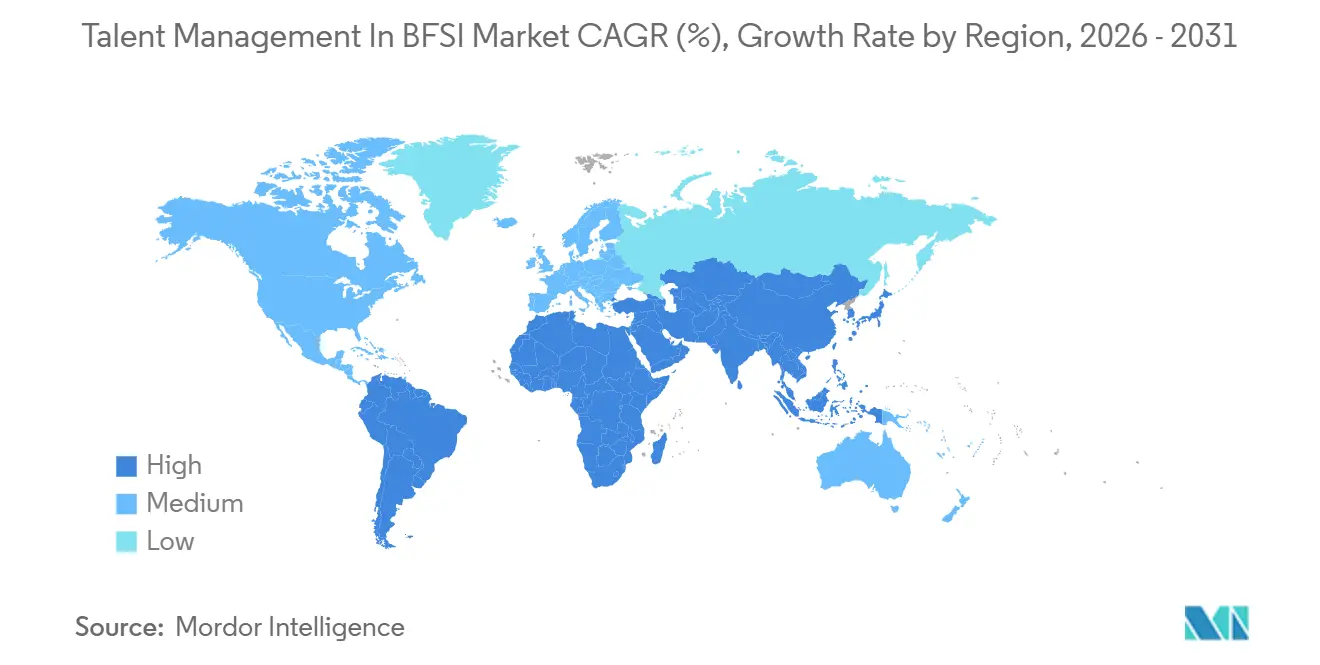
Asia-Pacific represents the fastest-growing regional slice of the talent management in BFSI market size, at 13.09% CAGR through 2031. The region is expanding quickly because institutions across India, Southeast Asia, China, South Korea, Australia, and Japan are adding digital roles faster than legacy HR systems can absorb them. People Matters reported that India's BFSI sector employs more than 8.5 million people across over 20,000 institutions, while many firms still acknowledge that workforce readiness lags transformation ambition. That readiness gap favors cloud-native and mobile-first platforms that can map skills, manage learning, and support localized workflows across the talent management in BFSI market.
The Americas, EMEA and APAC Talent Management in BFSI Market
Europe holds a significant share of the talent management in BFSI market because regulation is dense and financial-sector workforces remain broad across the UK, Germany, France, and the Nordics. WTW noted that the UK's variable pay rule changes are increasing the need for stronger compensation management tools, while Germany reported more than 42,000 unfilled finance positions in 2025, which is driving demand for skills-based hiring and internal mobility systems. South America, the Middle East, and Africa remain smaller but are becoming more relevant as local banks and fintech firms adopt digital hiring and learning platforms to support workforce expansion and localization targets. This leaves a broad regional picture, with North America setting the current scale, Asia-Pacific setting the growth pace, and Europe setting much of the compliance burden for the talent management in BFSI market.
Competitive Landscape
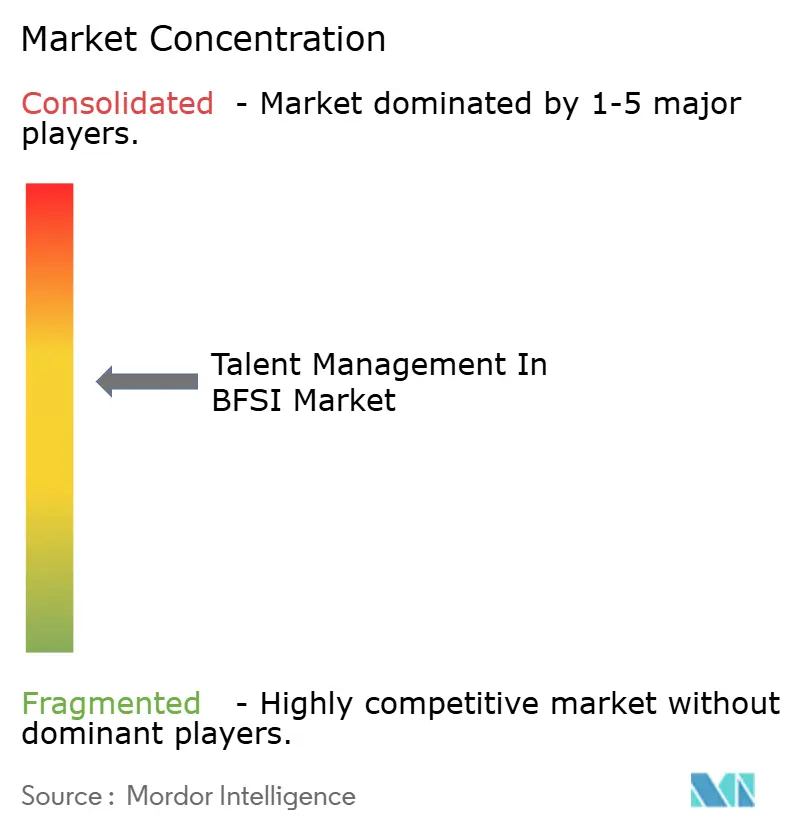
The talent management in BFSI market is moderately consolidated, with Workday, SAP SE, Oracle, and UKG holding much of the large-enterprise base through broad platform suites and integration depth. Competition is moving toward AI orchestration, governance controls, and data architecture rather than simple feature breadth. SAP used SAP Sapphire in May 2026 to launch Autonomous HCM and Joule AI Assistants for payroll, recruiting, onboarding, and HR service delivery, which strengthened its position with regulated enterprise buyers. Workday followed in March 2026 with Sana from Workday, which added agent-led self-service and more than 300 workflow skills across HR and finance.
These moves matter because BFSI buyers want automation that still leaves a clear audit trail and a controlled operating model. Workday also expanded its 2025 agent portfolio with tools for performance, job architecture, employee sentiment, case handling, and succession, while Workday Data Cloud opened zero-copy sharing between HR data and external analytics environments. SAP's 2026 talent releases added a Career Development Agent, a Development Goal Creation Agent, and a Succession Planning Agent, which pushed it further into career and skills orchestration. Darwinbox showed that regional challengers can win large financial accounts, with Chinabank completing an AI-driven HR transformation for more than 11,000 employees and Bank of the Philippine Islands implementing a unified platform for more than 18,000 employees. This mix of incumbent depth and challenger speed keeps rivalry active across the talent management in BFSI market.
AI-native specialists are also targeting narrower gaps inside the talent management in BFSI market. Eightfold AI launched the AI Interviewer and Digital Twin in 2025, while ICIMS introduced Frontline AI in 2026, claiming up to 75% lower time-to-fill and up to 90% less time spent on manual hiring tasks for frontline roles.[3] Smaller specialists are using agent-based matching, skills graphs, and targeted workflow automation to win point-use cases before expanding into broader suites. The result is a market where platform scale still matters, but compliance-ready AI execution is becoming the main factor that decides who gains share in new buying cycles across the talent management in BFSI market.
Talent Management In BFSI Industry Leaders
-
Workday, Inc.
-
SAP SE
-
Oracle Corporation
-
UKG Inc.
-
ADP, Inc.
- *Disclaimer: Major Players sorted in no particular order
Talent Management In BFSI Market Companies Covered in this Report
- Workday, Inc.
- SAP SE
- Oracle Corporation
- UKG Inc.
- ADP, Inc.
- Ceridian HCM Holding Inc.
- Cornerstone OnDemand, Inc.
- IBM Corporation
- SumTotal Systems, LLC
- Infor, Inc.
- Talentsoft S.A.S.
- PeopleFluent, Inc.
- Paycom Software, Inc.
- Paylocity Holding Corporation
- BambooHR LLC
- The Sage Group plc
- Zoho Corporation Pvt. Ltd.
- Eightfold AI Inc.
- ClearCompany, Inc.
- Darwinbox Digital Solutions Pvt. Ltd.
Recent Industry Developments in Talent Management In BFSI Market
- May 2026: SAP SE announced Autonomous HCM innovations at SAP Sapphire in Orlando, introducing Joule AI Assistants for payroll, recruiting, onboarding, and HR service delivery, along with AI-driven workforce planning connecting data across SAP Cloud ERP, SAP Fieldglass, and SAP SuccessFactors. SAP research cited in the announcement found that 62% of C-suite executives were dissatisfied with how people data connects to business performance, positioning the release as a direct response to BFSI's integrated analytics gap.
- March 2026: Workday launched "Sana from Workday," an enterprise AI platform offering Sana Self-Service Agent with 300-plus HR and finance workflow skills and Sana Enterprise, which orchestrates AI agents across connected enterprise systems including Gmail, Salesforce, ServiceNow, and Slack. Early customer adoption showed Berner achieving 90% platform adoption within 40 days and retiring 400 ChatGPT licenses, signaling competitive displacement of generic AI tools by purpose-built HR agents.
- March 2026: Prismforce, backed by Sequoia Capital, announced an agent-based talent supply chain solution built on the ServiceNow AI Platform, enabling skill-based workforce decisions through embedded agentic AI within ServiceNow HR Service Delivery, Talent Development, and Talent Acquisition dashboards. The solution supports real-time talent-to-demand matching, proactive redeployment, and agentic hiring within existing ServiceNow environments, a relevant capability for global banks using ServiceNow for IT and HR workflow management.
- February 2026: Workday introduced the Military Skills Mapper within Workday Recruiting, translating military service backgrounds into civilian-equivalent skills to help financial institutions access a talent pool typically excluded from banking recruitment pipelines. Availability was set for Workday Recruiting customers in fall 2026.
Global Talent Management In BFSI Market Report Scope
The talent management in BFSI market platforms are indispensable tools for banks, insurance companies, and financial institutions. These platforms oversee a range of functions, from performance management and compliance-driven training to succession planning and skills development. Given the sector's stringent regulatory landscape, there's a heightened emphasis on secure HR data management and analytics to boost workforce productivity. The market is diverse, featuring both integrated HCM suites and specialized talent platforms tailored for the BFSI domain. Key growth catalysts include the ongoing digitization of the sector, a pressing shortage of cybersecurity skills, and a strategic pivot towards skills-based workforce planning.
The Talent Management in BFSI Market Report is Segmented by Component (Software, and Services [Professional Services, and Support and Maintenance Services]), Application (Performance Management, Learning and Development, Succession Planning, Compensation Management, Recruitment and Talent Acquisition, Workforce Planning, Employee Engagement and Career Development, and Other Talent Management Applications), Deployment (On-Premise, and Cloud), Organization Size (Large Enterprises, and Small and Medium Enterprises [SMEs]), End User (Banking, Insurance, Wealth Management and Investment Firms, and Fintech and Other Non-Bank Financial Institutions), and Geography (North America, South America, Europe, Asia-Pacific, Middle East, and Africa). The Market Forecasts are Provided in Terms of Value (USD).
Segmentation Overview
| Software | |
| Services | Professional Services |
| Support and Maintenance Services |
| Performance Management |
| Learning and Development |
| Succession Planning |
| Compensation Management |
| Recruitment and Talent Acquisition |
| Workforce Planning |
| Employee Engagement and Career Development |
| Other Talent Management Applications |
| On-Premise |
| Cloud |
| Large Enterprises |
| Small and Medium Enterprises (SMEs) |
| Banking |
| Insurance |
| Wealth Management and Investment Firms |
| Fintech and Other Non-Bank Financial Institutions |
| North America | United States |
| Canada | |
| Mexico | |
| South America | Brazil |
| Argentina | |
| Rest of South America | |
| Europe | United Kingdom |
| Germany | |
| France | |
| Italy | |
| Spain | |
| Russia | |
| Rest of Europe | |
| Asia-Pacific | China |
| India | |
| Japan | |
| South Korea | |
| Australia | |
| Rest of Asia-Pacific | |
| Middle East | Saudi Arabia |
| United Arab Emirates | |
| Turkey | |
| Rest of Middle East | |
| Africa | South Africa |
| Nigeria | |
| Rest of Africa |
| By Component | Software | |
| Services | Professional Services | |
| Support and Maintenance Services | ||
| By Application | Performance Management | |
| Learning and Development | ||
| Succession Planning | ||
| Compensation Management | ||
| Recruitment and Talent Acquisition | ||
| Workforce Planning | ||
| Employee Engagement and Career Development | ||
| Other Talent Management Applications | ||
| By Deployment | On-Premise | |
| Cloud | ||
| By Organization Size | Large Enterprises | |
| Small and Medium Enterprises (SMEs) | ||
| By End User | Banking | |
| Insurance | ||
| Wealth Management and Investment Firms | ||
| Fintech and Other Non-Bank Financial Institutions | ||
| By Geography | North America | United States |
| Canada | ||
| Mexico | ||
| South America | Brazil | |
| Argentina | ||
| Rest of South America | ||
| Europe | United Kingdom | |
| Germany | ||
| France | ||
| Italy | ||
| Spain | ||
| Russia | ||
| Rest of Europe | ||
| Asia-Pacific | China | |
| India | ||
| Japan | ||
| South Korea | ||
| Australia | ||
| Rest of Asia-Pacific | ||
| Middle East | Saudi Arabia | |
| United Arab Emirates | ||
| Turkey | ||
| Rest of Middle East | ||
| Africa | South Africa | |
| Nigeria | ||
| Rest of Africa | ||
Key Questions Answered in the Report
What is the current size and forecast for talent management in BFSI?
The talent management in BFSI market was valued at USD 2.38 billion in 2025 and is projected to reach USD 4.55 billion by 2031, growing at an 11.45% CAGR over 2026-2031.
Which component leads spending in talent management platforms for BFSI firms?
Software led with a 66.41% share in 2025, while services is growing faster at a 13.92% CAGR as implementation and compliance work become more complex.
Why is learning and development expanding faster than other applications?
Learning and development is growing at a 12.77% CAGR because agentic AI is changing role requirements and forcing banks and insurers to reskill teams inside daily workflows.
Which deployment model is growing fastest in financial institutions?
Cloud is the fastest-growing deployment model at a 14.67% CAGR, even though on-premise still held a 67.89% share in 2025 due to data control and resilience requirements.
Which end-user group is expanding fastest?
Fintech and other non-bank financial institutions are projected to grow at a 13.51% CAGR because they are building skills-based and AI-supported workforce systems from the start.
Which region offers the strongest growth opportunity through 2031?
Asia-Pacific is the fastest-growing region at a 13.09% CAGR, while North America remained the largest in 2025 with a 36.11% share.