
Compensation Management In BFSI Market Size and Share
Market Overview
| Study Period | 2020 - 2031 |
|---|---|
| Market Size (2026) | USD 6.95 Billion |
| Market Size (2031) | USD 9.23 Billion |
| Growth Rate (2026 - 2031) | 5.83 % |
| Fastest Growing Market | Asia-Pacific |
| Largest Market | North America |
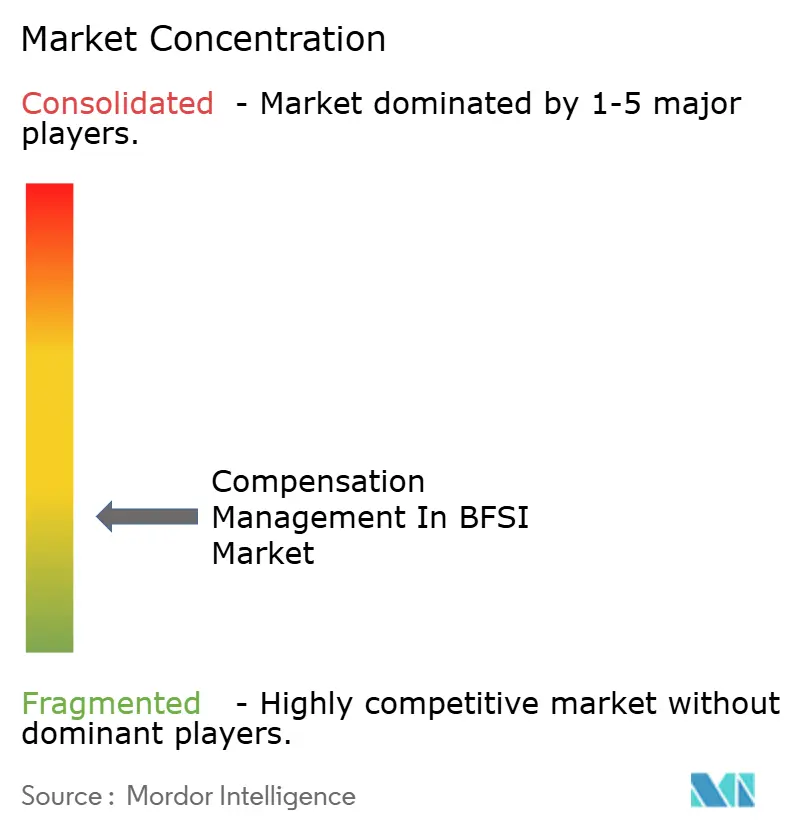
| Market Concentration | Low |
Major Players *Disclaimer: Major Players sorted in no particular order Image © Mordor Intelligence. Reuse requires attribution under CC BY 4.0. | |
Compensation Management In BFSI Market Analysis by Mordor Intelligence
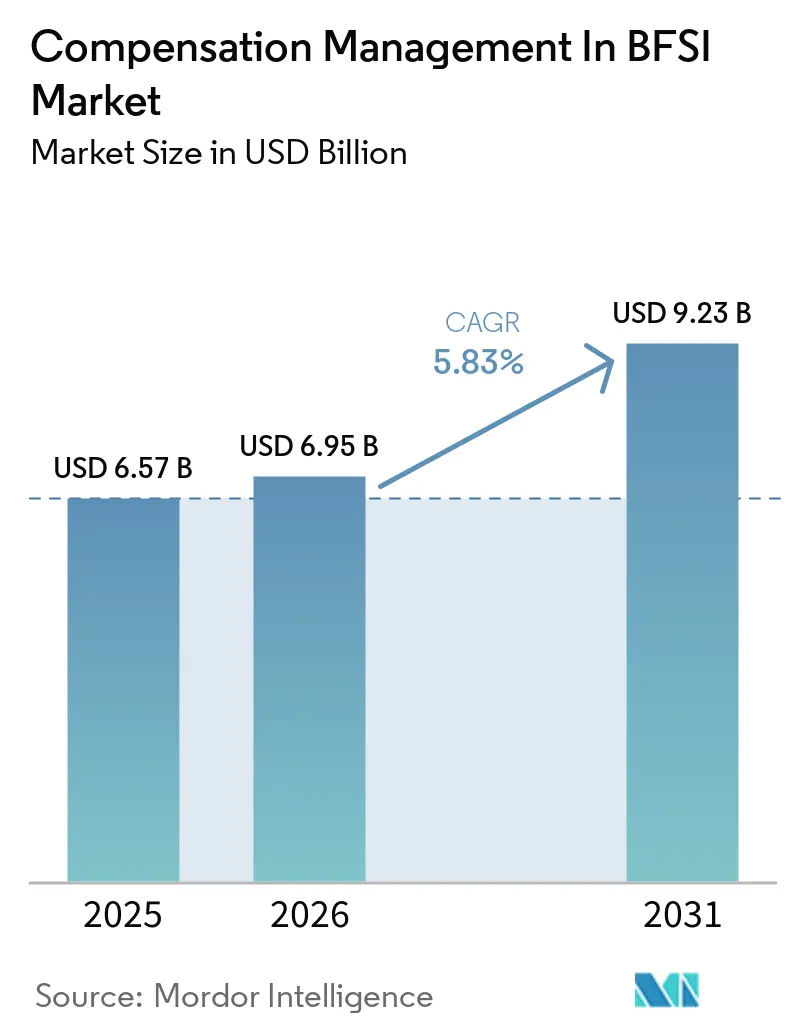
The compensation management in BFSI market size is projected to be USD 6.57 billion in 2025, USD 6.95 billion in 2026, and reach USD 9.23 billion by 2031, growing at a CAGR of 5.83% from 2026 to 2031. The compensation management in BFSI market is expanding because regulated banks and insurers now manage wider variable pay populations, more detailed clawback and deferral rules, and more frequent audit reviews than legacy spreadsheets can handle. Record Wall Street bonus pools in 2025 also showed that performance-linked pay volumes continued to rise, widening the gap between compensation complexity and the operating capacity of manual tools. Cloud adoption and AI-led workflow changes are also shifting buyer expectations toward faster cycle times, cleaner audit trails, and more configurable planning models. Another major pressure point comes from pay transparency and equal pay compliance, especially in Europe, where 2026 became the critical payroll data year for institutions that will need to support reporting from 2027 onward. Competitive conditions remain active as specialized vendors, larger HR software providers, and private equity-backed platforms vie for buyers who now prefer fewer systems with deeper integration and stronger governance controls.
Key Report Takeaways
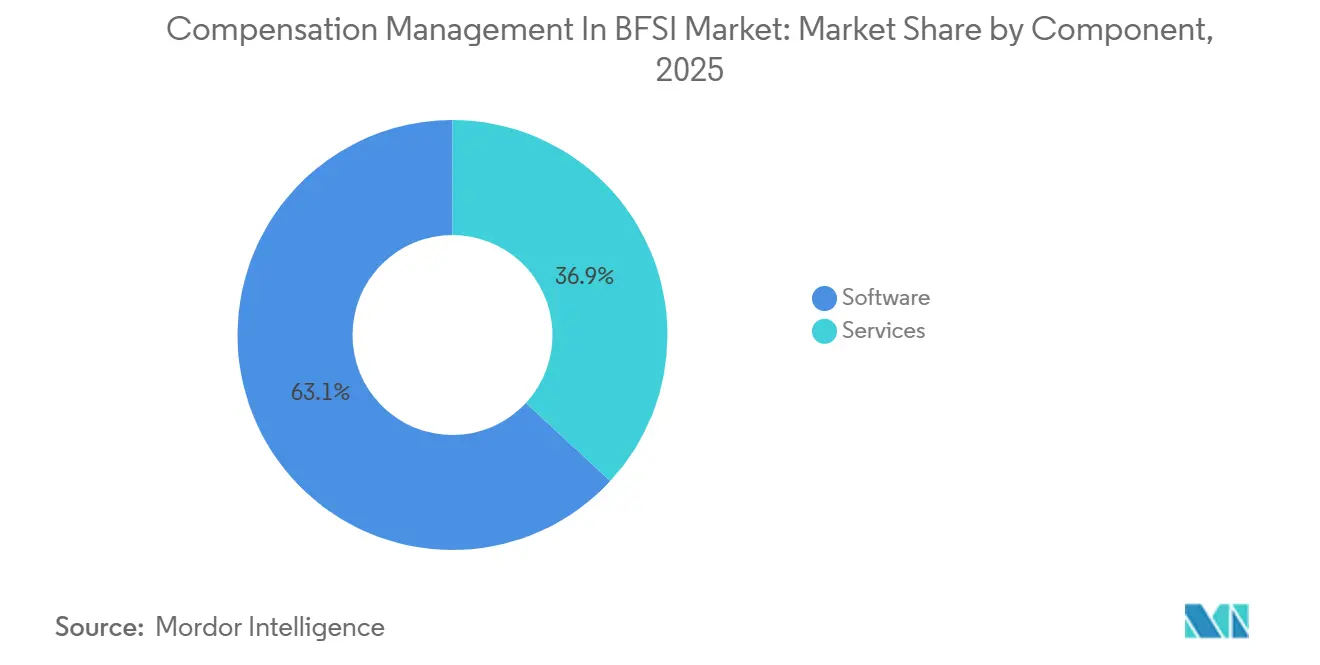
- By component, software held 63.12% share of the compensation management in BFSI market size in 2025, while services are projected to expand at an 8.06% CAGR through 2031.
- By compensation functionality, incentive compensation management led with 31.45% of the market share in BFSI market in 2025, while compensation analytics and reporting are expected to grow at a 6.11% CAGR through 2031.
- By deployment mode, on-premises captured 56.88% share of the compensation management in BFSI market size in 2025, while cloud-based deployment is projected to grow at a 7.28% CAGR through 2031.
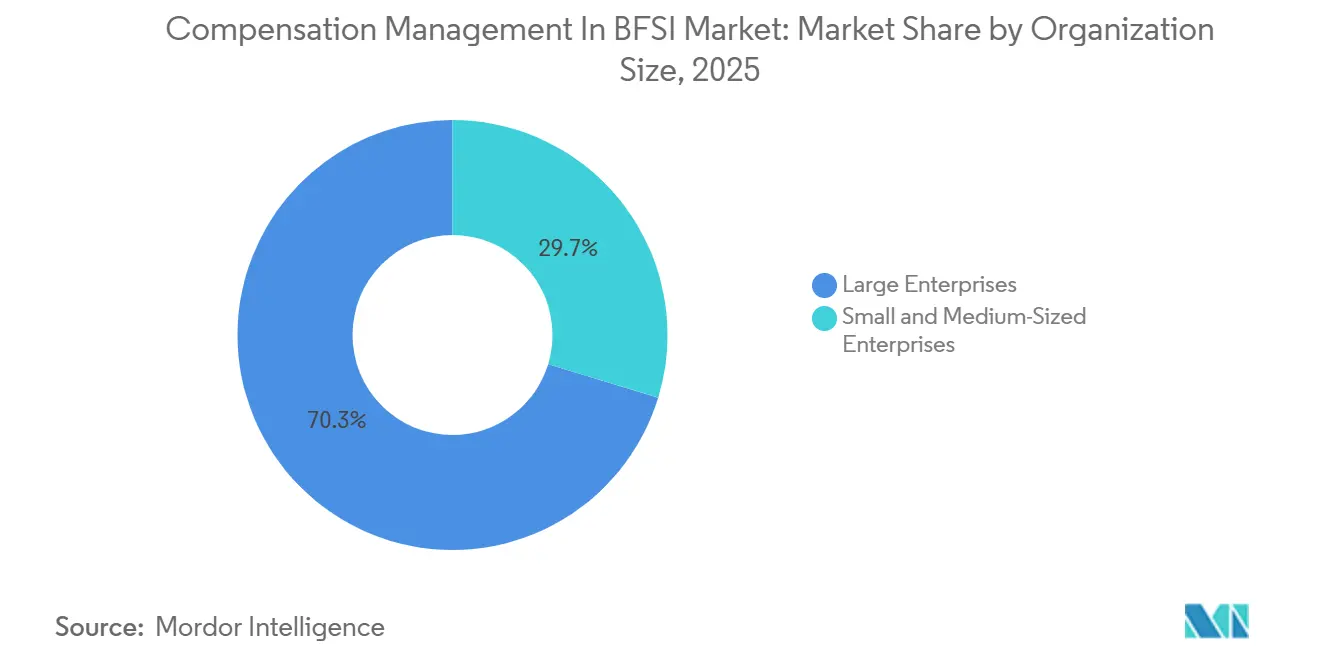
- By organization size, large enterprises accounted for 70.29% of market revenue in 2025, while SMEs are expected to expand at a 7.71% CAGR through 2031.
- By end-use industry, banking commanded a 46.71% share in 2025, while insurance is projected to grow at a 6.93% CAGR through 2031.
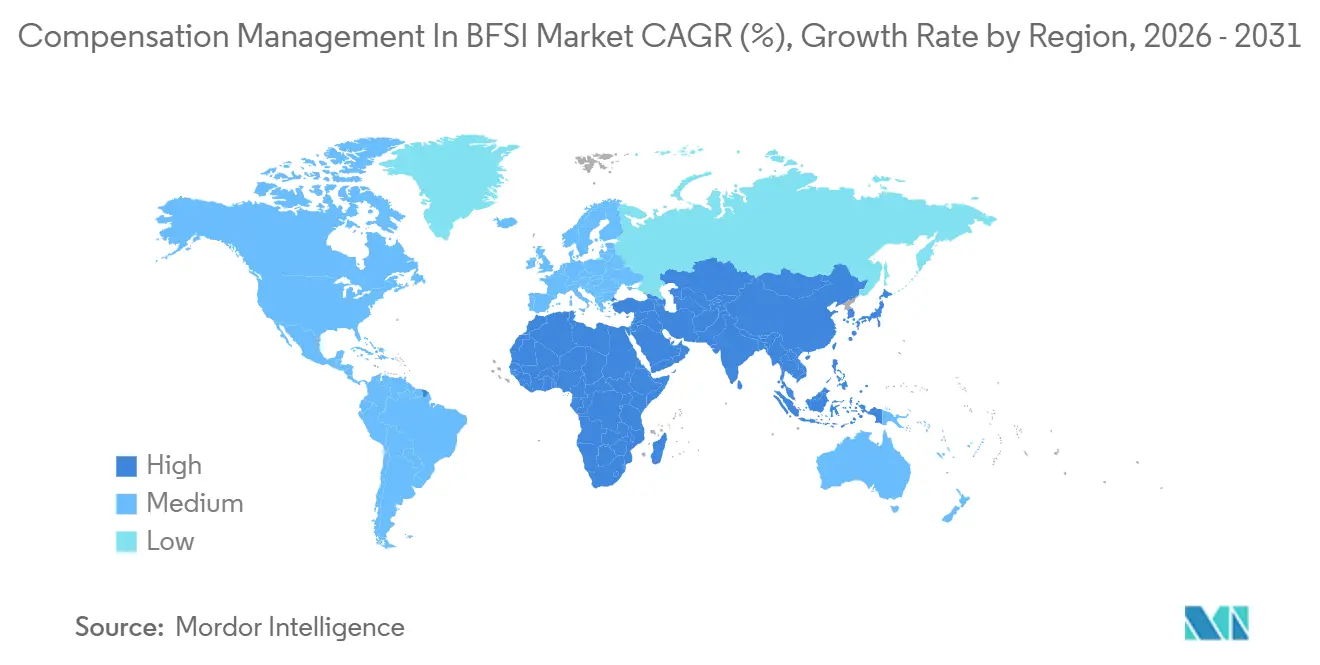
- By geography, North America held 37.66% share of the compensation management in BFSI market in 2025, while Asia-Pacific is expected to record the highest CAGR at 6.49% through 2031.
Note: Market size and forecast figures in this report are generated using Mordor Intelligence’s proprietary estimation framework, updated with the latest available data and insights as of January 2026.
Market Trends and Insights
Drivers Impact Analysis of Compensation Management In BFSI Market*
| Driver | (~) % Impact on CAGR Forecast | Geographic Relevance | Impact Timeline |
|---|---|---|---|
| Cloud and Artificial Intelligence Adoption in Compensation Operations | +1.4% | Global | Short term (≤ 2 years) |
| Need to Manage Complex Variable Pay across Regulated Workforces | +1.1% | Global, with highest intensity in North America and Europe | Medium term (2-4 years) |
| Tightening Incentive Pay Governance, Clawback, and Deferral Rules | +0.9% | North America and EU | Short term (≤ 2 years) |
| European Union Pay Transparency and Equal Pay Compliance Deadlines | +0.7% | EU-27, spill-over to North America and APAC | Short term (≤ 2 years) |
| Skills-Based Pay Premiums for Artificial Intelligence, Cyber, Quant, and Regulatory Technology Talent | +0.5% | Global | Medium term (2-4 years) |
| Insurance and Wealth Distribution Modernization | +0.4% | North America, APAC, and Europe | Long term (≥ 4 years) |
| Source: Mordor Intelligence | |||
Cloud and Artificial Intelligence Adoption in Compensation Operations
The compensation management in BFSI market is moving away from record-keeping tools and toward platforms that support live scenario modeling, workflow automation, and stronger audit evidence. AI-enabled platforms are helping banks and insurers compress review cycles that once depended on weeks of spreadsheet consolidation into faster, more controlled workflows. This shift favors cloud delivery because vendors can push model updates, compliance checks, and decision-support features across client environments without the long upgrade cycles that often slow on-premises estates. It also underscores the importance of explainability, bias monitoring, and human oversight, as employment-related AI tools now face greater scrutiny in regulated environments. In practice, that gives an edge to vendors that already offer governed AI layers, rather than institutions trying to build ad hoc tools around fragmented compensation data.
Need to Manage Complex Variable Pay across Regulated Workforces
The compensation management in BFSI market continues to draw demand from the simple fact that variable pay in banking and insurance is harder to administer than in most other sectors. Financial institutions often manage short-term incentives, deferred awards, clawback provisions, multi-currency bonus pools, and long-term performance structures across multiple jurisdictions simultaneously. A May 2026 survey of financial services reward leaders found that 86% saw compensation system management as complex and 80% reported broader participation in incentive programs over the prior 3 years. As incentive eligibility expands beyond senior leaders and into larger employee populations, manual administration becomes harder to scale without higher error rates and weaker budget control. That is why the compensation management in BFSI market keeps benefiting from demand for plan modeling, automated calculation, and jurisdiction-aware administration that can absorb rising pay complexity without adding equal levels of operating risk.
Tightening Incentive Pay Governance, Clawback, and Deferral Rules
The compensation management in BFSI market is also being pushed by stricter governance rules around performance-linked pay, especially in the United Kingdom and the United States.[1]The PRA and FCA reforms issued in October 2025 set a 4-year bonus deferral period for material risk takers and applied a 60% deferral threshold above GBP 660,000, while also changing retention treatment for incentive instruments. In the United States, lawmakers reintroduced banker clawback legislation in April 2026 that would require failed-bank executives at institutions with USD 10 billion or more in assets to return compensation from the prior 3 years. These frameworks increase the need for systems that can track awards across several performance years, apply different clawback windows, and generate supervisor-ready records without manual assembly. They also reinforce buyer preference for platforms that can manage deferrals, malus, retention, and policy evidence within one governed environment rather than across disconnected tools.
European Union Pay Transparency and Equal Pay Compliance Deadlines
The compensation management in BFSI market faces a strong demand impulse from the June 2026 deadline for EU member states to transpose the Pay Transparency Directive into national law. The directive requires salary disclosure before interviews, employee access to average pay information by gender for comparable roles, and gender pay gap reporting from 2027 using 2026 payroll data. Multi-country banks and insurers face additional pressure because transposition has been uneven, and some countries have applied lower employer thresholds or broader implementation rules than the directive minimum. Germany adds another layer with IVV 5.0 and BRUBEG-linked remuneration changes, increasing the need to align ESG-linked KPIs and broader pay governance with local banking regulation. As a result, the compensation management in BFSI market is seeing stronger preference for configurable reporting logic instead of one static compliance template that breaks when institutions operate across several EU jurisdictions.
Restraints Impact Analysis of Compensation Management In BFSI Market*
| Restraint | (~) % Impact on CAGR Forecast | Geographic Relevance | Impact Timeline |
|---|---|---|---|
| Legacy System Integration and Data Fragmentation | -1.1% | Global | Medium term (2-4 years) |
| Sensitive Pay Data Privacy and Cybersecurity Constraints | -0.8% | Global, with heightened impact in EU and APAC | Medium term (2-4 years) |
| Cross-Jurisdiction Remuneration Rule Divergence | -0.6% | EU, North America, APAC | Long term (≥ 4 years) |
| Auditability Burden for Deferred Awards and Equal-Value Job Mapping | -0.4% | EU and North America | Medium term (2-4 years) |
| Source: Mordor Intelligence | |||
Legacy System Integration and Data Fragmentation
The compensation management in BFSI market still faces its most persistent operational restraint in the form of legacy system integration and fragmented data estates. A May 2026 survey found that 66% of financial services compensation leaders saw multiple service providers as a barrier to accurate and consistent pay data, 64% worked across several regulatory environments, and 77% relied on multiple outsourcing partners across jurisdictions. That fragmentation limits the value of modern compensation software because forecasting, analytics, and scenario planning are only as reliable as the upstream finance, HR, and payroll feeds behind them. Zalaris showed how even a focused payroll modernization at Danske Bank required phased country rollouts and heavy change management to consolidate vendors and standardize processes across Nordic operations. A beqom case study on a global tier-1 bank also illustrated the scale of the issue, with more than 50 compensation components needing reconciliation across custom systems and Excel files before analytics could add full value.
Sensitive Pay Data Privacy and Cybersecurity Constraints
The compensation management in BFSI market also grows more slowly than it otherwise would because compensation data combines personal information with commercially sensitive intelligence on employee pay, incentives, and talent strategy. Security review is not a minor step for regulated institutions, and the 2025 cybersecurity compensation benchmark showed how expensive specialist security talent has become, with average annual cash compensation at USD 206,000 for security architects and USD 191,000 for security engineers. At the same time, pay transparency rules require firms to centralize and analyze more granular compensation data, thereby increasing the operational need for strict access controls and clear processor safeguards. That tension slows deployment because banks and insurers now ask vendors to prove data residency options, employee-level role controls, strong encryption, and documented operating controls before production approval. The result is longer buying cycles and higher implementation burden, especially where institutions want cloud flexibility without relaxing privacy or supervisory expectations.
*Our forecasts treat driver/restraint impacts as directional, not additive. The impact forecasts reflect baseline growth, mix effects, and variable interactions.
Compensation Management In BFSI Market Segment Analysis
By Component, Software Efficiency Advantage Underpins Vendor Switching Cycle
Software accounted for 63.12% of revenue in 2025, which kept the compensation management in BFSI market centered on configurable platforms that can absorb rule changes without full redevelopment. This lead reflected buyer preference for systems that can adapt to UK remuneration reform, EU pay transparency obligations, and evolving incentive plan structures, with less reliance on internal IT rebuilds. Within the software layer, demand has shifted toward tools that combine calculation accuracy with analytics, workflow control, and clear audit evidence for regulators and internal reviewers.[2] That shift has made mid-market banks and insurers more willing to reconsider generic HR suites when they need deeper incentive compensation and deferred award functionality. The software-heavy structure also reflects how strongly the compensation management in BFSI market depends on rule engines that can be configured across jurisdictions rather than hard-coded around one local pay process.
Services are the fastest-growing component, with a projected CAGR of 8.06% through 2031, because many institutions still need implementation, integration, and advisory support before software can perform as intended. Services demand rises when compensation platforms must connect to core banking systems, HR master data, payroll engines, CRM tools, and finance ledgers that were never designed around a common pay data model. That makes consulting, system mapping, and phased rollout more expensive to replace than the software license itself, especially at large, regulated institutions. It also means service revenue is relatively durable in the compensation management in BFSI market because clients tend to retain providers that already understand their control environment and historical compensation architecture. In a market moving toward fewer, deeper platforms, that service dependency becomes a practical source of contract stickiness and vendor defense.
By Compensation Functionality, ICM Anchors Revenue While Analytics Gains Importance
Incentive compensation management held the largest functionality share at 31.45% in 2025, which shows how much of the compensation management in BFSI market still revolves around variable pay administration. That position reflects the financial importance of incentive design across banking, insurance, advisory, and trading roles, where errors or payment delays can quickly affect revenue production and employee retention. The insurance side of the value chain reinforces that pattern, since commercial leaders continue to identify incentive compensation as a leading challenge in carrier operations. Dedicated ICM tools, therefore, remain central because they can manage complex formulas, disputes, exceptions, and split-credit rules with more consistency than broad HR modules. That keeps ICM at the core of buying decisions in the compensation management market in BFSI, even as firms also upgrade planning or analytics capabilities.
Compensation analytics and reporting is the fastest-growing functionality, with a CAGR of 6.11% through 2031, because compliance now depends on defensible tables, variance tracking, and timely evidence across several rule sets. Pay transparency, equal pay review, and material risk taker governance all rely on data structures that can explain outcomes, not just calculate them. That is pushing planning, bonus management, reporting, and pay equity monitoring closer together inside shared data models. Machine learning-based anomaly detection is also starting to influence product roadmaps, as buyers want compensation outliers flagged before decisions are finalized, rather than after reports are published. Over time, that makes analytics less of a standalone module and more of a control layer running through the broader compensation management in BFSI market.
By Deployment Mode, On-Premises Leadership Reflects Risk Controls While Cloud Advances
On-premises deployment retained a 56.88% share in 2025, which shows that the compensation management in BFSI market still carries a strong bias toward controlled internal environments for sensitive pay data. Large global banks remain cautious because compensation records for material risk takers, deferred awards, and policy-controlled instruments can overlap with data residency rules and supervisory access requirements. In many institutions, security committees also treat compensation data as highly sensitive because it combines personal data with business intelligence on talent, performance, and pay positioning. That has preserved on-premises demand, especially among institutions that support multiple regulators and want tighter control over infrastructure choices. The result is a compensation management in BFSI market where deployment choice still reflects governance posture as much as cost or ease of use.
Cloud-based deployment is projected to grow at a 7.28% CAGR through 2031, driven by mid-tier banks and insurers seeking faster upgrades, easier scaling, and access to newer AI-assisted features. Buyers with fewer internal infrastructure resources increasingly view cloud delivery as the faster route to modern workflows, reporting logic, and model updates. Hybrid deployment has also become strategically important because some institutions now keep the most sensitive records on-premises while moving analytics, manager workflows, and calculation modules to cloud environments. That mixed architecture better matches the operating reality of large institutions than a pure-cloud or pure-on-premises model. It also explains why vendors with native hybrid capabilities are well placed as the compensation management in BFSI market moves through a gradual rather than abrupt deployment transition.
By Organization Size, Large Enterprises Supply Revenue While SMEs Widen Adoption
Large enterprises represented 70.29% of revenue in 2025, reflecting how much of the compensation management in BFSI market is still tied to global banks, insurance groups, and asset managers with wide pay complexity. These institutions handle multi-currency bonus pools, jurisdiction-specific deferrals, material risk-taker identification, and long-term incentive administration, areas that smaller platforms often struggle to manage at scale. They also face the highest supervisory expectations, which makes it easier to justify investment in governed and auditable compensation systems. Large enterprise demand, therefore, anchors current revenue because these buyers need both breadth of functionality and depth of control. In the compensation management in BFSI market, that scale advantage still matters because vendor selection often depends on the ability to support many legal entities, business lines, and policy variations inside one platform.
SMEs are projected to post the fastest growth, at a CAGR of 7.71% through 2031, as compliance pressure reaches smaller employer thresholds and cloud delivery lowers adoption barriers. France is a clear example because national implementation applies to employers with 50 or more employees, thereby extending reporting pressure below the broader directive threshold. Regional banks, credit unions, and independent insurance agencies are also less willing to accept spreadsheet risk as pay equity and transparency enforcement become more visible. Vendors have responded by simplifying onboarding and packaging more modular pricing, which makes specialist platforms easier to adopt without a large enterprise rollout model. This broadens the addressable base for the compensation management in BFSI market even though large institutions remain the main revenue anchor today.
By End-Use Industry, Banking Leads While Insurance Drives The Faster Growth Path
Banking held a 46.71% share in 2025, which made it the largest end-use segment in the compensation management in BFSI market. That leadership came from the sector's high variable pay intensity, broader regulatory coverage, and the large material risk-taking populations that major banks must manage across business lines and jurisdictions. Banking also generates heavy incentive administration volumes in capital markets and advisory functions, where pay programs change with business performance and control expectations. That combination keeps banking at the center of vendor product design and compliance functionality. It is a major reason why the compensation management in BFSI market continues to favor vendors that can support both operational calculation and policy governance in one system.
Insurance is projected to be the fastest-growing end-use segment, at a CAGR of 6.93% through 2031, as carriers redesign commission structures and team-based advisory models. Survey evidence from the insurance carrier space showed that incentive compensation remained a primary challenge for commercial leaders, which helps explain continued spending on specialist tools. Wealth and asset management adds to that momentum because more practices now operate in team structures, which raises the need for dynamic split-credit and revenue attribution logic. Credit unions and building societies remain smaller users, but they are also moving toward dedicated platforms as transparency and governance obligations become harder to manage manually. This widens demand across the compensation management in BFSI market beyond global banks and supports the next growth wave in advisory and distribution-led businesses.
Geography Analysis
North America Compensation Management in BFSI Market
North America held a 37.66% share in 2025, which gave the region the largest position in the compensation management in BFSI market size. The region benefits from the concentration of large financial institutions, broad federal and state oversight, and a mature vendor base for incentive compensation and broader pay governance tools.[3] The United States remains the main demand center because banks, insurers, and capital markets firms face layered expectations on incentive governance, executive accountability, and pay data control. The region also shows a growing need for skills-based pay modeling as institutions compete for AI, cyber, and quantitative talent that does not cleanly fit within legacy compensation bands. Canada and Mexico remain smaller contributors, but both continue to support modernization demand as financial institutions expand digital HR and compensation processes.
Europe and South America Compensation Management in BFSI Market
Europe is the most regulation-heavy geography in the compensation management in BFSI market, and that raises both urgency and design complexity. The June 2026 pay transparency transposition deadline, UK remuneration reform, and national overlays such as Germany's IVV 5.0 have forced banks and insurers to review job architecture, reporting logic, and variable pay governance simultaneously. Germany stands out because industry discussion in May 2026 focused heavily on BRUBEG and IVV 5.0 implementation, pay transparency readiness, and ESG KPI integration into variable pay structures. That makes Europe a region where the compensation management in BFSI market share is shaped less by a single buying pattern and more by country-specific compliance design. South America remains at an earlier stage, led by Brazil, where banks have been more selective in adopting cloud-based incentive tools as they expand retail distribution and respond to new equal-pay reporting expectations.
APAC and MEA Compensation Management in BFSI Market
Asia-Pacific is the fastest-growing region, with a projected CAGR of 6.49% through 2031, which keeps it central to the next phase of the compensation management in BFSI market. Demand in APAC reflects aggressive HR technology modernization across China, India, Australia, and Japan, as well as rising complexity in local pay governance and variable reward structures. Institutions in the region are moving toward systems that can support multi-entity reporting, localized rule sets, and broader integration with payroll and performance data. The Middle East and Africa are smaller in current revenue terms, but both regions are showing more momentum as Gulf banks align executive pay governance with global practices and South African firms address widening pay reporting expectations. Together, these trends support a broader geographic spread of adoption even though North America and Europe still hold the largest current weight in the compensation management in BFSI market.
Competitive Landscape
The compensation management in BFSI market remained moderately fragmented at the enterprise tier, with pure-play ICM vendors competing alongside broader compensation and wealth-focused platforms. beqom SA, Xactly Corporation, Varicent Software Inc., CaptivateIQ Inc., HRSoft Inc., and PureFacts Financial Solutions were among the notable names shaping platform choice across banking, insurance, and wealth use cases. The field remained competitive because buyers sought strong configurability and deep compliance, while many mid-tier providers still competed on price and deployment flexibility. That structure supports innovation, but it also creates consolidation pressure as large institutions reduce vendor sprawl and favor fewer, better-integrated systems. In that setting, scale alone is not enough because vendors also need credible governance, implementation capacity, and cross-border design support to stand out in the compensation management in BFSI market.
Deal activity since 2024 has shown that investors and strategic buyers still see room to build larger platforms around proven compensation assets. GrowthCurve Capital acquired PureFacts in a USD 250 million transaction in 2024, Gryphon Investors completed a majority investment in HRSoft in March 2026, and ADP acquired Pequity in October 2025. Those moves pointed to a common strategy of pairing compensation planning with AI-led analytics, broader vertical depth, and stronger implementation reach. They also suggested that the compensation management in BFSI market is valuable not only for software revenue, but also for the recurring upgrade and services cycle created by regulation and product redesign.
Product strategy is also converging around governed AI and partner-led expansion. Xactly, CaptivateIQ, beqom, and Decusoft all launched or expanded AI-driven capabilities through 2025 and 2026 to automate plan configuration, scenario modeling, pay analysis, and dispute handling. At the same time, Decusoft partnered with Trusaic in May 2026, and PureFacts partnered with Innover Digital in March 2026, indicating that vendors still rely on alliances to fill gaps in global compliance, analytics, and transformation delivery.[4] No single platform yet appears to cover EU pay transparency, UK deferral governance, U.S. incentive controls, and APAC local requirements in a single, fully integrated rules engine, leaving room for future expansion. That gap is likely to keep product releases, partnerships, and selective acquisitions active across the compensation management in BFSI market.
Compensation Management In BFSI Industry Leaders
-
beqom SA
-
Xactly Corporation
-
Varicent Software Inc.
-
CaptivateIQ, Inc.
-
Aeqium, Inc.
- *Disclaimer: Major Players sorted in no particular order
Compensation Management In BFSI Market Companies Covered in this Report
- beqom SA
- Xactly Corporation
- Varicent Software Inc.
- PerformanceCentre, Inc.
- CaptivateIQ, Inc.
- Aeqium, Inc.
- HRsoft, Inc.
- Decusoft, Inc.
- PureFacts Financial Solutions
- Akeron S.r.l.
- Fintary Technologies, Inc.
- ComTrack Inc.
- Bentega AS
- Forma AI Inc.
- Iconixx Software Corporation
- Optymyze Pte. Ltd.
- Everstage Inc.
- Commissionly Limited
- CellarStone, Inc.
- Compport Private Limited
Recent Industry Developments in Compensation Management In BFSI Market
- May 2026: beqom SA launched its Bring Your Own Model (BYOM) AI capability, enabling financial institutions to integrate proprietary regression-based machine-learning pay-prediction models directly into compensation planning workflows. The solution supports unlimited models against enterprise data sets, targeting large global banks managing compensation across multiple countries, currencies, and business units.
- May 2026: CaptivateIQ Inc. launched the CaptivateIQ Agents portfolio at its annual user conference, comprising a Compensation Builder Agent, Compensation Operations Agent, and Revenue Planning Agent, all built on CaptivateIQ's SmartGrid real-time modelling architecture. The agents are in limited beta with general availability planned for later in 2026, addressing the gap where 39% of organizations still require 1 to 2 months to implement compensation plan changes.
- May 2026: Decusoft Inc. announced a strategic partnership with Trusaic, a global pay equity and pay transparency software provider, to deliver integrated tools for HR and compensation teams navigating global pay transparency compliance, including the EU Pay Transparency Directive and regional equal pay mandates.
- April 2026: Xactly Corporation launched its Fleet of Agents and Intelligence Studio at the Xactly Upside 2026 conference, providing pre-built and configurable AI agents, including an Incent Plan Configuration Agent and a Dispute Management Agent, that extend the Xactly Intelligent Revenue Platform for enterprise revenue operations and BFSI incentive compensation workflows.
Global Compensation Management In BFSI Market Report Scope
The Compensation Management in BFSI Market encompasses specialized software and services pivotal for banks, financial institutions, and insurance companies. These tools aid in designing, managing, and optimizing employee compensation structures. From salary planning and incentive management to bonus allocation and regulatory reporting, these solutions navigate the complexities of a highly governed environment. The market underscores the importance of compliance with financial regulations, ensuring that rewards align with performance and risk frameworks. This focus guarantees transparency, auditability, and strategic compensation planning within the BFSI landscape.
The Compensation Management in BFSI Market Report is Segmented by Component (Software, and Services [Implementation and Integration Services, Consulting and Advisory Services, and Support and Maintenance Services]), Compensation Functionality (Compensation Planning and Budgeting, Incentive Compensation Management, Bonus Management, Compensation Analytics and Reporting, Pay Equity and Transparency Management, and Other Compensation Functionalities), Deployment Mode (Cloud-Based, On-Premises, and Hybrid), Organization Size (Large Enterprises, and Small and Medium-Sized Enterprises), End-Use Industry (Banking, Insurance, Capital Markets and Asset Management, and Credit Unions and Building Societies), and Geography (North America, South America, Europe, Asia-Pacific, Middle East, and Africa). The Market Forecasts are Provided in Terms of Value (USD).
Segmentation Overview
| Software | |
| Services | Implementation and Integration Services |
| Consulting and Advisory Services | |
| Support and Maintenance Services |
| Compensation Planning and Budgeting |
| Incentive Compensation Management |
| Bonus Management |
| Compensation Analytics and Reporting |
| Pay Equity and Transparency Management |
| Other Compensation Functionalities |
| Cloud-Based |
| On-Premises |
| Hybrid |
| Large Enterprises |
| Small and Medium-Sized Enterprises |
| Banking |
| Insurance |
| Capital Markets and Asset Management |
| Credit Unions and Building Societies |
| North America | United States |
| Canada | |
| Mexico | |
| South America | Brazil |
| Argentina | |
| Chile | |
| Rest of South America | |
| Europe | United Kingdom |
| Germany | |
| France | |
| Italy | |
| Spain | |
| Russia | |
| Rest of Europe | |
| Asia-Pacific | China |
| Japan | |
| India | |
| South Korea | |
| Australia | |
| Rest of Asia-Pacific | |
| Middle East | Saudi Arabia |
| United Arab Emirates | |
| Turkey | |
| Rest of Middle East | |
| Africa | South Africa |
| Nigeria | |
| Rest of Africa |
| By Component | Software | |
| Services | Implementation and Integration Services | |
| Consulting and Advisory Services | ||
| Support and Maintenance Services | ||
| By Compensation Functionality | Compensation Planning and Budgeting | |
| Incentive Compensation Management | ||
| Bonus Management | ||
| Compensation Analytics and Reporting | ||
| Pay Equity and Transparency Management | ||
| Other Compensation Functionalities | ||
| By Deployment Mode | Cloud-Based | |
| On-Premises | ||
| Hybrid | ||
| By Organization Size | Large Enterprises | |
| Small and Medium-Sized Enterprises | ||
| By End-Use Industry | Banking | |
| Insurance | ||
| Capital Markets and Asset Management | ||
| Credit Unions and Building Societies | ||
| By Geography | North America | United States |
| Canada | ||
| Mexico | ||
| South America | Brazil | |
| Argentina | ||
| Chile | ||
| Rest of South America | ||
| Europe | United Kingdom | |
| Germany | ||
| France | ||
| Italy | ||
| Spain | ||
| Russia | ||
| Rest of Europe | ||
| Asia-Pacific | China | |
| Japan | ||
| India | ||
| South Korea | ||
| Australia | ||
| Rest of Asia-Pacific | ||
| Middle East | Saudi Arabia | |
| United Arab Emirates | ||
| Turkey | ||
| Rest of Middle East | ||
| Africa | South Africa | |
| Nigeria | ||
| Rest of Africa | ||
Key Questions Answered in the Report
What is the size outlook for compensation management in BFSI?
The market stood at USD 6.57 billion in 2025, reached USD 6.95 billion in 2026, and is forecast to reach USD 9.23 billion by 2031 at a 5.83% CAGR.
Which component leads revenue generation?
Software led in 2025 with a 63.12% revenue share because banks and insurers prefer configurable platforms that can adapt to rule changes without major rebuilds.
Why is cloud deployment growing faster than on-premises setups?
Cloud-based deployment is projected to grow at a 7.28% CAGR through 2031 because mid-tier institutions want faster updates, easier scaling, and quicker access to AI-enabled features.
Which end-use segment is expanding the fastest?
Insurance is the fastest-growing end-use segment, with a 6.93% CAGR through 2031, supported by changes in agent commissions and wider use of team-based advisory models.
What is driving demand in Europe right now?
The strongest pressure comes from pay transparency and equal pay compliance, especially the June 2026 transposition deadline and the need to use 2026 payroll data for future reporting.
Which region shows the strongest future growth?
Asia-Pacific is projected to be the fastest-growing region, with a 6.49% CAGR through 2031, as banks and insurers accelerate HR technology modernization and localized pay governance upgrades.