
Asia-Pacific Talent Management Software Market Size and Share
Market Overview
| Study Period | 2020 - 2031 |
|---|---|
| Forecast Data Period | 2026 - 2031 |
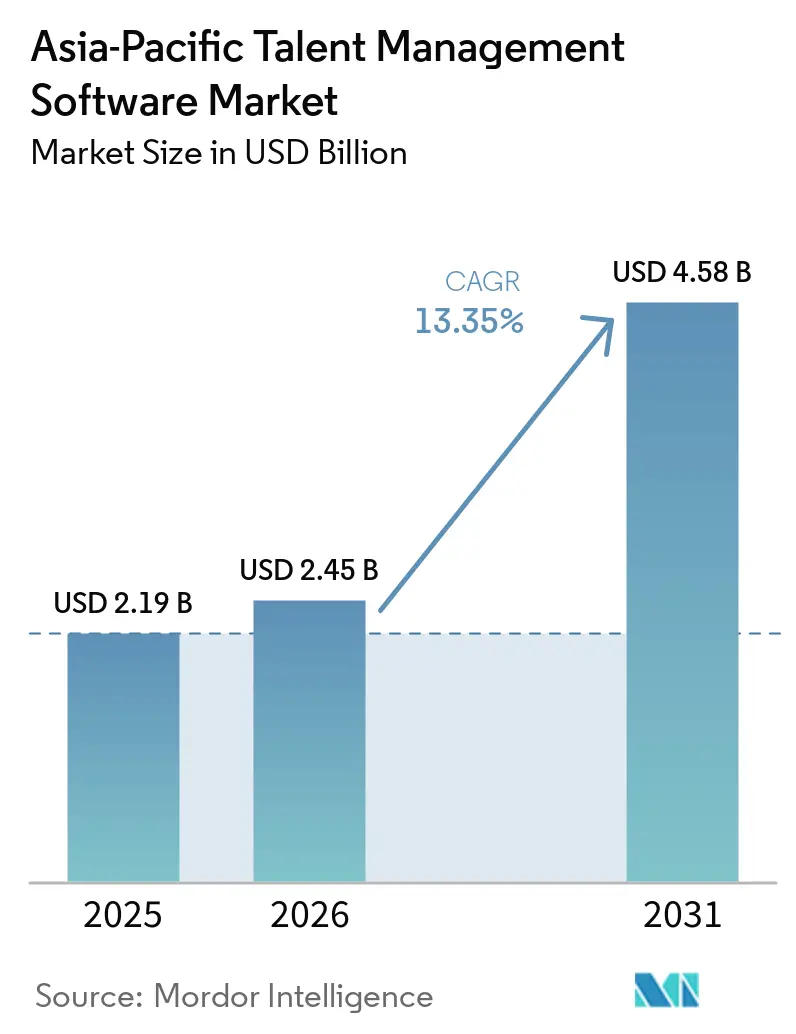
| Base Year Market Size (2025) | USD 2.19 Billion |
| Market Size (2026) | USD 2.45 Billion |
| Market Size (2031) | USD 4.58 Billion |
| Growth Rate (2026 - 2031) | 13.35 % |
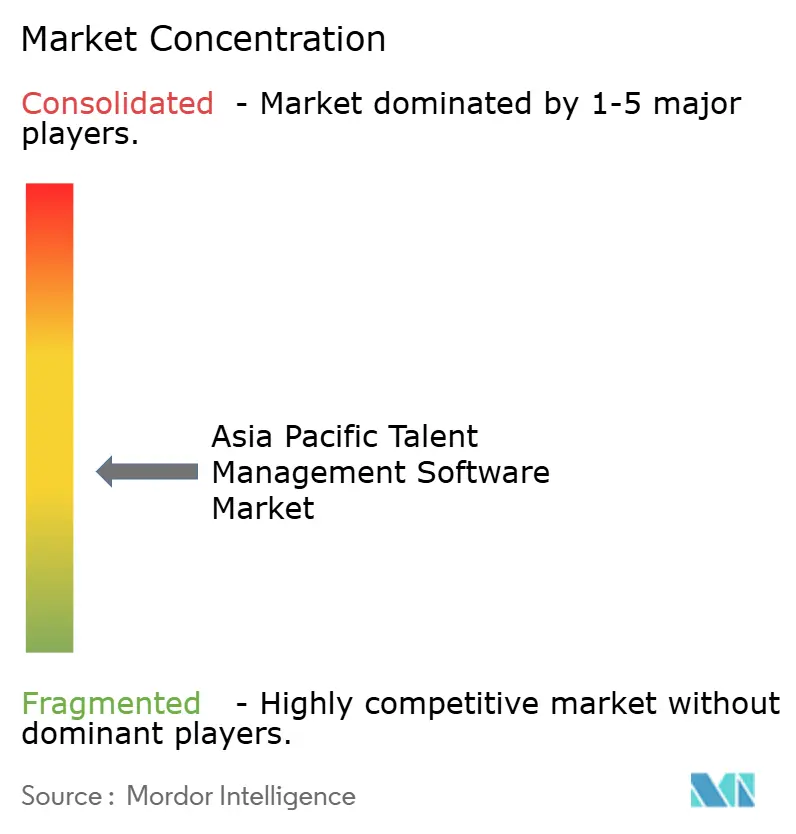
| Market Concentration | Medium |
Major Players *Disclaimer: Major Players sorted in no particular order Image © Mordor Intelligence. Reuse requires attribution under CC BY 4.0. | |
Asia-Pacific Talent Management Software Market Analysis by Mordor Intelligence
The Asia-Pacific talent management software market size is expected to grow from USD 2.19 billion in 2025 to USD 2.45 billion in 2026 and is forecast to reach USD 4.58 billion by 2031 at 13.35% CAGR over 2026-2031. The Asia-Pacific talent management software market is expanding as enterprises replace disconnected HR systems with platforms that bring recruitment, performance tracking, learning, succession, and workforce planning into one operating layer. Demand is also rising because organizations want tools that shorten hiring cycles, support skills mapping, and make workforce development easier to manage across large and varied employee bases. Cloud migration is becoming a stronger growth engine as buyers look for lower implementation friction, easier updates, and better compliance support than many older on-premise systems can provide. Government-backed digitalization programs, stronger attention to workforce planning, and wider adoption of AI-enabled workflows are making talent platforms more central to enterprise software spending across the region. Competitive pressure is increasing as global vendors deepen product breadth and regional specialists win buyers with localized compliance coverage, language support, and faster deployment models across the Asia-Pacific talent management software market.
Key Report Takeaways
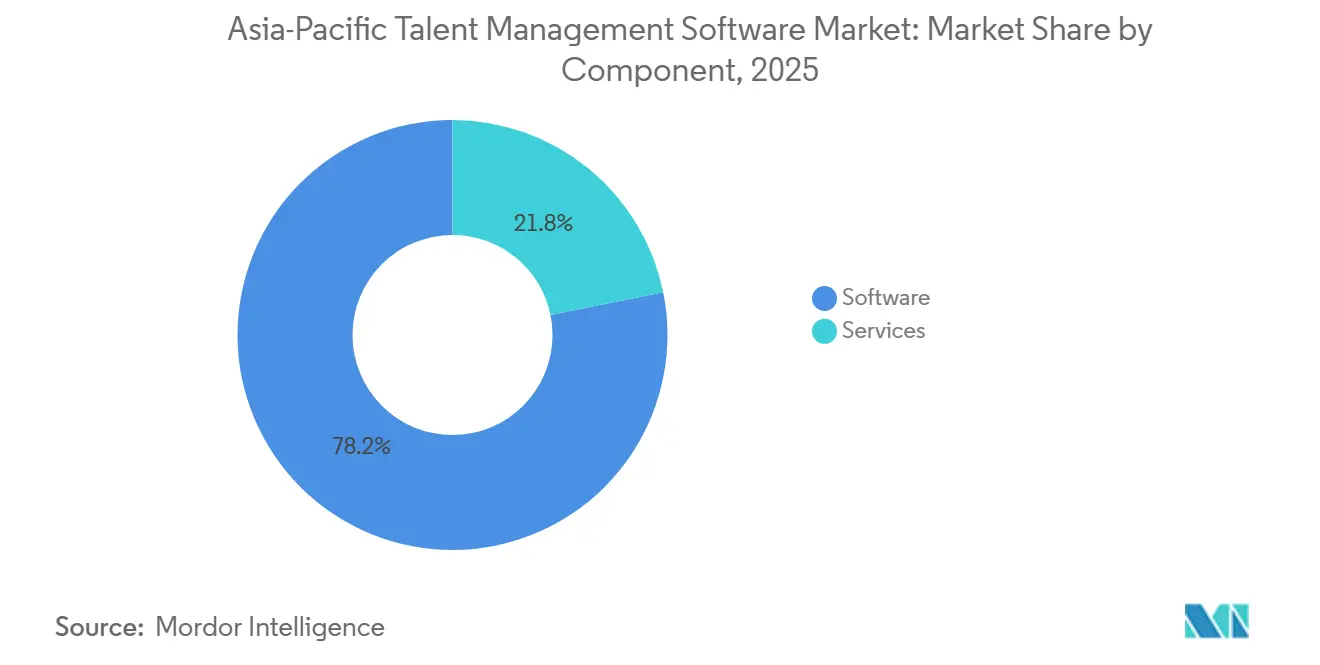
- By component, software led with 78.19% share of the Asia-Pacific Talent Management Software Market in 2025, while services recorded the highest projected CAGR at 15.91% through 2031.
- By application, performance management accounted for 23.65% share in 2025, while learning and development is forecast to expand at a 14.82% CAGR through 2031.
- By deployment, on-premise held 65.81% of the Asia-Pacific Talent Management Software Market share in 2025, while cloud recorded the highest projected CAGR at 16.58% through 2031.
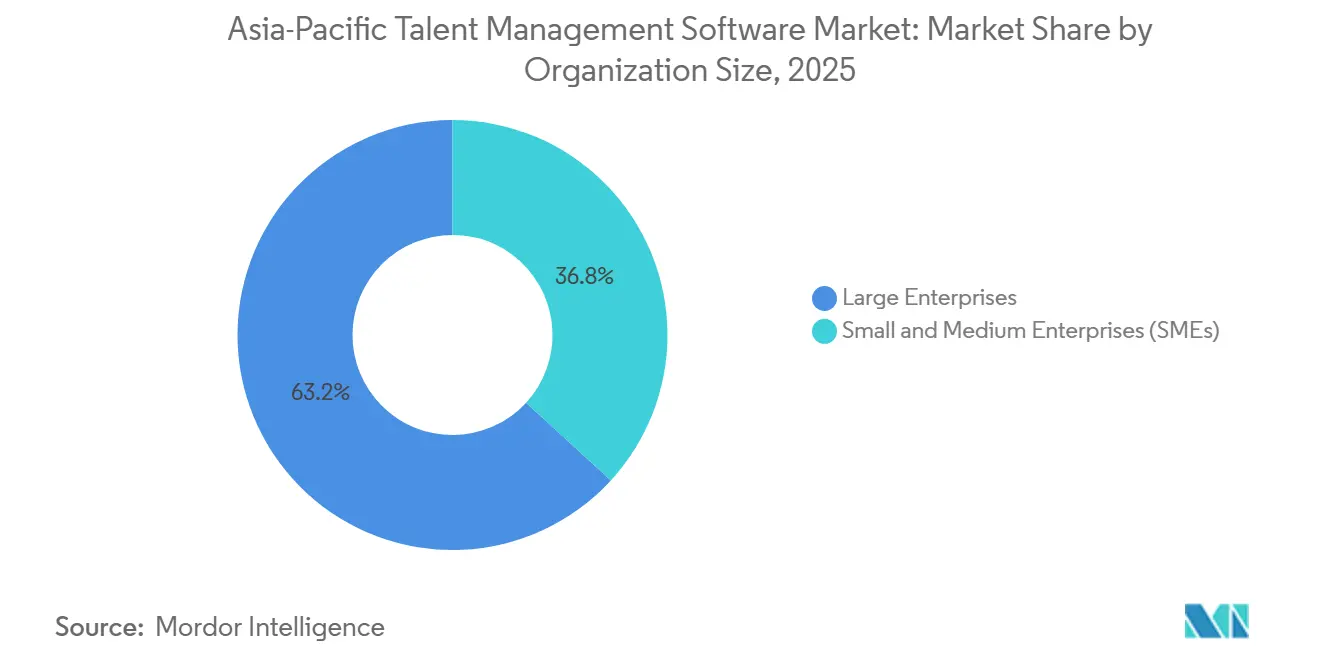
- By organization size, large enterprises captured 63.18% of the market in 2025, while SMEs are projected to grow at a 16.23% CAGR through 2031.
- By end-use industry, IT and telecommunications held 24.11% share in 2025, while healthcare and life sciences are expected to grow at a 15.19% CAGR through 2031.
- By region, China led with 30.21% of the Asia-Pacific Talent Management Software Market share in 2025, while India posted the highest projected CAGR at 15.52% through 2031.
Note: Market size and forecast figures in this report are generated using Mordor Intelligence’s proprietary estimation framework, updated with the latest available data and insights as of January 2026.
Market Trends and Insights
Drivers Impact Analysis of Asia-Pacific Talent Management Software Market*
| Driver | (~) % Impact on CAGR Forecast | Geographic Relevance | Impact Timeline |
|---|---|---|---|
| Escalating Digital Transformation Budgets amid Workforce Reskilling Mandates | +3.2% | Global, with concentrated spend in India, China, and Australia | Short term (≤ 2 years) |
| Rising Adoption of Artificial Intelligence for Data-Driven Recruitment | +2.8% | Global, led by India, Singapore, and Australia | Short term (≤ 2 years) |
| Government Incentives for Cloud-First Human Resource Systems across Asia-Pacific | +2.1% | Singapore, Hong Kong, Taiwan, Japan, and India | Medium term (2-4 years) |
| Surge in Distributed Workforce Models Post-Pandemic Accelerating SaaS TMS Uptake | +1.8% | Southeast Asia, India, and Australia | Short term (≤ 2 years) |
| Intensifying Competition for High-Skilled Talent in Emerging Asian Economies | +1.4% | India, South Korea, Vietnam, and the Philippines | Medium term (2-4 years) |
| Integration with Regional Social-Media Platforms Enhancing Candidate Experience | +0.9% | China, Japan, South Korea, and Southeast Asia | Medium term (2-4 years) |
| Source: Mordor Intelligence | |||
Escalating Digital Transformation Budgets amid Workforce Reskilling Mandates
Enterprises across the Asia-Pacific talent management software market are allocating a larger share of transformation budgets to HR systems because workforce readiness is now more closely tied to enterprise execution. The buying process is shifting away from single-module adoption toward suites that support skills frameworks, learning pathways, performance visibility, and internal mobility in a single environment. This change matters because reskilling is no longer treated as a separate HR activity with its own limited budget window. It is becoming part of wider digital programs that require better employee data, cleaner workflows, and measurable outcomes from managers and HR teams. Singapore is reinforcing this direction through its HR Industry Transformation Plan and through workforce planning tools such as TalentTrack and TalentTrack+, which support skills-based planning and cloud-led HR modernization.[1] As a result, the Asia-Pacific talent management software market is benefiting from spending that increasingly treats talent platforms as part of core operating infrastructure rather than as optional HR add-ons.
Rising Adoption of Artificial Intelligence for Data-Driven Recruitment
AI is becoming a more central layer in recruitment across the Asia-Pacific talent management software market because employers want faster candidate identification, more consistent screening, and stronger fit assessment. Vendors are responding by embedding conversational hiring tools, automation, and intelligence directly into recruitment workflows rather than offering them as add-ons. That shift is reducing the appeal of disconnected point tools and strengthening demand for platforms that link sourcing, screening, interview coordination, and workforce planning. Company examples also show that buyers are looking for systems that improve recruiter output without requiring major process redesign from the start. Eightfold AI stated that early deployments of its Recruiter Agent delivered up to 50% more candidate coverage and saved 4 hours per role, underscoring why AI-led recruiting modules are becoming more commercially relevant in the region. The Asia-Pacific talent management software market is therefore seeing stronger demand for platforms that use AI to raise recruiter productivity while keeping hiring decisions inside a broader talent system.
Government Incentives for Cloud-First Human Resource Systems across Asia-Pacific
Government programs are providing a stronger policy base for cloud HR adoption across several Asia-Pacific markets, which is supporting the Asia-Pacific talent management software market. Singapore has set out a five-year HR modernization roadmap that includes digitalization support and tools that help employers move toward skills-based planning and cloud-enabled HR operations. Hong Kong has already expanded its Government Human Resources Management Services across 29 bureaux and departments, demonstrating that centralized, cloud-based HR process standardization is moving from concept to execution in the public sector. Taiwan also approved a talent competitiveness program that combines digital training targets with measures to attract more foreign professionals, broadening the policy support for workforce technology adoption. These actions are important because they increase the cost of delay for organizations that still rely on older HR systems, and they make cloud adoption easier to justify in board-level investment discussions. In turn, the Asia-Pacific talent management software market is gaining from policy-driven normalization of cloud-first HR architectures across both public and private demand pools.
Surge in Distributed Workforce Models Post-Pandemic Accelerating SaaS TMS Uptake
Distributed work models continue to influence software buying behavior in the Asia-Pacific talent management software market, as employers need systems that work across locations, teams, and operating structures. The practical requirement is no longer limited to remote access. Buyers also need stronger data portability, standardized workflows, and local compliance coverage when employees, contractors, and managers operate across several jurisdictions. This is raising the importance of cloud-hosted platforms that can update quickly and support region-specific employment processes without heavy local customization. ADP’s rollout of Lyric HCM in Australia and New Zealand showed how vendors are adapting products to country-specific payroll and leave rules rather than relying on generic regional settings. That localization model matters because distributed work becomes much harder to manage when payroll, scheduling, absence rules, and compliance logic are spread across separate systems. The Asia-Pacific talent management software market is therefore seeing stronger SaaS demand from employers that want a single operational layer for talent and workforce administration across multi-country teams.
Restraints Impact Analysis of Asia-Pacific Talent Management Software Market*
| Restraint | (~) % Impact on CAGR Forecast | Geographic Relevance | Impact Timeline |
|---|---|---|---|
| Data Residency and Cross-Border Compliance Complexities | -1.5% | China, India, Southeast Asia, and Australia | Medium term (2-4 years) |
| Limited IT Infrastructure in Frontier Asia-Pacific Markets | -0.9% | Myanmar, Cambodia, and Pacific Island nations | Long term (≥ 4 years) |
| Persistent Skills Gaps in HR Analytics Teams | -0.6% | Asia-Pacific-wide, most acute in Southeast Asia | Short term (≤ 2 years) |
| High Switching Costs from Legacy On-Premises HR Suites | -0.4% | Japan, South Korea, and the manufacturing sector | Medium term (2-4 years) |
| Source: Mordor Intelligence | |||
Data Residency and Cross-Border Compliance Complexities
Compliance remains a significant barrier to the Asia-Pacific talent management software market because employers often manage employee data across countries with varying legal and technical requirements. This issue is most pronounced for organizations operating in China, India, and Southeast Asia simultaneously, where data transfer rules, privacy expectations, and audit obligations do not align easily. ADP’s 2026 review of Chinese enterprises noted that regulatory changes are making scalable compliance mechanisms a core buying requirement, especially for AI use in recruitment and cross-border data handling. That means vendors now need more than product functionality, because buyers also expect local legal readiness, secure architecture choices, and continuous compliance maintenance. These demands increase vendors' costs and lengthen buyers' implementation cycles, especially in large cross-border deployments. In the Asia-Pacific talent management software market, the result is slower rollout speeds in complex jurisdictions, even when demand conditions remain favorable.
Limited IT Infrastructure in Frontier Asia-Pacific Markets
Infrastructure constraints still limit the Asia-Pacific talent management software market in frontier economies, where broadband quality, enterprise IT budgets, and device access remain uneven. Cloud-first platforms are easier to deploy than older on-premise suites, but they still depend on reliable connectivity and a basic level of digital process maturity. In markets such as Myanmar, Cambodia, and some Pacific Island nations, this creates adoption friction even for lightweight SaaS tools designed for smaller organizations. The issue extends beyond system access, as many employers still rely on manual attendance records, paper-based files, or siloed payroll tools that do not produce clean employee data. When source data is fragmented, the benefits of analytics, automation, and AI-enabled recommendations become harder to realize in practice. That keeps parts of the Asia-Pacific talent management software market below their potential, even when vendors offer flexible pricing and mobile-led interfaces.
*Our forecasts treat driver/restraint impacts as directional, not additive. The impact forecasts reflect baseline growth, mix effects, and variable interactions.
Asia-Pacific Talent Management Software Market Segment Analysis
By Component:
Platform Licensing Leads while Services Gain Strategic WeightSoftware held 78.19% of the Asia-Pacific talent management software market share in 2025, which confirmed that most spending was still centered on core platforms rather than surrounding service layers. This position reflects the strength of integrated HCM suites, applicant tracking systems, and performance management products that buyers treat as foundational HR infrastructure. Subscription models also helped software remain dominant by reducing upfront budget pressure and allowing organizations to spread spending over longer contract periods. Even so, the maturity of the Asia-Pacific talent management software market is making buyers more aware that software alone does not determine outcomes after purchase. Implementation quality, data migration discipline, and change management now directly influence whether organizations achieve faster adoption, better reporting, and more reliable employee records. That is why service spend is becoming more closely linked to platform decisions, rather than sitting in a separate procurement stream.
Services are projected to expand at a 15.91% CAGR from 2026 to 2031, making them the fastest-growing component within the Asia-Pacific talent management software market. This growth reflects a shift in buyer priorities from product selection to execution quality, especially in large, multi-country deployments. Enterprises increasingly need integration support, local configuration, analytics enablement, and post-go-live optimization to make broader suite investments work as intended. Professional services remain the larger sub-segment because buyers need help with architecture planning, implementation, workflow redesign, and structured data migration before automation can scale. Support and maintenance are also becoming more important as HR systems take on payroll, compliance, and workforce planning processes that buyers consider business critical. In practical terms, the Asia-Pacific talent management software industry is moving toward a model in which services do not replace software growth, but instead determine how much operational value buyers can extract from it over time.
By Application:
Performance Management Anchors Spend While Learning and Development Rises FastPerformance management accounted for 23.65% of the Asia-Pacific talent management software market in 2025, indicating that appraisal and review workflows remain the most common entry point to broader platform adoption. Many enterprises start there because performance cycles touch most employees and create structured data that can later support succession, compensation, and workforce planning. That installed base gives performance management a durable position in the Asia-Pacific talent management software market, especially among larger employers that are modernizing older HR processes in stages. At the same time, buyers are increasingly requesting tighter alignment between performance records, skills frameworks, career progression, and internal mobility decisions. This is changing how application bundles are sold, as standalone appraisal tools no longer meet the operational needs of many regional employers. As a result, performance management remains central, but it now works more often as the anchor module inside broader suite contracts.
Learning and development is forecast to grow at a 14.82% CAGR from 2026 to 2031, which makes it the fastest-growing application in the Asia-Pacific talent management software market. The shift reflects stronger enterprise demand for structured reskilling, especially as AI adoption reshapes job design, skill expectations, and career planning. Government-supported tools in Singapore are also reinforcing the move toward skills-based planning and internal capability development, which helps learning modules gain relevance beyond traditional training administration. Recruitment and talent acquisition are also becoming high-innovation application areas as vendors add automation, conversational tools, and skills-based matching inside broader suite environments. Other functions, such as succession planning, compensation management, workforce planning, onboarding, and contingent workforce support, are gaining traction because buyers want fewer disconnected employee records throughout the talent lifecycle. Within the Asia-Pacific talent management software industry, the application mix is therefore shifting from isolated process automation toward connected talent decision systems that support learning, hiring, retention, and workforce planning together.
By Deployment:
On-Premise Retains Scale while Cloud Sets the Growth PaceOn-premise deployment retained a 65.81% share in 2025, indicating that legacy installations still accounted for a large share of the installed base in the Asia-Pacific talent management software market. That position remained strongest among large and regulated organizations in countries such as Japan, South Korea, and China, where older ERP links and internal control preferences continue to shape deployment decisions. In many cases, the on-premise share also included organizations that were already in phased migration programs but still carried legacy licenses in their system inventories. This means the headline share overstated the long-term durability of on-premise demand even though it still reflected current enterprise realities. Buyers in regulated sectors continue to weigh control, data location, and integration risk carefully before shifting critical HR data into cloud environments. For this reason, on-premise systems are not disappearing quickly, but they are gradually losing their role as the default deployment model in the Asia-Pacific talent management software market.
Cloud deployment is projected to grow at a 16.58% CAGR from 2026 to 2031, which makes it the fastest-growing deployment model and one of the clearest structural shifts in the regional outlook. Buyers are moving because cloud platforms offer faster updates, lower infrastructure burden, easier scalability, and better access to AI-enabled functions that many legacy environments cannot support well. Local compliance adaptation is also improving, as shown by ADP’s localized Lyric HCM rollout in Australia and New Zealand, which directly addressed country-specific payroll and labor requirements within the product design.[2] For enterprises, that reduces the need for heavy custom development and makes the business case for migration easier to defend. The cloud model is also better aligned with distributed work structures, mobile access expectations, and centralized reporting requirements across multi-country organizations. As a result, the Asia-Pacific talent management software market size for cloud deployments is expected to grow faster than any other deployment format through 2031.
By Organization Size:
Large Enterprises Hold the Base while SMEs Expand AccessLarge enterprises held a 63.18% share in 2025, reflecting their larger HR budgets, broader employee populations, and stronger need for integrated systems that can support multiple countries and business units. These buyers often require multi-language interfaces, workforce planning tools, compliance management, and deeper analytics because their HR operations are complex by design. That has kept large organizations at the center of the Asia-Pacific talent management software market, especially for suite-wide deployments that connect recruiting, development, and performance records. Their purchasing patterns also shape vendor roadmaps because enterprise accounts demand stronger integration with finance systems, payroll processes, and security controls. Even when adoption moves in phases, large employers usually influence the pace of product development across the region because they buy at a greater scale. This gives them a continuing lead in current revenue contribution across the Asia-Pacific talent management software market.
SMEs are forecast to expand at a 16.23% CAGR from 2026 to 2031, indicating that access barriers are falling across the regional buyer base. Subscription-led pricing, faster deployment, and lower reliance on heavy in-house IT teams are opening the market to firms that previously managed talent operations through spreadsheets, email, and manual review cycles. Public support in Singapore is helping this shift because pre-approved cloud HR packages under the Productivity Solutions Grant reduce cost friction for smaller employers that want to digitalize workforce processes. This trend matters because SMEs make up a very large share of businesses across the Asia-Pacific, and even modest adoption gains can meaningfully expand the demand base. Vendors that tailor product scope, language support, and local compliance coverage to smaller firms are therefore positioned to capture faster volume growth than vendors focused only on large enterprises. In that sense, the Asia-Pacific talent management software industry is not just deepening in the enterprise tier, it is also broadening into a new layer of cloud-first mid-market and SME demand.
By End-Use Industry:
IT and Telecom Stays Largest while Healthcare and Life Sciences AcceleratesIT and telecommunications accounted for a 24.11% share in 2025, making the sector the largest end-user segment in the Asia-Pacific talent management software market. This outcome followed from the sector’s ongoing need for specialized talent, its familiarity with SaaS tools, and the large recruitment volumes seen in technology services hubs such as India, the Philippines, and Vietnam. The sector also tends to move early on workflow digitization, which supports demand for integrated recruiting, learning, and performance tools rather than basic HR record systems. BFSI remains another important buyer group because compensation, governance, and regulatory control make structured talent processes especially relevant in financial organizations. Manufacturing is also broadening its presence as employers use digital HR systems to manage shift work, safety-linked skills tracking, and succession challenges tied to aging technical workforces. Together, these patterns keep demand diversified across the Asia-Pacific talent management software market, even though IT and telecom remain the largest verticals today.
Healthcare and life sciences are projected to grow at a 15.19% CAGR from 2026 to 2031, which makes it the fastest-growing end-user vertical in the regional outlook. Hospital expansion, compliance-heavy clinical hiring, and specialized demand in research and regulatory roles are all contributing to stronger interest in structured talent systems. This growth also stands out because the sector requires more rigorous credential tracking, role-based matching, and documentation discipline than many other industries. MokaHR reported that deployments at Dian Diagnostics Group and DXY improved resume processing efficiency by 4x for clinical roles, underscoring why healthcare employers are becoming more receptive to AI-led hiring support. Government and public sector demand is also rising in parallel as official cloud HR programs create a stronger operating model for standardized workforce systems. The Asia-Pacific talent management software market is therefore gaining momentum from a broader mix of vertical demand, with healthcare representing the clearest high-growth opportunity.
Geography Analysis
China Talent Management Software Market
China led with a 30.21% share in 2025, giving it the largest country position in the regional landscape and the clearest scale advantage in current adoption. China’s position reflects the depth of its domestic HCM ecosystem and the presence of established vendors serving large enterprise clients across recruitment, performance, and broader workforce management. The country also benefits from a large employer base where digital HR systems are becoming more central to compliance, process standardization, and talent planning. At the same time, the operating environment is becoming more demanding, as enterprise buyers increasingly expect stronger compliance handling built into platform design rather than as an added service layer. ADP’s China guidance for 2026 noted that changing rules on recruitment AI, data handling, and audit requirements are increasing the importance of scalable compliance features within HR systems.
Japan Talent Management Software Market
Japan remains an important part of the Asia-Pacific talent management software market because it combines a large installed base with a distinct local vendor environment and measured cloud migration patterns. Legacy ERP links and preference for on-site vendor support have slowed migration in some enterprise settings, but local suppliers continue to build meaningful product traction. Kaonavi stated that it held the No. 1 market share in Japan for talent management systems as of fiscal year 2024 and served more than 4,500 companies, including Toyota Motor Corporation and Mitsubishi Electric. Plus Alpha Consulting also expanded product intelligence in February 2025 when Talent Palette added a generative AI insight function for conversational analysis of HR big data. These developments show that Japan is not simply following overseas platform models, because local vendors are shaping product direction through domestic requirements and established client relationships. That keeps Japan structurally important to the Asia-Pacific talent management software market even when its cloud transition remains more gradual than in some neighboring markets.
Broader APAC Talent Management Software Market
India is the fastest-growing geography in the Asia-Pacific talent management software market and is projected to expand at a 15.52% CAGR through 2031, supported by the rise of Global Capability Centers, the scale of IT services hiring, and strong momentum in digital infrastructure. This growth profile matters because India combines high recruitment volumes with rising demand for structured skills assessment, internal mobility, and learning workflows across both enterprises and mid-sized firms. Australia, New Zealand, and Singapore remain among the more mature sub-markets for cloud HR adoption, helped by clearer regulatory alignment and stronger localization from large vendors. The Rest of Asia-Pacific is also expanding from a smaller base as foreign investment, digital economy growth, and shifts in manufacturing supply chains create new enterprise buyers for talent systems. That mix means the Asia-Pacific talent management software market is shaped by both mature cloud adopters and fast-scaling countries where workforce complexity is increasing quickly.
Competitive Landscape
The Asia-Pacific talent management software market remains moderately fragmented, with global vendors strongest in enterprise-tier contracts and regional specialists competing effectively on localization, compliance fit, and deployment speed. Workday Inc., SAP SE, and Oracle Corporation continue to benefit from existing enterprise relationships that allow talent modules to be sold into broader software estates. Even so, the regional market is not controlled by a small number of firms because mid-market demand, country-specific compliance needs, and language requirements create space for specialist suppliers. This is particularly visible in the SME segment, where pricing flexibility and implementation simplicity can matter more than global brand recognition. As a result, competitive performance in the Asia-Pacific talent management software market depends as much on fit-to-market execution as it does on broad product breadth.
A major competitive pattern is the use of product expansion and acquisition to shorten AI development cycles and create tighter connections across recruiting, learning, and workforce planning. SAP deepened its SmartRecruiters integration with SAP SuccessFactors in March 2026, connecting recruiting data more directly with the wider HCM suite and strengthening SAP’s position in AI-led hiring workflows.[3]Workday also expanded its regional footprint through customer rollouts such as Sime Darby’s extension of Workday Human Capital Management across Greater China, with further Asia-Pacific deployments planned beyond that phase. Eightfold AI launched TalentForge in May 2026 to enable enterprises to build proprietary HR applications on its talent intelligence layer, signaling a push toward an open platform rather than a closed suite model. These moves show that competition is shifting toward deeper workflow ownership, stronger data architecture, and faster AI commercialization across the Asia-Pacific talent management software market.
Regional specialists remain important because they address gaps that large global platforms do not always handle well in local settings. MokaHR has shown traction in healthcare recruitment use cases where specialized screening and higher resume volumes require more focused automation. Kaonavi and Alpha Consulting show that domestic vendors in Japan can still win on local process familiarity, installed trust, and product design suited to national reporting and workforce practices. UKG is also expanding regional delivery depth through leadership and partner moves across Asia-Pacific, especially in Australia, New Zealand, Southeast Asia, India, and Japan. Competitive advantage in the Asia-Pacific talent management software market, therefore, depends on balancing AI capability with local compliance execution, vertical relevance, and the ability to deploy quickly without excessive customization.
Asia-Pacific Talent Management Software Industry Leaders
-
Oracle Corporation
-
SAP SE
-
Workday Inc.
-
Automatic Data Processing Inc.
-
Ultimate Kronos Group Inc.
- *Disclaimer: Major Players sorted in no particular order
Asia-Pacific Talent Management Software Market Companies Covered in this Report
- Workday Inc.
- SAP SE
- Oracle Corporation
- Cornerstone OnDemand Inc.
- Ceridian HCM Holding Inc.
- Automatic Data Processing Inc.
- Ultimate Kronos Group Inc.
- BambooHR LLC
- PageUp People Pty Ltd
- SumTotal Systems LLC
- PeopleFluent Inc.
- Zoho Corporation Private Limited
- iCIMS Inc.
- Eightfold AI Inc.
- ClearCompany Inc.
- Paycom Software Inc.
- Paylocity Holding Corporation
- Ramco Systems Limited
- Sage Group plc
- Infor Inc.
Recent Industry Developments in Asia-Pacific Talent Management Software Market
- May 2026: Eightfold AI launched TalentForge, an open platform enabling enterprises to build custom HR applications on its Talent Intelligence infrastructure; the company also introduced a 360 Interview capability and Workforce Readiness module for CHROs to track AI productivity adoption across organizations. The launch positions Eightfold as a platform layer provider, competing directly with the closed-ecosystem architectures of established HCM suites.
- April 2026: Phenom completed the acquisition of Plum, a psychometric behavioral assessment firm, integrating talent verification capabilities into its AI hiring platform to counter the growing prevalence of AI-generated resumes and deepfake interviews; the deal, valued at undisclosed terms, was Phenom's third acquisition in 2026 following Included (January) and Be Applied (February).
- March 2026: Workday launched Sana from Workday globally, integrating Sana's AI-native agent and knowledge management capabilities into its HCM and finance platforms; the Sana Self-Service Agent, with over 300 skills, is available to all Workday customers via Flex Credits and is being deployed by over 400 enterprise customers in its initial rollout phase.
- March 2026: SAP SE deepened its integration of SmartRecruiters into the SAP SuccessFactors HCM suite, enabling bidirectional data flow between recruitment and talent management modules, with AI assistants Joule and Winston scheduled to operate as connected agents beginning in the second half of 2026.
Asia-Pacific Talent Management Software Market Report Scope
The Asia-Pacific talent management software market witnesses a diverse adoption of both cloud-based and on-premise talent management solutions, catering to both emerging and established economies. These platforms encompass a wide array of functionalities, from hiring and performance evaluation to learning, succession planning, and skills development. The demand for these solutions is robust, driven by sweeping digital transformations, the burgeoning enterprise sectors, and a rapidly expanding workforce in nations like India, China, and Australia. Notably, APAC's growth trajectory is steepened by a swift embrace of cloud technologies and heightened investments in AI-driven HR tools.
The Asia-Pacific Talent Management Software Market Report is Segmented by Component (Software, and Services [Professional Services, and Support and Maintenance Services]), Application (Performance Management, Learning and Development, Succession Planning, Compensation Management, Recruitment and Talent Acquisition, Workforce Planning, Employee Engagement and Career Development, and Other Talent Management Applications), Deployment (On-Premise, and Cloud), Organization Size (Large Enterprises, and Small and Medium Enterprises [SMEs]), End-Use Industry (IT and Telecommunications, Banking, Financial Services and Insurance [BFSI], Healthcare and Life Sciences, Retail and E-Commerce, Manufacturing, Government and Public Sector, and Other End-Use Industries), and Region (China, Japan, India, South Korea, Australia and New Zealand, and Rest of Asia-Pacific). The Market Forecasts are Provided in Terms of Value (USD).
Segmentation Overview
| Software | |
| Services | Professional Services |
| Support and Maintenance Services |
| Performance Management |
| Learning and Development |
| Succession Planning |
| Compensation Management |
| Recruitment and Talent Acquisition |
| Workforce Planning |
| Employee Engagement and Career Development |
| Other Talent Management Applications |
| On-Premise |
| Cloud |
| Large Enterprises |
| Small and Medium Enterprises (SMEs) |
| IT and Telecommunications |
| Banking, Financial Services and Insurance (BFSI) |
| Healthcare and Life Sciences |
| Retail and E-Commerce |
| Manufacturing |
| Government and Public Sector |
| Other End-Use Industries |
| China |
| Japan |
| India |
| South Korea |
| Australia and New Zealand |
| Rest of Asia-Pacific |
| By Component | Software | |
| Services | Professional Services | |
| Support and Maintenance Services | ||
| By Application | Performance Management | |
| Learning and Development | ||
| Succession Planning | ||
| Compensation Management | ||
| Recruitment and Talent Acquisition | ||
| Workforce Planning | ||
| Employee Engagement and Career Development | ||
| Other Talent Management Applications | ||
| By Deployment | On-Premise | |
| Cloud | ||
| By Organization Size | Large Enterprises | |
| Small and Medium Enterprises (SMEs) | ||
| By End-Use Industry | IT and Telecommunications | |
| Banking, Financial Services and Insurance (BFSI) | ||
| Healthcare and Life Sciences | ||
| Retail and E-Commerce | ||
| Manufacturing | ||
| Government and Public Sector | ||
| Other End-Use Industries | ||
| By Region | China | |
| Japan | ||
| India | ||
| South Korea | ||
| Australia and New Zealand | ||
| Rest of Asia-Pacific | ||
Key Questions Answered in the Report
What is the current and projected size of the Asia-Pacific talent management software market?
The Asia-Pacific talent management software market was USD 2.19 billion in 2025, stands at USD 2.45 billion in 2026, and is projected to reach USD 4.58 billion by 2031 at a 13.35% CAGR.
Which application area is growing the fastest in Asia-Pacific talent management software?
Learning and development is the fastest-growing application, with a projected 14.82% CAGR from 2026 to 2031, supported by stronger reskilling and skills-based workforce planning demand.
Why are cloud deployments gaining traction across Asia-Pacific?
Cloud is forecast to grow at 16.58% CAGR through 2031 because buyers want lower infrastructure burden, faster updates, better compliance support, and easier scaling across distributed workforces.
Which country is leading the region and which one is expanding the fastest?
China held the largest share at 30.21% in 2025, while India is the fastest-growing country with a projected 15.52% CAGR through 2031.
Which customer group is creating the strongest new demand opportunity?
SMEs are emerging as a major opportunity, growing at 16.23% CAGR as subscription pricing and faster deployments reduce adoption barriers for smaller firms.
Which end-use sector is likely to create the next wave of demand?
Healthcare and life sciences is the fastest-growing end-use vertical at 15.19% CAGR, driven by hospital expansion, clinical hiring needs, and stronger demand for structured credential and talent workflows.