
India Talent Management Software Market Size and Share
Market Overview
| Study Period | 2020 - 2031 |
|---|---|
| Forecast Data Period | 2026 - 2031 |
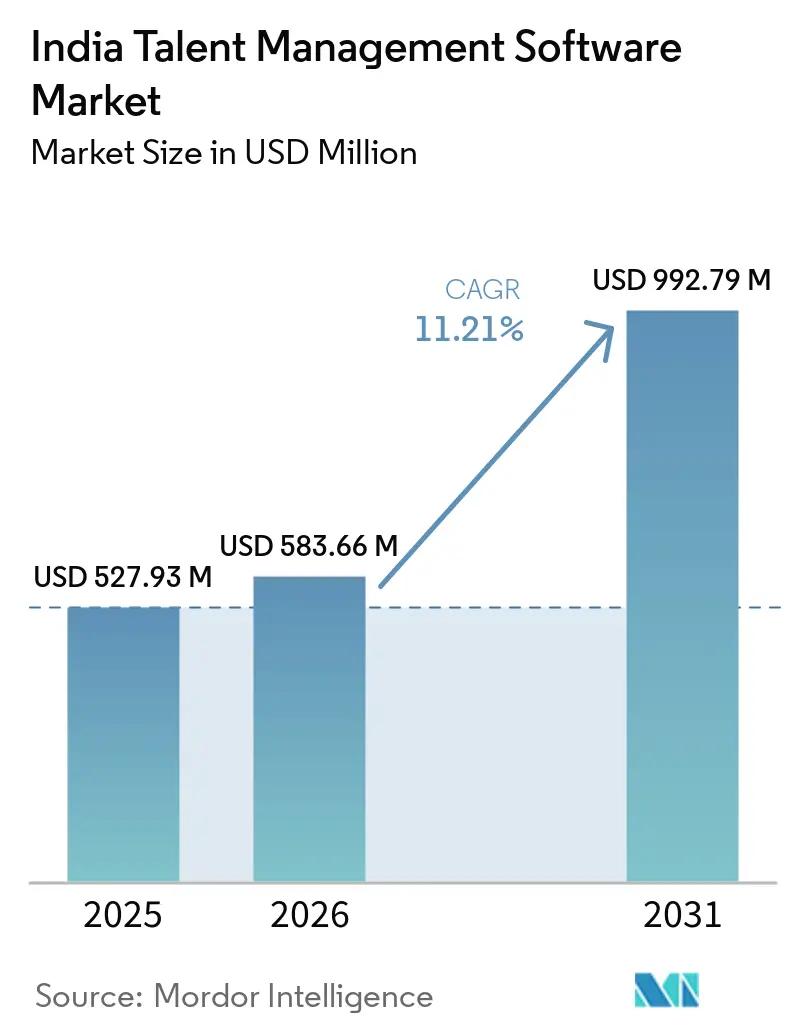
| Base Year Market Size (2025) | USD 527.93 Million |
| Market Size (2026) | USD 583.66 Million |
| Market Size (2031) | USD 992.79 Million |
| Growth Rate (2026 - 2031) | 11.21 % |
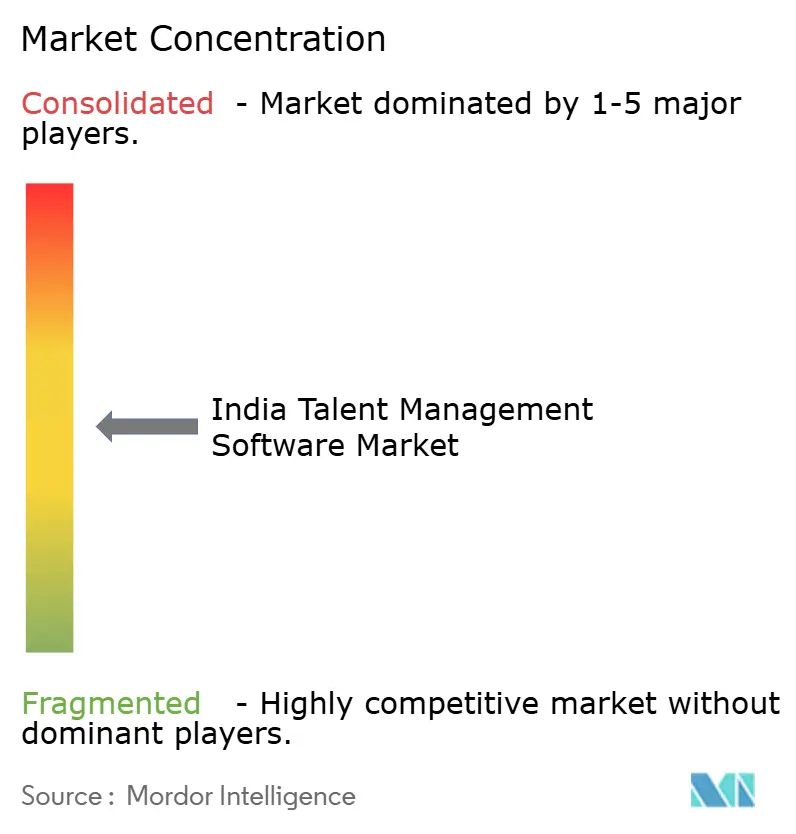
| Market Concentration | Medium |
Major Players *Disclaimer: Major Players sorted in no particular order Image © Mordor Intelligence. Reuse requires attribution under CC BY 4.0. | |
India Talent Management Software Market Analysis by Mordor Intelligence
The India talent management software market size is expected to increase from USD 527.93 million in 2025 to USD 583.66 million in 2026 and reach USD 992.79 million by 2031, growing at a CAGR of 11.21% over 2026-2031. The India talent management software market is undergoing a structural shift as enterprise digitization and GCC expansion are pushing talent systems into strategic planning. This is driving demand for connected platforms that link hiring, learning, performance, compensation, and workforce planning across larger, more distributed employee bases. Investor activity around Indian HR SaaS vendors also shows that the category is now viewed as capable of sustaining scaled recurring-revenue businesses. At the same time, tighter data governance is making local compliance, hosting readiness, and vendor due diligence more important in purchase decisions. The spread of gig work, hybrid work, and formal digital labor infrastructure is expanding the use case for platforms that can coordinate permanent, contract, and flexible workers within a single operating environment.
Key Report Takeaways
- By component, software held 75.19% of the India talent management software market share in 2025, while services are projected to grow at a 16.59% CAGR through 2031.
- By application, performance management accounted for 22.67% of the India talent management software market size in 2025, while learning and development is expected to expand at a 15.83% CAGR through 2031.
- By deployment, on-premise represented 68.71% of the India talent management software market size in 2025, while cloud recorded the highest projected CAGR at 17.32% through 2031.
- By organization size, large enterprises commanded 64.19% of the market in 2025, while SMEs are forecast to advance at a 17.02% CAGR through 2031.
- By end-use industry, IT and telecommunications held 25.13% of the India talent management software market share in 2025, while healthcare and life sciences is set to grow at a 16.22% CAGR through 2031.
Note: Market size and forecast figures in this report are generated using Mordor Intelligence’s proprietary estimation framework, updated with the latest available data and insights as of January 2026.
India Talent Management Software Market Trends and Insights
Drivers Impact Analysis*
| Driver | (~) % Impact on CAGR Forecast | Geographic Relevance | Impact Timeline |
|---|---|---|---|
| Surging Cloud Adoption among Indian Enterprises | +3.2% | Pan-India, with early gains in Bengaluru, Hyderabad, Pune, Mumbai, Delhi-NCR | Short term (≤ 2 years) |
| Government-Led Digital Skills Initiatives Boosting HR Tech Spend | +2.5% | National, with concentration in Tier-1 cities and GCC hubs | Medium term (2-4 years) |
| Accelerated Hybrid-Work Policies Requiring Agile Talent Solutions | +1.8% | National, with spill-over into Tier-2 cities via hub-and-spoke models | Short term (≤ 2 years) |
| Growing M&A Activity Among Indian IT Services Firms Creating Upsell Demand | +1.0% | Concentrated in IT corridors, Bengaluru, Hyderabad, Chennai, Pune, Delhi-NCR | Medium term (2-4 years) |
| Expansion of Gig Workforce Platforms Requiring Seamless Talent Orchestration | +0.9% | APAC core, with concentration in metro and Tier-2 cities across India | Medium term (2-4 years) |
| AI-Driven Learning Experience Platforms Enhancing Employee Retention | +0.8% | Pan-India, with spill-over to emerging Southeast Asian subsidiaries of Indian MNCs | Long term (≥ 4 years) |
| Source: Mordor Intelligence | |||
Surging Cloud Adoption among Indian Enterprises
Surging cloud adoption is reshaping enterprise software priorities across the India talent management software market. The Union Budget 2026-27 backed digital infrastructure through allocations tied to the IndiaAI Mission and the Digital India Corporation, which supports broader cloud-based service delivery across public and private programs. GCC expansion is also creating a demand tier that needs talent systems able to connect with global HCM stacks, shared controls, and cross-border reporting structures, which naturally favors cloud-native architecture.[1] That is one reason cloud is the fastest-growing deployment route inside the India talent management software market, even though on-premise still held the larger installed base in 2025. Workday made its India-region data center on Amazon Web Services available for new customers from December 2025, directly addressing a key procurement barrier around local hosting and governance. As a result, enterprise buying is moving away from a narrow cost discussion and toward a broader architecture discussion that includes interoperability, audit readiness, and data control.
Government-Led Digital Skills Initiatives Boosting HR Tech Spend
Government-backed skilling programs are widening the role of learning and workforce systems in the India talent management software market. The Union Budget 2025-26 allocated INR 500 crore (approximately USD 59.7 million) for a Center of Excellence in Artificial Intelligence for education, and also announced 5 National Centers of Excellence for Skilling with global partners. The Ministry of Skill Development and Entrepreneurship also pushed AI-linked skilling through the SOAR program in 2025, which provided employers with a stronger policy signal on structured digital learning and skill tracking. These programs increase the value of systems that can record competencies, certifications, learning completion, and role readiness in a standard format. The PM Internship Scheme, which targets 1 crore youth through 500 top companies by 2028-29 and has already activated 1.25 lakh pilot placements, widens the need for onboarding, training, and progression workflows at scale. This is helping learning modules move from a secondary purchase to a core budget line across much of the India talent management software market.
Accelerated Hybrid-Work Policies Requiring Agile Talent Solutions
Hybrid and distributed work models are expanding the functional scope of the India talent management software market. India’s gig workforce rose from 7.7 million in FY2020-21 to 12 million in FY2024-25, which means employers are now coordinating a broader mix of employment categories than before. That shift raises the importance of mobile approvals, distributed attendance workflows, role-specific learning access, and more flexible communication channels inside daily HR operations. Zoho People introduced WhatsApp-based approvals for leave, timesheets, and attendance regularization in February 2026, showing how vendors are redesigning products around dispersed teams and manager mobility. Vendor expansion in Pune and Chennai also reflects demand from multi-city operating models rather than single-location workforces. As enterprises extend teams into metro and Tier-2 locations, platforms that can apply consistent policies and workflows across sites are gaining an operational edge.
Growing M&A Activity Among Indian IT Services Firms Creating Upsell Demand
Corporate deal activity is creating new upsell opportunities across the India talent management software market. Goldman Sachs acquired a majority stake in PeopleStrong for USD 130 million in April 2025, while Darwinbox raised USD 140 million in March 2025 from investors led by Partners Group and KKR. These transactions give vendors more room to invest in product development, payroll capability, implementation capacity, and regional expansion. Larger employers that absorb businesses or align new operating units often need faster org design mapping, compensation harmonization, and unified review cycles, which raises the value of services-led selling. That dynamic benefits vendors that can bundle core software with deployment support, post-deal data cleanup, and workflow alignment across business entities. In practice, capital-backed suppliers are approaching the India talent management software market with broader product scope and stronger execution reach than in the previous wave of HR SaaS competition.
Restraints Impact Analysis*
| Restraint | (~) % Impact on CAGR Forecast | Geographic Relevance | Impact Timeline |
|---|---|---|---|
| Persistent Data Residency and Sovereignty Concerns | -1.8% | National, with heightened exposure in BFSI, healthcare, and government sectors | Short term (≤ 2 years) |
| Fragmented Legacy HRIS Ecosystems Limiting Integrations | -1.5% | Pan-India, concentrated in manufacturing, public sector, and traditional conglomerates | Medium term (2-4 years) |
| Budget Constraints within Traditional Manufacturing SMEs | -0.9% | Tier-2 and Tier-3 manufacturing clusters, Gujarat, Rajasthan, Maharashtra, Tamil Nadu | Medium term (2-4 years) |
| Shortage of Change-Management Expertise in Tier-2 Enterprises | -0.6% | APAC core, spill-over to Tier-2 and Tier-3 cities in India | Long term (≥ 4 years) |
| Source: Mordor Intelligence | |||
Persistent Data Residency and Sovereignty Concerns
Data residency remains one of the clearest friction points in the India talent management software market. The DPDP Rules, 2025, notified on November 13, 2025, made India’s first comprehensive data protection framework operational for organizations that process employee and candidate data. This underscores the importance of consent management, breach response, recordkeeping, and local governance in HR software procurement. Workday’s rollout of an India-region data center in late 2025 shows how central local hosting and in-country readiness have become to enterprise buying decisions. Buyers in regulated sectors are therefore spending more time on vendor reviews, security architecture, and data flow questions before signing contracts. That longer diligence cycle can delay decisions, especially for global platforms that still need to prove India-specific compliance depth.
Fragmented Legacy HRIS Ecosystems Limiting Integrations
Legacy system fragmentation continues to slow platform rollouts in the India talent management software market. SAP’s 1H 2026 SuccessFactors release included an Employee Data Integration Agent, underscoring how much effort enterprises still spend connecting data across HR systems. Workday launched Sana in March 2026, linking to Workday HCM, Financial Management, and third-party applications such as Salesforce, ServiceNow, and Confluence, underscoring the need to bridge disconnected environments. Many enterprises still run separate payroll, attendance, compliance, and core HR tools across business units, making it harder to assemble clean talent data into a single operating flow. That slows implementation, prolongs testing, and increases reliance on services teams during deployment. Even when buyers want a modern suite, the cost and disruption of replacing entrenched systems can postpone full adoption.
*Our forecasts treat driver/restraint impacts as directional, not additive. The impact forecasts reflect baseline growth, mix effects, and variable interactions.
Segment Analysis
By Component: Services Growth Signals a Maturing Implementation Ecosystem
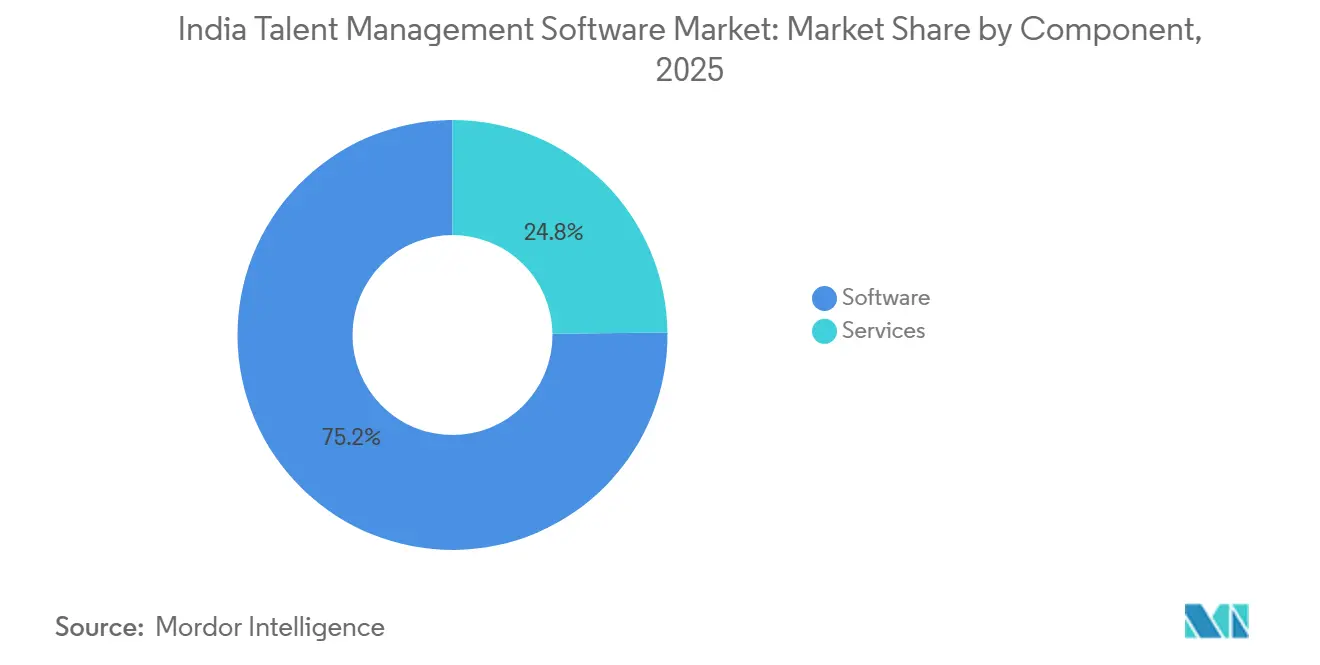
Software accounted for 75.19% of the market in 2025 and remained the largest component across the India talent management software market. That lead reflects the central role of platform licenses in unifying recruitment, learning, performance, compensation, and planning within a shared system. Even so, services are forecast to grow at a 16.59% CAGR through 2031, indicating that buyers are placing greater weight on implementation quality and integration outcomes. IBM’s AskHR environment, enhanced with watsonx Orchestrate, automates more than 80 HR tasks and handles more than 2.1 million employee conversations each year, illustrating how workflow design and integration can multiply value beyond the base license.[2] In the India talent management software market, that pattern is encouraging vendors to package consulting, integration, and optimization services alongside the core platform.
The faster growth of services also reflects the organizational and regulatory complexity that many Indian enterprises face during rollout. Multi-module implementations often require policy mapping, data migration, manager training, permissions design, and post-go-live tuning before adoption stabilizes across business units. This is one reason the India talent management software industry is moving toward blended revenue models that combine subscriptions with ongoing services support. Vendors that stay involved after deployment are better positioned to capture recurring work from compliance updates, workflow redesigns, AI feature activations, and operating model changes. The outcome is a more mature implementation ecosystem in which services no longer sit alongside the platform but increasingly determine whether the platform delivers measurable value in day-to-day HR operations.
By Application: Performance Management Anchors Spending while Learning Gains Strategic Weight
Performance management accounted for 22.67% of the India talent management software market in 2025, making it the largest application area. Large employers still depend on formal review cycles because pay decisions, succession choices, and manager accountability continue to flow through structured assessment systems. Learning and development is set to expand at a 15.83% CAGR through 2031, underscoring how quickly skill-building is moving to the center of platform budgets. The SOAR program and the wider government skilling push are encouraging employers to document competencies and learning progress in more formal digital formats. That makes learning modules more closely tied to role mapping, career planning, and internal mobility across the India talent management software market.
Recent product launches also show that application boundaries are becoming less rigid across the portfolio. Cornerstone launched Galaxy AI and Cornerstone Transform in May 2026 to connect learning, career pathing, workforce planning, and recruitment through a skills-based intelligence layer. SAP’s 1H 2026 SuccessFactors release included a Learning Compliance Agent and a Succession Planning Agent, signaling that enterprises increasingly want linked workflows instead of isolated tools. Oracle’s 2026 HR agentic applications added talent calibration and manager workspace tools, reinforcing the continued relevance of performance-led workflows within enterprise suites. As a result, the India talent management software market is shifting away from single-module buying and toward portfolios in which performance management remains the anchor while learning increasingly drives expansion.
By Deployment: Institutional Legacy Keeps On-Premise ahead while Cloud Becomes the Destination
On-premises deployment accounted for 68.71% of the India talent management software market in 2025, underscoring the continued dominance of legacy enterprise installations. This installed base remained strongest in regulated sectors and large organizations that built earlier HR systems around internal hosting and customized controls. Cloud deployment is projected to advance at a 17.32% CAGR through 2031, making it the fastest-growing route in the market. Workday’s India-region data center on Amazon Web Services, available for new customers from December 2025, directly addressed one of the main barriers to cloud HCM adoption in India. In the India talent management software market, cloud demand is rising because enterprises want faster updates, AI features, and easier integration across GCC and multi-entity operations.
The transition is rarely a straight move from one model to the other. Many organizations are adopting a hybrid architecture in which core HR records remain on-premise while talent applications move to the cloud in stages over multiple budget cycles. ZingHR said its multilingual cloud HCM platform served more than 1,200 enterprises, which suggests that cloud readiness is spreading beyond metro-headquartered IT firms into a broader enterprise base. This gradual path matters because it lowers operational risk for buyers who cannot replace payroll, attendance, and policy systems in a single step. Over time, the India talent management software industry is likely to favor vendors that can support this mixed architecture while maintaining consistent data controls, user experience, and integration quality.
By Organization Size: Large Enterprises Set the Baseline while SMEs Drive Momentum
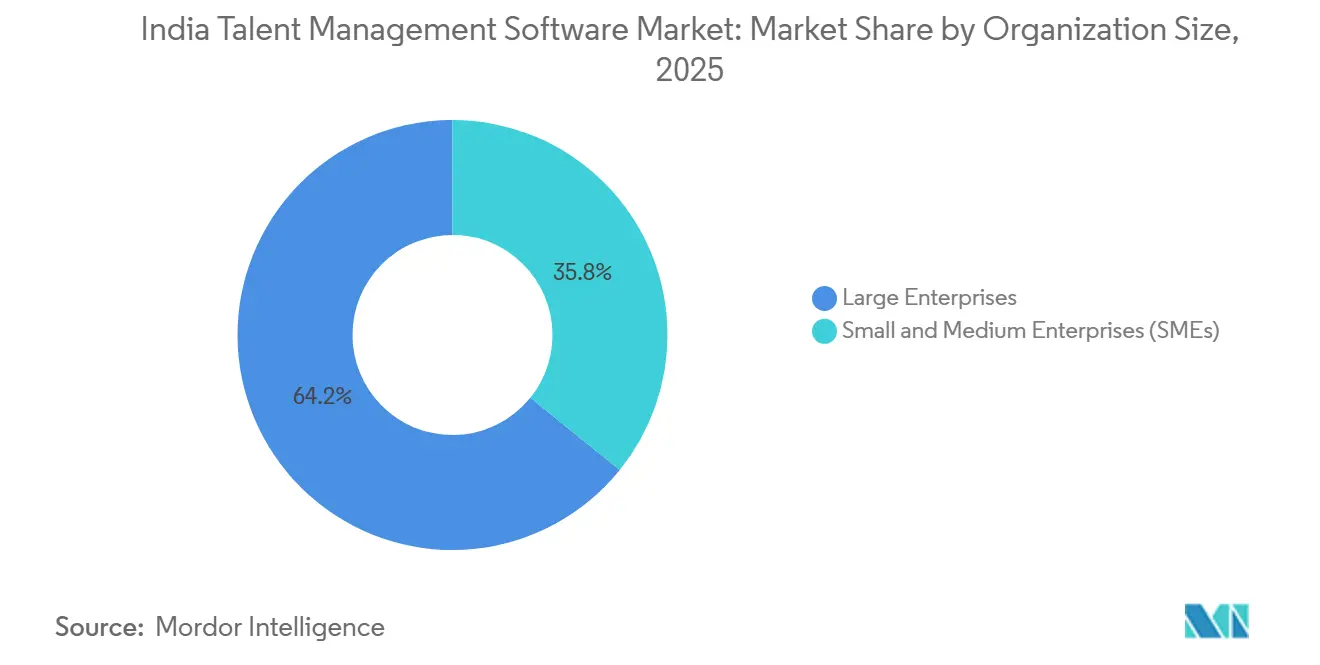
Large enterprises commanded 64.19% of the market in 2025, reflecting their wider module adoption, larger employee bases, and ability to fund enterprise-wide rollouts. These buyers generally favor integrated suites because they need common processes across business units, subsidiaries, functions, and leadership layers. SMEs are expected to grow at a 17.02% CAGR through 2031, making them the fastest-growing organization size segment. Cloud delivery and lower per-user pricing have made capable systems more accessible to smaller firms, with some offerings available at USD 2-10 per user per month and deployment timelines as short as a few weeks. This shift is widening the addressable market for India talent management software beyond its historical concentration in very large employers.
The SME case is also being strengthened by compliance pressure and user experience needs. ETHRWorld reported in 2025 that 70% of Indian companies planned strategic HR technology investments over the next 12 months, suggesting a broader demand pipeline beyond top-tier enterprises. Vendors are responding with payroll-linked automation, vernacular interfaces, and mobile-first workflows that fit smaller operating structures more easily. EZHRM promotes a Hindi-friendly assistant approach for Indian SMEs, reflecting a broader effort to reduce adoption friction outside English-dominant office environments. In the India talent management software market, that mix of affordability, compliance support, and easier user engagement is turning SMEs into a genuine growth engine rather than a secondary segment.
By End-Use Industry: IT Leads Current Demand while Healthcare Builds Faster
IT and telecommunications accounted for 25.13% of the market in 2025, making it the largest end-use segment in the India talent management software market. The segment’s weight comes from large digital workforces, heavy reskilling needs, and deeper use of structured performance and learning systems than many other verticals. HR-focused reporting on India’s major IT companies showed large-scale internal learning and talent initiatives across Infosys, TCS, and Tech Mahindra in 2025, underscoring the centrality of digital workforce development in this vertical. Healthcare and life sciences are forecast to expand at a 16.22% CAGR through 2031, the fastest rate among end-use industries. Trade coverage in 2026 pointed to a 30-35% hiring surge in India’s healthcare and pharma sector by 2030, which supports stronger demand for digital recruitment, onboarding, and development workflows.
BFSI remains important because compensation controls, audit trails, and access governance are more critical in this sector than in many others. Retail and e-commerce are also increasing talent requirements as gig-linked fulfillment and distributed operations reshape workforce planning and performance tracking. Manufacturing is moving more steadily, with attendance automation and compliance monitoring often leading the first phase of platform adoption. Government adoption is also growing, though procurement cycles tend to be longer and more procedural than in commercial accounts. Across the India talent management software market, sector-specific configuration is becoming a stronger competitive differentiator because the same core platform now has to adapt to very different hiring, learning, pay, and governance priorities.
Geography Analysis
Regional demand in the India talent management software market remains strongest in the major enterprise corridors that combine headquarters concentration, digital infrastructure, and large formal workforces. North India, especially Delhi-NCR, Noida, and Gurgaon, benefits from the presence of BFSI headquarters, multinational GCCs, and public-sector decision centers, which support demand for platforms with stronger governance and multi-entity controls. West India is anchored by Mumbai’s financial-services base and Pune’s technology ecosystem, and UKG expanded this footprint in April 2025 by opening a new Center of Excellence in Pune, with plans to add more than 500 employees by year-end. These regions matter because they continue to generate large enterprise accounts that often set the reference architecture for the wider India talent management software market.
South India continues to shape product innovation and enterprise adoption across the India talent management software market. Bengaluru remains central because of its software base, while Hyderabad brings a mix of IT services and life sciences demand. Workday deepened its India presence with a local data center announcement in 2025 and later signed a 1.94 lakh sq ft lease in Chennai in March 2026 for a GCC expected to create up to 3,000 jobs. That move shows South India is becoming not only a customer cluster but also a development hub for enterprise talent platforms. East India remains earlier in adoption, yet new manufacturing and logistics activity is widening the future need for digital workforce tools across a broader regional base.
The next geographic layer in the India talent management software market is coming from Tier-2 city expansion and distributed operating models. Vendor product choices, such as WhatsApp approvals in Zoho People and multilingual delivery from ZingHR, point to a user base that is no longer limited to metro headquarters.[3] The draft Shram Shakti Niti 2025 also supports a more connected digital labor framework through open APIs and portable worker identities, which could expand the use of formal HR data beyond the largest urban clusters. As enterprises spread teams across cities such as Coimbatore, Indore, Kochi, and Jaipur, regional growth is becoming less about a single metro and more about supporting distributed workforces with consistent workflows.
Competitive Landscape
Competition in the India talent management software market is intensifying as global suites, Indian challengers, and focused regional providers target many of the same enterprise workloads. Oracle, SAP, and Workday still retain credibility with multinational groups and GCC-linked buyers because of their installed bases, compliance posture, and wider enterprise software relationships. At the same time, Darwinbox, PeopleStrong, and Zoho have narrowed functional gaps through faster product cycles, deeper local compliance, and mobile-first design. Goldman Sachs acquired a majority stake in PeopleStrong for USD 130 million in April 2025, while Darwinbox secured USD 140 million in March 2025 from investors led by Partners Group and KKR, giving domestic challengers fresh capital for product development and expansion. That balance of global incumbency and local agility is making new deal cycles more competitive across the India talent management software market.
A major strategic theme in 2026 is the use of agentic AI to deepen product stickiness and widen workflow coverage. Oracle introduced 8 Fusion Agentic Applications for HR in April 2026, including tools for team talent calibration, career advancement, and manager support within existing cloud workflows. SAP followed with 4 SuccessFactors Joule Agents and broader 1H 2026 functionality, while the release added more than 400 innovations across HR processes.[4] These launches show that incumbents are defending accounts not only on scale, but also on how tightly AI can be embedded into daily HR decisions.
Competitive openings remain strongest in the mid-market band, where buyers want more than entry-level HR tools but remain cautious on enterprise-suite pricing. Workday strengthened its India position through a local data center, leadership expansion, and the Chennai GCC, which signals a longer-term commitment to local execution. Zoho People added WhatsApp workflow capability in February 2026, a move that aligned well with distributed teams and manager mobility in Indian workplaces. Freshworks decided to discontinue Freshteam and halt renewals from March 2026, releasing part of the SMB demand pool to competitors targeting lighter HR use cases. Overall, the India talent management software market is competitive but not dominated by a single vendor, as buyers can now choose among several credible products and delivery models.
India Talent Management Software Industry Leaders
-
Oracle Corporation
-
SAP SE
-
Workday, Inc.
-
ADP, Inc.
-
UKG Inc.
- *Disclaimer: Major Players sorted in no particular order
Recent Industry Developments
- May 2026: Cornerstone OnDemand unveiled Galaxy AI and Cornerstone Transform, powered by SkyHive's 40+ TB labor market dataset mapping 51,000+ skills across 250 million roles. Galaxy AI delivers agentic-first talent intelligence across learning, career pathing, workforce planning, and recruitment, serving over 7,000 organizations and 140 million users globally.
- April 2026: SAP released the SuccessFactors 1H 2026 Update with over 400 innovations, including a Pending Workflow Agent that can cut time-to-resolution by up to 40%, an Employee Data Integration Agent, a Learning Compliance Agent, and a Succession Planning Agent for proactive risk surfacing.
- April 2026: Oracle launched 8 Fusion Agentic Applications for HR at the Oracle AI World Tour, including a Team Talent Calibration and Review Workspace, Career Advancement Command Center, and Manager Concierge Workspace, all running on Oracle Cloud Infrastructure with LLM-powered decision logic within existing security frameworks.
- March 2026: Workday signed one of Chennai's largest enterprise office leases, 1.94 lakh sq ft at Millenia Business Park, establishing a GCC focused on product and technology development, expected to create up to 3,000 jobs.
India Talent Management Software Market Report Scope
The India talent management software market solutions are tailored to support a myriad of functions, including recruitment, onboarding, performance management, and workforce analytics, all attuned to the nation's swiftly growing labor market. Key sectors like IT, telecom, BFSI, and manufacturing are leading the charge in HR digitization, propelling widespread software adoption. The market dynamics are increasingly influenced by a cloud-first approach and a rising demand for versatile, scalable talent solutions that cater to multiple locations. Key growth drivers include a focus on skills transformation, the adoption of hybrid work models, and a broader push towards modernizing enterprise HR practices.
The India Talent Management Software Market Report is Segmented by Component (Software, and Services [Professional Services, and Support and Maintenance Services]), Application (Performance Management, Learning and Development, Succession Planning, Compensation Management, Recruitment and Talent Acquisition, Workforce Planning, Employee Engagement and Career Development, and Other Talent Management Applications), Deployment (On-Premise, and Cloud), Organization Size (Large Enterprises, and Small and Medium Enterprises [SMEs]), and End-Use Industry (IT and Telecommunications, Banking, Financial Services and Insurance [BFSI], Healthcare and Life Sciences, Retail and E-Commerce, Manufacturing, Government and Public Sector, and Other End-Use Industries). The Market Forecasts are Provided in Terms of Value (USD).
| Software | |
| Services | Professional Services |
| Support and Maintenance Services |
| Performance Management |
| Learning and Development |
| Succession Planning |
| Compensation Management |
| Recruitment and Talent Acquisition |
| Workforce Planning |
| Employee Engagement and Experience |
| Other Talent Management Applications |
| On-Premise |
| Cloud |
| Large Enterprises |
| Small and Medium Enterprises (SMEs) |
| IT and Telecommunications |
| Banking, Financial Services and Insurance (BFSI) |
| Healthcare and Life Sciences |
| Retail and E-Commerce |
| Manufacturing |
| Government and Public Sector |
| Other End-Use Industries |
| By Component | Software | |
| Services | Professional Services | |
| Support and Maintenance Services | ||
| By Application | Performance Management | |
| Learning and Development | ||
| Succession Planning | ||
| Compensation Management | ||
| Recruitment and Talent Acquisition | ||
| Workforce Planning | ||
| Employee Engagement and Experience | ||
| Other Talent Management Applications | ||
| By Deployment | On-Premise | |
| Cloud | ||
| By Organization Size | Large Enterprises | |
| Small and Medium Enterprises (SMEs) | ||
| By End-Use Industry | IT and Telecommunications | |
| Banking, Financial Services and Insurance (BFSI) | ||
| Healthcare and Life Sciences | ||
| Retail and E-Commerce | ||
| Manufacturing | ||
| Government and Public Sector | ||
| Other End-Use Industries | ||
Key Questions Answered in the Report
How large is the India talent management software market in 2026?
It stands at USD 583.66 million in 2026 and is projected to reach USD 992.79 million by 2031 at an 11.21% CAGR.
Which deployment model is growing faster in India?
Cloud is the faster-growing model, with a projected 17.32% CAGR through 2031, even though on-premise still held the larger share in 2025.
Which application area leads current spending?
Performance management led applications with a 22.67% share in 2025, showing that structured review and goal systems still anchor platform budgets.
What is driving faster growth in learning and development tools?
Government-backed skilling programs, AI-readiness efforts, and the need to track competencies digitally are pushing learning and development to a 15.83% CAGR through 2031.
Which end-use segment is the biggest buyer today?
IT and telecommunications is the largest end-use segment with a 25.13% share in 2025, supported by large digital workforces and heavy reskilling activity.
What is the main compliance issue affecting vendor selection?
Data residency and broader DPDP compliance are major concerns, especially for regulated buyers that now place more weight on local hosting, consent handling, and governance readiness.