
Talent Acquisition In BFSI Market Size and Share
Market Overview
| Study Period | 2020 - 2031 |
|---|---|
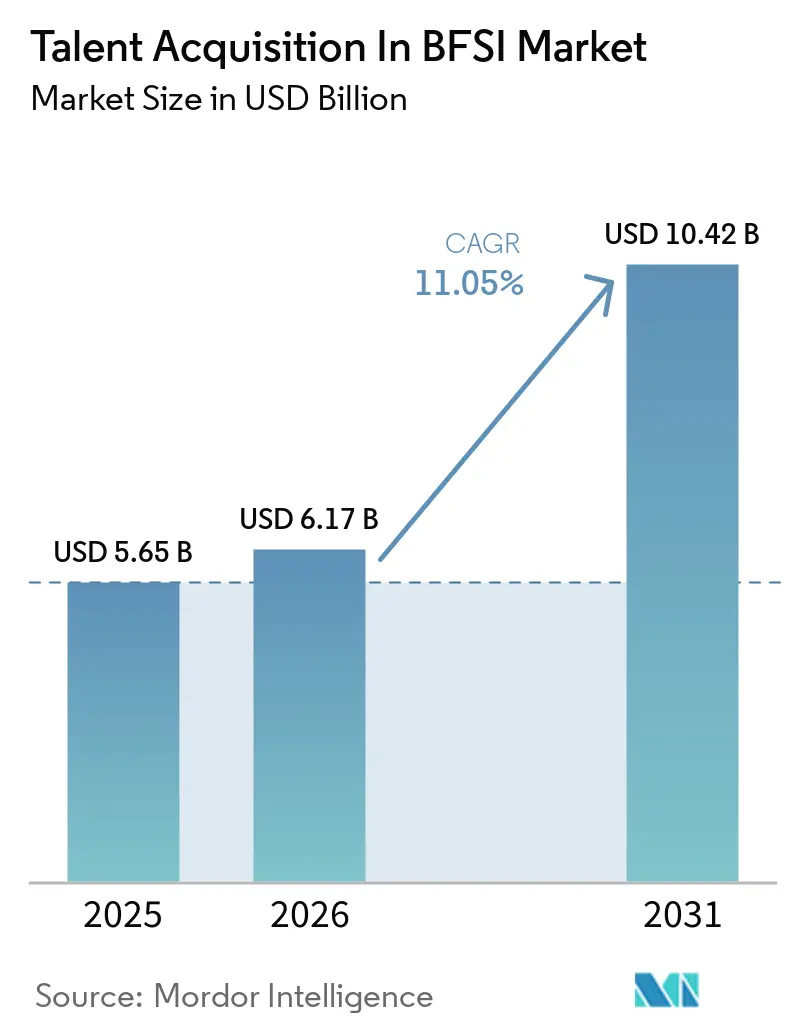
| Market Size (2026) | USD 6.17 Billion |
| Market Size (2031) | USD 10.42 Billion |
| Growth Rate (2026 - 2031) | 11.05 % |
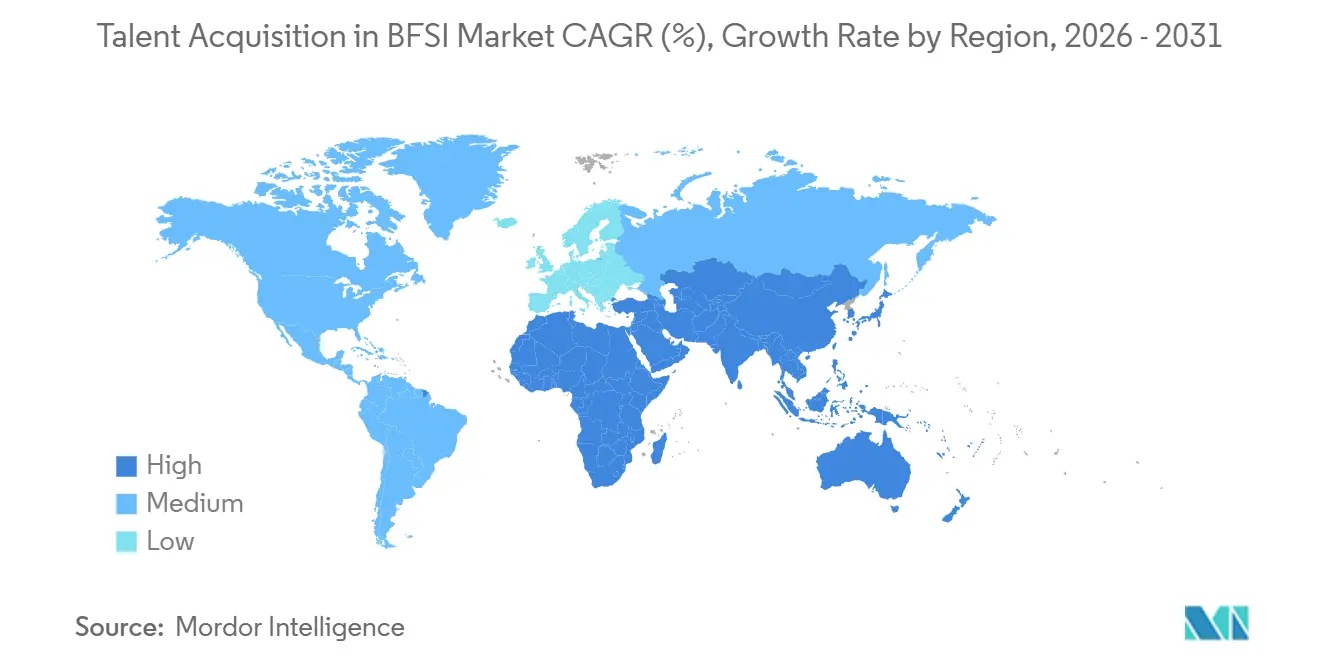
| Fastest Growing Market | Asia-Pacific |
| Largest Market | North America |
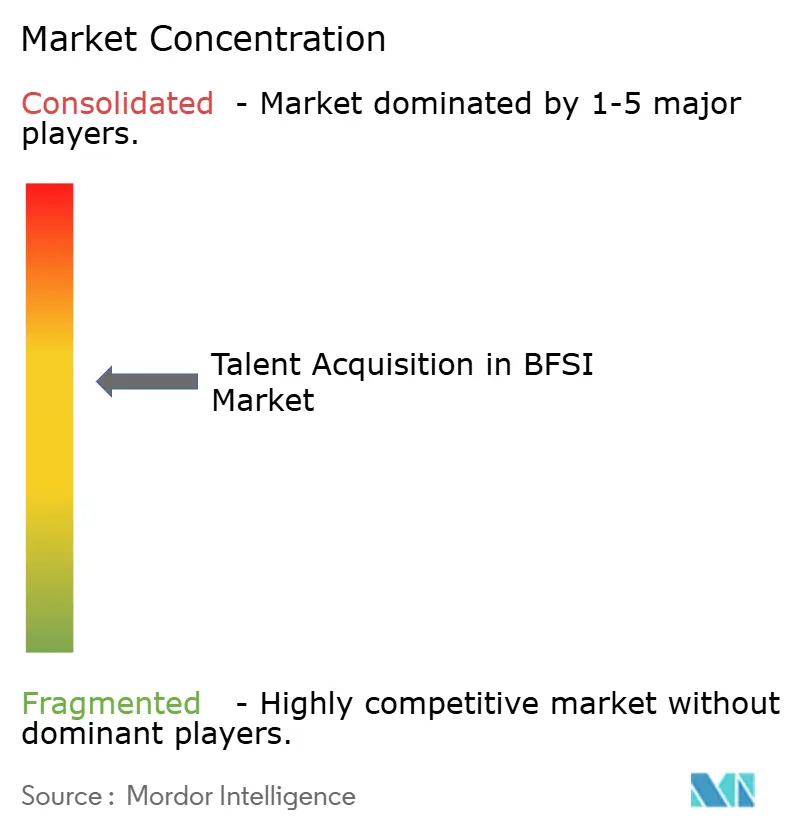
| Market Concentration | Medium |
Major Players *Disclaimer: Major Players sorted in no particular order Image © Mordor Intelligence. Reuse requires attribution under CC BY 4.0. | |
Talent Acquisition In BFSI Market Analysis by Mordor Intelligence
The talent acquisition in the BFSI market was valued at USD 5.7 billion in 2025 and is estimated to grow from USD 6.2 billion in 2026 to USD 10.4 billion by 2031, at a CAGR of 11.05% during the forecast period (2026-2031). Growth remains tied to structural hiring pressure across banking, financial services, and insurance institutions as they simultaneously manage regulatory expansion, workforce change, and the digitalization of platforms. Hiring demand has shifted away from volume-led recruitment toward targeted sourcing of compliance-ready, digitally fluent candidates, exposing the limits of older recruiting infrastructure. Automation is easing pressure in branch and contact center hiring, but hard-to-fill roles in financial crime, algorithmic compliance, and embedded finance architecture are becoming more difficult to source. Competition is also shifting as large enterprise HCM vendors consolidate hiring capabilities while AI-native specialists build deeper workflows for BFSI-specific use cases. The same pattern is opening the door to implementation and advisory support, as software capabilities are advancing faster than many institutions can operationalize.
Key Report Takeaways
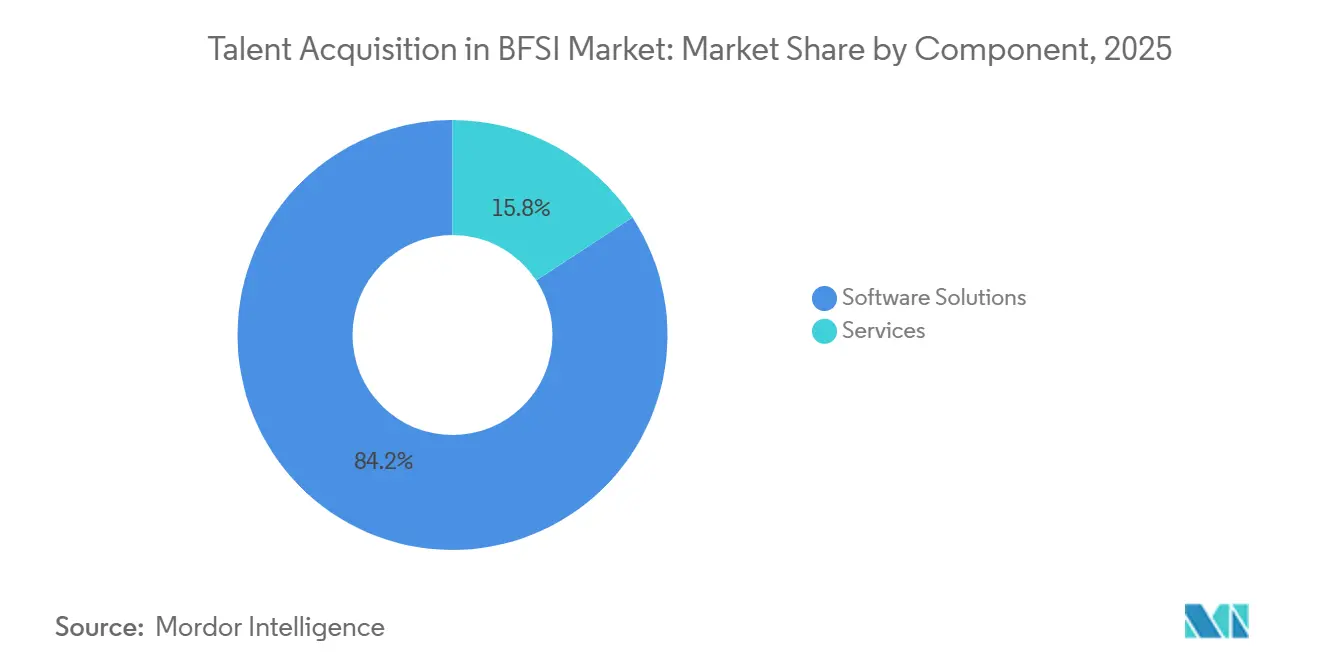
- By component, software solutions led with an 84.2% share in 2025; applicant tracking systems represented the largest individual sub-segment at 34.5% of the overall market; and services are projected to expand at a 11.8% CAGR through 2031.
- By deployment mode, cloud held 76.4% share in 2025, while on-premises is forecast to record the highest growth at 12.6% CAGR through 2031.
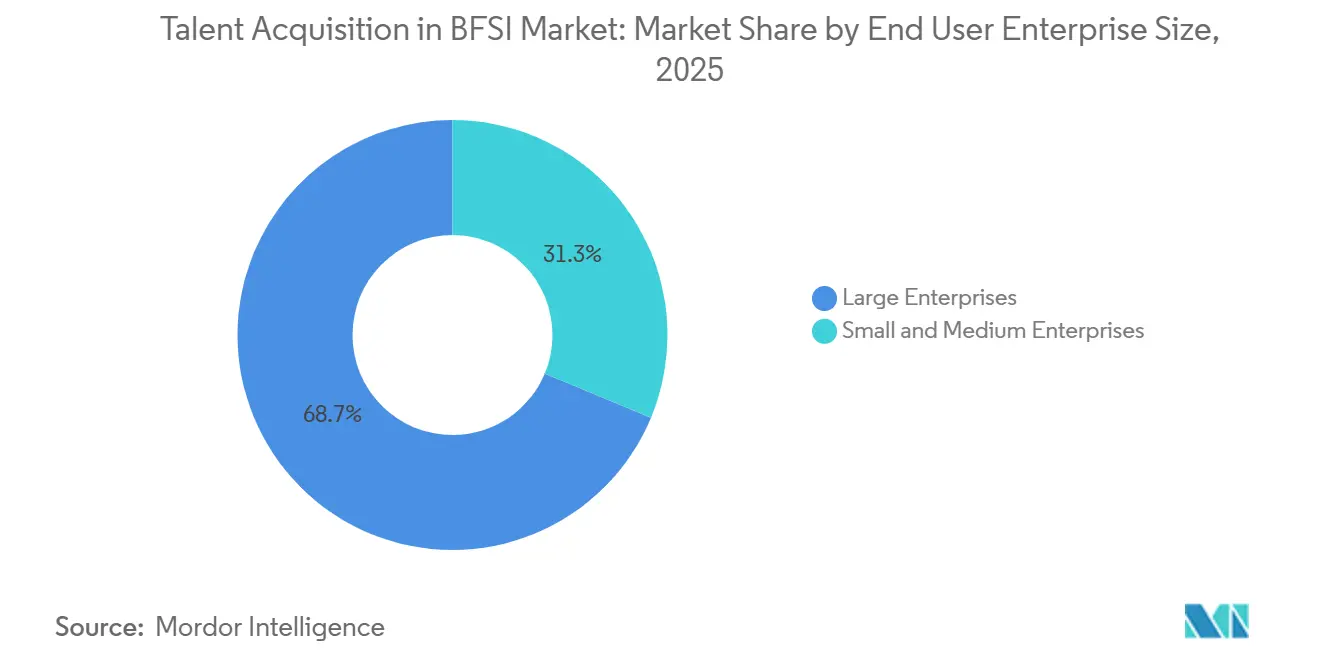
- By organization size, large enterprises accounted for 68.7% of the market in 2025, while SMEs are expected to grow the fastest at a 12.9% CAGR through 2031.
- By geography, North America held a 38.6% share at the start of 2026, while Asia-Pacific is set to advance at the fastest 13.8% CAGR through 2031.
Note: Market size and forecast figures in this report are generated using Mordor Intelligence’s proprietary estimation framework, updated with the latest available data and insights as of January 2026.
Market Trends and Insights
Drivers Impact Analysis of Talent Acquisition In BFSI Market*
| Driver | (~) % Impact on CAGR Forecast | Geographic Relevance | Impact Timeline |
|---|---|---|---|
| Digital-First Onboarding Mandates by Neobanks | +2.8% | Global, concentrated in Europe and Asia-Pacific | Short term (≤ 2 years) |
| Shortage of Niche Risk and Compliance Talent | +2.5% | Global | Short term (≤ 2 years) |
| AI-Powered Screening Reduces Time-to-Hire | +2.2% | Global, with advanced adoption in North America | Medium term (2-4 years) |
| Rise of Embedded Finance Expanding Hiring Pools | +1.5% | Global, with significant growth in emerging markets | Medium term (2-4 years) |
| Regulatory Push for Workforce Localization in GCC | +1.0% | Middle East, UAE, Saudi Arabia, Kuwait | Short term (≤ 2 years) |
| ESG Reporting Requirements Elevate HR Transparency | +0.7% | Europe, North America, Asia-Pacific | Long term (≥ 4 years) |
| Source: Mordor Intelligence | |||
Digital-First Onboarding Mandates by Neobanks
Neobanks are among the most prolific buyers of recruitment technology in BFSI, not simply because they hire at velocity, but because their compliance-first organizational structures require onboarding workflows that are fully auditable and digitally integrated from day one of any banking license activation. Revolut, which received its UK banking license in mid-2024, subsequently launched a 400-role Western European recruitment drive in 2025, with compliance, risk management, and financial crime prevention dominating the open positions, a campaign explicitly tied to its Paris banking license application and the regulatory staffing requirements that accompany it.[1] Dutch neobank Bunq expanded its global headcount by 70% in 2024, targeting specialized talent across nine cities and three continents, requiring a multi-jurisdictional talent-acquisition infrastructure as a prerequisite. Monzo is committed to nearly doubling its Irish headcount to 70 employees by mid-2027, driven by its December 2025 acquisition of a full EU banking license through the Central Bank of Ireland. Each neobank licensing event effectively mandates digital talent acquisition platforms as regulatory infrastructure rather than optional productivity tooling, a dynamic that makes neobank hiring programs a structural demand driver independent of broader economic cycles.[2]
Shortage of Niche Risk and Compliance Talent
The shortage of niche risk and compliance talent remains one of the strongest growth drivers for talent acquisition in the BFSI market, as it is structural rather than cyclical. Nearly 90% of financial services compliance executives reported their responsibilities had increased over the prior three years, while more than half expected a skills shortage in specialist areas within the next 12 months. In Singapore, the Monetary Authority of Singapore worked with local and global banks to improve AML standards and address staffing gaps, showing that the talent shortage had moved from an internal HR issue to a regulatory concern. Organizations with mature talent mobility functions were found to be 3.7 times more effective at addressing medium-term shortages, prompting BFSI institutions to adopt internal skills mapping and succession planning within modern hiring platforms. In Hong Kong and Singapore, salary data for 2026 pointed to 3-6% premiums for specialist roles such as MAS regulatory reporting and digital assets compliance, reinforcing the case for proactive pipelining rather than reactive posting. As a result, the talent acquisition in the BFSI market is being shaped by a narrow but persistent mismatch between available candidates and the regulatory complexity of open roles.[3]
AI-Powered Screening Reduces Time-to-Hire
AI-powered screening is becoming a measurable operating lever in talent acquisition in the BFSI market, as buyers can now point to direct cost savings, faster speed, and workflow gains. HSBC’s deployment with Accenture, Eightfold AI, and Workday delivered a 35% improvement in time-to-hire, USD 28.5 million in savings, and an 18% reduction in operating expenses, giving large financial institutions a reference case for internal approval processes. In January 2025, 65% of financial services institutions using AI reported lower cost-per-hire than non-AI users (39%), and some institutions saw a 75% reduction in time-to-offer.[4] Another survey found that 92% of chief human resources officers were already seeing benefits from AI adoption in HR, with more than 10% reporting productivity gains of 30% or more. Ping An Insurance launched its Ping An Talent system in March 2025, featuring AI job matching, AI interviews, and AI salary negotiation for campus hiring, demonstrating that full-process AI adoption is moving beyond screening alone. This creates a widening gap between institutions that can automate sourcing and evaluation at scale and those still relying on recruiter-heavy workflows. That gap continues to fuel talent acquisition in the BFSI market as buyers shift spending toward platforms with clear auditability and business-case support.
Rise of Embedded Finance Expanding Hiring Pools
The rise of embedded finance is expanding the talent pool for recruitment in the BFSI market, as financial institutions recruit beyond the traditional banking talent base. Firms building embedded lending, insurance, and payments capabilities need people who combine API architecture knowledge, digital product thinking, and regulatory fluency, and that mix is not available in enough volume inside legacy banking workforces. In April 2025, research showed that 75% of employers struggled to find talent in 2024, up from 36% a decade earlier, reflecting the growing difficulty of hiring for data-led and cross-functional roles. The same findings noted that financial services employers were increasingly recruiting from technology, consulting, and non-finance backgrounds to meet changing job requirements. This shift was reinforced in January 2026, when a payments executive with experience at Worldpay, Barclaycard, and NomuPay was hired to scale embedded finance partnerships, underscoring how BFSI hiring now extends into adjacent sectors for commercial and technical talent. As institutions compete with technology firms for the same talent, the BFSI market is also seeing stronger demand for candidate relationship management and recruitment marketing tools that enhance the digital hiring experience.
Restraints Impact Analysis of Talent Acquisition In BFSI Market*
| Restraint | (~) % Impact on CAGR Forecast | Geographic Relevance | Impact Timeline |
|---|---|---|---|
| Legacy Core Banking Systems Limit Integration | -1.8% | Global, most pronounced in Europe and South/Southeast Asia | Long term (≥ 4 years) |
| High Data Security and Privacy Concerns | -1.4% | Global, North America and Europe most regulated | Medium term (2-4 years) |
| Volatile Fintech Funding Cycles | -0.9% | Global, elevated impact in Asia-Pacific and South America | Short term (≤ 2 years) |
| Difficulty Quantifying ROI on Recruitment Tech | -0.6% | Global, most acute in mid-tier institutions | Medium term (2-4 years) |
| Source: Mordor Intelligence | |||
Legacy Core Banking Systems Limit Integration
Legacy core banking infrastructure continues to slow the talent acquisition in BFSI market because many institutions still run payroll, HR, and compliance systems built on old architectures with country-level customizations. Financial institutions often work with fragmented data environments shaped by systems built in the 1990s or earlier, which makes API-led integration with modern talent platforms difficult. Danske Bank’s ongoing effort to consolidate four Nordic payroll vendors into a unified cloud solution, with Finland planned to go live in late 2026, shows how even well-resourced institutions face multi-year modernization timelines. The barrier is sharper in mid-tier banks, cooperative institutions, and regional insurers because IT teams often do not have the capacity to modernize core systems and connect new recruiting tools at the same time. Governance gaps between HR and IT also add delay when data ownership, configuration standards, and system priorities are unclear. This makes the talent acquisition in BFSI market harder to penetrate in regions where older and highly customized banking structures remain common.
High Data Security and Privacy Concerns
High data security and privacy concerns are another major drag on talent acquisition in the BFSI market, as applicant data in financial services is subject to unusually strict compliance requirements. GDPR in Europe, state-level privacy rules in the United States, and sector-specific expectations from financial regulators make third-party hiring software a risk review rather than a routine technology purchase. Vendors handling applicant records must meet demanding security and governance standards, which lengthen due diligence and narrow the pool of approved providers, especially for smaller specialists with limited certification depth. Research found that 47% of financial services executives cited a lack of skills and experience to manage and use compliance data as a major barrier, showing that internal capability gaps are part of the problem, not only vendor readiness. The arrival of more autonomous AI recruiting functions is raising scrutiny further because buyers must now review how models advance, reject, document, and explain employment decisions. That review cycle is extending procurement timelines and shaping how institutions shortlist vendors in the BFSI talent acquisition market.
*Our forecasts treat driver/restraint impacts as directional, not additive. The impact forecasts reflect baseline growth, mix effects, and variable interactions.
Talent Acquisition In BFSI Market Segment Analysis
By Component:
Software Leads While Services Capture the Execution NeedSoftware solutions accounted for 84.2% of talent acquisition in the BFSI market in 2025, reflecting the heavy reliance of financial institutions on configurable platforms that support sourcing, screening, assessment, and onboarding within a single operating layer. Applicant tracking systems captured 34.5% of the overall market in 2025, confirming that ATS platforms remain the foundation on which candidate relationship management, interview tools, recruitment marketing, and onboarding modules are built. Within the talent acquisition in the BFSI industry, that foundation matters because institutions want system control, workflow consistency, and audit readiness before they expand into higher-value intelligence layers. Candidate relationship management platforms are gaining importance as hiring teams move away from reactive job posting and toward long-cycle talent pipelining for hard-to-fill compliance and risk positions. Interview and assessment tools are also rising in value as AI-enabled structured interviews create stronger process documentation and more consistent decision trails for regulated employers.
Services are projected to grow at a 11.8% CAGR through 2031, making them the fastest-growing component of talent acquisition in the BFSI market. This reflects a clear execution gap, as many BFSI HR teams still need help translating software capabilities into live process design, recruiter workflows, and governance controls. A 2025 review of talent acquisition technology found that 56% of organizations still viewed AI mainly as a productivity tool rather than a transformation enabler, which supports the case for implementation and change support. SAP deepened its SmartRecruiters integration within SAP SuccessFactors in March 2026 after its September 2025 acquisition, demonstrating how platform vendors are integrating closer service and deployment support into the product stack itself. As a result, talent acquisition in the BFSI market is not driven solely by software demand, because service partners are becoming essential to the quality and speed of adoption.
By Deployment Mode:
Cloud Stays in Front While On-Premises Expands for ComplianceCloud deployment commanded a 76.4% share in 2025, keeping it at the center of talent acquisition in the BFSI market, as multinational institutions value scalability, lower upfront infrastructure costs, and faster configuration across jurisdictions. Cloud systems make it easier to standardize recruiter workflows and candidate experience across Europe, Asia-Pacific, North America, and the Middle East while still supporting local data fields and consent requirements. In the talent acquisition in the BFSI industry, flexibility matters because regulatory obligations differ by country, even when employers want a unified operating model. Royal Bank of Canada’s Workday-Phenom environment processed more than 23,000 requisitions and 22,000 hires across 29 countries in 2025, illustrating the scale that cloud-native hiring infrastructure can support. Cloud also remains the default choice for organizations that need frequent feature updates, distributed recruiter access, and centralized reporting.
On-premises deployment is projected to grow at a 12.6% CAGR through 2031, making it the fastest-growing deployment model, even though it remains smaller in absolute terms. That growth reflects regulatory pressure rather than a shift in technology preference, since data residency rules in markets such as China, India, and parts of the Middle East can restrict where applicant data is stored and processed. This leaves on-premises and sovereign-cloud configurations as the practical option for state-owned banks and institutions with highly sensitive operations. Workday expanded Illuminate in September 2025 with new AI agents and configurable options, including sovereign-cloud and controlled-deployment choices, signaling vendor recognition of this regulated niche. The talent acquisition in the BFSI market is therefore staying cloud-led, but compliance-driven exceptions are creating a durable premium segment for controlled deployment models.
By Organization Size:
Large Enterprises Dominate While SMEs Accelerate AdoptionLarge enterprises held 68.7% of the talent acquisition in the BFSI market share in 2025, showing that the largest banks, insurers, and asset managers still account for most spending on enterprise-grade recruiting platforms. These organizations need systems that can manage large annual requisition volumes, connect with global HCM suites, and produce regulator-ready reporting across multiple business lines and geographies. Manulife used its AI-led talent acquisition environment to fill more than 7,000 roles annually across 12 markets, with over 100 recruiters, illustrating the operational scale that large-enterprise buyers place on platform vendors. Scotiabank also invested USD 82.1 million in training and development in fiscal 2024, signaling that leading financial institutions are connecting external recruitment with internal mobility and skills development rather than treating them as separate processes. That installed base keeps large enterprises at the center of talent acquisition in the BFSI market, even as newer buyer groups expand.
SMEs are projected to grow at a 12.9% CAGR from 2026 to 2031, making them the fastest-growing customer base in the BFSI talent acquisition market. Modular SaaS offerings are lowering the cost barrier for community banks, regional insurers, and mid-market fintech firms that previously could not justify the cost of enterprise hiring platforms. In the BFSI talent acquisition space, these buyers often have lean HR teams and limited compliance staff, so AI-assisted sourcing and screening serve as operational support rather than optional automation. Fintech lenders and embedded finance firms are especially active because rapid licensing and expansion schedules require compliant hiring pipelines that manual recruiting cannot build fast enough. In March 2026, iCIMS launched Frontline AI via SMS, WhatsApp, and web delivery, directly addressing high-velocity hiring needs without the implementation burden of large enterprise deployments.
Geography Analysis
North America Talent Acquisition in BFSI Market
North America held 38.6% of the talent acquisition in the BFSI market share at the start of 2026, keeping it in the lead because the region combines large financial institutions, mature HR technology spending, and persistent compliance hiring pressure. The United States continues to provide a strong demand base, with projected annual openings of 33,300 compliance officers from 2024 through 2034, which supports ongoing platform renewal and expansion across banks, insurers, and investment firms. Regulatory scrutiny is also shaping vendor selection, as New York City’s Local Law 144 has made annual bias audits a practical requirement for AI-enabled screening tools in many buyer evaluations. In Canada, large banks are increasingly blending external recruitment with internal mobility, as seen in Scotiabank’s workforce development spending and broader skills focus. Mexico and the rest of North America remain smaller contributors, but they are gaining relevance as regional fintech activity expands demand for digital and compliance talent.
APAC Talent Acquisition in BFSI Market
Asia-Pacific is set to expand at a 13.8% CAGR through 2031, making it the fastest-growing geography in the BFSI talent acquisition market. Digital banking, acute shortages of compliance talent, and regulatory modernization are all driving platform demand across Singapore, Hong Kong, China, India, Japan, South Korea, and Australia. Singapore’s regulator-backed AML working group and 2026 salary premiums of 3-6% for compliance and digital assets specialists in regional hiring hubs show how scarcity is pushing employers toward proactive sourcing systems. Ping An Insurance’s March 2025 launch of its in-house AI recruitment system further showed that leading regional incumbents are not waiting for vendor maturity and are actively raising the technology baseline across the market.
EMEA and South America Talent Acquisition in BFSI Market
Europe retained a significant position in the talent acquisition in the BFSI market in 2025, with the United Kingdom, Germany, and France remaining the main demand centers. In the UK, compliance hiring shifted in 2026 from project-based contracting toward permanent hiring as firms responded to Consumer Duty, operational resilience, non-financial misconduct, and emerging AI governance needs. The European Union’s Corporate Sustainability Reporting Directive is adding pressure for systems that can capture workforce diversity, pay equity, and training data in a structured form that legacy tools often miss. In the Middle East, the Central Bank of the UAE reported that 23,364 UAE nationals were working across banking, financial, and insurance activities as of December 31, 2025, representing a 31% Emiratisation rate, against a banking-sector target of 45% by the end of 2026 and 97% compliance among licensed institutions. Saudi Arabia’s widened 100% Saudization mandate across 69 job categories, effective from April 7, 2026, is creating a similar need for recruitment systems with localization tracking, wage compliance, and audit reporting, while Africa and South America remain earlier-stage opportunities led by the region’s largest banking groups and fintech firms.
Competitive Landscape
Talent acquisition in the BFSI market is moderately concentrated at the top end of enterprise accounts, but remains fragmented across mid-market and specialist use cases. Workday, SAP, and Oracle still control large installed bases because their recruiting products are embedded in broader HCM solutions that are difficult for customers to replace quickly. Workday completed its acquisition of Paradox in October 2025, and HireVue joined the Workday AI Agent Partner Network in January 2026, demonstrating how large platforms are building end-to-end hiring stacks through acquisition and partnerships rather than relying solely on internal development. At the same time, Eightfold AI and Phenom are gaining ground in talent acquisition in the BFSI market by focusing on skills-based hiring, interview intelligence, and enterprise-grade security certifications that align with the regulatory expectations of buyers.
The strongest white-space opportunities still sit in narrow workflows such as actuarial recruitment, regulatory examiner sourcing, cross-border mobility linked to GCC nationalization rules, AI governance hiring, and multilingual engagement for distributed frontline roles. iCIMS is targeting high-volume conversational hiring, Beamery is strengthening skills visibility through a Workday-certified integration, and other specialists are competing by solving specific pain points rather than displacing entire HCM suites. ISO 42001 and comparable governance standards are becoming increasingly important as BFSI buyers increasingly demand evidence that AI systems can be managed, monitored, and audited in a controlled manner. SAP’s acquisition of SmartRecruiters and its deeper March 2026 integration into SuccessFactors also underscore the same pattern of consolidation in the talent acquisition market in BFSI, with vendors trying to keep customers within a broader suite. Workday’s September 2025 Flex Credits and deployment expansion added another competitive layer by lowering entry barriers for smaller buyers seeking access to AI recruiting capabilities without full-scale, upfront commitments.
The competitive direction in talent acquisition in the BFSI market is therefore being shaped by consolidation at the platform level and specialization at the workflow level. Large incumbents benefit from embedded enterprise contracts, broad data models, and integration control, which gives them a strong hold in global bank and insurer accounts. Smaller vendors still have room to win when they solve compliance-heavy, skills-based, or candidate-experience problems with greater depth than legacy ATS architecture can offer. This means talent acquisition in the BFSI market is likely to remain contested, with buyer preferences increasingly shaped by auditability, deployment flexibility, and the ability to connect hiring activity with broader workforce planning.
Talent Acquisition In BFSI Industry Leaders
-
Workday Inc.
-
SAP SE
-
Oracle Corporation
-
International Business Machines Corporation
-
Cornerstone OnDemand Inc.
- *Disclaimer: Major Players sorted in no particular order
Talent Acquisition In BFSI Market Companies Covered in this Report
- Workday Inc.
- SAP SE
- Oracle Corporation
- International Business Machines Corporation
- Cornerstone OnDemand Inc.
- Automatic Data Processing Inc.
- Ceridian HCM Holding Inc.
- iCIMS Inc.
- SmartRecruiters Inc.
- Greenhouse Software Inc.
- Lever Inc.
- Jobvite Inc.
- HireVue Inc.
- Eightfold AI Inc.
- Phenom People Inc.
- ClearCompany LLC
- Avature Ltd.
- Pymetrics Inc.
- SeekOut Inc.
- Beamery Inc.
Recent Industry Developments in Talent Acquisition In BFSI Market
- April 2026: Eightfold AI expanded its Talent Agents to cover the full interview lifecycle, introducing the AI Interview Companion for real-time guidance in human-led interviews and new functional and coding interview capabilities. The platform, certified to ISO 42001, SOC 2 Type II, and ISO 27001, directly targets BFSI institutions' demand for structured, bias-audited, and fully documented interview processes.
- March 2026: iCIMS launched iCIMS Frontline AI, an AI-led conversational hiring solution accessible via SMS, WhatsApp, and web, with early adopters reporting up to a 75% reduction in time to fill and up to a 90% reduction in manual hiring tasks. The solution targets high-volume BFSI retail banking and frontline roles where candidate drop-off and hiring manager time constraints are most acute.
- March 2026: SAP deepened its SmartRecruiters integration within SAP SuccessFactors, enabling a unified AI-driven hiring experience in which SAP's Joule generative AI and SmartRecruiters' Winston AI operate in tandem, with new fraud detection and enhanced consent management, strengthening SAP's position as a consolidated BFSI HCM and talent acquisition platform.
- January 2026: HireVue joined the Workday AI Agent Partner Network, making the HireVue Talent Engagement Agent accessible within Workday HCM, enabling BFSI institutions to access validated assessments and adaptive candidate engagement natively within existing Workday workflows without separate integration projects.
Global Talent Acquisition In BFSI Market Report Scope
Talent acquisition in the BFSI market involves technology platforms and services that enable banks, insurers, and other financial institutions to source, screen, assess, and onboard talent in compliance with strict regulatory requirements. It integrates AI-driven workflows, candidate relationship management, and audit-ready reporting to address specialized hiring needs across risk, compliance, and digital finance roles.
The Talent Acquisition in BFSI Market Report is Segmented by Component (Software Solutions [ATS, CRM, Recruitment Marketing Suite, Interview and Assessment Tools, and Onboarding Solutions], and Services), Deployment Mode (On-Premises, and Cloud), Organization Size (Large Enterprises, and SMEs), and Geography (North America, South America, Europe, Asia-Pacific, Middle East, and Africa). The Market Forecasts are Provided in Terms of Value (USD).
Segmentation Overview
| Software Solutions | Applicant Tracking System (ATS) |
| Candidate Relationship Management (CRM) | |
| Recruitment Marketing Suite | |
| Interview and Assessment Tools | |
| Onboarding Solutions | |
| Services |
| On-Premises |
| Cloud |
| Large Enterprises |
| Small and Medium Enterprises |
| North America | United States |
| Canada | |
| Mexico | |
| South America | Brazil |
| Argentina | |
| Rest of South America | |
| Europe | United Kingdom |
| Germany | |
| France | |
| Italy | |
| Spain | |
| Rest of Europe | |
| Asia-Pacific | China |
| Japan | |
| India | |
| South Korea | |
| Australia | |
| Rest of Asia-Pacific | |
| Middle East | United Arab Emirates |
| Saudi Arabia | |
| Turkey | |
| Rest of Middle East | |
| Africa | South Africa |
| Nigeria | |
| Egypt | |
| Rest of Africa |
| By Component | Software Solutions | Applicant Tracking System (ATS) |
| Candidate Relationship Management (CRM) | ||
| Recruitment Marketing Suite | ||
| Interview and Assessment Tools | ||
| Onboarding Solutions | ||
| Services | ||
| By Deployment Mode | On-Premises | |
| Cloud | ||
| By Organization Size | Large Enterprises | |
| Small and Medium Enterprises | ||
| By Geography | North America | United States |
| Canada | ||
| Mexico | ||
| South America | Brazil | |
| Argentina | ||
| Rest of South America | ||
| Europe | United Kingdom | |
| Germany | ||
| France | ||
| Italy | ||
| Spain | ||
| Rest of Europe | ||
| Asia-Pacific | China | |
| Japan | ||
| India | ||
| South Korea | ||
| Australia | ||
| Rest of Asia-Pacific | ||
| Middle East | United Arab Emirates | |
| Saudi Arabia | ||
| Turkey | ||
| Rest of Middle East | ||
| Africa | South Africa | |
| Nigeria | ||
| Egypt | ||
| Rest of Africa | ||
Key Questions Answered in the Report
What is the current size and forecast for the talent acquisition in BFSI market?
The market stood at USD 6.2 billion in 2026 and is expected to reach USD 10.4 billion by 2031, advancing at an 11.05% CAGR over 2026-2031.
Why is hiring demand rising so sharply in BFSI recruitment platforms?
Financial institutions are dealing with regulatory expansion, digitalization, and harder-to-fill roles in compliance, financial crime, and embedded finance.
Which component category leads spending in this space?
Software solutions led with 84.2% share in 2025, while services are growing faster because many institutions still need implementation and workflow support.
Why are cloud platforms dominant even though on-premises is growing faster?
Cloud remains the preferred model for scale, multi-country configuration, and lower ownership cost, while on-premises growth is being driven by data residency and sovereignty rules.
Which regions are showing the strongest momentum?
North America remained the largest region with 38.6% share in 2026, while Asia-Pacific is the fastest-growing region with a 13.8% CAGR through 2031.
What is shaping vendor competition most strongly in 2026?
Competition is being defined by platform consolidation among large HCM vendors and deeper specialization by AI-native providers in skills, compliance, and interview workflows.