
Taiwan Solid Waste Management Market Size and Share
Market Overview
| Study Period | 2020 - 2031 |
|---|---|
| Forecast Data Period | 2026 - 2031 |
| Base Year Market Size (2025) | USD 7.25 Billion |
| Market Size (2026) | USD 7.75 Billion |
| Market Size (2031) | USD 10.21 Billion |
| Growth Rate (2026 - 2031) | 5.67 % |
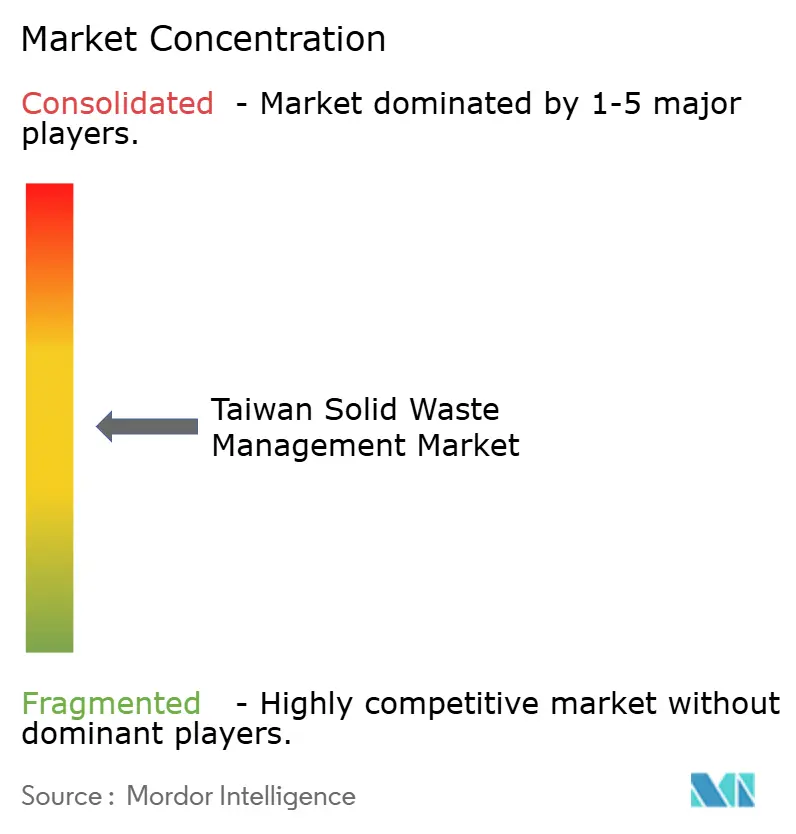
| Market Concentration | Medium |
Major Players *Disclaimer: Major Players sorted in no particular order Image © Mordor Intelligence. Reuse requires attribution under CC BY 4.0. | |
Taiwan Solid Waste Management Market Analysis by Mordor Intelligence
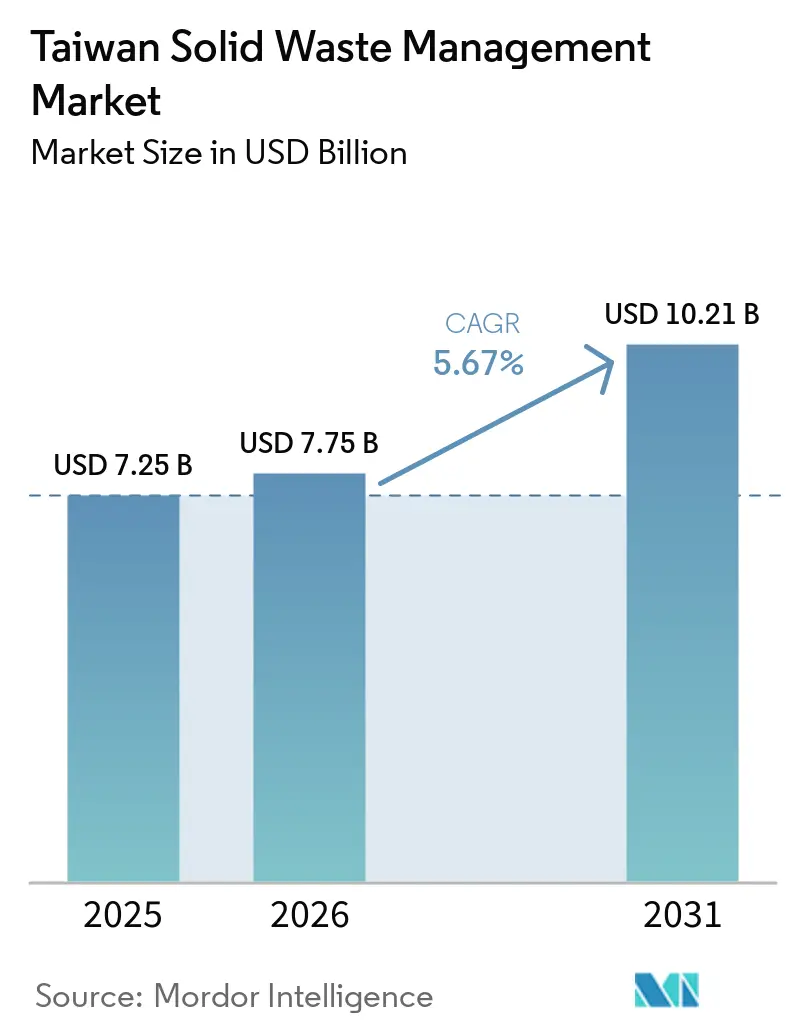
The Taiwan Solid Waste Management Market size is projected to expand from USD 7.25 billion in 2025 and USD 7.75 billion in 2026 to USD 10.21 billion by 2031, registering a CAGR of 5.67% between 2026 to 2031.
The Taiwan solid waste management market is shaped by tighter resource-circulation regulations, rising semiconductor manufacturing activity, and expanding use of digital systems in collection and sorting. The Resource Circulation Promotion Act took effect in June 2026 and extends policy attention from waste handling to product design, source reduction, sustainable consumption, and product life-cycle management. Taiwan’s 4-in-1 Recycling Program continues to link households, local governments, recycling operators, and the Recycling Fund through a single, established collection system. This structure supports the Taiwan solid waste management market by providing a clearer route for regulated materials from collection to recovery. Semiconductor plants are increasing the need for licensed treatment of chemical sludge, fluoride-containing wastewater, and other industrial residues. Operators offering end-to-end collection, treatment, recovery, and compliance reporting are preferred by semiconductor and industrial clients who require a single licensed partner across the waste service chain.
Key Report Takeaways
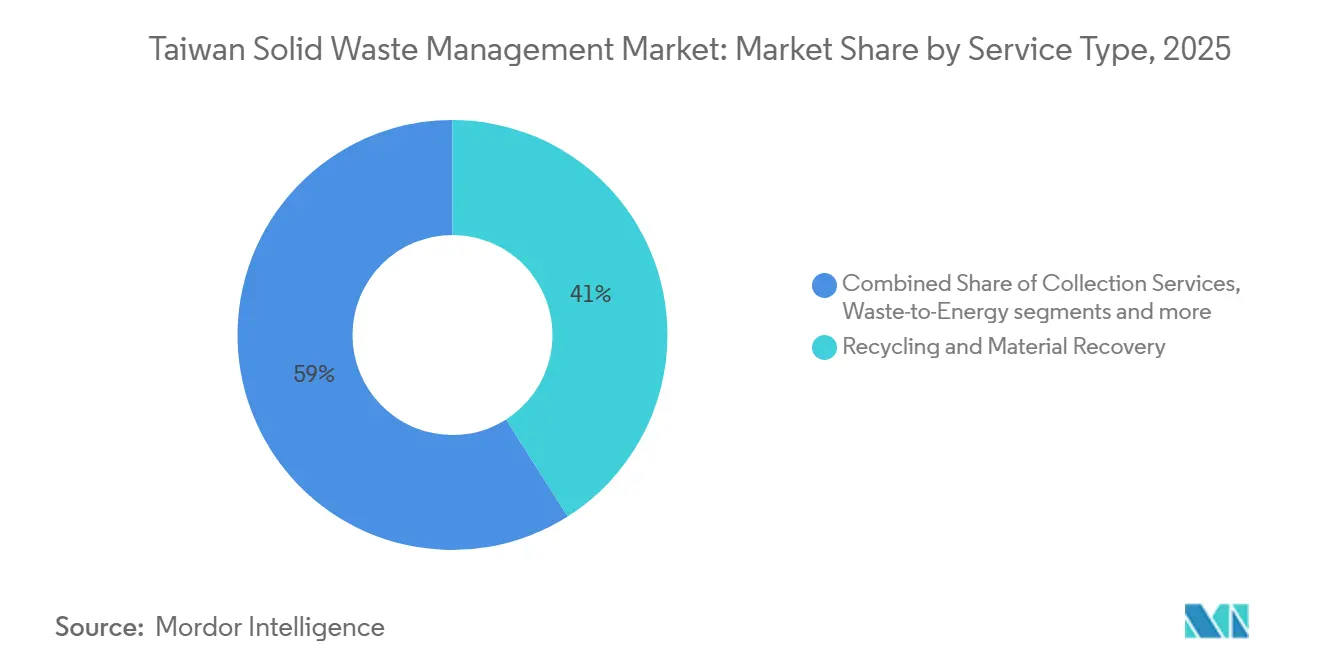
- By service type, recycling & material recovery accounted for 41% of the Taiwan solid waste management market size in 2025, while waste-to-energy is forecast to expand at a 7.8% CAGR through 2031.
- By waste type, industrial waste held 39.4% of the Taiwan solid waste management market share in 2025, while hazardous waste is forecast to expand at an 8.5% CAGR through 2031.
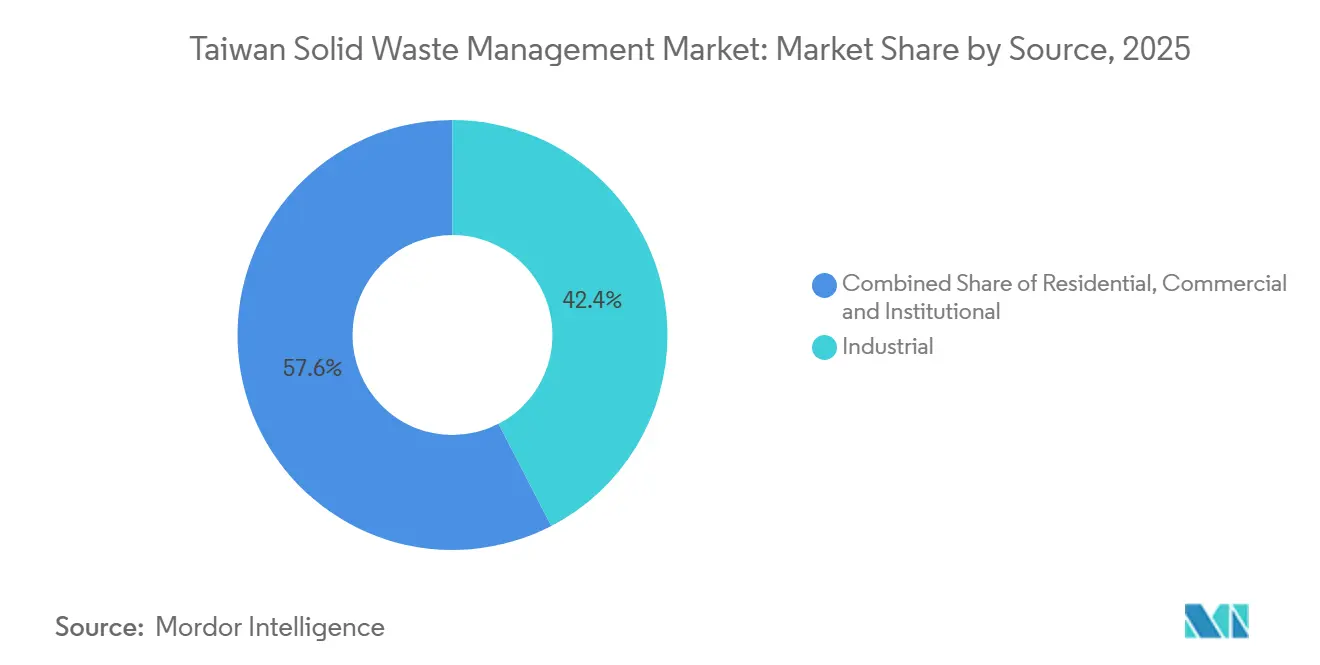
- By source, the industrial sector accounted for 42.4% of the Taiwan solid waste management market size in 2025 and is forecast to expand at a 7.1% CAGR through 2031.
Note: Market size and forecast figures in this report are generated using Mordor Intelligence’s proprietary estimation framework, updated with the latest available data and insights as of January 2026.
Taiwan Solid Waste Management Market Trends and Insights
Drivers Impact Analysis*
| Driver | (~) % Impact on CAGR Forecast | Geographic Relevance | Impact Timeline |
|---|---|---|---|
| 4-in-1 Recycling Program Strengthening Producer–Recycler Collaboration | +1.3% | National, with concentrated effects in northern and central urban centers | Long term (≥ 4 years) |
| Pay-As-You-Throw (PAYT) Waste Collection Model Improving Waste Reduction Performance | +1.1% | National, with the highest adoption in Taipei, New Taipei, and Taichung | Medium term (2-4 years) |
| Semiconductor Manufacturing Expansion Increasing High-Purity Industrial Waste Treatment Demand | +0.9% | Hsinchu, Taichung, and Tainan science park clusters, with spillover to Kaohsiung | Short term (≤ 2 years) |
| Mandatory Resource Recycling Fund: Accelerating Collection of Regulated Recyclables | +0.8% | National | Long term (≥ 4 years) |
| Growing Offshore Wind Supply Chain Driving Composite and Industrial Waste Processing | +0.7% | Changhua, Yunlin, and Miaoli coastal counties, with spillover to Kaohsiung port | Medium term (2-4 years) |
| AI-Enabled Smart Recycling Stations Enhancing Urban Waste Recovery Efficiency | +0.5% | New Taipei, Taipei, and Hsinchu | Short term (≤ 2 years) |
| Source: Mordor Intelligence | |||
4-in-1 Recycling Program Strengthening Producer-Recycler Collaboration
Taiwan’s 4-in-1 Recycling Program assigns distinct responsibilities to households, recycling enterprises, the Recycling Fund, and government agencies. The arrangement gives the Taiwan solid waste management market a stable framework for household collection and material recovery. The Recycling Fund Management Board sets fees for regulated categories of recyclables and provides subsidies to qualified collectors and recyclers.[1] These payments help licensed processors manage changes in secondary-material prices. In January 2025, the Ministry of Environment introduced lower recycling and disposal fees for plastic containers that contain at least 25% recycled content or have green design features under the 3S1R framework. [2] The measure links product design choices to demand for recovered materials and supports processors that meet environmental and safety requirements.
Pay-As-You-Throw Waste Collection Model Improving Waste Reduction Performance
Pay-As-You-Throw programs in Taipei, New Taipei, and Taichung make disposal costs more visible to households.[3] Research on New Taipei City found that the program reduced solid waste quantities during its first full implementation period and increased food-waste separation. The model encourages households to reduce waste and separate recyclable materials more carefully. Better separation can improve material quality for downstream recovery facilities. Taipei’s recycling rate rose from 2% to 57% after implementation, while per capita waste generation fell from 1.26 kg per person per day in 1997 to 0.87 kg by 2015. The Taiwan solid waste management market benefits when cleaner input materials reduce sorting and pretreatment needs for licensed operators.
Semiconductor Manufacturing Expansion Increasing High-Purity Industrial Waste Treatment Demand
Semiconductor manufacturing is increasing demand for specialized industrial and hazardous waste services in the Taiwan solid waste management market. Semiconductor waste generation has nearly doubled globally over the past eight years, and Taiwan accounts for a significant share of advanced logic chip manufacturing. Advanced fabrication produces chemical mechanical polishing sludge, fluoride-bearing wastewater, spent solvents, photoresist residues, and metal-bearing process wastes that require specialized treatment, recycling, and recovery technologies beyond conventional industrial waste handling. As semiconductor production capacity expands, chipmakers are increasingly relying on a combination of on-site resource recovery and licensed third-party waste management providers to manage complex residual waste streams under long-term service agreements. This trend is driving investment in high-value hazardous waste treatment and resource recovery infrastructure.
Mandatory Resource Recycling Fund: Accelerating Collection of Regulated Recyclables
The Recycling Fund Management Board converts producer-paid fees into support for licensed recyclable-waste collection and processing. Taiwan’s regulations on responsible enterprises managing regulated recyclable waste were revised in December 2024, with implementation continuing through 2025 as producers and recycling operators adapted to the updated compliance and reporting requirements. In 2025, the Environmental Management Administration continued using the Recycling Fund to subsidize registered collectors and recyclers, strengthen audit and inspection programs, expand public recycling awareness campaigns, and support improvements in recycling infrastructure. The system uses material-specific funds and dedicated resources for education, auditing, and grants. It allows collection support to differ by material type. This is particularly important for low-value materials that might not be collected consistently under commodity-price conditions alone. The Taiwan solid waste management market, therefore, benefits from a stable funding mechanism that helps maintain regulated collection and recycling performance even when recovered-material prices weaken.
Restraints Impact Analysis*
| Restraint | (~) % Impact on CAGR Forecast | Geographic Relevance | Impact Timeline |
|---|---|---|---|
| Limited Incinerator Expansion Due to Strict Air Quality Regulations | -0.6% | National, with the greatest pressure in northern and southern urban areas | Long term (≥ 4 years) |
| High Treatment Costs for Semiconductor Sludge and Hazardous Industrial Residues | -0.5% | Hsinchu, Taichung, and Tainan science park clusters | Short term (≤ 2 years) |
| Land Constraints Restricting the Development of New Waste Processing Facilities | -0.4% | National, with the greatest pressure in Taipei, New Taipei, and metropolitan areas | Long term (≥ 4 years) |
| Dependence on Export Markets for Selected Recovered Material Streams | -0.3% | National, with exposure through Kaohsiung and Keelung ports | Medium term (2-4 years) |
| Source: Mordor Intelligence | |||
Limited Incinerator Expansion Due to Strict Air Quality Regulations
Taiwan operates 25 large-scale municipal solid waste incineration plants with a combined annual treatment capacity of approximately 6.5 million tons, making waste-to-energy a core component of the country's waste management system. However, opportunities for constructing new facilities remain limited due to stringent air-quality regulations, land-acquisition constraints, and strong public opposition to new incinerator siting. The Air Pollution Control Program targets an annual average PM2.5 concentration of 13.0 μg/m³ by 2027, increasing the regulatory burden on thermal treatment facilities. In January 2025, the Ministry of Environment strengthened operating requirements for Solid Recovered Fuel (SRF) facilities by introducing continuous automated monitoring of dioxin indicators and tighter emissions oversight. At the same time, modernization of existing infrastructure continued, with 17 incineration plants undergoing upgrade programs that are expected to increase annual treatment capacity by approximately 330,000 tons while improving energy efficiency and emissions performance. As a result, capital investment in 2025 remained focused on retrofitting existing waste-to-energy assets, expanding mechanical-biological treatment and anaerobic digestion facilities, and improving resource recovery rather than developing new large-scale incinerators.
High Treatment Costs for Semiconductor Sludge and Hazardous Industrial Residues
Semiconductor residue treatment requires dedicated equipment and certified operating practices. The Ministry of Environment revised the water pollution control fee rules in April 2025 to include substances such as zinc, tin, and ammonia nitrogen. The revised fees apply from 2026 with increases scheduled over 6 years. The change affects businesses in semiconductor fabrication, printed circuit board production, and electroplating. TSMC’s Taichung center illustrates how integrated recovery can convert selected fabrication residues into reusable industrial inputs. Smaller manufacturers and upstream suppliers without comparable systems depend more heavily on certified external treatment providers. The Taiwan solid waste management market consequently favors operators with infrastructure suited to high-purity industrial residues.
*Our forecasts treat driver/restraint impacts as directional, not additive. The impact forecasts reflect baseline growth, mix effects, and variable interactions.
Segment Analysis
By Service Type: Recycling and Material Recovery Anchors the Market, Waste-to-Energy Expands Fastest
Recycling and Material Recovery accounted for 41% of Taiwan's solid waste management market in 2025. The segment relies on the 4-in-1 program, Recycling Fund support, and longstanding source-separation practices. Licensed enterprises process regulated recyclables under material-specific fund categories. The structure provides more stable conditions than reliance on recovered-material prices alone. It also creates regular demand for collection, sorting, and material-processing services. Regulatory collection obligations and product stewardship requirements support the Taiwan solid waste management market size for this service group. The 2025 green-fee measure for selected plastic containers reinforces demand for recycled content and green design. Operators that meet licensing and environmental standards are positioned to receive fund-supported business. The service category also connects municipal collection networks with industrial buyers of recovered materials.
Waste-to-Energy is the fastest-growing service category, forecast to expand at a 7.8% CAGR from 2026 to 2031. Taiwan’s incineration facilities generated 3.3 billion kWh of electricity and processed material through a national network of 25 large plants. Upgrades at 17 plants show that existing asset renewal is important for capacity and operating performance. Collection Services, Transportation, and Logistics remain essential parts of the service chain. These activities increasingly use vehicle tracking and route-planning tools. Treatment and Disposal include intermediate processing and the handling of hazardous waste. REMONDIS Taiwan identifies cement solidification as a method used for heavy-metal sludge at permitted facilities. Other services include battery recycling, medical waste treatment, and composite-material recovery. Recovery of high-value metals and chemicals from semiconductor waste is bringing treatment and recovery activities closer together.

By Waste Type: Industrial Waste Leads, Hazardous Waste Has the Fastest Growth
Industrial Waste accounted for 39.4% of Taiwan's solid waste management market in 2025. Taiwan’s semiconductor supply chain includes wafer fabrication, advanced packaging, equipment production, and chemical supply. These activities generate chemical mechanical polishing slurry, solvents, and fluoride-containing sludge. The range of residues calls for permitted collection, transport, treatment, and recovery services. Semiconductor waste generation has increased faster than additions in licensed treatment capacity. This supports the ongoing demand for qualified industrial waste operators. The Taiwan solid waste management market share held by Industrial Waste reflects the country’s concentrated high-technology manufacturing base. Industrial waste volumes are concentrated around Hsinchu, Taichung, Tainan, and Kaohsiung. This concentration supports dense collection and transfer networks around science parks and industrial zones.
Hazardous Waste is the fastest-growing waste type and is forecast to expand at an 8.5% CAGR from 2026 to 2031. Advanced semiconductor production generates complex residues that standard industrial waste infrastructure cannot always process. PFAS-bearing photoresist streams and multi-metal polishing sludge need specialized treatment systems. The Taichung Zero Waste Manufacturing Center processes acids, fluoride compounds, and metals from chip fabrication. Municipal Solid Waste remains important even though Pay-As-You-Throw and mandatory recycling have reduced per capita waste generation. Construction and Demolition Waste has become a policy concern due to limited disposal capacity. Agricultural and Medical Waste are smaller streams with separate handling requirements. Medical waste continues to require thermal treatment by licensed facilities. The Taiwan solid waste management market size for specialized treatment is therefore influenced by both industrial chemistry and municipal waste volumes.
By Source: Manufacturing Activity Strengthened Industrial Waste Management Demand
Industrial sources accounted for 42.4% of the Taiwan solid waste management market size in 2025 and are forecast to expand at a 7.1% CAGR from 2026 to 2031. Semiconductor and electronics plants generate regulated residues with varied chemical properties. Offshore wind component manufacturing and precision machinery production add industrial waste streams with their own treatment needs. Type-A licenses are important for operators handling hazardous, regulated, and resource-grade residues. Major industrial waste volumes are concentrated in Hsinchu, Taichung, Tainan, and Kaohsiung. This geographic pattern rewards firms that can operate collection and transfer systems close to manufacturing sites. The Taiwan solid waste management market share held by industrial sources is therefore linked to manufacturing density and compliance requirements. Industrial customers also need reliable treatment capacity for residues that ordinary municipal systems cannot handle. Integrated service providers can combine physical treatment with reporting and documentation for these customers.
Residential sources are shaped by sorting compliance, fixed collection times, and Pay-As-You-Throw pricing. These measures support source separation and reduce mixed-waste volumes. Commercial sources are changing as food service, e-commerce packaging, and hospitality operations generate more recyclable materials. Commercial users are also requesting recycling records and waste data to support sustainability reporting. Institutional sources include government buildings, hospitals, and education facilities. These sources can generate regulated medical and laboratory waste. Such materials require treatment routes that differ from ordinary commercial waste. The Taiwan solid waste management market continues to require collection systems that distinguish source types before treatment. Larger operators are developing tracking and reporting services alongside their physical collection and processing activities.
Geography Analysis
Taiwan's island geography limits landfill expansion and concentrates pressure on recovery, treatment, and disposal infrastructure. The country's incineration network processes approximately 6.5 million tons of waste annually and generates around 3.3 billion kWh of electricity. Rapid growth in semiconductor manufacturing, offshore wind development, and urban construction continues to increase demand for treatment and recycling capacity, particularly for industrial and construction waste streams. Limited disposal capacity encourages greater investment in material recovery, recycling, and permitted treatment facilities, supporting growth in the Taiwan solid waste management market.
Northern Taiwan contains the Taipei, New Taipei, and Keelung metropolitan corridor, as well as the Hsinchu Science Park cluster. Hsinchu’s semiconductor, display, and precision-equipment base creates demand for high-value hazardous-waste treatment. New Taipei has developed AI-enabled sorting capacity through a material recovery facility. Its first AI facility processes 12,000 tons annually and sorts 17 material categories with 97% accuracy. The city’s second AI material recovery facility in Xinzhuang is expected to operate by the end of 2026. Central Taiwan includes the Taichung Science Park, while southern Taiwan includes Kaohsiung’s industrial and port area.
Coastal Changhua, Yunlin, and Miaoli are becoming important locations for wind-related industrial waste. Taiwan’s offshore wind capacity reached 4.8 GW after the installation of its 500th turbine in June 2026. Kaohsiung and Taichung provide port links for this supply chain. Turbine blades, nacelles, substations, and other components will require specialized end-of-life processing as installations age. Swancor is developing a recyclable epoxy resin and chemical recycling methods with Siemens Gamesa and RWE. The Taiwan solid waste management market benefits from these new recovery needs in coastal industrial areas. Existing facilities were largely designed for municipal and conventional industrial materials. Composite waste recovery introduces a distinct technical requirement for the coastal processing base.
Competitive Landscape
The Taiwan solid waste management market exhibits a medium level of market concentration. Long-duration BOT and ROT structures create clear barriers in waste-to-energy and large treatment assets, because new entrants need capital, technical track record, and local government access to compete for contracts that often run 20 to 25 years. ECOVE is one of the clearest examples of scale, operating 11 resource recovery centers in Taiwan and 2 in Macau, giving it a strong base in large-scale treatment and circular service operations. This concentration is reinforced by the fact that advanced treatment assets are now expected to provide not only disposal, but also energy recovery, environmental reporting, and industrial circularity services. Veolia’s Taiwan Cement joint venture in Yilan shows that foreign-affiliated players can participate, but usually through partnership structures and concession-based entry rather than broad standalone expansion.
Competitive strategy is shifting away from simple disposal scale and toward technology-backed breadth of services. JFE Engineering’s equipment order for the same Chiayi project also shows that international engineering partners still see Taiwan as a credible destination for high-specification waste-to-energy investment. Taichung’s Wenshan BOT renovation adds another example of modernization being used to boost efficiency and reduce pollutants, rather than merely extending the life of existing capacity. These moves point to a Taiwan solid waste management market in which incumbents compete on compliance depth, engineering capabilities, digital operations, and the ability to serve industrial clients with more demanding reporting needs.
Emerging opportunities exist in food-waste carbon projects, lithium-battery recycling, solar panel and wind-turbine blade end-of-life management, and asbestos-related disposal services. The April 2026 legal amendments expand the regulatory scope for several of these waste streams, while the innovation experiment sandbox under the Resource Circulation Promotion Act lowers barriers to testing differentiated service models within the formal waste management system. As local collection remains fragmented and treatment infrastructure requires significant capital investment, partnerships between municipal contractors, niche recyclers, and licensed treatment operators are expected to remain a primary route to market expansion. Overall, the Taiwan solid waste management market remains competitive in routine collection and service contracts, while ownership of treatment infrastructure, long-term concessions, and hazardous waste processing capabilities provides larger operators with durable competitive advantages.
Taiwan Solid Waste Management Industry Leaders
-
Cleanaway Company Limited (Taiwan)
-
CTCI Resource Engineering Corporation
-
ECOVE Environment Corporation
-
Taiwan Environmental Scientific Co., Ltd.
-
Sunny Friend Environmental Technology Co., Ltd.
- *Disclaimer: Major Players sorted in no particular order
Recent Industry Developments
- June 2026: Taiwan enacted the Resource Circulation Promotion Act, replacing the former Resource Recycling Act, extending producer responsibility upstream to green product design, source reduction, sustainable consumption, and full product-lifecycle management. The Act creates long-term structural demand for material recovery and reverse logistics operators with EPR compliance capabilities.
- January 2025: MOENV introduced discounted EPR recycling and disposal fees for plastic containers incorporating ≥25% recycled content or meeting green design standards under the 3S1R framework, targeting a 24,000-tonne annual increase in recycled material usage and projected carbon reduction of 48,000 tonnes.
Taiwan Solid Waste Management Market Report Scope
The Taiwan Solid Waste Management Market is Segmented by Service Type (Collection Services, Transportation & Logistics, Recycling & Material Recovery, Treatment & Disposal, Waste-To-Energy, Others), by Waste Type (Municipal Solid Waste, Industrial Waste, Hazardous Waste, Agricultural Waste, and More), by Source (Residential, Commercial, Industrial, and Institutional). The Market Forecasts are Provided in Terms of Value (USD).
| Collection Services |
| Transportation & Logistics |
| Recycling & Material Recovery |
| Treatment & Disposal |
| Waste-to-Energy |
| Others |
| Municipal Solid Waste |
| Industrial Waste |
| Hazardous Waste |
| Construction & Demolition Waste |
| Agricultural Waste |
| Medical Waste |
| Others |
| Residential |
| Commercial |
| Industrial |
| Institutional |
| By Service Type | Collection Services |
| Transportation & Logistics | |
| Recycling & Material Recovery | |
| Treatment & Disposal | |
| Waste-to-Energy | |
| Others | |
| By Waste Type | Municipal Solid Waste |
| Industrial Waste | |
| Hazardous Waste | |
| Construction & Demolition Waste | |
| Agricultural Waste | |
| Medical Waste | |
| Others | |
| By Source | Residential |
| Commercial | |
| Industrial | |
| Institutional |
Key Questions Answered in the Report
What is the projected value of Taiwan solid waste management by 2031?
The Taiwan solid waste management market is forecast to reach USD 10.21 billion by 2031, from USD 7.75 billion in 2026, at a 5.67% CAGR.
Which service category leads Taiwan solid waste management?
Recycling and Material Recovery was the largest service category in 2025, supported by the 4-in-1 program and Recycling Fund mechanisms.
Why is hazardous waste treatment growing in Taiwan?
Advanced semiconductor manufacturing produces complex chemical residues that require specialized treatment and recovery services.
How does Pay-As-You-Throw affect waste collection in Taiwan?
The system encourages reduction and source separation, thereby improving the quality of recyclable materials for recovery operations.
What limits new waste-to-energy capacity in Taiwan?
Air-quality requirements, land constraints, environmental review, and local siting concerns limit the development of new incinerators.
Which areas create the highest industrial waste demand?
Hsinchu, Taichung, Tainan, and Kaohsiung generate substantial demand because they concentrate semiconductor and other industrial activity.