
Market Overview
| Study Period | 2020 - 2031 |
|---|---|
| Forecast Data Period | 2026 - 2031 |
| Base Year Market Size (2025) | USD 1.34 Billion |
| Market Size (2026) | USD 1.4 Billion |
| Market Size (2031) | USD 1.73 Billion |
| Growth Rate (2026 - 2031) | 4.35 % |
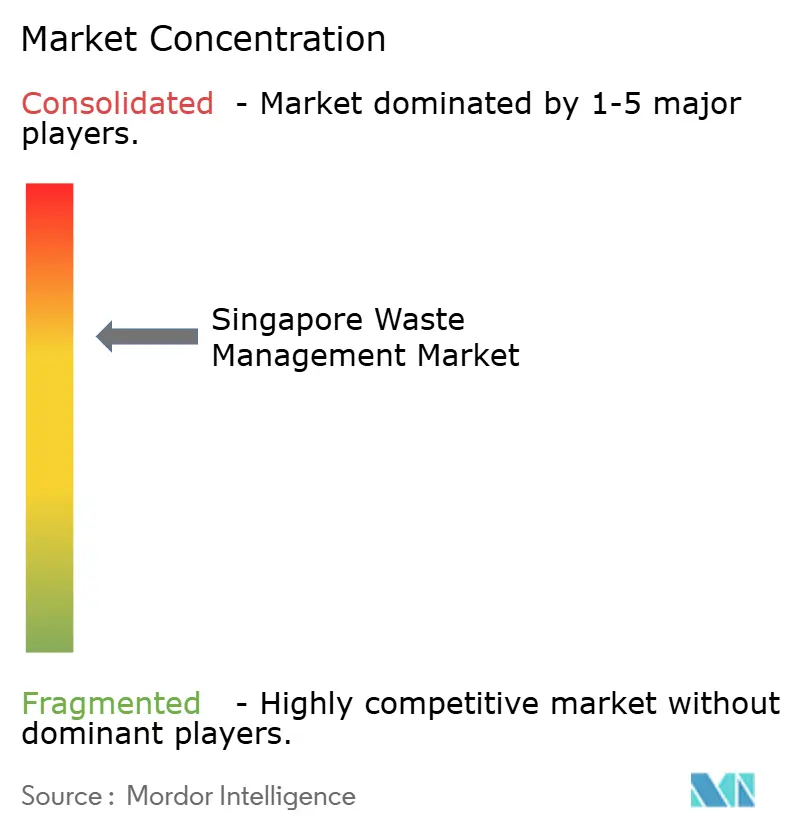
| Market Concentration | Medium |
Major Players *Disclaimer: Major Players sorted in no particular order Image © Mordor Intelligence. Reuse requires attribution under CC BY 4.0. | |
Singapore Waste Management Market Analysis by Mordor Intelligence
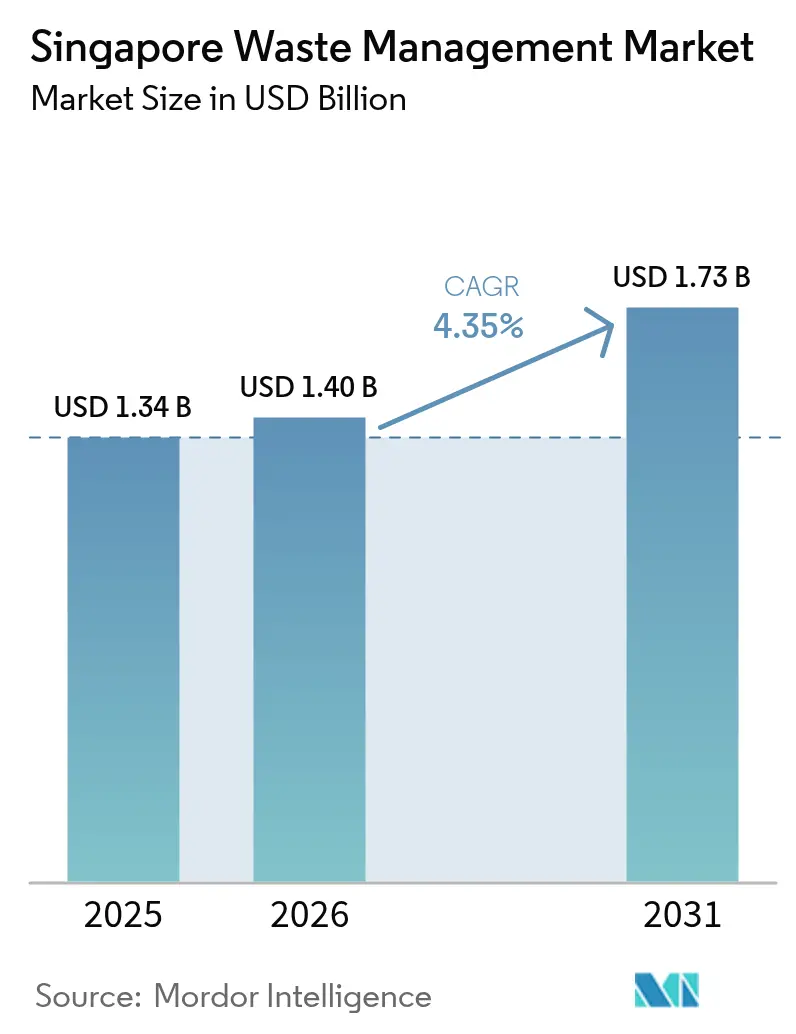
The Singapore Waste Management Market size is expected to grow from USD 1.34 billion in 2025 to USD 1.4 billion in 2026 and is forecast to reach USD 1.73 billion by 2031 at 4.35% CAGR over 2026-2031. This steady expansion reflects Singapore’s pivot toward circular-economy practices that prize material recovery over disposal. Tight land availability reinforces investment in waste-to-energy (WTE) assets, while the Resource Sustainability Act (RSA) and the Zero-Waste Masterplan create compulsory demand for recycling capacity across food, packaging, and electronic waste streams. Private operators gain ground as public agencies outsource specialized services, and national hydrogen ambitions underpin research into waste-derived fuels. Rising operating costs, fuel, labor, and carbon taxes are nudging the market toward automation, data-driven route optimization, and integrated processing complexes[1].
Key Report Takeaways
- By source, residential waste retained 39.12% of Singapore's waste management market share in 2025; commercial waste is the fastest-growing source at a 6.31% CAGR through 2031.
- By service type, collection, transport, and sorting held 47.15% revenue share in 2025, while recycling and resource recovery are projected to advance at a 6.42% CAGR to 2031.
- By waste type, municipal solid waste led with 26.10% share of the Singapore waste management market size in 2025, and e-waste is forecast to expand at a 5.32% CAGR through 2031.
- By contract model, public agreements accounted for a 73.05% share in 2025; private contracts are projected to grow at a 5.04% CAGR over the same period.
Note: Market size and forecast figures in this report are generated using Mordor Intelligence’s proprietary estimation framework, updated with the latest available data and insights as of 2026.
Market Trends and Insights
Drivers Impact Analysis of Singapore Waste Management Market*
| Driver | (~) % Impact on CAGR Forecast | Geographic Relevance | Impact Timeline |
|---|---|---|---|
| Zero-Waste Masterplan and circular-economy mandates | +1.2% | National | Long term (≥ 4 years) |
| Limited landfill capacity that accelerates incineration and recycling | +1.0% | National | Long term (≥ 4 years) |
| Mandatory Extended Producer Responsibility schemes | +0.8% | National | Medium term (2-4 years) |
| NEA incentive grants that expand private recycling capacity | +0.6% | National | Medium term (2-4 years) |
| Deployment momentum of pneumatic waste conveyance systems | +0.4% | Urban districts | Short term (≤ 2 years) |
| Tuas Nexus waste-to-hydrogen pilot projects | +0.3% | Tuas Industrial Zone | Long term (≥ 4 years) |
| Source: Mordor Intelligence | |||
Zero-Waste Masterplan and Circular-Economy Mandates
The Zero-Waste Masterplan sets a mandatory 70% national recycling rate and orders a 30% cut in landfill waste by 2030, reshaping the cash-flow logic of the Singapore waste management market. Three priority streams, e-waste, food waste, and packaging, together generate more than 40% of total waste, so compliance drives demand for sorting, composting, and advanced recycling kits. The RSA makes food-waste segregation compulsory for large premises from 2024, funneling business toward on-site digesters and bio-pulpers. A new build must now reserve space for such equipment, guaranteeing pipeline projects for technology vendors. Revenue predictability rises because enforcement includes mandatory monthly reporting and escalating penalties. Operators that supply integrated WTE and water recovery, as seen in the Tuas Nexus concept, sit in the policy sweet spot[2].
Limited Landfill Capacity Driving Incineration and Recycling Demand
Semakau Landfill may reach its design limit by 2035, so the island republic must divert waste or miniaturize it. Four WTE plants currently vaporize 3.8 million t annually and supply 2% of the grid, while the 2021-commissioned TuasOne unit processes 3,600 t per day and delivers 120 MW to the network. The coming Integrated Waste Management Facility (IWMF) at Tuas Nexus will be able to handle 5,800 t per day, becoming the largest single waste complex worldwide. Each incremental tonne incinerated frees scarce land, so feedstock certainty underwrites private-sector appetite for long-term build-operate-transfer deals.
Mandatory Extended Producer Responsibility Schemes
EPR now shifts disposal fees from taxpayers to manufacturers. Since 2021, the e-waste plan has enabled licensed Producer Responsibility Organizations to process 22,300 t of gadgets by September 2024, underpinning new collection routes and treatment plants. A beverage-container return program goes live in 2025 with a USD 0.07 deposit that targets an 80% take-back rate. Packaging EPR follows in stages through 2025, forcing large users to file Reduce-Reuse-Recycle plans. The approach secures long-term service contracts for recyclers, attracts project finance for plastics sorting lines, and telegraphs a stable revenue model that multinational players favor. Singapore’s early EPR adoption also gives local firms a reference track record for export consulting across Southeast Asia.
NEA Incentive Grants Accelerating Private-Sector Recycling Capacity
Grants lower financial barriers for new entrants. The 3R Fund reimburses up to USD 0.74 million (80% of project value) for novel waste-reduction pilots, and the Food Waste Fund subsidizes on-site digesters up to USD 74,000 per applicant. Several chemical-recycling start-ups rely on the Closing the Waste Loop program to prove technology readiness. Because co-funding neutralizes first-loss risk, small and medium enterprises can move into niches like optical sorting, anaerobic digestion, or plastics pyrolysis. A competitive grant cycle also shortens the time from lab prototype to commercial plant, pulling innovation into the mainstream of the Singapore waste management market.
Restraints Impact Analysis of Singapore Waste Management Market*
| Restraint | (~) % Impact on CAGR Forecast | Geographic Relevance | Impact Timeline |
|---|---|---|---|
| Scarcity of land for new facilities | -0.9% | National | Long term (≥ 4 years) |
| High capital expenditure of advanced treatment assets | -0.7% | National | Medium term (2-4 years) |
| Rising operating costs from labor, fuel, and carbon taxes | -0.6% | National | Short term (≤ 2 years) |
| Volatile recyclables prices in a small domestic market | -0.4% | National | Short term (≤ 2 years) |
| Source: Mordor Intelligence | |||
Scarcity of Land for New Facilities
Competing land uses raise opportunity costs, and only a handful of industrial plots remain zoned for odorous or potentially hazardous activities. Multi-story or subterranean designs can compress footprints but raise capex and O&M intricacy. Operators must design for higher throughput in the same envelope, which in turn raises technology risk and insurance premiums. Recycling centers need lay-down yards for baled goods, yet affordable space near collection zones is scarce, limiting new entrants.
High Capital Expenditure of Advanced Treatment Assets
Modern incinerators and chemical recyclers cost hundreds of millions of dollars to build, which narrows the field to firms with deep balance sheets or sovereign backing. TuasOne exceeded USD 740 million for a 3,600 t-per-day line, and the IWMF rings in above USD 3.7 billion. Smaller companies struggle to raise that scale of debt, and protracted permitting rounds stretch payback periods. Public-private partnerships defray risk but add complexity and extend tender cycles, slowing innovation adoption in the Singapore waste management market.
*Our forecasts treat driver/restraint impacts as directional, not additive. The impact forecasts reflect baseline growth, mix effects, and variable interactions.
Singapore Waste Management Market Segment Analysis
By Source:
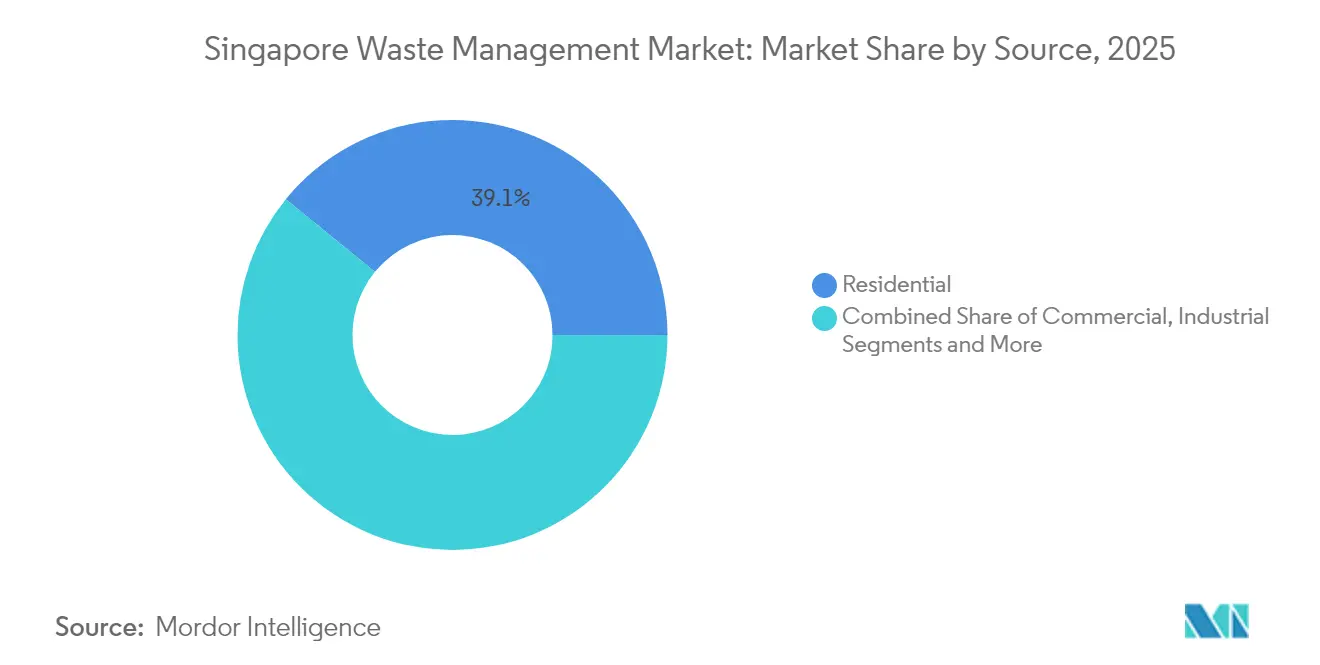
Residential Waste Dominates, Commercial Waste AcceleratesResidential streams captured a commanding 39.12% share of the Singapore waste management market in 2025 as Housing Development Board estates and condominiums generated steady daily tonnage. Commercial waste is the fastest riser, expanding at a 6.31% CAGR on the back of RSA-mandated food-waste segregation, electronics take-back kiosks, and green-lease requirements that compel malls to file waste-reduction plans. The residential backbone ensures base-load demand for public-sector collection routes, yet private haulers now court hotels and business parks with pay-as-you-throw schemes that bundle composters and real-time bin-level sensors.
Growth in the commercial slice also reflects aggressive service diversification. Chain eateries have begun installing 2 t-per-day digesters sourced from local start-ups such as Westcom Bio-Chem, shrinking disposal volumes at source. Office towers adopt Bluetooth-enabled compactors to unlock data that feeds ESG dashboards. Because these innovations go beyond traditional curbside pickup, operators secure higher-margin contracts that underpin the future value of the Singapore waste management market.

By Service Type:
Collection Rules Revenue, Resource Recovery Leads GrowthCollection, transport, and sorting still represent 47.15% of 2025 revenue, embodying the logistics backbone of the Singapore waste management market. Trucks make short urban hops to transfer stations, supported by Telematics that cut idle time. Yet the recycling and resource-recovery cluster is on a 6.42% CAGR trajectory through 2031. One example is REMEX’s bottom-ash processing plant that recovers 90% of ferrous metals from incinerator ash, monetizing an otherwise wasted stream.
Technology upgrades lift margins in recycling. Shell’s new pyrolysis oil upgrader turns 50,000 t of hard-to-recycle plastics into cracker feedstock at Pulau Bukom, signaling how resource recovery will dominate incremental dollar value. These moves reposition Singapore as a regional node for high-value circular materials, and they embed the Singapore waste management market size into the petrochemical supply chain.
By Waste Type:
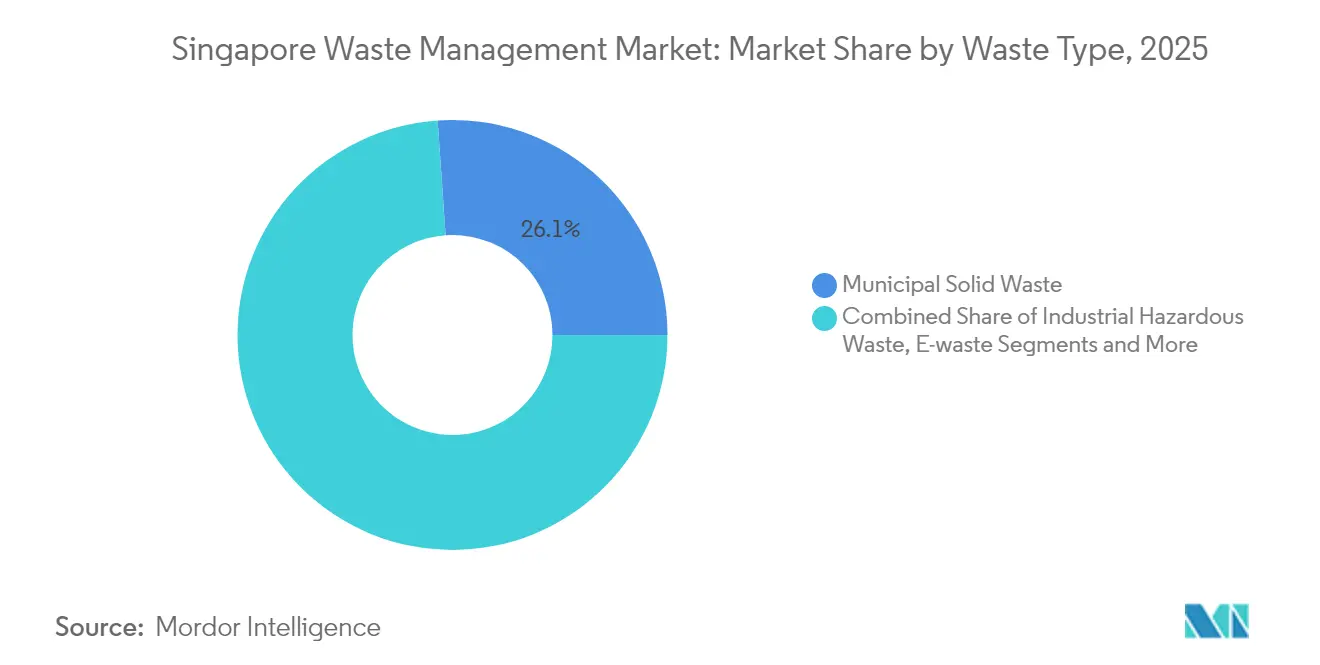
Municipal Solid Waste Leads, E-waste Picks Up PaceMunicipal solid waste retained 26.10% of the 2025 volume, giving it the largest slice of the Singapore waste management market. Households supply paper, plastics, and organics that flow into centralized bins under the National Recycling Program. E-waste is the clear growth leader at 5.32% CAGR. Extended Producer Responsibility and Alba’s doorstep bulky-item pick-ups, starting in 2025, add predictable tonnage. White-goods and IT peripherals now enter disassembly lines equipped with robotic arms that retrieve copper and precious metals.
Industry groups note that smartphones achieve more than 90% material recovery once manually pre-sorted, lifting the revenue per tonne above USD 800. In contrast, municipal mixed waste yields less than USD 30 per tonne after incineration. This divergence in value density underscores why e-waste will gradually tilt revenue mix away from bulk refuse within the Singapore waste management market.
By Contract Model:
Public Collectors Still Dominate, Private Deals AdvancePublic contracts, assigned to six sector monopolies via the NEA tender process, accounted for 73.05% market share in 2025. They ensure uniform service quality and city-wide coverage. Private arrangements, however, are growing 5.04% annually because industrial estates, shopping centers, and event venues can appoint any licensed General Waste Collector. Private service menus include on-site shredders, weighbridge integration into ERP systems, and carbon-offset packages.
The private surge benefits technology-first entrants who differentiate on data analytics and traceability. For example, Blue Planet Environmental deploys RFID-tagged bins that feed dashboards for corporate ESG disclosures. Coupled with favorable grant schemes, such features accelerate client conversion and dilute the concentration of the Singapore waste management market share held by legacy players.
Geography Analysis
Singapore’s entire nation acts as one integrated market, yet spatial waste patterns reflect land use clusters. High-rise residential zones around Tampines and Punggol create predictable household streams that anchor collection route density. Industrial belts in Jurong and Tuas discharge solvents, by-products, and scrap metals that require specialized transport permits. Tourist corridors downtown push retailers toward seven-day collection cycles to manage food residue amid dense foot traffic.
The Tuas industrial corridor houses WTE plants, ash treatment, and a new hydrogen pilot, turning the west of the island into a processing nucleus. Having core assets side by side slashes internal haulage and enables shared utilities like seawater intake and grid interconnection. That proximity sets Singapore apart from sprawling land-rich nations and binds the Singapore waste management market size tightly to a single logistics hub.
Regional logistics capabilities create export potential. The port handles 37 million TEUs annually, so backhaul routes can carry processed scrap to Indonesia or Vietnam, where metal smelters pay higher premiums. Nevertheless, strict transboundary waste controls limit raw refuse imports, ensuring domestic flows remain self-contained and traceable.
Regulatory Landscape
Singapore’s waste management regulation is anchored by the National Environment Agency (NEA) under the Environmental Public Health Act and the Resource Sustainability Act (RSA), with the Ministry of Sustainability and the Environment (MSE) setting overarching policy direction through the Zero Waste Masterplan. Regulatory tightening has increasingly targeted priority streams such as food, packaging, beverage containers, and e-waste, shifting compliance from general disposal requirements to circular-economy obligations (segregation, reporting, and producer responsibility).
From 8 March 2024, the RSA Food Waste Segregation, Treatment and Reporting Regulations require large food-waste generators to segregate and report, expanding demand for on-site and off-site treatment and audit-ready data capture. The Beverage Container Return Scheme was operationalized in 2026, with the Resource Sustainability (Beverage Container Return Scheme) Regulations 2026 setting deposit and marking requirements from 1 April 2026, and a prescribed compliance date of 1 October 2026 for return-related requirements under the Act. NEA also updated EPR implementation details via revised Producer Guidelines for e-waste dated 24 February 2026, refining scope thresholds and item categorization that influence collection-network design and downstream processing capacity planning.
Value Chain Analysis
The Singapore waste management value chain starts with waste generation across households, commercial premises, and industrial sites, followed by source segregation and collection by Public Waste Collectors (for zoned municipal streams) and licensed General Waste Collectors (for open-market commercial and industrial customers). Materials then move through transfer and sorting, including materials recovery for dry recyclables and specialized take-back channels under EPR for e-waste, while organics increasingly feed segregated treatment routes. For residual waste, incineration dominates through four operating waste-to-energy plants (TuasOne, Keppel Seghers Tuas, Tuas South Incineration Plant, and Senoko), with bottom ash and metals recovery feeding secondary materials markets.
Downstream processing is being shaped by integrated infrastructure and stream-specific regulation. The Tuas Nexus Integrated Waste Management Facility (IWMF), co-located with the Tuas Water Reclamation Plant, is designed to process 5,800 tonnes per day of incinerable waste, alongside dedicated capacity for household recyclables (250 tonnes per day), food waste (400 tonnes per day), and sludge (800 tonnes per day). Upstream quality controls also affect sorting economics, highlighted by the rollout of dedicated paper and cardboard collection services across all waste collection zones from December 2025 to reduce contamination. Regulatory cost signals flow through the chain as well, including the Environmental Public Health (General Waste Disposal Facility) (Amendment) Regulations 2024, which increased disposal facility license fees effective 1 January 2025, influencing pricing, contracting, and investment appetite for higher-value recovery routes.
Competitive Landscape
The field is moderately concentrated. SembWaste, Veolia Singapore, and ALBA W&H Smart City secure multiyear municipal concessions and invest in automated sorting lines. SembWaste co-owns WTE assets that provide baseload revenue, yet its parent plans a strategic refocus on renewables, hinting at potential divestments that could shift ownership patterns. Veolia applies global hazardous-waste know-how to win petrochemical contracts in Jurong Island.
Tech-led challengers are emerging. Magorium converts unrecyclable plastics into road-grade NEWBitumen and quadrupled output to 8 t per day in 2024. Westcom Bio-Chem installs modular digesters in food courts. Blue Planet installs AI vision systems that sort recyclables by polymer type at 4 t per hour. These niches carve out profitable lanes without directly colliding with incumbent residential collectors.
Foreign OEMs also play a role. Mitsubishi Heavy Industries runs TuasOne under a 25-year BOO concession, showcasing turnkey incinerator packages that include air-quality systems. Such deployments raise the technological bar, forcing smaller local players to ally with equipment vendors or risk obsolescence within the Singapore waste management market.
Singapore Waste Management Industry Leaders
-
SembWaste (Sembcorp)
-
Veolia Singapore
-
ALBA W&H Smart City
-
Colex Holdings Ltd.
-
800 Super Holdings
- *Disclaimer: Major Players sorted in no particular order
Singapore Waste Management Market Companies Covered in this Report
- SembWaste (Sembcorp)
- Veolia Singapore
- ALBA W&H Smart City
- Colex Holdings Ltd.
- 800 Super Holdings
- ECO Industrial Environmental Engineering
- Wah & Hua Pte Ltd.
- TES-AMM Singapore
- Ramky Cleantech Services
- Enviro-Hub Holdings
- Cleanway Disposal Services
- ChemCollect Services
- Envipure
- Rictec Pte Ltd.
- CH E-Recycling
- Indsutrial Wastes Auction
- Citic Envirotech
- IUT Global
- ENVAC Singapore
- Zero Waste SG (Services arm)
Market Opportunities and Future Outlook
Policy-driven source segregation and take-back programs are creating actionable whitespace in high-purity collection, sorting, and traceability solutions for packaging, beverage containers, food waste, and e-waste. The Beverage Container Return Scheme commencement in April 2026 adds a nationwide reverse-logistics layer (return points, counting, and auditing), while NEA’s updated e-waste Producer Guidelines (February 2026) sharpen operational requirements for operators with compliant collection networks and downstream processing partnerships. In parallel, the June 2026 MSE announcement of a comprehensive review of the 2019 Zero Waste Masterplan, prompted by a recycling-rate decline to 52% in 2025 (from 59% in 2019), points to an immediate need for cleaner segregated recyclables and tighter contamination control, supporting investments in technology-enabled sorting and upstream behavior-change programs.
Infrastructure and capability buildouts at Tuas also open a second opportunity cluster around integrated treatment and advanced residues management. NEA’s appointment of an AECOM, Binnies, and Ramboll joint venture in May 2026 for consultancy on Phase 2 of the IWMF at Tuas Nexus indicates a continuing pipeline for engineering, integration, and commissioning services across waste-to-energy, materials recovery, and organics treatment. In June 2026, NEA also launched TREASURES, a national research center focused on residue and toxic industrial waste management, reinforcing demand for specialized treatment pathways and compliance-grade analytics. Asset life extension in incineration is being formalized through retrofits, with NEA awarding Mitsubishi Heavy Industries Asia Pacific a contract (March 2026) to redesign and retrofit boilers at the Tuas South Incineration Plant to extend operations to 2035, creating scope for performance upgrades, emissions control packages, and operational optimization services within the existing plant fleet.
Recent Industry Developments in Singapore Waste Management Market
- June 2026: The National Environment Agency launched TREASURES, a national research center focused on residue and toxic industrial waste management. The initiative supports R&D and solution development for harder-to-treat waste streams, strengthening the specialist treatment segment alongside mainstream collection and incineration.
- October 2025: Veolia received Singapore’s first NEA license to treat firefighting foams containing PFAS using high-temperature thermal technology. The approval expands domestic capability for complex hazardous waste streams and positions licensed operators to capture regulated demand tied to PFAS disposal requirements.
- September 2025: Cora Environment (rebranded from SembWaste) announced a commitment of S$200 million over five years to expand waste-to-resource and recycling capabilities in Singapore. The investment points to a shift toward higher-value resource recovery and capability upgrades by a major incumbent servicing municipal and commercial waste flows.
Singapore Waste Management Market Report Scope and Research Methodology
Market Definition and Coverage
For this study, the market covers paid services and contracted activities used to collect, move, sort, treat, recycle, recover energy, and dispose of waste in Singapore, across municipal, commercial, and industrial generators.
Scope exclusions: We exclude informal or unpaid self-haul disposal by households and businesses, and we do not count the resale value of recovered materials as a separate market revenue line.
Segments Covered in This Report
- By Source
- Residential
- Commercial (retail, office, etc.)
- Industrial
- Medical (Health and Pharmaceutical)
- Construction & Demolition
- Others (institutional, agricultural, etc)
- By Service Type
- Collection, Transportation, Sorting & Segregation
- Disposal / Treatment
- Landfill
- Recycling & Resource Recovery
- Incineration & Waste-to-Energy
- Others (Chemical Treatment, Composting, etc.)
- Others (Consulting, Audit & Training, etc.)
- By Waste Type
- Municipal Solid Waste
- Industrial Hazardous Waste
- E-waste
- Plastic Waste
- Biomedical Waste
- Construction & Demolition Waste
- Agricultural Waste
- Other Specialized Waste (radio active, etc)
- By Contract Model
- Public
- Private
Data Sources, Market Sizing, and Validation
Desk Research
Desk work starts with aligning definitions to how waste flows through Singapore and how it is reported in public statistics. We used sources such as Singapore National Environment Agency waste and recycling statistics, Singapore Department of Statistics macro indicators, public tender and contract notices, and annual reports or sustainability disclosures of major operators and facility owners.
To make the model usable, we also tracked policy and compliance signals that change volumes and treatment mix, including Zero Waste Masterplan measures, Extended Producer Responsibility rules for e-waste, and updates on incineration, landfill, and recycling infrastructure. For selected cross-checks, we referenced paid subscriptions that compile company financials, tender awards, shipment-level trade indicators, and patent filings related to waste processing equipment. This list is not exhaustive, and many other public documents and data releases were reviewed to collect, validate, and clarify inputs.
Primary Interviews and Surveys
Primary discussions were done with operators, facility managers, collection and logistics stakeholders, and institutional waste generators to confirm service revenues, contract structures, and treatment routing. Inputs were also tested with domain experts familiar with Singapore regulations and infrastructure constraints so that assumptions on capacity use, pricing moves, and recycling participation were not left unchallenged across the full local value chain.
Distribution of primary research fieldwork respondents
| Company type | Respondent position |
|---|---|
| Top tier: 29% | CXOs: 13% |
| Mid tier: 53% | Functional/Unit leaders: 37% |
| Smaller Players: 18% | Managers: 50% |
Market-Sizing & Forecasting
Sizing starts with a top-down build where national waste generated and treated is reconstructed from official waste statistics, then split by treatment route and service type to form a realistic demand pool. From there, average service pricing is applied for key activities so the value output stays tied to observable volume and policy signals.
Several practical inputs are used to steer the model, such as annual waste generation by stream, recycling rate movements, incineration and landfill throughput, announced treatment and waste-to-energy capacity changes, and municipal versus commercial and industrial collection coverage. When any indicator moved sharply, it was checked against known drivers like enforcement changes, new facility commissioning, or shifts in construction and manufacturing activity.
Forecasts lean on scenario analysis supported by expert views on how fast recycling participation improves, how treatment capacity is utilized, and how unit pricing evolves under contracts. Results are then corroborated with selective bottom-up approximations, including sampled contract values, operator revenue disclosures, and sanity checks using implied price per ton by major treatment route, with gaps handled through conservative ranges that are narrowed after follow-up validation.
Data Validation & Update Cycle
Model outputs are cross-checked against independent signals such as reported waste handled, treatment capacity utilization direction, and observable changes in contract coverage and pricing. Variance checks are run at each step, and any outlier is reviewed in a second analyst pass before sign-off.
The report is refreshed annually, and interim updates are triggered when material events occur, such as new facility start-ups, major policy changes, or meaningful shifts in reported waste and recycling statistics. Before delivery, a final review is completed to ensure the latest public releases and confirmed expert feedback are reflected in the numbers.
Mordor Intelligence's Singapore Waste Management Market Size Compared Against Other Published Estimates
Published market values for Singapore waste management often differ because each publisher chooses its own scope, base year, and what it counts as market revenue, and then applies different pricing and volume assumptions.
Some external estimates appear to bundle broader environmental services or assign higher value capture to downstream recycling and treatment steps. In Mordor Intelligence's model, the value is limited to waste management service revenues tied to Singapore handled volumes and contract-linked pricing, with recycling participation, incineration throughput, and capacity additions used as direct checks before the forecast is finalized.
Benchmark comparison
| Source | Market Size | Gaps in Research Methodology |
|---|---|---|
| Mordor Intelligence | USD 1.34 B (2025) | |
| Industry Publisher A | USD 3.03 B (2023) | Often reflects a wider service bundle and a different base year, with limited clarity on whether broader environmental services and downstream value pools are added on top of core collection and treatment revenues. |
| Research Publisher B | USD 1.28 B (2024) | Uses a different base year and longer forecast window, and its public summary provides less detail on how treatment mix, contract pricing, and facility throughput checks are used to reconcile implied revenue per ton. |
Across the three figures, the spread is mainly explained by scope expansion and by how pricing and treatment mix are carried through the model. By keeping the estimate traceable to local waste handled, treatment routing, and observable contract pricing behavior, the resulting market size stays practical to replicate and easier to audit during updates.
Key Questions Answered in the Report
How big is the Singapore waste management market in 2026?
The market is valued at USD 1.4 billion in 2026 and is projected to reach USD 1.73 billion by 2031.
What is the main growth driver for Singapore’s waste sector?
The Zero-Waste Masterplan, which mandates a 70% recycling rate and caps landfill volumes, is the leading catalyst.
Which waste stream is growing the fastest?
E-waste is the fastest-expanding stream, advancing at a 5.32% CAGR due to Extended Producer Responsibility rules and free doorstep collections.
Why are grants important in Singapore’s waste market?
NEA grants reimburse up to 80% of project costs, enabling SMEs to adopt advanced recycling and treatment technologies with lower capital risk.
How will Tuas Nexus reshape the sector?
Tuas Nexus integrates waste, water, and energy systems, lifting processing capacity to 5,800 t daily and piloting waste-derived hydrogen production.
What risks do operators face in the next two years?
Rising labor costs, escalating carbon taxes, and volatile recyclables prices threaten margins, pressuring firms to automate and diversify revenue streams.