
Stored Grain Insecticides Market Size and Share
Market Overview
| Study Period | 2021 - 2031 |
|---|---|
| Market Size (2026) | USD 2.01 Billion |
| Market Size (2031) | USD 2.65 Billion |
| Growth Rate (2026 - 2031) | 5.72 % |
| Fastest Growing Market | Asia Pacific |
| Largest Market | North America |
| Market Concentration | Medium |
Major Players *Disclaimer: Major Players sorted in no particular order Image © Mordor Intelligence. Reuse requires attribution under CC BY 4.0. | |
Stored Grain Insecticides Market Analysis by Mordor Intelligence
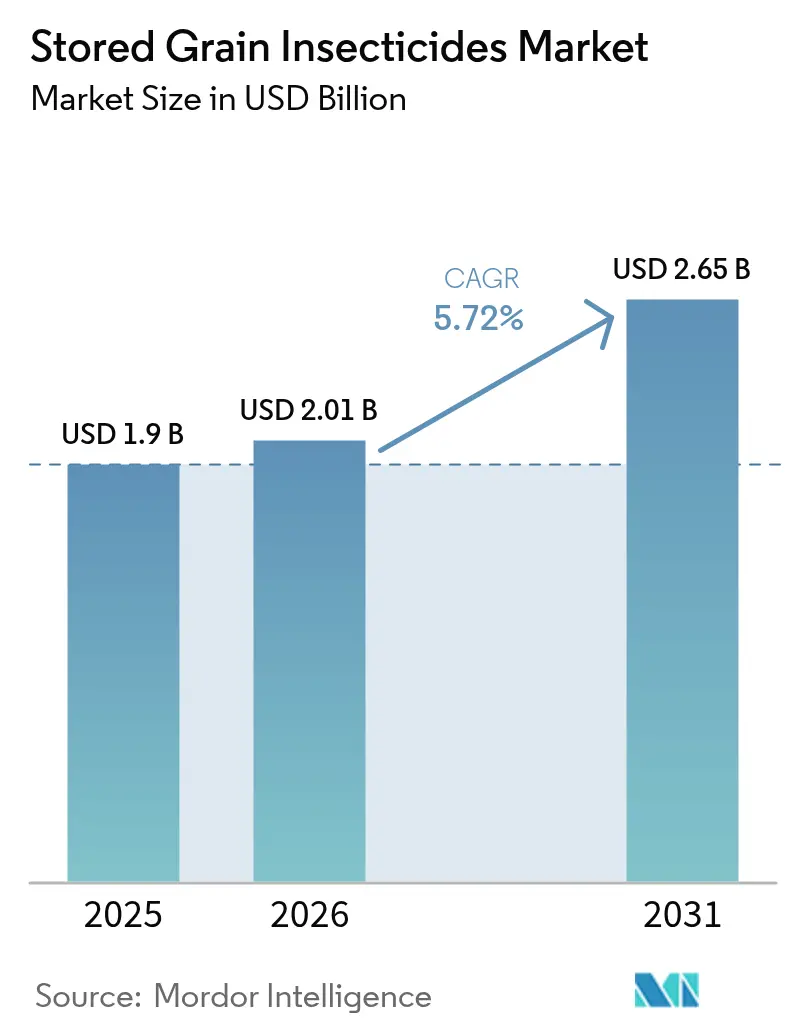
The stored grain insecticide market size is expected to grow from USD 1.90 billion in 2025 to USD 2.01 billion in 2026 and is forecast to reach USD 2.65 billion by 2031 at 5.72% CAGR over 2026-2031. Demand accelerates as exporters impose tighter residue limits, commercial elevators move toward preventive treatment programs, and resistance to single-mode products rises. Combination chemistries that extend efficacy windows, IoT-linked formulations that match dosing with sensor alerts, and bio-insecticides backed by ESG capital are reshaping competitive strategies. Rapid construction of sealed silos across Asia-Pacific and South America adds new first-time users, while carbon audits in Europe and North America nudge buyers toward lower-GWP formulations. Collectively, these factors sustain the positive trajectory of the stored grain insecticide market.
Key Report Takeaways
- By product type, organophosphates held 42.12% of the stored grain insecticide market share in 2025, and bio-insecticides are projected to post a 12.44% CAGR through 2031.
- By application, off-farm commercial elevators accounted for 37.65% of the stored grain insecticide market size in 2025, and export shipments are forecast to expand at a 9.58% CAGR to 2031.
- By formulation, liquid concentrates led with 46.85% revenue share in 2025, and micro-encapsulated products are advancing at 10.66% CAGR over the outlook period.
- By mode of action, contact neurotoxins represented 50.95% of sales in 2025, and juvenile hormone analogs are projected to grow at a 11.03% CAGR.
- By distribution channel, ag retailers and cooperatives captured 53.75% of value in 2025, and online input platforms are projected to grow at an 8.53% CAGR.
- North America retained 31.45% regional share of the stored grain insecticide market in 2025; Asia-Pacific is set to grow at a 6.82% CAGR through 2031.
Note: Market size and forecast figures in this report are generated using Mordor Intelligence’s proprietary estimation framework, updated with the latest available data and insights as of 2026.
Global Stored Grain Insecticides Market Trends and Insights
Drivers Impact Analysis*
| Driver | (~) % Impact on CAGR Forecast | Geographic Relevance | Impact Timeline |
|---|---|---|---|
| Surging global grain output and larger commercial silo capacity | +1.8% | Asia-Pacific and South America lead; global relevance | Medium term (2-4 years) |
| Mandatory maximum residue limits (MRLs) tightening worldwide | +1.5% | North America and Europe export corridors | Short term (≤ 2 years) |
| Escalating phosphine resistance accelerating combination chemistries | +1.2% | Core impact in Asia-Pacific, spill-over to Middle East and Africa | Medium term (2-4 years) |
| Rapid adoption of on-farm sealed storage in Asia-Pacific smallholder sector | +0.9% | India, Bangladesh, Philippines spearhead | Long term (≥ 4 years) |
| IoT-enabled storage monitoring driving demand for data-linked protectants | +0.6% | North America and Europe initially, rolling into urban Asia-Pacific | Long term (≥ 4 years) |
| ESG investment flows into bio-insecticide R&D and commercialization | +0.4% | North America and Europe concentrate early funding | Long term (≥ 4 years) |
| Source: Mordor Intelligence | |||
Surging Global Grain Output and Larger Commercial Silo Capacity
Record crop volumes and faster elevator buildouts translate directly into higher chemical demand. Maize alone topped 1.2 billion tons in 2024, while storage capacity expansion trails harvest growth by nearly one-fifth, forcing longer hold periods and increased pest pressure. The Andersons added 174 million bushels of capacity through its November 2024 Skyland Grain purchase, demonstrating how consolidation scales chemical programs. Commercial operators increasingly favor residual formulations with ninety-day efficacy to avoid costly re-fumigation cycles. Consequently, the stored grain insecticide market gains a stable spending base among professional handlers.
Mandatory Maximum Residue Limits (MRLs) Tightening Worldwide
Regulators now scrutinize shipment compliance more closely than ever. The Australian GRDC warns that single cargo rejections can erase multimillion-dollar margins, a reality prompting elevators to choose premium, residue-optimized products[1]Source: GRDC, “Grain Storage Guidelines,” grdc.com.au. SGS notes a 40% rise in distinct MRL levels across importing nations since 2020, complicating chemical selection. Combination products that suppress residue build-up, therefore command premium pricing, supporting the long-term value of the stored grain insecticide market.
Escalating Phosphine Resistance is Accelerating Combination Chemistries
Field surveys show resistant Rhyzopertha dominica strains in over 80% of tested lots, with some populations 1000 times less susceptible to phosphine. Grain handlers now adopt dual-mode actives such as deltamethrin plus piperonyl butoxide or spinosad plus s-methoprene. Corteva’s 2024 Conserve Plus launch in Australia reflects this trend[2]Source: Corteva Agriscience, “Conserve Plus Launch,” corteva.com.au . Although these blends add 25-40% to per-unit costs, they extend product lifecycles, sustaining growth within the stored grain insecticide market.
Rapid Adoption of On-Farm Sealed Storage in the Asia-Pacific Smallholder Sector
Metal silos and hermetic bags allow farmers to store grain safely beyond traditional two-month windows. Kenyan trials show metal silos add 1.8 months of food availability with returns of 61-80% depending on crop type. Zimbabwean studies reveal a 15-25% willingness-to-pay premium for hermetic units. Such systems rely on low-oxygen compatible tablets and pellets, driving fresh demand streams and widening the stored grain insecticide market.
Restraints Impact Analysis*
| Restraint | (~) % Impact on CAGR Forecast | Geographic Relevance | Impact Timeline |
|---|---|---|---|
| Regulatory phase-outs of high-toxicity organophosphates | -1.4% | North America and Europe lead restrictions | Short term (≤ 2 years) |
| Cross-resistance to multiple pyrethroids reducing product life cycles | -0.8% | Asia-Pacific and the Middle East spread to other regions | Medium term (2-4 years) |
| Predictive sensor analytics lowering prophylactic chemical applications | -0.3% | North America and Europe first, then global | Long term (≥ 4 years) |
| Carbon-footprint audits penalizing fumigants with high GHG load | -0.2% | Europe and North America are dominant | Medium term (2-4 years) |
| Source: Mordor Intelligence | |||
Regulatory Phase-Outs of High-Toxicity Organophosphates
The December 2024 EPA proposal to revoke most chlorpyrifos food uses removes roughly 70% of its former volume[3]Source: European Investment Bank, “EIB Supports GreenLight Biosciences,” eib.org. Similar moves in Canada and Europe drive formulators toward costlier replacements, raising prices 15-25% and temporarily slowing order cycles. While reforms ultimately push innovation, near-term friction trims growth in the stored grain insecticide market.
Cross-Resistance to Multiple Pyrethroids Reducing Product Life Cycles
Australian data confirm Tribolium castaneum populations with over 100-fold resistance to deltamethrin, bifenthrin, and related pyrethroids[4]Source: GRDC, “Grain Storage Guidelines,” grdc.com.au. Accelerated obsolescence compresses payback periods for new molecules, discouraging investment in traditional chemistry. This headwind marginally restrains the expansion of the stored grain insecticide market.
*Our forecasts treat driver/restraint impacts as directional, not additive. The impact forecasts reflect baseline growth, mix effects, and variable interactions.
Segment Analysis
By Product Type: Bio-Insecticides Lead Innovation Wave
Organophosphates retained a 42.12% share in 2025, underlining their entrenched role within the stored grain insecticide market. Bio-insecticides are forecast at a 12.44% CAGR, fueled by ESG funding and favorable regulation. Insect growth regulators, although at a 2.33% share, grow briskly due to compatibility with resistance stewardship programs.
The segment’s competitive intensity heightens as firms launch dual-mode blends. Corteva’s Conserve Plus unites spinosad with S-methoprene, targeting resistant insects while remaining residue-friendly. Venture money channels into RNAi and microbial pathways, promising fresh modes of action that may reset resistance clocks. Suppliers balancing legacy volumes with innovative lines will defend their position in the stored grain insecticide market.




By Application: Export Shipments Drive Premium Demand
Off-farm elevators account for 37.65% of demand as integrated handling chains institutionalize prophylactic treatments. Export shipments grow the fastest at 9.58% CAGR because residue compliance dictates premium products that clear diverse national limits. The stored grain insecticide market size tied to export channels is projected to climb from USD 372.6 million in 2026 to nearly USD 589.4 million in 2031. On-farm storage demand gains momentum as smallholder silos multiply.
Longer transit distances in consolidated supply chains increase insect exposure time, thereby elevating demand for extended residual formulations. Precision fogging inside shipping containers and railcars also rises, adding value despite modest volume. The export segment, therefore, remains a focal point for new combination offerings within the stored grain insecticide market.
By Formulation: Micro-Encapsulation Gains Traction
By formulation, liquid concentrates led with 46.85% revenue share in 2025, and micro-encapsulated products are advancing at 10.66% CAGR over the outlook period. Capsules release actives gradually, extending control for up to ninety days while lowering applicator exposure, a feature prized under tighter occupational rules. Emulsifiable concentrates hold a modest share, favored in pyrethroid blends that rely on oil carriers to penetrate grain surfaces.
Dust and dry flowables remain critical for bin clean-outs and empty-space treatments where bulk handling systems are common. Aerosol and fogging agents serve niche structural fumigation, though volatile organic compound rules cap growth. Tablet and pellet products shine in hermetic storage because preset dosages simplify use for smallholders. Across all formats, regulators and buyers seek user-friendly delivery systems that curb inhalation and dermal risk, guiding innovation in the stored grain insecticide market.
By Mode of Action: Combination Approaches Address Resistance
By mode of action, contact neurotoxins represented 50.95% of sales in 2025. Juvenile hormone analogs surge at 11.03% CAGR because they disrupt insect development, slowing resistance build-up when rotated with neurotoxins. Systemic actives gain traction for deep kernel penetration in long-distance transit.
Combination products that merge IGRs with neurotoxins climb steadily as firms aim for multi-modal resilience. Deltamethrin plus piperonyl butoxide and s-methoprene plus spinosad are flagship examples. The industry's focus on novel or paired mechanisms will intensify as regulatory bodies worldwide demand resistance management plans, reinforcing the importance of diversified toolkits in the stored grain insecticide market.
By Distribution Channel: Direct-to-Farm Sales Expand in Developing Markets
By distribution channel, ag retailers and cooperatives captured 53.75% of value in 2025. Online input platforms post the fastest 8.53% CAGR, riding on expanded internet coverage and digital payments that slash transaction friction. Grain elevator service providers hold a significant share, offering integrated pest management when contracting storage space, and logistics specialists cover 3.92% for in-transit applications.
Digital portals now feature label databases, residue calculators, and compliance checklists that simplify purchasing. Suppliers combining e-commerce with field expertise are likely to gain share, reflecting the growing importance of data-rich channels in the stored grain insecticide market.

Geography Analysis
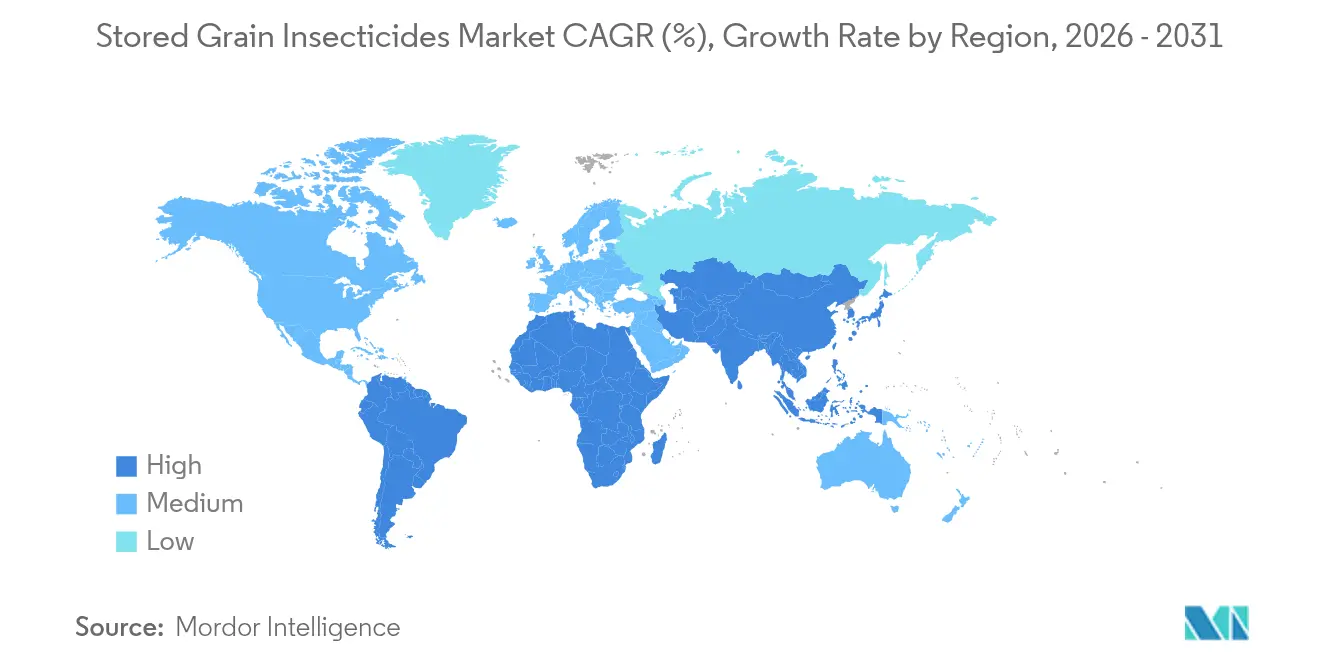
North America retains the largest regional position supported by 31.45% revenue share in 2025. Consolidation among elevator operators creates scale economies in chemical purchasing. The Andersons’ acquisition of Skyland Grain underscores infrastructure expansion that demands systematic protection. EPA phase-outs encourage shifts to lower-toxicity blends, keeping premium revenue streams alive. IoT adoption is also highest in the United States and Canada, reinforcing the premiumization trend in the stored grain insecticide market.
Asia-Pacific represents the fastest-growing geography at 6.82% CAGR through 2031, thanks to booming sealed silo installations and widespread phosphine resistance. Research confirms 1.8 additional months of grain security from metal silos in Kenya, a pattern repeated in India and the Philippines. As resistance spreads, users gravitate toward dual-mode products, expanding market value. National food security programs further subsidize modern storage, deepening penetration of the stored grain insecticide market.
Europe grows at a 3.74% CAGR, driven by sustainability mandates that penalize high-GWP fumigants. Germany’s guidance on sulfuryl fluoride reductions exemplifies regulatory direction. South America advances 5.69% CAGR, with Brazil and Argentina adding elevator capacity for soybean and corn exports. Investments in river logistics translate into longer transit windows that need durable protection.

Regulatory Landscape
Stored grain insecticides operate under pesticide registration frameworks (for example, FIFRA in the United States) and under tight residue compliance regimes that affect exportable grain. In the European Union, maximum residue levels are governed under Regulation (EC) No 396/2005, and Commission Regulation (EU) 2026/876 (21 April 2026) updated Annex II MRLs, including changes covering deltamethrin, reinforcing the need for residue-optimized programs for treated grain moving through export corridors.
Compliance oversight is becoming more programmatic and data-driven. Commission Implementing Regulation (EU) 2026/748 (31 March 2026) set a multiannual EU control program for 2027-2029 for pesticide residues, tightening the operational requirement for documented, audit-ready treatment and monitoring practices across elevators and logistics chains. Internationally, Codex Alimentarius MRLs remain a trade anchor, while updated OECD TG 506 residue stability guidance (June 2025) is being applied in FAO/WHO JMPR assessments from 2026, raising the bar for residue data packages used to support stored-commodity uses.
Competitive Landscape
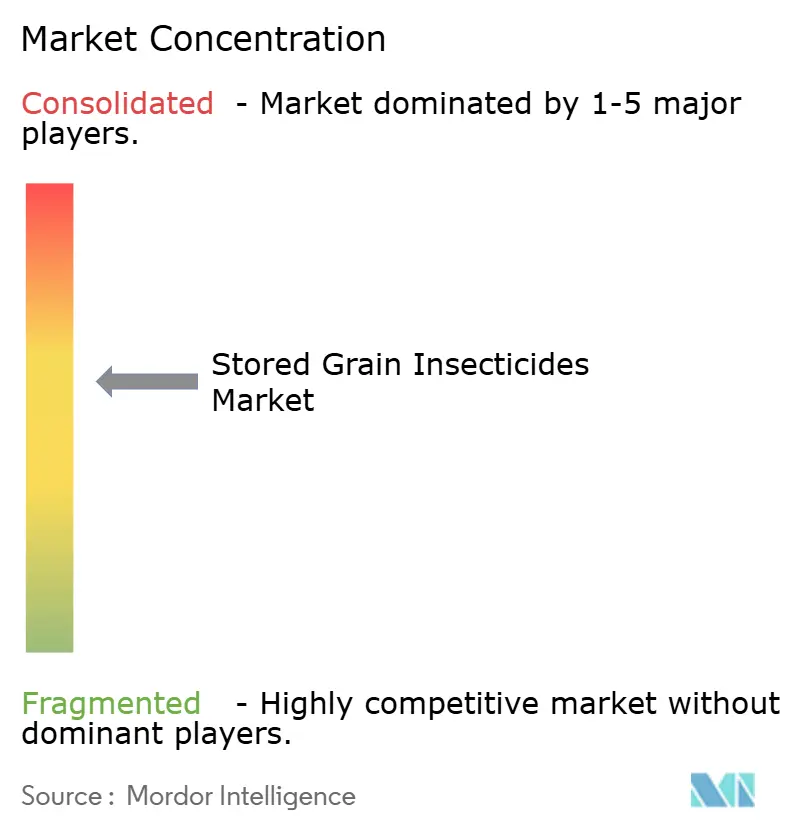
The stored grain insecticide market is moderately concentrated. The leading five players, like Syngenta, Corteva, BASF SE, Adama Agricultural Solutions Ltd., and UPL, hold a major share. These players leverage broad portfolios, strong distributor ties, and active resistance management training. Investment flows increasingly target integrated solutions such as UPL’s partnership with TeleSense that marries chemistry with real-time data.
Mid-tier firms differentiate through niche biologics or regional focus. GreenLight Biosciences received EUR 35 million (USD 36.75 million) from the European Investment Bank to advance RNAi products, a sign that disruptive technologies can draw institutional backing[5]Source: European Investment Bank, “EIB Supports GreenLight Biosciences,” eib.org. Other innovators like Vestaron bring peptide-based actives forward, aiming to satisfy residue and carbon norms. Partnerships between sensor firms and chemical majors intensify as data transparency becomes a procurement criterion.
Competitive positioning now hinges on the ability to provide compliant, resistance-smart, and low-footprint solutions. Companies that integrate application equipment, monitoring, and analytics create sticky service models. Meanwhile, regulatory shifts toward sustainable agriculture tilt the playing field in favor of agile players ready to replace phased-out molecules. Overall rivalry remains constructive, with incumbents adapting and newcomers injecting fresh innovation into the stored grain insecticide market.
Stored Grain Insecticides Industry Leaders
Syngenta AG
Corteva Agriscience
UPL Limited
BASF SE
Adama Agricultural Solutions Ltd.
- *Disclaimer: Major Players sorted in no particular order

Market Opportunities and Future Outlook
The strongest opportunity sits where tighter residue compliance meets resistance management, with buyers prioritizing products and programs that reduce re-treatments while staying within diverse importing-country MRLs. Export shipments are the fastest-growing application within the report scope, and this channel preference creates whitespace for synergized combination products, micro-encapsulated formats, and service-led offerings that bundle treatment, documentation, and verification. EU enforcement is also moving toward structured, multi-year residue monitoring (Regulation (EU) 2026/748 for 2027-2029), which increases demand for traceable, label-aligned solutions and supports digital recordkeeping tied to commercial elevator workflows.
Portfolio consolidation and innovation funding are reshaping options for end users. Envu completed the acquisition of Syngenta's Actellic stored-grain products in September 2025, strengthening a focused stored-grain portfolio that can be paired with integrated service models for professional storage operators. In parallel, the European Investment Bank provided EUR 35 million in February 2025 to GreenLight Biosciences to advance RNA-based biological pesticide development, reflecting institutional backing for new modes of action aligned with ESG-driven procurement. Non-chemical and hybrid approaches (modified atmospheres, ozone, and atmospheric cold plasma) are also moving through pilots and technical development, creating adjacent opportunity for suppliers that can integrate monitoring, decision rules, and precision application to reduce unnecessary prophylactic dosing without compromising compliance.
Recent Industry Developments
- July 2026: The US Environmental Protection Agency published a Federal Register notice acknowledging receipt of applications to register new pesticide active ingredients under FIFRA Section 3(c)(4). This step signals a continuing pipeline of new actives and can influence the competitive mix in stored grain protection as registrants progress toward approvals and commercialization.
- September 2025: Envu completed the acquisition of Syngenta's Actellic product line for the global stored grain market. The deal consolidated a stored-grain franchise under a specialist portfolio owner, supporting broader product and service bundling for commercial elevators and export-oriented handlers.
- December 2024: The US Environmental Protection Agency proposed a rule to revoke most chlorpyrifos food uses, retaining only a limited set of crops and reducing overall use volume materially. This regulatory move accelerated reformulation and substitution activity toward alternative chemistries and combination programs where organophosphate phase-outs constrain legacy options.


Research Methodology Framework and Report Scope
Market Definition and Coverage
This market covers insecticides used to prevent or control insect infestation in stored grains after harvest. It includes applications across farm storage, commercial facilities, and in-transit or export storage. Revenue is counted at the point of sale for products used as grain protectants, contact treatments, and fumigation solutions.
Scope exclusions: field crop insecticide use before harvest is excluded, along with rodenticides, fungicides, storage equipment, and general sanitation services.
Segmentation Overview
- By Product Type
- Organophosphates
- Pyrethroids
- Fumigants (Metal Phosphides, Sulfuryl Fluoride)
- Bio-insecticides
- Insect Growth Regulators
- Synergized Combination Products
- Others
- By Application
- On-farm Storage
- Off-farm Commercial Elevators
- Export Shipments
- Integrated Logistics and Transit
- Seed Storage/Seed Banks
- Emergency Rescue Treatments
- By Formulation
- Liquid Concentrate
- Dust and Dry Flowables
- Aerosol/Fogging Agents
- Tablets & Pellets
- Suspension Concentrate
- Micro-encapsulated
- By Mode of Action
- Contact Neurotoxins
- Systemic Actives
- Fumigant Gases
- Juvenile Hormone Analogs (IGRs)
- By Distribution Channel
- Direct-to-Farm Sales
- Ag Retailers and Cooperatives
- Grain Elevator Service Providers
- Online Ag Input Platforms
- By Geography
- North America
- United States
- Canada
- Mexico
- Rest of North America
- South America
- Brazil
- Argentina
- Rest of South America
- Europe
- Germany
- France
- United Kingdom
- Spain
- Italy
- Russia
- Rest of Europe
- Asia-Pacific
- China
- India
- Japan
- Australia
- Rest of Asia-Pacific
- Middle East
- Turkey
- Saudi Arabia
- Rest of Middle East
- Africa
- South Africa
- Nigeria
- Rest of Africa
- North America
Data Sources, Market Sizing, and Validation
Desk Research
Desk research was used to build the market map and set practical boundaries around where stored grain insecticides are actually used and purchased. For this, we relied on public sources such as FAOSTAT for grain production and stocks, USDA and similar agriculture agencies for storage and pest guidance, and national pesticide regulators such as the US EPA and the European Commission databases for approved actives and usage constraints.
To convert activity into market value, we also reviewed sources such as UN Comtrade for trade flows of relevant pesticide categories, peer-reviewed post-harvest entomology journals for infestation pressure and treatment practices, and grain and storage association publications that describe facility types and handling steps. Company annual reports, investor presentations, and press coverage were then used to sanity-check product-mix shifts and regional demand drivers. Where needed, paid subscriptions for company financials, patent databases, and import-export shipment level records were used to fill gaps in product positioning and cross-border movement. The examples above are indicative, and other sources were also reviewed to support data collection, validation, and clarification.
Primary Interviews and Surveys
Primary work focused on post-harvest crop protection experts across the value chain, including manufacturers, distributors, grain handlers, and storage facility operators. We used interviews and structured surveys to confirm treatment rates by storage type, typical product selection (fumigation versus protectants), and how realized pricing moves by channel, then to validate regional differences across APAC, EMEA, and the Americas.
Distribution of primary research fieldwork respondents
| Company type | Respondent position | Region |
|---|---|---|
| Top tier: 28% | CXOs: 12% | APAC: 44% |
| Mid tier: 57% | Functional/Unit leaders: 39% | EMEA: 29% |
| Smaller Players: 15% | Managers: 49% | Americas: 27% |
Market-Sizing & Forecasting
Our sizing model starts with a top-down demand pool build, where grain production and carryover stock indicators are converted into an addressable stored volume by region, and then filtered by storage practices and the share of grain that receives insect control during storage. That demand pool is priced using region-specific treatment cost ranges and product-mix splits, refined through primary discussions.
To keep totals realistic, the model is cross-checked with selective bottom-up approximations, such as sampling supplier revenue exposure to post-harvest protection, channel checks with distributors, and an ASP times volume logic for common treatments where public ranges exist. Key inputs tracked year to year include stored grain tonnage trends, fumigation frequency in commercial elevators, adoption of integrated pest management that shifts chemical intensity, regulatory restrictions on certain actives, and changes in freight and packaging costs that affect realized prices.
For forecasting, we mainly use scenario analysis supported by short series time trend smoothing, since weather shocks and policy changes can move stored volumes and treatment intensity quickly. Assumptions on treatment penetration and price progression are stress-tested with expert feedback, and countries with weaker data are handled through proxying from similar storage systems before being adjusted with local validation.
Data Validation & Update Cycle
Validation is done in multiple steps so the final number is not driven by a single data stream. Analysts compare outputs against independent signals such as grain stock movement, pesticide registration activity, and observed pricing ranges, then re-check any outliers at the country and regional roll-up levels before sign-off.
A second analyst reviews key assumptions, unit conversions, and currency handling. Follow-up calls are triggered when large variances show up versus prior-year patterns or known regulatory events. The report is refreshed annually, and material developments such as major approval changes or supply disruptions are incorporated through interim revisions. Before delivery, we perform a final freshness pass so clients receive the latest view available at that time.
Mordor Intelligence's Stored Grain Insecticide Market Estimate Compared With Other Published Estimates
Published market sizes for stored grain insecticides can look far apart because different studies count different product boundaries and they also treat the same storage activity in different ways. In our review, the biggest drivers are what is included as stored grain use, how treatment frequency is assumed across storage types, and how prices are converted and updated over time.
Trade and agriculture signals such as post-harvest stored grain volumes, regulator-published active ingredient lists, and distributor channel feedback are the checks that keep Mordor Intelligence's estimate aligned to insecticide demand tied to stored grain protection, rather than broader crop protection spending.
Benchmark comparison
| Source | Market Size | Gaps in Research Methodology |
|---|---|---|
| Mordor Intelligence | USD 2.01 B (2026) | |
| Industry Publisher A | USD 0.28 B (2024) | Often uses a narrower revenue scope that can lean toward select product groups or channels, and it may apply conservative treatment penetration assumptions across commercial elevators and export handling. |
| Market Publisher B | USD 0.79 B (2024) | May expand scope to additional post-harvest pest control use cases and services beyond core stored grain insecticide demand, and it can apply different pricing ladders and currency timing than an annualized model. |
The spread in the table mostly comes down to boundary choices and how stored grain activity is translated into treated volume and priced demand. By keeping inputs traceable to stored grain volumes, treatment frequency, and region-level pricing checks, the estimate stays repeatable and easier to reconcile when new regulation or storage practice changes occur.


Key Questions Answered in the Report
What is the current value of the stored grain insecticide market?
The stored grain insecticide market is valued at USD 2.01 billion in 2026.
How fast is demand for stored grain insecticides anticipated to grow?
Revenue is forecast to rise at a 5.72% CAGR, reaching USD 2.65 billion by 2031.
Which region is expanding most quickly?
Asia-Pacific is projected to post a 6.82% CAGR, driven by sealed silo adoption and resistance challenges.
Why are combination chemistries gaining popularity?
Rising phosphine resistance and stricter residue limits encourage dual-mode products that extend efficacy and simplify compliance.
What impact do IoT sensors have on chemical usage?
Precision monitoring typically reduces chemical volume by around one quarter while boosting performance through optimized application timing.
Page last updated on:





