
Spain ITSM Market Size and Share
Market Overview
| Study Period | 2021 - 2031 |
|---|---|
| Forecast Data Period | 2026 - 2031 |
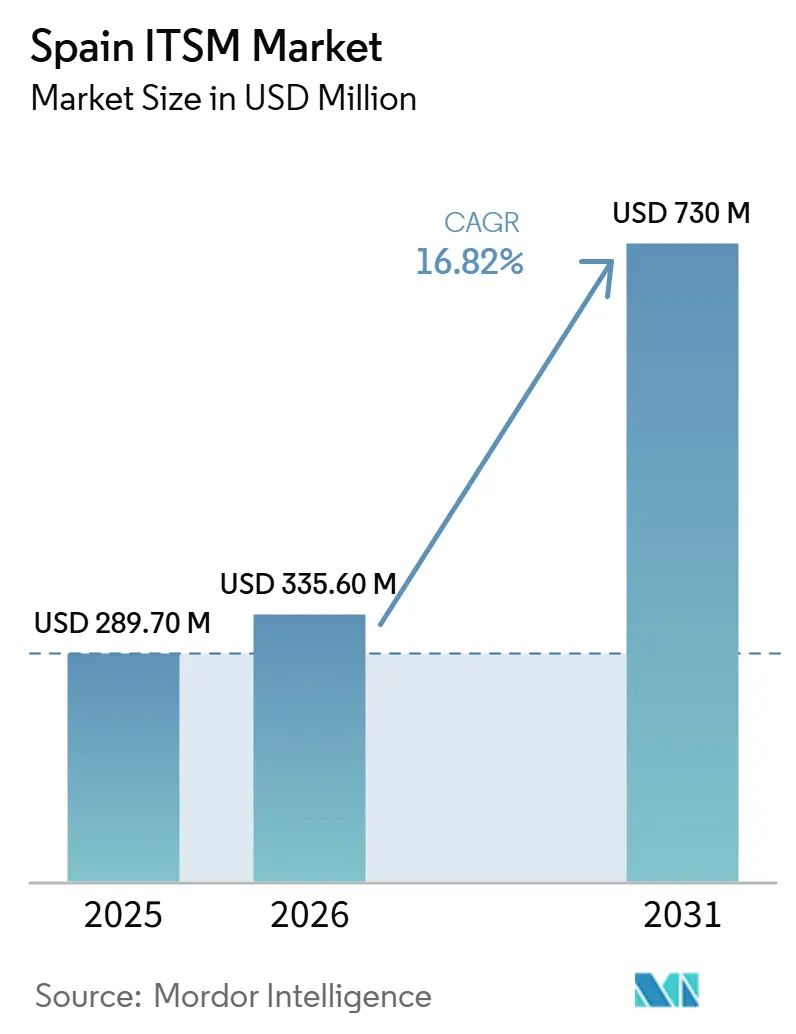
| Base Year Market Size (2025) | USD 289.70 Million |
| Market Size (2026) | USD 335.60 Million |
| Market Size (2031) | USD 730 Million |
| Growth Rate (2026 - 2031) | 16.82 % |
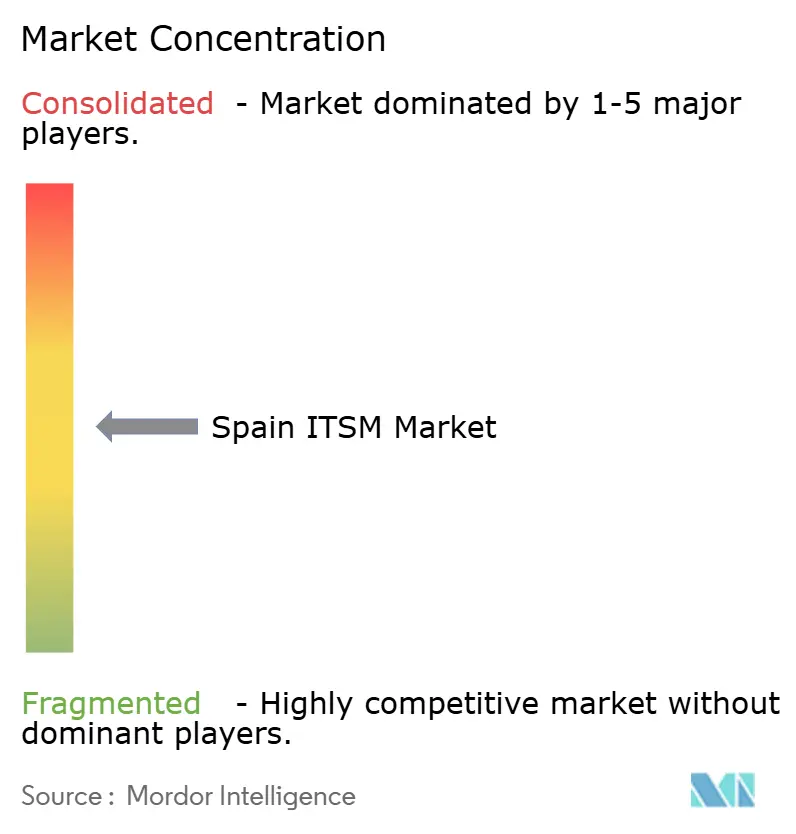
| Market Concentration | Medium |
Major Players *Disclaimer: Major Players sorted in no particular order Image © Mordor Intelligence. Reuse requires attribution under CC BY 4.0. | |
Spain ITSM Market Analysis by Mordor Intelligence
The Spain ITSM Market size is projected to expand from USD 289.70 million in 2025 and USD 335.60 million in 2026 to USD 730 million by 2031, registering a CAGR of 16.82% between 2026 to 2031.
The Spain ITSM market is moving higher as Spanish enterprises shift more core workloads into paid cloud environments, which raises the need for structured service catalogs, automated ticket routing, and stronger configuration control across expanding digital estates. The Spain ITSM market is also supported by Digital Spain 2026, which keeps enterprise modernization, regional digitization, and operational standardization high on the national agenda. Buyer priorities are becoming more selective because regulated organizations increasingly weigh hosting location, compliance readiness, and local support quality alongside workflow depth and usability. AI-led automation is changing the commercial logic of the Spain ITSM market because vendors now need to prove process orchestration, knowledge delivery, and cross-functional workflow value rather than simple ticket volume handling. Talent gaps and budget pressure still slow some deployments, yet both factors also reinforce demand for platforms that simplify support operations, improve self-service, and reduce manual intervention.
Key Report Takeaways
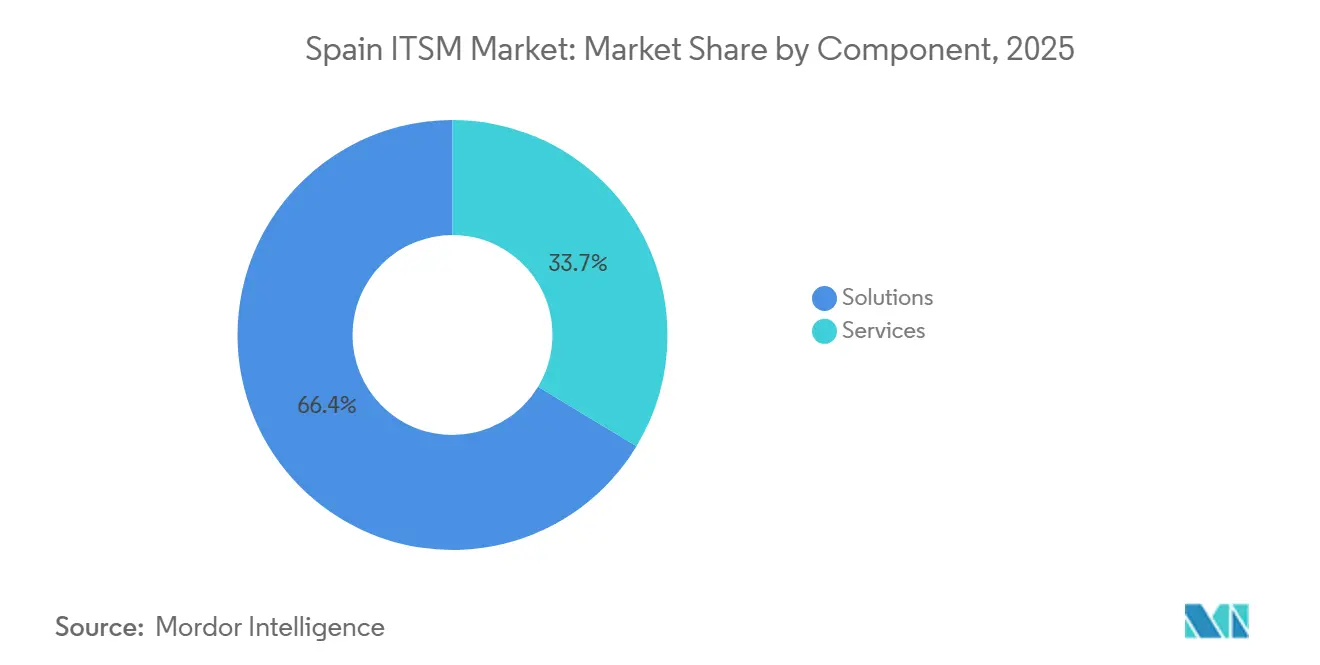
- By component, solutions held 66.35% share in 2025, while services are projected to expand at a 15.60% CAGR through 2031.
- By deployment, cloud captured 67.20% of the Spanish ITSM market in 2025.
- By application, Service Desk and Incident Management accounted for 29.40% share in 2025, while Knowledge Management is forecast to grow at a 15.46% CAGR through 2031.
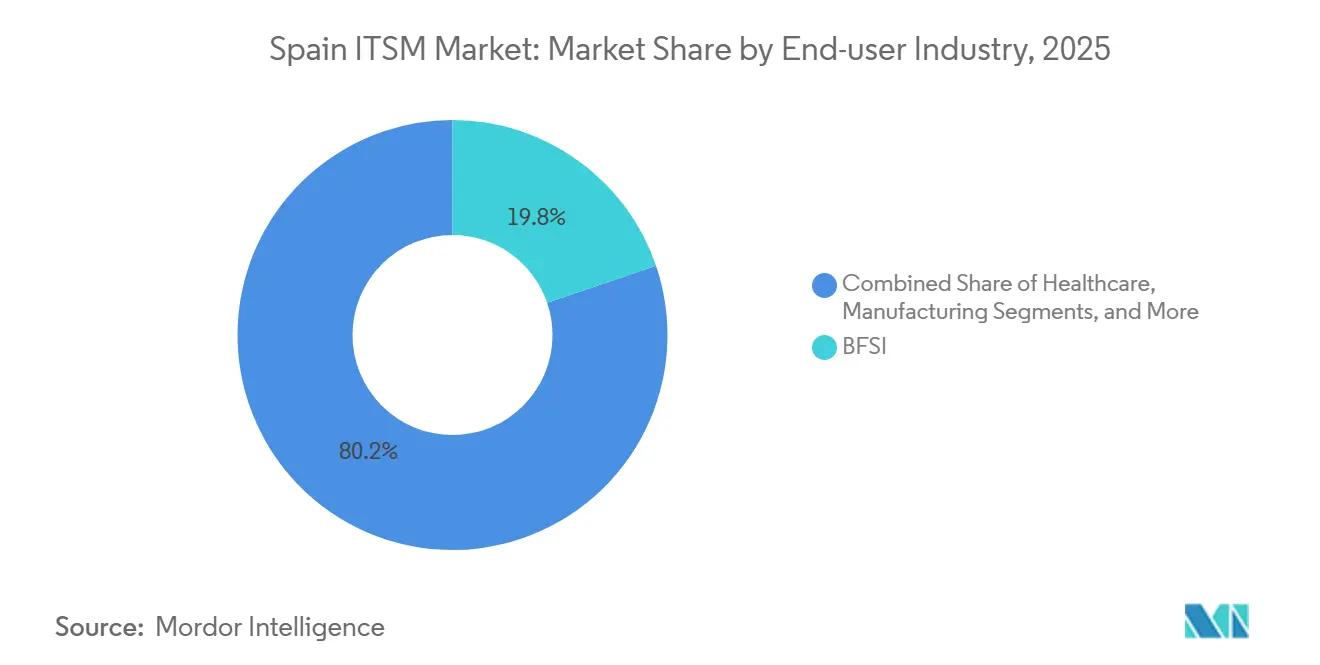
- By end-user industry, BFSI held 19.78% share in 2025, while healthcare is expected to advance at a 15.73% CAGR through 2031.
- By enterprise size, large enterprises represented 68.10% share in 2025, while SMEs are projected to grow at a 16.24% CAGR through 2031.
Note: Market size and forecast figures in this report are generated using Mordor Intelligence’s proprietary estimation framework, updated with the latest available data and insights as of January 2026.
Spain ITSM Market Trends and Insights
Drivers Impact Analysis*
| Driver | (~) % Impact on CAGR Forecast | Geographic Relevance | Impact Timeline |
|---|---|---|---|
| Cloud-First IT Operations Modernization | +3.5% | National, concentrated in Madrid and Barcelona enterprise hubs | Short term (≤ 2 years) |
| AI-Powered Ticket Triage and Workflow Automation | +3.2% | National | Medium term (2-4 years) |
| GDPR, NIS2, and Data Residency Compliance | +2.8% | National, strongest in BFSI and government verticals | Medium term (2-4 years) |
| Hybrid Workforce Support and Self-Service Adoption | +2.4% | National | Short term (≤ 2 years) |
| FinOps and Cost Transparency Across Distributed IT Estates | +2.0% | National, concentrated in multi-cloud enterprise environments | Medium term (2-4 years) |
| Low-Code and No-Code Workflow Orchestration | +1.5% | National, stronger uptake among Kit Digital-eligible SMEs | Long term (≥ 4 years) |
| Source: Mordor Intelligence | |||
Cloud-First IT Operations Modernization in Spanish Enterprises
The Spain ITSM market is gaining from deeper cloud use in business-critical workloads, not only from basic infrastructure migration. Spain recorded 44.3% usage of paid cloud computing services among enterprises with 10 or more employees in Q1 2025, which was 5.6% higher than Q1 2024, showing a clear rise in formal digital operations needs. The same operating shift becomes more meaningful when the cloud is tied to core systems such as ERP and CRM, because those environments require stable service routing, stronger change control, and clearer asset relationships across teams. Spain also entered this cycle with public policy support through Digital Spain 2026, which linked digital modernization to national funding and longer-term execution priorities across regions and institutions. As cloud estates spread across more tools, vendors that can connect service desks, CMDBs, automation layers, and governance records are better placed in the Spain ITSM market than providers centered on isolated help-desk functions. This keeps the Spain ITSM market tied to broader modernization programs rather than to short-lived software replacement cycles.
AI-Powered Ticket Triage and Workflow Automation
The Spain ITSM market is also moving upward because Spanish enterprises adopted AI much faster in 2025 than they had a year earlier. AI usage reached 21.1% among enterprises with 10 or more employees in Q1 2025, up 8.7% from Q1 2024, which widened the base of organizations ready to automate support workflows. This matters in service management because AI is no longer limited to classification support, and it is increasingly used for resolution paths, knowledge suggestions, and guided actions inside service workflows. Freshworks showed the strength of this direction when Freddy AI crossed USD 25 million in annual recurring revenue in Q4 2025, which pointed to broad enterprise uptake of AI-assisted service functionality[1]. The Spain ITSM market is therefore shifting toward vendors that can prove automation depth, measurable resolution gains, and usable knowledge delivery rather than vendors that mainly compete on seat counts or ticket volume. As repetitive requests become easier to automate, purchase decisions in the Spain ITSM market move closer to workflow quality, cross-team coordination, and scalable service design.
GDPR, NIS2, and Data Residency Compliance Requirements
Compliance needs are shaping the Spain ITSM market because regulated organizations increasingly treat service workflows as operational evidence, not just support tools. Spain also showed a strong preference for local infrastructure control, with 62% of enterprises preferring nationally hosted IT infrastructure, which raises the value of sovereign or European-hosted service platforms. That preference became more concrete in June 2026, when Telefónica Tech and Google Cloud launched a sovereign cloud service for Spanish public administration and regulated private-sector users[2]. These conditions push the Spain ITSM market toward vendors that can support auditable incident records, change tracking, access control alignment, and locally acceptable hosting models. The commercial effect is visible in regulated sectors, where infrastructure location and governance readiness now carry more weight in vendor shortlisting than they did in earlier software-led buying cycles. This makes compliance a practical growth driver for the Spain ITSM market because workflow structure and hosting credentials increasingly move together in final purchasing decisions.
Hybrid Workforce Support Driving Self-Service Adoption
The Spain ITSM market continues to benefit from permanent changes in how employees access systems, devices, and internal services. In Q1 2025, 37.4% of Spanish enterprises with 10 or more employees allowed remote work, while the figure reached 78.0% among large enterprises with 250 or more employees. This operating model spreads requests across more endpoints, more locations, and more user roles, which makes self-service portals, searchable knowledge, and virtual support agents more important for consistent response quality. EasyVista and OTRS Group found that Spanish SMEs ranked workflow automation, productivity through advanced IT tools, and AI integration among their top ITSM priorities, which supports the move toward broader self-service structures. The Spain ITSM market is therefore expanding beyond classic technical support because organizations want one place to handle requests from IT, HR, legal, and facilities with fewer manual handoffs. This broader use case lifts the relevance of enterprise service management in the Spain ITSM market and supports longer customer relationships after initial deployment.
Restraints Impact Analysis*
| Restraint | (~) % Impact on CAGR Forecast | Geographic Relevance | Impact Timeline |
|---|---|---|---|
| Legacy Tool Migration Complexity and Switching Costs | -2.8% | National, concentrated in large enterprises and public-sector organizations | Medium term (2-4 years) |
| Budget Pressure Among Mid-Market Buyers | -2.2% | National, strongest among SMEs and mid-market organizations | Short term (≤ 2 years) |
| Shortage of ITSM Process and Automation Skills | -1.8% | National | Long term (≥ 4 years) |
| Integration Friction With ERP, IAM, and Observability Stacks | -1.4% | National, concentrated in complex multi-system enterprise environments | Medium term (2-4 years) |
| Source: Mordor Intelligence | |||
Legacy Tool Migration Complexity and Switching Costs
The Spain ITSM market still faces friction because many large organizations have built support environments around older tools that are linked to identity systems, monitoring stacks, and internal approval paths. Once a service platform becomes embedded in change workflows and CMDB relationships, replacement risk feels higher even when current capabilities no longer match business needs. EasyVista and OTRS Group also pointed to uneven ITSM process maturity, which helps explain why automation interest can rise at the same time that migration planning remains difficult[3]. This slows the Spain ITSM market in larger accounts because buyers often need staged programs, connector work, and parallel operating periods before they can retire legacy platforms. The result is not weak demand, but a longer revenue conversion cycle for the Spain ITSM market, especially where service logic is tied closely to core enterprise systems.
Budget Pressure Among Mid-Market Buyers
Budget discipline remains a real restraint in the Spain ITSM market, especially outside the largest enterprise accounts. Mid-sized organizations often need stronger service management, yet they must balance that need against spending on cloud, cybersecurity, and AI at the same time. The Spain ITSM market, therefore, develops unevenly across buyer groups, with large enterprises moving toward deeper platform adoption while many smaller firms first look for lower-cost entry points and lighter rollout models. Even where digital intent is strong, purchase timing stretches when internal teams need to justify workflow software against several competing modernization priorities. This pressure matters because the Spain ITSM market depends on wider SME adoption to sustain growth beyond its already established enterprise base.
*Our forecasts treat driver/restraint impacts as directional, not additive. The impact forecasts reflect baseline growth, mix effects, and variable interactions.
Segment Analysis
By Component: Solutions Lead Current Spending While Services Gain Strategic Weight
Solutions held 66.35% of the Spain ITSM market in 2025, which shows that software platforms still account for most current spending in the category. That revenue concentration reflects an environment where many organizations are still replacing disconnected point tools with unified suites that combine service desk, asset visibility, workflow logic, and reporting in one operating layer. The Spain ITSM market has therefore remained license- and platform-led at this stage, especially in large enterprises and public bodies that need broad operational control across multiple teams. This pattern also fits the way buyers are approaching modernization, because they first need a stable system of record before they can scale automation across functions. As a result, solutions continue to anchor the installed base of the Spain ITSM market even as customer expectations become more process-driven.
Services, however, are forecast to expand at a 15.60% CAGR through 2031, which makes this the more dynamic part of the category over the next several years. That growth reflects a change in the role of services, which now extend beyond implementation into AI workflow tuning, operating model refinement, compliance support, and ongoing maturity improvement. Organizations that already deployed service platforms are increasingly buying recurring specialist support because the value of the tool depends on how well automation, knowledge design, and governance flows are maintained over time. This is why the Spain ITSM market is not simply adding software seats, and it is also building a deeper service layer around optimization and continuous improvement. The balance between these 2 components suggests that the Spain ITSM market will keep monetizing both platform consolidation and post-deployment sophistication through the forecast period.
By Deployment: Cloud Sets the Standard While Regulated Buyers Preserve Hybrid Needs
Cloud captured 67.20% of the Spain ITSM market size in 2025, confirming that it is the default deployment path for new service management rollouts. That lead reflects demand for scalable pricing, faster upgrades, and easier integration with broader digital environments that already run on hosted infrastructure. Spain also showed strong strategic cloud use in enterprise ERP and CRM, which supports the view that service management increasingly needs to sit close to other operational systems rather than remain isolated on local infrastructure. In practical terms, the Spain ITSM market has favored cloud because it reduces setup friction for expanding organizations and gives distributed teams more consistent access to service workflows. This has made the cloud the main commercial center of the Spain ITSM market, especially for greenfield deployments and multi-site support models.
On-premise deployment still retains relevance in defense, critical infrastructure, and certain public-sector settings where control over data location and operational architecture remains a deciding factor. Hybrid models are also becoming more important because some organizations want cloud-based service interfaces while keeping older CMDB replicas, custom connectors, or selected system records closer to internal environments. The sovereign cloud launch by Telefónica Tech and Google Cloud in June 2026 supports this mixed path because it addressed regulated demand without asking buyers to choose between modernization and hosting control. This means the Spain ITSM market is not moving toward a simple cloud-only outcome, and it is instead developing a more layered hosting structure shaped by compliance and integration needs. Over time, this should keep cloud in the lead while preserving a durable role for hybrid deployment across sensitive and highly connected operating environments.
By Application: Service Desk Drives Volume While Knowledge Management Gains Speed
Service Desk and Incident Management accounted for 29.40% of the Spain ITSM market size in 2025, making it the largest application area in current spending. This position is logical because incident handling is usually the first structured process that organizations formalize when they adopt an ITSM platform. It gives enterprises a clear operational entry point, and it creates a baseline workflow that can later support change control, asset governance, and service request routing. In the Spain ITSM market, this also explains why service desk contracts often lead to larger platform decisions, since buyers need a visible and immediate improvement in user support before extending the platform into broader service domains. The size of this segment, therefore, reflects both deployment order and the practical importance of restoring service quickly across growing digital estates.
Knowledge Management is forecast to grow at a 15.46% CAGR through 2031, which makes it the fastest-moving application area in the current outlook. This momentum comes from the fact that AI agents depend on usable, structured, and continuously updated knowledge if they are to guide users or resolve common issues with less manual input. Freshworks reported Freddy AI's annual recurring revenue above USD 25 million in Q4 2025, and that result supports the commercial weight of AI-assisted knowledge suggestions and article generation inside service workflows[4]. Service Request Management also remains important because organizations are extending formal request handling into onboarding, procurement, and facilities processes, which broadens the operational footprint of the Spain ITSM market. The application mix therefore shows that the Spain ITSM market is growing both from essential support functions and from the rising value of reusable organizational knowledge.
By End-User Industry: BFSI Leads Present Demand While Healthcare Gains Policy Support
BFSI held 19.78% of the Spain ITSM market share in 2025, which placed it at the top of end-user demand. Spain’s financial sector has a high level of digital engagement, and more than 50% of financial products were contracted online in 2025, which raises the need for resilient support, fast incident handling, and clean workflow governance across customer-facing systems. Santander’s completion of the Gravity core banking deployment across Spanish operations in June 2025 also underlined how large-scale cloud financial environments create direct requirements for incident, change, and service coordination at enterprise scale. In the Spain ITSM market, BFSI demand is therefore supported by both digital transaction intensity and the need to govern complex, always-on infrastructure. This makes the sector a stable revenue pillar for the Spain ITSM market even as other industries move through earlier modernization stages.
Healthcare is projected to grow at a 15.73% CAGR through 2031, making it the fastest-growing end-user vertical in the current forecast. The policy trigger is clear because Spain launched the National Health Data Space in January 2026 with EUR 70 million (USD 79.1 million) in funding to support health data sharing and innovation. That initiative increases the need for interoperable workflows across Spain’s 17-region health authority structure, where support coordination, change records, and auditable service processes become more important. Manufacturing and IT and telecommunications also hold meaningful positions because automation programs and telecom service complexity both raise the cost of weak internal support control. Government and public-sector demand remains steady as well, which keeps the Spain ITSM market tied to a wide base of compliance-led and infrastructure-led users rather than to one dominant vertical alone.

By Enterprise Size: Large Enterprises Anchor Revenue While SMEs Shape the Next Expansion Wave
Large enterprises held 68.10% of the Spain ITSM market share in 2025, which shows how strongly current revenue is concentrated in organizations with higher system complexity and greater governance demands. These buyers typically already operate formal service management structures, and they invest in broader platform depth, AI enablement, and enterprise service management expansion rather than only in initial setup. In the Spain ITSM market, that gives large accounts an outsized influence on contract values, deployment scope, and vendor visibility. It also explains why enterprise references matter so much in competitive positioning, because large clients tend to validate a vendor’s ability to manage scale, auditability, and cross-functional integration. Current revenue leadership, therefore, rests with organizations that treat ITSM as a core operating discipline rather than as a support add-on.
SMEs are forecast to grow at a 16.24% CAGR through 2031, which makes them the fastest-growing enterprise-size cohort. Their importance comes from volume, because cloud delivery lowers entry barriers and allows smaller organizations to adopt formal service processes without the same up-front burden seen in earlier deployment models. The Spain ITSM market is increasingly opening to SMEs as internal digital activity rises and more firms require structured support for remote work, cloud tools, and automation-led processes. This direction was reinforced by EasyVista and OTRS Group, whose survey showed strong interest among Spanish SMEs in workflow automation and AI integration as near-term ITSM priorities. The longer-term significance is that SMEs will broaden the customer base of the Spain ITSM market even if large enterprises continue to dominate average contract value. That gives the Spain ITSM industry a wider growth platform through 2031, with future gains likely to come from scaled, easier-to-deploy offerings rather than only from premium enterprise expansions.
Geography Analysis
The Spain ITSM market stood at USD 335.6 million in 2026 and remained geographically concentrated in the country’s leading enterprise centers, especially Madrid and Cataluña. In Q1 2025, Madrid recorded 58.0% cloud adoption and 25.6% AI adoption among enterprises, while Cataluña posted 54.2% cloud adoption and 30.1% AI adoption, both above national averages of 44.3% and 21.1%, respectively. This matters because advanced digital adoption in those 2 regions supports earlier and deeper use of structured service workflows than in slower-moving parts of the country. Madrid’s role as a financial and corporate headquarters center, and Cataluña’s role as a technology and business hub, keep them central to large-enterprise deployments in the Spain ITSM market. The geographic base of the Spain ITSM market is therefore not evenly spread, and it is still led by regions where enterprise density and digital maturity are both high.
Spain also presents a mixed picture in cloud maturity, which gives the geography of the Spain ITSM market a distinctive shape. Cloud Nation 2026 showed that Spain combined strong strategic cloud use with uneven adoption across the broader business base, which means advanced use cases are concentrated more heavily among a sophisticated subset of enterprises. That concentration supports stronger ITSM demand in the regions where complex ERP, CRM, and multi-cloud environments are already common. At the same time, secondary regions represent a meaningful expansion path as digital capability spreads beyond the largest urban and corporate centers. Digital Spain 2026 keeps that regional broadening relevant because its national digitization agenda aims to reduce gaps in digital readiness over time.
Northern and secondary markets are also becoming more visible in vendor strategy. EasyVista’s partnership with LKS Next in June 2025 directly targeted northern Spain and the Basque Country, which signaled recognized demand among industrial and manufacturing customers outside the largest metro hubs[5]. Data residency adds another geographic layer because 62% of Spanish enterprises preferred nationally hosted infrastructure, which increases the value of local or European service delivery models. The Spain ITSM market therefore has a 2-speed geographic structure, with Madrid and Cataluña driving scale today, and secondary regions offering the next wave of adoption as policy support, local partnerships, and digital maturity continue to improve.
Competitive Landscape
The Spain ITSM market has a moderately fragmented competitive structure, with global platforms strongest in large-enterprise accounts and a wider field of vendors competing across mid-market and SME demand. This shape reflects the way large organizations buy, because they often prefer broad workflow coverage, stronger governance features, and referenceable deployment scale when they shortlist vendors. The Spain ITSM market is therefore concentrated at the upper end of demand, but it remains open lower down where ease of deployment, partner reach, and local support often matter more than global brand weight. Competition is also shifting away from pure service desk positioning because buyers increasingly want enterprise service management breadth, AI assistance, and deployment flexibility in the same platform. As a result, the Spain ITSM market is being contested through product depth, operating model fit, and regional execution quality rather than through one single differentiator.
Several strategic moves from active vendors illustrate that shift. Freshworks launched its AI Service Operations platform in May 2026 and integrated Device42 ITAM and FireHydrant incident-response capabilities into a unified Freshservice environment, which strengthened its position in AI-led and asset-aware service delivery. EasyVista expanded its local execution model in June 2025 through a partnership with LKS Next, a move designed to raise delivery capacity and support coverage in northern Spain. Telefónica Tech and Google Cloud also launched a sovereign cloud service in June 2026, which raised the competitive standard for vendors serving regulated buyers that prioritize jurisdictional control. These moves show that vendors are no longer competing only on workflow design, and they are also competing on hosting credibility, local delivery structure, and operational AI relevance.
Customer-side transformation is also shaping vendor outcomes in the Spain ITSM market. Santander’s Gravity rollout across Spanish banking operations created a large-scale example of cloud-native infrastructure that requires strong incident, change, and coordination support across a demanding production environment. In healthcare, the launch of the National Health Data Space increased the relevance of vendors that can manage interoperable, auditable workflows in a fragmented public-service setting. The Spain ITSM market also favors suppliers that can support self-service growth, knowledge-led automation, and broader service management across non-IT functions. This keeps competitive pressure high because no vendor can rely on a narrow help-desk proposition if buyers increasingly want platform breadth and process continuity across the organization.
Spain ITSM Industry Leaders
-
ServiceNow, Inc.
-
BMC Software, Inc.
-
Atlassian Corporation
-
Ivanti, Inc.
-
Freshworks Inc.
- *Disclaimer: Major Players sorted in no particular order
Recent Industry Developments
- June 2026: Telefónica Tech and Google Cloud launched a sovereign cloud service for Spain's public administrations and regulated private-sector organizations, with Telefónica retaining encryption key management within Spanish jurisdiction. The partnership directly addresses ENS and NIS2 data-residency obligations and intensifies competition among hyperscaler and telecom-backed cloud providers for regulated enterprise IT infrastructure contracts in Spain.
- May 2026: Freshworks launched its AI Service Operations platform at Refresh 2026 in New York, integrating the Device42 ITAM acquisition and FireHydrant's incident-response capabilities into a unified Freshservice platform with Freddy AI Agent Studio and MCP Gateway connectivity. The new IT Asset Management experience became generally available to new Freshservice customers on March 31, 2026, materially expanding Freshworks' enterprise ITSM competitive footprint across European markets, including Spain.
- January 2026: Spain's Ministry of Digital Transformation launched the Espacio Nacional de Datos de Salud (National Health Data Space) with EUR 70 million (approximately USD 79.1 million) in government funding. The infrastructure creates a national health-data-sharing framework requiring ITSM-grade workflow automation and interoperability across Spain's regional health authorities, directly expanding the healthcare vertical's ITSM addressable market.
- June 2025: Santander completed the deployment of Gravity, its cloud-based core banking platform, across all Spanish operations, processing more than 4.3 billion transactions per year at peak rates of up to 33,000 transactions per second. The migration created direct integration requirements for ITSM platforms capable of managing incident workflows and change records across cloud-native financial infrastructure at enterprise scale.
Spain ITSM Market Report Scope
IT Service Management (ITSM) is the set of repeatable practices, processes, and enabling technologies used by organizations to plan, provision, operate, secure, and optimize IT‑delivered services for internal and external customers. It covers the full service lifecycle service strategy, design, transition, operation, and continual improvement, and includes core domains such as incident, problem, change, configuration, request, asset, and knowledge management, plus service-catalog and SLA governance.
The Spain ITSM Market Report is Segmented by Component (Solutions and Services), Deployment (Cloud, On-premise, and Hybrid), Application (Service Desk and Incident Management, Asset and Configuration Management, Change and Release Management, Service Request Management, Knowledge Management, and Other Applications), End-user Industry (BFSI, Manufacturing, Government and Public Sector, IT and Telecommunications, Retail and E-commerce, Healthcare, Travel and Hospitality, and Other End-user Industries), and Enterprise Size (Large Enterprises and Small and Mid-size Enterprises [SME]). The Market Forecasts are Provided in Terms of Value (USD).
| Solutions |
| Services |
| Cloud |
| On-premise |
| Hybrid |
| Service Desk and Incident Management |
| Asset and Configuration Management |
| Change and Release Management |
| Service Request Management |
| Knowledge Management |
| Other Applications |
| BFSI |
| Manufacturing |
| Government and Public Sector |
| IT and Telecommunications |
| Retail and E-commerce |
| Healthcare |
| Travel and Hospitality |
| Other End-user Industries |
| Large Enterprises |
| Small and Mid-size Enterprises (SME) |
| By Component | Solutions |
| Services | |
| By Deployment | Cloud |
| On-premise | |
| Hybrid | |
| By Application | Service Desk and Incident Management |
| Asset and Configuration Management | |
| Change and Release Management | |
| Service Request Management | |
| Knowledge Management | |
| Other Applications | |
| By End-user Industry | BFSI |
| Manufacturing | |
| Government and Public Sector | |
| IT and Telecommunications | |
| Retail and E-commerce | |
| Healthcare | |
| Travel and Hospitality | |
| Other End-user Industries | |
| By Enterprise Size | Large Enterprises |
| Small and Mid-size Enterprises (SME) |
Key Questions Answered in the Report
What is the current size of the Spain ITSM market and how fast is it growing?
The Spain ITSM market stands at USD 335.6 million in 2026 and is projected to reach USD 730 million by 2031, growing at a 16.82% CAGR over 2026-2031.
Which deployment model leads in Spain?
Cloud leads with 67.20% share in 2025 because enterprises want scalable delivery, faster upgrades, and easier integration with broader digital systems.
Which application area generates the most demand?
Service Desk and Incident Management leads with 29.40% share in 2025 because it is the first structured function most organizations formalize when they adopt ITSM.
Which end-user group is expanding the fastest?
Healthcare is projected to grow at a 15.73% CAGR through 2031, supported by Spain’s National Health Data Space and rising interoperability needs across regional health systems.
Why are large enterprises still the biggest buyers?
Large enterprises held 68.10% share in 2025 because they face greater IT complexity, stronger governance needs, and larger-scale service coordination requirements.
What is creating the biggest long-term opportunity?
SME adoption is a major long-term opportunity because this cohort is forecast to grow at a 16.24% CAGR through 2031 as cloud delivery lowers entry barriers and automation use rises.