
South Korea Tire Manufacturing Equipment Market Size and Share
Market Overview
| Study Period | 2019 - 2031 |
|---|---|
| Forecast Data Period | 2026 - 2031 |
| Base Year Market Size (2025) | USD 318.05 Million |
| Market Size (2026) | USD 331.31 Million |
| Market Size (2031) | USD 405.94 Million |
| Growth Rate (2026 - 2031) | 4.15 % |
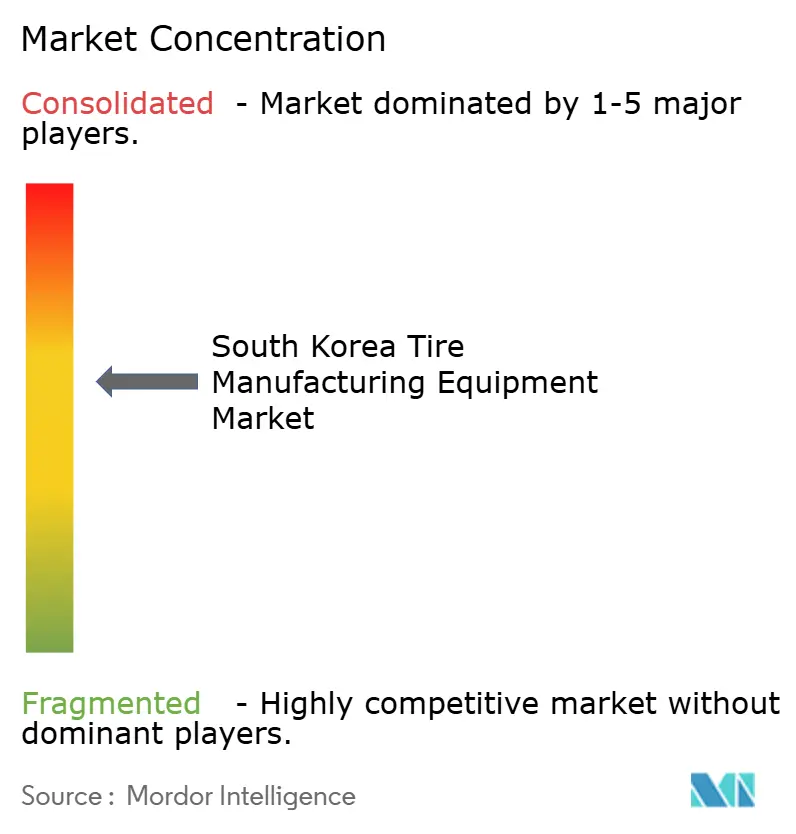
| Market Concentration | Medium |
Major Players *Disclaimer: Major Players sorted in no particular order Image © Mordor Intelligence. Reuse requires attribution under CC BY 4.0. | |
South Korea Tire Manufacturing Equipment Market Analysis by Mordor Intelligence
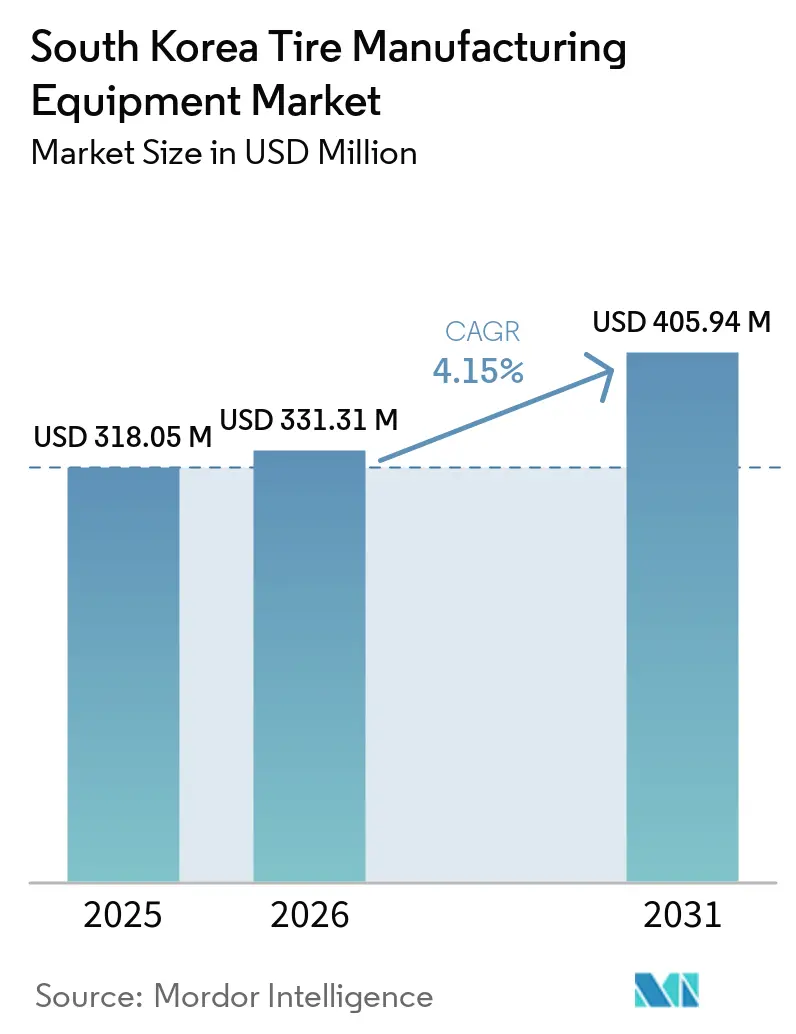
The South Korea tire manufacturing equipment market is expected to grow from USD 318.05 million in 2025 to USD 331.31 million in 2026 and reach USD 405.94 million by 2031, at a CAGR of 4.15% during the forecast period (2026-2031). Tire makers are channeling post-fire reconstruction, overseas green-field plants, and electric-vehicle (EV) product shifts into synchronized capital programs that emphasize precision curing presses, AI-enabled inspection, and IIoT-ready mixers. Passenger-car tire lines are retooling for 18-inch-plus rims. These rims, with their tighter tolerances, now demand CNC-controlled building machines and high-force presses. Meanwhile, government incentives now cover a significant share of qualified smart-factory investments, considerably reducing payback periods. Global suppliers are promoting electric curing technology, which significantly reduces CO₂ emissions and aligns with RE100 mandates. Concurrently, domestic firms are implementing predictive-maintenance platforms, boosting overall equipment effectiveness. Competitive dynamics intensify as China-based Mesnac leads in global sales, European vendor VMI secures 2025 innovation accolades, and Korean mold specialist Saehwa IMC integrates additive manufacturing into its tooling, expediting small-batch premium-tire initiatives.
Key Report Takeaways
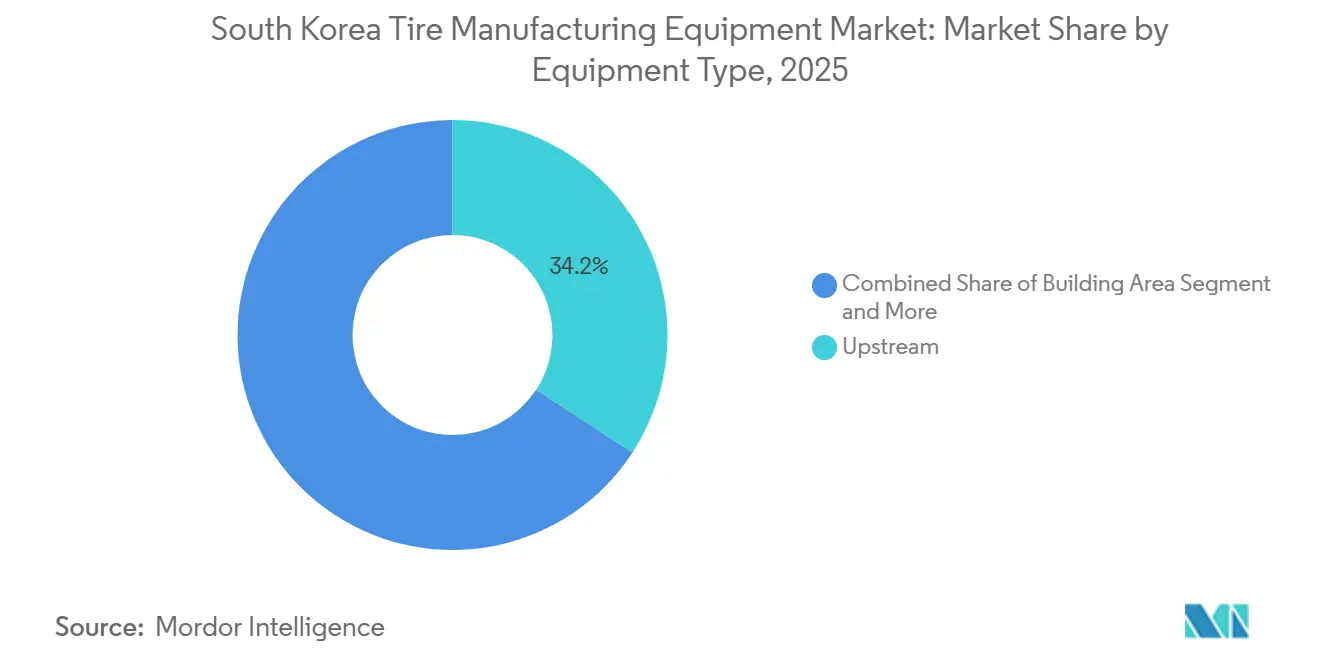
- By equipment type, upstream mixing and component preparation led with 34.16% of South Korea's tire manufacturing equipment market share in 2025, while curing and inspection are forecast to expand at a 7.63% CAGR through 2031.
- By tire design, radial equipment commanded 95.13% share of the South Korea tire manufacturing equipment market size in 2025 and is projected to grow at a 4.85% CAGR over 2026-2031.
- By vehicle type, passenger-car machinery accounted for a 48.34% share of the South Korea tire manufacturing equipment market in 2025 and is advancing at an 8.48% CAGR through 2031.
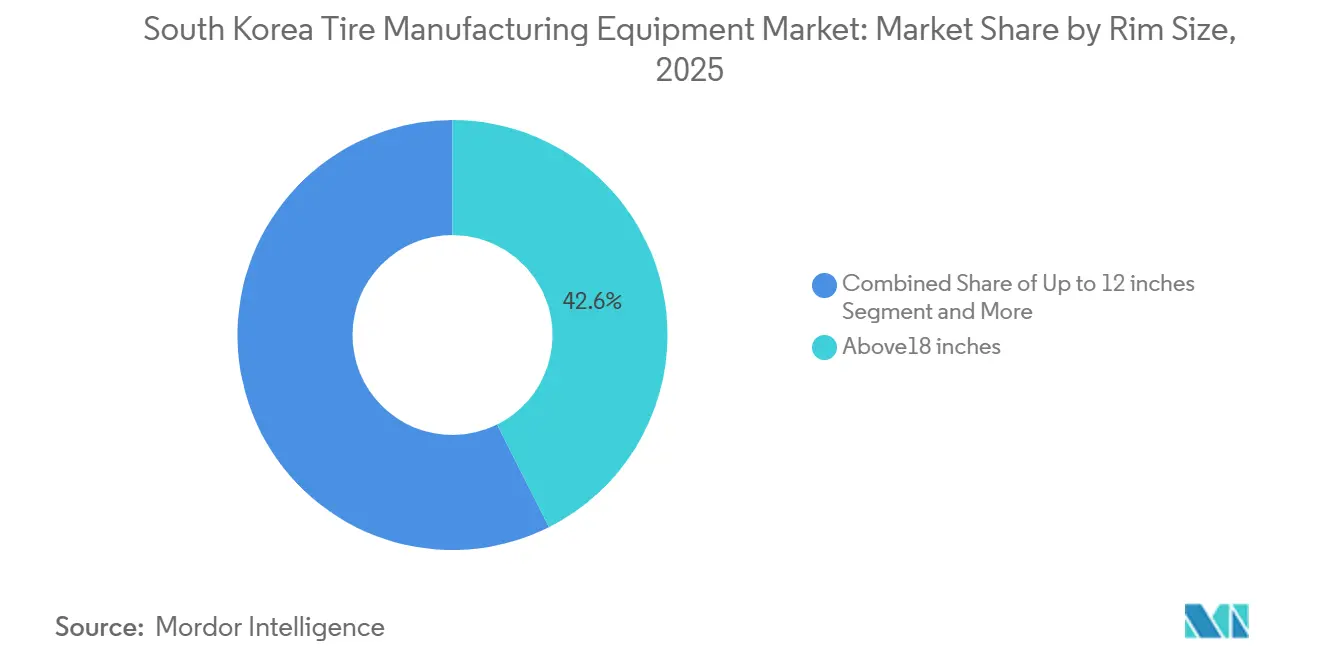
- By rim size, the above-18-inch segment captured 42.55% of South Korea's tire manufacturing equipment market share in 2025; it is set to grow at a 6.74% CAGR through 2031.
- By end-user, replacement and aftermarket lines held 82.36% share in 2025, while original-equipment lines posted the highest projected CAGR at 5.88% to 2031.
Note: Market size and forecast figures in this report are generated using Mordor Intelligence’s proprietary estimation framework, updated with the latest available data and insights as of January 2026.
Proportional positioning is established by comparing country level and regional contributions against the global total, including that of South korea. The tire manufacturing equipment market share in our global report expresses these relative weights.
South Korea Tire Manufacturing Equipment Market Trends and Insights
Drivers Impact Analysis*
| Driver | (~) % Impact on CAGR Forecast | Geographic Relevance | Impact Timeline |
|---|---|---|---|
| EV-Led Capacity Expansion | +1.2% | National | Medium term (2-4 years) |
| Shift to Above 18-Inch Rims | +0.9% | National | Short term (≤ 2 years) |
| Incentives for Smart and Automated Factories | +0.7% | Nationwide industrial complexes | Short term (≤ 2 years) |
| Energy-Efficient Mixers / Curing Presses | +0.6% | National | Long term (≥ 4 years) |
| Localization Push Amid Supply-Chain Risk | +0.5% | National | Medium term (2-4 years) |
| IIoT-Enabled Predictive Maintenance | +0.4% | Domestic and overseas Korean plants | Medium term (2-4 years) |
| Source: Mordor Intelligence | |||
EV-Led Capacity Expansion for Advanced Tires
Between 2024 and 2026, several projects are set to bolster EV-ready capacities in Tennessee, Hungary, Poland, and Hampyeong, South Korea [1]“Investment Presentation,” Hankook Tire, hankooktire.com. Each site is gearing up with machines, presses, and X-ray systems tailored to handle 20-inch-plus green tires, meeting the exacting standards of Porsche and BMW. The new production lines are integrating high-precision compound mixers, thinner-wall forming modules, and AI-driven inspections that can pinpoint sub-millimeter defects. This evolution underscores a robust and sustained demand for tire manufacturing equipment in South Korea.
Shift to Above 18-Inch Rims Driving Precision Machinery Demand
By 2025, equipment designed for 18-inch-plus tires will have gained significant traction in the market, and this trend will continue to grow. Automakers are increasingly promoting these larger wheels, which enhance both vehicle aesthetics and electric vehicle (EV) range. These larger SKUs offer higher profitability. Consequently, tire manufacturers are investing in CNC two-drum builders and high-closing-force presses, complete with automatic mold alignment.
Government Incentives for Smart and Automated Factories
Government incentives, including tax credits and depreciation benefits, are reducing the financial barriers to adopting advanced technologies such as robotics, machine vision, and MES systems. These measures are driving the integration of these technologies across plants in Gwangju, Ulsan, and Changnyeong. This trend is expected to play a pivotal role in strengthening the growth trajectory of South Korea's tire manufacturing equipment market in the coming years [2]“Smart Manufacturing Innovation 3.0,” KoreaTechDesk, koreatechdesk.com.
Energy-Efficient Mixers/Curing Presses to Cut Power Costs
Electric presses, such as HF TireTech's eCuring, significantly reduce CO₂ emissions by up to 50% [3]“eCuring Electric Press,” HF Mixing Group, hfmixinggroup.com. Additionally, when these presses operate on renewable energy, they enable manufacturing plants to fulfill the RE100 commitments increasingly prioritized by European OEMs. This capability highlights the rising importance of next-generation tire manufacturing equipment solutions in South Korea, as the market aligns with global sustainability goals and evolving industry demands.
Restraints Impact Analysis*
| Restraint | (~) % Impact on CAGR Forecast | Geographic Relevance | Impact Timeline |
|---|---|---|---|
| Rubber Price Volatility Tightening | -0.5% | South Korea | Short term (≤ 2 years) |
| VOC Limits Complicate Upgrades | -0.4% | South Korea | Medium term (2-4 years) |
| Domestic Replacement-Tire Demand | -0.3% | South Korea | Long term (≥ 4 years) |
| Mechatronics Talent Shortage | -0.2% | South Korea | Medium term (2-4 years) |
| Source: Mordor Intelligence | |||
Rubber Price Volatility Tightening Capex Budgets
In 2024, natural-rubber prices experienced a significant increase and are expected to remain elevated through 2026. This sustained rise in prices has been putting considerable pressure on profit margins, prompting some producers to delay their discretionary machinery purchases for an extended period, with some deferring such investments by up to two years.
Stricter VOC Limits Complicate Legacy Press Upgrades
The Clean Air Conservation Act, which enforces stricter exhaust limits at tire plants, has significantly impacted operations. To comply with the regulation requiring exhaust levels to remain within permissible limits, facilities are now compelled to undertake extensive retrofitting. This includes the installation of sealed systems, vapor recovery mechanisms, and catalytic oxidizers. These changes, implemented in recent years, have introduced substantial challenges for mid-sized sites, necessitating considerable investment and operational adjustments.
*Our forecasts treat driver/restraint impacts as directional, not additive. The impact forecasts reflect baseline growth, mix effects, and variable interactions.
Segment Analysis
By Equipment Type: Curing Systems Accelerate the Modernization Cycle
Curing and inspection equipment will lift the South Korea tire manufacturing equipment market size for this segment with 7.63% CAGR through 2031, outstripping mixers and builders as OEMs seek energy-frugal electric presses and inline vision modules. Replacement of steam presses with HF’s eCuring units, which cut CO₂ by half, is prioritized at fire-damaged Gwangju lines and upcoming Hampyeong factories. Mixers and calendaring machines retain a 34.16% 2025 share thanks to silica-rich EV compounds that need tighter dispersion. VMI's MILEXX platform, equipped with AI-inspection cameras, has significantly reduced operator headcount. Meanwhile, predictive-maintenance sensors have effectively lowered scrap rates. Component builders are now developing modular units that can be integrated into legacy pits in a short timeframe. This rapid integration is vital for plants operating continuously at high utilization rates.
Upstream suppliers are re-engineering bead-winding and inner-liner extruders to accommodate bio-based materials. This move ensures alignment with the sustainable rubber inputs mandated by European automakers. Additionally, energy-efficient drives combined with heated-nitrogen curing have significantly reduced electricity consumption. Consequently, curing systems have become the centerpiece of capital expenditure, driving the demand for modernization in South Korea's tire manufacturing equipment market, a trend expected to continue through 2031.



By Tire Design: Radial Dominance Drives Standardization
Radial machinery delivered 95.13% of South Korea's tire manufacturing equipment market share in 2025 and expanded on a 4.85% CAGR as bias demand lingers only in specialty niches. Standardized radial modules let vendors amortize R&D over larger volumes, compressing lead times to 16 weeks. VMI’s MAXX platform employs independently driven applicator rolls, ensuring precise belt placement, a critical factor for EV uniformity. Equipment producers, traditionally focused on bias, are now shifting their attention to low-volume off-road SKUs. These producers are adapting by offering rapid mold swaps within a short timeframe, a move aimed at maintaining their industry relevance.
As ultra-high-performance radials see increased fitment on EVs, the demand for precision intensifies. Presses are now calibrated to meet stringent control requirements for cavity temperatures. This push for uniformity solidifies radial investment as the industry standard. Consequently, South Korea's tire manufacturing equipment market remains firmly rooted in high-accuracy modules. These modules, known for their repeatability, are now being seamlessly transferred to new plants in the U.S. and Europe.
By Vehicle Type: Passenger-Car Lines Capture the Capex Spotlight
Passenger-car machinery represented 48.34% of South Korea's tire manufacturing equipment market size in 2025 and is projected to advance 8.48% CAGR through 2031 as SUVs and EVs migrate to 19-inch and 20-inch wheels. Light commercial segments leverage overlapping tooling, enhancing capex efficiency. By 2026, Hankook's expansion in Tennessee will significantly boost its capacity, focusing on electric vehicles.
In a bid to streamline operations, Hanwha has secured a contract to implement a turnkey system for Nexen in the Czech Republic. This system integrates Automated Guided Vehicles (AGVs) and high-bay warehouses, successfully reducing order-to-ship lead times. Meanwhile, while two-wheeler and off-road lines grapple with pricing pressures, they are leaning towards retrofit kits instead of investing in new presses. This trend has led to a surge in investments focused on passenger platforms. As a result, the South Korean tire manufacturing equipment market is increasingly prioritizing high-precision, high-margin modules tailored for car tires.
By Rim Size: Above-18-Inch Modules Propel Premium Shift
The above-18-inch category held 42.55% of South Korea's tire manufacturing equipment market share in 2025 and rose at 6.74% CAGR, supported by EV range benefits and consumer preference for larger wheels. Machines are now being built with reinforced transfer arms capable of handling green tires. Meanwhile, HF's presses are equipped with molds designed for large outer diameters.
Due to OEMs' ongoing demand for SKU refreshes, there's a push for modular presses. These presses have successfully reduced mold-change times significantly. While mid-sized lines continue to dominate in volume, their growth has slowed. In contrast, smaller segments are becoming more niche. Suppliers focusing on flexibility for larger rims and utilizing AI to monitor concentricity are poised to capture a larger share of the South Korean tire manufacturing equipment market.
By End-User: OEM Lines Gain Ground on Quality Mandates
OEM-dedicated equipment lifts the South Korea tire manufacturing equipment market size with the growth at a 5.88% CAGR by 2031, reflecting Hankook, Kumho, and Nexen’s insistence on IATF 16949-certified plants near European and U.S. automakers. Traceability functions track carbon intensity per tire, a prerequisite for Scope-3 disclosure. Tire equipment for replacement/aftermarket channel held the dominant share of 82.36% in 2025. Spending on replacement lines continues, albeit with modest growth, primarily targeting IIoT retrofits to enhance legacy capacities.
OEM runs require tighter uniformity and shorter batch cycles; recipe-driven builders and inline shearography secure zero-defect shipments. Replacement facilities, meanwhile, install wireless vibration sensors to prolong asset life by 24 months. The differential directs new machinery budgets toward OEM programs, reinforcing a quality-first trajectory for the South Korean tire manufacturing equipment market.
Geography Analysis
Domestic clusters in Gwangju, Changnyeong, Daejeon, and Pyeongtaek continue to drive demand. However, following a fire in 2025, Kumho's reconstruction has led to a temporary surge in local orders for electric presses and AI inspection, expected to last between 18 and 36 months. At the same time, the Hampyeong plant's investment in smart manufacturing underscores the ongoing capital influx into South Korea's tire manufacturing equipment market, even as replacement demand matures.
Internationally, from 2024 to 2029, significant investments are being directed into Poland, Hungary, Tennessee, and the Czech Republic, shifting a portion of equipment procurement focus towards Europe and North America. Each facility is committed to 100% renewable energy, influencing their preference for energy-efficient mixers and electric curing systems.
Government incentives bolster domestic advancements: In 2026, a major allocation for smart factories offers subsidies covering a significant portion of automation expenses. Additionally, perks from industrial complexes reduce land and utility costs further. While plants in regulatory VOC zones face mandatory retrofitting of abatement systems, they benefit from concurrent tax credits that alleviate some of this financial burden. Together, these elements ensure a harmonious balance between local modernization efforts and overseas green-field expansions, promoting stability in the growth of South Korea's tire manufacturing equipment market.
Mordor Intelligence examines the tire manufacturing equipment market across diverse other regional markets as well, including Europe, while also offering granular country-level perspectives for China, Japan, and United States and more.
Competitive Landscape
In the competitive landscape of tire manufacturing, around a dozen major players vie for dominance. VMI Group's MAXX and MILEXX platforms, which were honored as the 2025 innovation winner, are securing retrofit contracts by integrating hands-free AI quality loops. Meanwhile, HF TireTech is making strides by providing electric presses that comply with RE100 mandates and significantly reduce CO₂ emissions. Mesnac, leveraging its recent profit growth, is capitalizing on bundled RFID standards to solidify its foothold with clients in Southeast Asia, leading the global sales race.
On the domestic front, Saehwa IMC is utilizing additive-manufactured molds to expedite premium tire production. However, the company faces challenges: rising rubber costs and fluctuations in the won are tightening their pricing flexibility. Automation pioneers, including Cimcorp and Continental's proprietary AMRs, are introducing integrated material-flow cells, potentially sidestepping conventional press-builder interfaces. In a strategic move, Kobelco is diversifying its supply chain with an expansion in India, aiming to mitigate lead-time risks.
Today's buyers are increasingly seeking comprehensive turnkey solutions—encompassing equipment, MES, predictive maintenance, and training—to address the prevalent skill shortages in mechatronics. Vendors who respond to this demand not only enhance their service offerings but also benefit from sustained revenue streams. Collectively, the top suppliers command a significant market share, resulting in a concentration score indicative of a South Korean tire manufacturing equipment market that is moderately consolidated yet remains fiercely competitive.
South Korea Tire Manufacturing Equipment Industry Leaders
Saehwa IMC
HF TireTech Group
Kobelco (Kobe Steel)
VMI Group
Mesnac Co.
- *Disclaimer: Major Players sorted in no particular order

Recent Industry Developments
- January 2026: Nexen Tire secured OE supply for the new Kia Seltos, delivering tailored 16-, 18-, and inaugural 19-inch tires for gasoline and hybrid trims.
- December 2025: Kumho Tire signed a KRW 660.9 billion agreement with South Jeolla Province to build a 5.3-million-unit smart plant at Hampyeong, targeting full output by 2028.


South Korea Tire Manufacturing Equipment Market Report Scope
The scope includes segmentation by equipment type (upstream (mixing machines/rubber mixers, calendaring machines, extrusion machines, cutting machines, and others (cooling units, etc.)), building area (bead winding machine, tire building machine, and others (strip winding machine, etc.)), and curing and inspection (curing press machines, tire painting machines, and others (inspection machines, etc.)), tire design (bias and radial), vehicle type (two-wheelers, three-wheelers, passenger cars, light commercial vehicles, medium and heavy commercial vehicles, and ond ff-road vehicles), rim size (up to 12 inches, 12 to 18 inches, aabove 18 inches), and end-user (OEMs and replacement/aftermarket). Market size and growth forecasts are presented by value in USD.
| Upstream (Mixer and Component Preparation) | Mixing Machines / Rubber Mixers |
| Calendaring Machines | |
| Extrusion Machines | |
| Cutting Machines | |
| Others (Cooling Units, etc.) | |
| Building Area | Bead Winding Machine |
| Tire Building Machine | |
| Others (Strip Winding Machine, etc.) | |
| Curing and Inspection (Testing Area) | Curing Press Machines |
| Tire Painting Machines | |
| Others (Inspection Machines, etc.) |
| Bias |
| Radial |
| Two-wheelers |
| Three-wheelers |
| Passenger Cars |
| Light Commercial Vehicles |
| Medium and Heavy Commercial Vehicles |
| Off-Road Vehicles |
| Up to 12 inches |
| 12 to 18 inches |
| Above 18 inches |
| Original Equipment Manufacturers (OEMs) |
| Replacement / Aftermarket |
| By Equipment Type | Upstream (Mixer and Component Preparation) | Mixing Machines / Rubber Mixers |
| Calendaring Machines | ||
| Extrusion Machines | ||
| Cutting Machines | ||
| Others (Cooling Units, etc.) | ||
| Building Area | Bead Winding Machine | |
| Tire Building Machine | ||
| Others (Strip Winding Machine, etc.) | ||
| Curing and Inspection (Testing Area) | Curing Press Machines | |
| Tire Painting Machines | ||
| Others (Inspection Machines, etc.) | ||
| By Tire Design | Bias | |
| Radial | ||
| By Vehicle Type | Two-wheelers | |
| Three-wheelers | ||
| Passenger Cars | ||
| Light Commercial Vehicles | ||
| Medium and Heavy Commercial Vehicles | ||
| Off-Road Vehicles | ||
| By Rim Size | Up to 12 inches | |
| 12 to 18 inches | ||
| Above 18 inches | ||
| By End-User | Original Equipment Manufacturers (OEMs) | |
| Replacement / Aftermarket | ||


Key Questions Answered in the Report
What is the projected value of the South Korea tire manufacturing equipment market in 2031?
The South Korea tire manufacturing equipment market is forecast to reach USD 405.94 million by 2031.
Which equipment segment is expected to grow the fastest?
Curing and inspection machinery posts the highest CAGR at 7.63% between 2026-2031 as plants swap steam presses for electric, energy-saving units.
Which rim-size segment offers the highest margins for tire makers?
Above-18-inch passenger-car tires deliver 15-20% higher margins and are driving a 6.74% CAGR in related equipment demand.
How will EV adoption influence capital spending?
EV tires need precision mixing and large-rim presses, driving more than USD 3 billion of announced investments that buoy demand for advanced South Korea tire manufacturing equipment market solutions.
Page last updated on:





