
Europe Tire Manufacturing Equipment Market Size and Share
Market Overview
| Study Period | 2019 - 2031 |
|---|---|
| Forecast Data Period | 2026 - 2031 |
| Base Year Market Size (2025) | USD 0.92 Billion |
| Market Size (2026) | USD 0.96 Billion |
| Market Size (2031) | USD 1.22 Billion |
| Growth Rate (2026 - 2031) | 4.75 % |
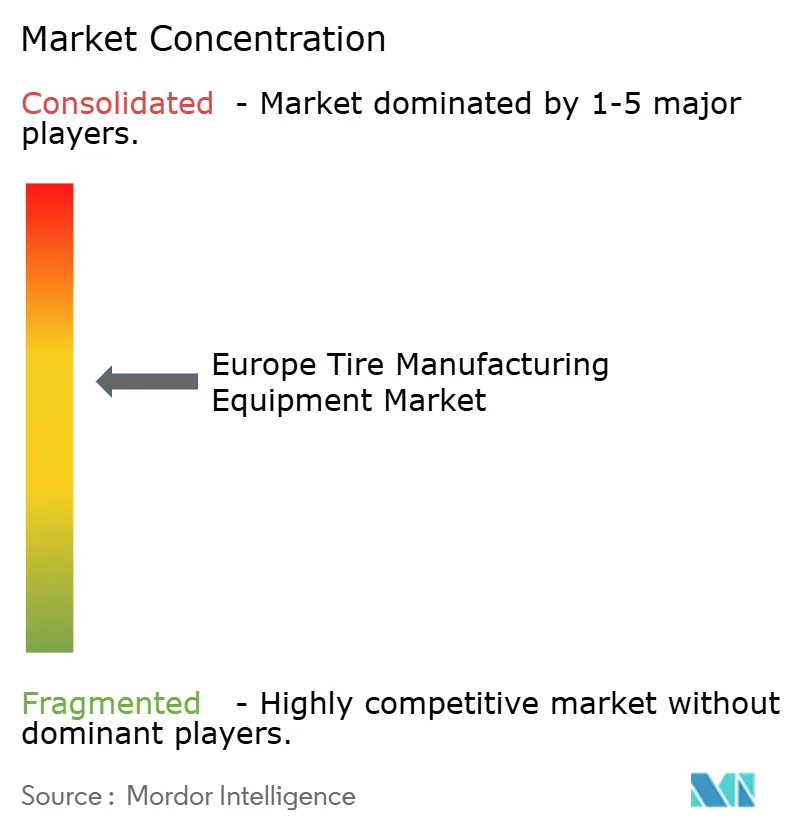
| Market Concentration | Medium |
Major Players *Disclaimer: Major Players sorted in no particular order Image © Mordor Intelligence. Reuse requires attribution under CC BY 4.0. | |
Europe Tire Manufacturing Equipment Market Analysis by Mordor Intelligence
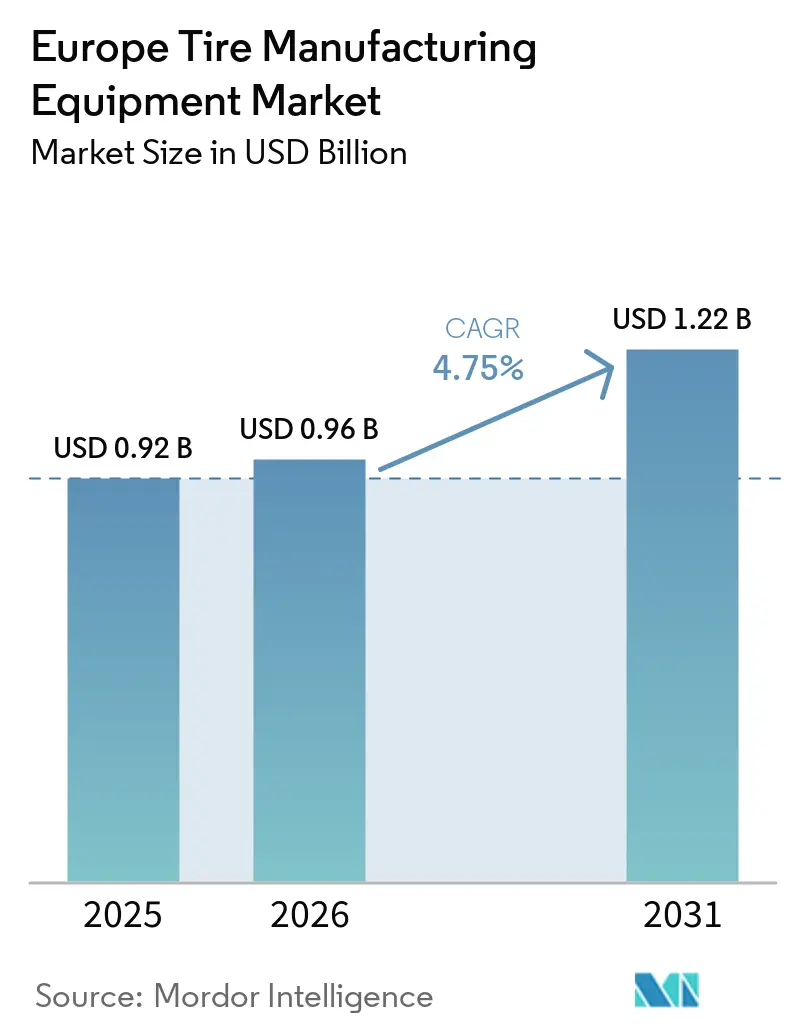
The European tire manufacturing equipment market size is expected to increase from USD 0.92 billion in 2025 to USD 0.96 billion in 2026 and reach USD 1.22 billion by 2031, growing at a 4.75% CAGR over 2026-2031. Building-area machinery led spending in 2025, yet the shift toward electric curing presses and automated inspection lines is redirecting budgets downstream. Radial-tire tooling now captures almost all new orders because bias construction has largely disappeared from European passenger and commercial segments. Suppliers are upgrading mixers to handle higher-silica EV compounds, while plants in Germany, Spain, and Romania race to comply with Euro 7 tire-particle limits. Circular-economy mandates are also reshaping capital plans as recovered carbon black feeds loop back into new compounds.
Key Report Takeaways
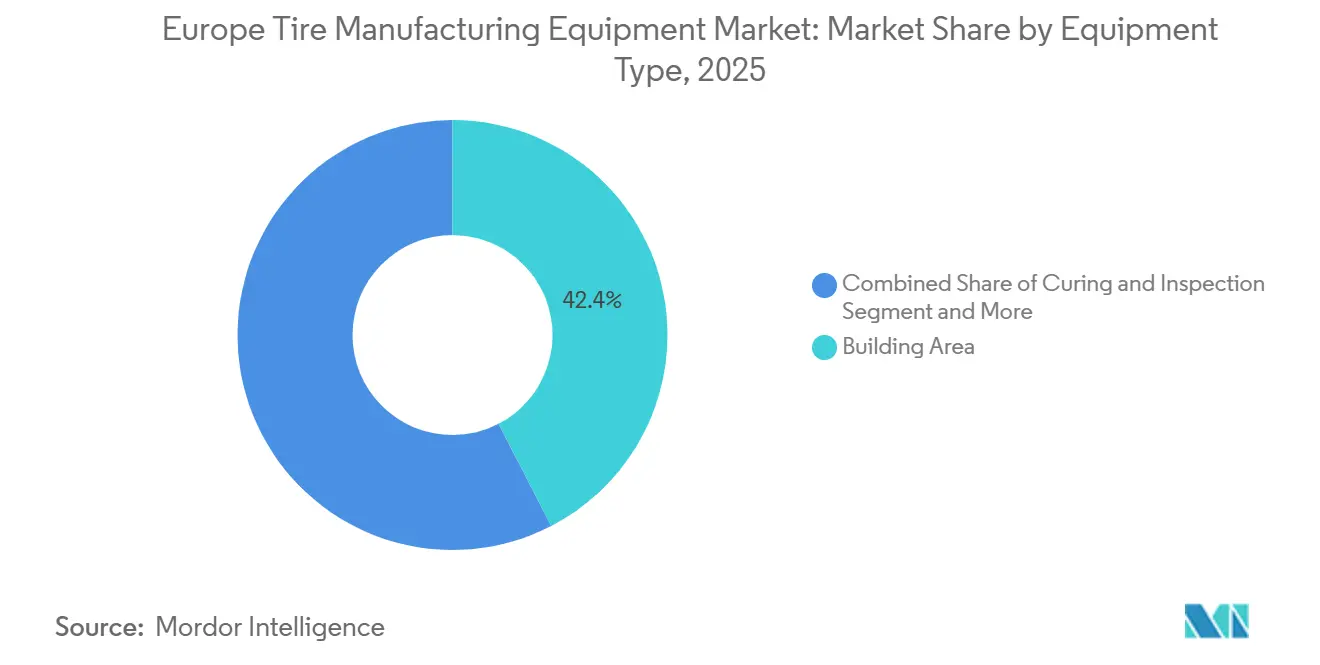
- By equipment type, Building-area machinery held 42.35% of the European tire manufacturing equipment market share in 2025, while Curing and Inspection lines are projected to expand at a 9.33% CAGR through 2031.
- By tire design, radial machinery accounted for 89.04% of the European tire manufacturing equipment market size in 2025 and is set to rise at a 5.45% CAGR to 2031.
- By vehicle type, Passenger-car lines commanded 49.12% revenue in 2025 and are advancing at an 8.74% CAGR on the back of high-rim EV fitments.
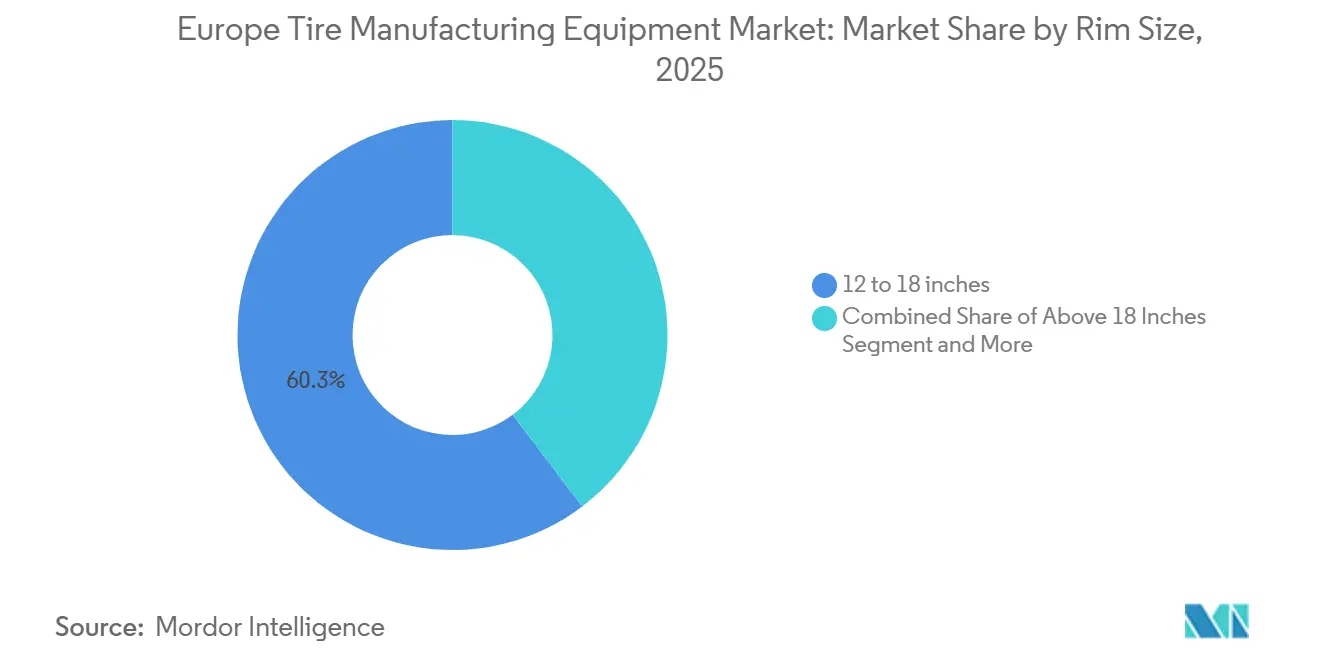
- By rim size, 12-to-18-inch tooling led with 60.33% share in 2025, yet above 18 inches is growing fastest at 6.86% CAGR as SUVs and EVs standardize on larger wheels.
- By end-user, OEMs captured 64.26% share in 2025 and are set to advance at a 6.42% CAGR by 2031.
- By country, Germany controlled 24.13% of 2025 spending, whereas the rest of Europe is the fastest-growing cluster at 5.96% CAGR as new capacity migrates eastward.
Note: Market size and forecast figures in this report are generated using Mordor Intelligence’s proprietary estimation framework, updated with the latest available data and insights as of January 2026.
Europe contributes to a system defined not by any single geography but by the interaction of many. The global tire manufacturing equipment market data by Mordor Intelligence represents that combined structure.
Europe Tire Manufacturing Equipment Market Trends and Insights
Drivers Impact Analysis*
| Driver | (~) % Impact on CAGR Forecast | Geographic Relevance | Impact Timeline |
|---|---|---|---|
| Surge in High-Silica Radial Compounds | +1.0% | Germany, France, Spain, Poland, Romania | Medium term (2-4 years) |
| Tire-Maker Capacity Expansions | +1.0% | Spain, Romania, the Czech Republic, and Poland | Short term (≤2 years) |
| Smart-Factory and Industry 4.0 Retrofits | +0.8% | Germany, France, the Netherlands, and Spain | Medium term (2-4 years) |
| Euro 7 Tire-Particle Limits | +0.7% | EU-wide, strongest in Germany, France, Italy | Short term (≤2 years) |
| Migration to Energy-Efficient Presses | +0.5% | Germany, France, Italy, Hungary | Medium term (2-4 years) |
| EU Circular-Economy Rules | +0.4% | Netherlands, Germany, France, Italy | Long term (≥4 years) |
| Source: Mordor Intelligence | |||
EV-Led Surge in High-Silica Radial Compounds Needs Advanced Mixing and Extrusion Lines
Mixers now demand higher shear to prevent scorching, as electric-vehicle tires are heavier per axle and incorporate silica. Kobelco’s 5THR rotor raises productivity by 43%, enabling OEMs to meet EV delivery windows without extra mixers [1]“5THR Rotor Productivity Study,” HF Mixing Group, hf-mixing-group.com. At Michelin’s Magnolia plant, an AI-controlled screw speed manages silica agglomeration, achieving an efficient extrusion rate. Bridgestone’s Burgos facility increased its capacity for high-rim EV sizes, necessitating the use of wider extrusion heads. Evonik's new precipitated-silica grades, which have tighter dispersion tolerances, have made rotor hardfacing a standard practice. As manufacturers aim for improved defect rates, the implementation of digital twins and predictive-maintenance algorithms has significantly enhanced uptime.
Tire-Maker Capacity Expansions Across Europe Drive Fresh Capex for Building Area Machines
Bridgestone, with a significant investment in Spain, is set to enhance its production capacity. This expansion necessitates the use of modular drums and servo ply feeders, enabling swift SKU transitions. Meanwhile, Apollo and Nokian are ramping up production in Hungary and Romania, leading to a surge in demand for new building machines by 2028. HF TireTech's HF ONE technology improves changeover efficiency and accommodates a wide range of SKUs. MESNAC's NPS one-stage builder offers a rapid cycle, perfectly suited for small-batch needs. According to The European Rubber Journal, substantial capital expenditures have been announced for 2025, with a significant portion of the budget allocated to building-area equipment.
Smart-Factory and Industry 4.0 Retrofits for Productivity and Traceability
By integrating mixer PLCs, drum construction, and curing presses into a unified plant-wide execution system, Michelin achieved significant operational savings. Bridgestone's Industry 4.0 transformation in Burgos realized notable efficiency gains through real-time monitoring of energy consumption and cycle times. Rockwell's MES integration has streamlined data from batches, drums, and presses, leading to a substantial reduction in changeover times. At Continental's retread facility in Hanover, autonomous robots enhance lot-level traceability by seamlessly transporting green tires and automatically updating RFID tags. Data from ETRMA highlights considerable R&D efforts from 2017 to 2023, with an increasing focus on cyber-physical retrofits, ensuring compliance with OEM audits.
Euro 7 Tire-Particle Limits Accelerate Uptake of Precision Curing and Inspection Machines
Under the upcoming Euro 7 regulations, limits are set on abrasion, with penalties imposed for uneven curing. In recent years, Michelin has installed advanced electric presses in Nyíregyháza, which maintain precise temperature control and utilize nitrogen heating for energy efficiency [2]“Michelin Electrifies Hungarian Tire Presses,” Diplomacy & Trade, diplomacyandtrade.hu. HF TireTech's eCuring platform significantly reduces CO₂ emissions while ensuring high-pressure accuracy. Rigdon has invested in new presses featuring photovoltaic integration to lower operating expenses. VMI's real-time optical and X-ray inspection systems identify belt misalignment prior to vulcanization, significantly reducing scrap and ensuring compliance with Euro 7 standards. Furthermore, certification frameworks, such as the UN R117 and the EU Type-Approval Directive, underscore the necessity of automated inspections.
Restraints Impact Analysis*
| Restraint | (~) % Impact on CAGR Forecast | Geographic Relevance | Impact Timeline |
|---|---|---|---|
| Natural-Rubber and Petrochemical Prices | −0.5% | Acute in Germany, France, Italy | Short term (≤2 years) |
| Capex and Long Payback Horizons | −0.4% | Spain, Italy, Portugal, Eastern Europe | Medium term (2-4 years) |
| Skilled-Maintenance Shortage | −0.3% | Slovakia, Poland, Romania, Czech Republic | Long term (≥4 years) |
| PFAS Ban Clouds Equipment-Seal | −0.2% | EU-wide, strongest in Germany, the Netherlands | Medium term (2-4 years) |
| Source: Mordor Intelligence | |||
Volatile Natural-Rubber and Petrochemical Prices Delay Equipment Purchases
In 2024, rubber prices reached their highest levels in over a decade, with significant spot-market fluctuations. This volatility has tightened margins for tire manufacturers and halted orders for high-value mixers. Meanwhile, synthetic feedstocks, closely tracking crude oil movements, introduced additional uncertainty in input costs. As a result, Sentury has put its Spanish greenfield project on hold, re-evaluating its assumptions. Furthermore, many mid-tier companies are now insisting on a period of stable pricing before they commit to new production lines. Given that raw materials account for a substantial portion of tire costs, any rise in feedstock risk directly impacts capital budgets.
High Capex and Long Payback Horizons Deter Smaller Manufacturers
Establishing a complete tire-building line requires significant investment, with returns expected over an extended period. Consequently, plants with lower production capacities often turn to refurbished assets. Individual HF Curemaster TBR presses pose a financial challenge for many retreaders. While the burgeoning secondary market—evidenced by Pelmar's acquisition of Continental’s Aachen assets—provides access to affordable legacy equipment, it falls short of Industry 4.0 standards. Moreover, anticipated closures in Germany and the Netherlands in 2026 are set to flood the market with used machines, exerting downward pressure on new-line pricing.
*Our forecasts treat driver/restraint impacts as directional, not additive. The impact forecasts reflect baseline growth, mix effects, and variable interactions.
Segment Analysis
By Equipment Type: Demand Shifts Downstream Toward Precision Curing
Curing and Inspection lines are projected to outpace all other categories at a 9.33% CAGR as plants electrify presses and tighten particle-emission control. The European tire manufacturing equipment market size for Building-area machines remains large, with 42.35% share in 2025, yet its share declines as OEMs divert budgets to energy-saving vulcanizers. Electric-heating retrofits that slot into existing frames allow fast swaps without civil works. Inspection systems using AI image analytics are bundled with new presses, giving suppliers like HF and VMI a cross-selling opportunity.
Upstream mixers and calenders still matter, especially with high-silica EV recipes. Kobelco’s 5THR and Comerio’s ZEUS calendars demonstrate that incremental productivity and footprint savings win orders even when headline growth lags. Strip winders and bead winders get uplift from Bridgestone and Nokian expansions, but overall growth trails that of curing lines because the latter tackle both Euro 7 compliance and carbon-neutral targets.



By Tire Design: Radial Dominance Locks in Specialized Tooling
Radial machinery captured 89.04% revenue in 2025 and will maintain a 5.45% CAGR growth trajectory through 2031. The European tire manufacturing equipment market share for bias tooling remains marginal, serving two-wheeler and niche off-road segments that now source many tires from Asia. Radial builders must handle wider belts for 18-to-24-inch passenger EV sizes, driving upgrades to servo tensioning and real-time belt tracking.
Bias presses are inexpensive and simple, yet demand is too low to entice most European OEMs. Plants that still need bias capability retrofit radial drums rather than buy standalone lines. Consequently, suppliers concentrate R&D on radial innovations such as AI-assisted foreign-object detection that can cut scrap by double digits.
By Vehicle Type: Passenger-Car EV Lines Lead Spending Uplift
Passenger-car tooling held 49.12% revenue in 2025 and is on track for an 8.74% CAGR. This segment anchors orders for wider extrusion heads, tangential mixers, and electric vulcanizers that manage high-silica formulations. Cyber-Tyre-ready building drums with wire-harness channels command 25-35% ASP premiums.
Commercial-vehicle lines grow more modestly but still require heavy-duty presses like HF Curemaster TBR with 62-67-inch molds. Two-wheeler and off-road demand stays small in Europe, so most suppliers bundle support for these tires into broader product families rather than design bespoke machines.
By Rim Size: Large-Diameter Tools Gain Ground
The 12-to-18-inch band still dominates, yet above 18 inches will expand at 6.86% CAGR as OEMs migrate to larger wheels for range and styling. Legacy equipment is being replaced as manufacturers turn to higher tonnage and larger cavity presses. By 2031, the market for large-rim presses in Europe's tire manufacturing equipment sector is projected to witness significant growth.
As compact-car tire production moves to Asia, 12-inch lines are diminishing. While truck and bus wheel diameters have stabilized, upgrades in this area are primarily centered on enhancing energy efficiency rather than expanding size capabilities.
By End-User: OEM Capex Outpaces Replacement Purchases
OEMs controlled 64.26% of 2025 sales and will keep a 6.42% CAGR because they earmark a notable share of sales for capex. Multiyear programs from Bridgestone, Pirelli, and Nokian underpin steady order books for turnkey integrators. The European tire manufacturing equipment industry sees aftermarket buyers choosing refurbished assets when payback horizons exceed five years.
Retreaders like Rigdon invest selectively in efficient presses but do not add full mixing or building capacity. As a result, OEM-centric suppliers sustain higher margins, while secondary-market brokers gain volume at lower price points.
Geography Analysis
Germany led spending with 24.13% in 2025, thanks to Michelin’s extrusion upgrade in Bad Kreuznach and Rigdon’s new retread presses. Automation at Continental’s Hanover site underlines the country’s drive for traceability, yet plant closures release used machinery that softens new-equipment demand.
Western Europe—the United Kingdom, France, Spain, Italy, Netherlands—accounts for roughly half of sales. Spain stands out: Bridgestone’s Burgos expansion pushes the European tire manufacturing equipment market toward larger-rim builders. France hosts R&D budgets but shifts production eastward, evidenced by Michelin’s conversion of Olsztyn, Poland.
Rest-of-Europe grows fastest at 5.96% CAGR. Nokian’s greenfield in Romania, Nexen’s Czech ramp-up, and Linglong’s Serbia site attract building machines, mixers, and electric presses. Skills shortages in Slovakia remain a drag, but foreign funding for training aims to close gaps. The Netherlands strengthens its circular-economy role through Circtec’s pyrolysis hub, which forces nearby plants to validate mixers for recovered carbon black [3]“Circtec Opens Delfzijl Plant,” Tyre and Rubber Recycling, tyreandrubberrecycling.com. Eastward migration will continue as subsidies and labor arbitrage remain compelling.
The tire manufacturing equipment market is analyzed by Mordor Intelligence across multiple other geographies. This is complemented by country-specific insights for United States, China, South Korea, and Japan, reflecting various localized market behavior and policy environments' coverage.
Competitive Landscape
The European tire manufacturing equipment market is characterized by moderate concentration, with a limited number of integrators operating in the space. HF TireTech, VMI, MESNAC, and Kobelco compete intensely, focusing on turnkey Industry 4.0 functionalities. Comerio’s ZEUS calendar highlights how Italian precision continues to dominate high-margin niches. Additionally, automation providers like Siemens and Rockwell are increasingly capturing retrofit budgets, a space traditionally controlled by OEMs.
AI capabilities have become a critical differentiator in the market. VMI’s foreign-object detection and HF’s eCuring nitrogen control address both Euro 7 standards and carbon reduction goals, enabling premium pricing strategies. Secondary-market players, such as Pelmar, challenge integrators by offering refurbished lines, though these often lack the advanced sensor suites demanded by major OEMs. While uncertainty surrounding PFAS regulations may delay certain upgrades, energy-efficient retrofits remain a priority for the industry.
Technology partnerships with leading tire manufacturers have emerged as the primary competitive advantage. These collaborations help integrators maintain their market position and navigate challenges such as evolving regulatory requirements and shifting customer demands. Despite uncertainties, the focus on innovation and sustainability continues to drive advancements in the tire manufacturing equipment market.
Europe Tire Manufacturing Equipment Industry Leaders
HF TireTech Group
MESNAC Co., Ltd.
Kobelco Stewart Bolling
VMI Group
Bartell Machinery Systems
- *Disclaimer: Major Players sorted in no particular order

Recent Industry Developments
- March 2026: MESNAC debuted its international NPS one-stage builder at Tire Technology Expo in Hannover, showing a 35-second cycle and unmanned operation that underpins smart, sustainable plants.
- March 2026: Comerio Ercole won Tire Manufacturing Innovation of the Year for its ZEUS calendering line, recognized for higher stability and productivity.
- February 2026: German retreader Rigdon has advanced its car tire retreading plans by ordering 35 vulcanization presses for bead-to-bead mold cure retreading.
- June 2025: Black Donuts opened InTire Labs in Tampere, Finland, to accelerate sustainable compound R&D, offering confidential mixing, milling, and curing services.


Europe Tire Manufacturing Equipment Market Report Scope
The scope includes segmentation by equipment type (upstream (mixing machines/rubber mixers, calendaring machines, extrusion machines, cutting machines, and others (cooling units, etc.)), building area (bead winding machine, tire building machine, and others (strip winding machine, etc.)), and curing and inspection (curing press machines, tire painting machines, and others (inspection machines, etc.)), tire design (bias and radial), vehicle type (two-wheelers, three-wheelers, passenger cars, light commercial vehicles, medium and heavy commercial vehicles, and ond ff-road vehicles), rim size (up to 12 inches, 12 to 18 inches, aabove 18 inches), and end-user (OEMs and replacement/aftermarket). The analysis also covers country-level segmentation, including Germany, the United Kingdom, Spain, Italy, France, the Netherlands, and the rest of Europe. Market size and growth forecasts are presented by value in USD.
| Upstream (Mixer and Component Preparation) | Mixing Machines / Rubber Mixers |
| Calendaring Machines | |
| Extrusion Machines | |
| Cutting Machines | |
| Others (Cooling Units, etc.) | |
| Building Area | Bead Winding Machines |
| Tire Building Machines | |
| Others (Strip Winding Machines, etc.) | |
| Curing and Inspection (Testing Area) | Curing Press Machines |
| Tire Painting Machines | |
| Others (Inspection Machines, etc.) |
| Bias |
| Radial |
| Two-Wheelers |
| Three-Wheelers |
| Passenger Cars |
| Light Commercial Vehicles |
| Medium and Heavy Commercial Vehicles |
| Off-Road Vehicles |
| Up to 12 inches |
| 12 to 18 inches |
| Above 18 inches |
| Original Equipment Manufacturers (OEMs) |
| Replacement / Aftermarket |
| Germany |
| United Kingdom |
| Spain |
| Italy |
| France |
| Netherlands |
| Rest of Europe |
| By Equipment Type | Upstream (Mixer and Component Preparation) | Mixing Machines / Rubber Mixers |
| Calendaring Machines | ||
| Extrusion Machines | ||
| Cutting Machines | ||
| Others (Cooling Units, etc.) | ||
| Building Area | Bead Winding Machines | |
| Tire Building Machines | ||
| Others (Strip Winding Machines, etc.) | ||
| Curing and Inspection (Testing Area) | Curing Press Machines | |
| Tire Painting Machines | ||
| Others (Inspection Machines, etc.) | ||
| By Tire Design | Bias | |
| Radial | ||
| By Vehicle Type | Two-Wheelers | |
| Three-Wheelers | ||
| Passenger Cars | ||
| Light Commercial Vehicles | ||
| Medium and Heavy Commercial Vehicles | ||
| Off-Road Vehicles | ||
| By Rim Size | Up to 12 inches | |
| 12 to 18 inches | ||
| Above 18 inches | ||
| By End-User | Original Equipment Manufacturers (OEMs) | |
| Replacement / Aftermarket | ||
| By Country | Germany | |
| United Kingdom | ||
| Spain | ||
| Italy | ||
| France | ||
| Netherlands | ||
| Rest of Europe | ||


Key Questions Answered in the Report
How large is the Europe tire manufacturing equipment market in 2026?
The Europe tire manufacturing equipment market size is USD 0.96 billion in 2026 and is forecast to reach USD 1.22 billion by 2031 at a 4.75% CAGR.
Which equipment segment is growing fastest?
Curing and Inspection lines are projected to grow at 9.33% CAGR through 2031 as plants adopt electric presses and automated inspection to meet Euro 7 particle limits.
Why are OEMs investing more than retreaders?
OEMs allocate roughly 11.7% of sales to capex and demand Industry 4.0 traceability, driving a 6.42% CAGR, while retreaders prefer refurbished assets due to longer payback periods.
How will Euro 7 regulation influence equipment demand?
Euro 7 caps tire-particle emissions, prompting rapid adoption of precision electric curing and real-time inspection systems, which boosts downstream equipment orders.
Page last updated on:


 Your data is secure and never sold or shared.


