
Asia-Pacific Material Handling Equipment Market Size and Share
Market Overview
| Study Period | 2020 - 2031 |
|---|---|
| Forecast Data Period | 2026 - 2031 |
| Historical Data Period | 2020 - 2024 |
| Growth Rate | 10.74 % |
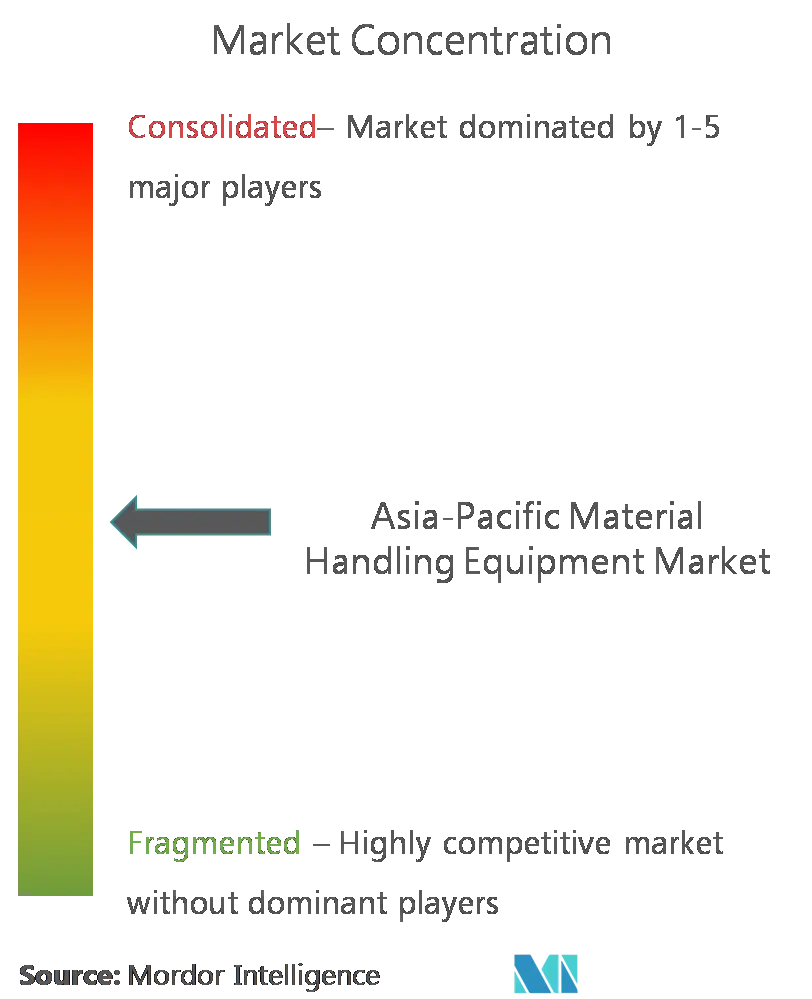
| Market Concentration | Medium |
Major Players *Disclaimer: Major Players sorted in no particular order Image © Mordor Intelligence. Reuse requires attribution under CC BY 4.0. | |
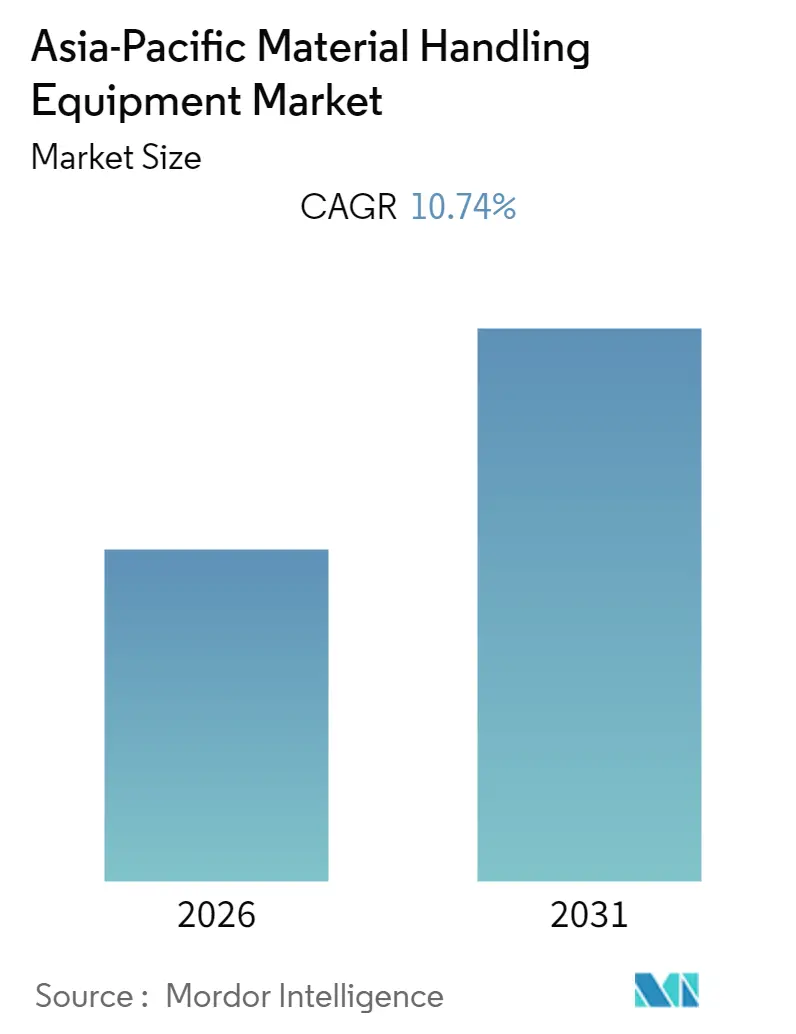
Asia-Pacific Material Handling Equipment Market Analysis by Mordor Intelligence
The Asia-Pacific material handling equipment market size is expected to register a CAGR of 10.74% during the 2026-2031 forecast period.
- Developing countries in Asia, such as India, are investing in material handling equipment significantly. According to the Wisconsin Economic Development Corporation, the Indian market for materials handling equipment (MHE), accounting for about 13% market share of the country's construction equipment industry, has witnessed significant growth in the recent past.
- Domestic air transport in China and India is expected to increase four times and six times, respectively. Considering the rapid growth rate of China and India, these countries, along with Japan and Indonesia, are expected to be among the ten largest passenger markets which are expected to impact the market's growth positively over the forecast period.
- According to the 2019 Industry Report of MHI, about 65% of supply chain professionals revealed that hiring and retaining a skilled workforce continue to be among the biggest obstacles faced by their businesses. Since millennials are known for placing a high importance on the quality of time-off and the ability to work on top-notch automated projects, automated warehouses are being marked as lucrative sources of employment and advanced learning.
Note: Market size and forecast figures in this report are generated using Mordor Intelligence’s proprietary estimation framework, updated with the latest available data and insights as of 2026.
Asia-Pacific Material Handling Equipment Market Trends and Insights
Electric Material Handling Equipment are Driving the Market
When it comes to material handling trucks the right choice of forklift can improve the overall performance and reduce the operational cost. However, some businesses are turning to electric equipment, as it offers improved efficiency, good battery power, low cost of ownership, low maintenance costs. These electric trucks are equipped with outdoor-friendly pneumatic tires too. This much-needed transformation is driven by the growing interest of customers who are opting for cleaner, higher-capacity trucks that can withstand heavy lifting and perform the same as an IC truck and are environmentally friendly.
Electric trucks are adopted in indoors for quite a few years for light operations. But now electric forklifts are efficiently working outdoors, for various demanding tasks performed by IC trucks. They are now been adopted in tough industries such as recycling centers and construction.
Lithium-ion batteries are becoming a popular option for electric lift trucks batteries as they do not require high-level maintenance as compared to lead-acid, also hydrogen and other gases which are produced by lead-acid are not acceptable in clean food production and storage areas.
According to the Industrial Truck Association's data, electric and internal combustion truck sales grew at a rate of 2.8% and 2.7%, in 2019, and electric products hold nearly two-thirds of the forklift market.
While many local players in the market are entering into the partnership with other regional players to increase their market presence
In 2020, Toyota Material Handling (TMH), introduced new 3,000- and 3,500-pound capacity electric lift trucks models which are equipped with Toyota-designed AC motors that are built to deliver high performance to boost both productivity and reduce operational cost.
In 2019, BYD which is one of the leaders in LiFePO4 lithium technology has partnered with eForklift for distributing its products in the Australian and New Zealand market.
Whereas in 2019, Encarna invests in Hyundai Material Handling, through this investment Encarna will expand its training portfolio to process with the new CACES (certificate of safe driving skills) training reforms.
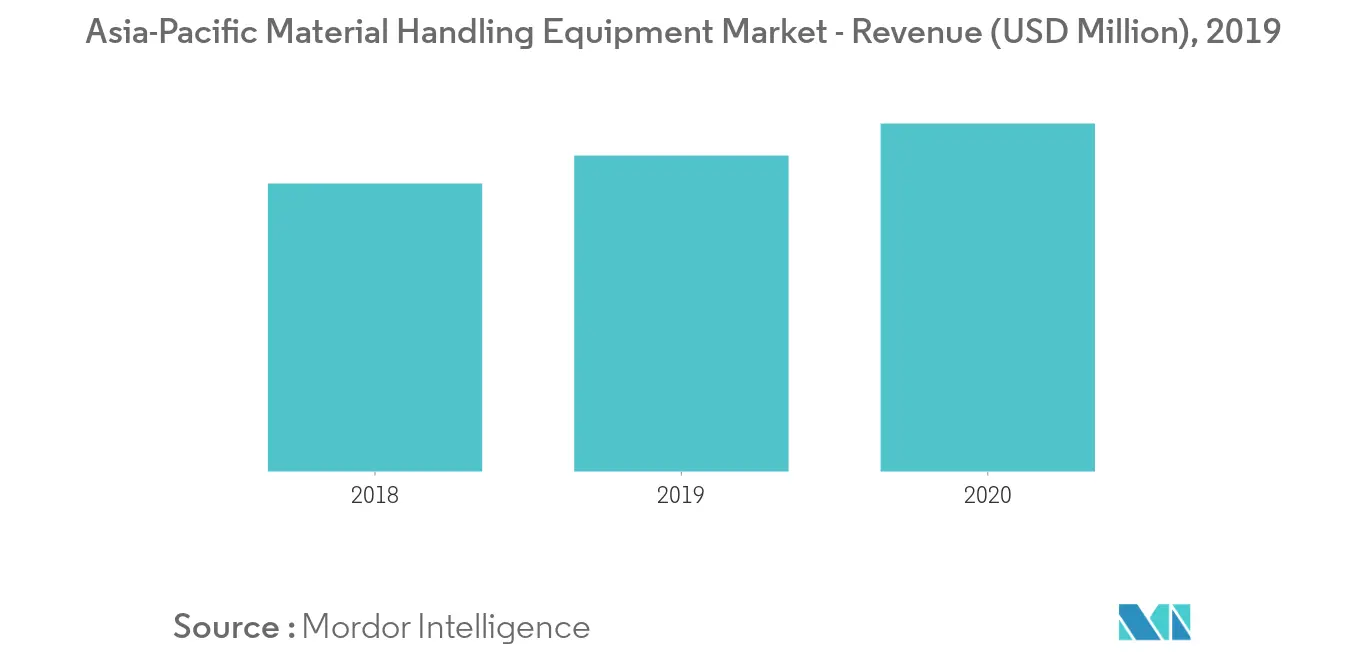


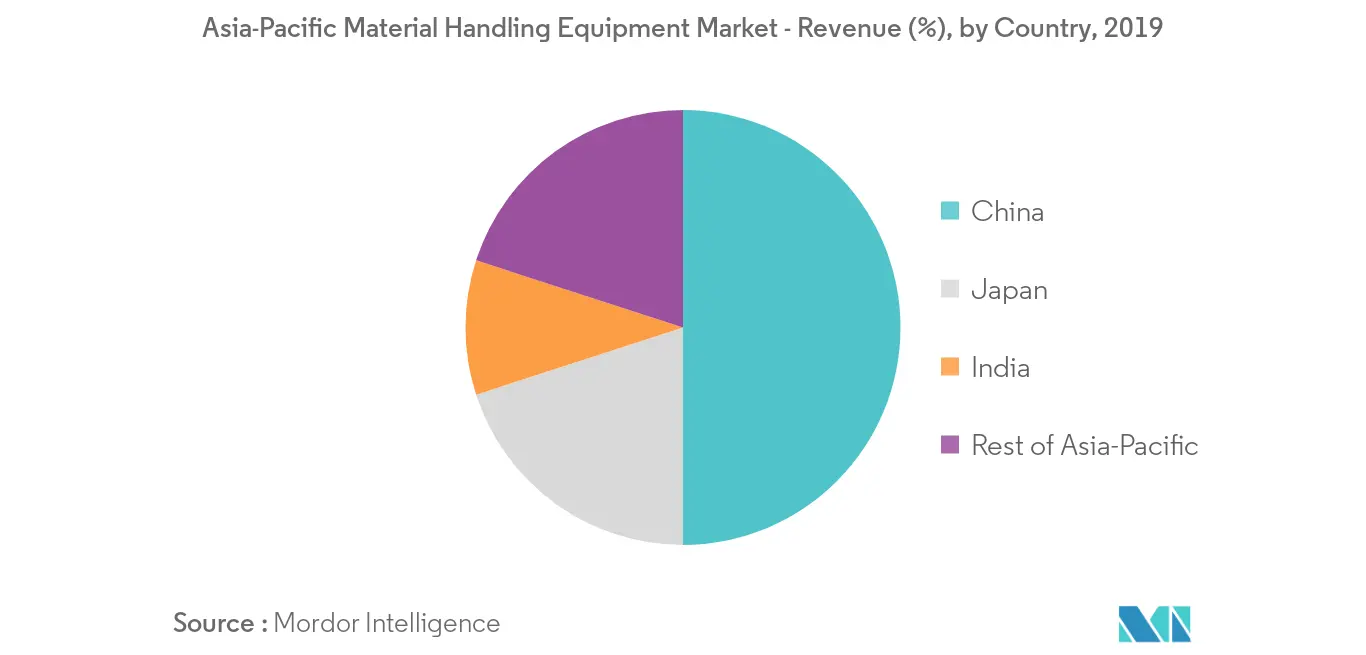
China is anticipated to have the largest share in the market
China has been a prominent contributor to the growth of the material handling equipment market in the Asia-Pacific region. The increasing demand for AMH products across industries, such as manufacturing, automotive, and e-commerce, among others, is boosting the market's growth positively. China has the presence of almost all the market leaders and the ecosystem of China helps in the growth of the market. As various events are being organized with the help of market participants often for showcasing the latest advancements and better business opportunities. For instance
The 2020 Beijing International Intelligent Warehousing and Material Handling Technology Expo (SMTS 2020) would be held on June 9-11, 2020, at the China International Exhibition Center in Beijing. Various new material handling equipment, such as automatic guided truck, handling and conveying system, forklift, trailer, tractor, palletizing robot, and handling robot, among others, are expected to be presented at this event.
While in February 2020, logistics automation specialist, Swisslog, member of the KUKA Group, received an order from IKEA Supply (Malaysia). Located at Pulai Indah, the Distribution Center run by Inter IKEA would be its most significant regional distribution center in the Asia-Pacific region.
Competitive Landscape
The Asia-Pacific material handling equipment market is fragmented due to the presence of many local players and the increasing presence of global players in the region such as Toyota Material Handling, Daifuku Co., Ltd., XCMG Group and Noblelift Intelligent Equipment Co. Ltd.. Many global players are forming joint ventures with local companies and acquiring them to increase their market presence and diversifying their product portfolio. Also, companies are incorporating the latest features in their material handling equipment to provide the best experience to their customers. For instance,
In 2019, Daifuku Co., Ltd. announced the completion of the acquisition of India-based Vega Conveyors & Automation Private Limited. Vega deals in consulting, designing, manufacturing, and installation of material handling equipment in the Indian market.
In 2020, Toyota Material Handling has announced the launch of more than 190 models that will be available in 2020. Most of the equipment are Class III models. Around 150 were launched in March and the other 40 options will be launched shortly. Toyota's new range includes many features such as bars with power hookups, an operator cooling fan, LED work lights.
Asia-Pacific Material Handling Equipment Industry Leaders
DAIFUKU Co. Ltd.
Murata Machinery Ltd.
Toyota Industries Corporation
XCMG Construction Machinery Co., Ltd.
Noblelift Intelligent Equipment Co. Ltd.
- *Disclaimer: Major Players sorted in no particular order

Market Opportunities and Future Outlook
Warehouse and in-plant automation programs across Asia-Pacific are creating demand for integrated material flow solutions that span industrial trucks, conveyors, robots, and software, particularly as operations shift toward higher SKU complexity and EV-related components. In July 2026, Volvo Group Australia opened a 21,000-square-metre automated parts distribution center in Minto, Sydney, anchored by high-density automated storage and retrieval, which reflects continued capex into automated material handling and parts readiness. Kardex Malaysia also announced an AutoStore StarterGrid partnership with Fordcon Jaya Sdn Bhd for automated automotive component warehousing, pointing to continued interest in modular automation that can be deployed in space-constrained facilities.
Capacity expansion by equipment suppliers and industrial groups is further broadening the market for electric and automated handling solutions. In June 2026, Godrej Enterprises Group set up a new material handling manufacturing facility in Khalapur, India, with an initial capacity of 15,000 units annually, which supports faster warehouse buildouts and forklift replacement cycles. On the systems side, Daifuku outlined a fiscal 2024-2027 investment plan that includes capacity expansion in Japan and the acquisition of Germany-based Eisenmann to strengthen automotive conveyor and paint systems capabilities, supporting a more end-to-end delivery approach for automotive, electronics, and adjacent manufacturing users across the region.
Recent Industry Developments
- July 2026: Daifuku Co., Ltd. completed the acquisition of all shares in Germany-based Eisenmann GmbH, making it a wholly owned subsidiary. The transaction expands Daifuku's capabilities in automotive-related systems such as conveyor and paint solutions, supporting larger, more integrated project scopes for manufacturers operating across Asia-Pacific.
- May 2026: Daifuku Co., Ltd. announced a strategic growth investment plan of 52 billion yen for 2026-2029, covering factory redevelopments and M&A activities. The planned spend indicates continued capacity and capability buildup for automated material handling offerings serving high-throughput logistics and industrial users.
- April 2026: Daifuku Co., Ltd. completed construction of a new factory building at Shiga Works, Japan, increasing production capacity for cleanroom material handling systems by 30%. The added output supports rising requirements from semiconductor and electronics manufacturing supply chains that demand specialized, contamination-controlled handling.


Research Methodology Framework and Report Scope
Market Definition and Coverage
This market is defined as the revenue generated from equipment and systems used to move, store, protect, and control materials within factories, warehouses, ports, and logistics facilities across Asia-Pacific.
Scope exclusions: We exclude non-equipment warehouse labor services and general construction contracting that is not tied to material handling equipment supply.
Segmentation Overview
- By Product Type
- Hardware
- Software
- Services
- By Autonomy Type
- Automatic
- Manual
- By Equipment Type
- Robot
- Industrial trucks
- Conveyor
- Others
- By End-user Vertical Type
- Airport
- Automotive
- Food and Beverages
- Others
- By Country
- India
- China
- Japan
- South Korea
- Rest of Asia-Pacific
Data Sources, Market Sizing, and Validation
Desk Research
We started by setting clear boundaries on what counts as material handling equipment in Asia-Pacific and then built the data spine for demand and supply mapping. Public sources were used to ground key activity indicators and policy context, such as national statistics agencies in China, Japan, India, and Australia, UN Comtrade trade flows, the World Bank macro series, and International Labour Organization wage and employment data.
To connect activity to equipment demand, we also referred to sources such as port and airport authorities for throughput signals, customs and excise notifications where relevant, and peer reviewed papers on warehouse automation adoption. Company annual reports, investor presentations, and press releases helped confirm product mix shifts and expansion timing. Where available, we used paid subscriptions for company financials and patent databases to fill private company gaps and verify technology direction. The desk sources listed are illustrative, and many other public and paid references were used for cross-checks and clarification.
Primary Interviews and Surveys
After the desk build, we validated the market logic through expert calls and structured surveys with equipment makers, distributors, system integrators, large end users, and logistics operators across major Asia-Pacific economies. Respondent inputs were used to align assumptions on typical selling prices, project lead times, replacement cycles, and how automation penetration is changing by warehouse type, which helped close gaps that are not visible in public data.
Distribution of primary research fieldwork respondents
| Company type | Respondent position |
|---|---|
| Top tier: 38% | CXOs: 13% |
| Mid tier: 40% | Functional/Unit leaders: 29% |
| Smaller Players: 22% | Managers: 58% |
Market-Sizing & Forecasting
The core sizing uses a top-down demand pool reconstruction, where production, trade, and activity indicators are translated into equipment demand by country and then rolled up to Asia-Pacific. To keep the totals realistic, we corroborated outputs with selective bottom-up checks such as sampled average selling price (ASP) times unit volumes for industrial trucks and conveyors, along with channel checks on large project deployments.
Key model inputs included manufacturing output trends, warehouse and logistics capacity additions, port throughput and airport cargo handling signals, automation penetration in new facilities, and typical ASP progression by equipment type and automation level. When product level gaps existed, we used proxy splits from interviews and public mix disclosures, and then applied conservative ranges before finalizing a single value. Forecasting relied on scenario analysis supported by expert consensus on capex cycles, electrification and automation adoption speed, and macro conditions, followed by smoothing of outlier years to avoid one-off spikes driving the curve.
Data Validation & Update Cycle
Model results were checked against independent signals, including trade movement direction, major capacity additions, and reported order momentum across the region, before numbers were finalized. Outliers were investigated through back checks on assumptions like ASP changes, import intensity, and timing of large automation projects, and then reviewed again in an internal analyst pass.
Reports are refreshed annually, and interim updates are triggered when material events occur, such as sharp currency moves, policy changes affecting manufacturing and logistics, or major investment announcements that shift near-term demand. Before delivery, a fresh review is done so the final version reflects the latest available data and validated assumptions.
Mordor Intelligence's Asia Pacific Material Handling Equipment Market Size Versus Other Published Estimates
Published market values for Asia-Pacific material handling equipment often differ because the scope can shift between manual and automated systems, some totals include software and services, and some use different currency timing for conversion into USD. Even when the same region is covered, the year chosen for price normalization and the way replacement demand is treated can widen the spread.
A refresh-led difference also shows up in pricing logic, because equipment ASPs move with steel, batteries, freight, and discounting, and those changes do not hit all countries at the same time. By rechecking currency timing and ASP progression during the latest update pass, and then validating the implied volumes against activity signals like manufacturing output and logistics expansion, Mordor Intelligence keeps the estimate aligned to what buyers are actually paying in the current cycle.
Benchmark comparison
| Source | Market Size | Gaps in Research Methodology |
|---|---|---|
| Mordor Intelligence | USD 0.00 B (2025) | |
| Regional Consultancy A | USD 102.00 B (2024) | Uses a single point estimate with unclear base year pricing, and the scope appears to bundle adjacent warehouse services along with equipment, which inflates the total. |
| Global Consultancy B | USD 62.80 B (2026) | Starts from a later base year and applies a broad CAGR without showing how ASP changes are handled by equipment type, which can understate near-term volatility in pricing and mix. |
The comparison shows that most of the spread comes from what gets counted as equipment revenue, which year and currency rate are used for USD conversion, and how ASPs are carried forward across countries. Our approach stays traceable because each step ties back to observable demand signals and interview-validated price and mix assumptions, which makes the final value easier to replicate and update.


Key Questions Answered in the Report
What is the current Asia-Pacific Material Handling Equipment Market size?
The Asia-Pacific Material Handling Equipment Market is projected to register a CAGR of 10.74% during the forecast period (2026-2031)
Who are the key players in Asia-Pacific Material Handling Equipment Market?
DAIFUKU Co. Ltd., Murata Machinery Ltd., Toyota Industries Corporation, XCMG Construction Machinery Co., Ltd. and Noblelift Intelligent Equipment Co. Ltd. are the major companies operating in the Asia-Pacific Material Handling Equipment Market.
What years does this Asia-Pacific Material Handling Equipment Market cover?
The report covers the Asia-Pacific Material Handling Equipment Market historical market size for years: 2019, 2020, 2021, 2022, 2023 and 2024. The report also forecasts the Asia-Pacific Material Handling Equipment Market size for years: 2026, 2027, 2028, 2029, 2030 and 2031.
Page last updated on:





