
South Korea EV Charging As A Service Market Size and Share
Market Overview
| Study Period | 2019 - 2031 |
|---|---|
| Forecast Data Period | 2026 - 2031 |
| Base Year Market Size (2025) | USD 31.5 Million |
| Market Size (2026) | USD 39.38 Million |
| Market Size (2031) | USD 109.55 Million |
| Growth Rate (2026 - 2031) | 22.71 % |
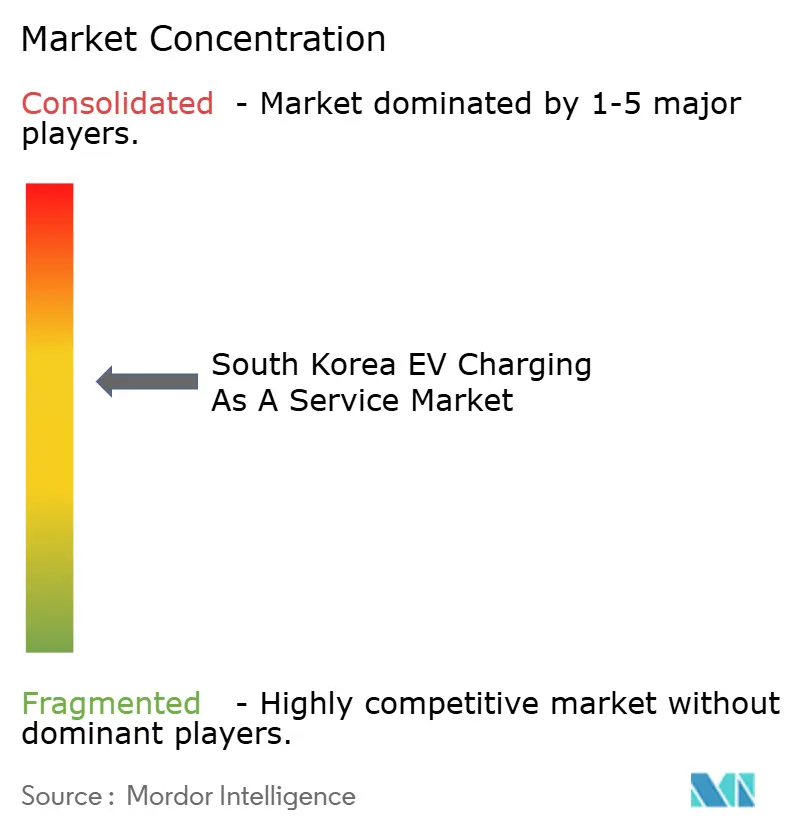
| Market Concentration | Medium |
Major Players *Disclaimer: Major Players sorted in no particular order Image © Mordor Intelligence. Reuse requires attribution under CC BY 4.0. | |
South Korea EV Charging As A Service Market Analysis by Mordor Intelligence
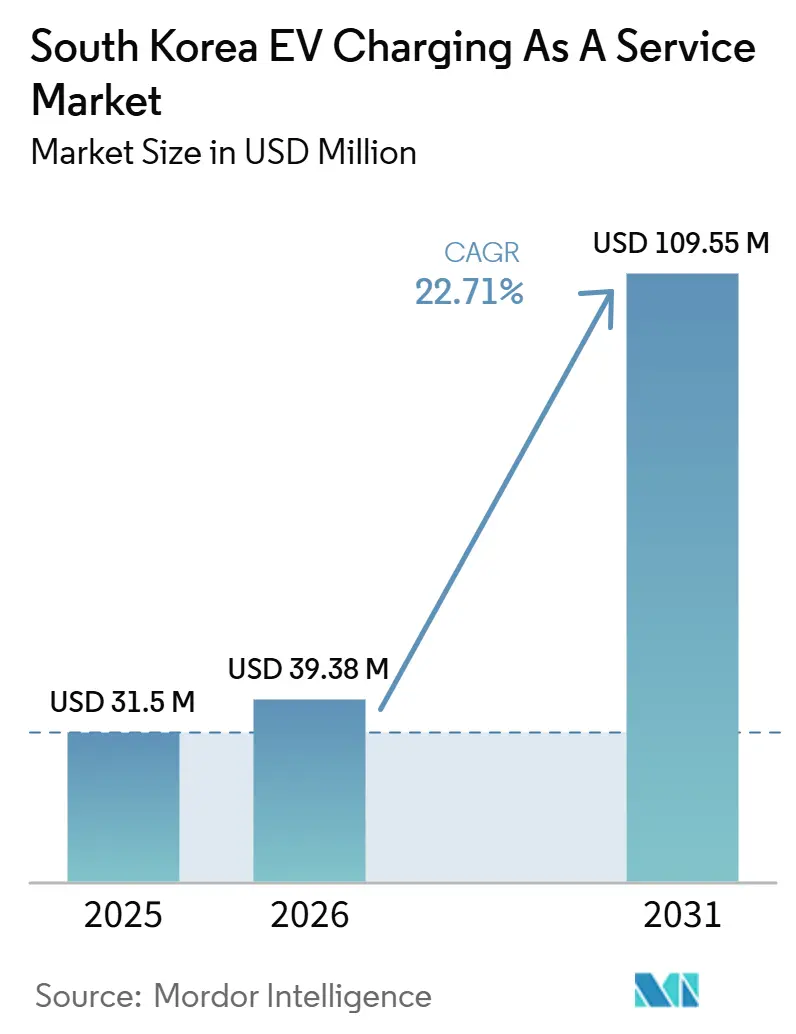
The South Korea EV Charging As A Service market size was valued at USD 31.50 million in 2025 and estimated to grow from USD 39.38 million in 2026 to reach USD 109.55 million by 2031, at a CAGR of 22.71% during the forecast period (2026-2031). Rising subsidy allocations that reward charger uptime, oil-refiner conversion of service stations, and corporate fleet electrification mandates are reshaping capital flows toward asset-light service contracts. Operators increasingly deploy AI-based load balancing to extract margin from constrained grids, while megawatt-charging pilots position the South Korea EV Charging As A Service market for heavy-duty fleet adoption. By the end of 2023, multiple charge-point operators competed in a fragmented market. This intense competition continues to exert pressure on prices, even as utilization rates improve. For operators, achieving profitability depends on shifting focus from installation volumes to performance metrics. These metrics enhance the value of grid services and address the growing demand for premium charging speeds.
Key Report Takeaways
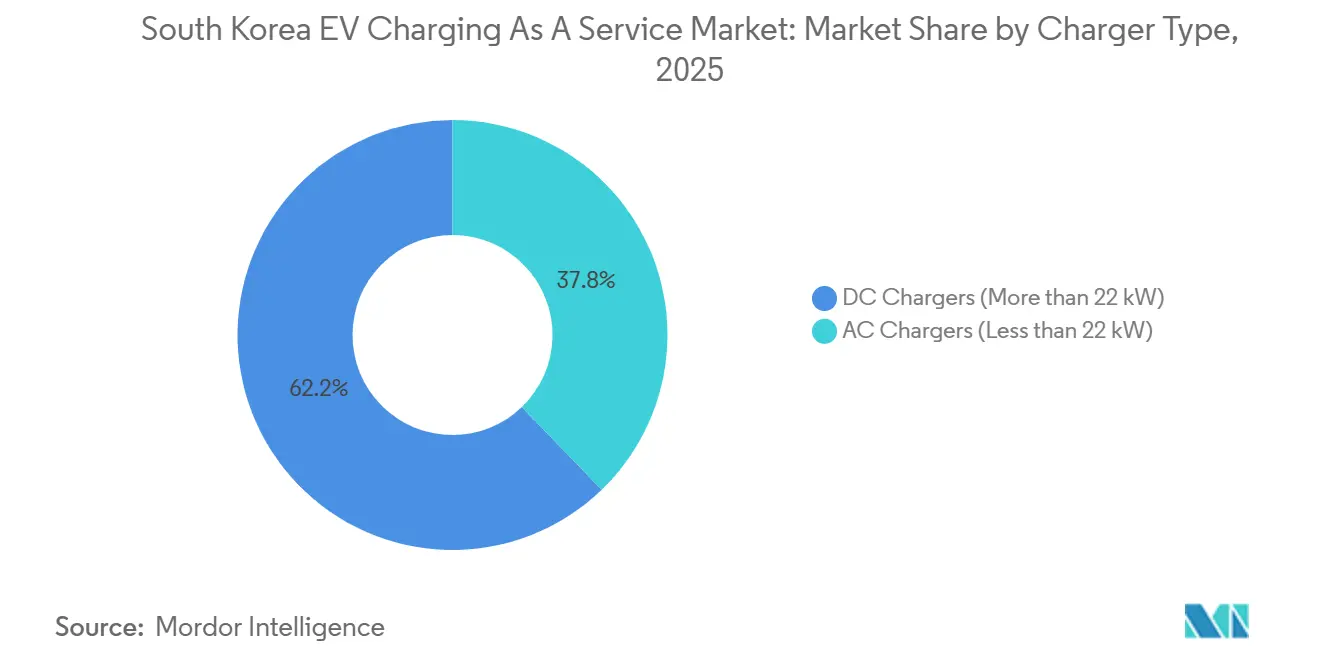
- By charger type, DC units led with 62.15% of South Korea EV Charging As A Service market share in 2025 and are advancing at a 29.14% CAGR through 2031.
- By power output, fast chargers (50 to 150 kW) led with 49.23% share in 2025, while the ultra-fast segment (above 150 kW) is forecast to expand at a 38.46% CAGR from 2026-2031.
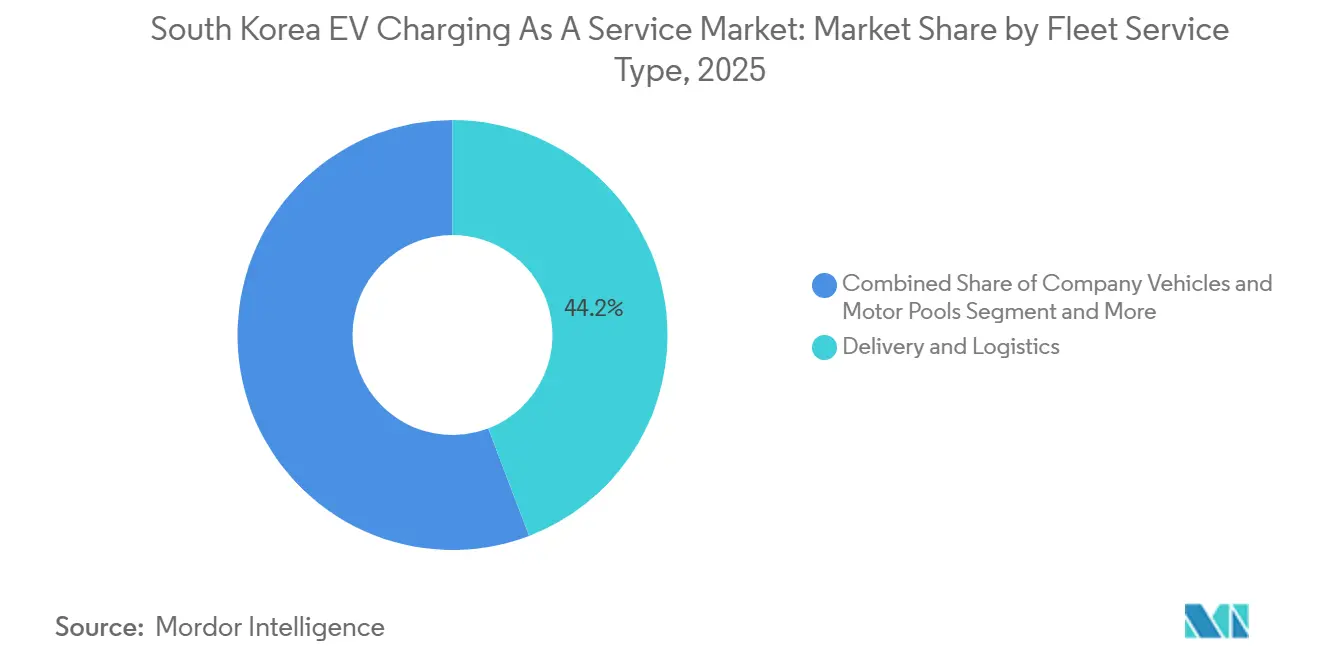
- By fleet service type, delivery and logistics accounted for 44.16% share of the South Korea EV Charging As A Service market size in 2025 and are progressing at a 26.38% CAGR to 2031.
- By end-use, public highway and retail sites captured 65.11% share in 2025 and are projected to grow at a 25.19% CAGR through 2031.
Note: Market size and forecast figures in this report are generated using Mordor Intelligence’s proprietary estimation framework, updated with the latest available data and insights as of January 2026.
Competitive positioning in South korea includes both locally based firms and those operating across multiple regions. The market landscape in the global ev charging as a service industry research shows how these players are arranged internationally.
South Korea EV Charging As A Service Market Trends and Insights
Drivers Impact Analysis*
| Driver | (~) % Impact on CAGR Forecast | Geographic Relevance | Impact Timeline |
|---|---|---|---|
| Capex Subsidies for Rapid Chargers | +4.2% | National, Seoul–Busan–Incheon corridors | Medium term (2-4 years) |
| Zero-Emission Logistics Mandates | +3.8% | National logistics hubs | Long term (≥ 4 years) |
| Oil-Refiner Conversion of Forecourts | +3.5% | Highway corridors, urban arterials | Medium term (2-4 years) |
| EV-to-Charger Ratio Below 2:1 | +2.9% | Seoul, Gyeonggi, Incheon | Short term (≤ 2 years) |
| AI-Optimized Dynamic Load | +2.1% | Seoul, Incheon, Daegu | Medium term (2-4 years) |
| Megawatt-Charging-System Trials | +1.8% | Ulsan, Gwangyang, Pyeongtaek | Long term (≥ 4 years) |
| Source: Mordor Intelligence | |||
Escalating Government Capex Subsidies for Rapid Chargers
Performance-based subsidies introduced in 2024 channel funds toward high-traffic depots where DC fast and ultra-fast chargers achieve mandated utilization thresholds[1]Source: Ministry of Environment, “Performance-Based Subsidy Guidelines 2024,” me.go.kr . When units remain offline, a deposit-token system forfeits bonds, effectively channeling investments into regions with higher demand. This approach ensures that resources are allocated efficiently to demand-dense corridors, optimizing the overall system's functionality. Operators who offer charging-as-a-service packages, supported by uptime guarantees, benefit from consistent and reliable revenue streams. This stability not only enables them to monetize additional grid services but also helps mitigate the risk of stranded assets, ensuring long-term operational sustainability.
Corporate Zero-Emission Logistics Mandates
Fleet owners, including Hyundai Glovis and CJ Logistics, have set their sights on net-zero targets between 2030 and 2045, anchoring these ambitions to a wholesale shift towards electrification. They've secured multi-year charging contracts, strategically favoring ultra-fast charging infrastructure located close to urban distribution hubs. Meanwhile, the joint venture between Kia and Coupang Partners showcases the financial benefits of dedicated charging networks, which not only lower the total cost of ownership but also simplify the often-complex grid connection process.
Oil-Refiner Conversion of Forecourts Into EV Hubs
GS Caltex, Hyundai Oilbank, and S-Oil are progressively transforming their fuel stations into multi-standard charging hubs. By capitalizing on their existing real estate assets and established grid connections, these companies have managed to streamline the process of deploying these hubs. This strategic approach not only reduces the time required for implementation but also enhances operational efficiency. Additionally, through the practice of cross-subsidization, they are able to maintain competitive gasoline prices, which helps attract a steady flow of customers to their convenience stores. This initiative is playing a crucial role in encouraging the adoption of electric charging, marking a significant step in the ongoing transition from traditional fuel to more sustainable energy solutions.
EV-to-Charger Ratio of Less Than 2:1 Boosts Utilization Economics
Over the years, national ratios have demonstrated steady improvement, with notable advancements observed in 2024 compared to the prior year. Despite this progress, peak holiday periods continued to present challenges on major highways, as the increasing adoption of electric vehicles (EVs) placed significant pressure on charging infrastructure. Insights from pilot programs underscored the potential of software-based scheduling tools, which utilize advanced technologies like deep Q-networks, to enhance the efficiency of charger usage. These developments indicate that adopting algorithmic pricing strategies and reservation systems could effectively streamline demand, ensuring more balanced operations without requiring additional capital expenditure (capex).
Restraints Impact Analysis*
| Restraint | (~) % Impact on CAGR Forecast | Geographic Relevance | Impact Timeline |
|---|---|---|---|
| Profit Squeeze from Over-Installation | -3.1% | Seoul, Busan, Incheon metros | Short term (≤ 2 years) |
| 2023 EV Sales Dip | -2.4% | National | Medium term (2-4 years) |
| Shrinking Per-Charger Subsidy | -1.9% | National, urban saturation zones | Short term (≤ 2 years) |
| Urban Grid-Congestion Fee | -1.7% | Seoul Capital Area, Busan | Medium term (2-4 years) |
| Source: Mordor Intelligence | |||
Profit Squeeze from Charger Over-Installation
SK Signet has been struggling with substantial operating losses driven by its aggressive expansion strategies over the years, while LG Electronics, despite years of dedicated investment, ultimately had to exit the market. This situation underscores the challenges posed by volume-based incentives, which have often resulted in stranded assets and underutilized resources. Although industry consolidation appears to be an inevitable outcome in the near future, the ongoing cash burn is significantly hampering the ability to reinvest in advanced and premium technologies, such as MCS, which are critical for long-term growth and competitiveness.
2023 EV Sales Dip Undermines Demand Visibility
In recent years, retail sales have experienced a significant decline, with a particularly sharp drop observed in the early months of 2024. These challenges have contributed to delays in fleet procurement cycles, creating longer payback periods for charging assets. The uncertainty surrounding the utilization of these assets has further compounded the issue. Additionally, operators remain exposed to financial risks due to fixed grid-connection costs, especially during periods of slowed vehicle adoption.
*Our forecasts treat driver/restraint impacts as directional, not additive. The impact forecasts reflect baseline growth, mix effects, and variable interactions.
Segment Analysis
By Charger Type: DC Dominance Reflects Fleet Prioritization
DC chargers secured 62.15% of the South Korea EV Charging As A Service market share in 2025 as fleet operators demanded rapid turnarounds that overnight AC systems could not match. The South Korea EV Charging As A Service market size for DC chargers is projected to grow at 29.14% CAGR to 2031, as subsidy formulas penalize low-utilization AC units. Dense urban housing stock without private parking also drives commuters to public DC hubs embedded in subway lots and mixed-use garages.
AC chargers remain relevant for residential complexes and workplaces where dwell times exceed four hours, yet falling subsidy support and stiffer performance criteria are reallocating capital toward 400 kW-plus DC corridors. Operators integrating DC hardware with fleet-management software and robotic plug-in systems capture higher margins by reducing labor costs and boosting daily charging sessions [2] “Launch of 400 kW Charger,” SK Signet, sksignet.com.


By Power Output: Ultra-Fast Segment Captures Premium Pricing
Fast chargers (50-150 kW) commanded 49.23% share in 2025, but the ultra-fast segment (>150 kW) is scaling at a 38.46% CAGR, reflecting willingness among logistics fleets to pay for sub-20-minute sessions. The South Korea EV Charging As A Service market size for ultra-fast systems benefits from dedicated highway concessions and retail partnerships that bundle amenities with kilowatt-hour sales.
Level 1 and Level 2 AC units face commoditization as performance-based funds shift toward higher-power assets. Ultra-fast providers that pair charging with reservation tools, lounge access, or integrated payment platforms defend price premiums even as slower segments compete on cost alone.
By Fleet Service Type: Delivery and Logistics Lead Electrification
Delivery and logistics fleets held 44.16% share in 2025 and will grow at 26.38% CAGR, reflecting last-mile operators’ drive to cut fuel expenses and meet zero-emission zones. The South Korea EV Charging As A Service industry bundles energy, maintenance, and software into predictable cost envelopes that de-risk electrification rollouts.
Passenger mobility fleets—taxi and ride-hailing—are the second-largest contributor, leveraging public DC corridors and proprietary passes that integrate Tesla Superchargers into ride-hailing apps. Smaller corporate motor pools adopt workplace solutions where property owners outsource hardware and operations to service providers.

By End-Use: Public Charging Dominates amid Home-Charging Constraints
Public highway and retail chargers accounted for 65.11% share in 2025, as the majority of South Koreans live in multi-unit dwellings that lack private stalls. The South Korea EV Charging As A Service market share for public setups will continue expanding with 25.19% CAGR, as refiners retrofit forecourts and mandatory highway provisions add ultra-fast arrays.
Semi-public workplace and commercial chargers fill daytime gaps but face margin compression from proposed demand tariffs. Operators hedge by installing battery storage or negotiating off-peak electricity blocks, tactics that reward scale and balance-sheet depth.
Geography Analysis
Seoul, Gyeonggi, and Incheon host roughly half of national EV registrations and the highest charger density, underpinning the largest revenue pool for the South Korea EV Charging As A Service market. Subsidy allocations target underserved provinces such as Gangwon and Jeolla, yet utilization still skews toward metropolitan cores where taxi, delivery, and ride-hailing demand is constant.
Holiday traffic on the Seoul-to-Busan highways saw a surge in EVs per charger at rest areas. This prompted a mandate for ultra-fast charger deployments at every service stop by 2027. Meanwhile, oil-refiner hubs are capitalizing on grid interconnections, allowing them to meet surge loads swiftly without the delays of protracted permitting. This gives established players a significant speed advantage in corridor build-outs.
Port cities like Ulsan, Gwangyang, and Pyeongtaek are serving as test beds for megawatt systems, electrifying drayage and container haulage. KEPCO is rolling out a storage solution across multiple substations, enhancing flexible dispatch capabilities. Operators integrating batteries can boost their revenue by bidding curtailment capacity into ancillary markets, all while effectively managing and smoothing out evening peak demands.
Mordor Intelligence tracks the ev charging as a service market across other major regions such as Europe, with additional country-level coverage spanning China, India, and United States, each reflecting localized structural drivers, restraints and more.
Competitive Landscape
Chaevi commands a significant presence in South Korea's EV Charging As A Service market, overseeing a substantial share of the nation's fast ports. Meanwhile, GS ChargeV operates a large number of slow outlets, and a competitive landscape sees numerous licensees competing for the remaining demand. The market, buoyed by subsidies, faced an overbuild that resulted in notable losses. In 2024, SK Signet reported significant deficits, and LG Electronics' subsequent withdrawal underscored a structural oversupply issue.
To navigate these challenges, players are turning to consolidation and platform integration. A prime example is Kakao Mobility's strategic joint venture with LG Uplus, which has birthed a robust network of chargers [3]“JV with LG Uplus Fact Sheet,” Kakao Mobility, kakao.com. This network not only integrates payment, navigation, and reservation features into a unified app but also boasts access to Tesla Superchargers, significantly enhancing utilization rates.
Emerging opportunities lie in megawatt systems tailored for heavy fleets, AI-driven load balancing solutions, and software packages that synchronize charging with route optimization. Furthermore, the strategic real estate holdings of oil refiners, combined with Tesla's impressive share of passenger EV sales in 2025, bolster the network-effect advantages for established players. Those who secure early connector compatibility deals stand to gain the most.
South Korea EV Charging As A Service Industry Leaders
SK Signet
LG CNS
Chaevi
Korea Electric Power Corp. (KEPCO)
GS Caltex
- *Disclaimer: Major Players sorted in no particular order

Recent Industry Developments
- April 2026: Chaevi launched region-specific promotions in Daegu and North Gyeongsang to attract Tesla owners with aggressive pricing and showcase megawatt technology.
- December 2025: Hyundai Motor Group announced expansion of its plug-and-charge network through partnerships with 12 domestic operators, extending coverage beyond 64 existing E-pit sites.
- March 2025: Water, a Brite Energy subsidiary, opened a 46-stall fast-charging hub at KINTEX in Goyang featuring 100-kW and 200-kW units.
- March 2025: iParking, an SK Innovation E&S company, was selected by the Ministry of Environment to implement the 2025 charging facility support project, focusing on apartment complexes and logistics centers.


South Korea EV Charging As A Service Market Report Scope
The scope includes segmentation by charger type (AC chargers (less than 22 kW) and DC chargers (more than 22 kW)), power output (level 1/AC (less than 22 kW), level 2 (22-50 kW), fast (50-150 kW), and ultra-fast (more than 150 kW)), fleet service type (company vehicles and motor pools, delivery and logistics, and passenger fleets (taxi/ride-hailing)), and end-use semi-public charging set-up (workplace/commercial) and public charging set-up (highway/retail). Market size and growth forecasts are presented by value in USD.
| AC Chargers (Less than 22 kW) |
| DC Chargers (More than 22 kW) |
| Level 1/AC (Less than 22 kW) |
| Level 2 (22 to 50 kW) |
| Fast (50 to 150 kW) |
| Ultra-fast (More than 150 kW) |
| Company Vehicles and Motor Pools |
| Delivery and Logistics |
| Passenger Fleets (Taxi/Ride-hailing) |
| Semi-public Charging Set-up (Workplace/Commercial) |
| Public Charging Set-up (Highway/Retail) |
| By Charger Type | AC Chargers (Less than 22 kW) |
| DC Chargers (More than 22 kW) | |
| By Power Output | Level 1/AC (Less than 22 kW) |
| Level 2 (22 to 50 kW) | |
| Fast (50 to 150 kW) | |
| Ultra-fast (More than 150 kW) | |
| By Fleet Service Type | Company Vehicles and Motor Pools |
| Delivery and Logistics | |
| Passenger Fleets (Taxi/Ride-hailing) | |
| By End-use | Semi-public Charging Set-up (Workplace/Commercial) |
| Public Charging Set-up (Highway/Retail) |


Key Questions Answered in the Report
What growth rate is projected for the South Korea EV Charging As A Service market between 2026 and 2031?
The market is forecast to advance at a 22.71% CAGR from 2026 to 2031, rising to USD 109.55 million by 2031.
Which charger type currently holds the largest share?
DC fast chargers led with 62.15% share in 2025 due to high demand from commercial fleets that value quick turnaround.
Why are oil refiners important players in South Korea’s public charging space?
Companies such as GS Caltex and S-Oil repurpose existing service-station real estate, leveraging built-in grid connections and customer traffic to roll out multi-standard charging hubs rapidly.
How are corporate logistics mandates influencing charger deployment?
Fleet electrification targets from firms like CJ Logistics create predictable high-utilization demand for ultra-fast depots, accelerating service-contract growth.
Page last updated on:


 Your data is secure and never sold or shared.


