
India EV Charging-As-A-Service Market Size and Share
Market Overview
| Study Period | 2019 - 2031 |
|---|---|
| Forecast Data Period | 2026 - 2031 |
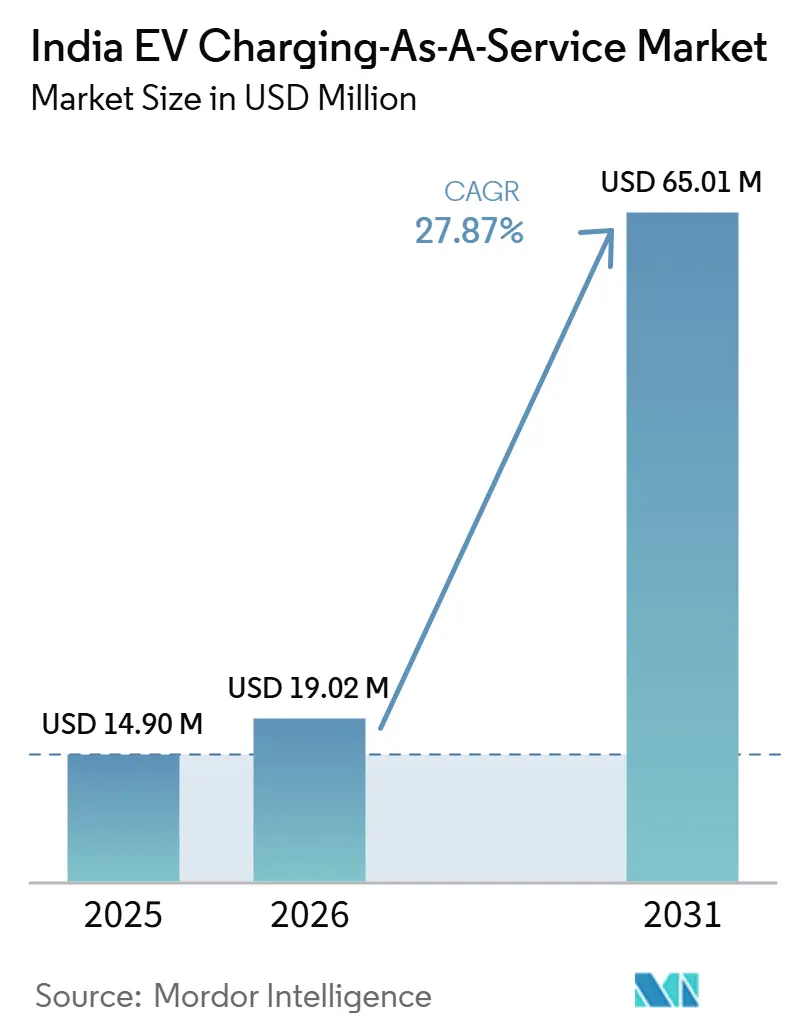
| Base Year Market Size (2025) | USD 14.90 Million |
| Market Size (2026) | USD 19.02 Million |
| Market Size (2031) | USD 65.01 Million |
| Growth Rate (2026 - 2031) | 27.87 % |
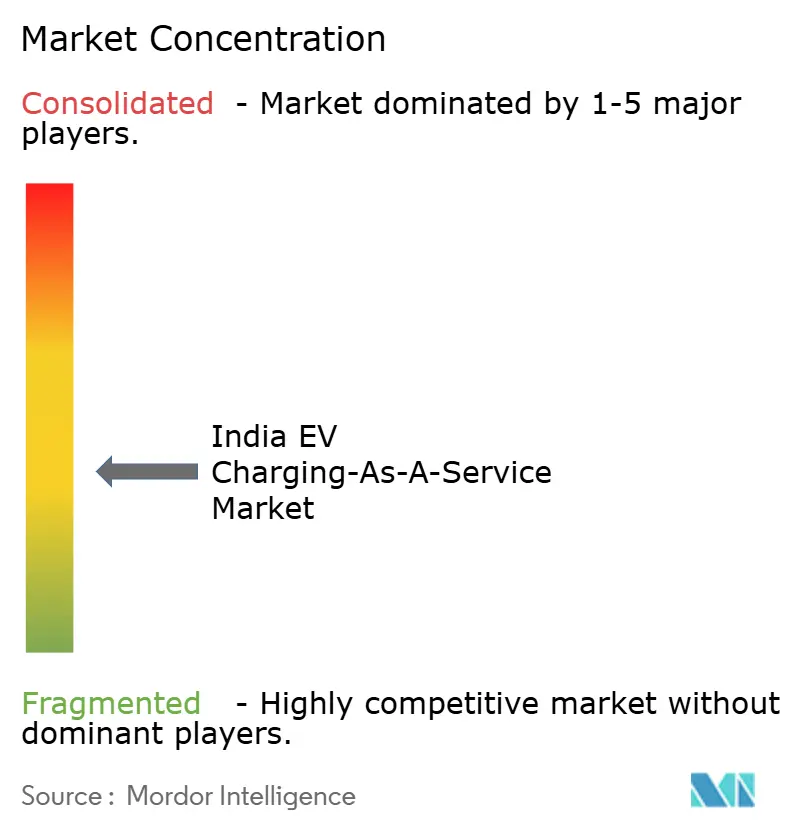
| Market Concentration | Medium |
Major Players *Disclaimer: Major Players sorted in no particular order Image © Mordor Intelligence. Reuse requires attribution under CC BY 4.0. | |
India EV Charging-As-A-Service Market Analysis by Mordor Intelligence
The India EV Charging-As-A-Service market size was valued at USD 14.90 million in 2025 and is estimated to grow from USD 19.02 million in 2026 to reach USD 65.01 million by 2031, growing at a CAGR of 27.87% over 2026-2031. Structural demand is rising as fleet operators with tight capital budgets pivot from owning chargers toward service contracts that bundle hardware, software, and electricity. The Commission for Air Quality Management’s January 2026 mandate requiring e-commerce and ride-hailing fleets in the National Capital Region to electrify has created an immediate need for reliable pay-per-use charging access. Operators are responding by signing multi-year CaaS agreements that guarantee uptime while avoiding high up-front expenditure on 50-150 kW fast chargers. Accelerated grid-connected solar capacity in states such as Maharashtra and Gujarat is lowering midday tariffs, further improving the operating economics of depot charging. Meanwhile, interoperability protocols approved in 2025 enable drivers to roam across networks without holding multiple accounts, lifting utilization rates for the Indian EV Charging-As-A-Service market.
Key Report Takeaways
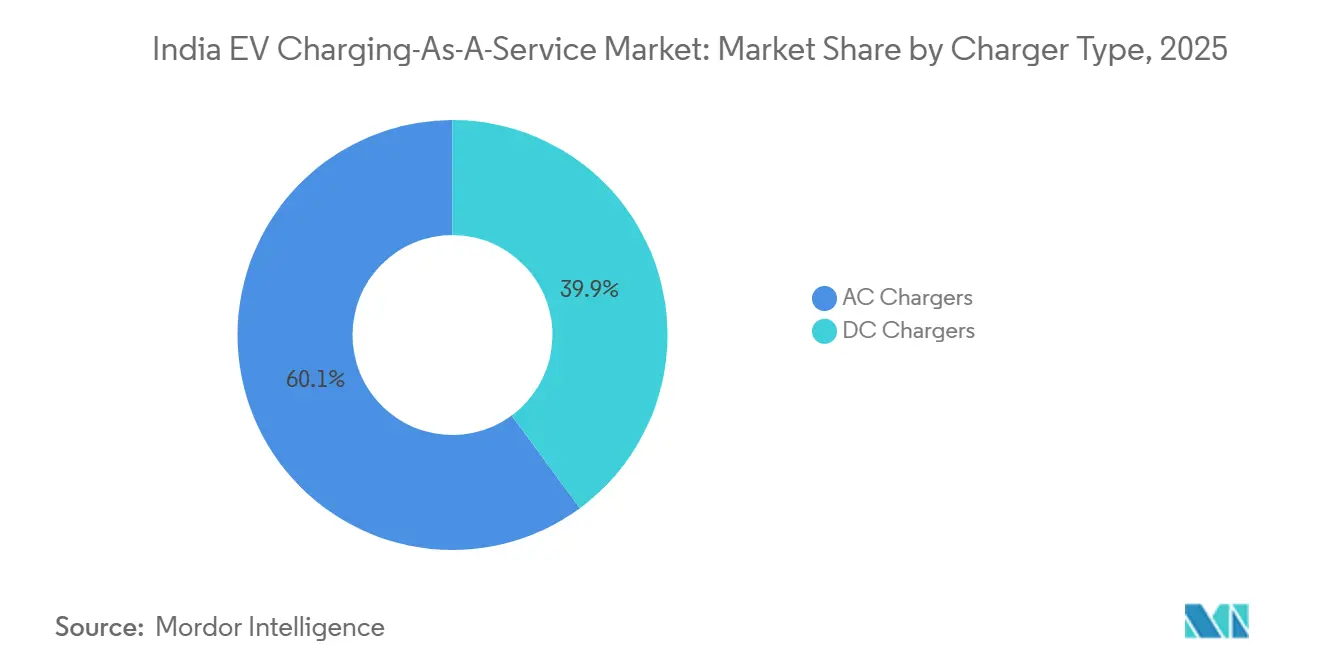
- By charger type, AC technology led with 60.13% of India's EV Charging-As-A-Service market share in 2025; DC chargers are projected to expand at a 29.65% CAGR to 2031.
- By power output, Level 2 equipment commanded 44.36% of the India EV Charging-As-A-Service market size in 2025, while units above 150 kW are forecast to grow at a 30.48% CAGR through 2031.
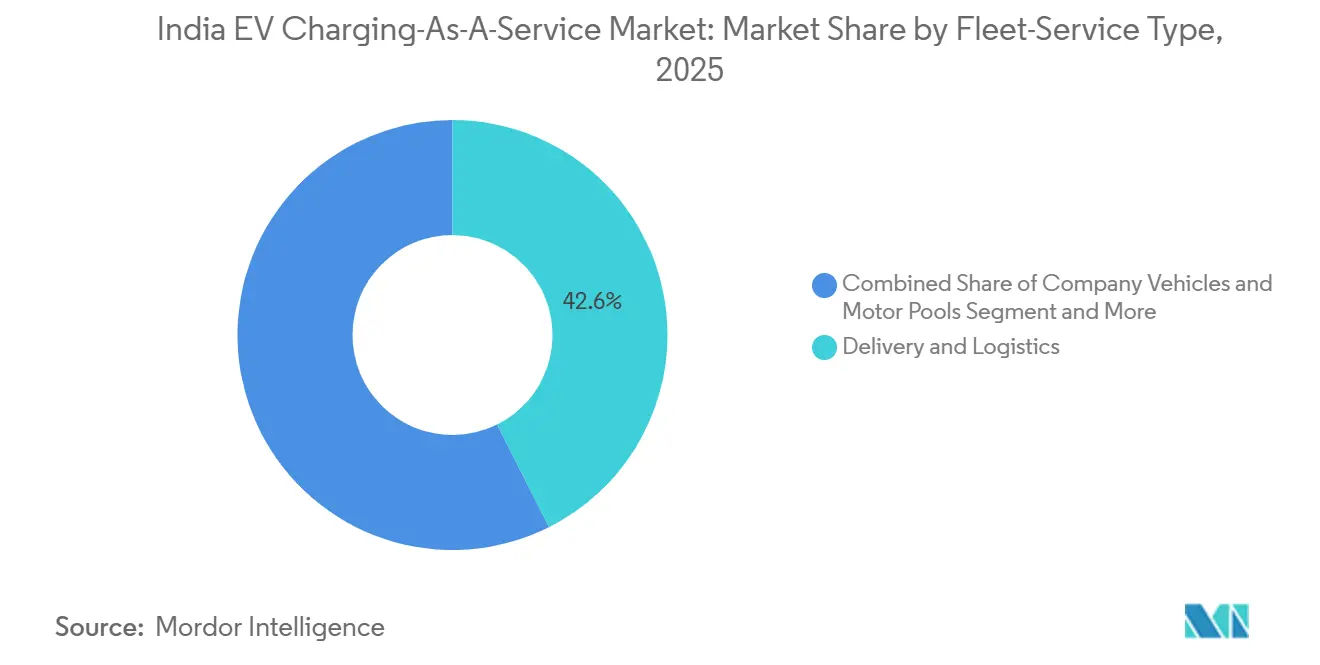
- By fleet-service type, delivery and logistics fleets held 42.55% share of the India EV Charging-As-A-Service market size in 2025; passenger fleets are advancing at a 28.33% CAGR to 2031.
- By end-use, semi-public depots accounted for 59.17% of India's EV Charging-As-A-Service market share in 2025, while public hubs along highways are set to grow at a 29.15% CAGR through 2031.
- By geography, West India led with 33.57% of India's EV Charging-As-A-Service market share in 2025; East India is projected to post the fastest regional CAGR of 30.04% to 2031.
Note: Market size and forecast figures in this report are generated using Mordor Intelligence’s proprietary estimation framework, updated with the latest available data and insights as of January 2026.
India contributes to a system defined not by any single country or region but by the interaction of many. The global ev charging as a service market data by Mordor Intelligence represents that combined structure.
India EV Charging-As-A-Service Market Trends and Insights
Drivers Impact Analysis*
| Driver | (~) % Impact on CAGR Forecast | Geographic Relevance | Impact Timeline |
|---|---|---|---|
| Corporate Fleet Electrification Mandates | +6.0% | National, concentrated in NCR, Bengaluru, Mumbai, Hyderabad | Short term (≤2 years) |
| FAME-II Extension and CAPEX Subsidies | +5.5% | National, early gains in Maharashtra, Karnataka, Gujarat, Tamil Nadu | Medium term (2-4 years) |
| Battery-Swapping Integration with CaaS | +4.5% | Early traction in Delhi NCR, Bengaluru, Mumbai | Medium term (2-4 years) |
| Mandatory EV-Ready Provisions | +4.0% | National, metro and Tier-1 cities | Long term (≥4 years) |
| Bharat Charger Interoperability Protocols | +3.5% | National, high-EV-penetration states | Medium term (2-4 years) |
| Time-of-Day Renewable-Linked Tariffs | +3.0% | Maharashtra, Gujarat, Karnataka, Tamil Nadu, Kerala | Short term (≤2 years) |
| Source: Mordor Intelligence | |||
Corporate Fleet Electrification Mandates by E-Commerce and Logistics Majors
The CAQM directive converts corporate pledges into compliance requirements, accelerating contract volumes for the India EV Charging-As-A-Service market [1]. Flipkart’s 20,000-plus electric delivery vehicles and Amazon India’s 10,000-vehicle target illustrate the scale of captive charging demand. Depot operators are bundling vehicle leasing, charging, and software in subscription packages that mitigate range anxiety and optimize total cost of ownership.
FAME-II Phase-Out Extension and State-Level CAPEX Subsidies
The Ministry of Heavy Industries extended FAME-II incentives through 2027 and introduced the PM E-DRIVE program, earmarking INR 2,000 crore (~USD 240 million) for public chargers in smaller cities [2]. In Maharashtra and Karnataka, parallel policies offer significant capital subsidies on hardware. This incentive reduces payback periods for depot installations to a few years. While this dual-layer support helps bridge the viability gap between early-adopter metros and Tier-2 markets, operators face a challenge: disbursement lags that strain their working capital.
Battery-Swapping-as-a-Service Integration with CaaS Hubs
Sun Mobility and IndianOil have announced plans to establish 10,000 battery swap stations by 2030 [3]. These stations will integrate cabinets alongside fixed chargers, designed to support a wide range of vehicle types, including two-wheelers, three-wheelers, and four-wheelers. Despite the current fragmentation in swappable battery formats, the Bureau of Indian Standards has formed a working group to draft a unified form factor. This effort aims to enable true cross-operator interoperability, which could significantly enhance the adoption of battery swapping technology across the market.
Mandatory EV-Ready Parking Provisions in National Building Code (2025 Draft)
In 2025, a draft code mandated that developers pre-wire new buildings for electric vehicle (EV) loads, effectively transferring infrastructure costs to builders. This requirement aimed to streamline the integration of EV charging infrastructure into new constructions, reducing future retrofitting expenses. Although there was industry pushback regarding restrictions on basement charging, regulators began evaluating ventilation and fire suppression standards. If approved, these changes could substantially increase basement capacity by 2027, addressing concerns over space limitations and safety requirements.
Restraints Impact Analysis*
| Restraint | (~) % Impact on CAGR Forecast | Geographic Relevance | Impact Timeline |
|---|---|---|---|
| Cost of Above 50 kW DC Chargers | -2.5% | National, acute in Tier-2/3 cities | Short term (≤2 years) |
| Distribution-Transformer Capacity Gaps | -2.0% | Tier-2/3 cities in East, Central, North-East | Medium term (2-4 years) |
| GST Input-Tax-Credit Eligibility | -1.5% | National, state-level variance | Short term (≤2 years) |
| Fragmented Municipal Land-Lease | -1.0% | National, legacy land-use policies | Long term (≥4 years) |
| Source: Mordor Intelligence | |||
High Upfront Cost of Above 50 kW DC Chargers
Charging units with moderate capacity are generally more accessible in terms of cost, whereas higher-capacity chargers remain significantly more expensive, posing challenges for smaller service providers to adopt them. Although subsidies are available to reduce a portion of the hardware costs, the process is often complicated by delays in obtaining necessary approvals and the additional expenses associated with upgrading transformers. These challenges lead many operators to initially invest in lower-capacity modules, with plans to expand their infrastructure gradually as conditions become more favorable.
Distribution-Transformer Capacity Gaps in Tier-2/3 Cities
Distribution transformers, which were originally designed to handle residential electricity loads, often lack the capacity to support clustered higher-capacity chargers. The process of requesting and implementing upgrades to these transformers is frequently prolonged, causing significant delays in the rollout of charging infrastructure across various cities. While pilot guidelines for the development of dedicated EV feeder lines are currently under review, the widespread implementation of these measures on a national scale is not anticipated until after 2028.
*Our forecasts treat driver/restraint impacts as directional, not additive. The impact forecasts reflect baseline growth, mix effects, and variable interactions.
Segment Analysis
By Charger Type: AC Remains the Workhorse, DC Races Ahead
AC installations dominated the India EV Charging-As-A-Service market size at 60.13% in 2025, thanks to lower hardware prices and alignment with overnight fleet downtime. Flipkart's fulfillment centers have adopted AC points, leveraging solar-linked tariffs to significantly reduce charging costs during the day. Introduced in recent years, these units have gained popularity among corporate campuses and smaller logistics firms.
DC fast chargers, although more expensive, are scaling quickly in last-mile delivery and ride-hailing depots where vehicle turnaround cannot exceed 30-45 minutes. Jio-bp’s network is 95% DC, and Tata Power’s new 60-320 kW EVERTA models will anchor highway corridors, helping the India EV Charging-As-A-Service market record a 29.65% CAGR for DC hardware through 2031[4].
By Power Output: Level 2 Holds Ground, 150 kW-Plus Chargers Accelerate
Level 2 (22-50 kW) captured 44.36% of India's EV Charging-As-A-Service market share in 2025 because four- to six-hour dwell times fit standard depot operations. In Bengaluru and Hyderabad, ChargeZone and Statiq have strategically clustered mid-range units to cater to BluSmart’s growing taxi fleet.
High-power chargers above 150 kW, necessary for long-haul trucks and inter-city buses, are forecast to rise at a 30.48% CAGR. In a bid to streamline operations, Tata Motors plans to install mega-chargers at regular intervals along the Golden Quadrilateral, reducing electric truck recharge stops to under an hour.
By Fleet-Service Type: Logistics Leads, Passenger Mobility Gains Momentum
Delivery and logistics fleets commanded a 42.55% share of the India EV Charging-As-A-Service market size in 2025, supported by Amazon India’s 10,000-vehicle pledge and Flipkart’s 20,000-plus vehicle deployment.
Passenger mobility is catching up fast. BluSmart had already expanded its electric taxi operations by late 2025, and passenger fleets are projected to clock a 28.33% CAGR through 2031, outstripping logistics growth. Ola Electric’s push into Tier-1 ride-hailing with the S1 scooter platform underscores rising demand for quick-turn chargers in urban centers.

By End-Use: Semi-Public Depots Still Dominate, Public Hubs Multiply
Semi-public depots and campuses held 59.17% of India's EV Charging-As-A-Service market share in 2025 because captive fleets guarantee 80-90% utilization and predictable revenue. Tata Power alone operates more than 1,200 e-bus-ready points for state transport operators.
Yet public hubs are expanding at a 29.15% CAGR under the PM E-DRIVE program, which reserves INR 2,000 crore (~USD 240 million) to seed chargers in Tier-2 cities. Interoperable roaming now lets any EV driver top up anywhere, lifting utilization by 25-35% and improving the business case for public infrastructure.
Geography Analysis
In 2025, West India held a dominant 33.57% share of India's EV Charging-As-A-Service market. This growth was primarily driven by Maharashtra, which boasted 3,728 public charging stations, and Gujarat, which leveraged over 1,200 sites. Gujarat complements fiscal aid with simplified single-window clearances, enabling rapid site approvals for both urban hubs and highway rest stops.
East India is the breakout growth story. West Bengal's revenue-sharing model and Bihar's pledge of 1,000 chargers support a 30.04% CAGR forecast. Meanwhile, Odisha's state utility, currently counting FAME-II-funded units, anticipates a significant increase in public points by 2030. While the North-East states are still in their infancy, they stand to gain once the Central Electricity Authority's feeder-line upgrade pilots transition from concept to reality post-2027.
South India follows closely, anchored by Karnataka’s 5,880 public chargers and the state’s 100% exemption on road tax and registration for electric commercial vehicles. Tamil Nadu’s lowest-in-India solar-hour tariff is drawing CaaS operators to Chennai, Coimbatore, and upcoming manufacturing hubs in Hosur.
The ev charging as a service market is analyzed by Mordor Intelligence across multiple other geographies, with in-depth regional assessments available for Europe. This is complemented by country-specific insights for China, South Korea, and United States, reflecting various localized market behavior and policy environments' coverage.
Competitive Landscape
The India EV Charging-As-A-Service market is fragmented, with Tata Power EZ Charge operating 5,500-plus public chargers in over 630 cities and leveraging rooftop solar and stationary storage to cross-subsidize pricing. Jio-bp Pulse has grown from 1,300 to more than 5,000 charging points by bundling EV infrastructure with its nationwide fuel-retail estate, giving fleet operators a single energy partner for liquid and electric fuels. Statiq’s alliance with Tata Motors under the Open Collaboration 2.0 program targeted 10,000 stations by FY 2025, enhancing geographic depth on highway corridors.
Smaller specialists such as ChargeZone, Volttic, and Ather Grid pursue white spaces in Tier-2 cities or differentiate through software. Ather Grid deploys predictive-maintenance analytics that promises 98% uptime, while ChargeZone’s franchise model lets local entrepreneurs finance sites with back-end support from State Bank of India. Convergence Energy Services Ltd., backed by the Government of India, installed several public chargers by March 2026, focusing on state-owned bus depots, yet moving at a slower pace than its private peers.
Strategic collaborations are intensifying. Sun Mobility’s joint venture with IndianOil merges swapping cabinets with fixed chargers, providing fleets with a two-minute top-up alternative to 30-minute DC sessions. Bolt.Earth’s 2026 partnership with Statiq lets four-wheeler EV owners tap into India’s largest peer-to-peer charging network through a single app, expanding network density without heavy capital outlay. Rising interoperability is shifting competition away from exclusive access and toward pricing transparency, asset uptime, and value-added fleet-management software.
India EV Charging-As-A-Service Industry Leaders
-
Tata Power
-
GLIDA (Fortum Charge & Drive India)
-
Statiq
-
ChargeZone
-
Ather Energy Limited
- *Disclaimer: Major Players sorted in no particular order
Recent Industry Developments
- March 2026: Tata.ev and Hopcharge introduced on-demand charging vans in the National Capital Region, letting EV owners summon a mobile charger via app.
- March 2026: ChargeZone unveiled plans for 1,000 supercharging stations along national highways by FY 2027 under a DOCO franchise structure financed by the State Bank of India.
- January 2026: Bolt.Earth partnered with Statiq to integrate peer-to-peer hosts with fast-charging hubs, giving four-wheeler drivers interoperable access through a single interface.
- November 2025: Mahindra announced Charge_IN, a network of 250 fast-charging stations rated at 180 kW each, totaling more than 1,000 charge points by 2027.
India EV Charging-As-A-Service Market Report Scope
The scope includes segmentation by charger type (AC chargers and DC chargers), power output (level 1/AC (below 22 kW), level 2 (22-50 kW), fast (50-150 kW), and high-power (above 150 kW)), fleet-service type (company vehicles and motor pools, delivery and logistics, and passenger fleets (ride-hailing, corporate cabs), and end-use (semi-public charging setup (depots and campuses) and public charging setup (highways, urban hubs). The analysis also covers regional-level segmentation, including North India (Delhi, Uttar Pradesh, Punjab, Haryana, Himachal Pradesh, Uttarakhand, and Rajasthan), North-East India (Assam, Arunachal Pradesh, Manipur, Meghalaya, Mizoram, Nagaland, Tripura, and Sikkim), South India (Tamil Nadu, Karnataka, Andhra Pradesh, Telangana, and Kerala), West India (Maharashtra, Gujarat, Rajasthan, and Goa), East India (West Bengal, Odisha, Bihar, and Jharkhand), Central India (Madhya Pradesh and Chhattisgarh), and Union Territories (Jammu & Kashmir, Ladakh, Chandigarh, Andaman & Nicobar Islands, Lakshadweep, Dadra & Nagar Haveli, Daman & Diu, and Puducherry). Market size and growth forecasts are presented by value in USD.
| AC Chargers |
| DC Chargers |
| Level 1 / AC (Below 22 kW) |
| Level 2 (22 - 50 kW) |
| Fast (50 -150 kW) |
| High-Power (Above 150 kW) |
| Company Vehicles and Motor Pools |
| Delivery and Logistics |
| Passenger Fleets (Ride-hailing, Corporate Cabs) |
| Semi-Public Charging Setup (Depots, Campuses) |
| Public Charging Setup (Highways, Urban Hubs) |
| North India (Delhi, Uttar Pradesh, Punjab, Haryana, Himachal Pradesh, Uttarakhand, and Rajasthan) |
| North-East India (Assam, Arunachal Pradesh, Manipur, Meghalaya, Mizoram, Nagaland, Tripura, and Sikkim) |
| South India (Tamil Nadu, Karnataka, Andhra Pradesh, Telangana, and Kerala) |
| West India (Maharashtra, Gujarat, Rajasthan, and Goa) |
| East India (West Bengal, Odisha, Bihar, and Jharkhand) |
| Central India (Madhya Pradesh and Chhattisgarh) |
| Union Territories (Jammu & Kashmir, Ladakh, Chandigarh, Andaman & Nicobar Islands, Lakshadweep, Dadra & Nagar Haveli, Daman & Diu, and Puducherry) |
| By Charger Type | AC Chargers |
| DC Chargers | |
| By Power Output | Level 1 / AC (Below 22 kW) |
| Level 2 (22 - 50 kW) | |
| Fast (50 -150 kW) | |
| High-Power (Above 150 kW) | |
| By Fleet-Service Type | Company Vehicles and Motor Pools |
| Delivery and Logistics | |
| Passenger Fleets (Ride-hailing, Corporate Cabs) | |
| By End-Use | Semi-Public Charging Setup (Depots, Campuses) |
| Public Charging Setup (Highways, Urban Hubs) | |
| By Geography (States & UTs) | North India (Delhi, Uttar Pradesh, Punjab, Haryana, Himachal Pradesh, Uttarakhand, and Rajasthan) |
| North-East India (Assam, Arunachal Pradesh, Manipur, Meghalaya, Mizoram, Nagaland, Tripura, and Sikkim) | |
| South India (Tamil Nadu, Karnataka, Andhra Pradesh, Telangana, and Kerala) | |
| West India (Maharashtra, Gujarat, Rajasthan, and Goa) | |
| East India (West Bengal, Odisha, Bihar, and Jharkhand) | |
| Central India (Madhya Pradesh and Chhattisgarh) | |
| Union Territories (Jammu & Kashmir, Ladakh, Chandigarh, Andaman & Nicobar Islands, Lakshadweep, Dadra & Nagar Haveli, Daman & Diu, and Puducherry) |
Key Questions Answered in the Report
How big will the India EV Charging-As-A-Service market be by 2031?
It is forecast to reach USD 65.01 million by 2031, expanding at a 27.87% CAGR from 2026-2031.
Which region currently leads charger deployment?
West India holds the largest share at 33.57% thanks to dense networks in Maharashtra and Gujarat.
What is driving fast growth in East India?
Policies in West Bengal and Bihar that mix capital subsidies with revenue-share models are producing a 30.04% regional CAGR.
Why are DC fast chargers gaining popularity?
Logistics and ride-hailing fleets need 15-30 minute turnarounds, and hardware costs are falling as volumes scale.