
Germany EV Charging Infrastructure Market Size and Share
Market Overview
| Study Period | 2020 - 2031 |
|---|---|
| Forecast Data Period | 2026 - 2031 |
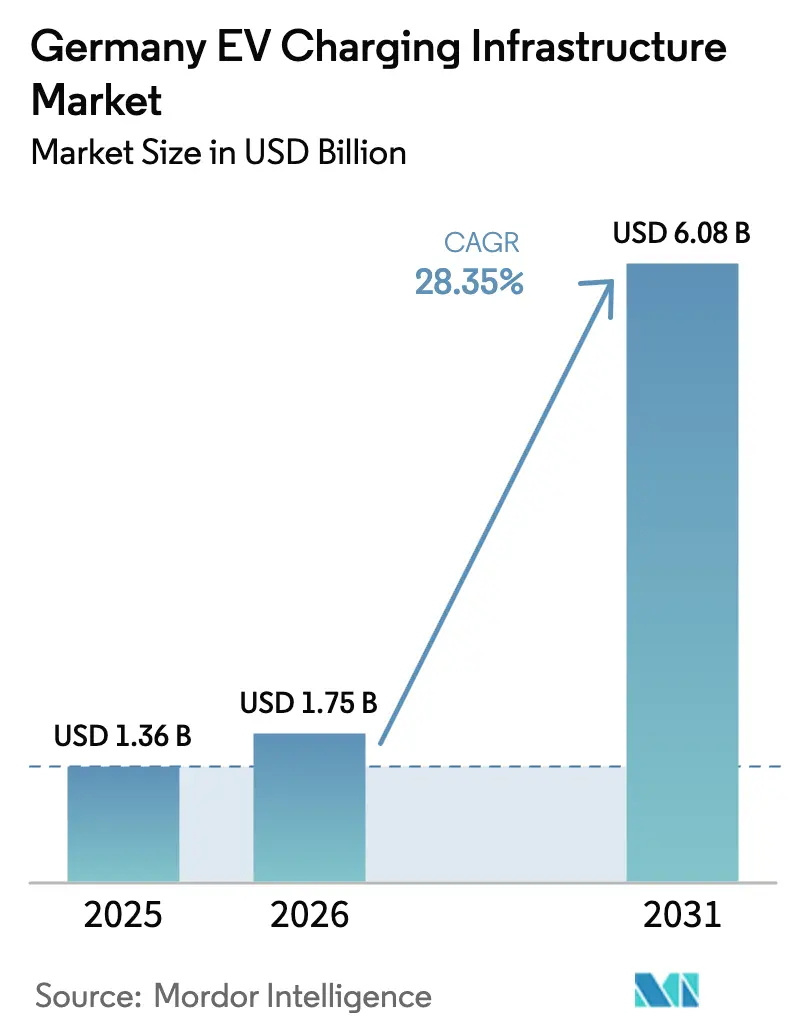
| Base Year Market Size (2025) | USD 1.36 Billion |
| Market Size (2026) | USD 1.75 Billion |
| Market Size (2031) | USD 6.08 Billion |
| Growth Rate (2026 - 2031) | 28.35 % |
| Market Concentration | Medium |
Major Players *Disclaimer: Major Players sorted in no particular order Image © Mordor Intelligence. Reuse requires attribution under CC BY 4.0. | |
Germany EV Charging Infrastructure Market Analysis by Mordor Intelligence
German EV charging infrastructure market size in 2026 is estimated at USD 1.75 billion, growing from 2025 value of USD 1.36 billion with 2031 projections showing USD 6.08 billion, growing at 28.35% CAGR over 2026-2031. Germany’s mandate to deploy 1 million additional charging points, its leadership in European vehicle production, and the rapid fall in per-kilometer charging costs are combined to accelerate deployment velocity across public and private sites. Commercial corridors and retail destinations capture the highest near-term investment flows, while condominium modernization funding unlocks unmet residential demand. National policy coordination through the Masterplan Ladeinfrastruktur II guarantees fast-charging coverage every 60 km on TEN-T routes, effectively de-risking high-power projects. Parallel improvements in grid-service revenues, such as frequency regulation and peak shaving, improve project economics for operators that integrate vehicle-to-grid functionality. Connector standardization around CCS2 and emerging megawatt chargers for heavy vehicles further reinforces Germany’s role as a technology testbed.
Key Report Takeaways
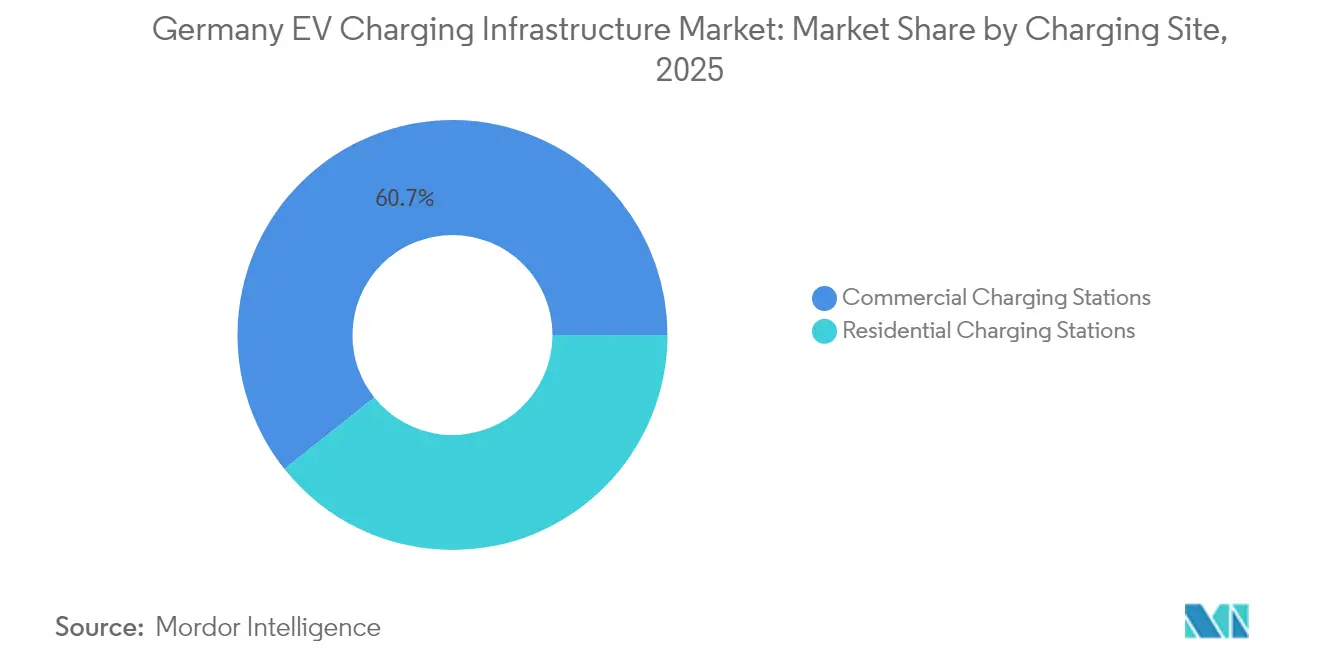
- By charging site, commercial locations led with 60.72% of the German EV charging infrastructure market share in 2025, while residential installations are projected to expand at a 28.84% CAGR to 2031.
- By charger type, AC systems accounted for 55.62% of the German EV charging infrastructure market size in 2025, whereas ultra-fast DC systems above 150 kW recorded the fastest 30.02% CAGR through 2031.
- By power output, ≤22 kW chargers held 55.91% share of the German EV charging infrastructure market size in 2025; chargers above 150 kW are advancing at a 30.68% CAGR through 2031.
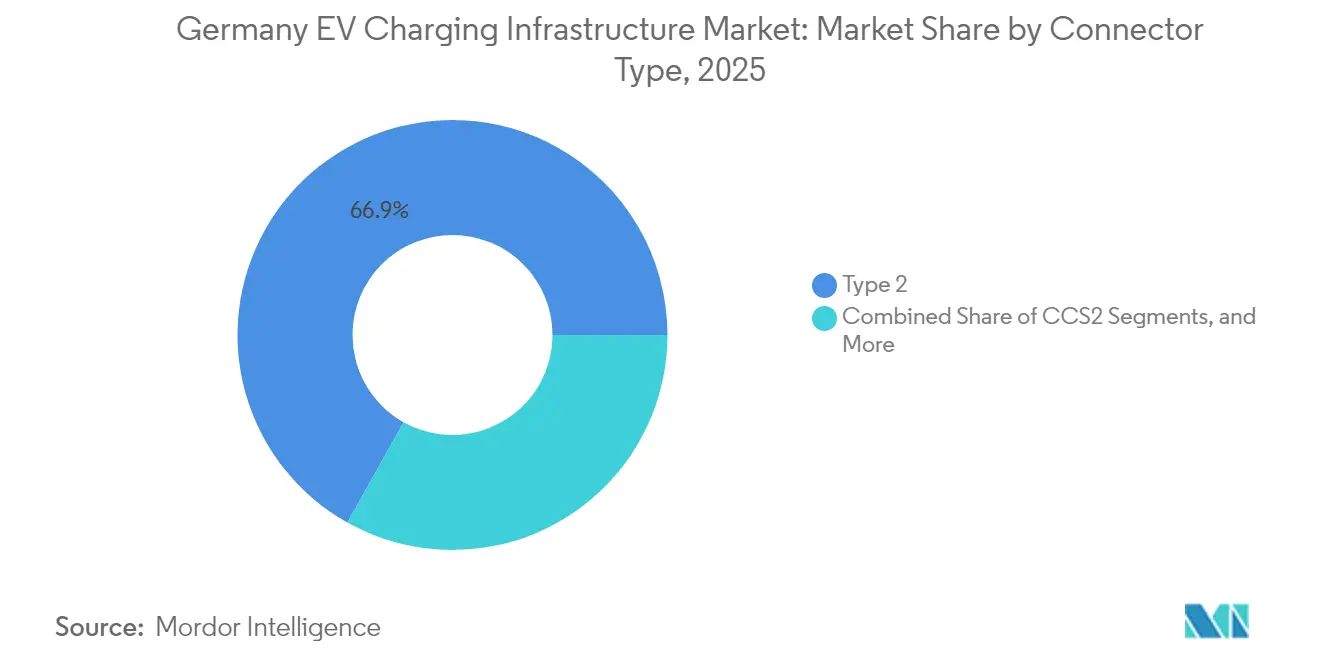
- By connector, Type 2 dominated with 66.87% of the German EV charging infrastructure market share in 2025 as CCS2 posts a 31.05% CAGR through 2031.
- By mounting configuration, wall-mounted units commanded a 56.48% of the German EV charging infrastructure market share in 2025, while pedestal systems posted the highest 31.02% CAGR through 2031.
- By vehicle type, passenger cars represented 75.88% of the German EV charging infrastructure market share in 2025, and medium-to-heavy trucks delivered the fastest 31.08% CAGR through 2031.
- By German federal state, Bavaria led with a 31.05% of the German EV charging infrastructure market share in 2025, whereas North Rhine-Westphalia achieved a 28.96% CAGR through 2031.
Note: Market size and forecast figures in this report are generated using Mordor Intelligence’s proprietary estimation framework, updated with the latest available data and insights as of 2026.
Market Trends and Insights
Drivers Impact Analysis of Germany EV Charging Infrastructure Market*
| Driver | (~) % Impact on CAGR Forecast | Geographic Relevance | Impact Timeline |
|---|---|---|---|
| National Policy Targets (Masterplan LIS II) | +8.2% | National; focus on TEN-T corridors | Medium term (2–4 years) |
| Growing BEV Adoption Rates | +7.1% | Urban hubs in Bavaria, NRW, Baden-Württemberg | Short term (≤ 2 years) |
| Private-Utility Investment Boom | +5.8% | Nationwide retail corridors and logistics hubs | Medium term (2–4 years) |
| Grid-Services Revenue (V2G, Load Balancing) | +3.4% | Urban centers and congested industrial zones | Long term (≥ 4 years) |
| Condominium Modernization Funding (WEG) | +2.9% | Apartment-dense districts in Berlin and Hamburg | Short term (≤ 2 years) |
| Freight-Corridor Electrification Incentives | +2.1% | Rhine-Alpine and North Sea-Baltic freight lanes | Long term (≥ 4 years) |
| Source: Mordor Intelligence | |||
National Policy Targets (Masterplan Ladeinfrastruktur II)
Germany is committed to building a nationwide EV charging network. Through the Deutschlandnetz initiative, the government invests heavily in fast-charger deployment to ensure reliable and widespread accessibility for EV users. These targets enhance consumer confidence and drive private-sector participation, accelerating the shift to electric mobility. Mandatory 60 km fast-charging intervals on TEN-T routes shift deployment from market-led clustering to systematic coverage, stabilizing demand for high-power hardware. Federal-state program stacking, such as Baden-Württemberg’s Charge@BW, minimizes funding gaps and drives procurement scale economies. The resulting certainty in utilization encourages private operators to invest in 400–600 kW equipment despite higher capex. Local permitting agencies increasingly mirror federal targets, reducing approval lead times and lowering project risk.
Growing BEV Adoption Rates
Q1 2025 battery-electric registrations attained record highs, with total-cost-of-ownership parity versus combustion vehicles tipping decisively in favor of EVs[1]. Each incremental EV lifts average daily charging demand, reinforcing the feedback loop between infrastructure expansion and vehicle sales. Commercial fleet electrification exerts an outsized load on public networks because vans and trucks draw higher currents and occupy bays longer. Urban-rural adoption asymmetry shapes investment logic: metropolitan areas prioritize home and workplace chargers, while intercity corridors prioritize ultra-fast hubs to support weekend and holiday travel surges. Automakers’ sales targets for 2030 create a predictable pipeline of EVs that underpins multi-year volume forecasts for charging operators.
Private-Utility Investment Boom
Partnerships such as EnBW-REWE and Vattenfall’s retail collaborations align grid expertise with high-footfall real estate, shortening site-acquisition cycles and tapping existing customer bases. Utilities use their balance sheets to co-finance transformers and cable upgrades, lowering total capex per charger compared to independent operators. Business models are shifting toward bundled energy services, where load balancing, on-site storage, and dynamic tariffs generate ancillary revenue. Rural sites, previously unbankable due to low utilization, now attract investment because utilities can cross-subsidize through regulated returns on grid assets. Sustained growth remains contingent on tariff structures that allow cost recovery without distorting competition.
Freight-Corridor Electrification Incentives
EU Fit-for-55 mandates obligate member states to deploy megawatt charging systems along core freight corridors, a requirement that Germany is fast-tracking through combined federal and EU funding. Rhine-Alpine and North Sea-Baltic routes see priority placement of MCS-ready sites to support long-haul truck pilots launching in 2026. Early installations integrate liquid-cooled cables and dedicated transformers, raising capex but ensuring compatibility with emerging truck chargers. Logistics operators view corridor consistency as pivotal for route planning, encouraging co-investment models where fleets commit to minimum volumes in exchange for discounted tariffs. Full commercial rollout stretches toward 2030 as truck production scales and power-class standards finalize.
Restraints Impact Analysis of Germany EV Charging Infrastructure Market*
| Restraint | (~) % Impact on CAGR Forecast | Geographic Relevance | Impact Timeline |
|---|---|---|---|
| High Install and Grid-Upgrade Costs | -4.7% | Nationwide; acute in rural and heritage zones | Medium term (2–4 years) |
| Urban Grid-Capacity Bottlenecks | -3.2% | Berlin, Munich, Hamburg | Short term (≤ 2 years) |
| Heritage-Site Permitting Delays | -1.8% | Historic districts nationwide | Medium term (2–4 years) |
| Cyber-Security Compliance Costs (IT-Sig 3.0) | -1.4% | Nationwide; heavier burden on small operators | Short term (≤ 2 years) |
| Source: Mordor Intelligence | |||
Urban Grid-Capacity Bottlenecks
Grid limitations increasingly constrain urban fast-charging expansion. Distribution system operators in major cities report that many proposed sites face capacity bottlenecks, challenging the deployment of high-powered chargers at scale. Medium-voltage feeders often lack spare headroom during evening peak demand, the window when commuters require charging. Interim mitigations—smart charging, battery buffering, and time-of-use pricing—can defer but not eliminate the need for reinforcement. DSOs presently coordinate upgrades on a project-by-project basis, stretching lead times. Policy discussions are underway to integrate charging infrastructure planning into urban development plans, but alignment on funding responsibility between municipalities, DSOs, and private operators remains unresolved.
Heritage-Site Permitting Delays
Germany’s Denkmalschutz regulations obligate developers to prepare visual-impact assessments and sometimes procure bespoke charger housings to match historical aesthetics. Approval cycles extend 6–18 months beyond standard procedures[2]. The cost penalty deters operators from targeting high-footfall tourist centers, although those locations would otherwise offer attractive utilization rates. Municipalities introducing pre-approved design catalogs report shorter timelines, yet these remain exceptions. Stakeholder engagement with preservation authorities early in the planning process is becoming a best practice to avoid redesign loops.
*Our forecasts treat driver/restraint impacts as directional, not additive. The impact forecasts reflect baseline growth, mix effects, and variable interactions.
Germany EV Charging Infrastructure Market Segment Analysis
By Charging Site:
Commercial Dominance Drives Market ExpansionCommercial sites accounted for 60.72% of the German EV charging infrastructure market share in 2025, propelled by highway corridors, retail destinations, and logistics hubs. Utilization rates at these locations reach 20–25 sessions daily, supporting profitable tariff structures even after grid-upgrade outlays. Fleet electrification, notably among logistics providers, fuels demand for dedicated depots with ≥350 kW dispensers and onsite storage. Destination charging at hotels and supermarkets leverages dwell times of 60–120 minutes, enabling operators to deploy mid-power 50–150 kW units and capture incremental retail spend.
Residential installations are scaling rapidly at a CAGR of 28.84% through 2031, as WEG reforms remove legal barriers in multi-unit buildings, although project coordination among apartment owners prolongs timelines. Private homes maintain high adoption where parking spaces and main-panel capacity are readily available. Collectively, the residential segment expands at 28.84% CAGR, its growth outpacing the larger commercial base but starting from a smaller installed-socket count. The shift rebalances load profiles toward overnight hours, which may ease some urban grid stress but heightens the need for smart-charging algorithms.

By Charger Type:
AC Foundation Supports DC TransitionAC chargers continued to represent 55.62% of the German EV charging infrastructure market size 2025, favored for low capex and seamless integration with existing three-phase electrical systems. Workplace and residential settings, where vehicles remain parked nearly 8 hours, rely on 11–22 kW AC outlets that minimize grid-reinforcement needs. Equipment lifecycles of above 10 years and mature standards ensure predictable maintenance profiles.
DC fast chargers above 150 kW post a 30.02% CAGR through 2031, as automakers launch higher-voltage battery systems enabling 270–350 kW peak intake. Intercity routes now host 400 kW-capable dispensers, reducing 10–80% charge times to 15–20 minutes. The hardware incorporates liquid-cooled cables and larger power modules, keeping unit prices high but achieving better revenue per connector. Mid-power 50–150 kW DC units address Tier-2 cities and suburban commercial centers, offering a compromise between installation cost and driver convenience.
By Power Output:
Ultra-Fast Growth Reshapes InfrastructureChargers up to 22 kW held 55.91% of the German EV charging infrastructure market size in 2025 because they align with standard building circuits and satisfy overnight charging needs. Retail parking lots increasingly allocate 20–40 bays to 22 kW posts, leveraging customers’ 2–3-hour dwell time.
Ultra-fast systems exceeding 150 kW exhibit a 30.68% CAGR through 2031, spearheaded by operators such as IONITY that commissioned 600 kW HYC1000 dispensers in 2025 . High-power clusters along the A8 and A9 autobahns feature 12–24 ultra-fast stalls, supported by dedicated 5–10 MVA grid connections and, in some cases, onsite battery storage. Intermediate ranges of 23–99 kW and 100–150 kW remain relevant in peri-urban contexts where site power is constrained but a faster turnaround is desired than AC can offer.
By Connector Type:
CCS2 Momentum Challenges Type 2 LeadershipType 2 plugs dominated AC charging, with 66.87% of the German EV charging infrastructure market size in 2025. They were the beneficiaries of early European standardization and broad OEM support. The connector supports 3-phase AC at 22 kW and remains the default for residential and workplace chargers.
CCS2’s dual AC/DC capability underpins its 31.05% CAGR through 2031, with every major European OEM adopting it for new models. The plug’s forward compatibility with 500 A pins makes it suitable for up to 350 kW delivery, removing the need for separate vehicle inlets. Operators transitioning legacy CHAdeMO bays to CCS2 improve utilization and reduce maintenance complexity. Tesla’s retrofit of its Supercharger network with CCS2 adapters expands network accessibility to non-Tesla drivers, further solidifying the standard’s dominance trajectory.
By Mounting Configuration:
Wall-Mounted Efficiency Meets Pedestal GrowthWall-mounted units, at 56.48% of the German EV charging infrastructure market size in 2025, remain the default for private garages and commercial buildings with adjacent walls. Installation leverages existing infrastructure, typically requiring only cable runs of nearly 10 m, which keeps average total costs under EUR 2,000 for 11 kW units.
Pedestal chargers deliver a 31.02% CAGR through 2031, underpinning the expansion of high-traffic public sites and parking lots lacking suitable walls. The design accommodates multiple cable lengths and integrated cooling necessary for up to 150 kW DC hardware. Municipalities prefer pedestal mounts for curbside rollouts where wall mounting is impossible. Pantograph systems occupy a niche within bus and depot charging but attract growing interest as zero-emission mandates extend to public transport.
By Vehicle Type:
Passenger Dominance Masks Commercial GrowthPassenger cars accounted for 75.88% of the German EV charging infrastructure market size in 2025, reflecting strong consumer adoption and mature charging standards. Utilization patterns are predictable, facilitating load-management algorithms optimized for commuting schedules.
Medium- and heavy-duty trucks accelerate at 31.08% CAGR through 2031, driven by tightening emission standards and the arrival of battery-electric long-haul models rated for 600–950 kW charging. Depot chargers integrate with fleet telematics, allowing operators to schedule charges during grid-friendly periods. Light commercial vans straddle consumer and freight use cases, increasing daytime demand at urban depots. Buses and coaches, enabled by overnight depot charging and opportunity charging at terminals, generate predictable load profiles that grid operators can plan for years in advance.
Geography Analysis
Bavaria’s 31.05% of the German EV charging infrastructure market size in 2025 stems from its automotive cluster, proactive subsidy programs, and integration of chargers into cross-border Alpine transport routes. The state’s mix of high-income urban centers and rural tourist areas demands a diverse charger portfolio. Highway sites on the A8 and A9 employ ≥350 kW units to serve Munich-Stuttgart and Munich-Salzburg corridors. In comparison, city centers encourage ≥22 kW AC posts in underground garages to mitigate street-level congestion. Rural guesthouses exploit federal micro-subsidies for 11 kW wall boxes, capturing EV-tourist traffic during ski season.
North Rhine-Westphalia, Germany’s industrial heartland, now experiences the sharpest growth at 28.96% CAGR through 2031, as municipalities fast-track permits under the Elektromobilität.NRW roadmap. Duisburg and Cologne pilot megawatt chargers at intermodal freight hubs, while Düsseldorf airport deploys 400 kW bays for ride-hailing fleets. DSOs coordinate grid reinforcements with renewable-energy developers, integrating 10–20 MW solar farms to supply new charging clusters. Urban density drives high bay rotation rates, ensuring faster payback periods despite elevated land costs.
Baden-Württemberg, Berlin, and Hamburg contribute niche dynamics. Stuttgart’s OEMs deploy private depot chargers exceeding 500 kW to demonstrate next-generation prototypes. Berlin’s apartment-heavy landscape channels funding toward shared garage retrofits with load-balancing software that caps simultaneous amperage draw. Hamburg’s port operations add shore-power experience to heavy-vehicle charging design, piloting 1 MW dispensers for drayage trucks. Northern states such as Lower Saxony capitalize on wind-power surpluses to run nearly carbon-neutral charging parks, pairing 15 MWh batteries with on-site wind turbines for peak-shaving services.
Regulatory Landscape
Germanys regulatory framework for EV charging combines federal deployment programs with energy-market, metrology, and data obligations. The Bundesnetzagentur (BNetzA) requires operators of publicly accessible charging points to register assets in the Ladesaeulenregister, while Eichrecht (calibration law) compliance governs accurate, legally valid metering and billing at public charge points. At the policy-program level, the BMDV-led Masterplan Ladeinfrastruktur (including Masterplan Ladeinfrastruktur II) is implemented through the Nationale Leitstelle Ladeinfrastruktur and overseen by the Interministerielle Steuerungsgruppe Ladeinfrastruktur (ISLa), aligning federal and state actions for nationwide coverage, including corridor build-outs.
On the grid-integration side, Section 14a of the Energy Industry Act (EnWG) links charging loads to distribution-network control and tariff structures. Modules 1 and 2 became effective in January 2024, and Module 3 from April 1, 2025, requires network operators to offer time-variable network tariffs to manage controllable consumption such as EV charging. These rules, along with ongoing BNetzA work on enabling bidirectional charging and storage participation in electricity markets, affect site design choices (smart charging and storage buffering) and increase compliance demands that can weigh more heavily on smaller charging point operators.
Value Chain Analysis
The Germany EV charging infrastructure value chain spans equipment manufacturing, software and services, grid connection and energy supply, site ownership and development, and network operations. Hardware supply is split across integrated Tier-1 and industrial players (for example Bosch, Continental, ZF Friedrichshafen) and specialized EVSE vendors (such as ABB E-mobility, Alpitronic, and Mennekes) providing AC wallboxes through ultra-fast DC systems. Upstream component availability (power electronics modules, cooling systems, and metering that complies with Eichrecht) and downstream commissioning constraints (civil works, transformer capacity, and DSO connection timelines) are key determinants of deployment pace, especially for sites above 150 kW that require medium-voltage connections.
Midstream, software platforms and service specialists (for example chargecloud) connect chargers to roaming, payment, pricing, and operations, while also supporting compliance and reporting requirements for publicly accessible infrastructure. Downstream, utility-backed CPOs and energy companies (such as EnBW, E.ON, RWE, and Shell/Ubitricity) increasingly bundle site acquisition, grid-upgrade financing, energy procurement, and operations, supporting scale-out at retail and corridor locations. This vertical integration trend shifts bargaining power toward players that can secure real estate, manage grid interfaces, and spread cybersecurity and data-integration costs across larger installed bases.
Competitive Landscape
Market concentration remains moderate as EnBW leads with a large number of fast-charging points and alliances with retailers such as REWE and NIO battery-swap trials. The Spark consortium—linking IONITY, Fastned, Atlante, and Electra—pools procurement and roaming back-ends to rival EnBW’s scale advantages.
Technology differentiation is intensifying around ultra-fast platforms. Grid-integrated models that bundle storage and demand response increasingly shape tenders, favoring energy companies capable of multi-product offerings. Rural coverage gaps attract infrastructure funds willing to accept longer paybacks in exchange for quasi-monopoly positions.
Cybersecurity compliance, a costly barrier for small networks, accelerates consolidation. Operators with in-house IT departments secure ISO 27001 and meet IT-Sig 3.0 more easily, widening competitive moats. New entrants from the software domain offer asset-light “network-operating-system” platforms, monetizing via SaaS fees rather than hardware margin. Automakers participate selectively: Mercedes-Benz invests in branded hubs adjacent to dealerships, and Volkswagen’s Elli division focuses on home-charging bundles that cross-sell energy tariffs.
Germany EV Charging Infrastructure Industry Leaders
-
EnBW Baden Württemberg AG
-
Ionity GmbH
-
Tesla Inc.
-
Allego B.V.
-
Shell Plc
- *Disclaimer: Major Players sorted in no particular order

Germany EV Charging Infrastructure Market Companies Covered in this Report
- EnBW Baden-Wurttemberg AG
- Ionity GmbH
- Allego B.V.
- Shell Plc
- ChargePoint Inc.
- Tesla Inc. (Supercharger Network)
- E.ON Drive GmbH
- ABB Ltd.
- Siemens AG
- EVBox Group
- Webasto Group
- Leviton Manufacturing Co.
- Compleo Charging Solutions AG
- BP Pulse (Germany)
- Fastned B.V.
- TotalEnergies SE
- EWE Go GmbH
- Stadtwerke Munchen GmbH
- SWARCO AG
- ADS-TEC Energy GmbH
Read Analysis of Germany EV Charging Infrastructure Companies
Market Opportunities and Future Outlook
The installed base and policy-backed rollout leave room for densification and quality upgrades at high-utilization commercial nodes and underserved residential segments. As of June 1, 2026, Germanys Ladesaeulenregister recorded 152,915 normal charging points and 53,292 fast charging points in operation, which supports opportunities in network optimization (uptime and bay availability) and in upgrades toward higher-power configurations where grid access permits. Masterplan Ladeinfrastruktur 2030 (adopted November 19, 2025) groups 41 measures aimed at streamlining planning, permitting, and grid connection, enabling faster replication of standardized site designs across retail corridors and TEN-T routes.
Data and grid-market integration also create additional monetization and differentiation levers for operators and software providers. A regulatory requirement effective April 14, 2026 mandates real-time charging point status disclosure in DATEX II format, pushing networks to improve telemetry, back-end interoperability, and public availability data, which can improve utilization through better driver routing and roaming performance. In parallel, BNetzA activity to enable vehicle-to-grid (V2G) and battery energy storage (BESS) participation in electricity markets supports business models that pair ultra-fast hubs with storage for peak shaving and flexibility services. Heavy-duty charging is another investment lane: plans covering Megawatt Charging System (MCS) installations at 350 motorway rest areas, supported by EUR 1.6 billion in EU subsidies, reinforce the need for MCS-ready site engineering (transformers, cooling, and high-current connectors) along core freight corridors.
Recent Industry Developments in Germany EV Charging Infrastructure Market
- July 2026: Tesla Inc. opened its first V4 Supercharger site in Germany near Freiburg, delivering up to 800V capability. The deployment signals a shift toward high-voltage V4 architecture and improves multi-brand charging availability in Germany.
- June 2026: EnBW Baden Württemberg AG construction commenced on a high-power charging park at EnBW headquarters in Karlsruhe with initial 12 x 480 kW HPC points (expandable to 20). The capacity addition strengthens EnBW's HPC network leadership and supports readiness for surge demand.
- March 2026: EnBW Baden Württemberg AG and XCharge signed a long-term framework agreement for 400 kW-class charging hardware and software to support EnBW HyperNet expansion. The agreement expands procurement and accelerates HyperNet rollout and network integration.
Germany EV Charging Infrastructure Market Report Scope and Research Methodology
Market Definition and Coverage
For this study, the market includes spending tied to building, installing, and operating electric vehicle charging points in Germany, across public and private locations, along with the related hardware and enabling site level components needed to deliver charging.
Scope exclusions: Battery manufacturing, vehicle sales, and broader power generation investments are not counted unless they are directly required for an EV charging site deployment.
Segments Covered in This Report
- By Charging Site
- Commercial Charging Stations
- Destination Charging Stations
- Highway Charging Stations
- Bus Charging Stations
- Fleet Charging Stations
- Other Commercial Sites
- Residential Charging Stations
- Private Houses
- Apartments
- Commercial Charging Stations
- By Charger Type
- DC High Power (Up to 150 kW)
- DC Low Power (50 - 150 kW)
- AC (Below 22 kW)
- By Power Output
- Up to 22 kW
- 23-99 kW
- 100-150 kW
- Above 150 kW (Ultra-fast)
- By Connector Type
- CCS2
- Type 2
- CHAdeMO
- Tesla (V3)
- Others
- By Mounting Configuration
- Wall-mounted
- Pedestal / Stand-alone
- Pantograph
- By Vehicle Type
- Passenger Cars
- Light Commercial Vehicles
- Buses and Coaches
- Medium and Heavy Trucks
- By Federal State
- Baden-Wurttemberg
- Bavaria
- Berlin
- Brandenburg
- Bremen
- Hamburg
- Hesse
- Lower Saxony
- Mecklenburg-Western Pomerania
- North Rhine-Westphalia
- Rhineland-Palatinate
- Saarland
- Saxony
- Saxony-Anhalt
- Schleswig-Holstein
- Thuringia
Data Sources, Market Sizing, and Validation
Desk Research
Desk research was used to set the factual base on chargers already deployed, policy direction, and the pace at which the EV fleet is expanding. We relied on public sources such as the German Federal Network Agency (Bundesnetzagentur) for infrastructure and market rules, the Federal Motor Transport Authority (KBA) for EV parc and registrations, and the German Federal Statistical Office (Destatis) for macro indicators that influence site build activity.
To avoid building the model on a single lens, we also reviewed publications and trackers from the International Energy Agency, the European Alternative Fuels Observatory, and the European Commission on AFIR related requirements and corridor coverage expectations. We then paired these with company filings, investor presentations, reputable press, and selected paid database subscriptions for company financials, patent activity, and tender awards that help signal rollout timing. The desk research sources mentioned are illustrative and not exhaustive, and additional references were used to collect data, validate assumptions, and clarify open questions.
Primary Interviews and Surveys
Primary work focused on validating what is actually being built and monetized in Germany, since public charger counts do not always translate into the same revenue pool. We spoke with a mix of charging operators, charge point hardware suppliers, engineering and installation firms, fleet and depot stakeholders, and site hosts like retail and parking owners, and we tested key assumptions with policy and grid facing experts.
Coverage was balanced across Germany, with extra attention on high utilization urban clusters and highway corridor locations, because these areas can shift average revenue per charger and the share of fast charging in a given year.
Distribution of primary research fieldwork respondents
| Company type | Respondent position |
|---|---|
| Top tier: 26% | CXOs: 14% |
| Mid tier: 57% | Functional/Unit leaders: 28% |
| Smaller Players: 17% | Managers: 58% |
Market-Sizing & Forecasting
Sizing was built using a top-down approach, where Germany charging point additions and the installed base were reconstructed from official infrastructure and EV parc signals, and then converted into value using charger mix and typical cost and revenue ranges. Once the demand pool was shaped, we corroborated the totals with selective bottom-up checks, such as sampled site rollouts by location type, channel checks on equipment pricing, and installed base service and maintenance run rates.
Key model inputs included the public versus private charging split, the share of DC fast charging versus AC points, average power ratings used in new deployments, utilization trends on busy corridors versus urban locations, and grid connection and civil work intensity that drives installed costs. Where bottom-up evidence was incomplete, especially for fragmented private and workplace installs, we used penetration ratios anchored to EV parc growth and housing and parking context, and then rechecked the output with interview feedback.
Forecasts were produced using scenario analysis supported by variable level expectations gathered from experts, since policy timing, tender award conversions, and grid readiness can shift yearly additions. The scenarios were then translated into a single base case after checking that charger counts, mix shifts, and implied spending stay consistent with observed rollout capacity and typical project lead times.
Data Validation & Update Cycle
Outputs were validated through multiple checks so the final market value stays consistent with real world activity. We compared modeled charger additions and charger mix against independent deployment signals, and then tested whether implied pricing and utilization assumptions produce reasonable outcomes across public hubs, highway sites, and private locations.
When large variances showed up, assumptions were revisited, and targeted re-contacts were triggered with the relevant respondent types before sign-off. Reports are refreshed annually, with interim updates when material events occur, such as funding changes, major corridor tender progress, or sharp shifts in EV registrations. Before delivery, an analyst completes a final pass so clients receive the latest updated view.
Mordor Intelligence's Germany Ev Charging Infrastructure Market Size Compared With Other Published Estimates
It is common to see different market sizes for Germany EV charging infrastructure because the boundary of what is counted can change from one study to another. Differences usually come from whether the scope leans toward hardware only, infrastructure plus services, or broader ecosystem spending, and also from the year chosen as the base.
Key gaps tend to come from how charger counts are converted into value, especially the assumed share of DC fast chargers, the installed cost split between equipment and civil work, and how utilization and pricing are treated in the operating revenue pool. By tracking charger additions, charger mix by power level, and tender driven corridor rollouts, Mordor Intelligence keeps the model tied to Germany specific deployment pace and then refreshes the cost and utilization assumptions when new policy or rollout signals emerge.
Benchmark comparison
| Source | Market Size | Gaps in Research Methodology |
|---|---|---|
| Mordor Intelligence | USD 1.36 B (2025) | |
| Industry Publisher A | USD 1.42 B (2024) | This estimate is stated for 2024, and it likely mixes charging station value with a broader set of charging network activities, which can pull value forward compared to an infrastructure build focused base year. |
| Industry Publisher B | USD 1.15 B (2024) | This number appears to use a narrower definition that can lean toward charging services or a limited charger set, and it may apply more conservative assumptions on DC fast share and average installed costs in the base year. |
The spread across sources is mostly explained by scope boundaries and the conversion logic from charger activity into USD value. When the charger mix, build intensity, and utilization assumptions are made explicit and rechecked against deployment signals, the final total becomes easier to trace and more repeatable year to year.
Key Questions Answered in the Report
Which state is growing fastest in charger rollout?
North Rhine-Westphalia posts the fastest 28.96% CAGR through 2031 due to coordinated industrial and municipal programs.
What power class is expanding quickest?
Ultra-fast chargers above 150 kW show a 30.68% CAGR as automakers release high-voltage vehicles and freight corridors demand rapid turnarounds.
How are operators offsetting high grid-upgrade costs?
They increasingly bundle battery storage, demand-response revenue and utility partnerships to spread costs across multiple income streams.
Are residential chargers still mostly AC?
Yes, 11–22 kW AC wall boxes remain the norm for homes and apartment garages because they integrate easily with existing circuits and overnight parking patterns.