
Market Overview
| Study Period | 2021 - 2031 |
|---|---|
| Forecast Data Period | 2026 - 2031 |
| Base Year Market Size (2025) | USD 714.82 Million |
| Market Size (2026) | USD 732.06 Million |
| Market Size (2031) | USD 824.68 Million |
| Growth Rate (2026 - 2031) | 2.41 % |
| Market Concentration | Medium |
Major Players *Disclaimer: Major Players sorted in no particular order Image © Mordor Intelligence. Reuse requires attribution under CC BY 4.0. | |
South Korea Chocolate Market Analysis by Mordor Intelligence
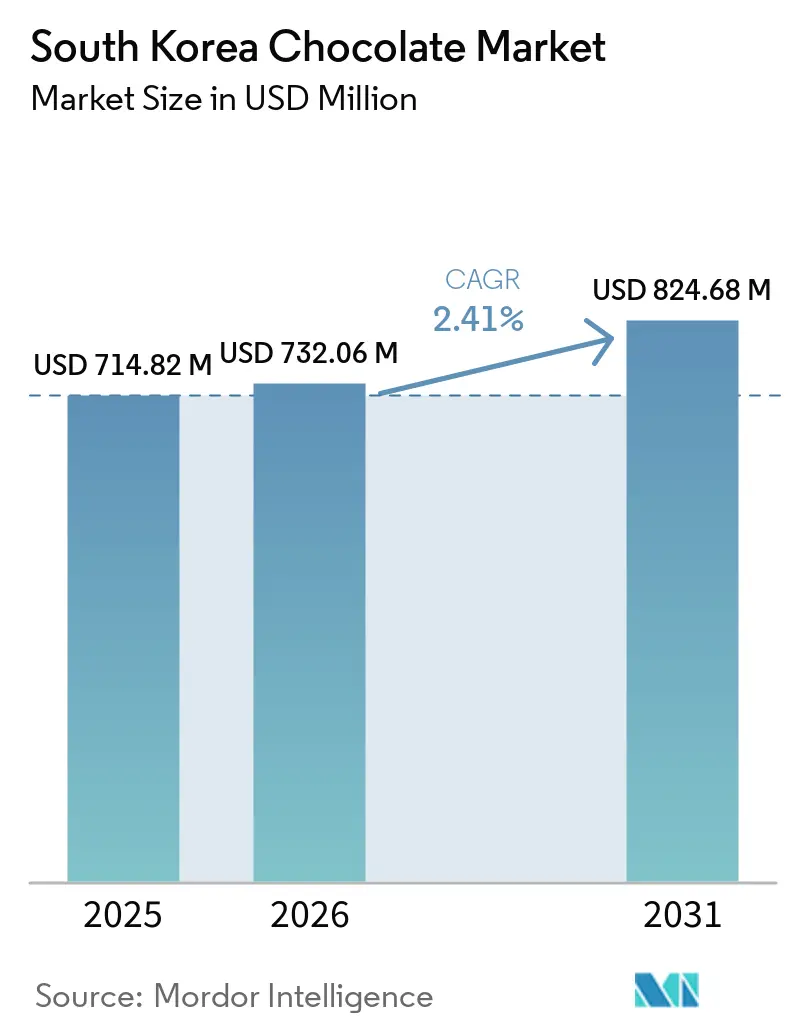
The South Korean chocolate market size was valued at USD 714.82 million in 2025 and estimated to grow from USD 732.06 million in 2026 to reach USD 824.68 million by 2031, at a CAGR of 2.41% during the forecast period (2026-2031). This growth trajectory reflects the market's evolution, where consumers increasingly balance everyday chocolate consumption with a growing appetite for premium offerings. The market dynamics are shaped by social media's influence on consumer preferences, alongside a notable shift towards health-conscious chocolate options. South Korea's deeply embedded gift-giving traditions continue to drive substantial seasonal sales, particularly during cultural celebrations like Valentine's Day and White Day. The Ministry of Food and Drug Safety (MFDS) implements comprehensive quality control measures for domestic and imported chocolates, fostering consumer trust in the market. The industry's development is accelerated by the robust growth of e-commerce platforms, increased introduction of sugar-free alternatives responding to Korea's health-conscious consumer base, and calculated market entries by global chocolate manufacturers. This market environment maintains moderate competitive intensity while providing viable opportunities for specialized market participants.
Key Report Takeaways
- By type, milk and white chocolate variants led with 63.12% of South Korea's chocolate market share in 2025, while dark chocolate is projected to log the fastest 3.60% CAGR through 2031.
- By category, sugar-based products commanded 81.70% of the South Korea chocolate market size in 2025, and sugar-free lines are forecast to rise at 3.44% CAGR.
- By price tier, mass-market SKUs accounted for 54.10% of revenue in 2025; the luxury/artisanal tier is poised for a 3.62% CAGR through 2031.
- By distribution, supermarkets and hypermarkets held a 46.05% revenue share in 2025, whereas online retail is on track for a 3.81% CAGR through 2031.
Note: Market size and forecast figures in this report are generated using Mordor Intelligence’s proprietary estimation framework, updated with the latest available data and insights as of 2026.
South Korea Chocolate Market Trends and Insights
Drivers Impact Analysis*
| Driver | (~) % Impact on CAGR Forecast | Geographic Relevance | Impact Timeline |
|---|---|---|---|
| Evolving taste preferences toward international and fusion flavors | +0.8% | National, concentrated in Seoul and Busan metropolitan areas | Medium term (2-4 years) |
| Rising popularity of premium and artisanal chocolates | +0.6% | National, with early gains in affluent urban districts | Long term (≥ 4 years) |
| Growing demand for organic, vegan, and gluten-free chocolates | +0.4% | National, led by health-conscious millennials and Gen Z | Medium term (2-4 years) |
| Expansion of global brands and international offerings | +0.5% | National, particularly in major retail chains | Short term (≤ 2 years) |
| Strong tradition of chocolate gift-giving | +0.3% | National, culturally embedded across all regions | Long term (≥ 4 years) |
| Growing awareness of sustainable/ethical sourcing and packaging | +0.2% | National, driven by corporate Environmental, Social, and Governance (ESG) initiatives | Long term (≥ 4 years) |
| Source: Mordor Intelligence | |||
Evolving Taste Preferences Toward International and Fusion Flavors
Korean consumers show increasing preference for international chocolate varieties and fusion flavors, influenced by their exposure to global culture through K-pop, Korean dramas, and international travel. The Dubai chocolate trend in December 2023 illustrates this shift, as TikTok-driven demand for pistachio-filled chocolates significantly increased pistachio cream imports and pistachio-flavored ice cream imports in 2024. Social media accelerates the adoption of international flavors, prompting convenience stores to introduce localized versions of trending products. The market shows sustained demand for European dark chocolates, Japanese matcha combinations, and Southeast Asian fruit-infused varieties. Korean manufacturers have adapted by creating fusion products that combine traditional Korean ingredients, such as red bean paste and green tea, with international chocolate formats. This trend is particularly strong among young consumers, who view chocolate consumption as both a cultural expression and an opportunity for social media content.
Rising Popularity of Premium and Artisanal Chocolates
The luxury chocolate segment in South Korea demonstrates significant market expansion, surpassing the broader confectionery market's performance. This growth reflects a fundamental shift in consumer behavior, where Korean buyers increasingly prioritize premium quality over quantity in their chocolate purchases. The trend is particularly pronounced among urban professionals and dual-income households, whose rising disposable income enables exploration of premium confectionery options. International luxury brands, including Godiva, ROYCE', and Hotel Chocolat, have strategically established their presence through exclusive boutiques in premium shopping districts, while domestic manufacturers have invested substantially in developing artisanal production capabilities to compete in this profitable market segment. The premium chocolate category has evolved beyond product quality to encompass sophisticated packaging design, compelling brand narratives, and immersive retail experiences that justify premium price positioning. The market sees growing consumer interest in single-origin chocolates and bean-to-bar products, appealing to discerning customers who value craftsmanship and supply chain transparency. The strong corporate gifting culture in Korea further drives premium chocolate sales, with businesses selecting luxury chocolates for client relationship management and employee recognition during traditional gift-giving seasons.
Growing Demand for Organic, Vegan, and Gluten-Free Chocolates
Korean consumers demonstrate a strong inclination toward functional chocolate alternatives that harmonize with their health and wellness aspirations while fulfilling their desire for indulgence. The country's zero-sugar movement has transformed the carbonated beverage market, subsequently influencing the chocolate segment, where sugar-free variants exhibit robust market performance. Rising consumer consciousness regarding pesticide residues and environmental sustainability propels the demand for organic chocolate products, while vegan alternatives resonate with the younger demographic embracing plant-based lifestyle choices. Korean manufacturers establish strategic partnerships with health food companies to innovate products incorporating alternative sweeteners such as stevia and monk fruit. International brands have responded to the increasing awareness of celiac disease by introducing gluten-free certified offerings. This health-conscious evolution aligns seamlessly with Korea's deep-rooted emphasis on functional foods, fostering a dynamic market for enhanced chocolate products featuring probiotics, collagen, and traditional Korean ingredients like ginseng and red ginseng.
Expansion of Global Brands and International Offerings
International chocolate manufacturers are strategically expanding their footprint in South Korea by capitalizing on the strong consumer preference for foreign food brands and the advantageous trade conditions established under the Korea-US Free Trade Agreement. Mars, a significant player in the global confectionery market, has demonstrated substantial market penetration through carefully crafted localized products and strategic retail partnerships. International brands have successfully integrated into South Korea's deeply rooted gift-giving traditions by developing market-specific packaging solutions and seasonal product offerings tailored to local celebrations and customs. Following the established pattern of other multinational food companies, these manufacturers are investing in domestic production facilities across South Korea to optimize their supply chain operations and reduce import-related expenses, thereby strengthening their competitive position in the market.
Restraints Impact Analysis*
| Restraint | (~) % Impact on CAGR Forecast | Geographic Relevance | Impact Timeline |
|---|---|---|---|
| Stricter food labeling and regulatory requirements for ingredients | -0.3% | National, enforced by Ministry of Food and Drug Safety (MFDS) nationwide | Short term (≤ 2 years) |
| Complexity in logistics for cold-chain chocolate delivery | -0.2% | National, particularly affecting rural and remote areas | Medium term (2-4 years) |
| Volatility in foreign exchange affecting import costs/pricing | -0.4% | National, impacting all imported chocolate products | Short term (≤ 2 years) |
| Sustainability demands raising production and packaging costs | -0.2% | National, driven by corporate Environmental, Social, and Governance (ESG) compliance requirements | Long term (≥ 4 years) |
| Source: Mordor Intelligence | |||
Stricter Food Labeling and Regulatory Requirements for Ingredients
The Ministry of Food and Drug Safety (MFDS) maintains a comprehensive regulatory framework for chocolate products, which significantly impacts market dynamics, especially affecting small-scale importers and artisanal producers. The regulations encompass detailed Korean-language labeling requirements, including comprehensive ingredient declarations, nutritional content information, allergen notifications, and manufacturing facility documentation. The standards establish specific minimum cocoa content thresholds for different chocolate categories [1]. For international manufacturers, HACCP certification protocols add substantial complexity to the market entry process. The regulations also mandate strict lead content limitations for cocoa powder, necessitating thorough testing procedures. The MFDS food additive approval system restricts manufacturers to using only approved substances in their formulations, which constrains product innovation and the development of new ingredient combinations. While these regulatory measures ensure consumer protection and food safety, they create significant market entry challenges that favor established companies with robust compliance infrastructure over smaller specialty producers.
Complexity in Logistics for Cold-Chain Chocolate Delivery
The chocolate supply chain in Korea faces significant operational challenges and mounting cost pressures due to stringent temperature-controlled distribution requirements. This is particularly evident during the summer months when ambient temperatures substantially exceed the optimal storage conditions for chocolate products. Premium and artisanal chocolates demand even more rigorous temperature controls to preserve their quality characteristics and prevent bloom formation throughout the transportation and storage processes. The rapidly expanding e-commerce chocolate retail market has intensified the demand for sophisticated cold-chain solutions, as direct-to-consumer deliveries require specialized packaging and time-sensitive shipping protocols. The distribution challenges become more pronounced in rural and remote areas, where extended transportation distances and limited cold-storage infrastructure create substantial barriers to market expansion. Domestic manufacturers and importers must make substantial investments in comprehensive cold-chain infrastructure, including refrigerated warehousing facilities, temperature-controlled transportation vehicles, and specialized packaging materials, resulting in increased operational costs throughout the distribution network.
*Our forecasts treat driver/restraint impacts as directional, not additive. The impact forecasts reflect baseline growth, mix effects, and variable interactions.
Segment Analysis
By Type: Dark Chocolate Gains Health-Conscious Momentum
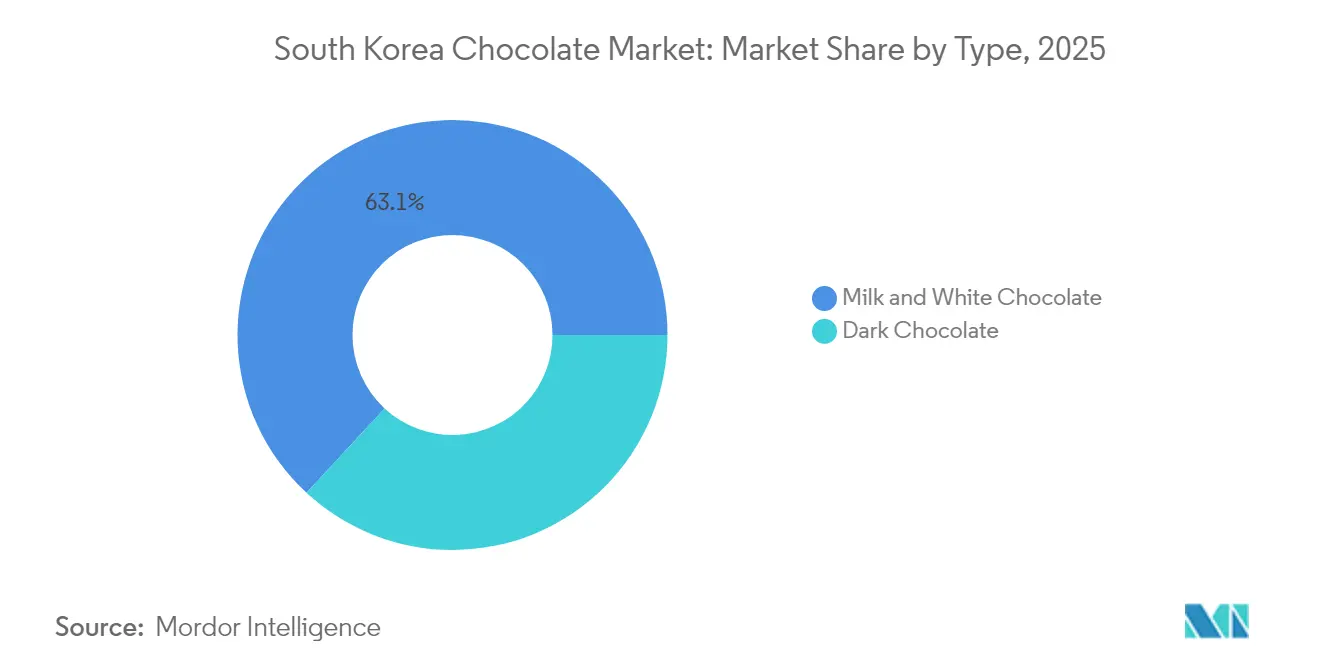
Dark chocolate is experiencing significant momentum in the South Korean confectionery market, with projections indicating a CAGR of 3.60% through 2031. This growth trajectory is particularly noteworthy when compared to the established dominance of milk and white chocolate segments, which currently command a substantial 63.12% market share in 2025. The increasing consumer preference for dark chocolate aligns with broader health and wellness trends in Korea, where consumers actively seek products with higher cocoa content. The viral Dubai chocolate phenomenon has further amplified dark chocolate's appeal, as Korean consumers increasingly associate darker varieties with premium quality and sophisticated taste profiles.
The traditional milk and white chocolate segments continue to maintain their market leadership position through deeply entrenched consumer preferences and extensive retail distribution networks. These segments particularly excel during cultural gift-giving occasions such as Valentine's Day and White Day, where they remain the preferred choice for many consumers. The market demonstrates clear generational preferences, with younger consumers gravitating toward dark chocolate variants due to their perceived health benefits and lower sugar content. In contrast, older demographic groups maintain their loyalty to conventional milk chocolate formulations. White chocolate occupies a distinct market position, finding its primary applications in seasonal product launches and premium confectionery offerings, where it serves specific consumer preferences and usage occasions.
By Category: Sugar-Free Alternatives Accelerate Amid Wellness Trends
The South Korean chocolate market remains firmly anchored in traditional sugar-based products, which account for 81.70% of market share in 2025. This dominance reflects deeply ingrained consumer preferences and well-established manufacturing processes that have been refined over decades. However, the market is experiencing a notable shift as sugar-free alternatives emerge as a significant growth segment, advancing at a 3.44% CAGR through 2031.
South Korea's transformation in zero-sugar consumption patterns is reflected in the substantial expansion of the carbonated beverage alternatives market during the post-pandemic period. Companies like Lotte Chilsung are strategically diversifying their sugar-free product portfolios to address the evolving preferences of health-conscious consumers. This market adaptation specifically targets individuals managing diabetes, consumers focused on weight management, and parents seeking nutritionally balanced beverage options for their children.
By Price Tier: Luxury Segment Outpaces Mass Market
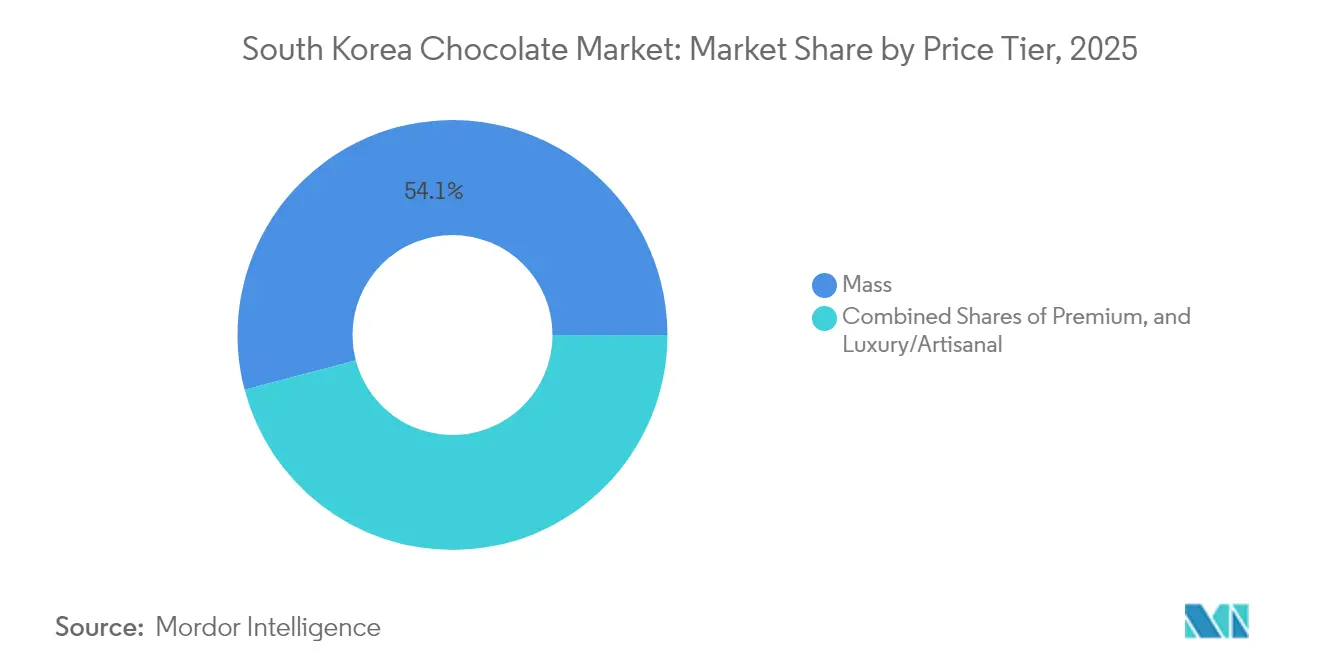
Mass-market chocolate dominates the South Korean confectionery landscape with a 54.10% market share in 2025. This significant market presence is attributed to established distribution networks spanning convenience stores, supermarkets, and online platforms, combined with competitive pricing strategies that ensure broad consumer accessibility. Meanwhile, the luxury and artisanal segments demonstrate robust growth potential, projected to expand at a 3.62% CAGR through 2031, indicating a notable shift in consumer preferences.
The market's evolution reflects the sophisticated purchasing behavior of Korean consumers who balance everyday chocolate consumption with premium indulgences. The premium segment's growth trajectory is strengthened by the strategic expansion of international luxury brands into the Korean market, alongside the emergence of local artisanal chocolatiers. This growth is further amplified by Korea's deeply rooted corporate gifting culture, where premium chocolate presentations serve as important business relationship tools. Luxury chocolate manufacturers have successfully positioned their products by emphasizing traditional craftsmanship, authenticating single-origin cocoa sourcing, and creating immersive retail environments that validate their premium pricing structure.

By Distribution Channel: Online Retail Transforms Shopping Patterns
The retail landscape for chocolate distribution in South Korea demonstrates a clear dominance of traditional brick-and-mortar establishments, with supermarkets and hypermarkets commanding a substantial 46.05% market share in 2025. This leadership position stems from their widespread physical presence across urban and suburban areas, combined with deeply ingrained consumer shopping patterns. In parallel, the online retail segment is experiencing significant momentum, projected to expand at a 3.81% CAGR through 2031, as consumers increasingly embrace digital shopping platforms.
This shift reflects broader changes in South Korean retail dynamics, particularly evident in the surge of online food purchases among younger generations and time-constrained dual-income households. The convenience store channel maintains its robust performance through strategically positioned outlets, capitalizing on impulse purchases and implementing agile product rotation strategies to feature trending items like Dubai chocolate varieties. Specialty stores have carved out their niche by focusing on premium, organic, and imported chocolate selections, where product expertise and carefully curated assortments serve discerning consumers. The digital transformation of retail channels has created new market opportunities, particularly for direct-to-consumer brands, subscription services, and businesses offering personalized chocolate products. This market evolution has simplified distribution, allowing artisanal chocolate producers to reach consumers nationwide without extensive physical retail networks.
Geography Analysis
The South Korean chocolate market functions within a unified national framework, with regional variations reflecting population density and urban-rural distribution patterns. The Seoul metropolitan area and major urban centers, including Busan, Daegu, and Incheon, remain instrumental in driving consumption patterns. These regions benefit from substantial consumer purchasing power, strong international brand presence, and advanced retail infrastructure that effectively supports premium product segments.
The geographic distribution mirrors South Korea's predominantly urban population structure, creating concentrated demand centers that enable streamlined distribution and marketing approaches. International chocolate manufacturers typically choose Seoul as their entry point before expanding their presence to other major cities. Meanwhile, domestic companies like Lotte and Orion have established comprehensive distribution networks that effectively serve consumers across both urban and rural markets.
Rural areas face distinct challenges in cold-chain logistics, where extended transportation routes and insufficient refrigerated infrastructure limit the availability of premium products and online shopping options. The Ministry of Food and Drug Safety implements comprehensive regulatory standards throughout the country, ensuring consistent product quality and safety requirements across regions. This regulatory uniformity creates favorable conditions for implementing national brand strategies and managing import procedures effectively.
Regulatory Landscape
Chocolate sold in South Korea is regulated under the Ministry of Food and Drug Safety (MFDS) framework, including the Food Sanitation Act and MFDS Food Code standards that define product categories (for example, milk chocolate, white chocolate, and semi-chocolate) with minimum cocoa and/or milk solid content requirements. MFDS standards also set controls for contaminants and ingredients, including limits for lead in cocoa powder, and require Korean-language labeling with ingredient lists, allergen declarations, nutrition facts, and traceability details for both domestic and imported products. HACCP compliance is a core operating requirement for manufacturers.
For import and commercialization, MFDS oversight also covers overseas manufacturing facility registration and label review practices, which raises the compliance bar for niche importers and small artisanal brands. A key recent compliance anchor is the MFDS expansion of nutrition labeling and information standards for sugar-free/no-sugar added claims effective January 1, 2026, which increases the need for pack and claim substantiation updates across mainstream and better-for-you chocolate lines. At the border, chocolate under HS 1806 also faces tariff treatment (with an 8% basic rate cited in customs/tariff references), which can affect final shelf pricing versus locally produced alternatives.
Competitive Landscape
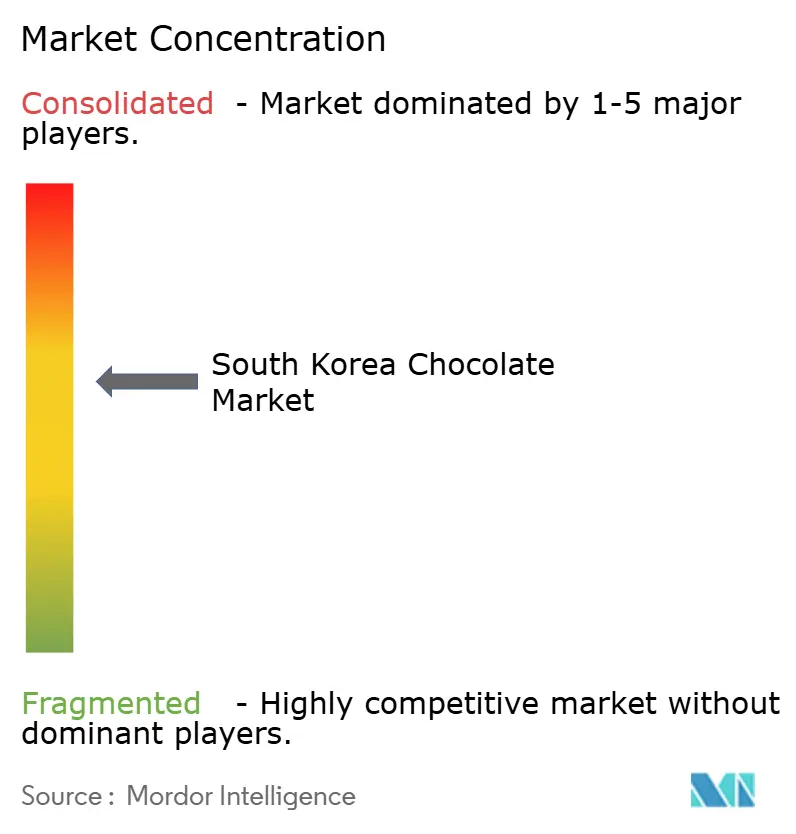
The South Korean chocolate market has medium market concentration, where established Korean conglomerates operate alongside international brands. Each player employs distinct positioning strategies and leverages distribution networks to maintain market presence. Domestic industry leaders Lotte Wellfood and Orion have built their success on deep-rooted local market understanding, strong retail partnerships, and the ability to develop products that resonate with Korean cultural preferences. Meanwhile, international companies such as Mars, Ferrero, and Nestlé maintain their competitive edge through established global brand recognition and premium market positioning. This market structure has created viable opportunities for artisanal producers and specialty brands that focus on serving health-conscious consumers, premium gift markets, and specific flavor preferences that remain underserved by mass-market companies.
The adoption of advanced technology has emerged as a crucial differentiator in the competitive landscape, particularly in areas such as e-commerce capabilities, supply chain optimization, and consumer engagement platforms. These technological advancements enable companies to effectively capture and respond to emerging trends, such as the recent Dubai chocolate phenomenon. Market participants continue to enhance their operations through investments in cold-chain logistics infrastructure, digital marketing initiatives, and sophisticated data analytics systems, allowing them to better understand and respond to evolving consumer preferences with agile product development strategies.
The current market dynamics indicate significant potential for industry consolidation through various strategic initiatives. Companies are exploring opportunities for partnerships, acquisition activities, and joint ventures that effectively combine local market expertise with international brand portfolios. These strategic alignments allow organizations to leverage complementary strengths, particularly in technological capabilities and market access, creating more robust and competitive business entities in the South Korean chocolate market.
South Korea Chocolate Industry Leaders
-
Lotte Wellfood Co., Ltd.
-
Orion Confectionery Co., Ltd.
-
Crown Confectionery Co., Ltd.
-
Ferrero International S.A.
-
Mars, Incorporated
- *Disclaimer: Major Players sorted in no particular order
Market Opportunities and Future Outlook
Vertical integration and local processing capacity are emerging as a practical whitespace for manufacturers looking to manage cocoa input volatility and tighten quality control in South Korea. In February 2026, Lotte Wellfood began full operations of a new cocoa bean processing line at its Yangsan plant, lifting cocoa mass production capacity to 2.5 tons per hour and shortening the production process by about 25%. This supports bean-to-bar style positioning, faster product iteration, and more resilient sourcing strategies for chocolate and chocolate-based confectionery.
Operational efficiency and compliance-ready product renovation are also creating room for differentiated offerings in sugar-free and premium categories. Smart-factory automation is being applied to confectionery processes, including automated coating and conveyor stability upgrades, to reduce defects and address labor and cost pressures. At the same time, MFDS tightening around sugar-free/no-sugar added information standards effective January 2026 pushes brands to strengthen labeling discipline and ingredient transparency. These shifts align with observed demand for premium gifting and health-oriented formulations, creating openings for compliant sugar-free portfolios, premium assortments with stronger provenance narratives, and e-commerce-friendly SKUs supported by temperature-controlled fulfillment.
Recent Industry Developments
- July 2026: Crown Confectionery introduced the Cookdas Ube Edition as a limited-edition lineup extension. Seasonal and flavor-led rotations like this support shelf differentiation in a market shaped by social-media-driven taste discovery, while keeping mainstream brands active in convenience and online channels.
- April 2025: Orion Corp. announced a USD 580 million investment over three years to expand snack manufacturing capacity. The added capacity strengthens domestic supply and reinforces competitive intensity across chocolate and chocolate-based confectionery by improving scale economics and launch agility.
- October 2024: Saudi Arabia’s Vlinder Chocolate entered South Korea, leveraging the viral Dubai chocolate trend with six Middle Eastern-inspired flavors. By securing import approvals and scaling distribution via major Korean e-commerce platforms, the brand highlighted how cross-border novelty products can use online retail to accelerate trial and category premiumization.
Research Methodology Framework and Report Scope
Market Definition and Coverage
For this study, the market covers chocolate products sold in South Korea and valued at the price paid by the buyer across retail and similar selling points. It includes mainstream and premium chocolate offerings, counted in USD, across the country.
Scope exclusions: We exclude cocoa raw materials and industrial cocoa ingredients sold mainly for further processing rather than as finished chocolate products.
Segmentation Overview
- By Type
- Dark Chocolate
- Milk and White Chocolate
- By Category
- Sugar
- Sugar- free
- By Price Tier
- Mass
- Premium
- Luxury/Artisanal
- By Distribution Channel
- Supermarkets/ Hypermarkets
- Convenience Stores
- Specialty Stores
- Online Retail
- Others
Data Sources, Market Sizing, and Validation
Desk Research
Desk research was used first to map how chocolate moves from importers and manufacturers into retail shelves, and to understand the demand drivers that matter in South Korea. We referred to public sources such as Statistics Korea (KOSTAT) for household spending signals, Korea Customs Service trade statistics for cocoa and chocolate-related imports, and the Ministry of Food and Drug Safety for labeling and category rules that shape what is sold as chocolate.
To build realistic selling-price and channel assumptions, we also reviewed company filings and investor materials where available, retail and e-commerce category pages, and reputable business press coverage of promotions and product launches. Where gaps remained, paid subscriptions were used for company financials and intelligence, and for shipment-level import and export checks that help confirm volume direction. The desk research sources listed here are illustrative only, and many other public and paid references were used for cross-checks and clarification.
Primary Interviews and Surveys
Primary work was then used to pressure-test the desk findings with people who see pricing, distribution, and shopper behavior directly. This helped us firm up the final assumptions on channel splits and the pace of premiumization, and it also clarified how sugar-free adoption is showing up by retailer type.
Since this is a single-country market, the interviews focused on national-level dynamics while still covering different route-to-market models, including convenience-led purchases and online gifting spikes.
Distribution of primary research fieldwork respondents
| Company type | Respondent position |
|---|---|
| Top tier: 32% | CXOs: 17% |
| Mid tier: 47% | Functional/Unit leaders: 32% |
| Smaller Players: 21% | Managers: 51% |
Market-Sizing & Forecasting
Market sizing was built using a top-down and bottom-up approach. The top-down view starts from country food spending patterns and retail sales signals, then narrows to chocolate using category shares and channel weights. To keep the totals realistic, the results were checked against selective bottom-up approximations, including sampled price points multiplied by observed pack and assortment activity across key channels.
Inputs used in the model included chocolate import trends, household consumption and gifting intensity, the split of sales across supermarkets, convenience stores, specialty stores, and online, plus price-tier mix shifts across mass and premium ranges. We also tracked category signals such as sugar-free claims and dark-chocolate preference changes, since these affect average selling prices and the mix of units sold.
For forecasting, scenario analysis was used. The base case was aligned to what primary respondents expect for volume growth and price movement over the next few years. When a bottom-up check was thin for a niche price tier or a smaller channel, the gap was handled by applying conservative ranges and then reconciling back to the top-down demand pool so the final path stayed consistent.
Data Validation & Update Cycle
Before sign-off, the estimates were triangulated against independent signals such as trade movement, retail channel momentum, and expected price changes, so outliers could be spotted early. Any large variances triggered a deeper review of assumptions, and where needed, follow-up outreach was done to re-check the practical reality on pricing and channel mix.
A multi-step internal review was followed so that calculations, conversions, and year mapping stayed consistent across the time series. The report is refreshed annually, and interim updates are made when material events occur that can shift demand or pricing. Right before delivery, a final analyst pass is completed to confirm the latest inputs are reflected in the published view.
Mordor Intelligence's South Korea Chocolate Market Sizing Compared With Other Published Estimates
It is common to see different market values for South Korea chocolate because each publisher draws the market boundary in a slightly different way, and each also makes distinct choices on prices, channels, and timing. Differences can also come from whether the estimate is built around retail sales value versus wider confectionery value, and from the year used for currency conversion.
By tracking channel-level price moves and refresh timing, Mordor Intelligence keeps the total tied to finished chocolate sold in South Korea, rather than expanding the scope into cocoa ingredients or broader cocoa-based product baskets that inflate value. The gap is also shaped by how premium and artisanal products are treated, since changes in assumed mix can shift the average selling price in this category.
Benchmark comparison
| Source | Market Size | Gaps in Research Methodology |
|---|---|---|
| Mordor Intelligence | USD 732.06 M (2026) | |
| Global Consultancy A | USD 975.70 M (2025) | Uses a broader chocolate definition with simplified segment splits (for example, traditional versus artificial), and the pricing base can lean more toward packaged retail averages without the same channel weighting by South Korea-specific route-to-market. |
| Industry Publisher B | USD 1159.00 M (2025) | Counts chocolate plus cocoa products, which can bring in baking ingredients and other cocoa-based uses, and this wider basket tends to push the value up compared with finished chocolate-only retail consumption. |
The table shows that the spread is mainly explained by scope and counting rules, especially whether cocoa products and ingredient-led demand are included. When the scope is kept to finished chocolate and the channel mix is applied consistently, the result is easier to trace back to clear demand drivers and repeatable checks.
Key Questions Answered in the Report
How fast is the South Korea chocolate market expected to grow to 2031?
The South Korea chocolate market value is projected to advance from USD 732.06 million in 2026 to USD 824.68 million by 2031, reflecting a 2.41% CAGR.
Which chocolate type is seeing the quickest uptake among Korean consumers?
Dark chocolate leads in growth with a 3.60% CAGR, propelled by wellness perceptions and social-media flavor trends.
Why are sugar-free chocolates gaining traction?
Rising health awareness and the broader national zero-sugar movement have lifted sugar-free chocolate sales at a 3.44% CAGR.
What role does e-commerce play in chocolate distribution?
Online retail is the fastest-growing channel, expanding at a 3.81% CAGR thanks to same-day delivery services and temperature-controlled packaging.
How does MFDS regulation shape the market?
Strict cocoa-content and labeling rules elevate compliance costs but also reinforce consumer confidence in product safety across all brands.