
Market Overview
| Study Period | 2020 - 2031 |
|---|---|
| Market Size (2026) | USD 2.88 Billion |
| Market Size (2031) | USD 3.82 Billion |
| Growth Rate (2026 - 2031) | 5.82 % |
| Fastest Growing Market | Asia Pacific |
| Largest Market | North America |
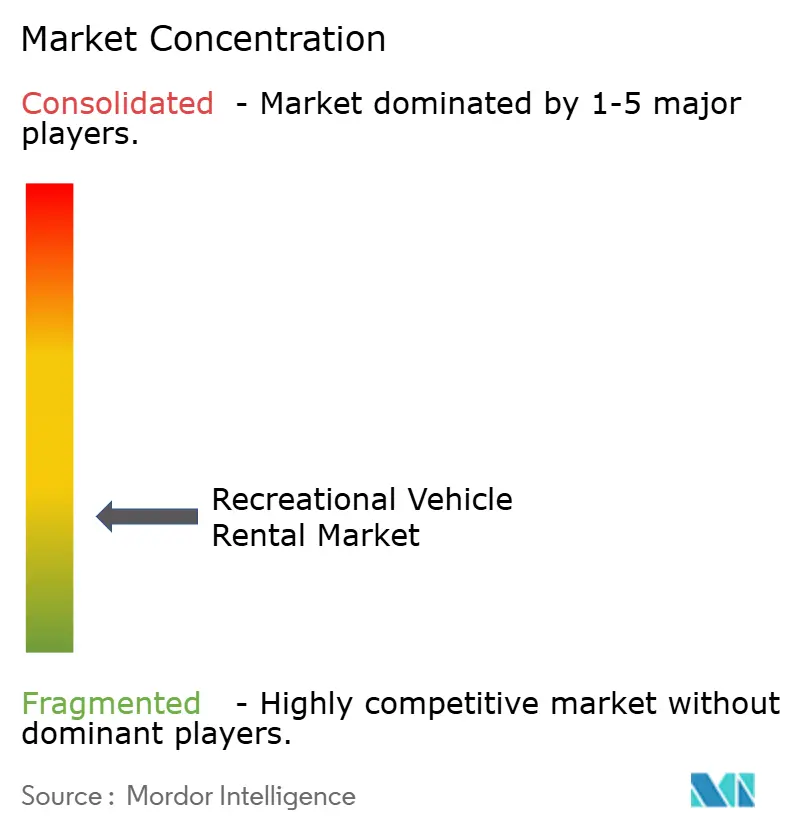
| Market Concentration | Low |
Major Players
*Disclaimer: Major Players sorted in no particular order Image © Mordor Intelligence. Reuse requires attribution under CC BY 4.0. |
|
Recreational Vehicle Rental Market Analysis by Mordor Intelligence
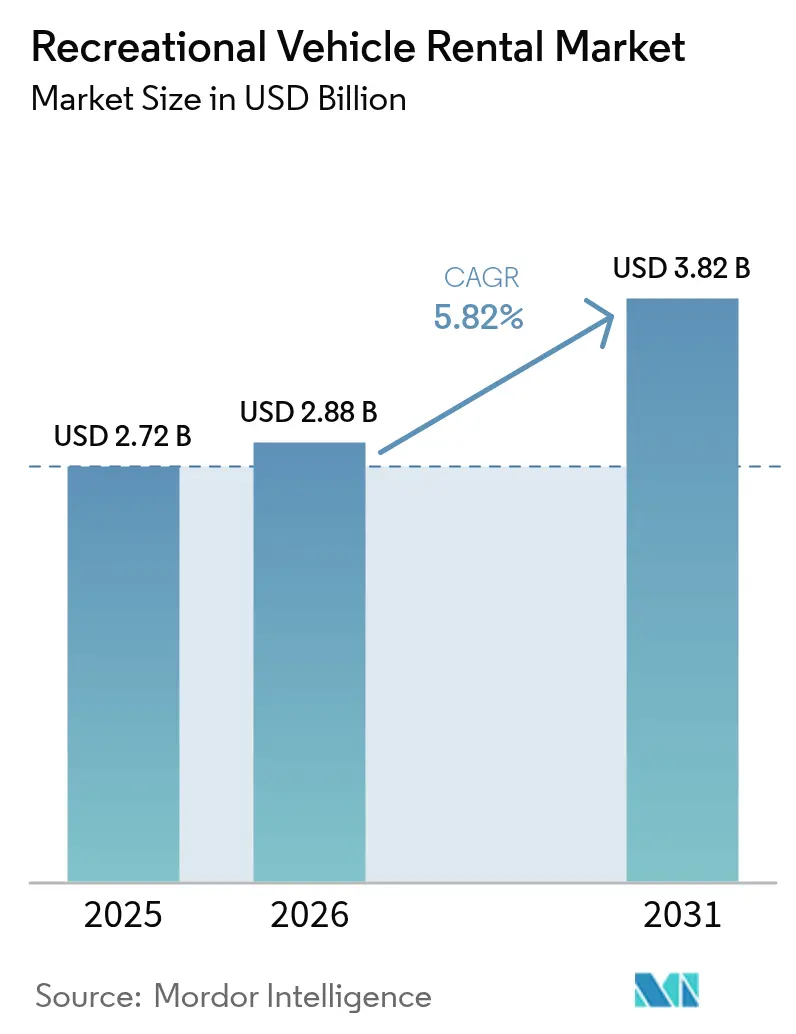
The Recreational vehicle Rental market size is projected to expand from USD 2.72 billion in 2025 and USD 2.88 billion in 2026 to USD 3.82 billion by 2031, registering a 5.82% CAGR between 2026 to 2031. The growing preference for experiential travel among younger cohorts, the rapid adoption of peer-to-peer platforms, and the initial electrification of rental fleets are reshaping supplier economics and traveler expectations. Experience-oriented consumers favor road trips that combine flexible itineraries with access to remote natural sites, a shift that boosts vehicle days and reduces ownership barriers. Digitally native renters demand instant booking and transparent pricing, pushing operators toward dynamic pricing models that raise average transaction value. Early fleet electrification signals a premium-segment opportunity, even as charging infrastructure remains sparse.
Key Report Takeaways
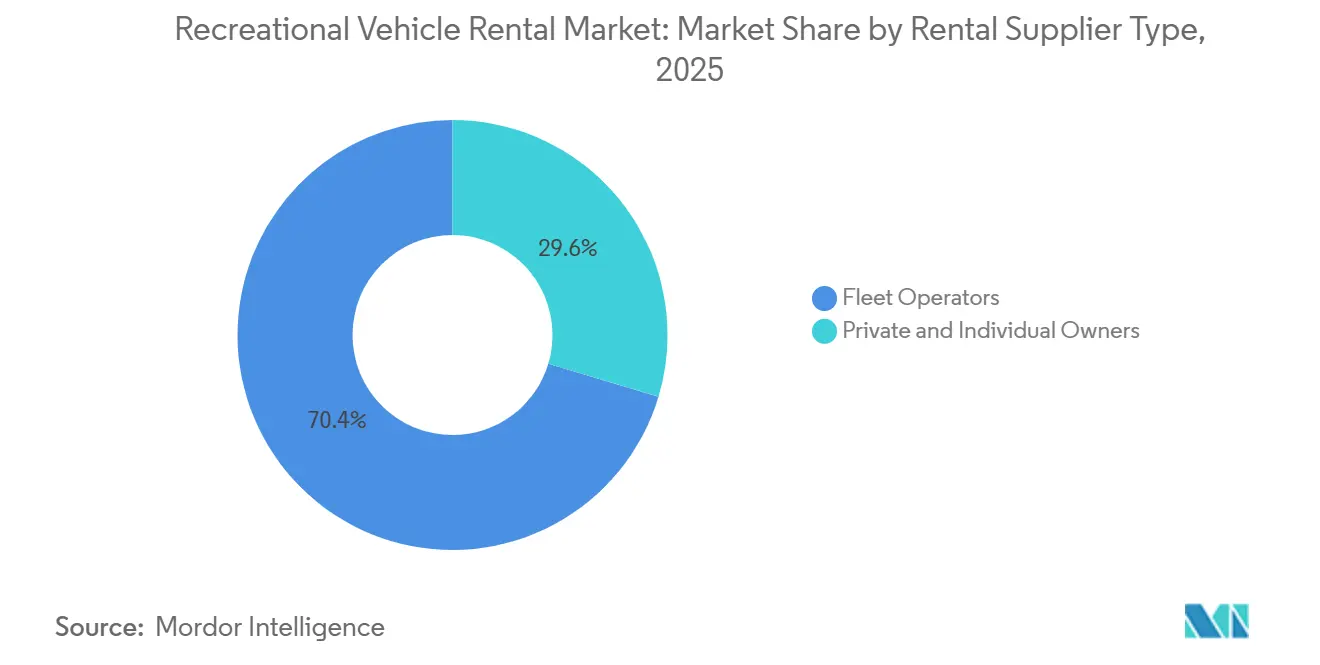
- By rental supplier type, fleet operators held 70.37% of the Recreational Vehicle Rental Market share in 2025, while individual owners recorded the fastest projected CAGR at 6.95% to 2031.
- By booking type, the online segment accounted for 61.55% of 2025 revenue, growing at an 8.01% CAGR through 2031.
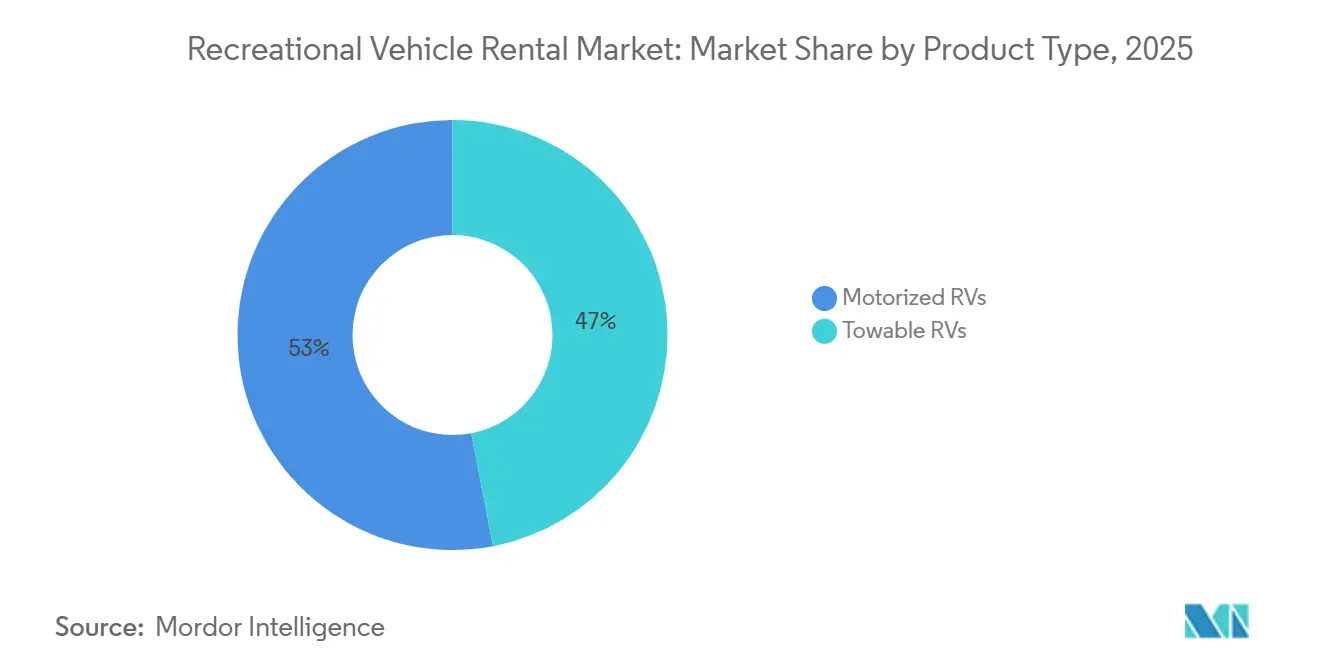
- By product type, motorized RVs led with 53.01% revenue share in 2025; towables are projected to expand at an 8.66% CAGR through 2031.
- By rental duration, short-term rentals accounted for 52.82% of the total market in 2025, yet mid-term rentals are projected to grow at 8.94% through 2031.
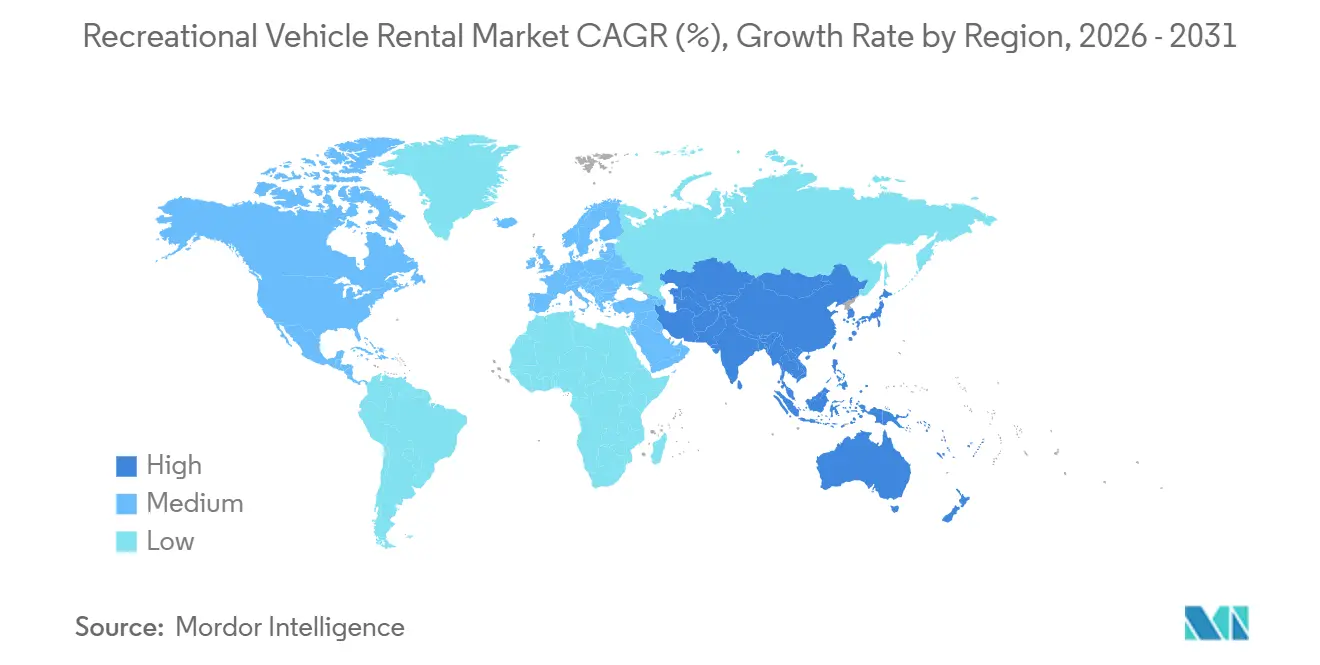
- By geography, North America accounted for 46.78% of 2025 revenue; Asia-Pacific is slated to post the highest regional CAGR of 11.35% through 2031.
Note: Market size and forecast figures in this report are generated using Mordor Intelligence’s proprietary estimation framework, updated with the latest available data and insights as of 2026.
Market Trends and Insights
Drivers Impact Analysis of Recreational Vehicle Rental Market*
| Driver | (~) % Impact on CAGR Forecast | Geographic Relevance | Impact Timeline |
|---|---|---|---|
| Surge in Domestic Tourism | +1.2% | Global, with highest impact in North America & Europe | Short term (≤ 2 years) |
| Expansion of Peer-to-Peer Rentals | +1.0% | Global, led by North America, expanding to APAC & Europe | Medium term (2-4 years) |
| Rising Disposable Income | +0.9% | Global, concentrated in developed markets | Long term (≥ 4 years) |
| Zero-Emission RV Incentives | +0.6% | North America (California + 9 states), EU | Long term (≥ 4 years) |
| Fleet Uptime Optimization | +0.5% | North America & Europe, spreading to APAC | Medium term (2-4 years) |
| Corporate Use | +0.2% | North America & Europe | Short term (≤ 2 years) |
| Source: Mordor Intelligence | |||


Surge in Domestic Road-Trip Tourism
Leisure travelers are redirecting budgets from overseas flights to drivable vacations, reinforcing the appeal of open-road itineraries. In 2024-25, Australia witnessed 8.40 million international visitor arrivals, up from 7.97 million in 2023-24[1] "Overseas arrivals and departures, Australia - 2024-25 financial year" Australian Bureau of Statistics, abs.gov.au. Heavier visitation at national parks tightens campground capacity and nudges renters toward dispersed public-land sites. Industry surveys show that millions of households now plan at least one RV trip each year, confirming a lasting behavioral shift from air to road travel. Operators that package vehicles with campsite reservations and pre-planned routes capture first-time renters who value convenience. Flexibility, avoidance of crowded airports, and access to remote scenery remain the primary pull factors for this driver segment.
Expansion of Peer-to-Peer (P2P) Rental Platforms
Digital marketplaces unlock income for idle privately owned RVs while giving renters a wider selection of vehicle styles. The model shifts maintenance and depreciation risk to owners, allowing platforms to scale without heavy capital outlay. Trust hinges on effective verification procedures and purpose-built insurance that protects both parties during each booking. Dynamic pricing engines help owners reach occupancy targets while keeping rates attractive for budget-sensitive travelers. As transactions grow, platform loyalty rises due to ease of booking, transparent reviews, and responsive customer support.
Rising Disposable Income Among Millennials and Gen-Z
A younger demographic is entering the peak earning years and channeling discretionary spending toward experiences rather than possessions. Social-media influence and remote-work policies encourage longer, more immersive RV adventures that blur the lines between vacation and daily life. These travelers gravitate to Wi-Fi-enabled motorized units and often comparison-shop across multiple apps before committing. Visual storytelling drives demand for units with stylish interiors and photogenic exteriors. Brands that partner with influencers and emphasize sustainability cues resonate strongly with this audience.
Zero-Emission RV Incentives Accelerating Electrified Fleets
Government incentives lower the upfront cost of adopting electric powertrains and charging infrastructure for rental fleets. Early prototypes of battery-assisted motorhomes show that premium renters will pay more for silent operation and lower emissions. Operators promoting green credentials differentiate themselves in urban and corporate segments where sustainability policies guide purchasing decisions. Limited rural charging networks remain a constraint, but also create opportunities for businesses that install fast chargers at depots and destination campgrounds. Early adopters enjoy marketing advantages and favorable press coverage that reinforce brand equity.
Restraints Impact Analysis of Recreational Vehicle Rental Market*
| Restraint | (~) % Impact on CAGR Forecast | Geographic Relevance | Impact Timeline |
|---|---|---|---|
| Maintenance and Insurance Costs | -1.1% | Global, most acute in North America & Europe | Short term (≤ 2 years) |
| Seasonality-Driven Low Asset Utilization | -0.8% | Northern hemisphere markets, moderate in APAC | Medium term (2-4 years) |
| Overnight Parking Restrictions | -0.6% | Urban centers in North America & Europe | Short term (≤ 2 years) |
| Supply Bottlenecks | -0.4% | Global, concentrated in complex motorized units | Medium term (2-4 years) |
| Source: Mordor Intelligence | |||
High Maintenance and Insurance Costs
Routine service on engines, tires, and onboard appliances, coupled with comprehensive insurance, compresses margins for small operators. Platforms mitigate some expenses through telematics that flag issues before breakdowns and through pooled purchasing of parts. Skilled labor for RV repair remains scarce, keeping hourly shop rates high and turnaround times unpredictable. Owners sometimes pass rising costs to renters, though price sensitivity places an upper limit on surcharges. Cost containment, therefore, relies on predictive maintenance, in-house service teams, and negotiated insurance coverage.
Seasonality-Driven Low Asset Utilization
Demand soars in warm months and falls sharply during colder seasons, leaving significant idle inventory at depots. Operators experiment with repositioning vehicles to year-round climates, but transport logistics and regulatory hurdles limit scale. Off-peak discounts attract retirees and digital nomads, yet narrow profit margins. Diversifying into corporate mobile offices or film-production support helps fill winter gaps but requires specialized vehicle layouts. Balancing fleet mix and exploring counter-cyclical use cases remain essential to smoothing utilization curves.
*Our forecasts treat driver/restraint impacts as directional, not additive. The impact forecasts reflect baseline growth, mix effects, and variable interactions.
Recreational Vehicle Rental Market Segment Analysis
By Rental Supplier Type:
Fleet Consolidation Drives Scale AdvantagesFleet operators accounted for 70.37% of the recreational vehicle rental market in 2025, reflecting well-organized networks that offer standardized fleets, reliable service, and comprehensive maintenance. Their scale ensures steady availability of Class A, B, and C motorhomes, attracting renters who value convenience and consistent quality. Strong brand recognition and established customer support also make trip planning easier for long-distance travelers. As RV vacations grow among families, retirees, and overseas visitors, large operators maintain their lead by modernizing their fleets and expanding coverage along major tourist routes, reinforcing their dominance in the overall market.
Private and individual owners form the fastest-expanding category, growing at a 6.95% CAGR through 2031 as peer-to-peer platforms gain momentum. Easy-to-use apps let owners earn income from underused vehicles, expanding supply in suburban and rural areas. Renters appreciate the unique models and budget-friendly prices often found outside corporate fleets. Trust in digital verification, bundled insurance, and driveway delivery services is rising among younger travelers, accelerating adoption and diversifying market demand.

By Booking Type:
Digital Transformation Accelerates Online AdoptionOnline booking accounted for 61.55% of the 2025 market size and is the fastest-growing channel, growing at an 8.01% CAGR as travelers increasingly expect digital convenience. Mobile platforms let users compare prices, view layouts, and secure a vehicle in minutes. Built-in GPS planners, digital check-ins, and instructional videos streamline the process, while last-minute weekend trips have become easier to arrange online. User reviews, seamless payments, and personalized recommendations are cementing the internet as the preferred route for reservations.
Offline reservations accounted for 38.45% of rentals in 2025. Many first-time RV travelers look for personal guidance on insurance, equipment use, and route planning, so in-person service at rental centers near national parks and highway hubs remains important. Customers arranging complex itineraries or lengthy trips still prefer face-to-face advice, keeping offline channels central to market revenue.
By Product Type:
Motorized Dominance Reflects Self-Contained PreferenceMotorized RVs led with a 53.01% share in 2025 because renters favor self-contained travel without towing. Class A units attract vacationers who need space and luxury; Class B vans appeal to younger, more mobile renters; and Class C models remain popular with families for practicality and ease of driving. Their comfort and versatility make motorized units the core of rental fleets, especially in regions with strong national park tourism.
Motorized RVs are also the fastest-growing product group, climbing at an 8.66% CAGR. Demand keeps rising for fully equipped vehicles with kitchens, bathrooms, and climate control. Manufacturers are improving interiors, safety features, and fuel economy, broadening appeal to newcomers. Longer-weekend travel habits and remote-work lifestyles favor comfortable on-the-road living, keeping motorized RVs at the center of market expansion.
By Rental Duration:
Extended Stays Reflect Lifestyle EvolutionShort-term rentals of 1–7 days captured 52.82% of the market in 2025, mirroring the popularity of weekend getaways and quick vacations. These bookings offer low-commitment experiences ideal for families, young couples, and first-time renters. Companies support the trend with flexible pickup options, mid-week discounts, and curated short-route packages, ensuring short trips remain the backbone of demand.
As digital nomads and remote workers opt for extended travel, rentals spanning 8–30 days have emerged as the fastest-growing segment, boasting an 8.94% CAGR. These multi-week journeys allow travelers to seamlessly blend work and leisure while discovering picturesque locales. RVs, equipped with features such as solar panels, dedicated workspaces, and reliable connectivity, cater perfectly to this slow-travel trend, bolstering the mid-term category's role in market expansion. By 2025, the median annual RV usage surged to 30 days, marking a notable 50% increase from the 20 days recorded in the 2021 study[2]"Go RVing RV Owner Demographic Profile" RV Industry Association, rvia.org.
Geography Analysis
North America Recreational Vehicle Rental Market
North America remains the largest revenue pool for RV rentals, accounting for 46.78% of the 2025 market, supported by a deep road-trip culture and an extensive campground network. Dispersed camping on public land adds capacity, though parking bans in dense urban areas deter spontaneous overnight stays. Cross-border rentals between the United States and Canada gain traction as insurance products become more standardized. Mexico attracts snowbird travelers seeking warmer winters, yet concerns over roadside assistance and vehicle security slow broader adoption. Continued consolidation among suppliers is likely as brands chase economies of scale in servicing and marketing.
APAC Recreational Vehicle Rental Market
Asia-Pacific is expected to grow at the fastest rate of 11.35% to 2031, driven by established outdoor-lifestyle cultures in Australia and emerging demand in China and India. Government initiatives to build rest areas and campgrounds accelerate first-time adoption among middle-class families. Insurance availability and right-hand-drive compatibility influence fleet composition, while compact vehicle formats meet urban parking constraints. Social-media-driven wanderlust pushes operators to curate photo-friendly itineraries that combine iconic landscapes with reliable connectivity. Partnerships with regional tourism boards provide credibility and marketing reach for early movers.
Europe Recreational Vehicle Rental Market
Europe benefits from visa-free Schengen travel and a dense supplier network that enables one-way, cross-border journeys. Seasonal shifts between northern and southern climates let operators rebalance fleets but also expose them to fuel-price volatility and evolving emissions regulations. Compact campervans remain popular due to tight village roads and higher fuel costs. Fragmented ownership creates space for local specialists to coexist alongside pan-European aggregators. Electrification pilots gain attention as cities adopt low-emission zones and travelers seek greener holiday options.

Regulatory Landscape
Regulation affecting RV rentals spans road-use, vehicle compliance, and campground or space-rental rules, creating a patchwork that operators manage by market. In the United States, health and safety rules for RV parks shape destination capacity and required amenities, including Florida Administrative Code 64E-15 requirements for sanitary facilities. State-level technical compliance also matters for vehicle build and inspection, such as Washington State WAC 296-150R governing RV design plans, quality control, and state insignia processes (updated in 2024).
Recent local and international actions reinforce this fragmentation and the compliance burden across jurisdictions. Arizona enacted the Recreational Vehicle Long Term Rental Space Act in January 2026, defining rights and remedies around long-term rented RV spaces. Deschutes County, Oregon authorized a 2026 program allowing rural residents to use RVs as rental dwellings under specified conditions. In Europe, harmonized frameworks remain central for cross-border operations and equipment conformity, with the European Commission maintaining support to Directive 2013/53/EU through updated harmonized standards and implementing actions through March 2026, alongside a 2025 Commission proposal (COM/2025/180) that addresses periodic roadworthiness testing modernization. Together, these steps reinforce the direction toward more standardized testing and in-vehicle monitoring expectations for fleets.
Value Chain Analysis
The RV rental value chain begins with upstream vehicle and component supply, moves through fleet acquisition and conversion, distribution and booking, and then to operations, maintenance, and remarketing. Rental fleets source motorized units and towables from RV OEMs and converters that rely on commercial automotive chassis and base vehicles, with supply ties to major OEM platforms (including Ford, Stellantis, and Mercedes-Benz) and RV manufacturing clusters such as Elkhart, Indiana. Downstream, rentals are sold through fleet-operator branches and online channels, increasingly via peer-to-peer marketplaces that add insurance, identity verification, payments, and customer support layers to reduce transaction friction.
Operations and aftersales are key value drivers because maintenance, insurance, and downtime affect usable vehicle-days. Repair shops, parts distributors, and roadside assistance networks support uptime, while campground networks and booking partners influence trip feasibility and ancillary revenues, including bundled campsite reservations. The chain also involves fleet technology providers, including telematics, dynamic pricing, and fleet-management software, plus depot infrastructure providers, with some locations upgrading electrical capacity to support higher onboard power needs as electrification pilots expand. Across the chain, chassis reliability, service labor access, and insurance product fit, whether fleet or peer-to-peer, remain common pinch points that shape pricing, utilization, and customer experience consistency.
Competitive Landscape
The recreational vehicle rental market is moderately concentrated. Incumbent fleet operators pursue electrification pilots, telematics integration, and concierge add-ons such as guaranteed campsite bookings. These moves aim to deepen customer loyalty while defending against price erosion. Data-driven preventive maintenance reduces downtime and positions large fleets as reliable choices for risk-averse travelers. Marketing narratives increasingly emphasize safety certifications, 24-hour roadside assistance, and seamless booking to differentiate from smaller rivals. Strategic investment in charging infrastructure begins to shape long-term competitive moats.
Peer-to-peer platforms expand consumer choice by listing everything from vintage trailers to luxury motorhomes at a range of price points. Transparent reviews and owner-to-renter messaging foster trust, yet quality control remains an ongoing challenge. Insurance products tailored to one-off rentals reduce friction and build confidence among hesitant newcomers. Algorithmic pricing nudges owners toward market-clearing rates while rewarding early bookings. As platform liquidity improves, network effects make it harder for latecomers to gain traction without unique service propositions.
Mid-scale challengers focus on design-forward camper vans, pan-regional one-way drop-offs, and influencer-friendly branding to stand out. Urban regulations that restrict overnight parking push these companies to negotiate bespoke campground partnerships near destination cities. Venture funding fuels quick fleet expansion and the rollout of app-based customer touchpoints. Collaborations with outdoor-gear brands create cross-promotion opportunities that attract adventure-seeking millennials. Over time, ecosystem alliances around insurance, roadside assistance, and route planning are expected to drive partial consolidation within the segment.
Recreational Vehicle Rental Industry Leaders
-
Cruise America
-
Apollo Tourism & Leisure Ltd (ATL)
-
Outdoorsy Inc.
-
RV Share
-
McRent (Rental Alliance GmbH)
- *Disclaimer: Major Players sorted in no particular order
Recreational Vehicle Rental Market Companies Covered in this Report
- Cruise America
- Apollo Tourism & Leisure Ltd
- Outdoorsy, Inc.
- RVshare
- McRent
- Indie Campers
- RoadSurfer GmbH
- Camplify
- Yescapa
- El Monte RV
- Just Go Motorhome Hire
- Escape Campervans
- JUCY Rentals
- Spaceships Rentals
- Bunk Campers

Market Opportunities and Future Outlook
Bundled trip packaging and itinerary enablement is a clear whitespace area where planning friction continues to act as a purchase barrier, particularly for first-time renters. RVshare added planning-led offerings in January 2026, including One-Way Rentals, RVshare Getaways, and an RV Rental Advisor team, and in March 2026 expanded turnkey packaging by partnering with Spot2Nite around the 2026 FIFA World Cup to combine rentals with campground bookings. These additions point to an opportunity for operators and platforms to integrate vehicle inventory, campsite availability, and route planning into a single checkout flow, which can improve conversion for online bookings that already accounted for 61.55% of revenue in 2025.
Platform-led expansion into adjacent mobility services and new geographies also supports more differentiated rental propositions and distribution partnerships. Outdoorsy Group expanded its insurtech footprint and market access by launching Roamly in Canada and acquiring Canadian Access in February 2025, then broadened its business scope in 2026 through the live launch of ride.auto in select US markets and a rebrand to The Ride Platform. For RV rental participants, this platform expansion supports opportunities around embedded insurance, delivery and concierge services, and multi-category inventory management. Where infrastructure permits, electrification pilots and depot charging partnerships remain a premium-segment lever.
Recent Industry Developments in Recreational Vehicle Rental Market
- June 2026: Outdoorsy Group rebranded as The Ride Platform, signaling a shift from a pure-play RV marketplace toward a broader mobility and fleet-technology umbrella. The move aligns its marketplace, insurance, and fleet-management capabilities under a single identity, sharpening cross-sell potential across RV rentals and adjacent vehicle categories.
- March 2026: RVshare partnered with Spot2Nite to promote turnkey travel packages tied to the 2026 FIFA World Cup, combining RV rentals with campground booking options. Packaging inventory and accommodations reduces planning friction and helps platforms capture higher-value bookings around time-bound travel surges.
- February 2025: Outdoorsy Group acquired Canadian Access and launched Roamly in Canada with headquarters in Toronto. The acquisition and market entry expanded its embedded insurance and support infrastructure, strengthening trust and transaction enablement for cross-border and Canada-focused rental activity.


Recreational Vehicle Rental Market Report Scope and Research Methodology
Market Definition and Coverage
This market covers paid rentals of recreational vehicles for leisure or travel. In practice, customers rent an RV for a defined period and pay a rental charge that typically reflects time and usage (for example, mileage rules).
Scope exclusions: It excludes new and used RV sales, financing and insurance products, and aftermarket parts and servicing when they are not part of the rental service.
Segments Covered in This Report
-
By Rental Supplier Type
- Private and Individual Owners
- Fleet Operators
-
By Booking Type
- Offline Booking
- Online Booking
-
By Product Type
-
Motorized RVs
- Class A Motorhomes
- Class B Motorhomes
- Class C Motorhomes
-
Towable RVs
- Fifth-Wheel Trailers
- Travel Trailers
- Truck Campers
- Sports Utility Trailers
-
Motorized RVs
-
By Rental Duration
- Short-term (1-7 days)
- Mid-term (8-30 days)
- Long-term (More than 30 days)
-
By Geography
-
North America
- United States
- Canada
- Rest of North America
-
South America
- Brazil
- Argentina
- Rest of South America
-
Europe
- Germany
- United Kingdom
- France
- Spain
- Italy
- Russia
- Rest of Europe
-
Asia-Pacific
- China
- India
- Japan
- South Korea
- Australia
- Rest of Asia-Pacific
-
Middle East and Africa
- United Arab Emirates
- Saudi Arabia
- Turkey
- South Africa
- Rest of Middle East and Africa
-
North America
Data Sources, Market Sizing, and Validation
Desk Research
Desk work starts by building a clean fact base on RV usage, travel demand, and rental pricing patterns, so later assumptions do not drift without context. We mainly use public sources such as tourism and travel statistics from UNWTO, national travel and spending series from agencies such as the US Bureau of Economic Analysis, price and inflation series from the US Bureau of Labor Statistics, and road safety and recall notices from regulators such as NHTSA.
To round out the supply and operating context, we also refer to RV and campground association publications, transport department vehicle registration summaries where available, and public customs and trade releases that help validate RV production and cross-border movement trends. Company filings, investor presentations, and press releases from rental operators and marketplace-style platforms are used to sanity-check utilization language, pricing strategy, and expansion plans. Paid subscriptions are used selectively for company financials and intelligence, plus news and financials. These examples are not exhaustive, and many additional public sources were referenced for data collection, validation, and clarification.
Primary Interviews and Surveys
Primary work focuses on what actually drives rental revenue in practice, including average daily rate ranges by RV type, utilization swings across peak and shoulder seasons, typical length of rental, and the share of bookings that pass through online channels. We spoke with a mix of fleet operators, private and individual owners active in rentals, booking intermediaries, and travel ecosystem participants across APAC, EMEA, and the Americas, so regional seasonality and pricing differences could be compared and reconciled.
Distribution of primary research fieldwork respondents
| Company type | Respondent position | Region |
|---|---|---|
| Top tier: 28% | CXOs: 12% | APAC: 38% |
| Mid tier: 56% | Functional/Unit leaders: 36% | EMEA: 36% |
| Smaller Players: 16% | Managers: 52% | Americas: 26% |
Market-Sizing & Forecasting
For sizing, we use a top-down demand pool build that starts from travel and camping activity signals and then narrows to RV-rental relevant trips by region, season, and rental-duration patterns. The revenue pool is reconstructed using practical variables such as average rental days per booking, average daily rates by motorized and towable RV categories, typical utilization for commercial fleets, and the online versus offline booking mix (which often affects pricing and commissions).
Selective bottom-up approximations are used as a cross-check, where supplier roll-ups, sample price scrapes, and channel checks help validate whether implied revenue per vehicle and per booking looks realistic. When gaps show up, we adjust using conservative ranges from interview feedback and public disclosures, and we avoid forcing a full supplier-by-supplier build where coverage would be uneven. For forecasting, scenario analysis is applied around key drivers such as leisure travel growth, campground capacity additions, fuel price sensitivity, and platform-led supply growth, and then the final path is confirmed through expert consensus on how rates and utilization are likely to move.
Data Validation & Update Cycle
Outputs are checked against independent signals such as RV registration trends, leisure travel indicators, and price movements seen in rental listings, and then major variances are flagged for a second review. If a region shows an unusual jump, assumptions such as utilization, average rental duration, and exchange-rate timing are re-tested before sign-off.
The work is reviewed in multiple steps so the final numbers are consistent across the total market and key cuts such as RV type and booking channel. Reports are refreshed annually, and interim updates are triggered when material events occur, such as demand shocks, pricing resets, or policy changes affecting road travel. Before delivery, a final pass is completed to ensure the latest public data and interview learnings are reflected.
Mordor Intelligence's Recreational Vehicle Rental Market Size Versus Other Published Estimates
Published market sizes for RV rentals can look far apart, even when they refer to the same broad activity, because counting rules are not always aligned. Differences usually come from what revenue is treated as rental revenue, whether peer-to-peer and fleet rentals are both included, and how much geography and channel detail is actually validated.
By tracking booking-duration bands, utilization-led revenue per vehicle, and currency timing in the model, Mordor Intelligence aligns the market total to rental-service revenue tied to rental days and rates, rather than counting wider trip spending or RV sales value that sits outside the rental market.
Benchmark comparison
| Source | Market Size | Gaps in Research Methodology |
|---|---|---|
| Mordor Intelligence | USD 2.72 B (2025) | |
| Trade Publisher A | USD 6.93 B (2025) | Uses a broader revenue lens that can inflate totals when adjacent travel and trip spending are counted near RV rental activity, and the treatment of peer-to-peer supply and platform fees is not clearly separated from end rental revenue. |
| Global Consultancy B | USD 0.94 B (2024) | Likely applies a narrower scope filter (for example, focusing on selected applications or operator types), which can undercount markets where private and individual owners and mixed booking channels contribute meaningful revenue. |
Looking across the three values, the spread is mainly explained by scope boundaries and what each publisher treats as billable rental revenue versus broader travel economics. When rental days, rates, and utilization are kept consistent with observed operating patterns, the resulting market size is easier to trace back to clear variables and repeatable steps, which makes it more usable for planning and tracking year to year.


Key Questions Answered in the Report
How fast is the recreational vehicle rental market growing through 2031?
It is forecasted to post a 5.82% CAGR between 2026 and 2031, lifted by peer-to-peer adoption and expanding digital bookings.
Which region offers the highest growth potential?
Asia-Pacific shows the fastest trajectory, with a projected 11.35% CAGR as infrastructure investment and rising incomes unlock first-time hires
Why are motorized RVs overtaking towables in rentals?
Integrated living amenities and easier setup appeal to remote workers and urban renters, pushing motorized RV revenue to 53.01% in 2025.
What is driving mid-term rental demand?
Remote-work policies encourage trips of 8-30 days, and operators now bundle discounts and co-working access to attract this segment.
How are operators addressing seasonality challenges?
Strategies include geographic repositioning to warmer states, dynamic off-season discounts, and diversification into corporate pop-up rentals.
Page last updated on:


 Your data is secure and never sold or shared.


