
Market Overview
| Study Period | 2021 - 2031 |
|---|---|
| Forecast Data Period | 2026 - 2031 |
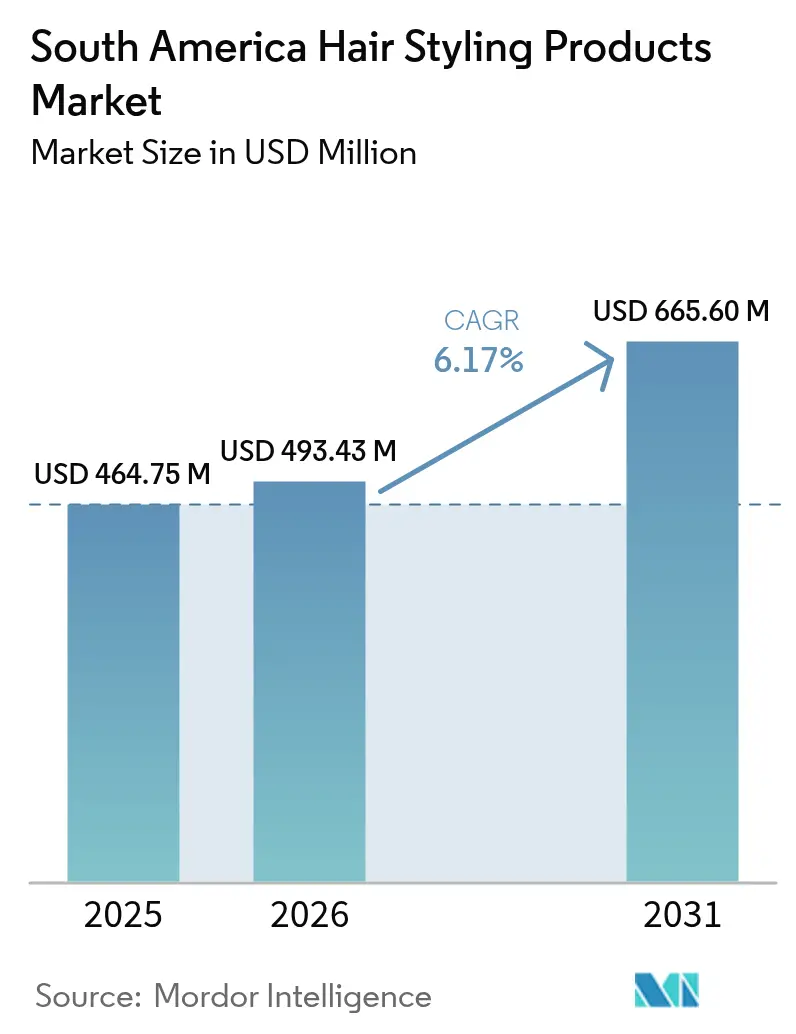
| Base Year Market Size (2025) | USD 464.75 Million |
| Market Size (2026) | USD 493.43 Million |
| Market Size (2031) | USD 665.6 Million |
| Growth Rate (2026 - 2031) | 6.17 % |
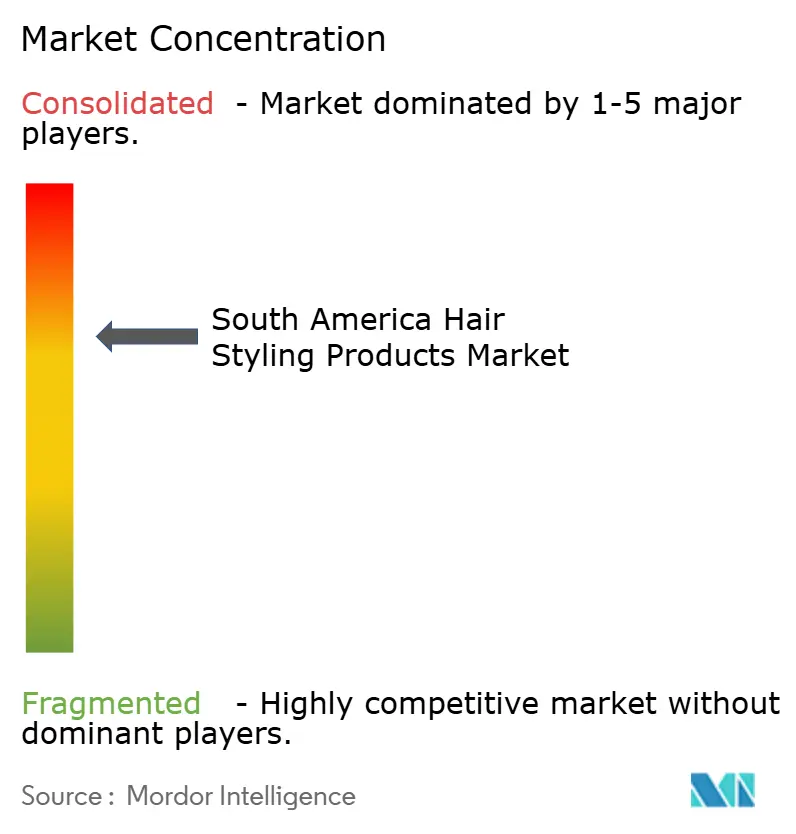
| Market Concentration | Medium |
Major Players *Disclaimer: Major Players sorted in no particular order Image © Mordor Intelligence. Reuse requires attribution under CC BY 4.0. | |
South America Hair Styling Products Market Analysis by Mordor Intelligence
The South American hair styling products market size in 2026 is estimated at USD 493.43 million, growing from 2025 value of USD 464.75 million with 2031 projections showing USD 665.6 million, growing at 6.17% CAGR over 2026-2031. This growth is underpinned by robust male grooming traditions and a burgeoning female demographic increasingly drawn to advanced styling solutions. Shoppers are increasingly gravitating towards natural, plant-based ingredients, highlighting a growing emphasis on health and sustainability. Additionally, cultural nuances, such as the Afro-Latin community's demand for specialized texturizing products, are diversifying the market landscape. Meanwhile, social commerce and influencer marketing are amplifying brand visibility and engagement, particularly among younger audiences. A notable trend is the rise of hybrid "hairceutical" products, merging styling with care, carving out a competitive edge. While Brazil dominates the region in terms of revenue, Argentina, buoyed by shifting consumer preferences and a trend towards premiumization, emerges as the fastest-growing market.
Key Report Takeaways
- By product type, creams, gels, and waxes held 77.02% revenue share in 2025; sprays and mousse are forecast to rise at 6.39% CAGR to 2031.
- By end user, the male segment commanded 82.05% of the South American hair styling products market share in 2025, whereas the female segment is projected to expand at 6.86% CAGR through 2031.
- By ingredient, conventional formulations accounted for 72.85% of the South American hair styling products market size in 2025, while natural/organic formats are the fastest mover at 6.6% CAGR.
- By distribution channel, supermarkets/hypermarkets led with 33.95% share in 2025; online retail is on track for a 7.29% CAGR through 2031.
- By geography, Brazil occupied 22.55% market share in 2025 and remains the largest single country market; Argentina records the fastest regional CAGR at 7.58% over 2026-2031.
Note: Market size and forecast figures in this report are generated using Mordor Intelligence’s proprietary estimation framework, updated with the latest available data and insights as of 2026.
Market Trends and Insights
Drivers Impact Analysis of South America Hair Styling Products Market*
| Driver | (~) % Impact on CAGR Forecast | Geographic Relevance | Impact Timeline |
|---|---|---|---|
| Growing Afro-Latin population driving texturizing and styling needs | +1.8% | Brazil, Colombia, Rest of South America | Long term (≥ 4 years) |
| Rising consumer focus on personal grooming | +1.5% | South America, with strongest impact in Argentina and Brazil | Medium term (2-4 years) |
| Influence of social media platform and celebrity endorsement | +1.2% | South America, with early adoption in urban centers | Short term (≤ 2 years) |
| Surge in demand for organic and natural hair styling products | +1.1% | Brazil, Argentina, urban centers across South America | Medium term (2-4 years) |
| Technological innovations in product formulations | +0.9% | Brazil, Argentina | Medium term (2-4 years) |
| Growing trend of DIY hairstyling at home, fueled by online tutorials | +0.8% | South America, with highest impact in Brazil and Argentina | Short term (≤ 2 years) |
| Source: Mordor Intelligence | |||
Growing Afro-Latin population driving texturizing and styling needs
In South America, the growing Afro-Latin demographic is driving a surge in demand for hair styling products designed specifically for textured hair types. Brazil, home to a substantial Afro-descendant population, is at the forefront of this trend. Scientific studies have pinpointed distinct genomic traits in Afro-textured hair, highlighting the need for tailored formulations. These formulations address unique characteristics, such as a tendency for lower moisture retention and increased fragility. Styling requirements for this demographic diverge significantly from those with straight or wavy hair, emphasizing the need for products that offer enhanced moisturizing properties and specialized holding capabilities. The market has responded with product development strategies that cater to these specific needs, balancing aesthetic desires with health considerations. Companies seizing this opportunity are crafting dedicated product lines that respect the molecular and structural nuances of Afro-textured hair, positioning themselves for sustained growth that promises to influence the market well into the future.
Rising consumer focus on personal grooming
In 2024, male consumers dominate South America's grooming market, holding a significant 82.65% share. This dominance underscores their pivotal role in reshaping the region's grooming landscape. Major cities, including São Paulo, Buenos Aires, and Bogotá, are witnessing a surge in demand for advanced hair grooming solutions. This uptick is driven by heightened professional appearance standards and a growing emphasis on self-care. Younger generations, particularly Gen Z and millennials, are leading this trend, eager to experiment with diverse hairstyles and premium products. The ascent of male grooming influencers on platforms like Instagram and TikTok has normalized conversations around hair care and product experimentation among men. This market evolution is further fueled by shifting perceptions of masculinity, rising disposable incomes, and expanded access to e-commerce. The World Bank reported Argentina's gross national income per capita at USD 12,890 in 2023 [1].
Influence of social media platform and celebrity endorsement
Across South America, social media platforms are reshaping how consumers adopt hair styling products. TikTok's platform has driven substantial growth in beauty product purchases. The platform's knack for short-form videos has made it a powerhouse for showcasing styling techniques and product advantages, birthing viral trends that seamlessly convert into sales. Adding to this momentum, celebrity endorsements play a pivotal role. Regional influencers, by highlighting styling methods that resonate culturally, strike a chord with local audiences. Notably, Brazilian consumers are gravitating towards brands that mirror their values, underscoring the potency of genuine endorsements. Furthermore, social platforms have democratized beauty advice, hastening product discovery and shortening the journey from marketing to purchase. While this dynamic offers brands a swift market impact, it demands constant adaptation. As platform preferences shift, brands must remain agile in their digital strategies to harness the ever-evolving trends and consumer attention.
Technological innovations in product formulations
In South America, the hair styling market is witnessing a transformation, driven by formulation innovations. Advances in ingredient science are now enabling products to offer multiple benefits at once. A notable evolution in this space is the rise of "hairceuticals," which seamlessly blend cosmetic and therapeutic properties. These cutting-edge formulations not only cater to styling preferences but also enhance hair health, resonating with a more discerning consumer base. Brands are now harnessing innovations like jojoba-based silicone alternatives and plant-derived keratin, ensuring top-notch performance while upholding their commitment to natural ingredients. Furthermore, the introduction of bubble gels and other unique textures is elevating the user experience, setting brands apart in a saturated market. These technological strides are especially pertinent in Brazil and Argentina, where consumers are more inclined to invest in innovative formulations. The medium-term effects of these advancements highlight the time needed for new technologies to gain traction and acceptance, with the promise of redefining category standards as their benefits become clearer to the masses.
Restraints Impact Analysis of South America Hair Styling Products Market*
| Restraint | (~) % Impact on CAGR Forecast | Geographic Relevance | Impact Timeline |
|---|---|---|---|
| Proliferation of counterfeit products | -0.7% | South America, with highest impact in border regions and urban centers | Medium term (2-4 years) |
| Fluctuating raw material prices impacting product pricing | -0.6% | South America, with highest impact in Argentina and Brazil | Short term (≤ 2 years) |
| Health concerns over chemical ingredients | -0.5% | Brazil, Argentina, urban centers across South America | Long term (≥ 4 years) |
| Increased competition from local brands | -0.4% | Brazil, Argentina, Colombia | Medium term (2-4 years) |
| Source: Mordor Intelligence | |||
Proliferation of counterfeit products
Counterfeit hair styling products are flooding South America, posing serious hurdles to market growth. These unauthorized replicas not only erode consumer trust but also jeopardize brand equity. Often, these fakes are laced with inferior ingredients, failing to deliver on their styling promises and, in some cases, putting consumers' health at risk. The problem is most pronounced in border areas and bustling urban centers, where enforcement is lax, allowing gray market distribution to thrive. Such counterfeit goods exert downward pressure on the prices of legitimate products. Many consumers, unable to differentiate between genuine and fake, opt for the cheaper alternatives. This shift limits manufacturers' capacity to invest in innovation and marketing, creating a detrimental cycle that stunts overall category growth. The medium-term repercussions are evident, highlighting the lag in evolving regulatory frameworks and the slow burn of consumer education. While brands are turning to authentication technologies and tightening supply chain controls, the widespread impact of these measures is still a work in progress, making the counterfeit challenge a persistent concern throughout the forecast period.
Health concerns over chemical ingredients
As consumers become increasingly aware of the health risks tied to chemical ingredients in hair styling products, conventional formulations, which command a 73.36% market share, are facing mounting challenges. Research has unveiled alarming levels of harmful chemicals in hair products. Notably, some synthetic variants have been found to contain carcinogens and lead, with concentrations surpassing safety limits by over 600%. Furthermore, studies highlight that hair salons exhibit volatile organic compound (VOC) concentrations that are 2 to 175 times higher than those found in typical office settings. Such revelations have caught the attention of regulators. The FDA's Modernization of Cosmetics Regulation Act of 2022 (MoCRA) is set to enforce stricter safety and manufacturing standards by December 2025 [2]. While these regulations pose challenges for conventional products, they simultaneously pave the way for natural and organic alternatives, which are witnessing a robust growth rate of 6.74% CAGR. This trend underscores the gradual shift in consumer behavior and the time manufacturers need to reformulate without compromising on performance.
*Our forecasts treat driver/restraint impacts as directional, not additive. The impact forecasts reflect baseline growth, mix effects, and variable interactions.
South America Hair Styling Products Market Segment Analysis
By Product Type:
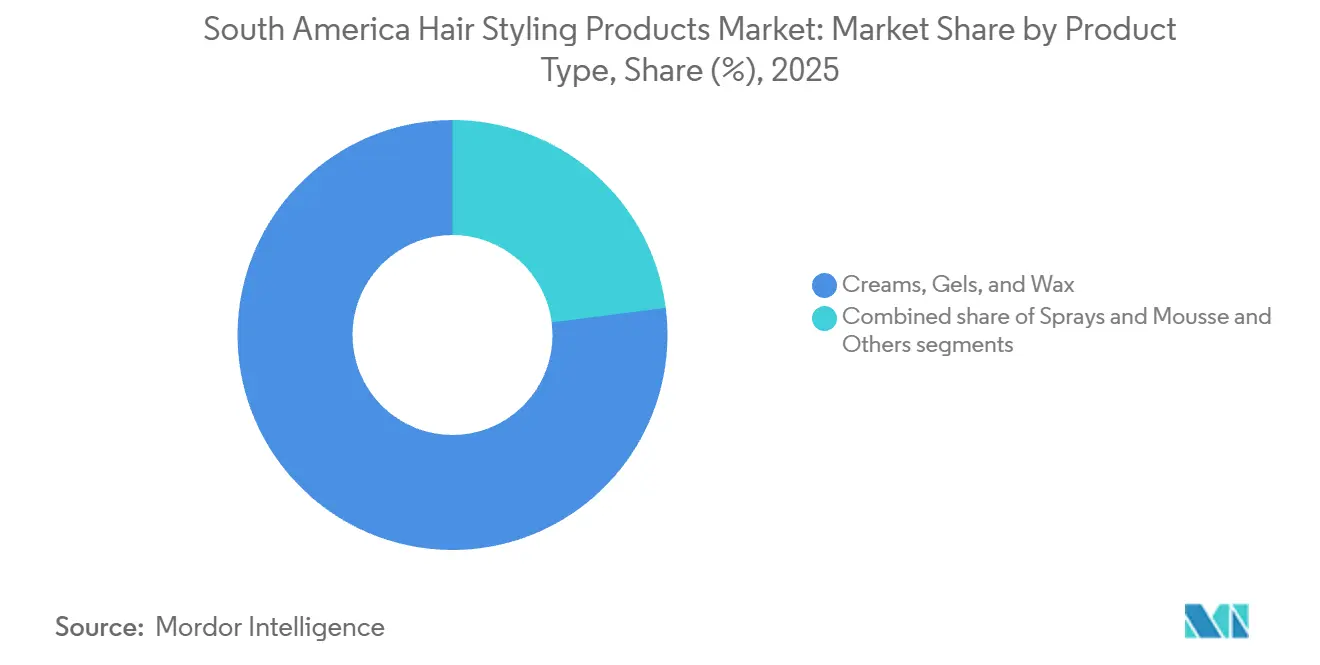
Creams and Gels Dominate Styling ArsenalIn 2025, creams, gels, and waxes dominate the South American hair styling products market, capturing a substantial 77.02% share. Their versatility caters to a range of hair types and styling preferences. This dominance is especially pronounced in Brazil, where the sizable Afro-Latin community turns to these products for adeptly styling textured hair. Recent product innovations are not only focusing on styling but also emphasizing hair health, alleviating concerns over potential damage from frequent use. Meanwhile, other segments, notably sprays and mousse, which are the fastest-growing at a 6.39% CAGR, along with a few others, make up the remaining 22.98% of the market, each catering to distinct styling needs and occasions.
Driving the sprays and mousse segment's robust 6.39% CAGR growth (2026-2031) are advancements in application technology and formulation science. Urban professionals, in particular, are gravitating towards these products for their quick application and dependable hold, all without stiffness or unsightly residue. Noteworthy innovations encompass ammonia-free formulations and those infused with natural ingredients, catering to both styling and hair health. The segment is also riding the wave of the "texturization" trend, with offerings that accentuate natural hair texture rather than imposing drastic changes. This aligns seamlessly with the shifting consumer preference for styles that exude a natural look, movement, and touchability.

By Ingredient:
Natural Formulations Gaining GroundIn 2025, conventional/synthetic ingredients command a dominant 72.85% market share, bolstered by their proven performance and consumer familiarity. Their supremacy is attributed to consistent performance, cost-effectiveness, and adaptability to varying environmental conditions. Yet, this stronghold faces challenges from rising health concerns. Research has spotlighted potential risks tied to prevalent synthetic ingredients. Notably, studies have linked certain preservatives and fragrances in hair care products to contact dermatitis, fostering a consumer shift towards alternative formulations.
While the natural and organic segment currently holds a 27.15% market share, it's on a rapid ascent, boasting a 6.6% CAGR from 2026 to 2031, outpacing the broader market. This surge is driven by heightened consumer awareness regarding ingredient safety and a tilt towards sustainable choices. Innovations like Natural Deep Eutectic Solvents (NaDES) are bridging historical performance gaps, bolstering the stability and efficacy of natural formulations. Major players, including L'Oréal and Grupo Boticário, are doubling down on sustainable sourcing and eco-friendly initiatives. Their commitment is underscored by workshops at the 34th IFSCC Congress in October 2024, spotlighting sustainability and biotechnology in cosmetics.
By Distribution Channel:
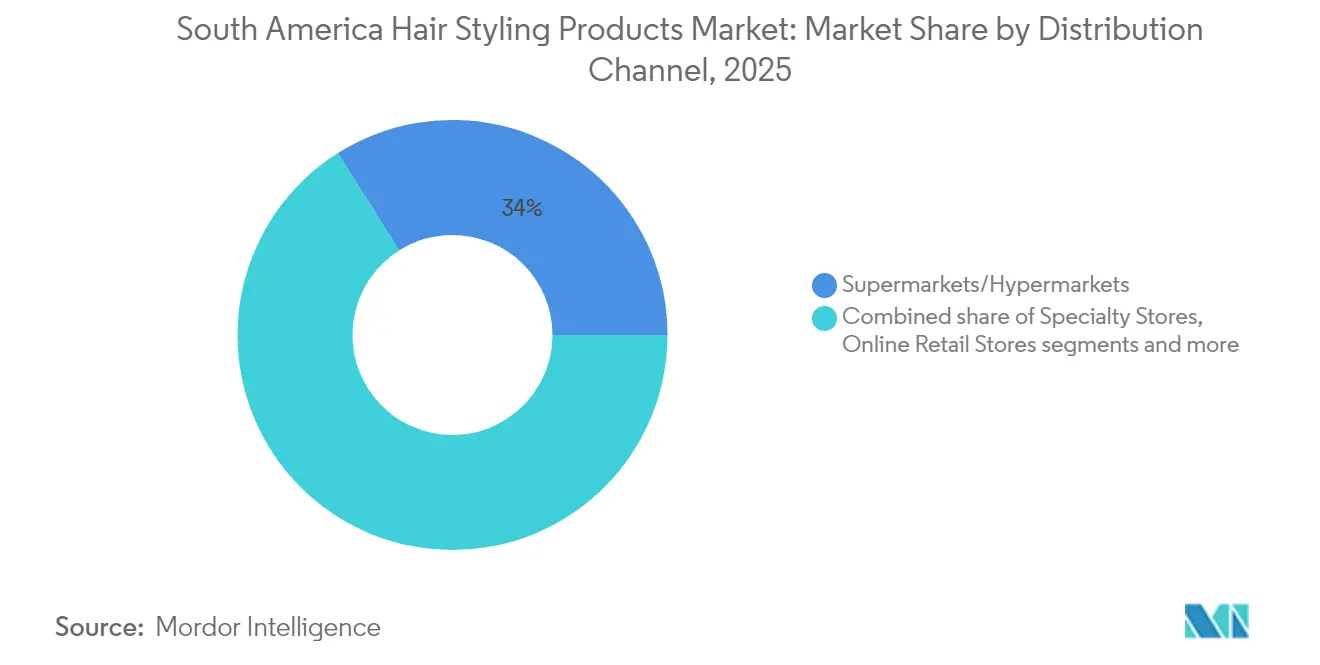
Retail Evolution UnderwayIn 2025, supermarkets/hypermarkets dominate the South American hair styling products market, holding a notable 33.95% share. Their stronghold is largely due to their vast geographic reach and ingrained presence in consumers' everyday shopping routines. These retail giants are most prominent in Brazil, Chile, and Argentina, where the organized retail landscape is notably advanced. Heavyweights like Carrefour, Walmart, and Grupo Éxito utilize their extensive distribution networks to clinch prime shelf space for leading hair styling brands, often bundling them with other personal care products. They've effectively employed strategies like promotional pricing, loyalty initiatives, and seasonal discounts, especially resonating with middle-income families who value both affordability and variety.
Online retail stores, while currently holding a smaller slice of the market, are rapidly ascending as the fastest-growing channel, projecting a robust CAGR of 7.29% from 2026 to 2031. This growth trajectory aligns with the overarching digital transformation sweeping across Latin America. Beauty-centric e-commerce platforms, such as Brazil's Beleza na Web and Chile's Falabella, are capitalizing on the rising consumer appetite for convenience, exclusive products, and personalized shopping journeys. The region's dynamic beauty culture, significantly shaped by visual platforms like Instagram, TikTok, and YouTube, highlights the critical role of digital avenues in product discovery. In this landscape, influencer-driven tutorials and user feedback are instrumental in guiding purchasing choices. Moreover, the burgeoning cross-border e-commerce trend is enabling consumers to access international styling products often missing from local stores, further fueling the online segment's expansion.
By End User:
Male Consumers Drive Market VolumeIn 2025, men command an 82.05% share of South America's hair styling products market, highlighting the region's deep-rooted emphasis on male grooming. This dominance mirrors age-old grooming traditions in nations like Brazil, Argentina, and Colombia, where hair plays a pivotal role in social and professional identity. Young consumers, swayed by regional football icons and influencers, gravitate towards gels, waxes, and pomades, favoring sleek, sculpted styles. Urban hubs like São Paulo and Buenos Aires see a pronounced product uptake, with salon visits and self-grooming becoming essential to men's care routines. The burgeoning barbershop culture, merging grooming services with retail, further cements loyalty to male-centric styling.
Meanwhile, women, holding a 17.95% market share, are on a rapid ascent, projected to grow at a robust 6.86% CAGR from 2026 to 2031, outpacing the market's overall pace. This surge is fueled by shifts like rising female workforce participation and newfound financial autonomy, especially in middle-income families. Nations like Chile and Peru are upping their spend on premium haircare, influenced by global beauty trends via digital platforms. Tailored product diversification, think anti-frizz sprays for humid climates and volumizing mousses for finer hair, is resonating with a wider female audience. The rise of gender-neutral and clean beauty brands is challenging traditional norms, broadening the market's scope and hinting at a surge in female engagement shortly.
Geography Analysis
Brazil Hair Styling Products Market
In 2025, Brazil solidifies its position as South America's top market for hair styling products, holding a commanding 22.55% market share. This leadership is driven by Brazil's expansive population and its deep-rooted beauty culture. A notable factor is the country's large Afro-descendant community, which creates a heightened demand for specialized texturizing and styling products. Scientific research underscores the unique genomic characteristics of Afro-textured hair, emphasizing the necessity for customized formulations. With a robust manufacturing foundation, Brazil's beauty sector faces intense competition from domestic powerhouses like Natura & Co. and Grupo Boticário, both of which challenge international players. E-commerce, deeply intertwined with Brazil's beauty ethos, is emerging as a crucial platform for both product discovery and sales. Additionally, Brazil is recognized as the region's hub of innovation, evidenced by events like the 34th IFSCC Congress in Iguazu Falls, which highlighted advancements in sustainable practices and ingredient innovations within the cosmetics realm.
Argentina Hair Styling Products Market
Meanwhile, Argentina is carving out its reputation as the region's growth dynamo, with a projected CAGR of 7.58% from 2026 to 2031, surpassing the broader market's anticipated 6.17% growth. This upswing is predominantly driven by Argentina's rapidly expanding e-commerce sector. In Argentina, e-commerce demonstrated high consumer activity, with 60% of shoppers making online purchases monthly. According to the Argentine Chamber of Electronic Commerce (CACE) 2024 data, 17% of consumers bought weekly, while 43% made purchases every 15-30 days . This regular purchasing pattern created opportunities for hair-styling product growth, as Argentinian consumers increasingly purchased grooming products online, particularly multifunctional styling gels, sprays, and creams. Companies leveraged these established buying behaviors through digital campaigns, subscription offerings, and social media promotions to reach these active online shoppers.
Regulatory Landscape
Hair styling products in South America sit under national cosmetics frameworks that increasingly align with MERCOSUR technical regulations for personal hygiene products, cosmetics, and perfumes, particularly around labeling and safety requirements. Brazil is the most consequential regulatory market in the region, where ANVISA maintains defined regularization pathways and product-category specific obligations, including documentation and safety expectations that affect styling items such as hair modeling pomades (RDC 814/2023).
Recent updates tightened the compliance cadence for manufacturers and importers. In Brazil, ANVISA updated the definitions, classification, and technical requirements for cosmetics regularization via RDC 907/2024, and in March 2026 published updates to technical requirements aligned to MERCOSUR guidance. For chemically active hair processing categories that intersect with styling routines (for example, straightening/curling), Brazil also ties formulation compliance to ANVISA lists such as IN 220/2023 for permitted actives, reinforcing the need for ongoing dossier and formulation monitoring across product portfolios that straddle styling and treatment claims.
Competitive Landscape
The South American hair styling products market exhibits moderate consolidation, with major multinational corporations controlling significant market share. Industry leaders, including L'Oréal SA, Unilever PLC, The Procter & Gamble Company, Henkel AG & Co. KGaA, and Natura & Co., execute strategic business initiatives through corporate mergers, strategic acquisitions, business partnerships, and continuous product development to enhance their competitive position and increase market penetration across diverse consumer segments.
A significant opportunity lies in addressing the unique hair care needs of the Afro-Latin population, a substantial consumer group that remains underserved. Companies are increasingly leveraging advancements in ingredient science to develop multifunctional products that cater to diverse hair types and preferences. For example, P&G reported a 2% year-over-year growth in its beauty net sales, reaching USD 3,550 million in Q1 2024. Grooming net sales increased by 3% to USD 1,539 million, while hair care organic sales in Latin America saw high single-digit growth, primarily driven by pricing strategies.
New and emerging brands are disrupting the market by adopting digital-first approaches, bypassing traditional distribution barriers, and utilizing social commerce to build brand awareness and foster direct customer engagement. The competitive landscape is also witnessing increased consolidation through strategic acquisitions. A notable example is Boticário Group's acquisition of TRUSS in January 2023, reflecting a broader trend of companies expanding their product portfolios and market reach to stay competitive in the evolving industry.
South America Hair Styling Products Industry Leaders
-
L'Oréal SA
-
Unilever PLC
-
The Procter & Gamble Company
-
Henkel AG & Co. KGaA
-
Natura & Co.
- *Disclaimer: Major Players sorted in no particular order
South America Hair Styling Products Market Companies Covered in this Report
- L'Oreal SA
- Unilever PLC
- Procter & Gamble Co.
- Henkel AG & Co. KGaA
- Natura & Co. (Grupo Natura, Aesop, The Body Shop)
- Grupo Boticario
- Revlon Inc.
- Coty Inc. (Wella, Sebastian)
- John Paul Mitchell Systems
- Conair Corp. (Aquage)
- Kenvue Inc (Vogue International LLC)
- Alfaparf Milano Group
- Beauty Care Brazil
- Keune Haircosmetics
- Estee Lauder Companies Inc (Aveda, Bumble and Bumble)
- Kao Corporation (Goldwell, KMS)
- LOLA Cosmetics
- Cless Cosmeticos
- JayLuc Cosmeticos
- Moroccanoil Inc.
Read Analysis of South America Hair Styling Products Companies
Market Opportunities and Future Outlook
Regulatory convergence and ingredient-list updates across MERCOSUR create a concrete reformulation and relabeling cycle that favors companies with strong regulatory operations and flexible manufacturing. In 2026, Argentina incorporated MERCOSUR GMC Resolutions 06/25 and 07/25 into its national framework through ANMAT provisions (with transitional compliance windows), while Brazil advanced MERCOSUR-aligned substance controls through ANVISA actions in 2026. This regulatory motion supports opportunity in compliant natural/organic and hybrid styling-plus-care products, especially where brand propositions can demonstrate ingredient transparency and safety while maintaining performance.
Commercial whitespace is also visible in texture-specific and digitally activated propositions. The market already skews to creams, gels, and waxes (77.02% share in 2025), and demand for textured-hair solutions is rising alongside social-commerce discovery. Brand moves in 2026 underline investment in technology-led differentiation and go-to-market modernization, including Natura partnering with Debut to commercialize an AI-discovered ingredient complex for Latin America and Unilever Brasil using TikTok Shop activation for hair launches. These actions support opportunity for styling brands that pair region-relevant formats (anti-frizz, UV protection, curl definition) with online-first selling, authentication, and education to counter counterfeit exposure in urban and border corridors.
Recent Industry Developments in South America Hair Styling Products Market
- July 2026: Henkel successfully closed its acquisition of premium hair care brand OLAPLEX after meeting closing conditions and receiving required approvals. The deal expands Henkel Consumer Brands exposure to higher-priced, performance-led hair categories that influence salon and at-home styling routines, intensifying premium competition across South America through portfolio and channel leverage.
- April 2025: Alfaparf Milano expanded its Brazilian operations by acquiring two Sao Paulo-based companies, Bioclean (manufacturer of Depil Bella hair styling products and related categories) and Raavi (a dermocosmetics manufacturer). The acquisitions strengthened Alfaparf's local manufacturing footprint and broadened its product base in Brazil, supporting faster assortment expansion across professional and retail channels.
- May 2024: Advent International completed the acquisition of Skala Cosmeticos, a Brazil-based vegan haircare brand with large household penetration and an export footprint. The deal expanded mass-market hair products and strengthened distribution across retail and e-commerce channels in Brazil.
South America Hair Styling Products Market Report Scope and Research Methodology
Market Definition and Coverage
This market covers retail and professional sales of hair styling formulations used to shape, hold, texture, or finish hair across South America, measured in value terms. It includes daily-use products as well as salon usage, and it is counted at the point of sale in the region.
Scope exclusions: Styling devices and electrical tools, along with hair colorants and basic cleansing or conditioning products, are excluded from this sizing.
Segments Covered in This Report
- By Product Type
- Creams, Gels, and Wax
- Sprays and Mousse
- Others
- By Ingredient
- Natural/Organic
- Conventional/Synthetic
- By End User
- Male
- Female
- By Distribution Channel
- Supermarkets/Hypermarkets
- Specialty Stores
- Online Retail Stores
- Others
- By Country
- Brazil
- Argentina
- Colombia
- Chile
- Peru
- Rest of South America
Data Sources, Market Sizing, and Validation
Desk Research
Desk work starts with building the demand context for styling products in South America and then mapping how the category is sold across modern trade, specialty retail, and online channels. For that, we rely on public sources such as national statistics offices, central bank consumer spending releases, and inflation series that help normalize price and currency movements.
We also use trade and regulatory signals to keep the category grounded, including customs and tariff databases, published import and export statistics, and labeling or ingredient guidance from public health and standards bodies where available. Company annual reports, investor presentations, and reputable press are used to understand channel focus, new launches, and country-level momentum. In a few places, paid subscriptions for company financials and news intelligence, plus a shipment-level import and export database, are used to cross-check direction and fill gaps in publicly reported splits. The sources listed here are illustrative only, and many other public references are also used for collection, validation, and clarification.
Primary Interviews and Surveys
We use interviews and surveys with brand, distributor, retailer, salon, and category managers across South America to test channel mix, format demand, pack prices, purchase frequency, and professional-use patterns. These views help challenge secondary assumptions, fill gaps in smaller countries, and triangulate country totals before final analysis.
Distribution of primary research fieldwork respondents
| Company type | Respondent position |
|---|---|
| Top tier: 32% | CXOs: 18% |
| Mid tier: 46% | Functional/Unit leaders: 32% |
| Smaller Players: 22% | Managers: 50% |
Market-Sizing & Forecasting
Sizing is built using a top-down and bottom-up approach where consumer spend and beauty and personal care category signals are reconstructed by country and then narrowed into the styling-products share, before being split by key formats and channels. The totals are then corroborated through selective bottom-up checks, such as sampling average selling prices by format and multiplying by estimated volumes in priority channels, followed by distributor and retailer sense checks.
Key inputs used in the model include category price inflation and currency movement, penetration of online retail for beauty products, the mix shift between sprays, gels and wax, creams, and mousse, and the relative weight of salon versus at-home usage. We also track country-level population and urbanization direction, since styling usage is typically higher in urban areas where product availability and salon density are stronger. Where direct volume indicators are missing, gaps are handled by using neighboring-country ratios and then validating them through interview feedback and observed channel behavior.
For forecasting, scenario analysis is used because demand and pricing can swing with macro conditions and promotional intensity. The scenario ranges are anchored to expert expectations on format trends, channel shifts, and realistic price progression, and then the final forecast is selected after the assumptions match what respondents say is achievable in the next cycle.
Data Validation & Update Cycle
Validation is done in several passes so the final values do not depend on one data stream. We compare outputs against independent signals like import trends for relevant product groups, observed price ladders in major channels, and country-level category growth patterns, and then outliers are reviewed until the story fits the numbers.
Before sign-off, the model is reviewed by another analyst who checks arithmetic, conversions, and the reasonableness of key assumptions. Any large variance triggers a re-check of inputs and, when needed, a follow-up call to clarify. Reports are refreshed on an annual cycle, with interim updates when major events materially change pricing, trade flows, or channel structure. Right before delivery, a final pass is completed so the client sees the latest incorporated updates.
Mordor Intelligence's South America Hair Styling Products Market Sizing Compared With Other Published Estimates
Published values for hair styling products in South America can differ even when the growth direction looks similar, because the counted products, the region definition, and the year used for currency conversion are not always aligned. Differences also come from how firms treat salon demand versus retail demand, and whether they assume premiumization at the same pace across countries.
Some estimates take a broader basket that drifts into adjacent hair care items or apply a single price expansion assumption across the full period. For the Mordor Intelligence comparison, the total is limited to styling formulations such as creams, gels and wax, sprays and mousse, and other styling products, and the country roll-up is checked against channel mix and year-specific price movement before consolidation.
Benchmark comparison
| Source | Market Size | Gaps in Research Methodology |
|---|---|---|
| Mordor Intelligence | USD 464.75 M (2025) | |
| Global Consultancy A | USD 1.40 B (2023) | Uses an earlier base year and appears to apply a wider interpretation of the category, which can lift totals when adjacent hair care spend or broader channel revenue is blended into styling. |
| Industry Portal B | USD 629.35 M (2030) | Publishes a later-year figure and may roll forward pricing using one growth path, which can overstate value if country inflation, FX timing, and format mix shifts are not normalized year by year. |
The spread in the table is mainly explained by category breadth, base year choice, and how price growth is applied across South American countries and channels. By keeping the steps tied to clear product inclusions, observable channel splits, and repeatable price checks, clients can reconcile differences without relying on hidden assumptions.
Key Questions Answered in the Report
What is the current value of the South American hair styling products market?
The market stands at USD 493.43 million in 2026 and is forecast to reach USD 665.6 million by 2031.
Which end-user segment dominates sales?
Male consumers lead with 82.05% share in 2025, a reflection of cultural grooming norms that prioritize male hair styling.
Which ingredient category is growing fastest?
Natural and organic formulations are expanding at 6.6% CAGR, outpacing conventional synthetics as safety and sustainability concerns rise.
How fast is online retail growing in this market?
Online channels are advancing at 7.29% CAGR, benefiting from expanding smartphone penetration and social commerce.