
Market Overview
| Study Period | 2021 - 2031 |
|---|---|
| Forecast Data Period | 2026 - 2031 |
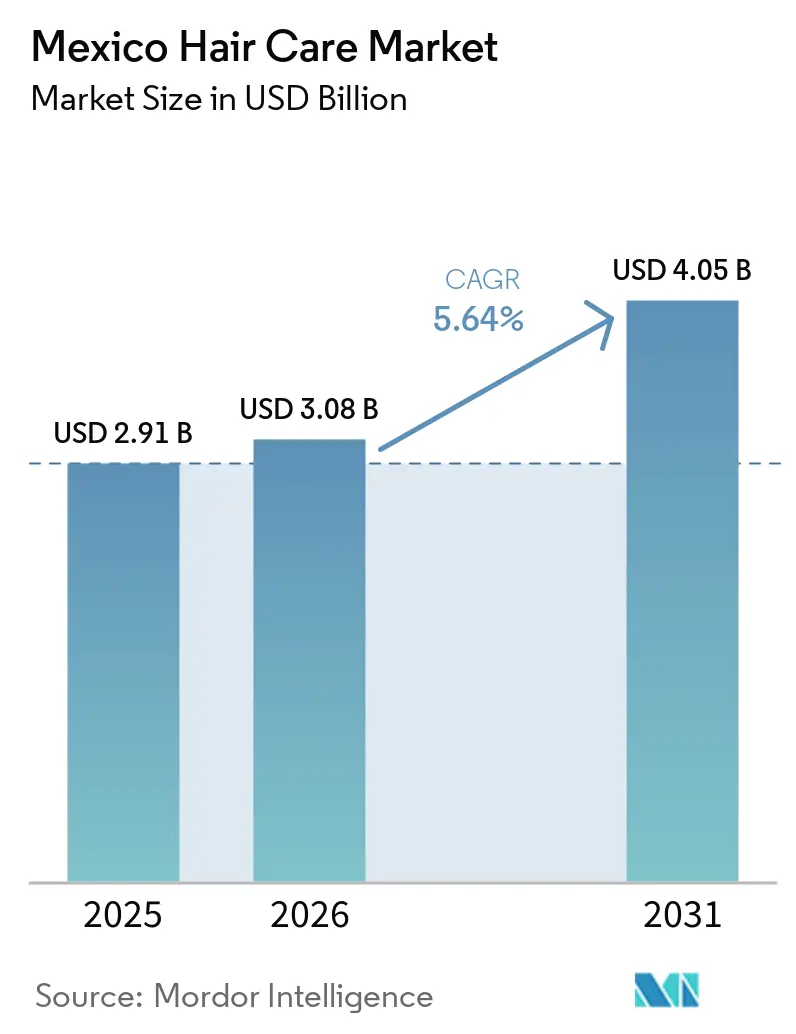
| Base Year Market Size (2025) | USD 2.91 Billion |
| Market Size (2026) | USD 3.08 Billion |
| Market Size (2031) | USD 4.05 Billion |
| Growth Rate (2026 - 2031) | 5.64 % |
| Market Concentration | Medium |
Major Players *Disclaimer: Major Players sorted in no particular order Image © Mordor Intelligence. Reuse requires attribution under CC BY 4.0. | |
Mexico Hair Care Market Analysis by Mordor Intelligence
The Mexico hair care market size in 2026 is estimated at USD 3.08 billion, growing from 2025 value of USD 2.91 billion with 2031 projections showing USD 4.05 billion, growing at 5.64% CAGR over 2026-2031. Increasing consumer awareness of hair health, beauty routines, and scalp care is driving the demand for specialized, scientifically-backed products. A youthful population, rapid urbanization, and an expanding middle class are supporting resilient demand despite broader economic challenges. Multinational suppliers are expanding local production, accelerating the trend toward premiumization. Consumers are increasingly choosing professional-grade, salon-quality products for at-home use to address modern challenges such as damage repair and UV protection. There is strong demand for natural, organic, cruelty-free, and vegan hair care formulations, driven by concerns over harmful cosmetic chemicals like sulfates, parabens, and silicones. Retailers such as Ulta Beauty are upgrading digital infrastructure, adopting social commerce, and implementing omnichannel strategies, which are boosting direct-to-consumer sales. At the same time, local innovators are leveraging Mexico’s botanical heritage to meet the rising interest in clean beauty, fostering healthy competition across various price points and formulations.
Key Report Takeaways
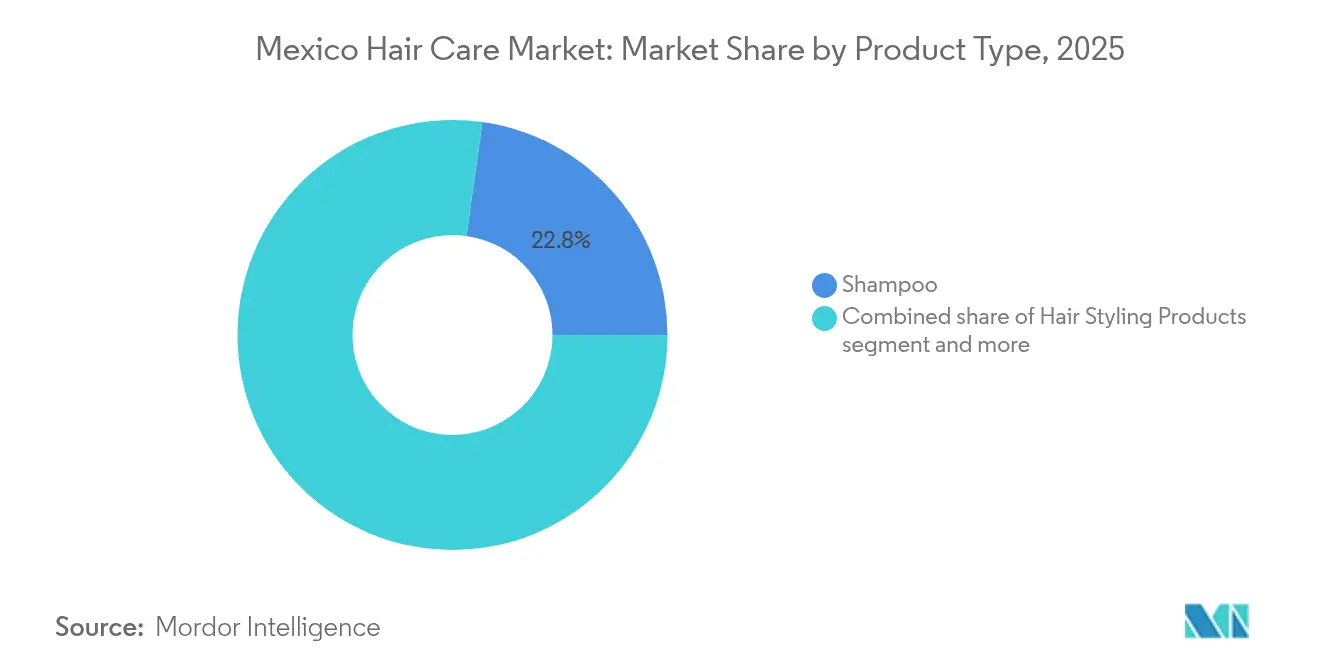
- By product type, shampoo captured 22.78% of the Mexico hair care market share in 2025 while hair styling products are forecast to expand at a 5.77% CAGR to 2031.
- By category, synthetic offerings held 76.85% share of the Mexico hair care market size in 2025, whereas natural-organic products are projected to rise at a 6.03% CAGR through 2031.
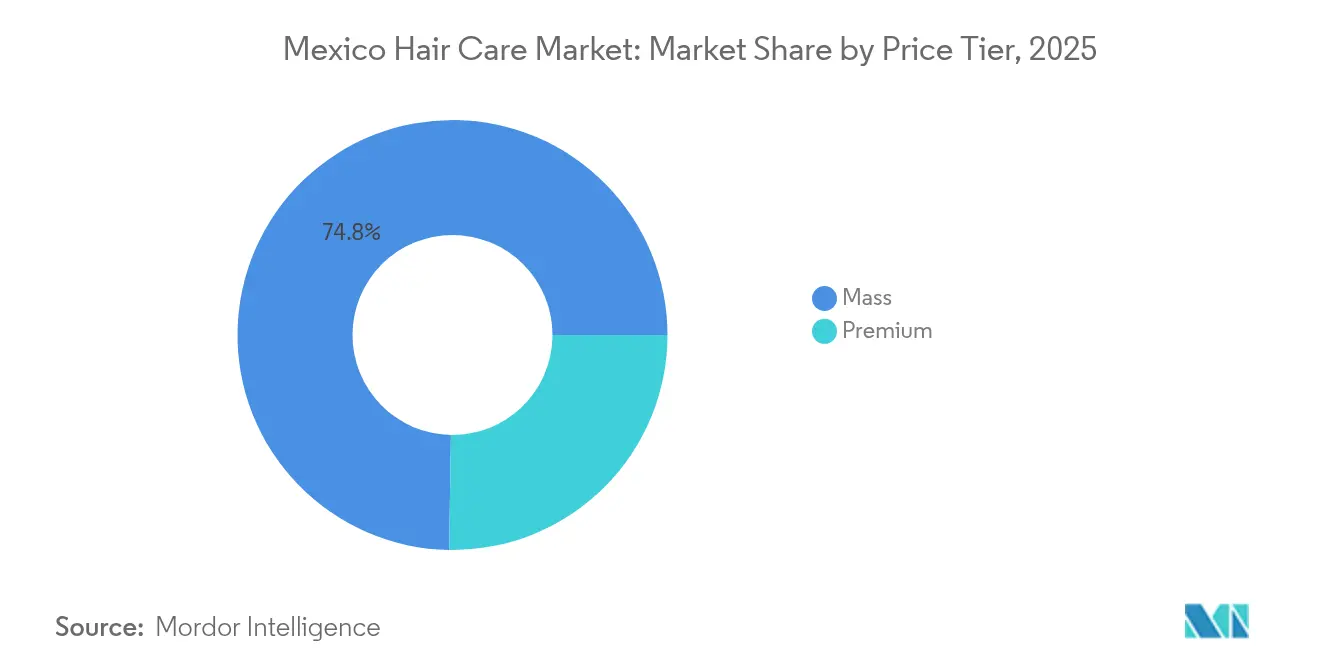
- By price tier, mass products accounted for 74.75% of 2025 revenue, but premium lines are set to post the fastest growth at 5.66% CAGR to 2031.
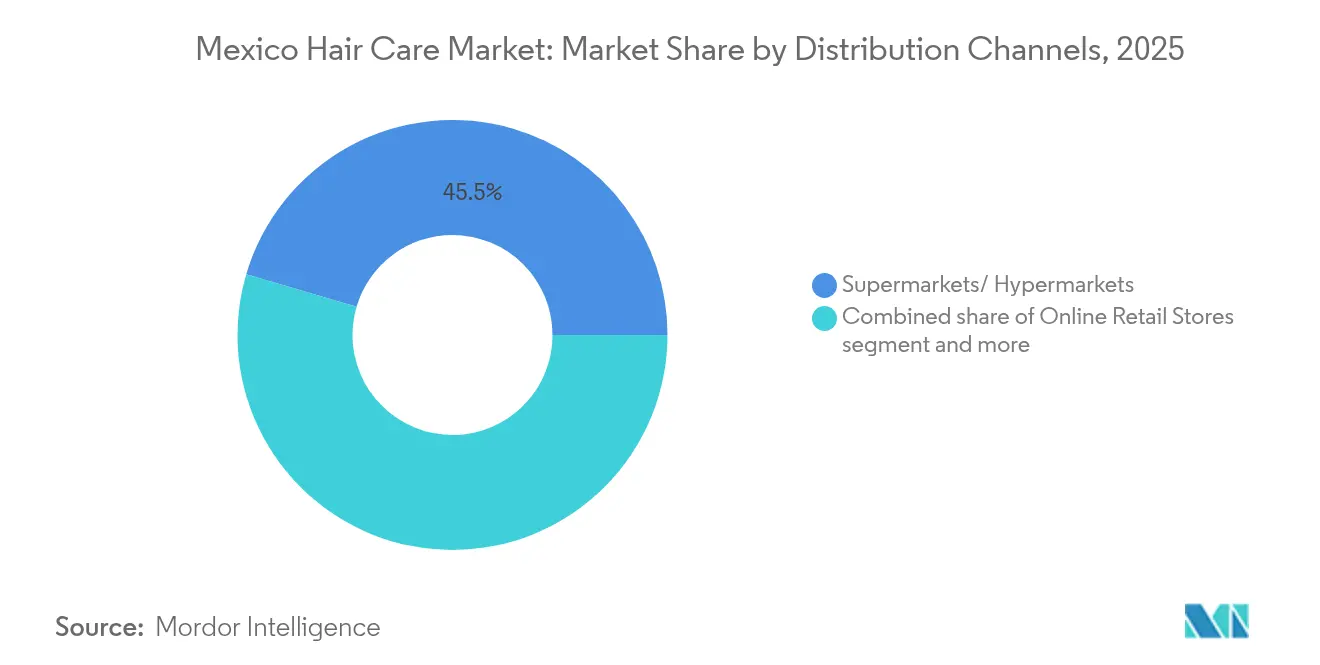
- By distribution channel, supermarkets-hypermarkets led with 45.45% share in 2025, while online retail is advancing at a 6.81% CAGR over the outlook period.
Note: Market size and forecast figures in this report are generated using Mordor Intelligence’s proprietary estimation framework, updated with the latest available data and insights as of 2026.
Mexico Hair Care Market Trends and Insights
Drivers Impact Analysis*
| Driver | (~) % Impact on CAGR Forecast | Geographic Relevance | Impact Timeline |
|---|---|---|---|
| Expanding consumer awareness on hair health and beauty trends | +1.2% | Mexico City, Guadalajara, Monterrey | Medium term (2-4 years) |
| Greater demand for premium and customized hair care | +1.5% | Major urban centers | Long term (≥ 4 years) |
| Rising demand for natural/organic formulations | +0.9% | Nationwide metros | Medium term (2-4 years) |
| Influence of social media and celebrity endorsements | +0.8% | Digitally dense regions | Short term (≤ 2 years) |
| Product innovation and packaging | +0.7% | Countrywide rollouts | Medium term (2-4 years) |
| Trend toward multipurpose and convenient products | +0.6% | Urban and suburban zones | Short term (≤ 2 years) |
| Source: Mordor Intelligence | |||
Expanding consumer awareness on hair health and beauty trends
Consumers are becoming increasingly aware of the impact of lifestyle choices, stress, pollution, and chemicals on their hair and scalp. This growing awareness has driven a strong preference for scientifically developed products that address specific concerns such as dandruff, hair loss, damage, and UV protection. As a result, the production of hair care products has also increased. For instance, in December 2023, Mexico produced 46,317 thousand units of shampoos, conditioners, and hair rinses, according to the National Institute of Statistics and Geography (INEGI) [1]. Mexican consumers now approach hair care with a wellness perspective, emphasizing scalp health and hair barrier protection over purely aesthetic benefits. This shift aligns with the broader "skinification" trend, where hair care incorporates dermatological principles and active ingredients like hyaluronic acid, collagen, and biotin, traditionally associated with skincare. Additionally, urban centers such as Mexico City, Jalisco, and Estado de México serve as knowledge hubs, where the concentration of professionals accelerates the adoption of advanced hair care concepts.
Greater demand for premium and customized hair care
Urban and younger Mexican consumers are increasingly opting for high-quality, salon-grade, and scientifically formulated products to address their hair health and styling needs. This trend toward premium products has led to higher average spending per shopper, faster adoption of advanced ingredients such as biotin, argan oil, and caffeine, and a growing presence of international brands in retail. Mexico's premiumization trend is fueled by rising disposable incomes in key metropolitan areas and evolving consumer expectations shaped by global beauty standards. As incomes rise, consumers are shifting their preferences toward these premium offerings. For instance, GDP per capita in Mexico increased from USD 13,826.1 in 2023 to USD 14,157.9 in 2024, according to the World Bank [2]. L'Oréal's focus on premiumization within its Consumer Products division has delivered strong growth in Mexico, showcasing the success of its premium strategies. The diverse hair characteristics in Mexico present significant opportunities for customization. Research shows that Mexican mestizo hair exhibits properties that fall between Asian and Caucasian hair types, emphasizing the need for specialized formulation approaches.
Rising demand for natural/organic formulations
Consumers are increasingly choosing products free from harmful chemicals like sulfates, parabens, and silicones. Instead, they prefer gentle, nourishing ingredients such as aloe vera, argan oil, coconut oil, and herbal extracts. This shift aligns with global trends promoting sustainability and clean beauty. Additionally, interest in cruelty-free and vegan products continues to grow. The natural and organic segment is expanding, driven by rising health awareness and a cultural inclination toward botanical ingredients. Hispanic and Latino women, in particular, favor natural and organic personal care products. Mexican brands like Sorégano exemplify local innovation by offering solid shampoos made with oregano and rosemary essential oils, sourced from Yucatán plantations and certified under the "Sello Hecho en Yucatán" program. Supporting this trend, COFEPRIS, Mexico's regulatory authority, is reviewing synthetic colorants, including Red No. 3, following concerns raised by the United States Food and Drug Administration. This regulatory scrutiny is accelerating the consumer shift toward natural alternatives.
Influence of social media and celebrity endorsements
Mexico is a prominent market for influencer marketing in Latin America, where personal recommendations from social media figures significantly influence purchases. PROFECO's 2023 Influencer Advertising Guide requires clear disclosure of commercial relationships through tags like PaidAdvertising or SponsoredBy. This regulation strengthens consumer trust while maintaining marketing effectiveness. TikTok's rapid growth, alongside established platforms like YouTube and Instagram, is notable, with the upcoming launch of TikTok Shop in Mexico expected to boost direct-to-consumer hair care sales. According to the Mexican Internet Association, user engagement rates in Mexico are 86% for Facebook, 81% for Instagram, 63% for YouTube, and 62% for TikTok [3]. Brands must comply with the regulatory framework by ensuring influencer content adheres to PROFECO's truthfulness and verifiability standards. This is particularly important for efficacy claims, as those suggesting therapeutic benefits may attract COFEPRIS sanitary oversight.
Restraints Impact Analysis*
| Restraint | (~) % Impact on CAGR Forecast | Geographic Relevance | Impact Timeline |
|---|---|---|---|
| Counterfei and grey-market products | -0.8% | Border corridors | Short term (≤ 2 years) |
| Consumer skepticism about product claims | -0.6% | Highly educated metros | Medium term (2-4 years) |
| Regulatory challenges and compliance costs | -0.5% | Nationwide manufacturers | Long term (≥ 4 years) |
| Product formulation and hair type diversity challenges | -0.4% | All regions | Long term (≥ 4 years) |
| Source: Mordor Intelligence | |||
Counterfeit and grey-market products
Counterfeit goods create pricing pressures on legitimate brands, reducing their market shares and revenues. Mexico's updated intellectual property enforcement, introduced through the Federal Law for the Protection of Industrial Property (LFPPI), addresses counterfeiting via both administrative (IMPI) and criminal (FGR) channels. Customs authorities at major ports like Manzanillo and Lázaro Cárdenas maintain trademark watchlists. Rights holders must respond within a 72-hour window for customs seizures and can impose fines of up to USD 1.1 million through IMPI's administrative proceedings. The rise of e-commerce intensifies the challenge, requiring active monitoring of platforms such as MercadoLibre, Amazon Mexico, and Linio for counterfeit listings. COFEPRIS's regulatory influence includes improved surveillance mechanisms and the release of a Self-Verification Guide for cosmetics establishments in December 2024. These initiatives raise compliance standards for legitimate manufacturers while creating obstacles for counterfeit operations.
Product formulation and hair type diversity challenges
Mexico's diverse ethnic composition, including mestizo, indigenous, European, and Afro-descendant groups, poses notable challenges for product formulation. For example, Mexican mestizo hair displays unique characteristics that lie between Asian and Caucasian hair, requiring customized solutions. Afro-Mexican communities, primarily concentrated in Guerrero, Veracruz, Oaxaca, and Mexico City, have specific needs for their textured hair, necessitating formulations that focus on moisture retention and mechanical protection. Furthermore, the variation in Mexico's regional climates—from humid coastal areas to arid northern regions—adds another layer of complexity to product development, as each climate demands distinct performance attributes. These formulation challenges not only drive up production costs but also complicate inventory management. However, they also present significant opportunities for brands capable of addressing Mexico's diverse hair care requirements. By creating targeted product lines and leveraging culturally informed marketing strategies, companies can effectively serve this multifaceted market and unlock substantial growth potential.
*Our forecasts treat driver/restraint impacts as directional, not additive. The impact forecasts reflect baseline growth, mix effects, and variable interactions.
Segment Analysis
By Product Type: Styling Products Drive Innovation
Shampoo holds a leading 22.78% market share in 2025, highlighting its essential role in daily hair care routines across Mexico's diverse climate zones and hair types. Widely used by a broad demographic, shampoo fulfills basic cleansing needs, making it the starting point for many consumers' hair care routines. On the other hand, hair styling products are the fastest-growing segment, with a 5.77% CAGR projected through 2031. This growth is driven by the rising popularity of male grooming and professional styling trends amplified by social media. The styling segment is also benefiting from premiumization, as consumers increasingly invest in specialized products for heat protection, texture improvement, and long-lasting hold.
Conditioner and hair colorants remain stable, mature categories, while “other product types”, including treatments, masks, and specialized care products, are experiencing accelerated growth. This trend reflects a shift toward more comprehensive hair care routines, influenced by broader wellness movements that incorporate skincare-inspired multi-step regimens into hair care. Urban areas show a stronger preference for styling products and treatments, while rural regions focus on basic cleansing and conditioning. Furthermore, cross-border trends are sustaining demand for finishing sprays and matte clays, while coastal climates are driving interest in humidity-resistant formulas.

By Category: Natural Formulations Gain Momentum
Synthetic and conventional products hold a significant 76.85% share of the market in 2025, highlighting established consumer preferences and notable price sensitivity within Mexico's diverse economy. Manufacturers have effectively navigated regulatory requirements, excelling in synthetic formulations that enable efficient large-scale production and distribution. This efficiency contrasts with the complex supply chain issues often linked to sourcing natural ingredients. However, the natural and organic segment is experiencing the fastest growth, with a 6.03% CAGR (2026-2031). This growth is driven by increasing health awareness, a cultural inclination toward botanical ingredients, and stricter regulations on synthetic additives. Brands like Sorégano exemplify successful natural positioning by utilizing locally sourced ingredients. Their use of oregano and rosemary essential oils, sourced from Yucatán plantations and certified under regional quality programs, highlights this approach.
Despite its growth, the natural segment faces challenges due to Mexico's varied climate, which requires advanced preservation systems and thorough stability testing to ensure consistent product performance across humid coastal and arid northern regions. Regulatory oversight is also increasing. COFEPRIS, Mexico's health regulatory authority, is reviewing synthetic colorants, including Red No. 3, following safety concerns raised by the United States Food and Drug Administration. This regulatory focus strengthens the shift toward natural alternatives. Brands that effectively convey the advantages of their natural products while meeting the performance expectations of Mexican consumers are well-positioned to capitalize on this trend. Additionally, updated Good Manufacturing Practices (NOM-259-SSA1-2022) reinforce quality standards across both synthetic and natural categories, enhancing consumer trust in product safety and efficacy.
By Price Tier: Premium Segment Accelerates
Mass market products hold a 74.75% share in 2025, highlighting Mexico's price-sensitive consumer base. Mass market hair care products are competitively priced to appeal to the majority of Mexico's population, particularly middle and lower-income groups. This pricing strategy ensures these products are accessible across urban, semi-urban, and rural areas through extensive distribution networks. In contrast, premium products, growing at a robust 5.66% CAGR, are concentrated in affluent metropolitan areas such as Mexico City, Monterrey, and Guadalajara. The premium segment's growth is driven by Ulta Beauty's market entry and L'Oréal's effective premiumization strategy, which has positioned Mexico as a key growth market in Latin America.
Premium positioning thrives on innovation-led differentiation. For example, L'Oréal's AirLight Pro hair dryer highlights technological benefits that justify its higher price. Conversely, the mass market remains strong due to value-focused positioning and widespread distribution, including traditional trade channels. Leading mass brands successfully combine affordability with functional benefits, offering various pack sizes and bulk pricing options to meet the diverse purchasing habits across Mexico's economic spectrum.
By Distribution Channel: Digital Transformation Accelerates
Supermarkets and hypermarkets lead the distribution landscape with a 45.45% share in 2025. Their dominance stems from extensive geographic reach and consumer preferences for in-person evaluations of personal care products, given the wide variety of brands available. Meanwhile, online retail stores are experiencing the fastest growth, with a 6.81% CAGR. This growth is driven by advancements in digital infrastructure and evolving consumer behaviors post-pandemic. Mexico's expanding e-commerce ecosystem, featuring key players like Amazon Mexico and MercadoLibre, along with the anticipated launch of TikTok Shop, is creating new direct-to-consumer opportunities.
Specialty and convenience stores hold significant roles in Mexico's fragmented retail market, particularly in secondary cities and rural areas where modern retail penetration remains limited. This channel diversity highlights Mexico's complex distribution needs. Successful brands often implement multi-channel strategies, integrating modern retail, traditional trade, and emerging digital platforms. Furthermore, professional services act as a vital indirect channel. With 421,000 hair care professionals influencing consumer brand preferences and product adoption, they play a critical role. However, the high informality rate in this sector presents both challenges and opportunities for brands aiming to establish professional relationships and drive salon-to-consumer conversions.
Geography Analysis
Mexico's hair care market demonstrates significant regional differences, shaped by economic inequalities, demographic variations, and infrastructure development trends. Mexico City leads the market with the highest household spending on personal care. Northern states, such as Nuevo León, Baja California, and Coahuila, benefit from their proximity to U.S. markets, strong industrial employment, and advanced digital infrastructure. These factors drive demand for premium products and enhance e-commerce penetration. In May 2025, Unilever plans to invest USD 1.5 billion in a new factory in Nuevo León, focusing on beauty and personal care production. This investment highlights the region's manufacturing strengths and growth potential. The stable employment provided by the manufacturing sector supports discretionary spending on hair care products, while cross-border trade facilitates access to international brands and trends.
Central and western Mexico, anchored by cities like Mexico City and Guadalajara, represent the largest consumer markets due to their diverse demographics and well-established retail infrastructure. Ulta Beauty has identified these urban centers as key markets, opening stores in Mexico City, Guadalajara, Monterrey, and Tijuana. These cities not only serve as beauty retail hubs but also host a concentration of professional hair care services. Notably, Estado de México, Veracruz, and Jalisco employ the largest numbers of hairdressers and stylists.
Southern states such as Guerrero, Oaxaca, and Chiapas face economic challenges but offer opportunities for value-focused products and culturally specific formulations. These regions' rich cultural heritage and abundant botanical resources support the development of natural products. For example, Yucatán-based Sorégano utilizes locally cultivated oregano and rosemary in its hair care formulations. However, with rural digital connectivity falling 78% below OECD averages, these areas rely more on traditional distribution channels and in-person marketing, limiting the role of e-commerce.
Competitive Landscape
Mexico's hair care market is moderately consolidated, with well-established multinational corporations dominating a significant portion of the market share. However, these players face growing competition from emerging local brands and new entrants in the retail space. Leading companies such as Unilever Plc, Genomma Lab Internacional, S.A.B. de C.V., Kenvue, L'Oréal SA, and Procter and Gamble Company leverage their expansive manufacturing capabilities, extensive brand portfolios, and widespread distribution networks to maintain their competitive edge. Among these, L'Oréal has demonstrated exceptional performance, identifying Mexico as its second-largest contributor to growth within the Latin American region.
The strategic focus of market leaders increasingly revolves around enhancing omnichannel capabilities and embracing digital transformation. Companies are making significant investments in e-commerce platforms, forming partnerships with influencers, and expanding direct-to-consumer channels to strengthen their market presence. The competitive landscape underwent a notable transformation in 2025 with the entry of Ulta Beauty into the Mexican market. Through a partnership with Grupo Axo, Ulta Beauty introduced a leading U.S. beauty retailer offering an extensive range of hair care products and salon services to Mexican consumers. Simultaneously, Natura launched a franchise model to capitalize on Mexico's position as its second-largest market, aiming to expand its distribution network and deepen its penetration in the local market.
Technology adoption has emerged as a critical factor in differentiating market players. L'Oréal's launch of the AirLight Pro hair dryer exemplifies how innovation in professional tools can create a competitive advantage across both salon and consumer channels. Additionally, significant opportunities remain untapped in specialized segments, such as textured hair care products tailored for Mexico's Afro-descendant population, natural and organic formulations that utilize the country's rich botanical resources, and convenience-focused products designed to meet the demands of urban lifestyles. Regulatory compliance has also become increasingly crucial as COFEPRIS strengthens its oversight through updated Good Manufacturing Practices and enhanced surveillance mechanisms. These regulatory measures create challenges for non-compliant competitors while rewarding companies with robust quality systems, thereby raising the overall standards of the market.
Mexico Hair Care Industry Leaders
-
Unilever PLC
-
L'Oréal SA
-
Genomma Lab Internacional, S.A.B. de C.V.
-
Kenvue
-
The Procter and Gamble Company
- *Disclaimer: Major Players sorted in no particular order

Recent Industry Developments
- September 2025: Ulta Beauty, in partnership with Grupo Axo, entered the Mexican market by opening stores at Antara Fashion Hall in Mexico City and Galerías Metepec. The company plans further expansion with new locations expected in Guadalajara, Monterrey, Tijuana, and León.
- May 2025: Unilever unveiled a USD 1.5 billion investment initiative in Mexico, set for 2025-2028. The plan features the establishment of a new beauty and personal care factory in Nuevo León, bolstering local production for hair care brands like Dove, TRESemmé, and Sunsilk.
- April 2025: Aveda and Xela Pack have launched a global initiative to introduce paper-based, recyclable hair care sachets. These sachets reduce plastic usage by 80% compared to traditional tubes. The rollout begins with the Botanical Repair Bond Building Pre-Shampoo Treatment, marking the commencement of a multi-year sustainability collaboration between the two companies.
- July 2024: TRESemmé has introduced its innovative hair care line, Lamellar Shine, in Mexico. Featuring its exclusive Lamellar molecule technology, the product smooths the hair's surface to enhance shine across all hair textures.
Mexico Hair Care Market Report Scope
The term "hair care" refers to all aspects of hygiene and cosmetology related to the human hair that grows on the head.
Mexico's hair care market is segmented by product type and distribution channel. Based on the product type, the market is segmented into shampoo, conditioner, hair loss treatment products, hair colorants, hair styling products, perms and relaxants, and other product types. Based on the distribution channel, the market is segmented into supermarkets/hypermarkets, convenience stores/grocery stores, pharmacy/drug stores, online stores, and other distribution channels.
The report offers market size and forecasts in value (USD million) for the above segments.
By Product Type
| Shampoo |
| Conditioner |
| Hair Colorants |
| Hair Styling Products |
| Other Product Types |
By Category
| Synthetic/Conventional |
| Natural /Organic |
By Price Tier
| Mass |
| Premium |
By Distribution Channel
| Supermarkets/ Hypermarkets |
| Specialty Stores |
| Convenience Stores |
| Online Retail Stores |
| Other Distribution Channels |
| By Product Type | Shampoo |
| Conditioner | |
| Hair Colorants | |
| Hair Styling Products | |
| Other Product Types | |
| By Category | Synthetic/Conventional |
| Natural /Organic | |
| By Price Tier | Mass |
| Premium | |
| By Distribution Channel | Supermarkets/ Hypermarkets |
| Specialty Stores | |
| Convenience Stores | |
| Online Retail Stores | |
| Other Distribution Channels |
Key Questions Answered in the Report
How big will the Mexico hair care market be by 2031?
It is projected to reach USD 4.05 billion by 2031, reflecting a 5.64% CAGR from 2026.
Which category is growing fastest in Mexican hair products?
Natural-organic formulations are forecast to rise at 6.03% CAGR, the quickest among all categories.
What channel is gaining the most share in Mexican hair care sales?
Online retail shows the highest growth, advancing at 6.81% CAGR as consumers shift to e-commerce.
Why are styling products outperforming other segments?
Social-media-driven grooming trends and higher male adoption push styling items toward a 5.77% CAGR.