
Brazil CRM Marketing Services Market Size and Share
Market Overview
| Study Period | 2020 - 2031 |
|---|---|
| Forecast Data Period | 2026 - 2031 |
| Base Year Market Size (2025) | USD 512.23 Million |
| Market Size (2026) | USD 564.12 Million |
| Market Size (2031) | USD 949.72 Million |
| Growth Rate (2026 - 2031) | 10.98 % |
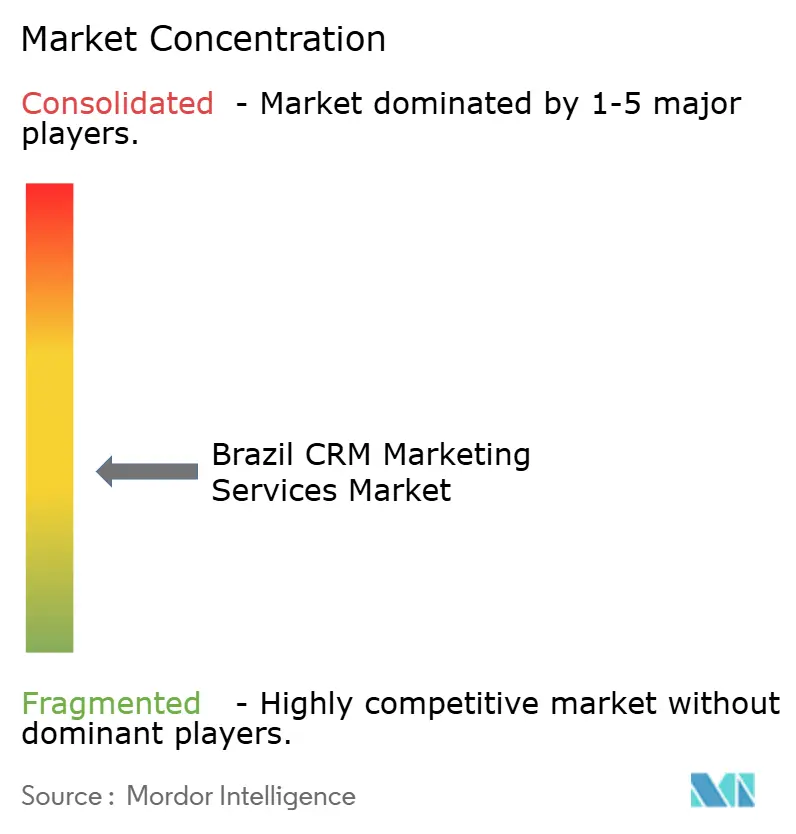
| Market Concentration | Medium |
Major Players *Disclaimer: Major Players sorted in no particular order Image © Mordor Intelligence. Reuse requires attribution under CC BY 4.0. | |
Brazil CRM Marketing Services Market Analysis by Mordor Intelligence
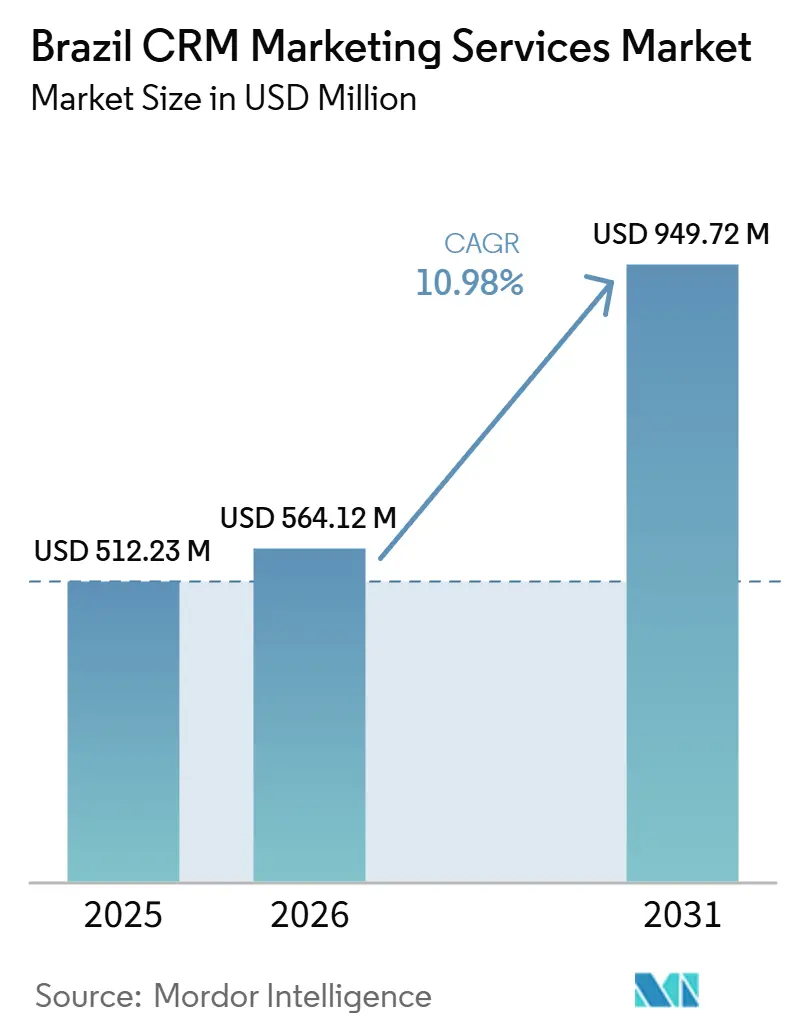
The Brazil CRM marketing services market size is expected to grow from USD 512.23 million in 2025 to USD 564.12 million in 2026 and is forecast to reach USD 949.72 million by 2031 at 10.98% CAGR over 2026-2031. The Brazil CRM marketing services market entered 2026 with strong carryover demand because enterprise spending on cloud, analytics, and customer data systems had already widened in 2025. Brazil’s digital commerce mix also strengthened the case for CRM spending, as Pix handled 42% of e-commerce transactions and digital wallets kept gaining relevance in online payments, which improved the volume and usability of customer interaction data. The regulatory environment added another layer of demand because stricter data governance expectations pushed enterprises to fund consent management, audit support, and workflow controls inside CRM programs. Competition is also moving beyond basic implementation work, as global platform vendors are raising service standards through in-country AI capabilities and local language support. Even with these favorable conditions, the Brazil CRM marketing services market still faces delivery pressure from talent shortages and integration-heavy legacy environments, which keep execution quality and specialization central to vendor selection.
Key Report Takeaways
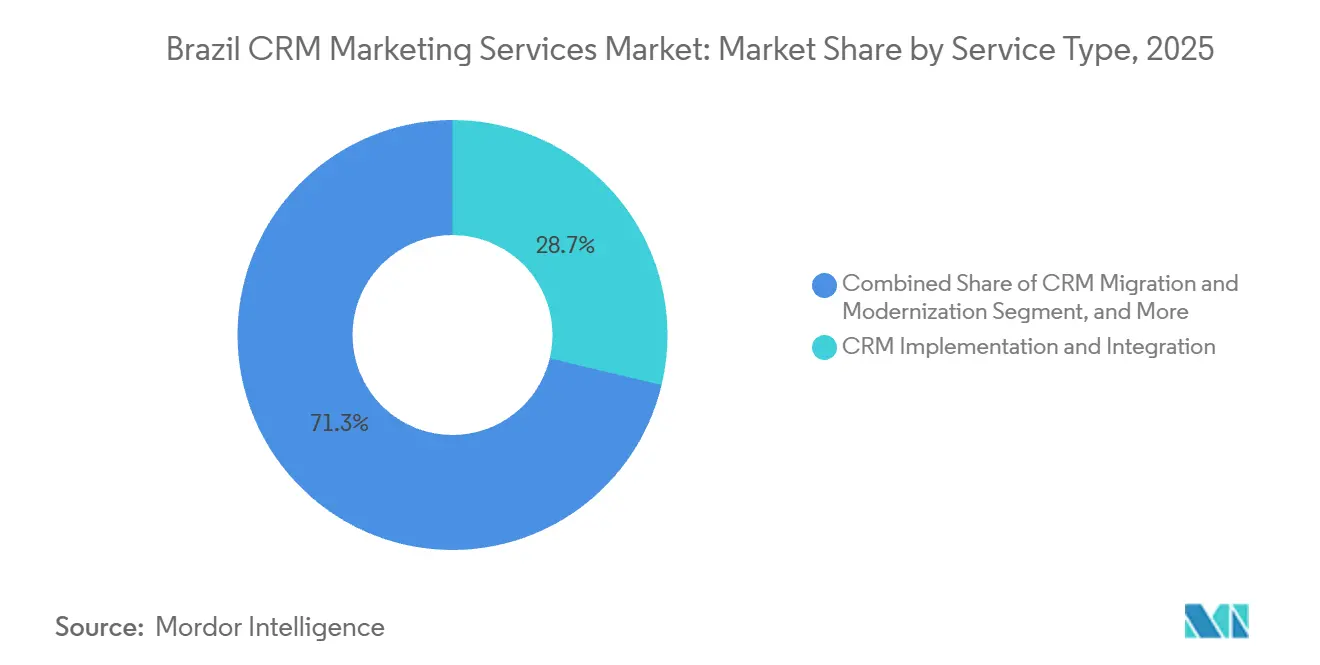
- By service type, CRM implementation and integration led with a 28.74% share of the Brazil CRM marketing services market in 2025, while CRM managed services is projected to expand at a 12.84% CAGR through 2031.
- By enterprise size, large enterprises held 66.42% of revenue in 2025, while small and medium enterprises are projected to record the fastest CAGR at 11.93% through 2031.
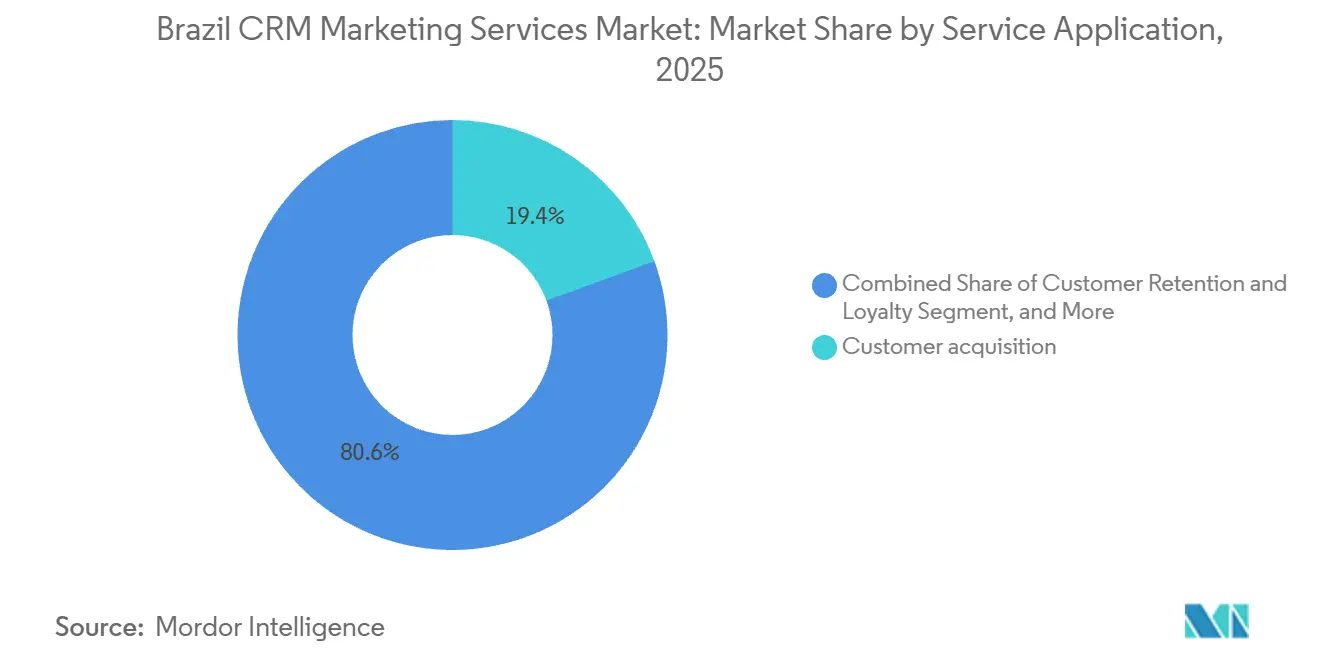
- By service application, customer acquisition accounted for a 19.62% share in 2025, while personalization services is projected to grow at a 13.67% CAGR through 2031.
- By end-user industry, BFSI held 23.16% of the Brazil CRM marketing services market in 2025, while retail and e-commerce is projected to advance at a 12.46% CAGR through 2031.
Note: Market size and forecast figures in this report are generated using Mordor Intelligence’s proprietary estimation framework, updated with the latest available data and insights as of January 2026.
Brazil CRM Marketing Services Market Trends and Insights
Drivers Impact Analysis*
| Driver | (~) % Impact on CAGR Forecast | Geographic Relevance | Impact Timeline |
|---|---|---|---|
| AI-Led Hyperpersonalization Across Sales and Service Journeys | +2.8% | Southeast Brazil, especially São Paulo and Rio de Janeiro, with spillover into the South and Center-West | Medium term (2-4 years) |
| Rapid Shift to Cloud-Delivered CRM and Marketing Services | +2.5% | National, concentrated in São Paulo metro and expanding into secondary cities | Short term (≤ 2 years) |
| WhatsApp-First Conversational Commerce and Service Orchestration | +2.0% | National, strongest in retail, BFSI, and SME demand centers | Short term (≤ 2 years) |
| LGPD-Driven Data Governance, Consent Management, and Auditability Needs | +1.6% | National, with the strongest relevance in BFSI and digital platforms | Medium term (2-4 years) |
| Expansion of E-Commerce, Digital Payments, and Omnichannel Engagement | +1.4% | National, led by Southeast retail corridors and e-commerce hubs | Medium term (2-4 years) |
| Enterprise Modernization of Legacy CRM, ERP, and Customer Data Stacks | +1.0% | National, concentrated among large enterprises in manufacturing and telecom | Long term (≥ 4 years) |
| Source: Mordor Intelligence | |||
AI-Led Hyperpersonalization Across Sales and Service Journeys
AI-led personalization is changing what buyers expect from the Brazil CRM marketing services market, because enterprises now want customer engagement systems that can predict behavior and tailor actions at the individual level. This demand is strongest in sectors with large customer databases and frequent digital interactions, especially banking, retail, and online services. HubSpot reported in 2026 that 98% of Brazilian companies saw positive ROI from AI investments, which supports broader willingness to fund personalization programs instead of keeping them in pilot mode.[1] The shift also raises the standard for service partners, because buyers increasingly expect Portuguese-language deployment, usable decision flows, and measurable commercial outcomes rather than generic automation claims. That makes implementation quality, data preparation, and model oversight more important in procurement discussions across the Brazil CRM marketing services market. Providers that cannot show a clear performance lift are likely to face more pressure in enterprise buying cycles.
Rapid Shift to Cloud-Delivered CRM And Marketing Services
Cloud delivery has become the preferred route for many CRM projects because subscription pricing lowers entry barriers and shortens deployment cycles for new users. The broader Brazilian IT mix also supports this movement, as software represented 32.1% of spending and services accounted for 20.1% in 2025, which shows an environment already oriented toward scalable digital platforms. Salesforce also expanded Agentforce 3 infrastructure into Brazil in June 2025 and added Portuguese-language support, which lowered part of the execution risk around in-country AI-enabled CRM delivery. As a result, the Brazil CRM marketing services market is seeing more demand for packaged implementation, migration support, and recurring optimization services that can be activated faster than older on-premises programs. This matters for both large enterprises and smaller buyers because cloud programs make it easier to add analytics, workflow changes, and user expansion without rebuilding the core environment. It also improves the commercial case for managed services, since ongoing platform administration can be delivered through predictable service contracts.
WhatsApp-First Conversational Commerce and Service Orchestration
WhatsApp works as a primary business communication layer in Brazil, which makes messaging integration central to CRM service design across the Brazil CRM marketing services market. Meta’s WhatsApp Business Platform supports enterprise-grade connections for CRM, service, and marketing automation use cases, which has turned native integration into a baseline buyer requirement rather than a premium feature. This has changed the service mix because providers now need practical experience in conversational workflow design, lead capture, follow-up sequencing, and message-driven service orchestration. The relevance is especially high in retail, BFSI, and SME environments where customer interaction often begins and continues inside messaging channels. Buyers also want message histories connected to customer records, campaign triggers, and service tickets so that a conversation can move across teams without losing context. Providers that lack this capability are likely to face a narrower addressable base in the Brazil CRM marketing services market.
LGPD-Driven Data Governance, Consent Management, and Auditability Needs
LGPD compliance has moved from policy planning into day-to-day operating practice, which is lifting demand for governance-heavy CRM work in the Brazil CRM marketing services market. ANPD’s public monitoring activity in late 2025 showed a more visible enforcement posture, which gave enterprises a stronger reason to formalize consent management, data access controls, and audit trails inside customer systems. The regulatory change became even more meaningful in January 2026, when ANPD and the European Commission finalized a mutual adequacy decision for personal data transfers between Brazil and the European Union.[2] That step reduced friction for multinational CRM programs, but it also increased the need for service partners that can map governance standards across jurisdictions. In practice, regulated sectors now treat consent logging, audit readiness, and data lineage as core parts of CRM scope rather than secondary compliance work. This gives an advantage to providers that already package governance features into their implementation and managed service offerings.
Restraints Impact Analysis*
| Restraint | (~) % Impact on CAGR Forecast | Geographic Relevance | Impact Timeline |
|---|---|---|---|
| Integration Complexity Across Legacy ERP, POS, and Commerce Systems | -1.5% | National, most acute in industrial manufacturing, retail, and telecom | Long term (≥ 4 years) |
| Data Quality Gaps That Weaken Automation and Attribution Outcomes | -1.2% | National, concentrated in SMEs and mid-market enterprises that lack governance maturity | Medium term (2-4 years) |
| Shortage of MarTech, CRM Administration, and RevOps Talent | -0.9% | Southeast-concentrated, with sharper scarcity in secondary cities | Long term (≥ 4 years) |
| Budget Sensitivity and Long Payback Cycles in Mid-Market Accounts | -0.7% | National, most visible in Center-West and Northeast mid-market segments | Short term (≤ 2 years) |
| Source: Mordor Intelligence | |||
Integration Complexity Across Legacy ERP, POS, And Commerce Systems
Integration complexity remains one of the largest delivery constraints in the Brazil CRM marketing services market because many enterprise environments still depend on deeply customized fiscal, ERP, and commerce systems. IT Convergence described Brazil’s ERP setting as unusually complex because of tax, invoicing, and reporting requirements that force country-specific system customization. TOTVS also positions iPaaS and integration support as necessary for connecting applications and managing data flows across business systems, which reinforces how common middleware requirements are in Brazilian software estates. For CRM projects, this means service providers often need to resolve connectivity and data movement problems before users can benefit from automation, personalization, or analytics. The issue is most visible in manufacturing, telecom, and retail, where customer records, commerce events, and billing data sit in separate operational layers. Providers with ready-made connectors and local integration experience, therefore, hold a meaningful advantage over generic implementation teams.
Data Quality Gaps That Weaken Automation and Attribution Outcomes
Poor data quality continues to weaken CRM outcomes because fragmented records, duplicate customer identities, and disconnected systems limit the performance of automation and analytics tools in the Brazil CRM marketing services market. HubSpot reported in 2026 that 27.6% of Brazilian companies operated with completely disconnected systems, while 72% could not measure return on investment from marketing activity because of data gaps. This weakness becomes even more serious when enterprises try to add AI, since prediction and personalization models lose value quickly when the input records are incomplete or duplicated. Mid-market buyers are especially exposed because they often lack dedicated data governance teams and are more sensitive to delays before visible returns appear. In many cases, providers must start with data cleansing, deduplication, and integration work before CRM implementation can move forward at full pace. That extra step adds cost and time, which can slow decision-making in budget-sensitive accounts.
*Our forecasts treat driver/restraint impacts as directional, not additive. The impact forecasts reflect baseline growth, mix effects, and variable interactions.
Segment Analysis
By Service Type: Implementation Revenue Leads, Managed Services Gains Momentum
CRM implementation and integration held 28.74% of the Brazil CRM marketing services market share in 2025, making it the largest service-type segment in the period. This leadership reflects the volume of migration and build-out work still underway across enterprises that are modernizing legacy SAP, Oracle, and TOTVS-based customer systems. The strongest demand remains tied to environments where CRM must connect with payment systems, commerce platforms, and regulated customer records, which keeps project scope broad and delivery cycles longer than in simpler deployments. At the same time, the segment’s size shows that many buyers in the Brazil CRM marketing services industry are still in an active transition phase rather than a mature maintenance phase.
CRM managed services is projected to grow at a 12.84% CAGR from 2026 to 2031, which makes it the fastest-growing service type in the Brazil CRM marketing services market. The move toward recurring contracts is becoming more visible as enterprises seek outside support for administration, optimization, campaign operations, and AI governance that they cannot staff fully in-house. Salesforce’s launch of Agentforce 360 in October 2025 widened this need because autonomous AI agents introduce new oversight, workflow tuning, and operating control requirements for service partners.[3] Providers that can combine implementation depth with long-term operational support are therefore better placed to capture value as CRM scope expands across departments.

By Enterprise Size: Large Enterprises Hold the Revenue Base While SMEs Advance
Large enterprises held a 66.42% share of revenue in 2025, which kept them at the center of the Brazil CRM marketing services market. Their lead comes from the scale of customer data environments, stronger budgets for multi-year programs, and heavier compliance exposure in sectors such as BFSI and technology. These buyers also tend to require broader service packages that cover integration, governance, workflow redesign, and long-term managed support rather than stand-alone deployment. As a result, large-account contracts continue to shape the commercial base of the Brazil CRM marketing services industry.
Small and medium enterprises are projected to expand at an 11.93% CAGR from 2026 to 2031, which makes them the faster-growing enterprise-size segment. Cloud-native pricing and easier onboarding have lowered entry barriers, while messaging-led selling and service workflows fit well with the needs of smaller teams. The official WhatsApp Business Platform has further supported this path by making enterprise messaging connections more practical for CRM and automation use cases. The Brazil CRM marketing services market, therefore, still has meaningful room for first-time SME adoption, especially where buyers want usable customer records and campaign control without building large in-house technology teams.
By Service Application: Acquisition Still Leads While Personalization Accelerates
Customer acquisition accounted for 19.62% of the Brazil CRM marketing services market size in 2025, which kept it as the largest service application by revenue. That position reflects the longer-standing maturity of digital lead generation and outbound customer growth programs across large enterprises. Personalization services, however, is projected to grow at a 13.67% CAGR through 2031, which shows that spending priorities are moving deeper into conversion improvement and lifetime-value management. The gap between the current leader and the fastest-growing application suggests a shift from broad audience capture toward more targeted engagement across the Brazil CRM marketing services market.
Campaign management, marketing automation, customer analytics, and omnichannel coordination still account for a large share of daily service demand because Brazilian enterprises must organize signals from payments, messaging, e-commerce activity, and service interactions. Retention and loyalty work is also drawing renewed attention, where acquisition costs have risen enough to improve the business case for keeping existing customers active for longer. WhatsApp Business integration strengthens this application mix because it connects customer conversations more directly with marketing triggers, service actions, and follow-up workflows. In the Brazil CRM marketing services industry, application growth is moving toward unified orchestration rather than isolated channel execution.
By End-User Industry: BFSI Leads While Retail and E-Commerce Expands Fastest
BFSI held a 23.16% share of revenue in 2025, which made it the largest end-user group in the Brazil CRM marketing services market. The segment benefits from large customer bases, high volumes of regulated interactions, and a steady need for data governance, service quality, and customer lifecycle control. Banks and financial institutions also tend to adopt CRM process improvements earlier than many other sectors because customer engagement directly affects retention, cross-sell potential, and operating efficiency. Healthcare and life sciences, IT and telecom, and industrial manufacturing also contributed meaningful demand, each with its own mix of complexity and adoption needs.
Retail and e-commerce is projected to grow at a 12.46% CAGR from 2026 to 2031, which makes it the fastest-growing end-user segment. Trade.gov projected that 94 million Brazilian consumers would make online purchases in 2025, which supports the need for CRM programs that can manage large digital customer volumes and repeated engagement across channels. EBANX also reported that digital wallets were the fastest-growing payment method in Brazilian e-commerce in 2025, which adds more usable behavioral data for segmentation, follow-up, and loyalty design. This makes retail CRM demand increasingly tied to conversational commerce, digital checkout behavior, and the ability to turn first-time buyers into repeat customers inside the Brazil CRM marketing services market.
Geography Analysis
The Southeast corridor represented the largest revenue base in the Brazil CRM marketing services market in 2025, led by São Paulo, Rio de Janeiro, and Minas Gerais. This concentration reflects the region’s weight in enterprise technology spending, formal-sector employment, financial services activity, and large-scale retail operations. São Paulo remains the main operating center for global CRM vendors and their partner networks, which gives the region an advantage in both direct platform access and delivery capacity. Brazil’s 2025 IT spending mix also favored software at 32.1% and services at 20.1%, which fits the profile of the Southeast’s more mature technology demand structure.[4] Rio de Janeiro adds another layer of demand through large, complex enterprise environments in energy, infrastructure, and adjacent services.
The South region has become the most developed secondary technology zone in the country, with demand linked to manufacturing, retail cooperatives, and agribusiness-related customer operations. Cities such as Florianópolis and Curitiba support a growing base of software providers and service firms that can address CRM modernization outside the main Southeast hubs. The Center-West region, anchored by Brasília and Goiânia, is also gaining importance as government bodies and large agribusiness groups evaluate customer engagement systems that can manage distributor, partner, and citizen interaction flows. In these secondary regions, managed services often carry stronger appeal because buyers need CRM capability without relying entirely on local in-house staffing.
The North and Northeast remain the largest greenfield opportunity inside the Brazil CRM marketing services market, although infrastructure limits and lower digital maturity still constrain near-term scale. LGPD requirements apply across all states, which creates a national compliance floor for consent management, auditability, and customer data handling standards. Lower CRM penetration among smaller firms leaves room for first-time adoption, especially where companies are trying to organize customer records and sales follow-up more formally. E-commerce expansion, Pix usage, and digital payment adoption are also raising the need for CRM tools that can support acquisition and loyalty programs in these regions.
Competitive Landscape
The Brazil CRM marketing services market is moderately concentrated at the platform layer but remains fragmented at the service delivery layer. Salesforce, Microsoft, Oracle, and SAP hold strong positions in enterprise CRM environments, while a large field of local and regional providers competes for implementation, integration, and managed service work. What makes this market distinct is that global product strength alone is not enough to win, because local execution still depends on WhatsApp integration, ERP connectivity, and Brazil-specific operational workflows. That structure gives specialist firms room to defend niche positions even when large global vendors remain visible at the top end of enterprise accounts. As a result, competition in the Brazil CRM marketing services market is shaped as much by local delivery readiness as by software brand recognition.
Strategic differentiation is shifting toward AI execution, operating control, and data-layer performance rather than basic platform selection alone. Salesforce raised the standard in June 2025 when it deployed Agentforce 3 infrastructure in Brazil with Portuguese-language support, which improved the case for in-country autonomous CRM workflows. The company widened that move again in October 2025 with Agentforce 360, which introduced autonomous AI agents and a per-conversation pricing model that changed how enterprises assess service economics over multi-year programs. These changes matter for partners because AI-led CRM environments need governance, tuning, and operating support that sit above traditional system administration.
SAP also strengthened its position in 2026 by regrouping its data, agent, and orchestration capabilities under the SAP Business AI Platform, which reduces the distance between ERP logic and CRM-side AI use cases.[5] This supports buyers that want fewer handoffs between back-office systems and customer engagement workflows, especially in large enterprise programs. At the same time, ANPD’s more visible oversight posture keeps governance capabilities relevant for competitive positioning, because providers must show how customer data can be used, transferred, and audited under current rules. Firms that can combine local integration depth, messaging orchestration, and practical AI controls are likely to hold the most durable positions in the Brazil CRM marketing services market.
Brazil CRM Marketing Services Industry Leaders
-
Salesforce, Inc.
-
Microsoft Corporation
-
Oracle Corporation
-
SAP SE
-
Adobe Inc.
- *Disclaimer: Major Players sorted in no particular order
Recent Industry Developments
- May 2026: SAP announced the rebranding and strategic repositioning of its Business Technology Platform, BTP, as the SAP Business AI Platform, SAP BAIP, at SAP Sapphire 2026, centralizing AI agents, Business Data Cloud, and an AI Agent Hub under a unified AI-first product architecture. This restructuring directly affects the CRM and customer experience product roadmap for Brazilian enterprises currently migrating from SAP ECC, compressing the integration pathway between CRM and ERP AI capabilities within the SAP ecosystem.
- January 2026: The ANPD and the European Commission finalized a mutual data protection adequacy agreement under ANPD Resolution No. 32/2026, recognizing LGPD and GDPR as providing equivalent personal data protection. The decision removes the need for separate data transfer instruments for CRM data flows between Brazilian and EU-based systems, directly reducing compliance overhead for multinational enterprises with cross-border customer databases.
- November 2025: ANPD launched an Oversight Dashboard in Power BI, providing real-time public monitoring of supervisory proceedings, preparatory measures, and sanctioning processes under the LGPD. The transparency tool accelerated LGPD compliance planning cycles for CRM data controllers and formalized the ANPD's data governance enforcement posture for enterprise procurement teams evaluating CRM consent management investments.
- October 2025: Salesforce launched Agentforce 360 in general availability globally, enabling Brazilian enterprises to deploy autonomous AI agents across CRM workflows with integrated Data Cloud context, Slack-native orchestration, and multi-step reasoning capabilities. The platform introduced a per-conversation pricing model for AI agents, representing a structural shift from per-user licensing that is already prompting CRM managed services providers in Brazil to restructure their contract economics.
Brazil CRM Marketing Services Market Report Scope
The Brazil CRM marketing services market comprises revenues generated from professional and managed services that support the planning, deployment, integration, modernization, optimization, operation, and maintenance of customer relationship management (CRM) and marketing technology environments. The market includes CRM strategy and consulting, CRM implementation and integration, CRM migration and modernization, CRM managed services, and CRM training and support delivered to organizations across Brazil.
The Brazil CRM Marketing Services Market Report is segmented by Service Type (CRM Strategy and Consulting, CRM Implementation and Integration, CRM Migration and Modernization, CRM Managed Services, and CRM Training and Support), Enterprise Size (Large Enterprises, and Small and Medium Enterprises), Service Application (Customer Acquisition, Customer Retention and Loyalty, Campaign Management Services, Marketing Automation Services, Customer Analytics and Insights, Omnichannel Customer Engagement, and Personalization Services), and End-user Industry (BFSI, Healthcare and Life Sciences, Information Technology and Telecom, Retail and E-Commerce, Industrial Manufacturing, Government and Public Administration, and Other End-user Industries). The Market Forecasts are Provided in Terms of Value (USD).
| CRM Strategy and Consulting |
| CRM Implementation and Integration |
| CRM Migration and Modernization |
| CRM Managed Services |
| CRM Training and Support |
| Large Enterprises |
| Small and Medium Enterprises |
| Customer Acquisition |
| Customer Retention and Loyalty |
| Campaign Management Services |
| Marketing Automation Services |
| Customer Analytics and Insights |
| Omnichannel Customer Engagement |
| Personalization Services |
| BFSI |
| Healthcare and Life Sciences |
| Information Technology and Telecom |
| Retail and E-commerce |
| Industrial Manufacturing |
| Government and Public Administration |
| Other End-user Industries |
| By Service Type | CRM Strategy and Consulting |
| CRM Implementation and Integration | |
| CRM Migration and Modernization | |
| CRM Managed Services | |
| CRM Training and Support | |
| By Enterprise Size | Large Enterprises |
| Small and Medium Enterprises | |
| By Service Application | Customer Acquisition |
| Customer Retention and Loyalty | |
| Campaign Management Services | |
| Marketing Automation Services | |
| Customer Analytics and Insights | |
| Omnichannel Customer Engagement | |
| Personalization Services | |
| By End-user Industry | BFSI |
| Healthcare and Life Sciences | |
| Information Technology and Telecom | |
| Retail and E-commerce | |
| Industrial Manufacturing | |
| Government and Public Administration | |
| Other End-user Industries |
Key Questions Answered in the Report
What is the current and future size of the Brazil CRM marketing services market?
The Brazil CRM marketing services market stood at USD 512.23 million in 2025, reached USD 564.12 million in 2026, and is forecast to hit USD 949.72 million by 2031 at a 10.98% CAGR.
Which service type leads revenue in Brazil CRM marketing services?
CRM implementation and integration led the market with a 28.74% revenue share in 2025, showing that many enterprises are still building or modernizing core customer systems.
Which application area is growing the fastest in Brazil?
Personalization services is projected to grow at a 13.67% CAGR through 2031, reflecting stronger demand for targeted engagement, conversion improvement, and customer lifetime value management.
Why is BFSI the leading end-user in this space?
BFSI held 23.16% of revenue in 2025 because it manages large volumes of regulated customer interactions and needs stronger control over data, service quality, and retention workflows.
What is driving retail and e-commerce demand for CRM services in Brazil?
Retail and e-commerce is projected to grow at a 12.46% CAGR through 2031, supported by 94 million online buyers in 2025, rising digital wallet use, and stronger demand for loyalty and conversational commerce programs.
How important is WhatsApp to CRM service delivery in Brazil?
It is a core operating channel, not just an add-on. Enterprises increasingly expect CRM systems to connect WhatsApp interactions with customer records, campaign triggers, and service workflows.