
India Rice Market Analysis by Mordor Intelligence
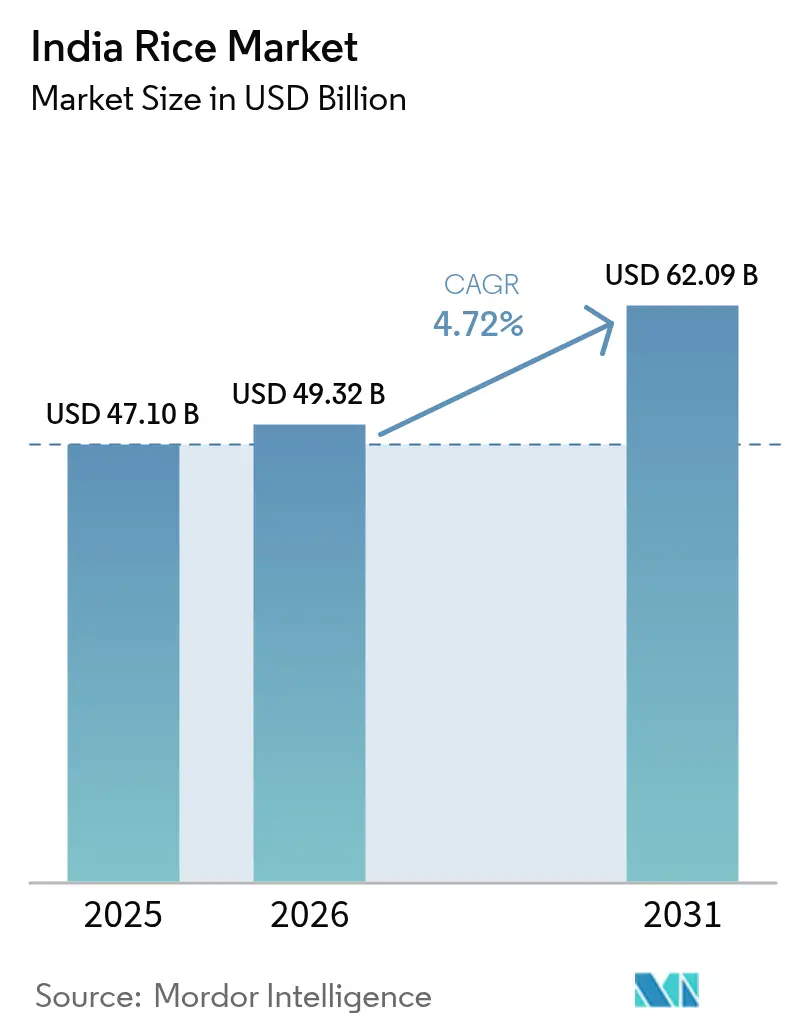
The India rice market size in 2026 is estimated at USD 49.32 billion, growing from 2025 value of USD 47.1 billion with 2031 projections showing USD 62.09 billion, growing at 4.72% CAGR over 2026-2031. India accounts for 30.3% of global rice exports, with domestic production projected to reach 151 million metric tons in 2025-26, establishing the country as a significant influence on global rice prices[1]U.S. Department of Agriculture, “India to Dethrone China as Largest Rice Producer,” usda.gov . The removal of the September 2024 ban on non-basmati white rice exports has increased export opportunities, while increased minimum support prices (MSP) support farmer income and encourage production capacity growth. The adoption of advanced technologies, including genome-edited varieties and remote-sensing water management systems, is enhancing production efficiency and improving product traceability for export markets.
Key Report Takeaways
- In the India rice market, Telangana, Uttar Pradesh, and West Bengal collectively contributed more than 35% to the total rice production in 2025.
Note: Market size and forecast figures in this report are generated using Mordor Intelligence’s proprietary estimation framework, updated with the latest available data and insights as of 2026.
India Rice Market Trends and Insights
Drivers Impact Analysis*
| Driver | (~) % Impact on CAGR Forecast | Geographic Relevance | Impact Timeline |
|---|---|---|---|
| Rising domestic per-capita rice consumption | +1.0% | National; greater pull in urban centers | Medium term (2-4 years) |
| Mandatory rice fortification across Public Distribution System | +0.8% | National; strong rural and tribal coverage | Long term (≥ 4 years) |
| Higher minimum support price and procurement volumes | +1.2% | West Bengal, Uttar Pradesh, and Punjab | Short term (≤ 2 years) |
| Farm mechanization and irrigation expansion | +0.7% | Punjab, Haryana, Western Uttar Pradesh; spillover into Eastern states | Long term (≥ 4 years) |
| Hybrid, high-protein rice varieties targeting health-aware consumers | +0.5% | Premium urban markets nationwide | Medium term (2-4 years) |
| Blockchain-based traceability premiums in exports | +0.3% | Punjab, Haryana, and Western Uttar Pradesh | Medium term (2-4 years) |
| Source: Mordor Intelligence | |||
Rising Domestic Per-Capita Rice Consumption
Per-capita rice consumption is increasing in Indian metropolitan areas where changing lifestyles drive demand for convenient, nutritionally enhanced staples. Government surveys indicate growing differences in cereal preferences between rural and urban areas, leading suppliers to develop high-protein and low-glycemic index products that can command higher prices[2]Ministry of Statistics and Programme Implementation, “Share of Cereals in Consumption 2022-23,” mospi.gov.in. The International Rice Research Institute has enhanced protein content to 15.99%, while the black-grained BPT 2841 variety offers increased lysine content, appealing to health-conscious consumers[3]International Rice Research Institute, “Genes for High Protein in Rice,” irri.org. KRBL's 18% increase in domestic branded sales demonstrates that premium products perform well in modern retail channels. Rice suppliers are investing in new varieties, improved packaging, and multi-channel distribution to capture urban market share. This trend has increased value realization across the supply chain, benefiting farmers who meet quality standards.
Mandatory Rice Fortification Across Public Distribution System
The government mandate for grain fortification through the Public Distribution System (PDS) has established consistent demand. The program serves more than 800 million beneficiaries, with 1,023 fortified kernel plants having a capacity of 111 lakh metric tons, which is twice the scheme's requirements. The installation of blending equipment in over 21,000 rice mills has created an additional processing network that ensures steady operations for millers. The guaranteed annual procurement of 520 lakh metric tons provides stable demand for compliant suppliers. States with high anemia rates, such as Nagaland, demonstrate the public health need that supports continued budget allocation. The fortification requirements are projected to become standard specifications, encouraging open-market participants to produce nutrient-enriched products.
Higher Minimum Support Price (MSP) and Procurement Volumes
The Minimum Support Price (MSP) for paddy increased to INR 2,369 per quintal (USD 28.4) for 2025-26, maintaining the policy of ensuring 1.5 times the production cost. Government procurement increased from 761.40 lakh metric tons in 2014-15 to 1,062.69 lakh metric tons in 2022-23, increasing farmer earnings from INR 1.06 lakh crore (USD 12.8 billion) to INR 2.28 lakh crore (USD 27.5 billion)[4] Press Information Bureau Staff, “Year-End Review of Department of Food and Public Distribution – 2024,” Press Information Bureau, pib.gov.in. This price protection encourages farmers to adopt high-yield hybrid varieties without concerns of market oversupply, although the domestic price floor may reduce export competitiveness. The concentration of procurement in West Bengal, Uttar Pradesh, and Punjab creates regional income disparities and influences crop selection patterns in these regions.
Farm Mechanization and Irrigation Expansion
India's agricultural mechanization rate of 40-45% indicates significant potential for improvement through precision planters, direct-seeded rice techniques, and laser-leveled irrigation systems. Research conducted across four states demonstrates that direct-seeded rice reduces cultivation costs by 79% and increases net earnings per acre by 62%. Remote-sensing data from Punjab indicates 20-40% water conservation without compromising crop yields, highlighting improved climate resilience. Government initiatives, including SMAM subsidies and an INR 500 crore (USD 60.2 million) genome-editing fund, support technology adoption, particularly through smallholder service platforms that consolidate demand. These improvements create a cycle of enhanced productivity that addresses increasing labor shortages.
Restraints Impact Analysis*
| Restraint | (~) % Impact on CAGR Forecast | Geographic Relevance | Impact Timeline |
|---|---|---|---|
| Monsoon volatility and climate shocks | -1.8% | National, with severe impact in rainfed areas | Short term (≤ 2 years) |
| Small farm size and high production cost structure | -0.9% | Eastern and Southern states predominantly | Long term (≥ 4 years) |
| Methane-emission compliance pressure | -0.8% | National, with higher impact in intensive rice cultivation zones | Medium term (2-4 years) |
| Shift of acreage to higher-value horticulture | -0.4% | Progressive farming regions with market access | Medium term (2-4 years) |
| Source: Mordor Intelligence | |||
Monsoon Volatility and Climate Shocks
Extreme precipitation events were observed during the 2024 monsoon, affecting agricultural fields in Gujarat, Andhra Pradesh, and Telangana. Analysis indicates that rainfall exceeding 1,621 mm negatively impacts Kharif crop yields. Climate projections indicate a potential 20% decline in irrigated crop yields in Uttar Pradesh, while rain-fed areas may experience slight improvements. Farmers are responding by adjusting planting schedules and adopting drought-resistant crop varieties, though infrastructure development for climate resilience remains inconsistent across regions.
Small Farm Size and High Production Cost Structure
Small landholdings averaging below 1.1 hectares restrict mechanization and increase per-unit input costs. Direct-seeded rice trials demonstrate yield improvements in Uttar Pradesh, while results vary in Madhya Pradesh due to diverse soil conditions. Hybrid seeds, despite offering 2-metric tons per hectare higher yields, cost 3-4 times more than open-pollinated varieties, making them less accessible to small farmers. Punjab's decision to ban hybrid paddy by 2025, following Food Corporation of India's quality concerns, highlights the challenge of balancing productivity gains with market requirements.
*Our forecasts treat driver/restraint impacts as directional, not additive. The impact forecasts reflect baseline growth, mix effects, and variable interactions.
Geography Analysis
India's rice export strength originates from geographically concentrated surplus regions with established canal irrigation and policy support. Punjab and Haryana contribute over 70% of basmati exports, while Eastern states primarily supply non-basmati varieties to the Public Distribution System (PDS), creating distinct logistics channels. The India rice market benefited from the September 2024 policy change that resumed non-basmati exports, leading to increased freight bookings to West Africa and the Middle East.
Telangana leads the southern expansion through canal modernization and state input subsidies that support multiple cropping cycles. While eastern coastal zones maintain high productivity, port infrastructure limitations increase freight costs and reduce profit margins. Remote sensing data indicates 78% accuracy in identifying sustainable water-saving practices across 3 million Punjab plots, offering potential solutions for water-stressed regions across India.
Processing infrastructure aligns with raw-paddy production zones, with more than 21,000 fortification-compliant mills located in major procurement areas, strengthening regional advantages. Climate events, such as the 2024 floods, reveal infrastructure vulnerabilities, highlighting the importance of diverse sourcing within the India rice market. Export competitiveness varies based on distance to ports; Punjab basmati faces higher logistics costs compared to Pakistani exports through Karachi, compelling Indian exporters to focus on value-added branding to maintain price levels.
Regulatory Landscape
India's rice market is shaped by export controls and public food distribution specifications administered through agencies such as the Directorate General of Foreign Trade (DGFT), APEDA, and the Department of Food and Public Distribution. On April 10, 2026, DGFT Notification No. 07/2026-27 mandated a Certificate of Inspection from the Export Inspection Council (EIC) or Export Inspection Agency (EIA) for basmati and non-basmati rice exports to EU member states, the UK, and select EFTA markets (Iceland, Liechtenstein, Norway, and Switzerland), while exempting other European destinations for a six-month window ending October 1, 2026. For non-basmati exports, policy implementation also relies on APEDA contract registration via the Registration-Cum-Allocation Certificate (RCAC) process, tightening shipment-level traceability and compliance around contract validity and documentation.
On the domestic side, quality and efficiency reforms in subsidized distribution are being reinforced through the Rice Milling Transformation (RMT) scheme cleared by the Cabinet Committee on Economic Affairs (CCEA) in July 2026. The scheme tightens quality norms for PDS rice by reducing permissible broken grain content from 25% to 10% for raw rice and from 16% to 5% for parboiled rice, creating a clearer compliance target for mills supplying government channels. It also links milling outcomes to logistics and handling reforms, including how broken rice is handled at mill premises, which pushes mill upgrades and segregation practices as part of the PDS supply standardization agenda.
Value Chain Analysis
India's rice value chain starts with input providers (seed companies, fertilizer and crop-protection suppliers, irrigation and farm machinery providers) and a highly fragmented farm base dominated by smallholders, where aggregation often happens through commission agents (arthiyas), farmer groups, and local traders. Paddy then moves into a mixed processing landscape of private and cooperative rice mills, with quality differentiation between basmati export-oriented lines and non-basmati streams that often serve government procurement. Public agencies such as the Food Corporation of India (FCI) and state procurement entities anchor demand through MSP-linked procurement, while fortified rice requirements have driven installation of blending equipment across thousands of mills, strengthening the processing layer tied to the Public Distribution System.
Downstream, distribution splits between domestic wholesale and modern retail channels for branded rice, and export channels managed by traders and integrated exporters. For non-basmati exports, execution includes contract registration and allocation under APEDA's RCAC process, which adds a documentation and timing step before shipment. Key bottlenecks persist around post-harvest losses, storage gaps, and variable milling infrastructure, while technology-led interventions are increasingly visible across the farm and processing interface, including direct-seeded rice systems and newer varietal pipelines (for example, genome-edited and DSR-suited varieties identified for release) aimed at reducing labor and water intensity and stabilizing throughput for mills and exporters.
Market Opportunities and Future Outlook
Export-oriented opportunities center on compliance-led differentiation and more streamlined execution for specific destinations. DGFT Notification No. 07/2026-27 (April 10, 2026) concentrated mandatory EIC/EIA inspection requirements on EU member states, the UK, and select EFTA markets through October 1, 2026, while exempting other European countries during that window. The result is a clearer compliance roadmap by destination. In parallel, APEDA's RCAC contract registration requirement for non-basmati exports increases the value of integrated exporters and service providers that can manage documentation, traceability, and shipment scheduling, supporting investments in testing and inspection workflows and batch-level traceability systems for exporters targeting premium or regulated markets.
On the domestic and production side, scale programs and demonstrated field outcomes are creating space for mechanization services, DSR-enablement, and input innovations. IIRR and SBI Foundation's 2024-2026 initiative in Telangana reported DSR yield gains of 8-13% and cultivation cost reductions of 21-23%, and Punjab reported 4 lakh acres under DSR in Kharif 2026, pointing to expanding operational adoption that pulls demand for direct seeding equipment, advisory services, and water-management tools. At the same time, the July 2026 CCEA approval of the Rice Milling Transformation scheme, which tightens permissible broken content for PDS rice, provides a defined upgrade path for mills supplying government channels, supporting modernization, segregation, and quality-control solutions that reduce broken grain and improve consistency across procurement-linked supply chains.
Recent Industry Developments
- April 2026: DGFT issued Notification No. 07/2026-27 requiring a Certificate of Inspection from EIC/EIA for basmati and non-basmati rice exports to EU member states, the UK, and select EFTA markets, while exempting other European countries for a six-month period ending October 1, 2026. The change refocuses compliance investments toward the most regulated European destinations and simplifies documentation burden for exporters shipping to non-EU European markets during the exemption window.
- May 2025: The Indian Council of Agricultural Research introduced genome-edited rice varieties DRR Dhan-100 (Kamala) and Pusa DST Rice 1, positioned for improved yield traits and climate resilience attributes such as drought and salinity tolerance and improved nitrogen-use efficiency. The release strengthens the varietal pipeline for productivity gains and supports input and seed-system upgrades tied to water and labor constraints in key rice belts.
- September 2024: The Government of India removed the export ban on non-basmati white rice and set a minimum export price of USD 490 per metric ton, alongside a reduction in duty on parboiled rice to 10%. Reopening non-basmati shipments expanded addressable export channels for millers and traders and increased the role of export policy settings in domestic price formation and inventory management.


Research Methodology Framework and Report Scope
Market Definition and Coverage
For this study, the market is defined as the total value of rice consumed and traded from India, expressed in USD, and aligned to the rice volumes and prices seen across the country and export channels.
Scope exclusions: It does not count non-rice staples, rice seed, or farm inputs such as fertilizers and crop protection products.
Segmentation Overview
- India
- Production Analysis (Volume)
- Consumption Analysis (Value and Volume)
- Export Analysis (Value and Volume)
- Import Analysis (Value and Volume)
- Price Trend Analysis
Data Sources, Market Sizing, and Validation
Desk Research
We first built the fact base from public datasets that help explain rice supply, use, and trade flows in India. Sources used include, for example, Government of India agriculture statistics, FAOSTAT, USDA PSD and GAIN notes, UN Comtrade trade tables, and customs or port-level bulletins where available.
To convert volumes into consistent value series, we also reviewed public price references such as government mandi price disclosures and inflation releases, along with association publications and reputed press coverage of export restrictions and minimum export price changes. Company annual reports, investor presentations, and a paid subscription focused on company financials and news were used to sanity-check revenue exposure and the timing of reported price moves. These examples are not exhaustive, and many other public sources were also referred to for data collection, validation, and research clarification.
Primary Interviews and Surveys
Next, we validated assumptions through expert interviews and structured surveys with participants across farming procurement, milling, trading, export logistics, and bulk buying. Since this is an India-only market, coverage was balanced across major producing belts and large consumption centers, then cross-checked with trade-oriented respondents who follow destination demand and currency-linked pricing. Respondent input was also used to confirm conversion ratios, price realization bands, and the practical impact of policy actions on both volumes and margins.
Distribution of primary research fieldwork respondents
| Company type | Respondent position |
|---|---|
| Top tier: 39% | CXOs: 16% |
| Mid tier: 40% | Functional/Unit leaders: 37% |
| Smaller Players: 21% | Managers: 47% |
Market-Sizing & Forecasting
Sizing was anchored using a top-down build where production, domestic use, and net trade are reconstructed from official volume series, and then translated into value using observed price references and a clean USD conversion for the same time window. Where needed, adjustments were applied for the typical spread between farmgate and wholesale realizations so the value reflects the market transaction layer being measured.
The totals were then corroborated with selective bottom-up approximations, such as sampled volume handled by mills and traders multiplied by realistic price bands, followed by channel checks on export price realization. Key inputs that were tracked (illustrative) included paddy and wholesale rice prices, export volumes and export unit values, harvested area and yield trends, per capita consumption signals, and the timing of policy moves affecting export availability. For forecasting, scenario analysis was used so that changes in production outlook and trade policy could be translated into clear upside and downside paths, and then a central case was agreed after reconfirming assumptions with primary respondents. When company-side volume coverage was partial, gaps were handled by scaling to known state production shares and trade shares, and then rechecking the implied prices against published ranges.
Data Validation & Update Cycle
Outputs were triangulated across independent signals, so the value trend had to make sense against volume movements, price direction, and trade intensity in the same year. Variance checks were run to flag unusual jumps in implied USD per ton, sudden shifts in export share, or inconsistencies between domestic availability and consumption, which were then reviewed by another analyst before sign-off.
The report is refreshed annually, and interim updates are triggered when material events occur, such as major export rule changes, sharp price shocks, or currency moves that change realizations. Before delivery, a fresh validation pass is completed so clients receive an updated view aligned to the latest available statistics and confirmed market feedback.
Mordor Intelligence's India Rice Market Size Compared With Other Published Estimates
Different published values for India rice can vary even when they all look credible, because the timing of currency conversion, the price series chosen, and the way export realizations are averaged can shift the final USD number. Variations also come from whether the model treats the market more as a domestic consumption value pool or as a broader value pool that reflects both domestic and export-linked pricing.
In this study, the refresh cadence is kept tight around new season outcomes and policy actions, and the USD conversion is applied consistently to the same pricing window before the final number is locked. These are checks used by Mordor Intelligence to reduce drift from short-lived price spikes. Some other estimates lean on older base-year prices, apply a different mix of retail versus wholesale pricing, or carry forward export unit values without re-validating them against current shipment and domestic price signals.
Benchmark comparison
| Source | Market Size | Gaps in Research Methodology |
|---|---|---|
| Mordor Intelligence | USD 47.10 B (2025) | |
| Regional Consultancy A | USD 58.60 B (2024) | Uses an earlier base year and appears to lean more heavily on export narrative and value framing, with less clarity on how domestic price realization and USD timing are aligned to the same period. |
| Global Consultancy B | USD 54.47 B (2021) | Anchors the series to an older revenue base year and grain-type segmentation, which can understate recent policy-led export price shifts and the latest wholesale price cycle in India. |
Taken together, the spread mainly traces back to year selection and the price and currency windows used when converting large volumes into USD value. By keeping the steps traceable to production, trade, and price signals that can be rechecked each year, the final estimate stays repeatable even when the market is affected by policy and seasonal swings.


Key Questions Answered in the Report
What is the projected value of the India rice market in 2031?
India rice market is forecast to reach USD 62.09 billion by 2031, reflecting a 4.72% CAGR over 2026-2031.
How is growing urban rice consumption influencing future demand?
Higher per-capita intake in cities is lifting value-added sales of high-protein and low-GI varieties.
Which are the major rice-producing states in Indian?
Uttar Pradesh, West Bengal, Punjab, Andhra Pradesh, Telangana, and Odisha are the major rice-producing states in Indian.
How is mandatory fortification influencing demand?
Fortification secures an annual procurement floor of 520 lakh metric tons, creating a stable demand floor.
What technologies are transforming cultivation?
Genome-edited high-yield varieties, direct seeded rice, and blockchain-based traceability are boosting productivity and export premiums.
Page last updated on:


 Your data is secure and never sold or shared.


