Market Overview
| Study Period | 2021 - 2031 |
|---|---|
| Forecast Data Period | 2026 - 2031 |
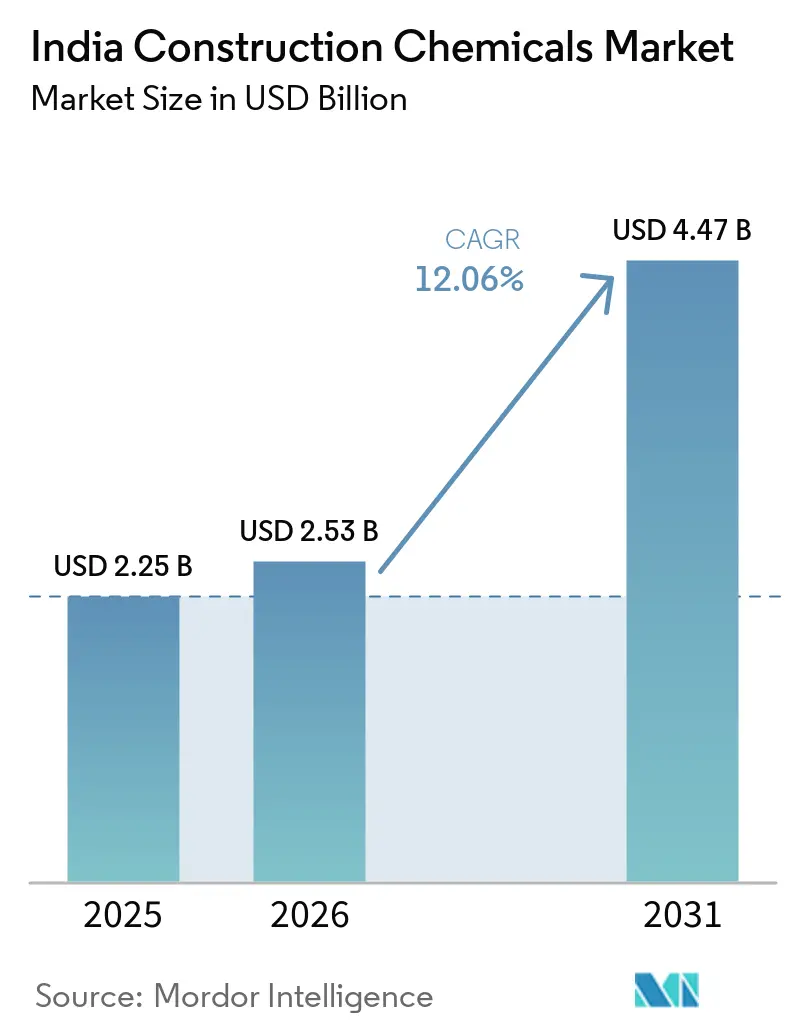
| Base Year Market Size (2025) | USD 2.25 Billion |
| Market Size (2026) | USD 2.53 Billion |
| Market Size (2031) | USD 4.47 Billion |
| Growth Rate (2026 - 2031) | 12.06 % |
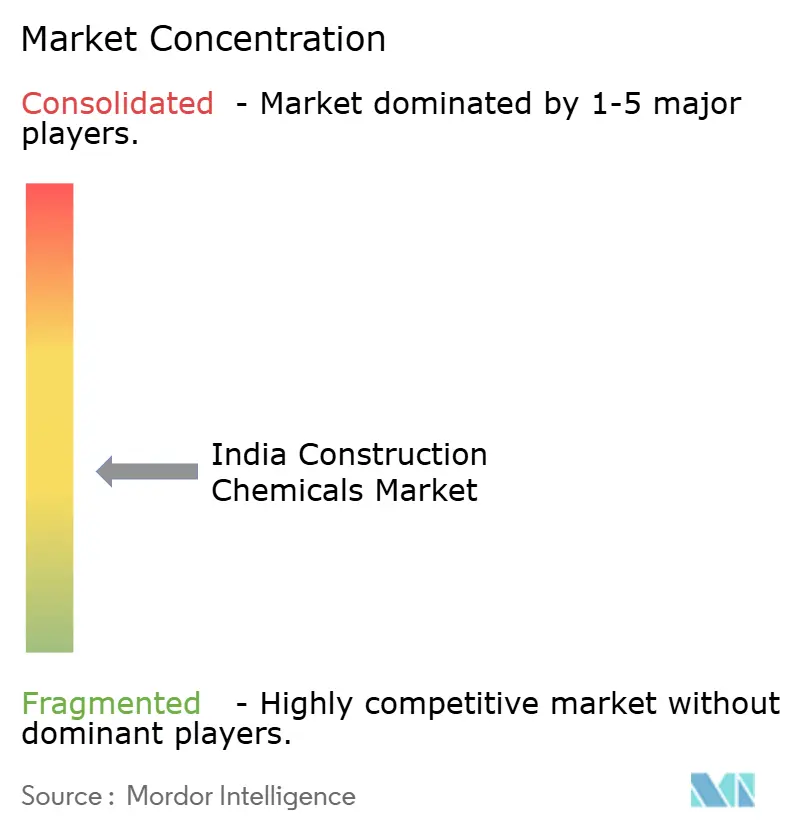
| Market Concentration | Medium |
Major Players *Disclaimer: Major Players sorted in no particular order Image © Mordor Intelligence. Reuse requires attribution under CC BY 4.0. | |
India Construction Chemicals Market Analysis by Mordor Intelligence
The India Construction Chemicals Market size is expected to grow from USD 2.25 billion in 2025 to USD 2.53 billion in 2026 and is forecast to reach USD 4.47 billion by 2031 at 12.06% CAGR over 2026-2031. Government capital-expenditure outlays, most notably the INR 11.1 trillion National Infrastructure Pipeline, anchor the long-range demand outlook as metros, highways, and smart-city projects scale nationwide. Ready-mixed concrete (RMC) adoption is accelerating beyond Tier-1 cities, creating a sustained demand for high-performance admixtures and dosing technologies that deliver the workability and durability parameters specified in large infrastructure packages. Simultaneously, the rapid rise of green-label construction drives shifts in formulation toward low-VOC sealants, bio-based membranes, and recycled-content additives as builders target IGBC or EDGE certifications.
Key Report Takeaways
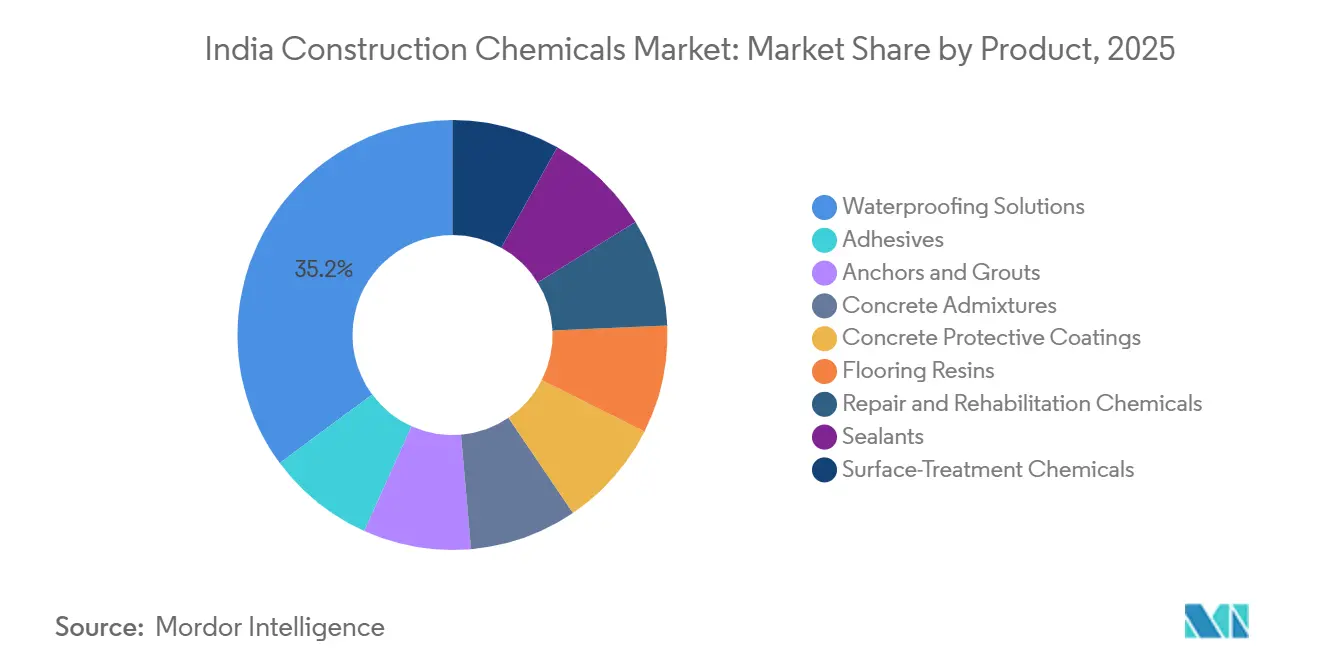
- By product category, waterproofing solutions held 35.15% of India construction chemicals market share in 2025, and waterproofing solutions are forecast to expand at an 13.43% CAGR through 2031.
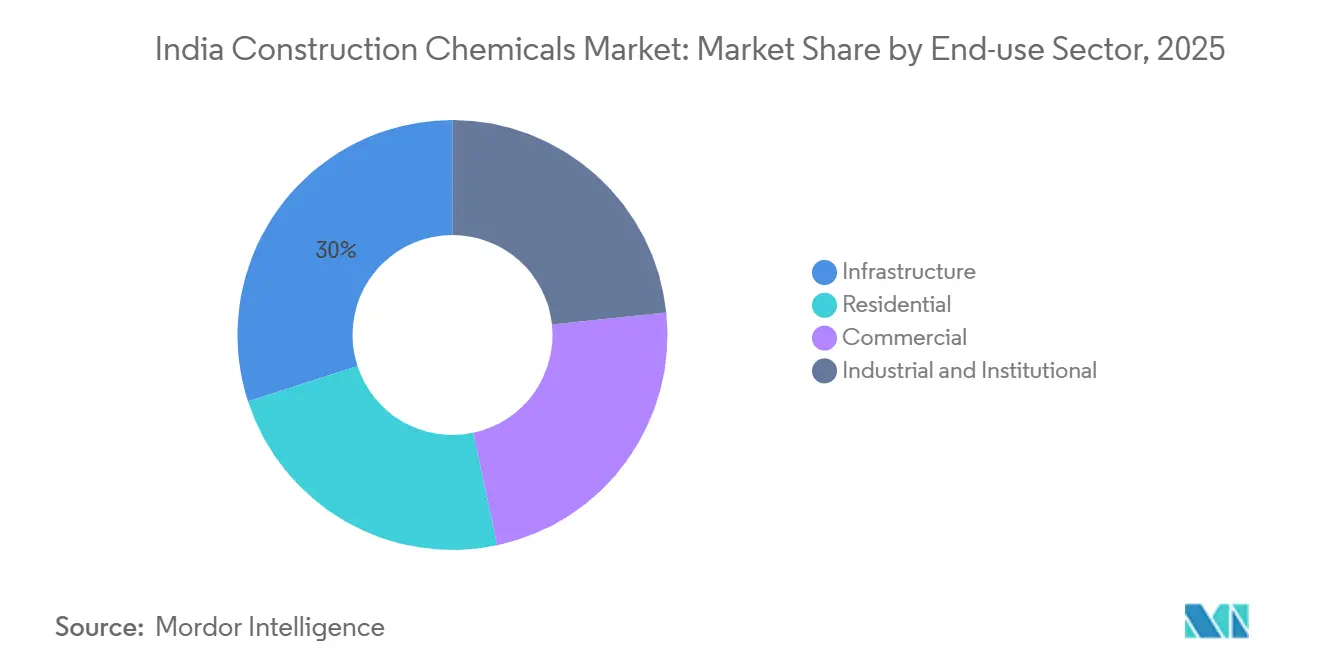
- By end-use sector, the infrastructure segment accounted for 30.01% of the India construction chemicals market size in 2025, and infrastructure applications are advancing at an 12.51% CAGR to 2031.
Note: Market size and forecast figures in this report are generated using Mordor Intelligence’s proprietary estimation framework, updated with the latest available data and insights as of 2026.
Market Trends and Insights
Drivers Impact Analysis of India Construction Chemicals Market*
| Drivers | (~) % Impact on CAGR Forecast | Geographic Relevance | Impact Timeline |
|---|---|---|---|
| Mega-infrastructure pipeline boosts specialty admixture demand | +1.5% | National, with concentration in metro cities and economic corridors | Medium term (2-4 years) |
| Transition from on-site mixed concrete to ready-mixed concrete | +1.2% | Urban centers, expanding to Tier-2 cities | Short term (≤ 2 years) |
| Rapid penetration of green-label certified products | +0.8% | Metropolitan areas, industrial hubs with environmental compliance focus | Long term (≥ 4 years) |
| Growth of renovation and reconstruction projects | +1.0% | Established urban markets, heritage restoration zones | Medium term (2-4 years) |
| Rising need for affordable housing projects | +0.7% | Pan-India with emphasis on rural-urban fringe areas | Long term (≥ 4 years) |
| Source: Mordor Intelligence | |||
Mega-infrastructure pipeline boosts specialty admixture demand
National Infrastructure Pipeline allocations channel steady large-volume orders toward high-range water reducers, corrosion inhibitors, and shrinkage-reducing admixtures needed for metro tunneling, coastal bridges, and seismic-zone viaducts[1]. High-specification concrete for the Mumbai Metro Line 3 and Delhi-Meerut RRTS requires elevated early strength and low permeability, thereby heightening demand for premium polycarboxylate-ether chemistries. Highway packages under the Bharatmala Pariyojana are increasingly mandating performance-based mixes, which embed superplasticizer and air-entrainment dosages in tender documents. Suppliers therefore align research and development pipelines to resilient-infrastructure guidelines, releasing fiber-reinforced polymer systems and crystalline waterproofing lines for cut-and-cover segments exposed to groundwater ingress. These dynamics keep the India construction chemicals market closely tethered to public-sector rollout timetables, with regional stocking hubs springing up near project clusters to minimize lead times. Consequently, integrated producers with backward linkages to key monomers secure a competitive cost advantage as specialty-grade resin inputs become increasingly scarce globally.
Transition from on-site mixed concrete to ready-mixed concrete
RMC penetration is increasing, reshaping reagent ordering cycles toward bulk-supply contracts with batching plant operators. Consistent slump retention across long haul times pushes demand for retarding admixtures, viscosity-modifying agents, and pumping aids that small on-site mixers seldom use. Automated dosing systems now integrate directly with ERP platforms, enabling suppliers to monitor real-time consumption and remotely optimize formulation tweaks. Metro contractors in land-scarce downtown cores favor RMC to curtail traffic disruptions, strengthening the captive pull for additive packages bundled under multi-year framework agreements. As regional players invest in inline moisture sensors and rheology controllers, the India construction chemicals market deepens its shift from commodity bulk powders toward service-wrapped chemistry solutions that embed technical advisory fees within product invoices. This transformation raises entry barriers for unorganized formulators lacking application engineering bandwidth.
Rapid penetration of green-label certified products
The IGBC-registered floor area expanded by 40% year-on-year in 2024, making eco-friendly sealants, membranes, and low-carbon admixtures mainstream in metro office and premium residential buildings. State procurement norms now stipulate the use of low-VOC coatings for public buildings, while corporate occupiers integrate scope 3 emissions targets into vendor scorecards, rewarding suppliers who can provide full material health disclosures. Product stewardship drives the adoption of bio-based polyurethane membranes and recycled microsilica blends, which reduce embodied carbon without compromising performance. Chemical manufacturers respond by overhauling their feedstock portfolios toward lignin-based polyols and plant-derived plasticizers, investing in life-cycle assessment labs and obtaining third-party EPD certifications. The India construction chemicals market, therefore, witnesses a parallel race: scaling domestic resin capacity to lower import dependence and switching toward circular-economy inputs to meet certification pathways. Market messaging has shifted from price-per-kilogram to kilogram-of-CO₂-saved, opening premium pockets even in cost-sensitive sub-segments.
Growth of renovation and reconstruction projects
Roughly 60% of metropolitan commercial stock now exceeds 20 years of age, generating steady demand for rehabilitation orders, including crack-injection epoxies, carbon-fiber wraps, and polymer-modified repair mortars. Smart Cities Mission funding favors adaptive-reuse blueprints that integrate seismic upgrades and energy retrofits, requiring high-bond-strength grouts and elastomeric coatings compatible with mixed substrates. Heritage structures under ASI oversight require breathable, low-sodium materials that preserve their visual character, steering demand toward micro-lime-based crystalline additives. Contractors specializing in structural strengthening enter into long-term supply agreements with niche formulators, enhancing margin visibility for value-added chemistries. Energy-efficiency retrofits spur interest in reflective roof coatings and spray-applied polyurethane foams, broadening the portfolio penetration of construction chemical houses. Renovation spending thus offers a counter-cyclical cushion that stabilizes revenue flows when new-build cycles moderate, underscoring its increasing weight within the India construction chemicals market.
Restraints Impact Analysis of India Construction Chemicals Market*
| Restraints | (~) % Impact on CAGR Forecast | Geographic Relevance | Impact Timeline |
|---|---|---|---|
| Volatility in petro-chemical-based resin prices | -0.9% | National, with a higher impact on import-dependent regions | Short term (≤ 2 years) |
| Fragmented applicator ecosystem limits specification compliance | -0.6% | Tier-2 and Tier-3 cities with limited technical expertise | Medium term (2-4 years) |
| Import dependency on specialty raw materials amid geopolitical risks | -0.5% | Coastal manufacturing hubs and import-dependent industrial centers | Short term (≤ 2 years) |
| Source: Mordor Intelligence | |||
Volatility in petro-chemical-based resin prices
Price swings in epoxy and polyurethane resins during 2024 hindered project budgeting and eroded the working capital buffers of small manufacturers. Currency fluctuation layered extra cost-pass-through risk onto imports of MDI and TDI, while Red Sea freight disruptions extended lead times by a month. Larger players absorbed shocks by tapping term crude contracts and using hedging instruments, but regional blenders struggled to synchronize selling prices with volatile input costs, resulting in delivery delays. Contractors, wary of mid-project price resets, sometimes reverted to basic cement-sand blends, which dampened the uptake of premium-grade materials. Government Production-Linked Incentive (PLI) frameworks for specialty chemicals may alleviate exposure over the medium term; however, in the interim, margin compression weighs on new capacity decisions, tempering the otherwise upbeat trajectory of the India construction chemicals market.
Fragmented applicator ecosystem limits specification compliance
Roughly 70% of chemical installations are carried out by small contractors who lack calibrated dosing tools and systematic training, resulting in premature failures and warranty disputes. In Tier-2 and Tier-3 cities, performance-driven specifications often give way to lowest-cost selections, blunting penetration for high-end admixtures and membranes. Manufacturers have scaled up on-site training academies and mobile demo labs, yet high labor turnover erodes program continuity. This fragmentation inflates after-sales support costs and slows the progress of standard-setting, keeping the India construction chemicals market below its potential premiumization curve. Over time, the growing involvement of national developers in provincial projects may lead to structured applicator certification; however, for now, the gap persists as a tangible drag on CAGR momentum.
*Our forecasts treat driver/restraint impacts as directional, not additive. The impact forecasts reflect baseline growth, mix effects, and variable interactions.
India Construction Chemicals Market Segment Analysis
By Product:
Waterproofing Solutions Lead Market ConsolidationWaterproofing solutions captured 35.15% of India's construction chemicals market share in 2025 as monsoon-exposed cities and rising basement construction heightened the need for robust hydrostatic protection. The segment benefits from mandated roof-treatment warranties in Mumbai, Chennai, and Kochi, where saline spray accelerates corrosion. Bitumen-based sheets are gradually being replaced by crystalline admixtures and modified polyurethane membranes, which offer longer life-cycle value with thinner profiles. Suppliers bundle site diagnostics and IR-thermography services into product packages, leveraging value engineering to upsell solvent-free primers and moisture-curing topcoats. Across Western India, tunnel waterproofing for metro extensions sustains a steady volume of PVC membrane sales, injecting scale efficiencies into domestic extrusion lines. Complementary growth arises from balcony, podium, and water tank applications within the mid-income housing boom, broadening SKU rotation beyond big-ticket infrastructure projects.
Concrete admixtures are driven by the uptake of RMC plants and performance-based tender norms. Early-strength superplasticizers secure night concreting windows for metro contractors, while slump-retention retarding blends support 60-minute haul distances in congested metros. As value-added grades grow, the India construction chemicals market size for admixtures is projected to outpace that of commodity grey powders. Adhesives, anchors, and grouts gain traction from precast modules and façade panels, with rapid-curing polyester resins supporting vertical construction speed targets. Protective coatings line sewage lift stations, desalination plants, and chemical storage yards where high acid resistance is critical. Flooring resins, led by epoxy terrazzo and polyurethane cement, are gaining traction in pharmaceutical and food and beverage plants to meet HACCP and cleanroom standards. Repair chemicals unlock premium price points through specialty carbon-fiber wraps for bridge girders and chimney stack rehabilitation, adding resilience to revenue mixes during new-build pauses.

By End-Use Sector:
Infrastructure Acceleration Reshapes DemandInfrastructure retained the largest 30.01% share of the India construction chemicals market in 2025, and logged the fastest 8.02% CAGR projection to 2031, as metro rail, expressway, and port expansions multiplied the chemistries deployed per linear kilometer of asset. Large bills of quantities for segmental box girders, precast sleepers, and diaphragm walls institutionalize the consumption of admixture and grout. Contractors pre-approve product brands during tendering, granting repeat cascading orders across multiple packages and insulating suppliers from short-term market troughs. Commercial builds, particularly Grade-A offices and data centers in IT hubs, specify antistatic floorings, fire-rated seals, and high-clarity epoxy terrazzo, thereby enlarging the specification-driven segment of the India construction chemicals market. Industrial and institutional projects under PLI programs are adopting chemical-resistant coatings for battery plants and semiconductor fabs, broadening the application palettes. Government smart-city allocations spur multisector demand but still pivot on compliance with IS 9103 and IS 2645, which position quality benchmarks at the center of procurement frameworks.
Residential construction is driven by the 10 million-unit housing shortage and ongoing rollouts of the Pradhan Mantri Awas Yojana. Waterproofing primers, tile adhesives, and elastomeric wall coatings experience high repeat purchase rates in this segment, thanks to aspirational homeowners seeking premium finishes. Affordable housing clusters are increasingly specifying factory-blended plasters and grouts to shorten project cycles, thereby increasing the chemical content per square meter. Developers differentiate via green-certified envelope systems, creating extra pull for low-VOC sealants and reflective coatings in climate-responsive building codes.
Geography Analysis
Maharashtra led regional consumption, supported by Mumbai’s metro expansion, Navi Mumbai International Airport, and RMC penetration, which institutionalized demand for admixture. The coastal climate necessitates the use of mandatory podium waterproofing and marine-grade protective coatings, thereby bolstering demand for polyurethane and polyurea membranes. In Pune, integrated township developments continue to sustain a steady demand for tile adhesives and repair mortars as developers refurbish legacy stock to attract IT tenants. Tier-2 cities such as Nagpur and Nashik follow suit, propelled by state-level infrastructure nodes that embed chemical standards in EPC contracts.
Gujarat is leveraging petrochemical parks at Dahej and Hazira, where industrial flooring and chemical-resistant linings account for a sizable slice of the India construction chemicals market. Port modernization under the Sagarmala initiative accelerates the use of specialty grouts for breakwater blocks and epoxy coatings for cargo terminals, while the state’s proactive industrial policy eases land acquisition for new resin plants, thereby tightening supply loops. Ahmedabad metro builds and high-speed rail packages further expand admixture uptake, reinforcing regional demand resilience. Meanwhile, Karnataka and Tamil Nadu maintain brisk growth curves: Bangalore’s aerospace park specifies high-strength anchoring systems, and Chennai’s automotive OEMs seek anti-vibration grouts and low-shrinkage repair mortars. The southern climate’s heavy rainfall fosters robust sales of breathable masonry coatings and balcony waterproofing compounds.
The National Capital Region (NCR) exhibits a diversified demand as metro corridor extensions, Grade-A offices, and central government complexes coexist. Strict environmental norms encourage the adoption of water-borne sealants, while seismic requirements drive the use of fiber-reinforced polymers for retrofit programs. Emerging corridors, such as Telangana’s Hyderabad-Warangal industrial belt and Haryana’s Gurugram-Manesar logistics spine, reflect a rising uptake in Tier-2 clusters. Northern and eastern states provide frontier opportunities: Uttar Pradesh’s expressways create continuous demand for pavement joint sealants; West Bengal’s riverine bridges specify corrosion inhibitors for high-humidity exposure; and Northeast hill projects use low-temperature accelerators for remote concreting. Although base volumes remain smaller, strategic infrastructure under the Act East Policy unlocks repeat orders for niche cold-weather admixtures. As a result, the geographic mosaic sustains balanced growth across all zones despite the clear dominance of western and southern states in the overall India construction chemicals market value.
Competitive Landscape
The India construction chemicals market is moderately fragmented yet steadily consolidating. Technology investments differentiate top-tier players. Digital dosing skids and IoT-tagged tote bins enable remote viscosity monitoring, reducing waste and enhancing contractor confidence. Several producers pilot AI-enabled mix-design advisors embedded in mobile apps that recommend admixture dosages based on live weather feeds, reinforcing brand stickiness among RMC operators. Sustainability-oriented disruptors emerge with bio-polyol membranes and CO₂-cured protective coatings, prompting incumbents to accelerate their green chemistry research and development budgets. Licensing partnerships with European niche innovators grant domestic firms access to ultra-high-performance concrete admixtures, further intensifying the competitive landscape. Regional formulators defend turf through relationship-led sales and customized SKUs, but compliance with revised IS 9103 and IS 2645 standards adds working-capital strain, nudging many toward merger talks. Overall, supplier consolidation is forecast to intensify as capital-intensive resin backward integration becomes essential to mitigate the impact of oil-price shocks.
India Construction Chemicals Industry Leaders
-
Sika AG
-
Saint-Gobain
-
Pidilite Industries Ltd.
-
Asian Paints
-
MYK LATICRETE India, Inc.
- *Disclaimer: Major Players sorted in no particular order
India Construction Chemicals Market Companies Covered in this Report
- 3M
- ADT Industries Private Limited
- Ardex Endura (India) Pvt Ltd
- Arkema (Bostik)
- Asian Paints
- Berger Paints India Ltd.
- Chembond Chemicals Limited
- CICO Group
- ECMAS Group
- H.B. Fuller Company
- Henkel AG & Co. KGaA
- Jotun
- Kansai Nerolac Paints Ltd.
- MAPEI S.p.A.
- MC-Bauchemie
- MYK LATICRETE India, Inc.
- PENETRON
- Pidilite Industries Ltd.
- RPM International
- Saint-Gobain
- Sika AG
Recent Industry Developments in India Construction Chemicals Market
- April 2025: UltraTech Cement Ltd. acquired Wonder WallCare Private Limited. This acquisition encompasses a manufacturing facility, boasting an annual capacity of 600,000 metric tons, dedicated to wall putty and its related products. The plant is situated in Rajsamand – Nathdwara, Rajasthan.
- February 2025: Saint-Gobain acquired Fosroc, Inc., a prominent global player in construction chemicals, notably strong in India. Fosroc, Inc. offers diverse technical solutions for the construction sector, from concrete and cement admixtures to adhesives, sealants, waterproofing, concrete repairs, and flooring solutions.
India Construction Chemicals Market Report Scope
Commercial, Industrial and Institutional, Infrastructure, Residential are covered as segments by End Use Sector. Adhesives, Anchors and Grouts, Concrete Admixtures, Concrete Protective Coatings, Flooring Resins, Repair and Rehabilitation Chemicals, Sealants, Surface Treatment Chemicals, Waterproofing Solutions are covered as segments by Product.Segmentation Overview
By Product
| Adhesives | Hot-Melt |
| Reactive | |
| Solvent-borne | |
| Water-borne | |
| Anchors and Grouts | Cementitious Fixing |
| Resin Fixing | |
| Concrete Admixtures | Accelerator |
| Air-Entraining | |
| Super-plasticizer | |
| Retarder | |
| Shrinkage-Reducer | |
| Viscosity-Modifier | |
| Plasticizer | |
| Other Types | |
| Concrete Protective Coatings | Acrylic |
| Alkyd | |
| Epoxy | |
| Polyurethane | |
| Other Resins | |
| Flooring Resins | Acrylic |
| Epoxy | |
| Polyaspartic | |
| Polyurethane | |
| Other Resins | |
| Repair and Rehabilitation Chemicals | Fiber-Wrapping Systems |
| Injection Grouting | |
| Micro-concrete Mortars | |
| Modified Mortars | |
| Rebar Protectors | |
| Sealants | Acrylic |
| Epoxy | |
| Polyurethane | |
| Silicone | |
| Other Resins | |
| Surface-Treatment Chemicals | Curing Compounds |
| Mold-Release Agents | |
| Other Types | |
| Waterproofing Solutions | Chemicals |
| Membranes |
By End-Use Sector
| Commercial |
| Industrial and Institutional |
| Infrastructure |
| Residential |
| By Product | Adhesives | Hot-Melt |
| Reactive | ||
| Solvent-borne | ||
| Water-borne | ||
| Anchors and Grouts | Cementitious Fixing | |
| Resin Fixing | ||
| Concrete Admixtures | Accelerator | |
| Air-Entraining | ||
| Super-plasticizer | ||
| Retarder | ||
| Shrinkage-Reducer | ||
| Viscosity-Modifier | ||
| Plasticizer | ||
| Other Types | ||
| Concrete Protective Coatings | Acrylic | |
| Alkyd | ||
| Epoxy | ||
| Polyurethane | ||
| Other Resins | ||
| Flooring Resins | Acrylic | |
| Epoxy | ||
| Polyaspartic | ||
| Polyurethane | ||
| Other Resins | ||
| Repair and Rehabilitation Chemicals | Fiber-Wrapping Systems | |
| Injection Grouting | ||
| Micro-concrete Mortars | ||
| Modified Mortars | ||
| Rebar Protectors | ||
| Sealants | Acrylic | |
| Epoxy | ||
| Polyurethane | ||
| Silicone | ||
| Other Resins | ||
| Surface-Treatment Chemicals | Curing Compounds | |
| Mold-Release Agents | ||
| Other Types | ||
| Waterproofing Solutions | Chemicals | |
| Membranes | ||
| By End-Use Sector | Commercial | |
| Industrial and Institutional | ||
| Infrastructure | ||
| Residential | ||
Market Definition
- END-USE SECTOR - Construction chemicals consumed in the construction sectors such as commercial, residential, industrial, institutional, and infrastructure are considered under the scope of the study.
- PRODUCT/APPLICATION - Under the scope of the study, the consumption of construction chemical products such as concrete admixtures, repair and rehabilitation chemicals, flooring resins, waterproofing solutions, anchors and grouts, adhesives and sealants, and surface treatment chemicals is considered.
| Keyword | Definition |
|---|---|
| Accelerator | Accelerators are admixtures used to fasten the setting time of concrete by increasing the initial rate and speeding up the chemical reaction between cement and the mixing water. These are used to harden and increase the strength of concrete quickly. |
| Acrylic | This synthetic resin is a derivative of acrylic acid. It forms a smooth surface and is mainly used for various indoor applications. The material can also be used for outdoor applications with a special formulation. |
| Adhesives | Adhesives are bonding agents used to join materials by gluing. Adhesives can be used in construction for many applications, such as carpet laying, ceramic tiles, countertop lamination, etc. |
| Air Entraining Admixture | Air-entraining admixtures are used to improve the performance and durability of concrete. Once added, they create uniformly distributed small air bubbles to impart enhanced properties to the fresh and hardened concrete. |
| Alkyd | Alkyds are used in solvent-based paints such as construction and automotive paints, traffic paints, flooring resins, protective coatings for concrete, etc. Alkyd resins are formed by the reaction of an oil (fatty acid), a polyunsaturated alcohol (Polyol), and a polyunsaturated acid or anhydride. |
| Anchors and Grouts | Anchors and grouts are construction chemicals that stabilize and improve the strength and durability of foundations and structures like buildings, bridges, dams, etc. |
| Cementitious Fixing | Cementitious fixing is a process in which a cement-based grout is pumped under pressure to fill forms, voids, and cracks. It can be used in several settings, including bridges, marine applications, dams, and rock anchors. |
| Commercial Construction | Commercial construction comprises new construction of warehouses, malls, shops, offices, hotels, restaurants, cinemas, theatres, etc. |
| Concrete Admixtures | Concrete admixtures comprise water reducers, air entrainers, retarders, accelerators, superplasticizers, etc., added to concrete before or during mixing to modify its properties. |
| Concrete Protective Coatings | To provide specific protection, such as anti-carbonation or chemical resistance, a film-forming protective coat can be applied on the surface. Depending on the applications, different resins like epoxy, polyurethane, and acrylic can be used for concrete protective coatings. |
| Curing Compounds | Curing compounds are used to cure the surface of concrete structures, including columns, beams, slabs, and others. These curing compounds keep the moisture inside the concrete to give maximum strength and durability. |
| Epoxy | Epoxy is known for its strong adhesive qualities, making it a versatile product in many industries. It resists heat and chemical applications, making it an ideal product for anyone needing a stronghold under pressure. It is widely used in adhesives, electrical and electronics, paints, etc. |
| Fiber Wrapping Systems | Fiber Wrapping Systems are a part of construction repair and rehabilitation chemicals. It involves the strengthening of existing structures by wrapping structural members like beams and columns with glass or carbon fiber sheets. |
| Flooring Resins | Flooring resins are synthetic materials applied to floors to enhance their appearance, increase their resistance to wear and tear or provide protection from chemicals, moisture, and stains. Depending on the desired properties and the specific application, flooring resins are available in distinct types, such as epoxy, polyurethane, and acrylic. |
| High-Range Water Reducer (Super Plasticizer) | High-range water reducers are a type of concrete admixture that provides enhanced and improved properties when added to concrete. These are also called superplasticizers and are used to decrease the water-to-cement ratio in concrete. |
| Hot Melt Adhesives | Hot-melt adhesives are thermoplastic bonding materials applied as melts that achieve a solid state and resultant strength on cooling. They are commonly used for packaging, coatings, sanitary products, and tapes. |
| Industrial and Institutional Construction | Industrial and institutional construction includes new construction of hospitals, schools, manufacturing units, energy and power plants, etc. |
| Infrastructure Construction | Infrastructure construction includes new construction of railways, roads, seaways, airports, bridges, highways, etc. |
| Injection Grouting | The process of injecting grout into open joints, cracks, voids, or honeycombs in concrete or masonry structural members is known as injection grouting. It offers several benefits, such as strengthening a structure and preventing water infiltration. |
| Liquid-Applied Waterproofing Membranes | Liquid-Applied membrane is a monolithic, fully bonded, liquid-based coating suitable for many waterproofing applications. The coating cures to form a rubber-like elastomeric waterproof membrane and may be applied over many substrates, including asphalt, bitumen, and concrete. |
| Micro-concrete Mortars | Micro-concrete mortar is made up of cement, water-based resin, additives, mineral pigments, and polymers and can be applied on both horizontal and vertical surfaces. It can be used to refurbish residential complexes, commercial spaces, etc. |
| Modified Mortars | Modified Mortars include Portland cement and sand along with latex/polymer additives. The additives increase adhesion, strength, and shock resistance while also reducing water absorption. |
| Mold Release Agents | Mold release agents are sprayed or coated on the surface of molds to prevent a substrate from bonding to a molding surface. Several types of mold release agents, including silicone, lubricant, wax, fluorocarbons, and others, are used based on the type of substrates, including metals, steel, wood, rubber, plastic, and others. |
| Polyaspartic | Polyaspartic is a subset of polyurea. Polyaspartic floor coatings are typically two-part systems that consist of a resin and a catalyst to ease the curing process. It offers high durability and can withstand harsh environments. |
| Polyurethane | Polyurethane is a plastic material that exists in various forms. It can be tailored to be either rigid or flexible and is the material of choice for a broad range of end-user applications, such as adhesives, coatings, building insulation, etc. |
| Reactive Adhesives | A reactive adhesive is made of monomers that react in the adhesive curing process and do not evaporate from the film during use. Instead, these volatile components become chemically incorporated into the adhesive. |
| Rebar Protectors | In concrete structures, rebar is one of the important components, and its deterioration due to corrosion is a major issue that affects the safety, durability, and life span of buildings and structures. For this reason, rebar protectors are used to protect against degrading effects, especially in infrastructure and industrial construction. |
| Repair and Rehabilitation Chemicals | Repair and Rehabilitation Chemicals include repair mortars, injection grouting materials, fiber wrapping systems, micro-concrete mortars, etc., used to repair and restore existing buildings and structures. |
| Residential Construction | Residential construction involves constructing new houses or spaces like condominiums, villas, and landed homes. |
| Resin Fixing | The process of using resins like epoxy and polyurethane for grouting applications is called resin fixing. Resin fixing offers several advantages, such as high compressive and tensile strength, negligible shrinkage, and greater chemical resistance compared to cementitious fixing. |
| Retarder | Retarders are admixtures used to slow down the setting time of concrete. These are usually added with a dosage rate of around 0.2% -0.6% by weight of cement. These admixtures slow down hydration or lower the rate at which water penetrates the cement particles by making concrete workable for a long time. |
| Sealants | A sealant is a viscous material that has little or no flow qualities, which causes it to remain on surfaces where they are applied. Sealants can also be thinner, enabling penetration to a certain substance through capillary action. |
| Sheet Waterproofing Membranes | Sheet membrane systems are reliable and durable thermoplastic waterproofing solutions that are used for waterproofing applications even in the most demanding below-ground structures, including those exposed to highly aggressive ground conditions and stress. |
| Shrinkage Reducing Admixture | Shrinkage-reducing admixtures are used to reduce concrete shrinkage, whether from drying or self-desiccation. |
| Silicone | Silicone is a polymer that contains silicon combined with carbon, hydrogen, oxygen, and, in some cases, other elements. It is an inert synthetic compound that comes in various forms, such as oil, rubber, and resin. Due to its heat-resistant properties, it finds applications in sealants, adhesives, lubricants, etc. |
| Solvent-borne Adhesives | Solvent-borne adhesives are mixtures of solvents and thermoplastic or slightly cross-linked polymers such as polychloroprene, polyurethane, acrylic, silicone, and natural and synthetic rubbers. |
| Surface Treatment Chemicals | Surface treatment chemicals are chemicals used to treat concrete surfaces, including roofs, vertical surfaces, and others. They act as curing compounds, demolding agents, rust removers, and others. They are cost-effective and can be used on roadways, pavements, parking lots, and others. |
| Viscosity Modifier | Viscosity Modifiers are concrete admixtures used to change various properties of admixtures, including viscosity, workability, cohesiveness, and others. These are usually added with a dosage of around 0.01% to 0.1% by weight of cement. |
| Water Reducer | Water reducers, also called plasticizers, are a type of admixture used to decrease the water-to-cement ratio in the concrete, thereby increasing the durability and strength of concrete. Various water reducers include refined lignosulfonates, gluconates, hydroxycarboxylic acids, sugar acids, and others. |
| Water-borne Adhesives | Water-borne adhesives use water as a carrier or diluting medium to disperse resin. They are set by allowing the water to evaporate or be absorbed by the substrate. These adhesives are compounded with water as a dilutant rather than a volatile organic solvent. |
| Waterproofing Chemicals | Waterproofing chemicals are designed to protect a surface from the perils of leakage. A waterproofing chemical is a protective coating or primer applied to a structure's roof, retaining walls, or basement. |
| Waterproofing Membranes | Waterproofing membranes are liquid-applied or self-adhering layers of water-tight materials that prevent water from penetrating or damaging a structure when applied to roofs, walls, foundations, basements, bathrooms, and other areas exposed to moisture or water. |
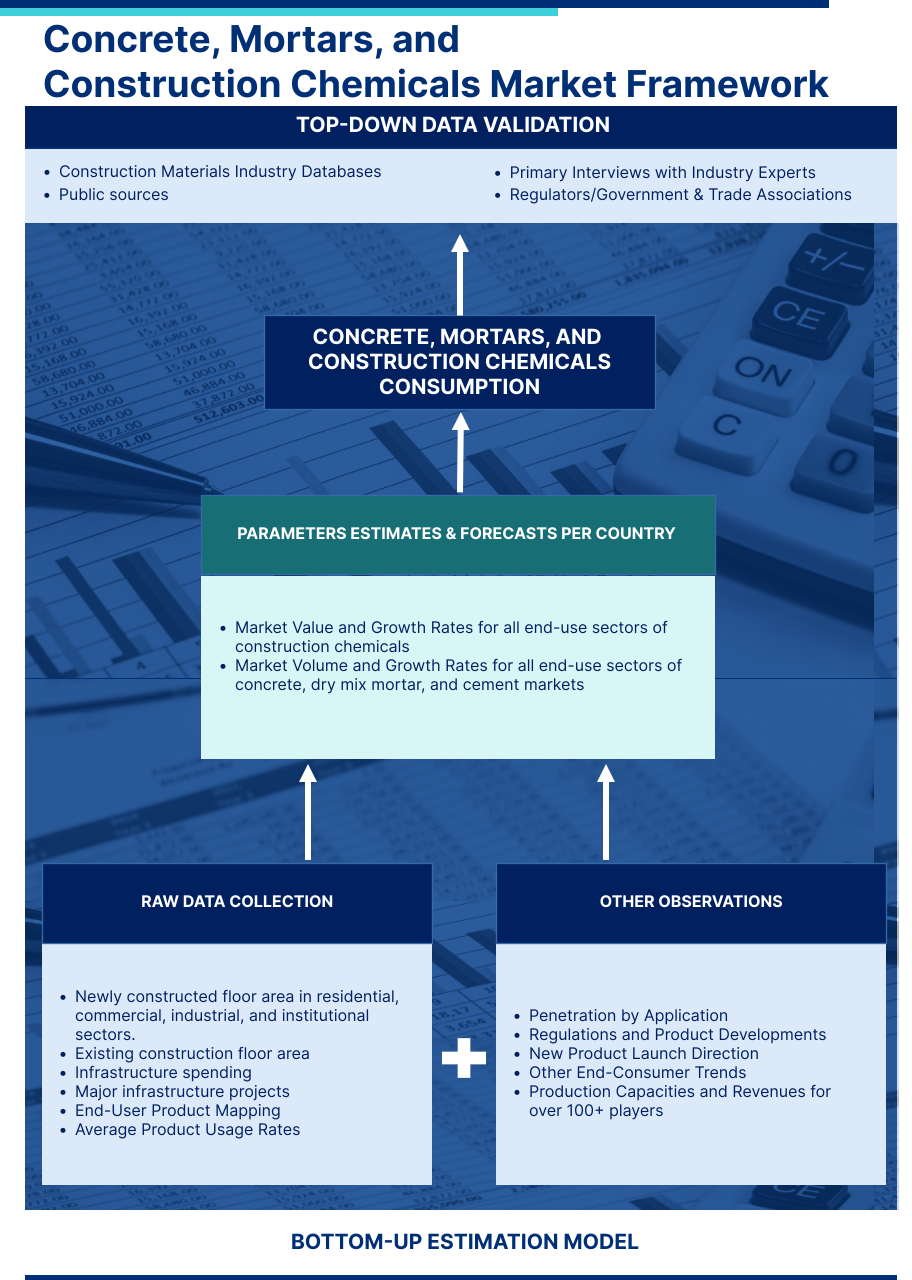
Research Methodology
Mordor Intelligence follows a four-step methodology in all our reports.
- Step-1: Identify Key Variables: The quantifiable key variables (industry and extraneous) pertaining to the specific product segment and country are selected from a group of relevant variables & factors based on desk research & literature review; along with primary expert inputs. These variables are further confirmed through regression modeling (wherever required).
- Step-2: Build a Market Model: In order to build a robust forecasting methodology, the variables and factors identified in Step-1 are tested against available historical market numbers. Through an iterative process, the variables required for market forecast are set and the model is built on the basis of these variables.
- Step-3: Validate and Finalize: In this important step, all market numbers, variables and analyst calls are validated through an extensive network of primary research experts from the market studied. The respondents are selected across levels and functions to generate a holistic picture of the market studied.
- Step-4: Research Outputs: Syndicated Reports, Custom Consulting Assignments, Databases & Subscription Platforms