
Technology, Media and Telecom
5th MayAccelerating Additive Manufacturing Adoption in India
3 Min Read
Smart Pneumatics Market Segmented by Product Type (Smart Pneumatic Valves, Smart Pneumatic Actuators and Smart Pneumatic Modules), Component, Instrument Type, End-User Industry (Automotive, Oil & Gas and Food & Beverage), Communication Protocol (EtherNet/IP, PROFINET and IO-Link), Distribution Channel and Geography. The Market Forecasts are Provided in Terms of Value (USD).
Market Overview
| Study Period | 2020 - 2031 |
|---|---|
| Market Size (2026) | USD 6.24 Billion |
| Market Size (2031) | USD 8.37 Billion |
| Growth Rate (2026 - 2031) | 6.07 % CAGR |
| Fastest Growing Market | Middle East and Africa |
| Largest Market | Asia Pacific |
| Market Concentration | Medium |
Major Players *Disclaimer: Major Players sorted in no particular order. Image © Mordor Intelligence. Reuse requires attribution under CC BY 4.0. |
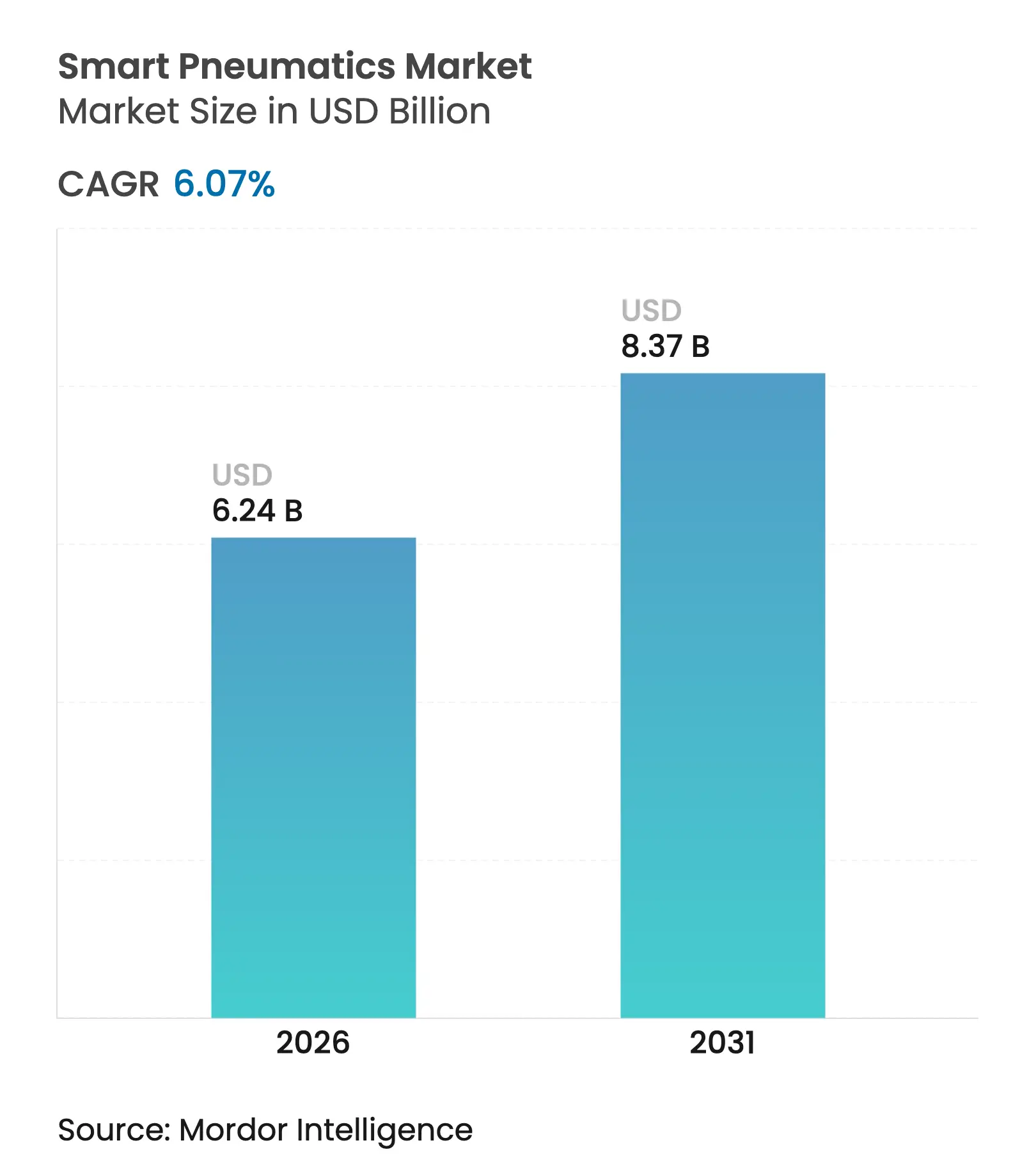

The smart pneumatics market size was valued at USD 5.88 billion in 2025 and estimated to grow from USD 6.24 billion in 2026 to reach USD 8.37 billion by 2031, at a CAGR of 6.07% during the forecast period (2026-2031). Growth is propelled by the fusion of compressed-air power with IIoT connectivity, which allows real-time monitoring, energy optimization, and predictive maintenance within factory environments. Manufacturers are prioritizing pneumatic upgrades that reduce unplanned downtime, cut compressed-air leaks, and integrate seamlessly with MES and cloud analytics. Regional momentum is strongest in Asia-Pacific, where large-scale semiconductor investments and government automation programs are expanding the installed base of connected pneumatic devices. Meanwhile, the Middle East shows rapid uptake in oil-and-gas wellhead applications, where safety-critical valve actuation benefits from live health diagnostics. Competition centers on data stewardship, with leading suppliers adding AI capabilities that convert sensor data into actionable insights.
Key Report Takeaways
Note: Market size and forecast figures in this report are generated using Mordor Intelligence's proprietary estimation framework, updated with the latest available data and insights as of 2026.
Drivers Impact Analysis
| Driver | (~) % Impact on CAGR Forecast | Geographic Relevance | Impact Timeline |
|---|---|---|---|
Predictive-maintenance imperatives in automotive tier-1 plants | +0.6% | Europe, North America, emerging Asia-Pacific | Medium term (2-4 years) |
Integration of IO-Link-ready sensors in pneumatic valves | +0.8% | North America, Europe, Japan, South Korea | Short term (≤ 2 years) |
Accelerated semiconductor capacity build-out in China and Taiwan | +1.2% | Asia-Pacific, spillover North America | Medium term (2-4 years) |
Safety-critical adoption in oil and gas well-heads | +1.1% | Middle East, North America, Russia | Long term (≥ 4 years) |
| Source: Mordor Intelligence | |||
Predictive-maintenance imperatives in automotive tier-1 plants
Automotive tier-1 suppliers are embedding pressure, flow, and temperature sensors into cylinder assemblies to detect wear patterns weeks before failure. European body-in-white lines have documented 20-30% maintenance cost reductions and near-zero unplanned stops by coupling pneumatic sensor streams with machine-learning algorithms that flag anomaly clusters. North American power-train plants replicate the model to protect line takt times, and Asian OEMs are piloting it as local labour shortages intensify. As electrified vehicle programs expand, mixed-model assembly lines rely on fault-prediction accuracy to sustain hourly throughput. Predictive health data from smart pneumatic devices therefore shifts maintenance planning from calendar to condition-based logic, preserving uptime and compressing inventory of critical spares.
Integration of IO-Link-ready sensors in pneumatic valves
IO-Link converts valves from passive air switches into addressable field devices. Emerson field data indicates commissioning time cuts of 40% when valve islands self-identify and auto-populate controller tags. Eight Class A ports on a single master support combinations of flow, pressure, and position sensors placed up to 30 m from PLC cabinets without signal loss. Faster device replacement lowers mean-time-to-repair, while parameter backups prevent manual set-point errors. Japan and South Korea have accelerated adoption in electronics packaging lines that must swap tooling frequently. As factories unify sensor connectivity on IO-Link, pneumatic diagnostics feed edge gateways that push alarm packets to CMMS applications, closing the loop between operations and maintenance.
Accelerated semiconductor capacity build-out in China and Taiwan
Chip shortages stimulated record fab investments, including NT$32.9 billion in Taiwan during 2024. Cleanroom handling stages rely on vacuum-powered end-effectors, while lithography tracks call for nanometre-level table positioning driven by ultra-clean compressed air. Smart pneumatics therefore becomes mandatory to sustain sub-10 nm process nodes, with integrated leak detection that alerts technicians before particulate contamination risks wafer yield. Capacity additions ripple across supporting industries, boosting demand for modular valve terminals, compact regulators, and ISO Class 1 filtration units equipped with cloud dashboards. Spillover purchases in North America, where several foundries are under construction, reinforce global momentum for connected pneumatic hardware in front-end processes.
Safety-critical adoption in oil and gas well-heads
Hydraulic Safety Shutdown Systems paired with smart pneumatic actuators now supervise isolation valves at desert and offshore wellheads. Real-time feedback on actuator torque, stem position, and ambient temperature allows operators to detect seal wear or sand ingress early, mitigating blow-out risk. Middle Eastern producers view digitalized shutdown architecture as a prerequisite for capacity expansions mandated by national diversification agendas. Remote diagnostics reduce field crew travel, cutting exposure to harsh environments. North American shale platforms integrate similar technology to satisfy tighter regulatory audits covering emergency response times and environmental compliance. Long-life components coated for H₂S resistance extend overhaul cycles, aligning with total-cost-of-ownership targets.
Restraints Impact Analysis
| Restraint | (~) % Impact on CAGR Forecast | Geographic Relevance | Impact Timeline |
|---|---|---|---|
Lack of Ethernet-IP interoperability with legacy fieldbus islands | -0.4% | Global, greater effect in plants with aging networks | Medium term (2-4 years) |
High TCO versus electromechanical alternatives in light-duty lines | -0.7% | Global, strongest in cost-sensitive Asia-Pacific and Latin America | Short term (≤ 2 years) |
| Source: Mordor Intelligence | |||
Lack of Ethernet-IP interoperability with legacy fieldbus islands
Brownfield sites often operate PROFIBUS, DeviceNet, or CC-Link islands that cannot natively exchange CIP objects. Adding protocol gateways introduces 5-15 ms latency, which jeopardizes time-critical blow-off sequences in high-speed pick-and-place units. Isolated automation pockets hinder end-to-end data visibility, forcing maintenance teams to juggle multiple diagnostic tools. Multi-protocol nodes and Time-Sensitive Networking promise relief, yet widespread deployment awaits capital-budget cycles. Until then, system integrators must design hybrids that compromise on either speed or cost, slowing refresh projects that would otherwise expand the smart pneumatics market.
High TCO versus electromechanical alternatives in light-duty lines
Compressed-air leakage can consume 20-30% of a plant’s electricity, eroding apparent hardware savings from pneumatic cylinders. Intermittent carton-forming lines illustrate the dilemma: air pressure is maintained during idle times, while comparable electric actuators draw power only on motion. Smart regulators and auto-shut valves reduce losses but added sensor cost raises payback thresholds. Smaller factories in Southeast Asia and parts of Latin America therefore pivot to low-cost stepper actuators for simple pick operations. Skills shortages compound the issue, as fewer technicians can tune pressure profiles or diagnose valve-island faults. Supplier roadmaps now focus on air-management apps that quantify leakage in monetary terms, aiming to defend pneumatic technology where force density still tips the balance.
By Product Type: Modules Outpace Traditional Components
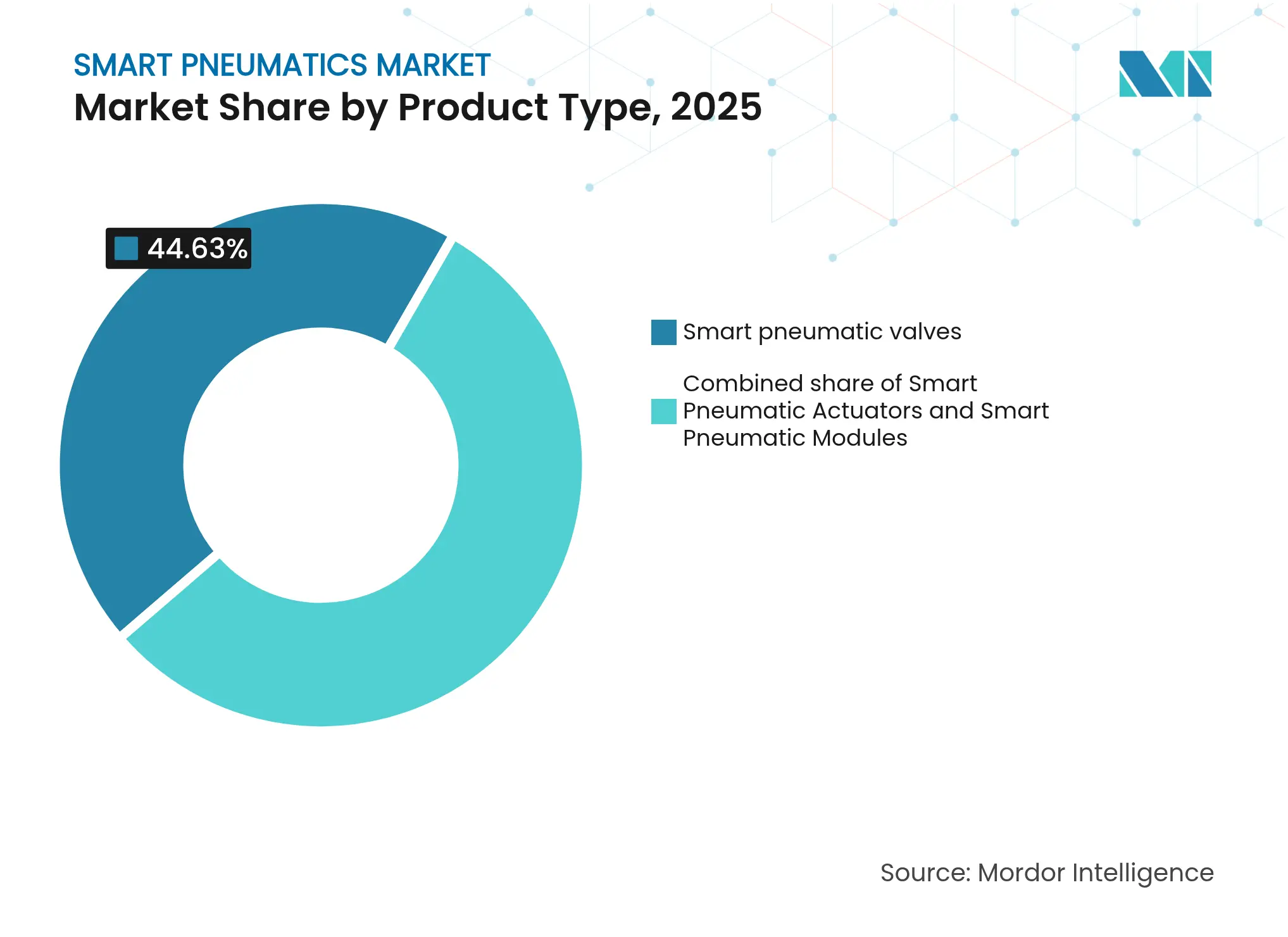
Smart pneumatic valves anchored the smart pneumatics market with 44.63% revenue in 2025, supplying most industries with sensor-rich manifold platforms that broadcast pressure, flow, and cycle counts to PLCs. Valve health metrics inform condition-based overhaul schedules, helping automotive paint shops avoid overspray defects linked to pressure drift. Integration of IO-Link within manifold blocks simplifies expansion, as eight-way masters accept hot-swap cartridges without rewiring. Add-on analytics calculate leakage per valve, highlighting energy losses invisible in legacy systems. Semiconductor fabs adopt stainless-steel variants that comply with cleanroom particulate standards, reinforcing demand continuity.
Smart pneumatic modules are accelerating at an 8.36% CAGR through 2031, outpacing single-function components by bundling valve control, pressure regulation, and edge computing in one enclosure. Festo’s Motion Terminal runs downloadable apps that switch a module from on/off control to proportional regulation or vacuum generation in minutes. Such flexibility lowers SKU counts and speeds product changeovers in fast-moving consumer-goods plants. Modules also embed energy-savings algorithms that auto-reduce stand-by pressure, supporting factory-wide decarbonization goals. Their expanding role in system-level orchestration positions them as pivotal contributors to the smart pneumatics market, particularly in greenfield lines designed for plug-and-play scalability.
Note: Segment shares of all individual segments available upon report purchase
By Component: Services Drive Long-term Value Creation
Hardware accounted for 59.4% of 2025 revenue, reflecting the replacement cycle of valves, cylinders, regulators, and manifolds that populate factory floors. New-generation cylinders incorporate magnetic encoders delivering 0.1 mm resolution positional feedback, enabling coordinated multi-axis moves in packaging cells. Miniaturized flow sensors fit into regulator bodies, capturing consumption data down to the litre. Vendors increasingly ship hardware with secure boot firmware to guard against unauthorized code injection, aligning with OT cybersecurity frameworks.
Services represent the fastest-growing component at a 9.86% CAGR from 2026-2031. Cloud dashboards aggregate valve-island KPIs, rank them by anomaly risk, and generate automatic work orders in CMMS platforms. Energy-audit services use the data to assign cost values to leaks, convincing finance departments to fund air-line retrofits. Remote-assist subscriptions let vendor specialists access device logs, guiding plant technicians through corrective actions and reducing travel. Over time, this data-driven service layer converts transactional product sales into recurring revenue, an approach echoed by similar transitions in the smart pneumatics industry.
By End-user Industry: Semiconductor Sector Accelerates Adoption
Automotive lines retained 27.55% of 2025 revenue, driven by spot-welding clamps, panel handling, and door-assembly stations that combine high force density with contamination-free actuation. Predictive sensors inside impact cylinders detect piston seal wear, allowing tier-1 suppliers to align maintenance windows with takt breaks. Smart blow-off nozzles in paint booths balance airflow to enhance coating quality and minimize overspray rework, reinforcing the technology’s enterprise-wide value.
The semiconductor and electronics segment are projected to grow at a 8.91% CAGR, propelled by wafer-fab buildouts stimulated by the CHIPS Act. Cleanroom robots use miniature bellows cylinders to pick fragile 300 mm wafers, relying on ultra-clean compressed air supplied by ISO 8573-1 Class 0 filter sets with onboard differential-pressure sensors. Vacuum generators inside test handlers adjust suction force based on live leak measurements, safeguarding delicate dies. As advanced packaging demands micron-level accuracy, process engineers prioritize actuators that combine sub-micron resolution with feedback loops tied into fabs’ APC (advanced process control) frameworks, cementing the segment’s strategic importance within the smart pneumatics market.

Recognized by Experts. Trusted by Leaders.
A trusted intelligence partner to global decision-makers across 90+ countries.







By Communication Protocol: EtherNet/IP Leads Network Connectivity
EtherNet/IP dominates network interfaces in North American plants, leveraging standard Ethernet wiring and CIP objects that merge control and diagnostic data. Pneumatic valve blocks expose cycle counters, temperature, and idle time to MES dashboards, unifying OT and IT views. Engineering teams appreciate the ability to tunnel configuration packets without halting real-time traffic, easing firmware updates across hundreds of nodes. Device profiles streamline tag structures, so PLC programs can swap manufacturers without ladder logic rewrites, increasing vendor flexibility at project bid stage.
PROFINET is making inroads in Europe, where deterministic class C operation achieves 250 µs update times for multi-axis pick-and-place units that coordinate pneumatic grippers with servo drives. Comparative benchmarks show 30-50% faster synchronization during high-speed cartooning, critical for maximizing OEE in bulk beverage lines. Multi-protocol valve terminals now ship with auto-detect firmware that boots into either protocol, mitigating the long-standing divide and widening global deployment opportunities. Emerging TSN profiles promise sub-100 µs latency while preserving standard Ethernet-based wiring, a change likely to surface in new product generations beyond 2026.
By Distribution Channel: System Integrators Add Implementation Value
Direct sales remain essential for complex installations, particularly in semiconductor fabs and aerospace assembly, where cleanroom standards, force calculations, and redundancy assessments demand deep application know-how. OEM specialists visit sites to validate compressed-air quality, recommend energy-saving designs, and certify network architectures against cybersecurity guidelines. Field data from these visits' feeds RandD roadmaps, fostering faster iteration loops in a technology landscape that evolves annually.
System integrators increasingly shape project outcomes, bundling pneumatic modules with robots, vision, and MES connectors into turnkey cells for SMEs. Certified training programs by Parker, Emerson, and Festo equip integrators to size air-supply stations, configure IO-Link masters, and map OPC UA tags into SCADA suites. As factories pursue lights-out operations, integrators deliver unified dashboards that merge pneumatic KPIs with servo and PLC metrics. This channel therefore amplifies the reach of all suppliers, accelerating penetration of smart pneumatics market solutions into segments that lack in-house automation teams.
Note: Segment shares of all individual segments available upon report purchase
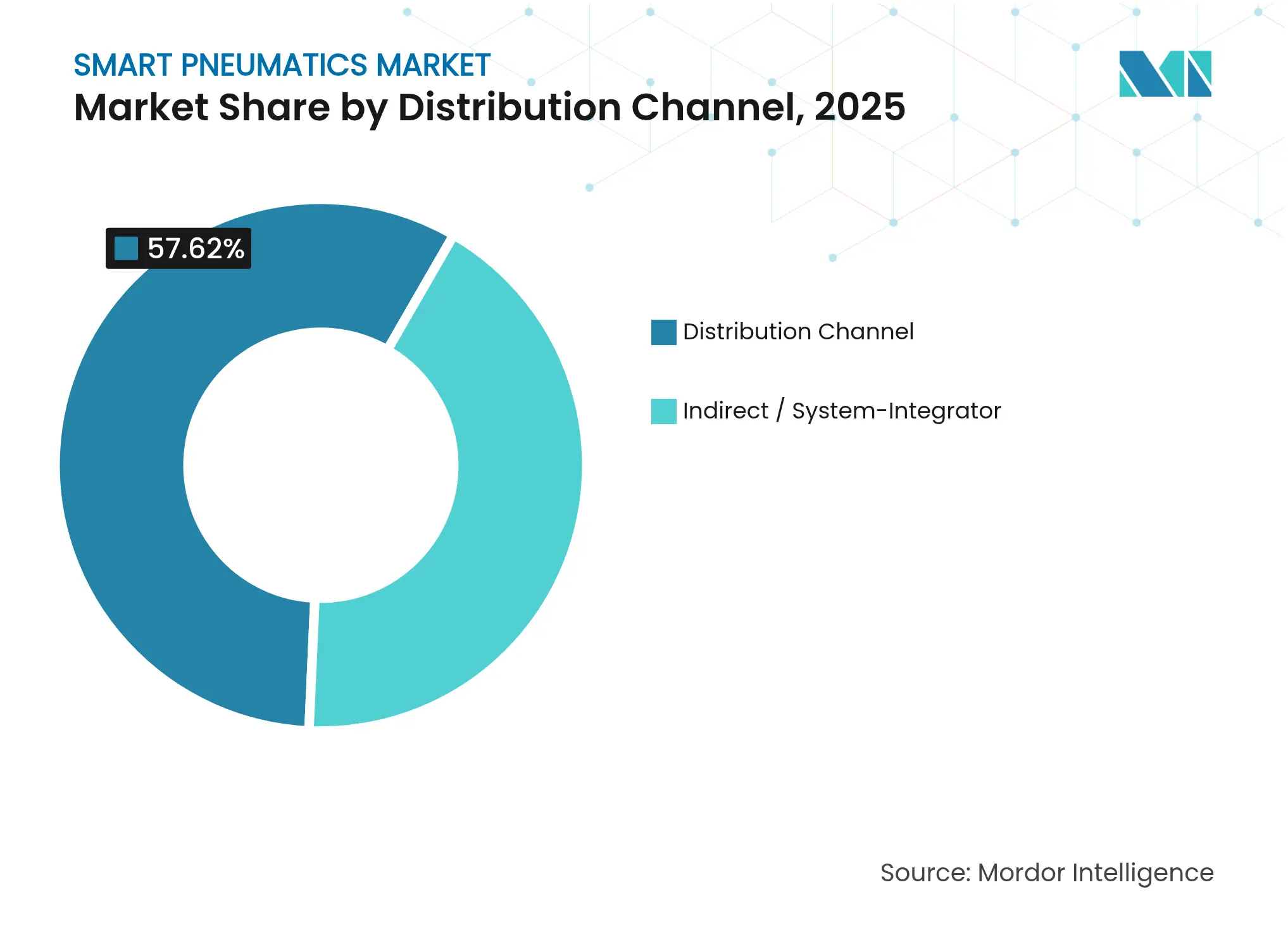
Asia-Pacific held 37.74% revenue in 2025, supported by China’s automation drive under “Made in China 2025” and Taiwan’s NT$32.9 billion semiconductor investments. High-density factory clusters adopt valve manifolds with built-in analytics that flag compressed-air leaks before they inflate utility bills. Japanese automotive plants roll out IO-Link enabled cylinders across stamping presses, cutting changeover times during multi-model shifts. Local vendors such as Ningbo Smart Pneumatic supply cost-optimized modules tailored to regional SMEs, intensifying competition and stimulating rapid price-performance improvements that strengthen regional dominance.
North America represents a mature yet innovation-focused buyer base. Automotive OEMs connect valve islands to cloud AI engines that predict line stoppages 30 days in advance, reducing downtime penalties. The CHIPS Act incentivizes new fabs in Arizona, Texas, and Ohio, each specifying ISO Class 1 clean-compressed-air networks with live dew-point alarms. Energy-reduction mandates push plants to adopt air-management systems capable of shutting off feed lines during idle periods, reflecting a broader push toward sustainability in the smart pneumatics market.
The Middle East is expected to grow at 7.38% CAGR through 2031. National oil companies retrofit wellheads with PLC-based safety shutdown units integrating dual-redundant pneumatic actuators that broadcast stem-movement profiles to central control rooms. The harsh climate drives demand for corrosion-resistant alloys, extended-temperature seals, and self-diagnosing valve blocks that anticipate sand ingress. Beyond oil and gas, Gulf states invest in food and pharmaceutical plants to diversify economies, adopting modular pneumatics that fit isolated facilities with limited local engineering support. This emerging demand widens the geographic footprint of smart pneumatics market suppliers.
Market Concentration

Global suppliers such as Emerson, Festo, Parker Hannifin, and SMC collectively control a substantial portion of revenue, leveraging broad catalogues that span actuators, valves, regulators, and analytical software. Emerson’s USD 621 million acquisition of Aventics expanded its range to include IO-Link valve terminals, while Festo’s Motion Terminal added app-based configurability that rivals software-defined drives. Parker’s USD 150 million Shanghai plant enhances Asian delivery speed, shortening project lead times and strengthening local after-sales support. SMC’s AMS 2.0 platform reduces compressed-air use by up to 40%, aligning with sustainability KPIs in Fortune 500 factories.
Specialists such as Cypress EnviroSystems deploy retrofit sensors that clamp onto legacy cylinders, injecting brownfield assets into cloud dashboards without dismantling air lines. Burkert’s cable plug turns ordinary solenoid valves into data sources, enabling incremental upgrades in cash-constrained plants. Digital newcomers emphasize API-centric architectures that expose pneumatic data to MES, ERP, and energy portals, challenging incumbents to accelerate firmware openness.
Competition now hinges more on software and analytics than on peak cylinder force or flow rates. Vendors that demonstrate closed-loop energy savings, predictive maintenance accuracy, and cybersecurity resilience are winning multi-plant rollouts. White-space opportunities include protocol-agnostic gateways, AI-driven leak diagnostics, and fully integrated pneumatic-electric hybrid actuators that aim to balance TCO with force density. The competitive tempo is likely to intensify as factories pursue net-zero targets and demand quantifiable ROI from every compressed-air system upgrade.

*Disclaimer: Major Players sorted in no particular order
1. INTRODUCTION
2. RESEARCH METHODOLOGY
3. EXECUTIVE SUMMARY
4. MARKET LANDSCAPE
5. MARKET SIZE AND GROWTH FORECASTS (VALUE)
6. COMPETITIVE LANDSCAPE
7. MARKET OPPORTUNITIES AND FUTURE OUTLOOK
With sensory data flowing in both directions, old pneumatic processes are being renovated into smart pneumatic systems, with data communicated to higher-level controllers and distributed to local networks through pneumatic components such as smart actuators, smart valves. This integration incorporates in various end-users such as manufacturing, industrial, etc.
| Smart Pneumatic Actuators | Smart Pneumatic Modules | |
| By Component | Hardware | |
| Software | ||
| Services | ||
| By Instrument Type | Cylinders | |
| Transducers | ||
| Switches | ||
| By End-user Industry | Automotive | |
| Oil and Gas | ||
| Food and Beverage | ||
| By Communication Protocol | EtherNet/IP | |
| PROFINET | ||
| IO-Link | ||
| By Distribution Channel | Direct Sales | |
| Indirect / System-Integrator | ||
| By Geography | North America | United States |
| Canada | ||
| Mexico | ||
| Europe | United Kingdom | |
| Germany | ||
| France | ||
| Italy | ||
| Rest of Europe | ||
| Asia-Pacific | China | |
| Japan | ||
| India | ||
| South Korea | ||
| Rest of Asia | ||
| Middle East | Israel | |
| Saudi Arabia | ||
| United Arab Emirates | ||
| Turkey | ||
| Rest of Middle East | ||
| Africa | South Africa | |
| Egypt | ||
| Rest of Africa | ||
| South America | Brazil | |
| Argentina | ||
| Rest of South America | ||
Accelerating Additive Manufacturing Adoption in India
3 Min Read
Pricing Strategy for Semiconductor Components
3 Min Read
When decisions matter, industry leaders turn to our analysts. Let’s talk.

