
Smart Pills Boxes And Bottles Market Size and Share
Market Overview
| Study Period | 2020 - 2031 |
|---|---|
| Market Size (2026) | USD 217.25 Million |
| Market Size (2031) | USD 350.15 Million |
| Growth Rate (2026 - 2031) | 10.02 % |
| Fastest Growing Market | Asia Pacific |
| Largest Market | North America |
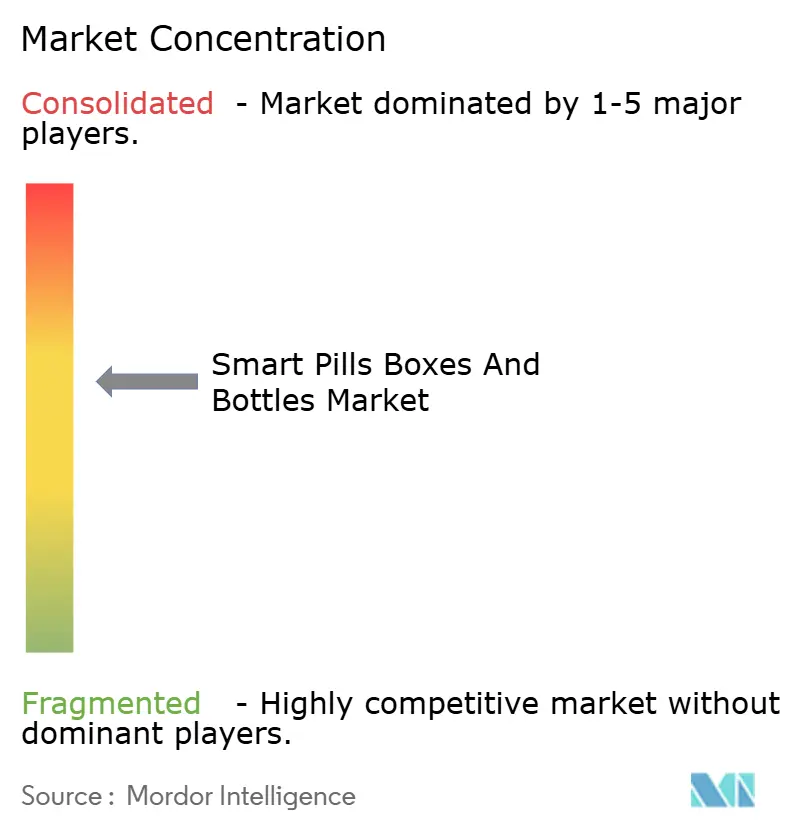
| Market Concentration | Medium |
Major Players *Disclaimer: Major Players sorted in no particular order Image © Mordor Intelligence. Reuse requires attribution under CC BY 4.0. | |
Smart Pills Boxes And Bottles Market Analysis by Mordor Intelligence
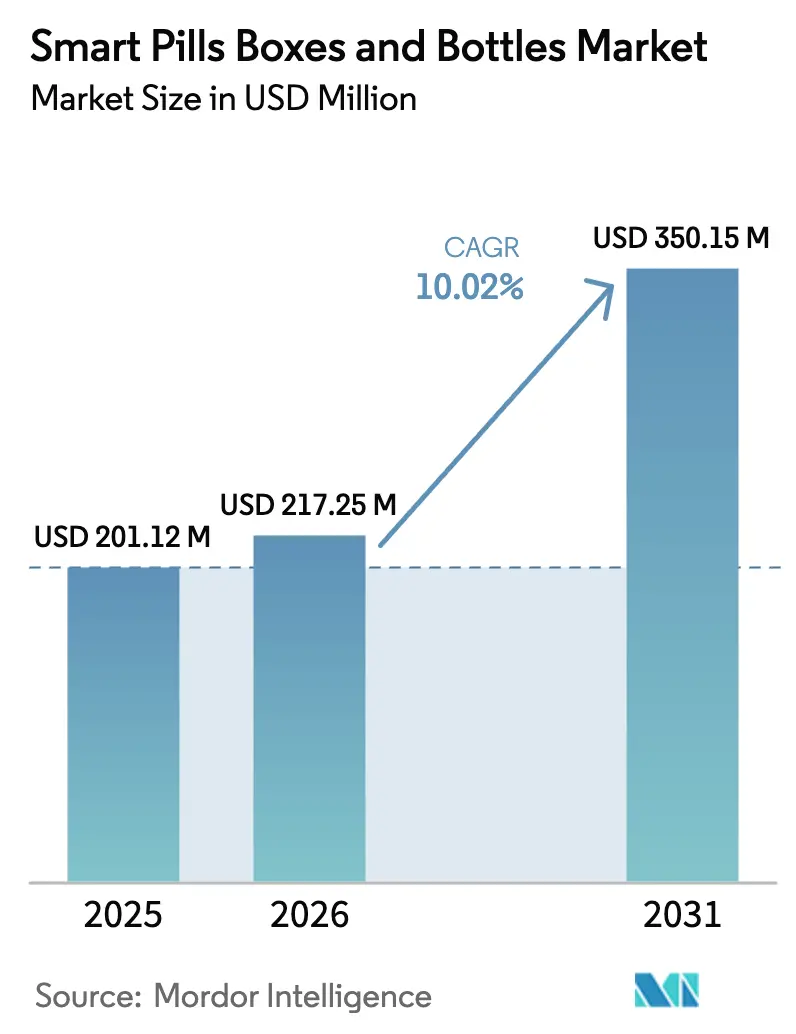
The Smart Pills Boxes And Bottles Market size is expected to grow from USD 201.12 million in 2025 to USD 217.25 million in 2026 and is forecast to reach USD 350.15 million by 2031 at 10.02% CAGR over 2026-2031.
Sustained growth rests on three structural shifts: payers now link reimbursement to real-time adherence data, chronic disease prevalence keeps climbing, and connected packaging lowers the cost of measuring dose-by-dose compliance. Device shipments rose after U.S. Medicare Advantage plans began subsidizing Bluetooth pill boxes, while Germany’s 2025 digital health law added smart dispensers to reimbursable “digital health applications.” Clinical-trial sponsors also accelerated demand, embracing cellular-enabled bottles that verify investigational-drug intake without patient smartphones. Vendors are responding with lower-cost NFC blister packs, predictive analytics that flag likely non-adherence, and battery-saving chips that meet European e-waste rules. Supply-chain fragility has eased since 2025 as new semiconductor fabs have come online; yet, long-term growth still hinges on interoperable data platforms that satisfy GDPR and HIPAA requirements.
Key Report Takeaways
- By product type, connected pill boxes held 44.67% revenue share in 2025; smart blister packs are projected to expand at an 8.26% CAGR through 2031.
- By connectivity, Bluetooth Low-Energy commanded 53.26% of the smart pill boxes and bottles market share in 2025, while cellular and NB-IoT recorded the highest projected CAGR at 7.23% through 2031.
- By end user, home healthcare captured 57.21% of the smart pill boxes and bottles market size in 2025, and clinical-trial sponsors are advancing at an 8.66% CAGR through 2031.
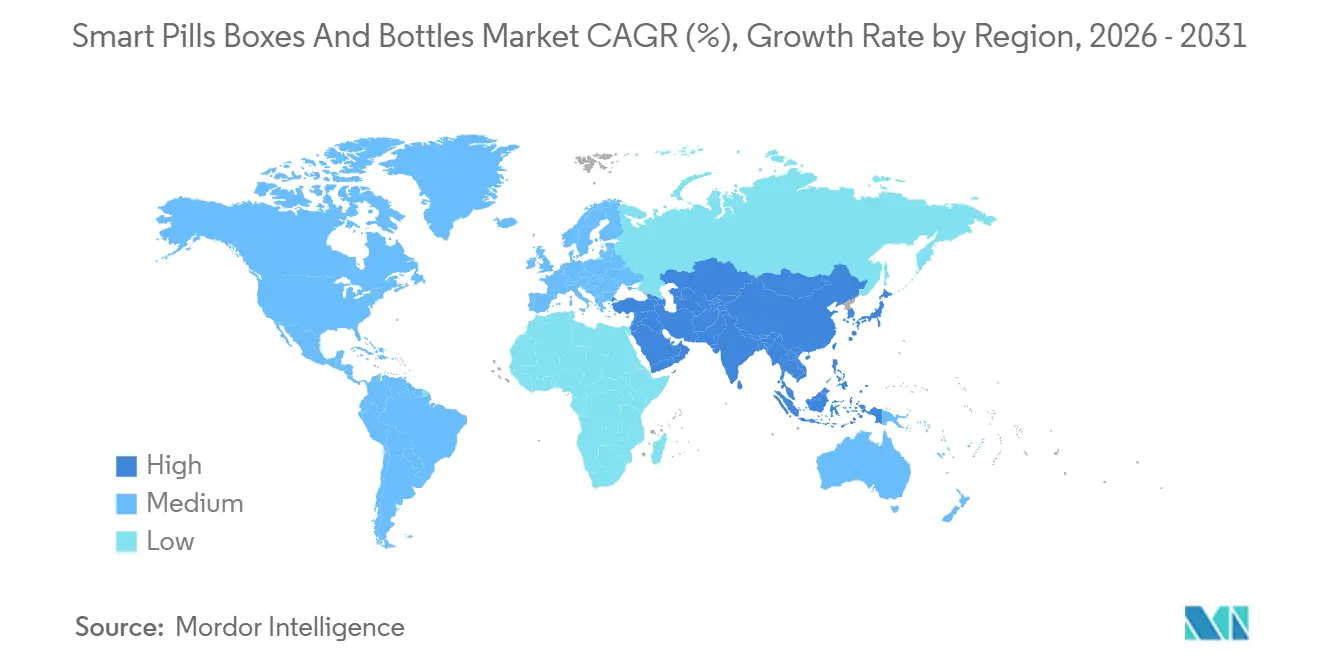
- By geography, North America led with 36.52% revenue share in 2025; Asia-Pacific is set to grow at a 6.34% CAGR to 2031.
Note: Market size and forecast figures in this report are generated using Mordor Intelligence’s proprietary estimation framework, updated with the latest available data and insights as of January 2026.
Market Trends and Insights
Drivers Impact Analysis of Smart Pills Boxes And Bottles Market*
| Driver | (~) % Impact on CAGR Forecast | Geographic Relevance | Impact Timeline |
|---|---|---|---|
| Rapid rise in chronic disease prevalence & poly-pharmacy | +2.1% | Global, with highest intensity in North America, Europe, and high-income Asia-Pacific | Long term (≥ 4 years) |
| Push by payers for medication-adherence linked reimbursements | +1.8% | North America and Western Europe, early pilots in Australia | Medium term (2-4 years) |
| Integration of smart packaging into digital therapeutics ecosystems (DTx) | +1.5% | North America and EU, with regulatory pathways opening in Japan and South Korea | Medium term (2-4 years) |
| Ageing population in high-income Asia driving home-care tech uptake | +1.3% | Japan, South Korea, Singapore, urban China | Long term (≥ 4 years) |
| Smart blister refill programs from e-pharmacies | +1.2% | North America, UK, Germany, emerging in India and Brazil | Short term (≤ 2 years) |
| Emergence of "track-and-trace as a service" for clinical trials | +1.1% | Global, led by United States, EU, and contract research hubs in Eastern Europe and Asia | Medium term (2-4 years) |
| Source: Mordor Intelligence | |||
Rapid Rise in Chronic Disease Prevalence and Poly-Pharmacy
Non-communicable diseases now account for 74% of global deaths, and 40% of adults over 65 in high-income countries take five or more medications daily.[1]World Health Organization, “Noncommunicable Diseases Fact Sheet,” WHO, who.int Each added drug increases missed-dose risk by 12%, a gap that connected pill boxes close through time-stamped reminders reviewed during telehealth visits.[2]European Medicines Agency, “EMA Regulatory Science to 2025 — Strategic Reflection,” EMA, ema.europa.eu U.S. payers spend USD 300 billion annually on avoidable hospitalizations tied to non-adherence, so Medicare Advantage plans subsidize devices for high-risk enrollees. Oncology regimens with narrow therapeutic windows intensify the need for real-time dosing logs. These forces keep the smart pills boxes and bottles market on a durable upward path.
Push by Payers for Medication-Adherence-Linked Reimbursements
The U.S. CMS 2024 rule lets Part D plans count digital adherence endpoints, and some European insurers now offer 5%–10% premium discounts for members who share certified device data. Specialty drugs exceeding USD 50,000 per patient gain higher net revenue when adherence tops 80%, so manufacturers bundle smart bottles to strengthen formulary bids. A Philips pilot showed 87% adherence with connected bottles versus 62% for standard packaging, supporting payer ROI arguments. EMA draft guidance in 2025 allows smart-device data as secondary endpoints in post-marketing studies.[3]Lisa Rosenbaum and William H. Shrank, “Taking Our Medicine — Improving Adherence in the Accountability Era,” New England Journal of Medicine, nejm.org
Integration of Smart Packaging into Digital Therapeutics Ecosystems
FDA cleared 37 software-based therapeutics in 2024, many requiring hardware proof of medication use. Germany’s BfArM reimbursed 12 digital health apps in 2025, four bundled with pill dispensers. Novartis and Roche each partnered with connected-device vendors for oral oncology portfolios, indicating that smart packaging is becoming mandatory within broader digital-health offerings.
Ageing Population in High-Income Asia Driving Home-Care Tech Uptake
Japan subsidizes smart dispensers for residents over 75, affecting 8 million potential users. South Korea earmarked KRW 140 billion to deploy connected health devices in 500,000 households by 2027. China’s provincial insurers reimburse pill boxes for chronic-care patients, while Singapore pilots cut medication-related emergency visits by 34%. These programs aim to avert costly hospitalizations and will intensify demand as the 75-plus cohort expands 40% between 2025 and 2035.
Restraints Impact Analysis of Smart Pills Boxes And Bottles Market*
| Restraint | (~) % Impact on CAGR Forecast | Geographic Relevance | Impact Timeline |
|---|---|---|---|
| Data-privacy compliance costs (GDPR/HIPAA) | -0.9% | EU and North America, with spillover to countries adopting similar frameworks | Medium term (2-4 years) |
| Low margins in retail pharmacy channel | -0.7% | Global, most acute in North America and Western Europe | Short term (≤ 2 years) |
| Battery-life and electronic waste concerns | -0.6% | Global, with regulatory scrutiny highest in EU under WEEE Directive | Long term (≥ 4 years) |
| IC shortages delaying IoT component supply | -0.5% | Global, with most severe impact in 2024-2025, easing by 2027 | Short term (≤ 2 years) |
| Source: Mordor Intelligence | |||
Data-Privacy Compliance Costs Under GDPR and HIPAA
Digital-health companies spend about USD 520,000 a year on audits, data-protection officers, and breach insurance, a fixed cost that weighs on startups. EU regulators issued EUR 1.2 billion in fines across health tech during 2025. Vendors must maintain parallel systems for FDA’s MyStudies and Europe’s Health Data Space, slowing multi-region roll-outs.
Low Margins in the Retail Pharmacy Channel
Independent U.S. pharmacies earn 2%–4% net profit, so they would need to charge USD 40–60 per device to break even, exceeding typical willingness to pay. Chain pilots remain confined to high-value chronic patients, under 5% of prescription volume. Germany allows EUR 15 monthly billing for digital adherence counseling, but payer uptake is slow, limiting channel growth.
*Our forecasts treat driver/restraint impacts as directional, not additive. The impact forecasts reflect baseline growth, mix effects, and variable interactions.
Smart Pills Boxes And Bottles Market Segment Analysis
By Product Type:
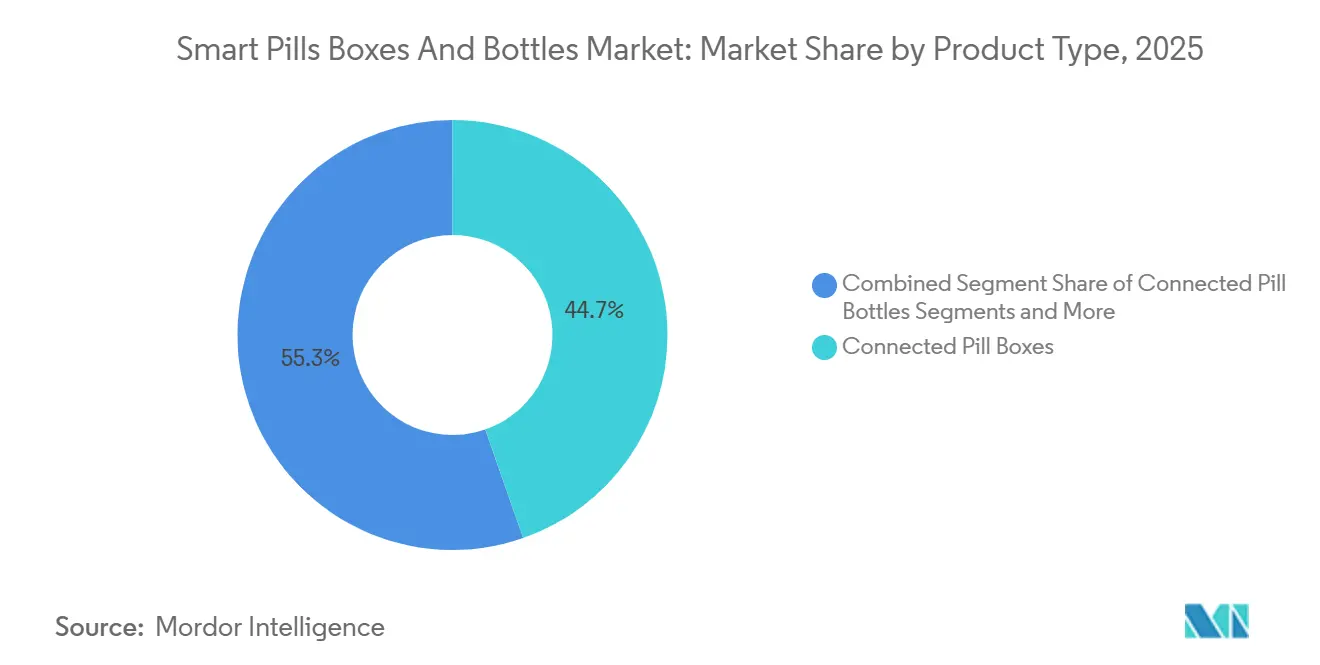
Blister Packs Accelerate on E-Pharmacy MomentumConnected pill boxes generated 44.67% of 2025 revenue, yet smart blister packs are projected to grow at an 8.26% CAGR as e-pharmacy subscriptions scale. Pre-filled packs with embedded NFC tags reduce patient effort and enable pharmacies to trigger auto-refills five days before depletion. Smart blister pricing of EUR 3–5 per unit undercuts the USD 40–80 reusable pill box, enabling payer-subsidized roll-outs. Automatic dispensers serve long-term care facilities with carousel rotation that prevents double-dosing. In 2024, FDA draft guidance proposed a new “medication adherence system” classification, which is likely to shorten 510(k) timelines and favor integrated blister solutions. Europe’s MDR now requires outcome evidence, so vendors with real-world adherence data gain a head start. The smart pills boxes and bottles market will therefore shift toward disposable, pre-filled formats as e-pharmacies expand.



By Connectivity Technology:
Cellular Gains Ground in Decentralized TrialsBluetooth Low-Energy held a 53.26% share in 2025 thanks to low power draw and native smartphone pairing, but its reliance on patient devices leaves data gaps. Cellular and NB-IoT modules, forecast to grow at 7.23% annually, transmit dose logs directly to the cloud and satisfy trial sponsors that need uninterrupted data. GSMA reported NB-IoT modules fell below USD 5 in 2025, tipping cost-benefit calculus toward embedded SIM designs. Wi-Fi dispensers cover home-care agencies that install broadband hubs, while NFC blister packs deliver the lowest tag cost but require active patient scanning. FDA decentralized-trial guidance endorses cellular devices as a preferred real-time capture method, so connectivity mix will bifurcate: BLE remains dominant in consumer retail, while cellular wins institutional deployments.
By End User:
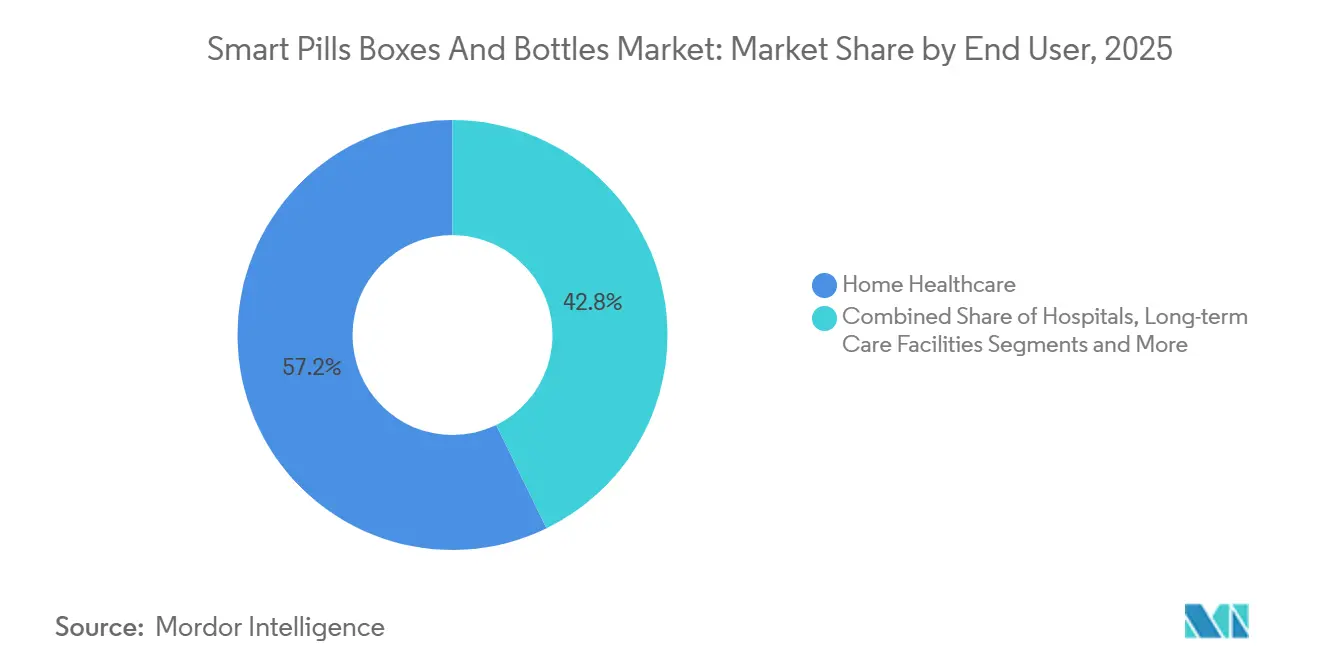
Clinical Trial Sponsors Drive Fastest AdoptionHome healthcare accounts for 57.21% of demand, as agencies seek higher Medicare scores and reduced caregiver burden. Hospitals deploy devices in discharge kits to curb readmissions during the vulnerable transition period. Long-term care facilities rely on automatic dispensers for regulatory compliance. Clinical-trial sponsors, though smaller in volume, are projected to grow at an 8.66% CAGR, fueled by remote studies that need objective adherence logs. NIH data shows 34% of 2025 trials include remote monitoring, and connected devices lift evaluable-patient rates to 91%. Sponsors expense per-patient fees as trial costs, so adoption is less price-sensitive than in consumer channels.
By Distribution Channel:
Online Pharmacies Reshape Fulfillment ModelsRetail pharmacies held 39.63% share in 2025 but face margin pressure and unclear reimbursement. Online pharmacies are projected to grow at 7.89% annually by bundling smart blister subscriptions at USD 15 per month, boosting retention and lifetime value. Hospital pharmacies focus on discharge and specialty-drug programs, while direct-to-consumer subscriptions attract tech-savvy patients willing to pay for convenience. DEA policy now permits Schedule II drugs in tamper-evident connected packs, expanding prescription scope by roughly 15%. Europe considers a unified e-pharmacy framework, which could unlock cross-border scale.
Geography Analysis
North America Smart Pills Boxes and Bottles Market
North America captured 36.52% of 2025 revenue, propelled by Medicare subsidies and FDA’s clear 510(k) pathway. Roughly 4.2 million Medicare Advantage members used connected devices by mid-2025. Canada’s Ontario pilot hints at broader provincial adoption, while Mexican private insurers begin offering smart boxes as differentiators. High smartphone penetration and mature e-pharmacy infrastructure further accelerate growth.
APAC Smart Pills Boxes and Bottles Market
Asia-Pacific is forecast to grow at a 6.34% CAGR, the strongest regional rate. Japan subsidizes devices for patients managing five or more medications, South Korea’s Silver Tech program deploys 500,000 units by 2027, and China’s provincial schemes reimburse pill boxes for chronic conditions. Australia’s Pharmaceutical Benefits Scheme covers up to AUD 100 per patient annually for digital adherence support, stimulating general-practitioner uptake. India and Southeast Asia remain nascent but show traction in urban private hospitals.
EMEA and South America Smart Pills Boxes and Bottles Market
Germany’s statutory insurers reimburse devices for chronic patients who meet adherence thresholds, France approved three connected devices for oncology and anticoagulation, and the UK cut medication-related admissions by 19% during NHS pilots. Southern and Eastern Europe lag, but Catalonia’s diabetic pilot signals momentum. Middle East, Africa, and South America together account for under 10% of revenue, with Brazil and South Africa leading regional pilots.

Regulatory Landscape
In the United States, smart pill boxes, connected bottles, and automated dispensers typically fall under FDA device rules for medication management systems, with Class II pathways for higher-risk medication management functions (21 CFR 880.6315) that require 510(k) clearance. Certain medication reminders and solid medication dispensers are categorized under 21 CFR 890.5050 (including product codes such as NXQ and NXB) and are generally exempt from premarket notification, though establishment registration and general controls still apply. This split shapes how vendors frame claims (reminder versus medication management), structure documentation, and build quality systems, particularly when devices are used in clinical programs that need auditable adherence records.
Across major regions, market access also depends heavily on data governance. Adherence logs are treated as health data and must fit HIPAA and GDPR operating models. The report scope also intersects with electronic waste compliance for battery-powered connected packaging, which encourages suppliers to prioritize lower-power connectivity and serviceable battery designs to reduce lifecycle risk in regulated healthcare deployments.
Value Chain Analysis
The value chain starts with electronics and sensing components, including BLE, cellular/NB-IoT modules, NFC tags, and batteries. Plastics and packaging suppliers feed contract manufacturers that assemble pill boxes, bottles, dispensers, and smart blister formats. Upstream design choices track regulatory classification and connectivity cost curves, and they drive downstream service needs such as device provisioning, calibration, and cybersecurity hardening for healthcare settings.
In the midstream layer, vendors provide firmware, companion apps, cloud analytics, and integration tooling that connect adherence events to pharmacy systems and, increasingly, to provider workflows and EHR environments. Downstream value is captured through distribution partners and care-delivery channels, including retail and online pharmacies, hospital discharge programs, long-term care pharmacies, and clinical trial sponsors. Revenue is often recurring, centered on monitoring subscriptions, patient support services, and data interfaces that help payers, providers, and sponsors operationalize adherence metrics at scale.
Competitive Landscape
The smart pills boxes and bottles market is moderately fragmented. BD and Philips leverage global hospital relationships and regulatory expertise, while Hero Health, AdhereTech, and Pillsy compete on user experience and subscription models. Baxter integrates connected bottles into its DoseEdge workflow, extending adherence tracking from inpatient to outpatient settings. Philips patented a multi-device aggregation platform in 2024, aiming to satisfy payer demand for unified dashboards. CRO partnerships allow smaller firms to bundle hardware and analytics for decentralized trials. Predictive analytics that forecast non-adherence before it happens now differentiate top vendors, since large datasets and AI talent raise entry barriers.
Smart Pills Boxes And Bottles Industry Leaders
Koninklijke Philips N.V.
MedMinder Systems
AdhereTech Inc.
Spencer Health Solutions
Hero Health Inc.
- *Disclaimer: Major Players sorted in no particular order
Smart Pills Boxes And Bottles Market Companies Covered in this Report
- AdhereTech Inc.
- Amiko Digital Health
- Baxter’s DoseEdge Pharmacy Workflow
- Beckton Dickinson
- CareOS Health, Inc.
- Dose Health LLC
- E-pill, LLC
- Hero Health Inc.
- iRxReminder LLC
- Koninklijke Philips
- MedAdvisor Ltd.
- Medisafe Ltd.
- MedMinder Systems Inc.
- Omnicell
- Pillsy
- Popit Ltd.
- Shenzhen Kangwei Smart Pharm Tech
- SMRxT, Inc.
- Spencer Health Solutions

Market Opportunities and Future Outlook
One whitespace area is deeper interoperability with clinical workflows, where adherence events extend beyond patient-facing reminders into provider-facing decision support. Efforts like the Philips collaboration with Epic illustrate how connected-device signals can be surfaced inside routine care tools, which creates room for vendors offering validated data streams, configurable alerts, and audit trails that support both clinical documentation and payer reporting.
Institutional channels also offer a near-term expansion route because they can attach devices to services and established medication programs rather than depending on out-of-pocket consumer purchases. The Spencer Health Solutions and PharMerica partnership shows how long-term care pharmacy networks can function as scaled distribution and implementation partners for smart dispensers. In parallel, clinical-trial programs that use connected packaging for objective dosing verification continue to support demand for cellular-enabled devices and the platform analytics used for decentralized monitoring and protocol compliance.
Recent Industry Developments in Smart Pills Boxes And Bottles Market
- February 2026: iZafe Group AB signed a letter of intent with JDM Innovation GmbH to integrate the Dosell medication robot with the Smila dispensing solution into a joint digital platform for the European market. The integration creates an interoperability platform for European smart-dispensing ecosystem. The collaboration establishes a unified platform for European deployments and payer interoperability in smart dispensing.
- September 2025: PillSafe opened a SAFE investment round ahead of its 2026 commercial launch. Funding to accelerate commercialization of secure smart prescription delivery. Supports 2026 market entry and scale of secure dispensing solutions.
- August 2025: Pill Connect entered a strategic partnership with AARDEX Group to integrate Pill Connect's connected capsule dispensers with AARDEX MEMS Mobile app for a Phase 2A clinical trial. Clinical-trial adherence monitoring integration with MEMS platform. Strengthens data-driven adherence in decentralized trials and expands pharma ecosystem partnerships.


Smart Pills Boxes And Bottles Market Report Scope and Research Methodology
Market Definition and Coverage
This market covers connected medication storage and dispensing formats that help users follow dosing schedules, and that can record, remind, and share adherence information through digital connectivity.
Scope exclusions: We exclude standard, non-connected pill organizers and basic packaging that does not have sensing, connectivity, or adherence-tracking features.
Segments Covered in This Report
- By Product Type
- Connected Pill Boxes
- Connected Pill Bottles
- Automatic Pill Dispensers
- Smart Blister Packs
- By Connectivity Technology
- Bluetooth Low-Energy (BLE)
- Wi-Fi
- Cellular / NB-IoT
- Near-Field Communication (NFC)
- By Distribution Channel
- Retail Pharmacies
- Online Pharmacies
- Hospital & Clinic Pharmacies
- Direct-to-Consumer Subscriptions
- By End User
- Home Healthcare
- Hospitals
- Long-term Care Facilities
- Clinical Trial Sponsors
- By Geography
- North America
- United States
- Canada
- Mexico
- Europe
- Germany
- France
- United Kingdom
- Italy
- Spain
- Rest of Europe
- Asia-Pacific
- China
- Japan
- India
- South Korea
- Australia
- Rest of Asia-Pacific
- Middle East & Africa
- GCC
- South Africa
- Rest of Middle East & Africa
- South America
- Brazil
- Argentina
- Rest of South America
- North America
Data Sources, Market Sizing, and Validation
Desk Research
Desk work starts with mapping what counts as a smart pill box or bottle, and where it is used, which keeps the model tied to real adoption. We refer to public healthcare and aging trend data, such as the US CDC, the World Health Organization, United Nations population statistics, and OECD health indicators to understand the size and growth of the medication adherence need.
To ground the technology and regulatory context, we also review sources such as the US FDA device databases and guidance notes, patent databases for connected packaging and adherence devices, and association and standards sites relevant to medical devices and packaging. Company annual reports, investor presentations, earnings call notes, and credible press coverage are then used to frame product launches, geographic expansion, and channel focus. Select paid subscriptions are used only for company financials and news screening, patent lookups, and shipment-level trade checks where applicable. These sources are illustrative, and many other public documents were used for data collection, validation, and clarifying assumptions.
Primary Interviews and Surveys
Primary work focuses on confirming what is actually being purchased and used, and how pricing changes by connectivity, channel, and care setting. We speak with device and packaging stakeholders, pharmacy and distribution participants, and care providers across major regions so the adoption curve and average selling price logic can be checked and then adjusted where needed.
Distribution of primary research fieldwork respondents
| Company type | Respondent position | Region |
|---|---|---|
| Top tier: 30% | CXOs: 16% | APAC: 49% |
| Mid tier: 54% | Functional/Unit leaders: 30% | EMEA: 31% |
| Smaller Players: 16% | Managers: 54% | Americas: 20% |
Market-Sizing & Forecasting
The core model is built using a top-down demand pool that is reconstructed from care-setting adoption and device penetration assumptions for connected pill boxes, connected pill bottles, automatic dispensers, and smart blister packs, and then translated into revenue using average selling prices. Results are corroborated with selective bottom-up approximations, such as sampled ASP-by-feature checks, channel markups, and supplier and distributor roll-ups for a limited set of countries, which are then scaled carefully.
Inputs are kept practical and tied to how the market behaves, including the share of patients on multi-drug regimens, aging population growth, home healthcare uptake, refill frequency patterns that influence replacement cycles, and the mix shift across connectivity types (Bluetooth, Wi-Fi, cellular, NFC) that changes pricing. When coverage gaps exist, for example in smaller countries with limited public shipment or sales signals, we infer values using peer-country adoption and income proxies, and then re-check them with interview feedback.
For forecasting, we rely on scenario analysis supported by short series trend smoothing, because adoption is affected by reimbursement behavior, provider workflows, and device integration speed. The forward view is anchored to expected penetration changes, channel mix (retail pharmacy, online, hospital and clinic pharmacy, and direct subscription), and realistic ASP progression rather than assuming uniform price growth.
Data Validation & Update Cycle
Outputs are checked against independent signals, including regional growth patterns, implied unit volumes from price and revenue splits, and whether the results match known adoption constraints in hospitals, long-term care, and home settings. Any sharp jumps are reviewed, and assumptions are revisited when they do not align with interview feedback or observable launches and procurement activity.
Before sign-off, the work goes through a multi-step review where calculations, conversions, and country rollups are rechecked, followed by a final logic pass on drivers and restraints. Reports are refreshed annually, and interim updates are added when material events occur, such as major regulatory changes, new connectivity requirements, or notable shifts in care delivery. Right before delivery, an analyst performs a fresh pass so clients receive the latest updated view.
Mordor Intelligence's Smart Pills Boxes and Bottles Market Sizing Compared With Other Published Estimates
Published numbers for smart pill boxes and bottles rarely line up because the product boundary is not consistent across sources, and because the same revenue can be counted at different points in the channel. Differences also show up when some studies mix in broader medication management devices or adjacent connected packaging that is not used for pill storage and dispensing.
Shipment and channel signals, plus cross-checks from interviews on replacement cycles and pricing by connectivity, are the evidence that keeps Mordor Intelligence tied to a defined revenue pool that reflects smart pill boxes, smart pill bottles, automatic dispensers, and smart blister packs sold through pharmacy and direct channels.
Benchmark comparison
| Source | Market Size | Gaps in Research Methodology |
|---|---|---|
| Mordor Intelligence | USD 201.12 M (2025) | |
| Industry Publisher A | USD 160.20 M (2023) | Uses an earlier base year and a different time window, and the value can shift when inflation and currency timing are not normalized to a single base year across regions. |
| Industry Publisher B | USD 195.00 M (2025) | Often emphasizes consumer-use settings and may not fully reconcile pharmacy, hospital, and direct subscription channel accounting, which can undercount or double-count parts of the revenue flow. |
The spread in values is mainly explained by what gets included as a smart adherence product, and by how channel revenue is treated across geographies and years. By keeping the scope tight to connected boxes, bottles, dispensers, and smart blister packs, and by validating pricing and adoption assumptions with repeatable checks, the resulting estimate stays easy to trace and to update.


Key Questions Answered in the Report
What is the current value of the smart pills boxes and bottles market?
The market is valued at USD 217.25 million in 2026 and is projected to reach USD 350.15 million by 2031.
Which product type is growing fastest?
Smart blister packs are the fastest-growing product, expanding at an 8.26% CAGR through 2031.
Why are clinical-trial sponsors adopting connected pill bottles?
Cellular-enabled bottles provide real-time adherence data that reduces protocol deviations and strengthens regulatory submissions.
How does Bluetooth compare with cellular connectivity in these devices?
Bluetooth dominates consumer use due to low cost and smartphone pairing, while cellular connectivity wins institutional deployments that need independent cloud uploads.
Which region shows the highest growth potential?
Asia-Pacific leads in growth with a forecast CAGR of 6.34% through 2031, driven by aging populations and government subsidies for home-care technology.
What is the main regulatory hurdle for vendors?
Complying with GDPR and HIPAA data-privacy rules, which together add roughly USD 520,000 in annual compliance costs for dual-region operations.
Page last updated on:





