
Market Overview
| Study Period | 2020 - 2031 |
|---|---|
| Forecast Data Period | 2026 - 2031 |
| Historical Data Period | 2020 - 2024 |
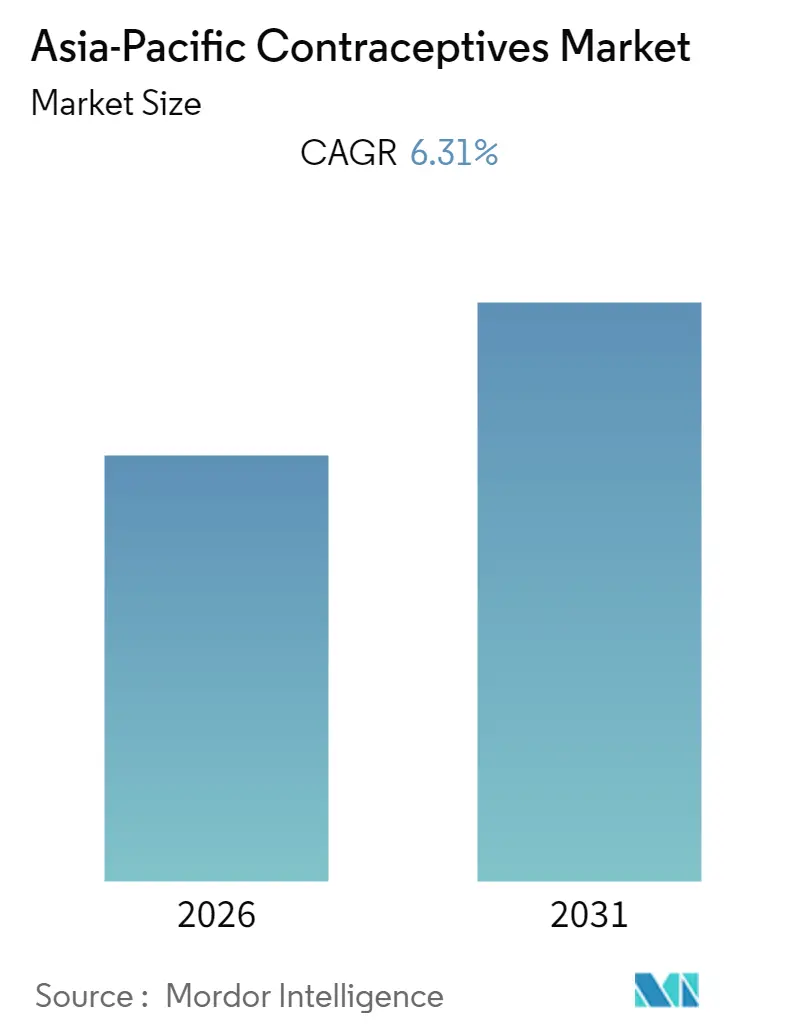
| Growth Rate | 6.31 % |
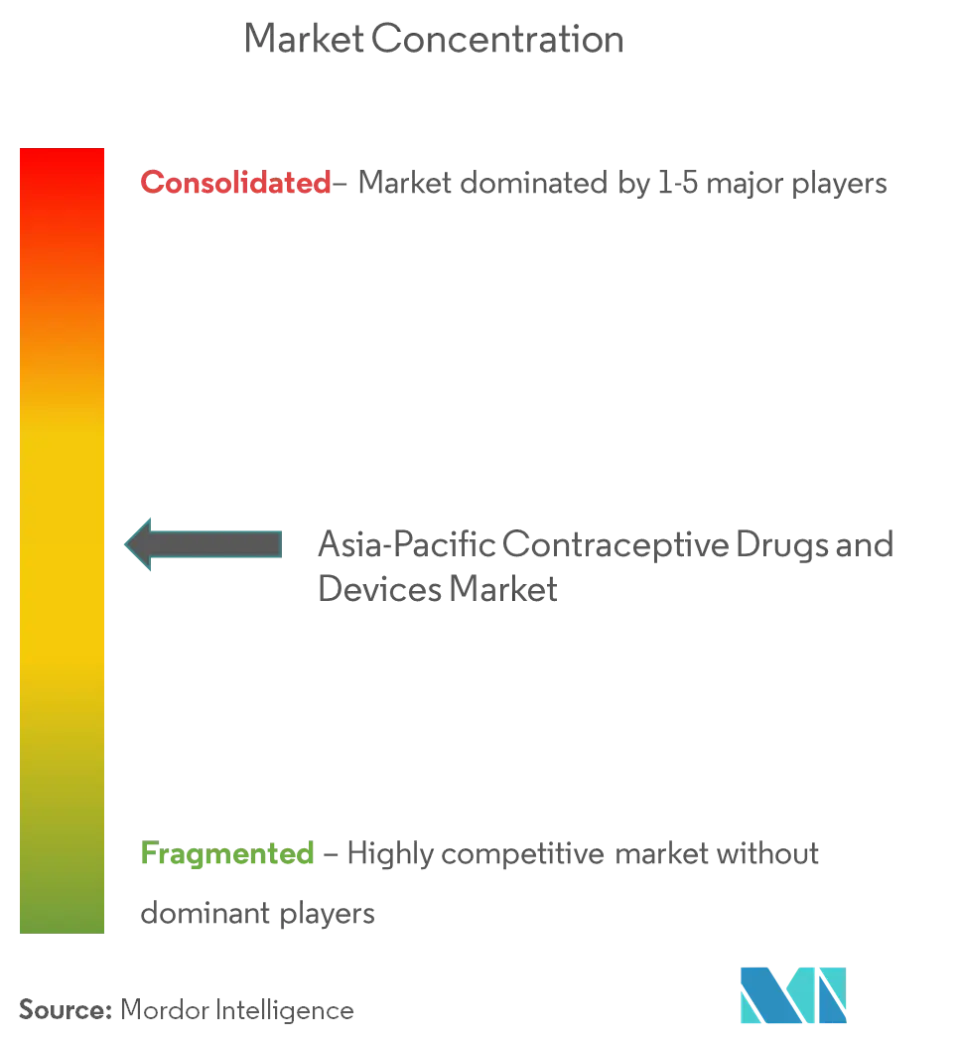
| Market Concentration | Medium |
Major Players *Disclaimer: Major Players sorted in no particular order Image © Mordor Intelligence. Reuse requires attribution under CC BY 4.0. | |
Asia-Pacific Contraceptives Market Trends and Insights
Oral Contraceptive Segment is Expected to Hold the Largest Market Share in the Asia-Pacific Contraceptives Market
Oral contraceptive pills are seen as the easiest method of contraception in the industry. They act by prohibiting implantation within the uterus if taken within 2-3 days of having unsafe sexual contact. The simplicity of their usage makes them an ideal contraceptive in the market. These are easily marketed across the region by companies, and thus, easily consumed by a large section of the population, regionally. These factors are expected to contribute to the growth of the market during the forecast period.
Competitive Landscape
The Asia-Pacific contraceptives market is competitive and consists of several players. In terms of market share, few of the major players are currently dominating the market. Some prominent players are vigorously making acquisitions and joint ventures with the other companies to consolidate their market positions across the region. Some of the companies that are currently dominating the market are Bayer AG, Pfizer Inc., Merck & Co. Inc., CooperSurgical Inc., and Allergan PLC.
Asia-Pacific Contraceptives Industry Leaders
-
Bayer AG
-
Pfizer Inc.
-
Merck & Co., Inc.
-
CooperSurgical, Inc.
-
Allergan PLC
- *Disclaimer: Major Players sorted in no particular order
Market Opportunities and Future Outlook
Procurement and policy changes across Asia-Pacific are creating room for suppliers that can meet institutional tender requirements and local compliance. In January 2026, China removed a long-standing tax exemption and applied a 13% value-added tax to contraceptive drugs and devices, which has shifted pricing dynamics for both domestic manufacturers and importers. In Indonesia, the Ministry of Population and Family Development stated in July 2026 it will seek a higher 2026 budget for contraceptive procurement, citing a sharp drop in the 2025 allocation versus the prior year. This highlights how public programs track funding cycles and points to opportunities for suppliers with flexible delivery and a broader portfolio.
On the supply side, India is building capacity that can support regional demand and export-led growth in condoms and selected hormonal products. Anondita Medicare announced an expansion of about 1,360 million pieces per annum at its Noida facility (with part in trial production) and also secured a South African government condom export order, with execution scheduled through September 2026. Corona Remedies inaugurated and commercialized an EU-GMP approved women’s hormone manufacturing facility near Ahmedabad in June 2026, which suggests a pathway for regional players to move beyond commodity barrier methods into more complex women’s health categories where quality certifications and manufacturing controls matter.
Recent Industry Developments
- July 2026: Bayer expanded access initiatives for long-acting reversible contraception in the Philippines through Project LAYA, centered on competency-based clinical skills training for healthcare providers. The update supports broader service readiness for LARC methods and strengthens public-private collaboration around women’s reproductive health delivery.
- June 2026: Pfizer highlighted continued collaboration to support access to Sayana Press injectable contraception in eligible low- and lower-middle-income countries in its 2025 Impact Report. The sustained supply and partnership model reinforces the role of donor and access programs in shaping demand for injectables alongside traditional retail channels.
- July 2025: Corona Remedies acquired seven brands from Bayer’s pharma division in India, expanding its women’s health and hormone therapy footprint. The transaction reflects portfolio rationalization by multinationals and provides local players with established brands that can be scaled through domestic distribution and manufacturing capabilities.
Research Methodology Framework and Report Scope
Market Definition and Coverage
For this study, the market covers contraceptive drugs and contraceptive devices sold across Asia-Pacific for pregnancy prevention, measured as the value of products consumed through retail and institutional channels.
Scope exclusions: We exclude fertility and ovulation testing kits, prenatal supplements, and abortion drugs and procedures because they do not prevent conception.
Segmentation Overview
- By Product
- By Drugs
- Oral Contraceptives
- Topical Contraceptives
- Contraceptive Injectable
- By Device
- Condoms
- Diaphragms
- Cervical Caps
- Sponges
- Vaginal Rings
- IUD
- Other Devices
- By Drugs
- By Gender
- Male
- Female
- Geography
- Asia-Pacific
- China
- Japan
- India
- Australia
- South korea
- Rest of Asia-Pacific
- Asia-Pacific
Data Sources, Market Sizing, and Validation
Desk Research
Desk research starts with mapping demand signals and policy context, and then aligning them with supply availability and pricing ranges across major Asia-Pacific countries. We rely on public health and demographic sources such as UN Population Division datasets, WHO and UNFPA family planning indicators, national health ministries and statistics offices, and OECD health statistics where available.
To keep sizing practical, we also review country procurement notes and program documents, customs and trade statistics where they help explain device flows, and peer-reviewed clinical and public health journals for method-mix trends. Company annual reports, investor materials, and credible press are used to sanity check product availability and major launches, and we reference a paid subscription for company financials plus a patent database selectively when public detail is limited. These desk research sources are illustrative, and we also used other public documents for cross-checks and clarification.
Primary Interviews and Surveys
Primary work is used to test real-world assumptions that desk sources do not fully settle, especially around method mix shifts, pricing moves, and channel dynamics. We spoke with a mix of manufacturers, distributors, public health stakeholders, and clinical or pharmacy channel experts across key APAC markets, so specific gaps could be closed and assumptions could be stress-tested before finalizing the model.
Distribution of primary research fieldwork respondents
| Company type | Respondent position |
|---|---|
| Top tier: 27% | CXOs: 16% |
| Mid tier: 57% | Functional/Unit leaders: 36% |
| Smaller Players: 16% | Managers: 48% |
Market-Sizing & Forecasting
Sizing is built using both top-down and bottom-up logic so the final number remains explainable and repeatable. On the top-down side, a demand pool is reconstructed by country using women of reproductive age, contraceptive prevalence, method mix, and treatment duration assumptions, then converted into annualized unit needs and value using typical price bands.
Those totals are checked with selective bottom-up approximations, such as sampled ASP x volume for major product groups, distributor channel checks, and a practical roll-up of country-level program and retail signals where available. When a country has sparse data, we use proxy indicators such as urbanization, health spend patterns, and adjacent market penetration, then re-align the output during validation.
For forecasting, scenario analysis is used, supported by a simple multivariate regression for key countries where longer historical series exist. Inputs that matter most include changes in contraceptive prevalence, direction of public program funding, OTC access and reimbursement rules, pricing inflation and currency movement, and adoption trends for long-acting reversible methods versus short-acting options.
Data Validation & Update Cycle
Model outputs are cross-checked against independent signals like demographic series, reported program targets, and directional pricing trends, and then reviewed for outliers at country and product level. If a variance looks material, we re-contact sources to confirm whether it is a real market shift, a timing issue, or a definition mismatch.
Before sign-off, the full workbook is reviewed in steps so calculations, units, and assumptions stay consistent across countries and years. Reports are refreshed annually, and interim adjustments are made when material events occur, such as policy changes, major tenders, or sharp currency swings. Right before delivery, a final freshness check is performed so clients receive the most updated view available.
Mordor Intelligence's Asia Pacific Contraceptives Market Size Versus Other Published Estimates
Published market sizes for contraceptives in Asia-Pacific can vary widely even when they appear to cover the same region. The differences usually come from how each publisher defines what counts as a contraceptive product, which years are treated as the base, and how pricing and currency are handled.
Method choices drive the biggest spread. Some estimates lean more heavily on manufacturer sales, while others rely more on demand-side prevalence signals. By tracking country-level contraceptive prevalence and method mix, then refreshing price bands with channel checks, Mordor Intelligence keeps the estimate tied to a clear consumption pool rather than mixing in adjacent sexual wellness items or using different channel boundaries.
Benchmark comparison
| Source | Market Size | Gaps in Research Methodology |
|---|---|---|
| Mordor Intelligence | USD 10.53 B (2024) | |
| Industry Publisher A | USD 6.57 B (2025) | Uses a different base year and appears to apply narrower country coverage and segment boundaries, which can understate value when key device categories and pricing ranges are treated conservatively. |
| Industry Publisher B | USD 10.53 B (2024) | Similar year value, but the split and growth path differ because the approach is oriented around revenue category splits and a shorter forecast window, with less emphasis on prevalence-led unit conversion checks. |
The comparison indicates that the widest differences usually come from scope and timing, not from arithmetic errors. When the definition stays focused on contraceptive drugs and devices, and the build uses transparent inputs like prevalence, method mix, and practical price bands, the market size is easier to reconcile across countries and to update year over year.
Key Questions Answered in the Report
What is the current Asia-Pacific Contraceptives Market size?
The Asia-Pacific Contraceptives Market is projected to register a CAGR of 6.31% during the forecast period (2026-2031)
Who are the key players in Asia-Pacific Contraceptives Market?
Bayer AG, Pfizer Inc., Merck & Co., Inc., CooperSurgical, Inc. and Allergan PLC are the major companies operating in the Asia-Pacific Contraceptives Market.
What years does this Asia-Pacific Contraceptives Market cover?
The report covers the Asia-Pacific Contraceptives Market historical market size for years: 2019, 2020, 2021, 2022, 2023 and 2024. The report also forecasts the Asia-Pacific Contraceptives Market size for years: 2026, 2027, 2028, 2029, 2030 and 2031.