
Saudi Arabia Roadside Safety Barriers Construction Market Size and Share
Market Overview
| Study Period | 2020 - 2031 |
|---|---|
| Forecast Data Period | 2026 - 2031 |
| Base Year Market Size (2025) | USD 327.62 Million |
| Market Size (2026) | USD 351.24 Million |
| Market Size (2031) | USD 497.51 Million |
| Growth Rate (2026 - 2031) | 7.21 % |
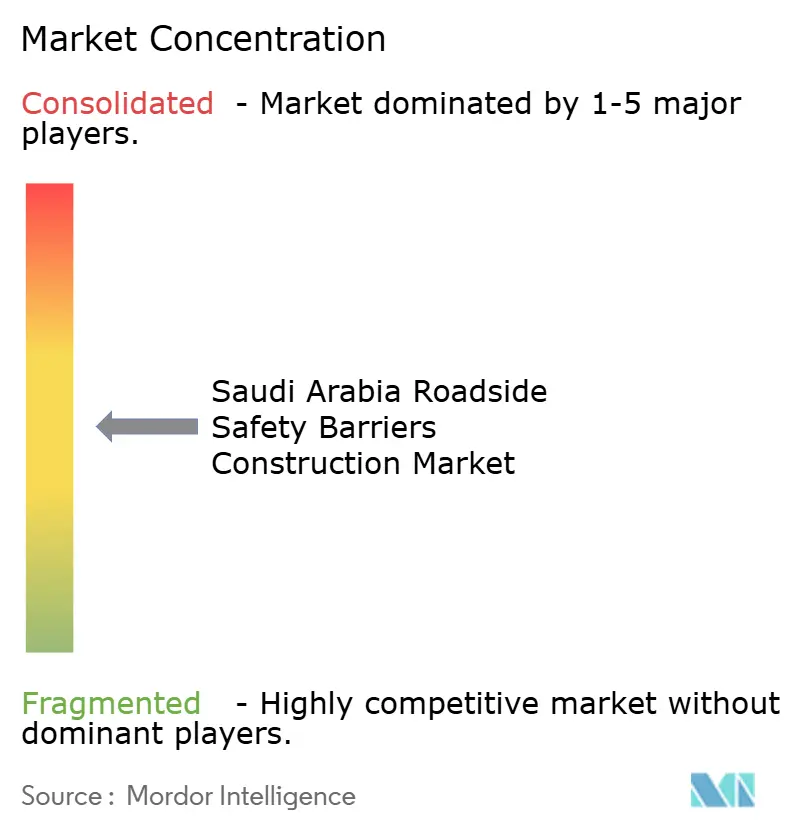
| Market Concentration | Medium |
Major Players *Disclaimer: Major Players sorted in no particular order Image © Mordor Intelligence. Reuse requires attribution under CC BY 4.0. | |
Saudi Arabia Roadside Safety Barriers Construction Market Analysis by Mordor Intelligence
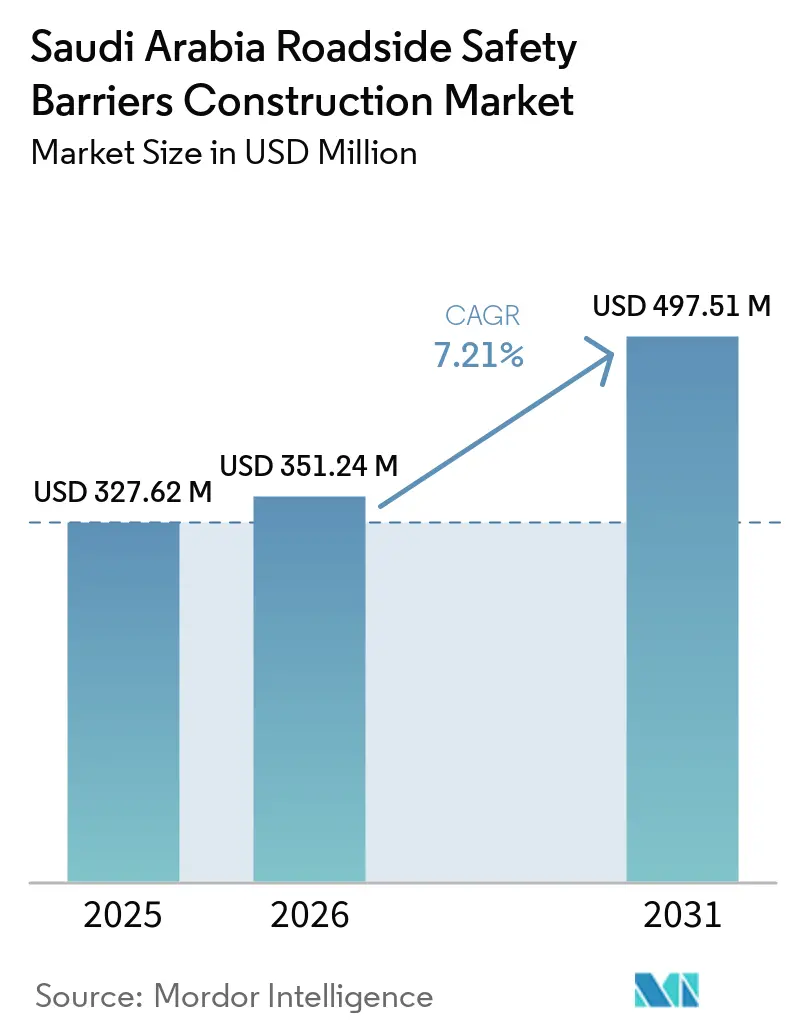
The Saudi Arabia Roadside Safety Barriers Construction Market size is expected to increase from USD 327.62 million in 2025 to USD 351.24 million in 2026 and reach USD 497.51 million by 2031, growing at a CAGR of 7.21% over 2026-2031. Steady investments in road construction under Vision 2030, an increasing number of bridges and flyovers, and adherence to Gulf Cooperation Council (GCC) vehicle-restraint standards are the primary factors driving market growth. Cable systems are gaining popularity as decision-makers consider lifecycle cost savings despite higher initial costs, while plastic-composite materials are drawing interest due to their corrosion resistance in desert environments. Procurement trends are shifting toward public-private partnerships (PPPs), favoring suppliers that can provide integrated solutions encompassing design, supply, installation, and long-term maintenance. Key risks include price volatility in imported steel and degradation caused by extreme heat. However, the pipeline of large-scale projects, such as NEOM and Qiddiya, continues to support demand in the Saudi Arabia roadside safety barriers construction market.
Key Report Takeaways
- By product type, metal guardrails captured 55.4% of the Saudi Arabia roadside safety barriers construction market share in 2025, while cable barrier systems are projected to grow at 7.98% CAGR between 2026 and 2031.
- By material, steel accounted for 62.2% share of the Saudi Arabia roadside safety barriers construction market size in 2025; plastic and composite formulations are on track for an 8.05% CAGR between 2026 and 2031.
- By application, highways and expressways held 49.1% of 2025 revenue, whereas bridges and flyovers are set to advance at 8.13% CAGR between 2026 and 2031.
- By installation type, new construction commanded 65.7% of 2025 spending, yet retrofit and repair activities will expand at 7.67% CAGR between 2026 and 2031.
- By city, Riyadh led with 35.8% of the 2025 value, and the Dammam Metropolitan Area is forecast to grow fastest at 8.21% CAGR between 2026 and 2031.
Note: Market size and forecast figures in this report are generated using Mordor Intelligence’s proprietary estimation framework, updated with the latest available data and insights as of January 2026.
Saudi Arabia Roadside Safety Barriers Construction Market Trends and Insights
Drivers Impact Analysis*
| Drivers | (~) % IMPACT ON CAGR FORECAST | Geographic Relevance | Impact Timeline |
|---|---|---|---|
| Growth in large-scale infrastructure and economic-zone projects | +2.1% | National (Riyadh, NEOM, Qiddiya, Red Sea) | Long term (≥ 4 years) |
| Continuous expansion of intercity highways and expressways | +1.8% | Riyadh–Dammam, Riyadh–Taif, Makkah–Madinah | Medium term (2–4 years) |
| Enforcement of stricter road-safety regulations | +1.5% | National (GSO EN 1317-5:2011, SASO) | Short term (≤ 2 years) |
| Rising freight traffic from industrial and logistics hubs | +1.2% | Eastern Province, Jeddah Port | Medium term (2–4 years) |
| Focus on reducing accidents in high-risk desert corridors | +0.9% | Ad-Dahna, An-Nafud, Rub Al-Khali | Long term (≥ 4 years) |
| Source: Mordor Intelligence | |||
Growth in Large-Scale Infrastructure and Economic-Zone Projects
Multibillion-dollar giga-projects provide a long visibility window for barrier demand. Qiddiya alone has over USD 1.5 billion in live road and bridge contracts that specify high-containment systems, while NEOM’s Oxagon port corridors require barrier integration that supports autonomous-vehicle sensors. Award schedules spread procurements over 2026-2030, lowering the risk of abrupt order swings. To access these tenders, vendors must pre-qualify on digital portals such as NEOM’s SAP Ariba, submit non-disclosure agreements, and maintain up-to-date crash-test certificates.
Continuous Expansion of Intercity Highways and Expressways
The Riyadh Main and Ring Road Axes Development Program involves over 500 kilometers of infrastructure upgrades, divided into three groups. This includes the construction of 32 new bridges and several tunnels. Group 3, initiated in December 2025, introduced a USD 2.1 billion package to enhance the 29-kilometer Jeddah Road, transforming it into a corridor capable of handling 353,000 vehicles per day. The high hourly traffic volumes necessitate the implementation of Test Level 4 and 5 barriers, as outlined in the American Association of State Highway and Transportation Officials (AASHTO) Manual for Assessing Safety Hardware (MASH), raising the technical requirements for suppliers[1]Royal Commission for Riyadh City, “Main and Ring Road Axes Development Program Fact Sheet,” rcrc.gov.sa .
Enforcement of Stricter Road-Safety Regulations
The GSO EN 1317-5:2011 standard, adopted across the GCC, regulates barrier performance and certification. Additionally, the Saudi Standards, Metrology, and Quality Organization (SASO) mandates the installation of underrun-protection devices for trucks. Starting in April 2026, autonomous vehicle regulations will impose stricter requirements on sensor line-of-sight, impacting barrier height, reflectivity, and mounting design. Contractors failing to comply may face project delays and penalties during Roads General Authority site audits[2]Saudi Standards, Metrology and Quality Organization, “Technical Regulations for Vehicle Restraint Systems 2025,” saso.gov.sa.
Rising Freight Traffic from Industrial and Logistics Hubs
The national freight market is projected to grow from USD 20.5 billion in 2023 to USD 32.1 billion by 2026. The development of new logistics zones and port expansions has increased heavy truck traffic on the Dammam–Jubail Highway and the Safwa–Rahima link, which became operational in November 2025. The higher axle loads have led to increased impact energy, encouraging specifiers to opt for stronger W-beam or Thrie-beam guardrails and crash-tested end terminals[3]Saudi Ports Authority, “Annual Port Traffic 2025,” mawani.gov.sa .
Restraints Impact Analysis*
| Restraints | (~) % IMPACT ON CAGR FORECAST | Geographic Relevance | Impact Timeline |
|---|---|---|---|
| Extreme heat and sand are accelerating degradation | −1.3% | Ad-Dahna, An-Nafud, Rub Al-Khali | Short term (≤ 2 years) |
| High upfront installation and repair costs | −0.9% | National, budget-constrained municipalities | Medium term (2–4 years) |
| Dependence on imported raw materials | −0.7% | National, exposed to global steel prices | Short term (≤ 2 years) |
| Source: Mordor Intelligence | |||
Extreme Heat and Sand Accelerating Degradation
Surface temperatures exceeding 50 °C cause steel rails to expand and concrete joints to crack, while migrating dunes compromise structural footings. Research from comparable climates indicates that maintenance intervals decrease to 10-15 years compared to the standard 20-25 years, leading to higher lifecycle costs. To address these challenges, agencies implement measures such as thicker galvanizing, composite skins, and sand-deflection berms; however, inspection frequency continues to increase.
High Upfront Installation and Repair Costs
Energy-absorbing crash cushions are priced at approximately USD 574 per meter, which is more than three times the cost of a basic W-beam line. This high cost often discourages adoption by budget-constrained localities. However, public-private partnership (PPP) contracts that include long-term maintenance encourage investors to opt for low-maintenance systems, offering cost savings over 20 years. Field studies highlight that inadequate welds and poor rebar anchorage can lead to expensive failures during high-speed impacts.
*Our forecasts treat driver/restraint impacts as directional, not additive. The impact forecasts reflect baseline growth, mix effects, and variable interactions.
Segment Analysis
By Product Type: Cable Systems Gain Traction
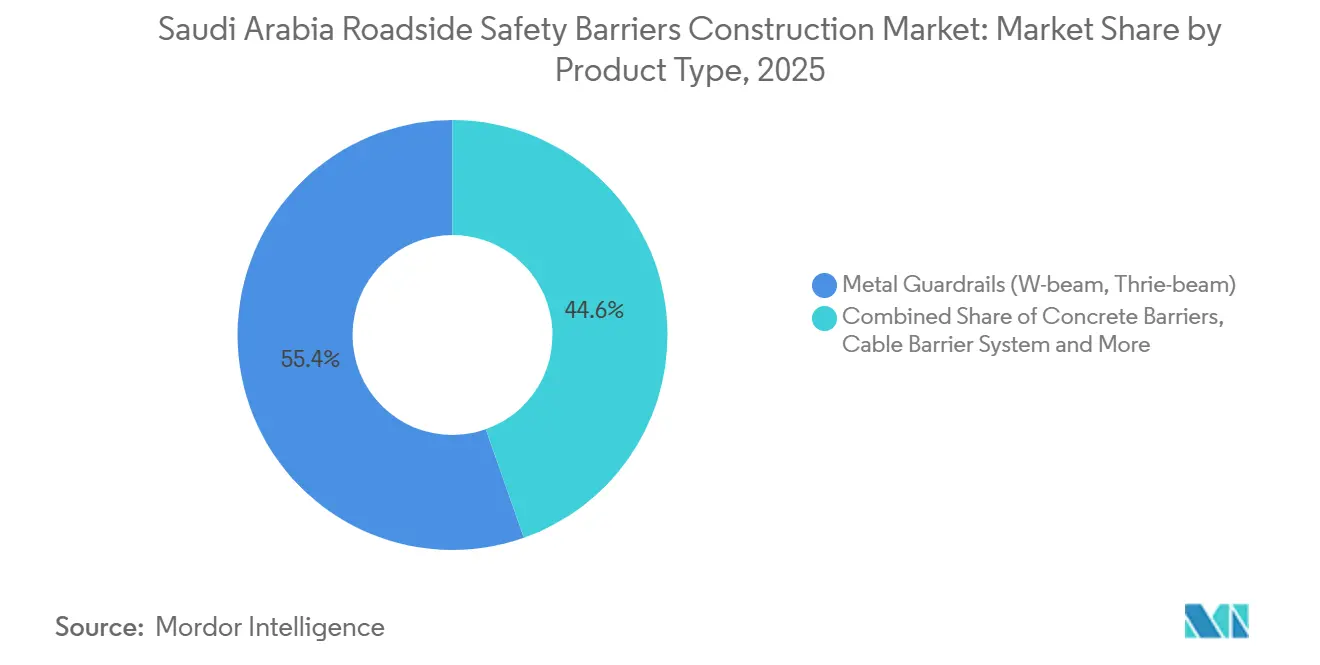
Metal guardrails accounted for 55.4% of the Saudi Arabia roadside safety barriers construction market in 2025, driven by local steel fabrication capabilities and proven crash performance. Cable barriers are projected to grow at a CAGR of 7.98% through 2031, supported by high-tension designs that offer low deflection and quick post-crash resets. High-traffic median corridors, such as those on the Riyadh-Dammam highway, are increasingly adopting cable systems to minimize maintenance-related lane closures. The National Academies' 2025 guidance on material standards further enhances confidence in standardized procurement processes.
Metal guardrails benefit from domestic hot-dip galvanizing capacity, which fulfilled 69% of local demand in 2023. However, heavier W-beam profiles exceeding 200 mm still require imports. Concrete barriers are preferred in urban expressways where limited space necessitates minimal deflection, although thermal expansion requires precise joint spacing. Additionally, crash cushions with reusable elastomer cartridges are increasingly used to protect bridge piers and gore zones, aligning with the industry's focus on reducing life-cycle costs in the Saudi Arabia roadside safety barriers construction market.



By Material: Composites Address Climate Extremes
Steel accounted for 62.2% of the projected 2025 revenue, valued for its weldability and compatibility with global crash-test standards. Plastic-composite alternatives are expected to grow at a CAGR of 8.05%, attributed to their resistance to corrosion and up to 50% lighter weight, which simplifies crane logistics in remote desert areas. A study by the University of Nebraska–Lincoln highlighted hybrid steel-rubber posts that recover their shape after impact, reducing repair labor requirements.
Concrete remains critical for applications requiring mass to contain heavy vehicles, such as bridge parapets, but faces challenges like cracking due to 30 °C day-night temperature fluctuations. Composite rails made from glass fiber and recycled polymers are increasingly used in temporary work zones and mountainous detours, representing a cost-efficient innovation in the Saudi Arabia roadside safety barriers construction market.
By Application: Bridges Drive Fastest Expansion
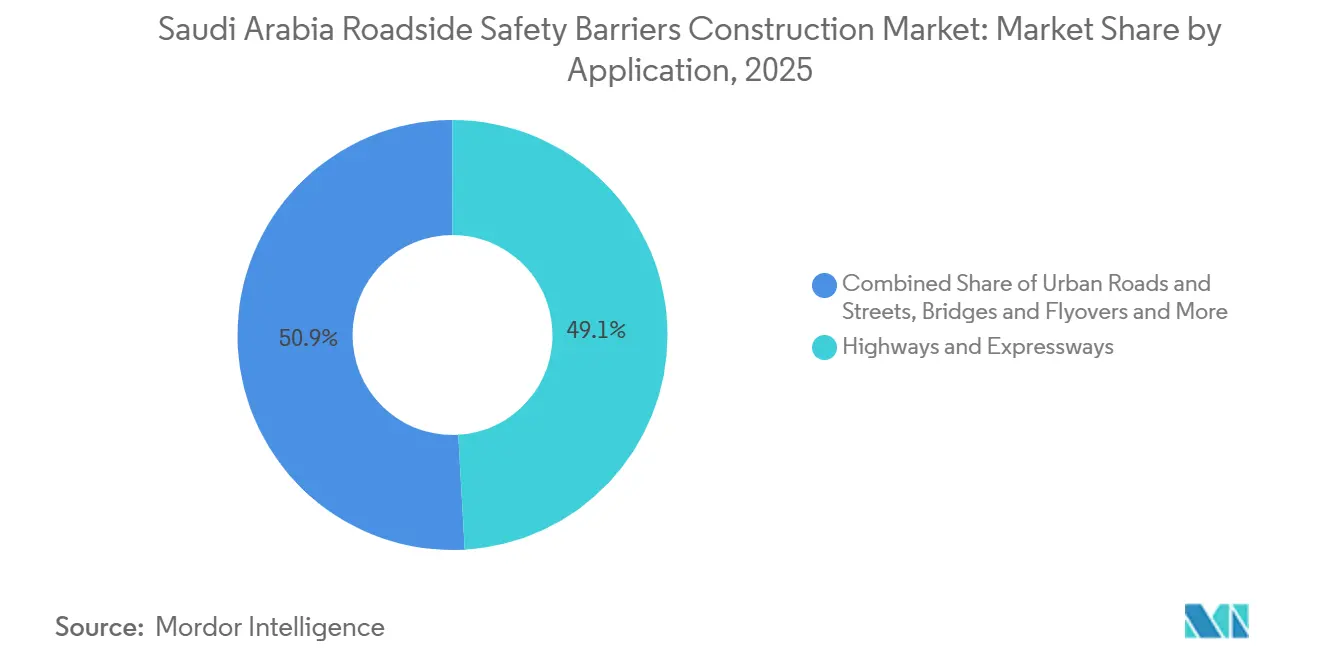
Highways and expressways accounted for 49.1% of the 2025 expenditure, while bridges and flyovers are projected to grow at a CAGR of 8.13% through 2031. The Riyadh Axes program includes the construction of over 100 new bridges requiring Test Level 4 parapets, end transitions, and motorcycle rails. The 702-meter Safwa–Rahima sea bridge, inaugurated in 2025, utilized marine-grade stainless clips to resist chloride attacks, highlighting specialized innovations within the Saudi Arabia roadside safety barriers construction market.
Urban streets in Jeddah feature pedestrian-friendly rails, whereas tunnels under Thumamah Road require low-profile barriers to accommodate ventilation ducts. Crash cushions with sand-filled barrels are used for temporary detours, demonstrating how diverse applications support product variety in the Saudi Arabia roadside safety barriers construction industry.
By Installation Type: Retrofit Opportunities Emerge
New constructions accounted for 65.7% of the Saudi Arabia roadside safety barriers construction market size in 2025, driven by the development of highways and flyovers under the Vision 2030 initiative. However, retrofit projects are expected to grow at a faster pace, with a forecasted CAGR of 7.67%, as older barriers fail to meet the current GSO EN 1317-5 strength standards. For instance, Riyadh’s Group 3 package is replacing outdated rails with higher-containment concrete barriers on ramps that now accommodate 450,000 vehicles daily. Private concessionaires are increasingly opting for reusable systems that minimize lane closures and reduce lifecycle costs.
From 2026 onward, retrofit projects are projected to account for a larger share of revenue as performance-based contracts tie payments to barrier uptime. The Safwa–Rahima upgrades illustrate this trend, with replaceable-cartridge crash cushions reducing closure times by 40%. Contractors offering integrated services, including design, traffic management, and onsite repairs, are likely to secure the majority of tenders. Additionally, as regulations for sensor-ready infrastructure to support autonomous vehicles become stricter, retrofit demand is expected to align with the growth momentum of new constructions in the Saudi Arabia roadside safety barriers construction market.
Geography Analysis
Riyadh contributes the largest revenue share with its three-group development program, budgeted at over USD 7.7 billion. This initiative upgrades 500 kilometers of arterial roads and more than 100 bridges. High containment levels and urban traffic densities necessitate Test Level 4 to 5 solutions, maintaining high specification complexity. The city's procurement schedule is evenly distributed until 2030, ensuring a stable order flow in the Saudi Arabia roadside safety barriers construction market.
The Dammam Metropolitan Area is projected to expand the fastest through 2031, driven by the USD 700 million Safwa–Rahima bridge, which opens a 15-kilometer logistics corridor to Ras Tanura Port. Heavy truck traffic along the Dammam–Jubail Highway requires thick-gauge Thrie-beams and crash-tested terminals capable of withstanding repeated 80 km/h impacts without full replacement. Meanwhile, Jeddah, serving as a gateway to the holy cities, increases demand for barriers on coastal expressways where marine chloride exposure reduces coating durability. The use of stainless clips and duplex steel rails raises initial capital costs but extends maintenance intervals, appealing to PPP concessionaires.
Elsewhere in Saudi Arabia, giga-projects such as NEOM and Qiddiya contribute new greenfield kilometers, while desert and mountain roads create opportunities for composite rails and rockfall-anchored posts. These developments enhance geographic balance within the Saudi Arabia roadside safety barriers construction market.
Competitive Landscape
Competition in the Saudi Arabia roadside safety barriers construction market remains moderate, with global companies such as Trinity Industries, Lindsay Corporation, Hill & Smith, and Valmont Industries competing against local fabricators like Saferoad RRS, Saudi Guardrail, and Passing Road Group. Local players benefit from shorter lead times and expertise in handling SASO paperwork, while multinational firms offer extensive crash-test libraries and modular product solutions compliant with GSO EN 1317-5 standards.
Strategic developments for 2025-2026 indicate a shift toward turnkey services. Lindsay Corporation introduced a managed-maintenance contract for Riyadh’s Prince Turki Road, linking performance payments to barrier uptime. Trinity Industries collaborated with InfraRoad Trading & Contracting on an EPC package for Group 2 bridges. Meanwhile, Saferoad RRS increased its galvanizing capacity by 25% in Dammam to reduce reliance on imports and mitigate foreign exchange fluctuations.
Innovation plays a critical role in differentiating competitors. Hill & Smith conducted field tests for a composite post-and-rail system on the Qiddiya spine road, which reduces post-impact repair time by half. Valmont Industries is testing digital tags that record impact data for integration into asset-management dashboards, a feature appealing to PPP financiers. These advancements enhance product-service integration and contribute to the technological evolution of the market.
Saudi Arabia Roadside Safety Barriers Construction Industry Leaders
Valtir (formerly Trinity Highway)
Lindsay Corporation
Hill & Smith PLC
Valmont Industries Inc.
Saferoad RRS (Saudi)
- *Disclaimer: Major Players sorted in no particular order

Recent Industry Developments
- April 2026: SASO's technical regulation for autonomous vehicles became mandatory, introducing sensor-line-of-sight and vehicle-to-infrastructure communication considerations that influence roadside barrier height, reflectivity, and mounting-bracket design specifications.
- December 2025: The Royal Commission for Riyadh City launched Group 3 of the Main and Ring Road Axes Development Program with a budget exceeding SAR 8 billion (USD 2.13 billion). This includes 6 major road projects requiring extensive roadside safety barrier installations, including the Jeddah Road upgrade (29 km, 14 bridges) and Taif Road development (15 km, 4 bridges, 2 tunnels).
- November 2025: Saudi Arabia opened the Safwa-Rahima sea bridge and road project in the Eastern Province, featuring a 3.2-kilometer twin sea bridge and 15-kilometer route with upgraded intersections and 5 additional bridges. This project required specialized marine-grade barrier systems and bridge parapets for coastal applications.
- September 2025: Saudi giga-projects (NEOM, Qiddiya, Red Sea Global, others) reached approximately USD 904 billion in total project value, with USD 116.6 billion in contracts awarded through September 2025. Qiddiya's transport and road packages in execution include roads, bridges, utilities, and tunnels totaling over USD 1.3 billion, all requiring roadside safety barriers.


Saudi Arabia Roadside Safety Barriers Construction Market Report Scope
| Metal Guardrails (W-beam, Thrie-beam) |
| Concrete Barriers (Jersey, F-shape) |
| Cable Barrier Systems |
| Crash Cushions & Impact Attenuators |
| Others (Motorcyclist protection, hybrid, emerging) |
| Steel |
| Concrete |
| Plastic & Composite |
| Others (Aluminum, rubber, recycled blends) |
| Highways & Expressways |
| Urban Roads & Streets |
| Bridges & Flyovers |
| Others (Rural, industrial/private, parking, tunnels, temp zones) |
| New Installation |
| Renovation / Retrofit / Repair |
| Riyadh |
| Jeddah |
| DMA (Dammam Metropolitan Area) |
| Rest of Saudi Arabia |
| By Product Type | Metal Guardrails (W-beam, Thrie-beam) |
| Concrete Barriers (Jersey, F-shape) | |
| Cable Barrier Systems | |
| Crash Cushions & Impact Attenuators | |
| Others (Motorcyclist protection, hybrid, emerging) | |
| By Material | Steel |
| Concrete | |
| Plastic & Composite | |
| Others (Aluminum, rubber, recycled blends) | |
| By Application | Highways & Expressways |
| Urban Roads & Streets | |
| Bridges & Flyovers | |
| Others (Rural, industrial/private, parking, tunnels, temp zones) | |
| By Installation Type | New Installation |
| Renovation / Retrofit / Repair | |
| By Cities | Riyadh |
| Jeddah | |
| DMA (Dammam Metropolitan Area) | |
| Rest of Saudi Arabia |


Key Questions Answered in the Report
How large will Saudi Arabia’s roadside safety barrier spending become by 2031?
It is forecast to reach about USD 497.51 million by 2031, growing at 7.21% CAGR from 2026.
Which product type now dominates new highway projects?
Metal guardrails still lead with a 55.4% 2025 share, but cable systems are the fastest climber at 7.98% CAGR.
Why is retrofit demand set to rise after 2026?
Many 1980s-era barriers no longer meet GSO EN 1317-5 containment rules, prompting a 7.67% CAGR upgrade wave.
What city offers the quickest growth opportunity?
The Dammam Metropolitan Area is projected to expand at 8.21% CAGR as new bridges connect ports and industrial hubs.
How are contractors coping with desert climate challenges?
They employ thicker galvanizing, composite rails, and more frequent inspections to offset heat- and sand-related wear.
What procurement shift should suppliers prepare for?
Funding is moving toward PPP models where lifecycle performance, not lowest upfront cost, wins contracts.
Page last updated on:





