
Saudi Arabia Food And Beverage Market Size and Share
Market Overview
| Study Period | 2021 - 2031 |
|---|---|
| Forecast Data Period | 2026 - 2031 |
| Base Year Market Size (2025) | USD 36.35 Billion |
| Market Size (2026) | USD 38.38 Billion |
| Market Size (2031) | USD 50.38 Billion |
| Growth Rate (2026 - 2031) | 5.59 % |
| Market Concentration | Medium |
Major Players
*Disclaimer: Major Players sorted in no particular order Image © Mordor Intelligence. Reuse requires attribution under CC BY 4.0. |
|
Saudi Arabia Food And Beverage Market Analysis by Mordor Intelligence
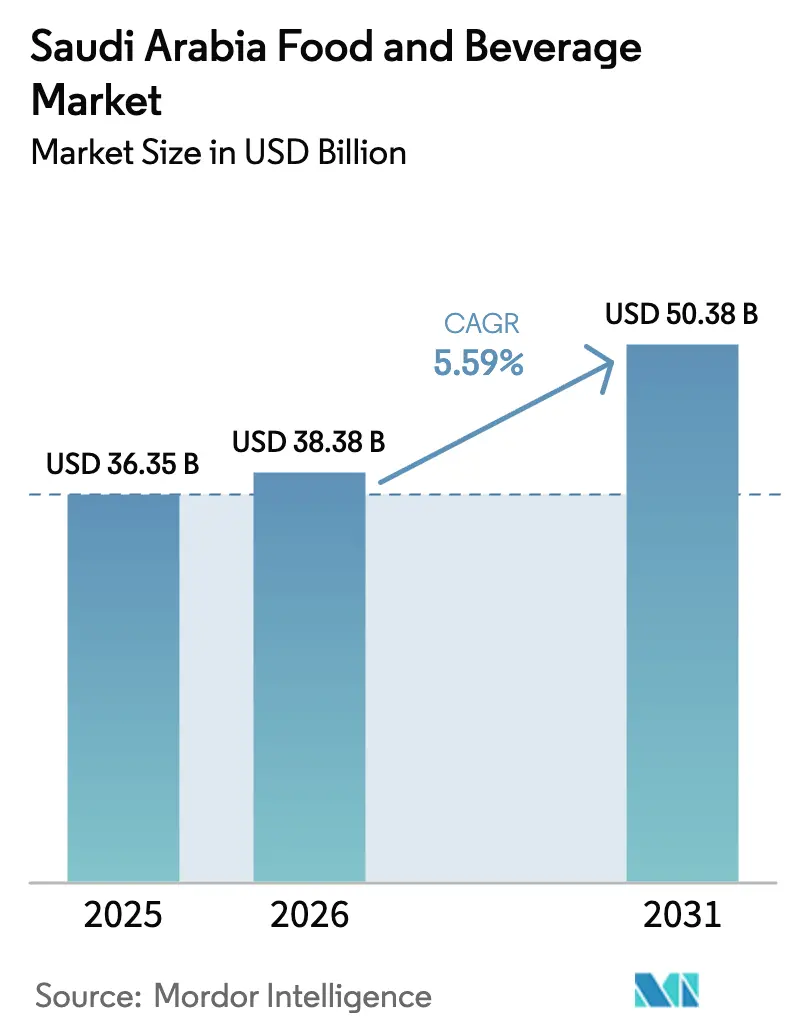
The Saudi Arabia food and beverages market size was valued at USD 36.35 billion in 2025 and estimated to grow from USD 38.38 billion in 2026 to reach USD 50.38 billion by 2031, at a CAGR of 5.59% during the forecast period (2026-2031). Vision 2030 policies are steering oil revenues into bolstering domestic agri-food capabilities. These policies aim to reduce reliance on imports and enhance food security by strengthening local production. A significant government investment of USD 70 billion is being funneled into processing plants to support this initiative. With the population expected to hit 40 million by 2030, these moves are timely and critical for meeting the growing domestic demand[1]Source: USDA FAS," Saudi Arabia: Food Processing Ingredients", fas.usda.gov. Projects aimed at achieving livestock self-sufficiency, coupled with clean-label reformulations that cater to evolving consumer preferences for transparency and healthier options, are driving volume increases. Additionally, a surge in pilgrimage traffic, particularly during peak seasons, is boosting seasonal spending on packaged foods, further contributing to market growth. To protect their margins from utility-price reforms, retailers are tightening their supply chains through vertical integration, which enhances operational efficiency, and developing private labels to offer cost-effective alternatives. While tax surcharges on sugary beverages pose challenges for certain product categories, they simultaneously carve out opportunities for healthier snacks, dairy products, and date-based drinks, aligning with the growing consumer shift toward health-conscious choices.
Key Report Takeaways
- By product type, meat, poultry, seafood, and meat Substitutes led with 27.62% of the Saudi Arabian food and beverages market share in 2025 and are expected to grow at a 3.02% CAGR to 2031.
- By product type, savory snacks are projected to record the fastest 8.31% CAGR during 2026-2031 after holding 3.88% revenue share in 2025, reflecting urban demand for convenience formats.
- By distribution channel, supermarkets/hypermarkets commanded 57.10% share of the Saudi Arabia food and beverages market size in 2025; Online Retail Stores are anticipated to expand at an 7.82% CAGR through 2031, buoyed by nationwide 5G roll-out and last-mile cold-chain hubs.
Note: Market size and forecast figures in this report are generated using Mordor Intelligence’s proprietary estimation framework, updated with the latest available data and insights as of 2026.
Worldwide, activity is shaped by contributions from multiple countries and regions, with Saudi arabia representing one among them. The global report on food and beverage market by Mordor Intelligence reflects how these countries and regional layers combine into a single system.
Saudi Arabia Food And Beverage Market Trends and Insights
Drivers Impact Analysis*
| Driver | (~)% Impact on CAGR Forecast | Geographic Relevance | Impact Timeline |
|---|---|---|---|
| Rising demand for clean-label food and beverages | +0.8% | National, with concentration in urban centers | Medium term (2-4 years) |
| Growth in dairy consumption per capita | +0.6% | National, strongest in Central and Eastern provinces | Long term (≥ 4 years) |
| Hajj and Umrah pilgrimage foodservice spill-over boosting retail packs | +0.4% | Makkah and Madinah regions, spillover to national retail | Short term (≤ 2 years) |
| Rise of government-backed "Made-in-Saudi" localization program | +0.7% | National, with manufacturing hubs in Riyadh and Eastern Province | Long term (≥ 4 years) |
| Expansion of modern grocery retail formats | +0.5% | National, accelerated in secondary cities | Medium term (2-4 years) |
| Surge in cold-chain logistics infrastructure outside Tier-1 cities | +0.3% | Secondary cities and rural distribution networks | Medium term (2-4 years) |
| Source: Mordor Intelligence | |||
Rising demand for clean-label food and beverages
Saudi shoppers are increasingly turning away from artificial additives, prompting the SFDA's trans-fat ban to drive reformulations in carbonated drinks, baked goods, and ready-to-eat meals. Local innovators, like Thurath Al-Madina, have introduced Milaf Cola, a soda sweetened with dates and made from indigenous crops, highlighting the advantage of local sourcing[2]Source: Saudi Food and Drug Authority," Eliminating Trans Fats In Saudi Arabia", sfda.gov.sa. This shift reflects a broader consumer preference for products that align with cultural heritage and health-conscious values. With excise taxes set at 50% for soft drinks and a staggering 100% for energy drinks, brands are pivoting towards natural ingredients, motivated by both health considerations and financial incentives. These taxes not only discourage the consumption of sugary and artificially flavored beverages but also create opportunities for healthier alternatives to gain market share. Retailers are capitalizing on this trend, establishing dedicated "healthy shelf" zones that have notably increased sales for low-sugar yogurts and air-fried snacks. These zones cater to the growing demand for functional and better-for-you products, further reinforcing the shift in consumer behavior. Looking ahead, medium-term transparency regulations, in line with Codex labels, are set to solidify this trend, directing premium pricing towards producers who adhere to these standards. These regulations are expected to enhance consumer trust and encourage manufacturers to prioritize compliance, ultimately fostering a more health-oriented market landscape.
Growth in dairy consumption per capita
Saudi Arabia's dairy sector has surpassed 121% self-sufficiency, contributing 46% to the nation's agricultural GDP. Almarai, the sector's flagship player, operates fully integrated farms, ensuring price stability even amidst global feed fluctuations. These farms integrate advanced technologies and sustainable practices, enabling efficient production and cost management. Meanwhile, NADEC reported a net income of SAR 213.2 million in H1 2024, buoyed by a 7.3% rise in revenue, driven by strategic investments in product innovation and market expansion. Domestic loyalty runs deep, with 69% of households favoring local milk due to its perceived freshness and quality. Additionally, government-backed loans are fueling capacity expansions, including the introduction of automated barns in Al-Kharj, which enhance operational efficiency and production scalability. The segment's sustained growth is bolstered by a youthful demographic, increasingly leaning towards fortified, single-serve products that cater to their on-the-go lifestyles, reflecting a shift in consumer preferences toward convenience and health-conscious choices.
Hajj and Umrah pilgrimage foodservice spill-over
By 2030, the government aims to welcome 30 million Umrah visitors, significantly boosting demand for shelf-stable halal packs, portioned dairy desserts, and bottled water. This ambitious target is expected to create a ripple effect across the supply chain, driving growth in production, packaging, and distribution sectors. Each Ramadan, retailers in Jeddah and Taif set up pop-up satellite warehouses to meet the surge in demand, ensuring the timely availability of essential products for pilgrims. These warehouses play a critical role in managing the seasonal spike, enabling retailers to stockpile and distribute goods efficiently. After the rush, they channel any leftover stock through discount channels, maintaining efficient nationwide distribution and minimizing wastage. This annual rhythm benefits nimble manufacturers who adeptly manage inventory, implement flexible production schedules, and prioritize safety protocols, ensuring readiness for any pandemic-related challenges or unforeseen disruptions. Additionally, manufacturers with robust supply chain strategies and adaptive logistics are better positioned to capitalize on this growing market opportunity.
Rise of “made-in-Saudi” localization program
More than 4,800 SKUs now proudly display the certification label, which not only enhances their visibility on shelves but also gives them an edge in public tenders by meeting specific compliance and quality standards. Food processors are reaping the rewards of subsidized industrial land, which reduces operational costs, and a 30% cash-back incentive on capital equipment, effectively bridging the cost gap with imports and encouraging local production. With aquaculture targets set at 300,000 tonnes and significant biotech milestones achieved, there's a clear pivot towards soy analogs and precision-fermented proteins, which are gaining traction as sustainable and innovative food solutions[3]Source: Kingdom of Saudi Arabia, "National Industrial Development and Logistics Program", vision2030.gov.sa. Meanwhile, harmonized SASO regulations guarantee export-grade standards throughout the GCC, ensuring consistency and quality for regional trade. Consumer surveys reveal a growing domestic preference, with 33% of respondents favoring local snacks and bottled water, highlighting the policy's success in fostering demand for domestically produced goods and strengthening consumer trust in local brands.
Restraints Impact Analysis*
| Restraint | (~)% Impact on CAGR Forecast | Geographic Relevance | Impact Timeline |
|---|---|---|---|
| High salt/sugar preservatives in ready-meals | -0.3% | National, with regulatory pressure in urban markets | Medium term (2-4 years) |
| Price sensitivity amid subsidy rationalization | -0.5% | National, most acute in lower-income segments | Short term (≤ 2 years) |
| Strict shelf-life compliance for summer road freight | -0.2% | National, particularly affecting inter-city distribution | Long term (≥ 4 years) |
| Packaging-waste regulations driving cost inflation | -0.4% | National, with compliance costs affecting all manufacturers | Medium term (2-4 years) |
| Source: Mordor Intelligence | |||
Price sensitivity amid subsidy rationalization
As fuel and power tariffs rise, households face increased expenses, leading to a squeeze on disposable incomes and a subsequent reduction in spending on premium food and beverages. This shift in spending patterns has prompted manufacturers to adopt a dual strategy to cater to diverse consumer segments. They are introducing value packs tailored for budget-conscious families, ensuring affordability, while simultaneously rolling out premium SKUs designed to appeal to wealthier consumers seeking high-quality options. To regain sales momentum and drive consumer engagement, promotions are strategically timed around key occasions such as Eid and National Day, which are periods of heightened consumer activity. These promotional efforts often include discounts, bundled offers, and targeted marketing campaigns to attract a wide range of consumers. However, staples like vegetable oil and poultry exhibit significant price sensitivity, making it essential for manufacturers to implement meticulous margin management strategies. This involves closely monitoring input costs, optimizing supply chain efficiencies, and adjusting pricing strategies to maintain profitability while addressing consumer demand effectively.
Packaging-waste regulations driving cost inflation
Under the General Environmental Regulations, the phased plastic ban mandates a shift towards biodegradable films, corrugated shippers, and aluminum caps. This compliance not only incurs machinery retrofit costs but also necessitates new SFDA testing cycles, thereby squeezing margins in the carbonated beverage and confectionery sectors. Companies are required to invest in upgrading their production processes to meet these regulations, which often involves significant capital expenditure. In response, companies are turning to lightweight PET and digital-ink date coding to reduce material intensity. These solutions help minimize environmental impact but come with challenges, as the capital payback period for mid-sized processors extends beyond three years, making it a long-term investment. On the upside, eco-labels offer premium shelf placement, enhancing product visibility and appeal to environmentally conscious consumers. Additionally, they align with the ESG mandates of institutional investors, which are increasingly influencing corporate strategies and market positioning.
*Our forecasts treat driver/restraint impacts as directional, not additive. The impact forecasts reflect baseline growth, mix effects, and variable interactions.
Segment Analysis
By Product Type: Protein Dominance Meets Snacking Revolution
As of 2025, the meat, poultry, seafood, and meat Substitutes segment commands a dominant 27.62% share of Saudi Arabia's food and beverages market. This stronghold is bolstered by substantial infrastructure investments, notably the USD 2 billion livestock city project. This ambitious initiative aims to elevate broiler output by an impressive 250 million birds annually, thereby fortifying the domestic protein supply. Local operators, such as Tanmiah, are capitalizing on this momentum, expanding their capacity with approximately 100 state-of-the-art automated poultry houses. The protein category, driven by a deep-rooted consumer preference for red meat and fish, is poised for steady growth, projecting a 3.02% CAGR through 2031. While the market remains anchored in traditional protein choices, there's a gradual embrace of plant-based alternatives. Items like soy kebabs and jackfruit shawarma, primarily featured on quick-service restaurant menus, cater to the expatriate vegan demographic. The segment's robust domestic production capabilities ensure consistent availability and competitive pricing. Furthermore, strategic expansions and modernization efforts bolster Saudi Arabia's leadership in the regional protein landscape.
On the other hand, the snack segment is emerging as the fastest-growing category in Saudi Arabia's food and beverages market, boasting an impressive 8.31% CAGR. This surge is largely driven by impulse buying and a heightened health consciousness, especially in light of regulatory sodium restrictions. Popular snack choices, including chips, baked nuts, and date bars, owe their rising fame to effective brand positioning and a strong "Made-in-Saudi" identity that resonates with local consumers. By emphasizing authenticity and regional roots, domestic snack producers have elevated brand preference to 33%, carving a niche in a competitive landscape. Their alignment with esports sponsorships and the youth culture further amplifies their reach, especially among Gen Z, leading to both trial and repeat purchases. Moreover, initiatives like reformulating products with sea salt and adopting air-frying technologies underscore the industry's dedication to clean-label standards and regulatory adherence, catering to urban consumers seeking healthier snack options. This robust growth trajectory underscores a significant shift in consumer habits and lifestyle choices, positioning snacks as a dynamic and rapidly expanding segment in Saudi Arabia's food market.




By Distribution Channel: Digital Transformation Accelerates Modern Retail
In 2025, supermarkets and hypermarkets claimed a dominant 57.10% share of Saudi Arabia's food and beverages market, establishing themselves as the primary touchpoint for consumers. These large-format retailers are not just enhancing shopper convenience but are also boosting basket sizes. By integrating features like click-and-collect lockers and in-aisle QR codes, they streamline the shopping experience and promote cross-selling. The organized retail space is on a steady growth trajectory, with a projected CAGR of 3.98%, bolstered by the addition of around 1 million square meters of new mall gross leasable area (GLA). Their vast product assortments and robust physical presence continue to draw a diverse consumer base, seamlessly blending traditional retail strengths with digital innovations. In a strategic pivot, convenience stores are now clustering franchises near industrial zones, operating 24/7 to cater to night-shift workers. Specialty health outlets, emphasizing gluten-free and organic products, are carving a niche in upscale areas like Riyadh’s Diplomatic Quarter and Jeddah’s Corniche. Meanwhile, traditional local shops, or bakalas, thrive on immediacy but grapple with challenges from new payment terminal mandates. These requirements limit their cash transaction flexibility, pushing them to forge partnerships with distributors for competitive pricing.
Online retail stores are emerging as the fastest-growing segment in Saudi Arabia's food and beverages market, boasting a robust 7.82% CAGR. This growth is largely attributed to the expansion of 5G coverage and the rise of advanced fintech payment solutions. Notably, this channel has adeptly transformed Ramadan's bulk buyers into loyal subscribers throughout the year, especially for staples like dairy and rice. While the e-grocery market share currently lingers in the single digits, it's witnessing a doubling approximately every two years. This surge is powered by enhancements in cold-chain infrastructure, ensuring superior product quality and reliable delivery. The allure of digital platforms, coupled with swifter internet speeds and smooth payment methods, is gradually reshaping consumer preferences towards online shopping. Furthermore, the integration of omnichannel strategies allows retailers to merge the benefits of virtual and physical shopping, aligning with the evolving demands for flexibility and efficiency. As digital adoption accelerates, online retail is set to play a pivotal role in the future of Saudi Arabia’s food and beverages distribution landscape.

Geography Analysis
Riyadh, home to 8 million residents, and its integrated logistics parks, anchor one-third of Saudi Arabia's food and beverages market in the Central Province. With robust purchasing power and a modern retail density above the national average, it's no surprise that 45% of new openings from retail giants Lulu and Danube are concentrated here. Meanwhile, the Eastern Province, capitalizing on King Abdulaziz Port and SABIC’s agri-nutrient complexes, plays a pivotal role in supplying animal feed and packaging resin to national processors. The Western Province, benefiting from pilgrimage flows, sees Jeddah’s annual port throughput of 67 million tons significantly expedite import substitution initiatives by reducing inbound freight times.
As part of the Vision 2030 regional programs promoting agricultural diversification, Al-Jouf and Tabuk have made headlines by shipping their first tomato consignment to Europe in 2024, underscoring their export potential. NEOM is making strides in the alternative protein sector, investing in precision fermentation plants with a target of producing 20,000 MT by 2030, setting a benchmark for tech-driven production. Additionally, secondary cities like Hail, Abha, and Najran are capitalizing on new cold-chain corridors, which significantly reduce spoilage and seamlessly integrate local farms into the national retail landscape.
Due to customs union agreements, neighboring GCC countries are eliminating import tariffs on Saudi dairy and poultry products, resulting in a surge in cross-border trade. Rail initiatives, such as the Landbridge, have slashed the transit time from Jeddah to Dammam to a mere 18 hours, bolstering the movement of perishables across the east-west corridor. On another front, the National Water Strategy is making a significant move by designating 2.5 billion m³ of treated wastewater for agrifood use by 2030. This initiative not only alleviates stress on aquifers but also ensures sustained yields in date orchards and forage crops.
Regulatory Landscape
Saudi Arabia’s food and beverage regulatory framework is led by the Saudi Food and Drug Authority (SFDA), the independent regulator responsible for food safety oversight across domestic production and imports. Under the Food Act (2017), SFDA sets technical rules for foods, food establishments, and employees, and it adopts equivalent international references such as Codex Alimentarius and ISO where national or GCC requirements are not specified. SFDA also has powers for inspection, seizure of non-compliant goods, and import controls.
Import governance includes mandatory registration requirements covering local importers, foreign establishments that export to Saudi Arabia, and selected imported food items, which makes compliance and documentation central to market access. Standard-setting and labeling alignment remain a key compliance theme as reformulations move toward clean-label positioning, including SFDA enforcement actions linked to industrial trans fat removal. Saudi Arabia’s role in international standard-setting is also visible through its Codex Alimentarius Commission participation, including a Vice-Chair role through 2027, which supports harmonization of food standards and labeling practices that affect product reformulation, claims, and cross-border trade within the GCC.
Value Chain Analysis
The Saudi Arabia food and beverage value chain combines import-dependent ingredient flows with expanding local farming and processing capacity driven by Vision 2030 localization. Upstream, strategic food-security investors such as SALIC (PIF-owned) participate across global agri-food supply to secure commodities and inputs, while SABIL (a SALIC subsidiary) supports grain supply and strategic reserves connected to domestic milling and livestock feed availability. These structures influence cost and supply continuity for processors, particularly in staples and protein categories where feed and grains are key input drivers.
In the midstream and downstream, leading manufacturers and agrifood groups continue to strengthen vertical integration to stabilize supply and improve traceability and margins. NADEC expanded upstream control by moving to full ownership of Al Raie National Livestock Company and commissioning the Haradh slaughterhouse in Q2 2026, tightening the link from livestock sourcing to retail-ready protein output. Large domestic players such as Almarai run integrated logistics networks to support high-frequency delivery, while investments in local processing, cold-chain capacity, and last-mile distribution, including e-grocery fulfillment, shift value capture toward operators with integrated manufacturing, warehousing, and compliance-ready quality systems.
Competitive Landscape
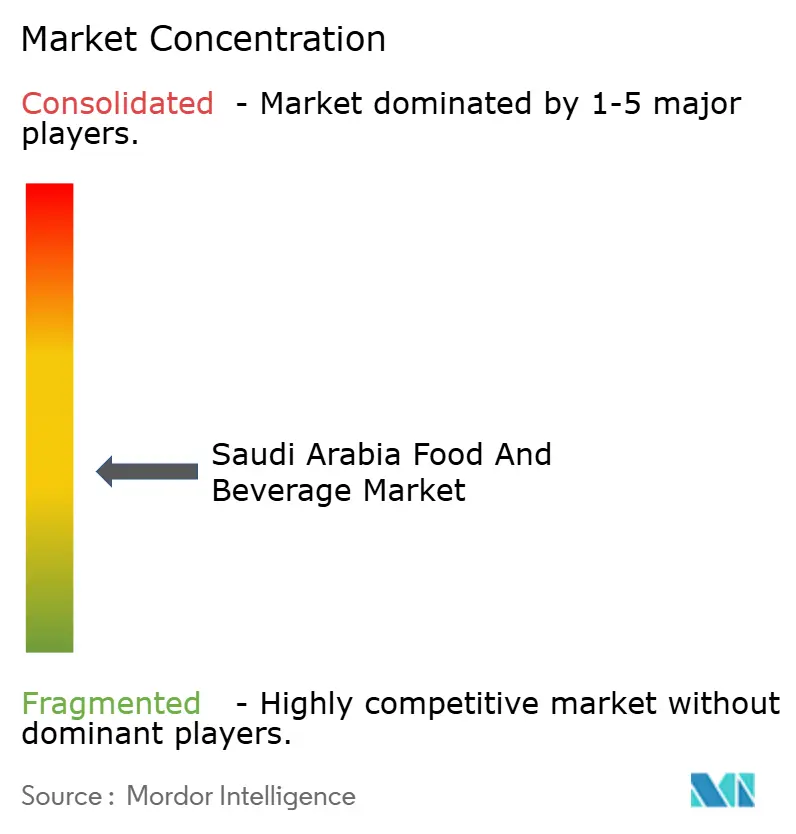
Saudi Arabia's food and beverage market is moderately fragmented. To counter competition from both international newcomers and rising local contenders, established domestic players are increasingly turning to vertical integration strategies. Almarai, a key player, oversees everything from fodder farms to processing, boasting a fleet of 1,400 trucks that ensure a swift 24-hour milk-to-shelf cycle. Meanwhile, Savola Group's recent February 2024 decision to spin off its 34.52% stake in Almarai reshuffles equity distribution without disrupting existing operational synergies. NADEC, tapping into Agricultural Development Fund loans, is automating its cheese production, resulting in a notable 310-basis-point increase in profit margins. The race for poultry dominance heats up, with Almarai, Tanmiah, and JBS all vying for a stake in Al Watania, highlighting the strategic importance of protein supply.
Investment in technology is on the rise. In a significant move, Liberation Labs has teamed up with NEOM to establish a precision-fermentation facility, aiming to produce animal-free whey by 2027. This joint venture positions Saudi Arabia as a frontrunner in the regional novel protein market. On another front, Saudi Dairy & Foodstuff Co. is pioneering blockchain technology for yogurt traceability, not only meeting the SFDA’s mandates but also bolstering its export reputation.
Retailers are increasingly turning to private labels to boost margins. Danube's private label, with 380 SKUs, commands a notable 12% of shelf space, while Othaim's budget line offers a 15% discount compared to multinational brands. The e-grocery sector is buzzing with activity; BinDawood's investment in IATC ensures a promise of same-day delivery across 27 cities. Foreign players are making their mark with specialty products, like Nestlé's USD 1.9 billion coffee mix factory extension in 2024, but face a hurdle: a 40% local-content requirement to access public contracts.
Saudi Arabia Food And Beverage Industry Leaders
-
Almarai Co. Ltd.
-
National Agricultural Development Company (NADEC)
-
PepsiCo Inc.
-
Nestle SA
-
Al Rabie Saudi Foods Co. Ltd.
- *Disclaimer: Major Players sorted in no particular order

Market Opportunities and Future Outlook
Localization programs and import-substitution priorities create space for domestic processing, controlled-environment agriculture, and branded protein and dairy adjacencies. The National Food Production Initiative has been framed around building sustainable farming facilities to reduce import reliance, which reaches 85% in some categories, creating an addressable gap for locally produced ingredients and finished foods that meet SFDA standards. In grains and staples, SABIL’s role in managing supply and strategic reserves supports domestic milling and livestock operators, strengthening the operating environment for processors that rely on stable commodity inputs.
Product and platform expansions by major in-country players also open opportunities across protein, premium produce, and novel foods. NADEC’s commissioning of the Haradh slaughterhouse and its move to full ownership of Al Raie National Livestock Company support a shift toward retail-ready red meat, while its investments in high-tech greenhouses and vertical farming align with demand for consistent premium produce supply. In parallel, Topian (NEOM Food Company) is building a pipeline across climate-proof agriculture, regenerative aquaculture, novel foods, and sustainable supply and ESG, which supports commercialization pathways for alternative proteins and higher-value categories tied to localization and traceability.
Recent Industry Developments
- June 2026: National Agricultural Development Company (NADEC) commissioned the new Haradh slaughterhouse facility, supporting NADEC-branded red meat products launch. The project strengthens the local red meat supply chain and expands NADEC's processing footprint in line with Vision 2030 goals.
- April 2026: National Agricultural Development Company (NADEC) signed a share purchase agreement to acquire the remaining 49% stake in Al Raie National Livestock Company for SAR 23.69 million. The deal makes NADEC's livestock subsidiary wholly owned and expands its downstream operations within the asset base.
- April 2026: PepsiCo Inc. established a new research and development facility in Riyadh’s King Abdullah Financial District with an investment of SAR 30 million. The move supports local product development and reformulation to meet growing consumer preferences.


Research Methodology Framework and Report Scope
Market Definition and Coverage
For this methodology, the Saudi Arabia food and beverage market is defined as the value of packaged and processed food products and non-alcoholic beverages sold for consumption in the country across retail and foodservice-linked channels.
Scope exclusions: This sizing excludes alcoholic beverages and excludes non-edible categories such as tobacco products and household or personal care items.
Segmentation Overview
-
By Product Type
-
Dairy and Dairy Alternatives
-
Dairy Products
- Butter
- Cheese
- Cream
- Dairy Desserts
- Milk
- Sour-Milk Drinks
- Yogurt
- Dairy Alternatives
-
Dairy Products
-
Confectionery
- Chocolate Confectionery
- Sugar Confectionery
-
Snack Bars
- Cereal Bars
- Protein/Energy Bars
- Fruit and Nut Bars
- Non-Alcoholic Beverages
-
Bakery
- Cakes and Pastries
- Biscuits
- Bread
- Morning Goods
- Other Bakery Products
- Savory Snacks
-
Meat, Poultry, Seafood and Meat Substitutes
- Meat
- Poultry
- Seafood
- Meat Substitutes
- Breakfast Cereals
- Ready Meals
-
Dairy and Dairy Alternatives
-
By Distribution Channel
- Supermarkets/Hypermarkets
- Convenience Stores
- Specialty Stores
- Online Retail Stores
- Other Distribution Channels
Data Sources, Market Sizing, and Validation
Desk Research
We start by building the Saudi Arabia country context using public, checkable datasets that show demand, trade flows, and consumer spending direction. Sources used include, for example, Saudi General Authority for Statistics releases, Saudi Food and Drug Authority publications, Saudi Central Bank macro series, and customs or trade statistics published by UN Comtrade and the World Bank.
After that, the model is shaped using company disclosures and public market signals, such as annual reports and investor presentations of large listed players with Saudi exposure, press releases on capacity expansions, and association or government program pages tied to food security and local manufacturing. Where needed, approved paid subscriptions are used for company financial intelligence, patent lookups, and shipment-level import or export checks to confirm categories that are heavily import dependent. The desk sources named here are illustrative, and additional references were used during data collection, cross-checking, and clarification.
Primary Interviews and Surveys
Primary work was used to pressure-test the desk model, especially where category splits and channel shares were not directly observable in public reporting. We spoke with manufacturers, distributors, retailers, and foodservice-facing stakeholders in Saudi Arabia, and then we validated pricing logic and volume direction with functional leaders and managers who track execution on the ground.
Distribution of primary research fieldwork respondents
| Company type | Respondent position |
|---|---|
| Top tier: 30% | CXOs: 14% |
| Mid tier: 53% | Functional/Unit leaders: 34% |
| Smaller Players: 17% | Managers: 52% |
Market-Sizing & Forecasting
Sizing begins with a country demand pool build that reconstructs category value using consumption and trade signals, then distributes that value across the main routes to market. We formed a top-down view using Saudi consumer spending direction, population and household growth, and import intensity by major food and beverage groups, then translated it into value using observed price bands.
After the top line was shaped, selective bottom-up checks were used to keep totals realistic, including supplier and distributor roll-ups for a sample of categories and a sampled ASP multiplied by volume logic for fast-moving lines. In Saudi Arabia, the inputs that influenced the model most were packaged food penetration and trading-up trends, retail format expansion (modern trade and online grocery), tourism and pilgrimage-linked foodservice demand, local manufacturing capacity additions, and food inflation patterns that change unit pricing. Forecasts were produced using scenario analysis supported by expert views on income growth, inflation easing or persistence, and channel shift speed. Where a category time series was patchy, we handled gaps through conservative interpolation.
Data Validation & Update Cycle
We validate outputs by comparing model totals against independent signals such as food retail sales direction, processed food and beverage import trends, and macro consistency checks tied to consumer spending. Outliers are reviewed, assumptions are re-tested, and follow-up calls are triggered when a variable moves sharply or conflicts across multiple sources.
Before sign-off, the model goes through a multi-step analyst review where key inputs, formulas, and category mapping are rechecked for variance and unit consistency. Reports are refreshed annually, and interim updates are made when material events occur, such as sharp price shocks, policy changes, or major capacity announcements. Right before delivery, a final pass is completed to ensure the latest information is reflected.
Mordor Intelligence's Saudi Arabia Food and Beverage Market Size Versus Other Published Estimates
Published market sizes for Saudi Arabia food and beverage often do not match because the market label is used differently across studies, and because channel coverage and price build logic are not always aligned. Differences are also created by the starting year selected, the treatment of inflation versus real growth, and how imports and local output are combined.
Alcoholic beverages sit outside the scope of Mordor Intelligence here, and that single exclusion alone can move the total depending on whether another publisher bundles alcohol into a wider beverages line. Other gaps usually come from counting foodservice-linked packaged sales differently, applying aggressive price escalation, or using a less frequent refresh cycle that misses recent shifts in online grocery and modern retail expansion.
Benchmark comparison
| Source | Market Size | Gaps in Research Methodology |
|---|---|---|
| Mordor Intelligence | USD 36.35 B (2025) | |
| Government Trade Brief A | USD 58.00 B (2024) | Often reported as retail food sales value, which can include a wider basket and mixes retail turnover measures with market value, and it may not align with a packaged and processed scope. |
| Government Trade Brief B | USD 30.00 B (2024) | Commonly reflects foodservice sector sales (HRI) rather than the full food and beverage market, which leaves out large retail-led packaged consumption and shifts the base year and pricing basis. |
The comparison shows that the spread is mainly explained by what each source is actually measuring, such as retail turnover, foodservice sales, or a packaged product market value. By keeping the scope consistent and then checking it against trade, pricing, and channel indicators, the estimate stays traceable to clear demand and pricing variables that can be repeated each year.


Key Questions Answered in the Report
How big is the Saudi Arabia food and beverages market in 2026?
The Saudi Arabia food and beverages market size is USD 38.38 billion in 2026.
What is the forecast CAGR for food and beverage sales in Saudi Arabia?
Aggregate revenue is projected to grow at a 5.59% CAGR between 2026 and 2031.
Which product category leads current sales?
Meat, Poultry, Seafood and Meat Substitutes hold 27.62 % share, the largest among all categories.
Which distribution channel is expanding fastest?
Online Retail Stores are expected to post a 7.82 % CAGR through 2031.
Page last updated on:


 Your data is secure and never sold or shared.


