
Satellite Cable And Assemblies Market Size and Share
Market Overview
| Study Period | 2019 - 2030 |
|---|---|
| Market Size (2025) | USD 0.51 Billion |
| Market Size (2030) | USD 1.43 Billion |
| Growth Rate (2025 - 2030) | 23.07 % |
| Fastest Growing Market | Asia Pacific |
| Largest Market | North America |
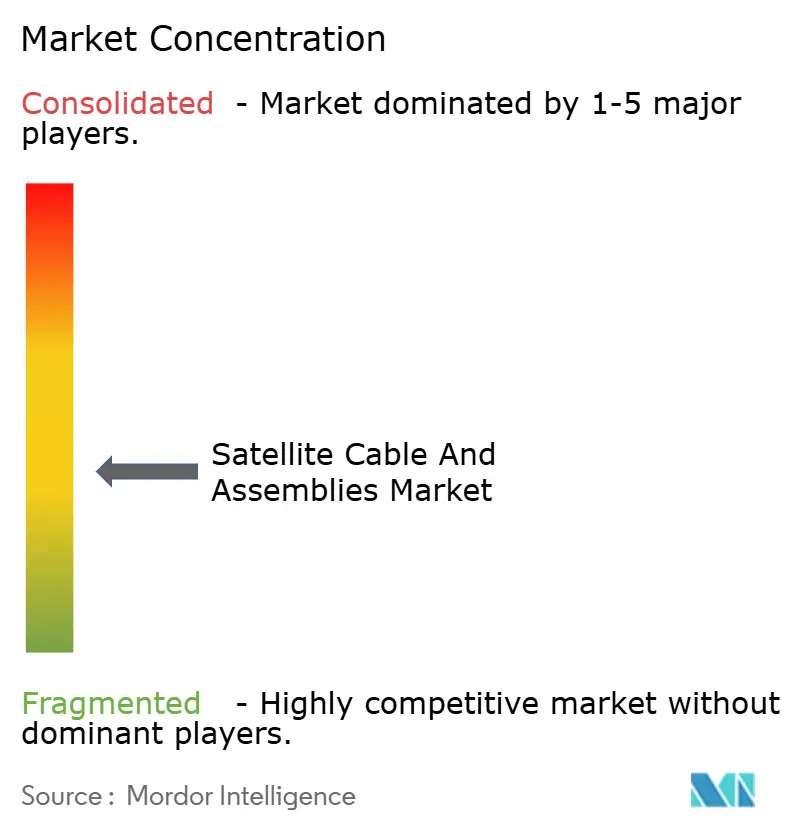
| Market Concentration | Medium |
Major Players *Disclaimer: Major Players sorted in no particular order Image © Mordor Intelligence. Reuse requires attribution under CC BY 4.0. | |

Satellite Cable And Assemblies Market Analysis by Mordor Intelligence
The satellite cable and assemblies market size stands at USD 0.51 billion in 2025 and is forecasted to reach USD 1.43 billion by 2030, reflecting a 23.07% CAGR during 2025-2030. This robust growth is anchored in mass-production LEO constellations, escalating Ku/Ka-band throughput requirements, and rising defense outlays that collectively redefine performance targets and volume expectations for the satellite cable assemblies market. Miniaturized satellite buses and digital payload architectures shrink form factors while multiplying internal interconnect counts, pushing suppliers toward lighter materials and automated manufacturing lines. Defense programs that demand hardened, tamper-resistant harnesses reinforce premium pricing power, whereas Asia-Pacific production hubs inject new competition on cost. Yet qualification costs above USD 500,000 per design and outgassing and PFAS-related material constraints temper the near-term supply response.[1]Source: European Chemicals Agency, “PFAS Restriction Proposal,” echa.europa.eu
Key Report Takeaways
- By cable type, coaxial cables led with 37.80% of the satellite cable assemblies market share in 2024, while fiber-optic cables are projected to expand at a 27.98% CAGR through 2030.
- By assembly type, RF cable assemblies accounted for 42.50% of the satellite cable assemblies market size in 2024, whereas data/signal harnesses recorded the highest 2025-2030 CAGR at 26.65%.
- By subsystem, antenna and RF front-end captured 32.64% revenue in 2024; payload connectivity is forecasted to advance at a 25.45% CAGR to 2030.
- By orbit, LEO platforms commanded 58.90% share of the satellite cable assemblies market size in 2024 and will grow fastest at 24.87% CAGR.
- By application, commercial communications held a 47.10% share in 2024, while Earth observation will register a 27.30% CAGR through 2030.
- By geography, North America led 32.55% of the satellite cable assembly market share in 2024; Asia-Pacific is set to rise at a 27.60% CAGR between 2025 and 2030.
Note: Market size and forecast figures in this report are generated using Mordor Intelligence’s proprietary estimation framework, updated with the latest available data and insights as of January 2026.
Market Trends and Insights
Drivers Impact Analysis of Satellite Cable And Assemblies Market*
| Driver | (~)% Impact on CAGR Forecast | Geographic Relevance | Impact Timeline |
|---|---|---|---|
| Surge in LEO constellation deployments | +4.2% | Global, strong in North America and Europe | Medium term (2-4 years) |
| Demand for high-throughput Ku/Ka-band links | +3.8% | Asia-Pacific and North America | Short term (≤2 years) |
| Satellite bus miniaturization and weight reduction | +2.1% | Global, led by commercial manufacturers | Long term (≥4 years) |
| Defense and government SATCOM spending | +1.9% | North America, Europe, Asia-Pacific | Medium term (2-4 years) |
| On-orbit servicing driving modular cabling | +1.7% | Early adoption in North America and Europe | Long term (≥4 years) |
| Radiation-resistant fiber links inside payloads | +1.5% | Global, science and defense missions | Long term (≥4 years) |
| Source: Mordor Intelligence | |||
Surge in LEO Constellation Deployments
LEO constellations pivot the satellite cable assemblies market toward automobile-style production volumes rather than bespoke aerospace lots. SpaceX manufactures 4.7 million Starlink user terminals annually and operates satellites capable of 1 Tbps downlink, triggering demand for standardized, high-frequency RF harnesses in space and ground equipment. Airbus will build Eutelsat’s first tranche of 100 satellites and a follow-on batch of 340, extending multiyear visibility for European suppliers. Sovereign programs such as the EU Iris² constellation add further momentum by 2030. The volume surge compels cable vendors to automate strip-crimp-test cycles, invest in MES-enabled plants, and secure dual-source material pipelines that tolerate PFAS reformulation risks.
Demand for High-Throughput Ku/Ka-Band Links
Modern Ka-band payloads operate up to 40 GHz, forcing cable assemblies to deliver sub-1 dB/m insertion loss and phase stability under ±3° across −55 °C to +125 °C. Traditional coaxial dielectrics strain at these limits, catalyzing the adoption of low-loss expanded PTFE and air-core designs.[2]Source: NASA, “Outgassing Requirements under ASTM E595,” nasa.gov Digital processors inside software-defined payloads route terabit-scale traffic, prompting fiber-optic interconnects with radiation-hardened glass and hermetic termini. Concurrent growth in ground terminals—exemplified by Starlink’s global rollout—multiplies precision-cut RF jumpers that must survive Arctic cold and desert heat without VSWR drift. Emerging V-band systems will escalate frequency pressure, sustaining a multicycle upgrade path for the satellite cable assemblies market.
Satellite Bus Miniaturization and Weight Reduction
CubeSats under 20 kg and ESPA-class vehicles under 200 kg limit cable volume to mere millimeters of stack height. Designers substitute ultra-thin fluoropolymer jackets and high-density Nano-D connectors to reclaim space, while additive manufacturing embeds raceways into panel ribs.[3]Source: IEEE, “Performance Targets for Ka-Band Cable Assemblies,” ieee.org Electric propulsion frees mass margins for payloads but raises power channel count, requiring lightweight aluminum conductors with silver-plated terminations. Standardized MicroSat chassis spur volume runs of harness topologies that once were custom, allowing the satellite cable assemblies industry to amortize tooling and speed qualification cycles.
Defense and Government SATCOM Spending
The US Space Force and allied agencies procure hard-sealed, TEMPEST-rated harnesses that throttle electromagnetic emanations. Requirements for antijam and anti-tamper features raise shielding braid coverage to greater than 95% and integrate secure fiber running key distribution. Multi-orbit architectures blend commercial capacity with government-owned satellites, so suppliers must meet both MIL-STD-1553 and Ethernet-based OpenVPX interfaces in a single design. NATO programs harmonize specifications, enabling scale yet elevating audit scrutiny. These dynamics sustain high-margin defense lines even as commercial volumes climb.
Restraints Impact Analysis of Satellite Cable And Assemblies Market*
| Restraint | (~)% Impact on CAGR Forecast | Geographic Relevance | Impact Timeline |
|---|---|---|---|
| Space-grade qualification costs | -2.3% | Global, heavier on new entrants | Short term (≤2 years) |
| EU PFAS rules tightening PTFE/PEEK supply | -1.8% | Europe primary, global ripple effect | Medium term (2-4 years) |
| Outgassing limits on lightweight jackets | -1.4% | Global, acute in small satellites | Long term (≥4 years) |
| Added shielding against orbital debris | -1.1% | LEO segments worldwide | Medium term (2-4 years) |
| Source: Mordor Intelligence | |||
Space-Grade Qualification Costs
The ECSS-Q-ST-20-30C harness standard demands vibration, thermal vacuum, insulation resistance, and UV aging tests that cost over USD 500,000 per new design, deterring small firms. NASA’s ASTM E595 outgassing cap of 1% TML and 0.1% CVCM lengthens material screening, stretching time-to-market beyond 12 months. Limited global test chambers create slot shortages and locking capacity during constellation ramp-ups. Start-ups thus enter through commercial off-the-shelf LEO programs first and later pursue deep-space qualifications once cash flow stabilizes.
EU PFAS Rules Tightening PTFE/PEEK Supply
ECHA’s draft restriction covers over 10,000 PFAS, including high-frequency fluoropolymers vital for Ka-band cables. Even with 5-year phase-in periods, upstream resin firms face CapEx for containment that inflates prices and may trim product ranges. IPC’s advocacy underscores insufficient substitutes for −200 °C to +260 °C dielectrics. Non-European satellites still rely on EU-origin PTFE, exposing global programs to the same scarcity risk.
*Our forecasts treat driver/restraint impacts as directional, not additive. The impact forecasts reflect baseline growth, mix effects, and variable interactions.
Satellite Cable And Assemblies Market Segment Analysis
By Cable Type:
Fiber-Optic Cables Lead Growth AccelerationCoaxial assemblies retained 37.80% of the satellite cable assemblies market share in 2024 through entrenched RF pathways. Yet, fiber-optic volumes will rise at a 27.98% CAGR as terabit-class processors overpower copper bandwidth ceilings. Radiation-hardened fiber mitigates single-event upsets and proton darkening for 15-year GEO missions, unlocking higher payload throughput without weight penalties. Advanced expanded PTFE coax keeps a foothold in high-power uplink chains where 100 W per path dissipates heat poorly in fiber connectors. Waveguides remain essential above 40 GHz, though additive-manufactured aluminum variants lower mass by 20%. Power cables gain from all-electric satellites that draw >20 kW, while hybrid multi-core designs pack coax, twisted pair, and fiber under one braid to save tray space, albeit at higher qualification cost.
Fiber assemblies exploit M29504 termini and hermetic feed-throughs that survive −180 °C lunar nights. Asian fabs ramp ribbonizing of radiation-tolerant fibers to meet small-sat volume while Western primes lock multi-year LTAs to secure supply amid PFAS uncertainty.




By Assembly Type:
Data Harnesses Surge on Digital ProcessingRF harnesses delivered 42.50% of 2024 revenue, reflecting their ubiquity in uplink, downlink, and antenna switching chains. Digital transformation shifts momentum to data/signal harnesses, projected at 26.65% CAGR, as software-defined payloads require hundreds of multi-gigabit serial links. These harnesses blend fiber and shielded twinax within micro-circular connectors to achieve 25 Gbps per lane while meeting 2,000-cycle mating life. Power harnesses enlarge cross-section for Hall thrusters, drawing up to 6 kW, whereas wire harnesses persist for housekeeping functions but commoditize under LEO volume pressure.
ECSS traceability calls for complete lot-level serialization of every crimp contact, pushing suppliers to RFID-tag assemblies and integrating SPC dashboards. Automation adoption lags in power harnesses due to thick conductors that still need manual lug terminations, constraining labor reduction potential.
By Subsystem:
Payload Connectivity Drives Market EvolutionAntenna and RF front-end subsystems commanded 32.64% revenue in 2024 because bent-pipe GEO spacecraft still rely on fixed gain amplifiers, rotary joints, and long waveguide runs that consume premium coax assemblies. Cabling here must hold insertion-loss drift below 0.2 dB across a 200 °C swing, so suppliers use expanded-PTFE dielectrics and silver-plated braid, keeping average price per meter high. Digital beamforming chips, onboard routers, and compression engines inside next-generation payloads multiply the number of high-speed links, driving payload interconnect value to rise at a 25.45% CAGR through 2030. Each digital slice adds four to six duplex fiber routes plus twinax command lines, quickly eclipsing legacy RF counts.
Modular servicing concepts push designers toward blind-mate, zero-g connectors that tolerate 100 dock-undock cycles without fretting wear, stimulating fresh IP across latch, keying, and debris-tolerant seal technologies. Bus-structure harnesses shrink by replacing copper with lightweight aluminum conductors, but still keep PFA jackets for micrometeoroid shielding, preserving dielectric integrity after a micrometeoroid grazes. Propulsion loops integrate PTFE-insulated thermocouples along Xenon feed lines so operators can throttle Hall thrusters within ±1 °C, aligning cabling trends with electric-propulsion penetration. Avionics boxes migrate to distributed architectures that localize processing near sensors, shortening some runs while increasing total node count, which nets positive volume for the satellite cable assemblies market.

By Satellite Orbit:
LEO Dominance Reshapes IndustryLow-Earth-orbit (LEO) platforms captured 58.90% share in 2024 and carry a forecast of 24.87% CAGR, forcing suppliers to compress design cycles from 36 months to 12 months and pivot toward high-mix automation that supports hundreds of buses annually. Cable armor weight falls by 15-20% because radiation levels and thermal swings are milder than GEO, yet debris flux near 550 km triggers double-wrapped braid or stainless-steel helical guards on critical trunks. Each 200-kg LEO bus still demands roughly 45 m of RF, data, and power harnessing, but the aggregate constellation scale multiplies overall meterage, anchoring long-run revenue visibility through 2030.
Geostationary satellites remain lucrative, with USD 5-10 million cable orders per spacecraft for customized waveguide, high-power coax, and long-haul power trunks, even though annual unit counts hover near 15. Medium-Earth-orbit (MEO) navigation fleets sustain niche demand for radiation-hardened fiber distributing Rubidium-clock signals. At the same time, Highly Elliptical Orbits necessitate exotic polyimide shields that survive −150 °C to +150 °C orbital extremes, fetching premium margins. Orbit diversification obliges vendors to maintain parallel product lines, lightweight braids for LEO, deep-space fluoropolymers for GEO/MEO as a hedge against constellation pacing risk, ensuring balanced capacity utilization across mixed-orbit backlogs.
By Application:
Earth Observation Accelerates Commercial GrowthCommercial communications absorbed 47.10% of 2024 revenue thanks to broadband constellations that install dual-polarized Ku and steerable Ka spot beams. Each path demands low-VSWR semi-rigid coax plus multi-core fiber for router traffic. Every user terminal adds another trio of precision-cut jumpers, extending value beyond the spacecraft and cushioning revenue against launch delays. Sliding-scale subscription models spur operators to prebuild spare satellites, locking multiyear cable agreements that stabilize factory loading for tier-one suppliers.
Earth observation is poised for a 27.30% CAGR as SAR and optical fleets chase daily global revisit, embedding 4-6 kW RF payloads that require low-loss Ka-band harnesses and radiation-hardened fiber for 3 Gbps data dumps. Navigation and timing programs such as GPS III and Galileo 2.0 retain steady investment in precision coax feeds that must limit phase noise to 0.1 ps RMS. Military customers specify EMI-quiet harnesses and TEMPEST shielding, accepting 20% price uplifts for compliance, while scientific spacecraft adopt ultra-stable fiber for gravitational-wave detection, sustaining a boutique yet technically influential demand slice that often seeds next-generation materials for commercial adoption.
Geography Analysis
North America Satellite Cable and Assemblies Market
North America retained a 32.55% share in 2024 owing to Starlink production, NASA programs, and an integrated qualification ecosystem that speeds harness iteration. Suppliers like TE Connectivity and Gore co-locate design, plating, and testing, compressing lead times for constellation cadence. US Space Force budgets secure demand for radiation-hardened power harnesses across protected satellite programs. Canada adds small-sat integration for weather missions, while Mexico’s maquiladora plants deliver sub-assemblies that feed into the US final build.
APAC Satellite Cable and Assemblies Market
Asia-Pacific registers the highest 27.60% CAGR outlook, propelled by China’s multi-orbital Guowang network, India’s SmallSat boom, and Japan’s SAR export drive. Domestic manufacturing incentives fund new PTFE extrusion and fiber draw towers to localize supply and de-risk PFAS exposure. Kratos data indicates regional SATCOM revenues passed USD 21 billion in 2023, yet capacity oversupply signals room for aggressive service pricing that indirectly lifts terminal harness volumes.
EMEA and South America Satellite Cable and Assemblies Market
Europe balances a 20.57% share through ESA missions, Eutelsat’s LEO plan, and sustained GEO bus output at Airbus Toulouse. ECSS harmonization helps SMEs export, but PFAS rules threaten dielectric cost inflation. The Iris² program secures forward demand, while Eastern European contract manufacturers capture labor-intensive harness builds under offset agreements. South America plus Middle East and Africa contribute under 10% combined; they import qualified assemblies for domestic ground segment rollouts but start to license assembly IP for future sovereign programs.


Competitive Landscape
The satellite cable assemblies market is moderately fragmented, reflecting high barriers but multiple specialized niches. TE Connectivity dominates space-grade coax and fiber termini portfolios, Radiall leverages SMPM-HDR connectors up to 65 GHz, and Smiths Interconnect scales quadrature-phase harnesses for digital payloads. Winchester Interconnect sustains MIL-spec rugged lines, while Gore’s expanded PTFE dielectric sets insertion-loss benchmarks.
Strategic moves include BizLink acquiring Cable Connection in 2024 to bolster QPL-approved harness capacity. Amphenol RF launched Ka-band cable lines with phase-matched sets for beamforming arrays in 2025. Element Materials Technology doubled thermal-vacuum chambers to relieve qualification bottlenecks in 2024. Consolidation aims to integrate testing, plating, and over-molding under one roof, cutting lead times demanded by LEO schedules. Emerging Asian entrants pursue ITAR-free niches, but full ECSS compliance remains a hurdle, preserving Western players’ pricing power.
Satellite Cable And Assemblies Industry Leaders
TE Connectivity plc
Rosenberger Hochfrequenztechnik GmbH & Co. KG
W. L. Gore & Associates, Inc.
Meggitt Ltd. (Parker-Hannifin Corporation)
Smiths Interconnect Group Limited (Smiths Group plc)
- *Disclaimer: Major Players sorted in no particular order
Satellite Cable And Assemblies Market Companies Covered in this Report
- TE Connectivity plc
- Radiall, SA
- Smiths Interconnect Group Limited (Smiths Group plc)
- Rosenberger Hochfrequenztechnik GmbH & Co. KG
- Times Microwave Systems (Amphenol Corporation)
- W. L. Gore & Associates, Inc.
- Axon' CABLE SAS
- HUBER+SUHNER AG
- Belden Inc.
- MegaPhase, LLC
- TPC Engineering Holdings, LLC, d/b/a Trexon
- Cinch Connectivity Solutions, Inc. (Bel Fuse Inc.)
- Meggitt Ltd. (Parker-Hannifin Corporation)

Recent Industry Developments in Satellite Cable And Assemblies Market
- April 2025: Smiths Interconnect strategically expanded its cable harness production capacity at its Tunisia facility to enhance EMEA operations. This investment aligns with the company’s goal to meet growing demand for high-quality cable harness solutions across aerospace, defense, automotive, and construction machinery industries. Cable harnesses, essential for transmitting signals and power, are critical to various applications. By strengthening its product offerings with high-performance solutions designed for harsh environments, Smiths Interconnect reinforces its market position and commitment to innovation.
- December 2024: Molex, a global electronics leader, acquired AirBorn, a rugged connectors and electronic components manufacturer for mission-critical applications in aerospace, defense, and other industries. This strategic move enhances Molex’s product portfolio and expands its reach into aerospace, defense, space exploration, and commercial air sectors. The combined company, with over 50,000 employees and 85 plants in 20 countries, will leverage Molex’s global manufacturing strength and AirBorn’s expertise under the leadership of AirBorn’s Michael Cole to drive innovation and growth.


Global Satellite Cable And Assemblies Market Report Scope
| Coaxial Cables |
| Fiber-Optic Cables |
| Waveguides |
| Power Cables |
| Hybrid/Multi-core Cables |
| RF Cable Assemblies |
| Wire Harnesses |
| Power Harnesses |
| Data/Signal Harnesses |
| Payload |
| Bus (Structure and Thermal) |
| Antenna and RF Front-End |
| Power System |
| Propulsion |
| Avionics |
| Low Earth Orbit (LEO) |
| Medium Earth Orbit (MEO) |
| Geostationary Orbit (GEO) |
| Highly Elliptical Orbit (HEO) |
| Commercial Communications |
| Earth Observation |
| Navigation and Timing |
| Military and Defense |
| Scientific Research |
| Others |
| North America | United States | |
| Canada | ||
| Mexico | ||
| Europe | United Kingdom | |
| France | ||
| Germany | ||
| Italy | ||
| Russia | ||
| Rest of Europe | ||
| Asia-Pacific | China | |
| India | ||
| Japan | ||
| South Korea | ||
| Rest of Asia-Pacific | ||
| South America | Brazil | |
| Rest of South America | ||
| Middle East and Africa | Middle East | Saudi Arabia |
| Israel | ||
| United Arab Emirates | ||
| Rest of Middle East | ||
| Africa | South Africa | |
| Rest of Africa | ||
| By Cable Type | Coaxial Cables | ||
| Fiber-Optic Cables | |||
| Waveguides | |||
| Power Cables | |||
| Hybrid/Multi-core Cables | |||
| By Assembly Type | RF Cable Assemblies | ||
| Wire Harnesses | |||
| Power Harnesses | |||
| Data/Signal Harnesses | |||
| By Subsystem | Payload | ||
| Bus (Structure and Thermal) | |||
| Antenna and RF Front-End | |||
| Power System | |||
| Propulsion | |||
| Avionics | |||
| By Satellite Orbit | Low Earth Orbit (LEO) | ||
| Medium Earth Orbit (MEO) | |||
| Geostationary Orbit (GEO) | |||
| Highly Elliptical Orbit (HEO) | |||
| By Application | Commercial Communications | ||
| Earth Observation | |||
| Navigation and Timing | |||
| Military and Defense | |||
| Scientific Research | |||
| Others | |||
| By Geography | North America | United States | |
| Canada | |||
| Mexico | |||
| Europe | United Kingdom | ||
| France | |||
| Germany | |||
| Italy | |||
| Russia | |||
| Rest of Europe | |||
| Asia-Pacific | China | ||
| India | |||
| Japan | |||
| South Korea | |||
| Rest of Asia-Pacific | |||
| South America | Brazil | ||
| Rest of South America | |||
| Middle East and Africa | Middle East | Saudi Arabia | |
| Israel | |||
| United Arab Emirates | |||
| Rest of Middle East | |||
| Africa | South Africa | ||
| Rest of Africa | |||


Key Questions Answered in the Report
What is the current value of the satellite cable assemblies market?
The satellite cable assemblies market size is USD 0.51 billion in 2025 and is projected to reach USD 1.43 billion by 2030.
Which region leads in revenue contribution?
North America holds 32.55% satellite cable assemblies market share in 2024 due to Starlink manufacturing and robust defense budgets.
Which cable type is growing fastest?
Fiber-optic assemblies are forecasted to expand at 27.98% CAGR from 2025-2030, benefiting from terabit-class digital payloads.
How do PFAS regulations affect suppliers?
EU PFAS restrictions could curtail PTFE and PEEK availability, raising costs and prompting material substitution programs.
What is the primary driver behind market growth?
Mass deployment of LEO constellations requiring automated, high-volume cable assembly production is the leading growth catalyst.
Which application segment shows the highest future growth?
Earth observation is expected to post a 27.30% CAGR, driven by optical and SAR imaging constellations seeking daily global coverage.
Page last updated on:





