
Market Overview
| Study Period | 2019 - 2031 |
|---|---|
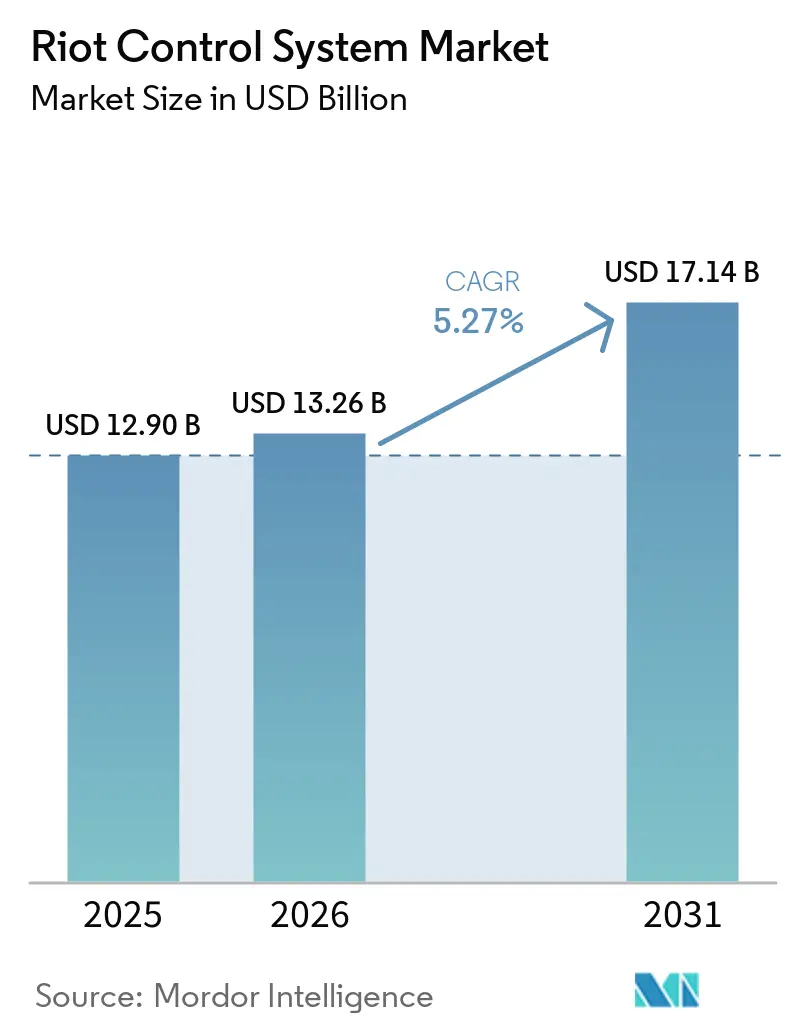
| Market Size (2026) | USD 13.26 Billion |
| Market Size (2031) | USD 17.14 Billion |
| Growth Rate (2026 - 2031) | 5.27 % |
| Fastest Growing Market | Asia-Pacific |
| Largest Market | North America |
| Market Concentration | Medium |
Major Players *Disclaimer: Major Players sorted in no particular order Image © Mordor Intelligence. Reuse requires attribution under CC BY 4.0. | |
Riot Control System Market Analysis by Mordor Intelligence
The riot control system market size was valued at USD 12.90 billion in 2025, and is forecast to grow from USD 13.26 billion in 2026 to reach USD 17.14 billion by 2031, at a 5.27% CAGR during the forecast period (2026-2031). Civil unrest, large public gatherings, and persistent border-security needs are driving demand across police, paramilitary, and specialized forces, where buyers must maintain operational readiness for a range of incidents. Agencies in the riot control system market are placing greater value on systems that can record decisions, communications, and deployments during an incident, especially when subsequent reviews require clear evidence. This favors suppliers that pair less-lethal equipment with surveillance, command, and evidence-management tools. Procurement in the market is also moving beyond single hardware purchases because agencies must align launchers, ammunition, protective equipment, training, documentation, maintenance arrangements, and established operating procedures. Human-rights reviews, export controls, and component constraints can slow deliveries, but they also shift spending toward documented and interoperable systems.
Key Report Takeaways
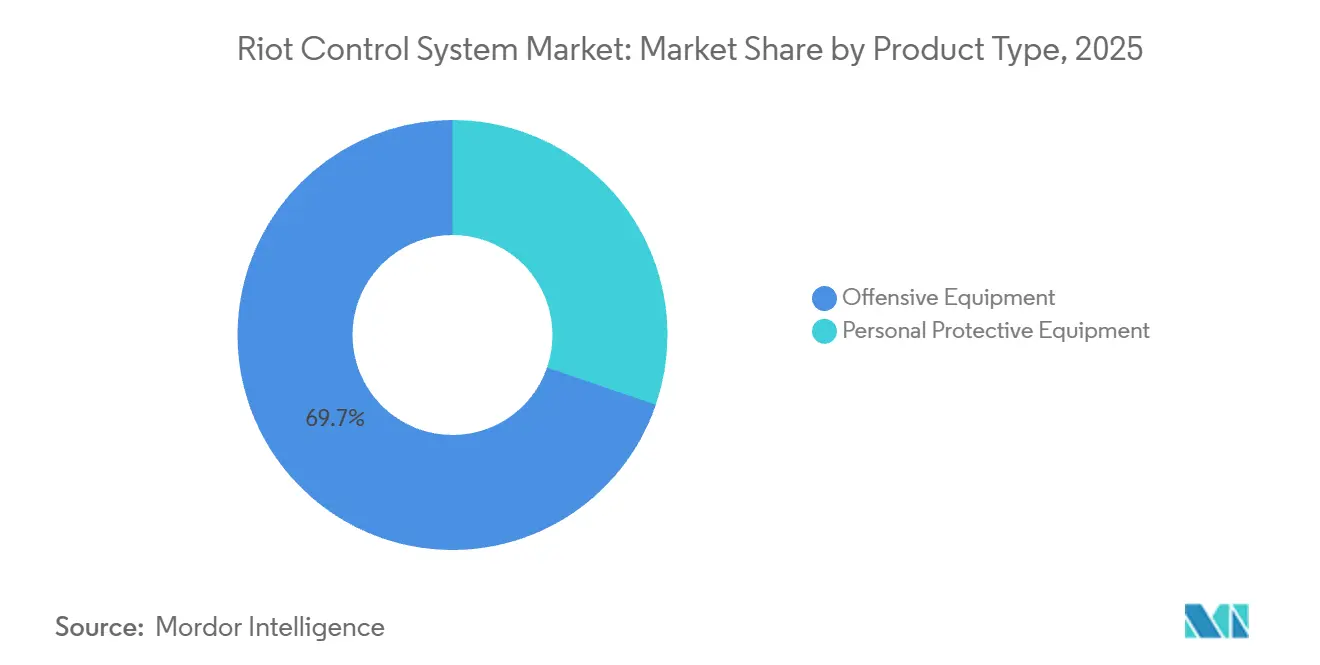
- By product type, offensive equipment held 69.74% of the riot control system market share in 2025, while personal protective equipment is forecast to grow at a 6.67% CAGR through 2031.
- By end-user, law enforcement held 63.87% of the riot control system market share in 2025, while special forces is forecast to grow at a 6.15% CAGR through 2031.
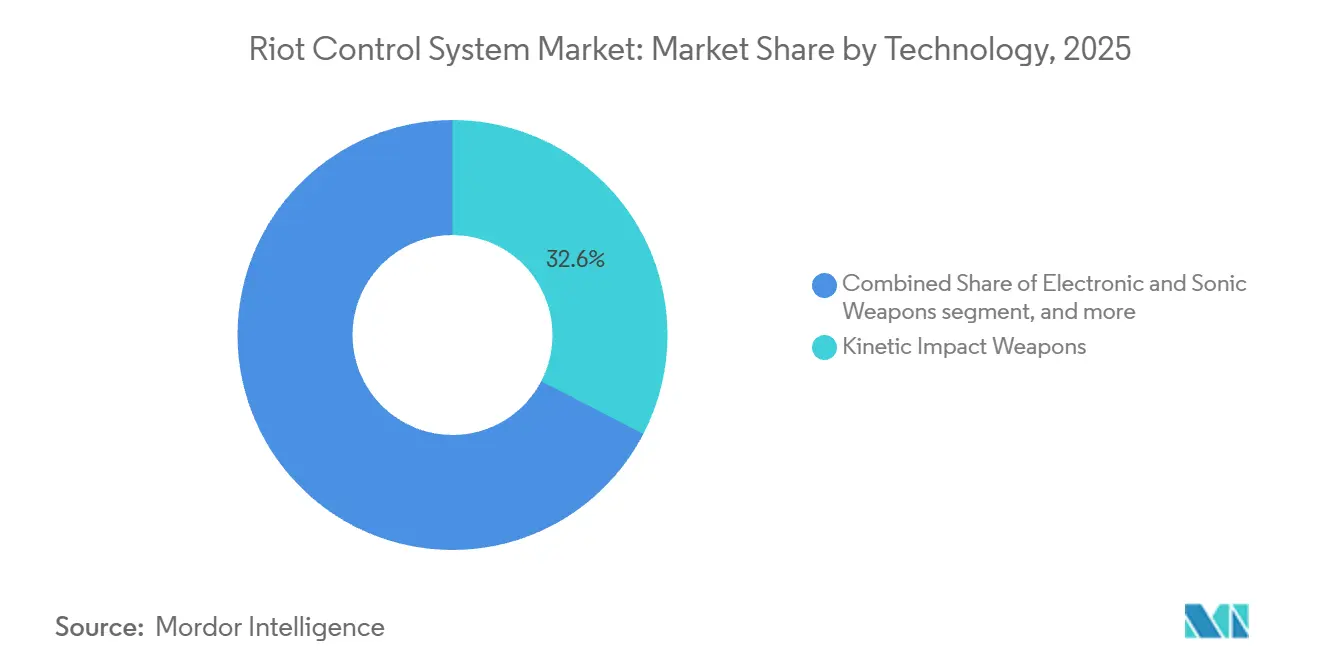
- By technology, kinetic impact weapons held 32.62% of revenue in 2025, while electronic and sonic weapons are forecast to grow at a 6.52% CAGR through 2031.
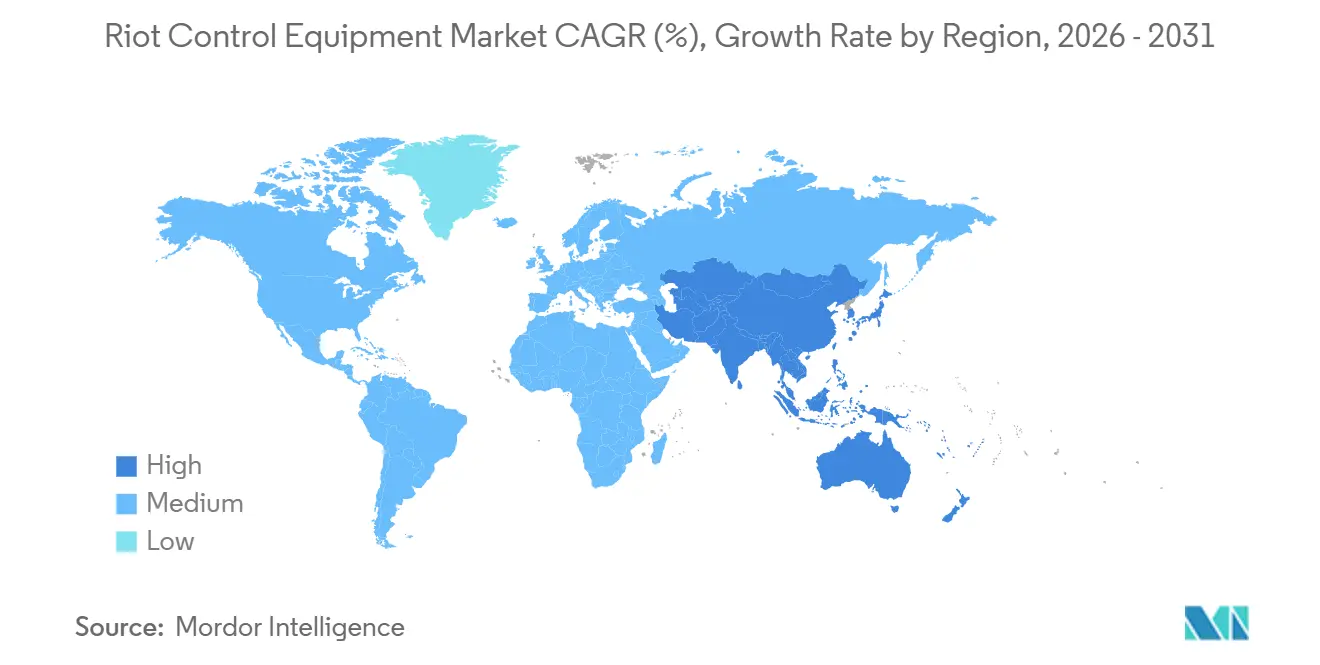
- By geography, North America held 29.01% revenue share in 2025, while Asia-Pacific is forecast to grow at a 6.09% CAGR through 2031.
Note: Market size and forecast figures in this report are generated using Mordor Intelligence’s proprietary estimation framework, updated with the latest available data and insights as of January 2026.
Global Riot Control System Market Trends and Insights
Drivers Impact Analysis*
| Driver | (~) % Impact on CAGR Forecast | Geographic Relevance | Impact Timeline |
|---|---|---|---|
| Civil unrest, protests, and large public gatherings | +1.50% | Global | Short term (≤ 2 years) |
| Modernization of law-enforcement and public-order forces | +1.20% | North America, Europe, Asia-Pacific | Medium term (2-4 years) |
| Asia-Pacific border-security and urban-safety procurement | +0.80% | Asia-Pacific core, spill-over to Middle East and Africa | Medium term (2-4 years) |
| De-escalation mandates and accountability requirements | +0.70% | North America and European Union | Long term (≥ 4 years) |
| Integrated evidence, surveillance, and command platforms | +0.50% | Global | Medium term (2-4 years) |
| Compatibility of less-lethal ammunition with installed launchers | +0.30% | North America, European Union | Short term (≤ 2 years) |
| Source: Mordor Intelligence | |||
Civil Unrest, Protests, and Large Public Gatherings
Protest frequency and intensity are prompting law enforcement agencies in the riot control system market to review crowd-management readiness more often, including their stock of munitions, protective equipment, and communication tools. ACLED recorded more than 173,900 protests and riots globally between mid-November 2024 and mid-November 2025, which represented a nearly 5% year-over-year increase. The organization also reported Gen-Z-led mass mobilizations in more than 70 countries during this period. In the US, Princeton Bridging Divides recorded nearly 20,000 demonstrations in 2025 and found that less-lethal weapons were used in 22% of protests with recorded police engagement. The same source described that deployment rate as almost 4 times the 2024 level. The market, therefore, benefits when suppliers can meet surge orders while supporting installed launcher platforms.
Modernization of Law-Enforcement and Public-Order Forces
Modernization programs create market demand that continues beyond the response to an individual public event, because public agencies commonly plan purchases around replacement schedules and standardized training. The US Customs and Border Protection awarded a less-lethal specialty munitions contract in April 2026 valued at up to USD 50 million. The contract covered 123 product types across 10 categories, indicating the breadth of equipment that agencies procure together. Such requirements commonly link equipment standardization with operator training, supply continuity, and fleet-level replacement planning. Suppliers with established frameworks can benefit after an agency selects a hardware platform. The riot control system industry also benefits when agencies replace compatible ammunition alongside related hardware.
Asia-Pacific Border-Security and Urban-Safety Procurement
Asia-Pacific procurement is supporting the riot control system market through paramilitary modernization, urban security needs, and border operations, which require different products for local police and specialized units. State-level public-order agencies can make procurement decisions that are relevant to the wider market landscape, particularly when they need to replace vehicle fleets, communications equipment, and protective products. The source draft reported an August 2026 tender from the Uttar Pradesh Home Department for 100 mob and riot control vehicles, but the cited tender platform is not used here because it is a commercial aggregator. China also maintains domestic production capacity that supports a separate public-security technology ecosystem. Regional agencies are increasingly evaluating acoustic hailing and surveillance equipment for coast guard, navy, police, and border applications. This creates room for suppliers that can meet domestic qualification requirements and operate through local production or distribution partnerships.
De-Escalation Mandates and Accountability Requirements
De-escalation rules are increasing the importance of equipment in the riot control system market that supports proportionate and documented use of force, while providing supervisors with information to review events after deployment. A Stanford Law review of policies in the 100 largest US cities found that, in 2025, 79% of departments required de-escalation techniques before force. The review found that 28% restricted chemical agents to situations involving an imminent threat of crowd violence. These policies favor acoustic communication, body-worn camera integration, precision launchers, and other systems that preserve an auditable deployment record. They also raise the value of software that connects surveillance, command decisions, and post-incident evidence. The market may, therefore, see stronger demand for integrated tools even where limits apply to particular munitions.
Restraints Impact Analysis*
| Restraint | (~) % Impact on CAGR Forecast | Geographic Relevance | Impact Timeline |
|---|---|---|---|
| Human-rights, liability, and use-of-force exposure | -0.80% | North America & European Union | Medium term (2-4 years) |
| Chemical, environmental, and export-control restrictions | -0.50% | EU, Global | Long term (≥ 4 years) |
| Variable effectiveness and recertification requirements | -0.40% | North America, European Union | Medium term (2-4 years) |
| Procurement fragmentation and interoperability costs | -0.30% | South America, Middle East and Africa | Long term (≥ 4 years) |
| Source: Mordor Intelligence | |||
Human-Rights, Liability, and Use-of-Force Exposure
Liability risk and human rights scrutiny can extend the time required for the procurement review of riot control systems, particularly when agencies need legal guidance before approving a new product or operating method. CIVICUS documented excessive force against protesters in at least 67 countries during 2025. This scrutiny can narrow the products that agencies approve, even when funding remains available. The Uppsala Conflict Data Program recorded 244,600 fatalities from organized violence in 2025, compared with 187,000 in 2024. This environment makes use-of-force incidents subject to immediate public, legal, and policy attention. The market is consequently moving toward higher-value systems that better document equipment use, even when volume growth is constrained.
Chemical, Environmental, and Export-Control Restrictions
Chemical riot control agents in the riot control system market face overlapping export, environmental, and use restrictions that can alter product selection, distributor responsibilities, and delivery timing. EU Regulation 2019/125 controls exports of goods that could be used for torture or cruel treatment, including riot control agents. The source material states that individual end-user certifications can add 6 to 18 months to export timelines. In the US, ECCN 1C607 is subject to Chemical Weapons Convention requirements under the Export Administration Regulations. The UK government reported that 11 organizations held individual production or possession licenses under Schedule 1 in 2025. Suppliers that can manage compliance and provide alternatives with lower persistence profiles are better placed to serve regulated customers.
*Our forecasts treat driver/restraint impacts as directional, not additive. The impact forecasts reflect baseline growth, mix effects, and variable interactions.
Segment Analysis
By Product Type: Offensive Equipment Drives Revenue, PPE Remains Foundational
Offensive equipment captured 69.74% of the riot control system market share in 2025, giving it the leading position within the category. This position reflects long-standing inventories of launchers, chemical rounds, kinetic projectiles, and directed-energy systems. Ammunition is a frequently replenished item within this category. That recurring requirement can temper the uneven timing of hardware orders. The April 2026 Customs and Border Protection contract covered hand-delivered pyrotechnic munitions, impact munitions, and other less-lethal products.
Personal protective equipment, including vests, helmets, gas masks, and shields, is forecast to grow at a 6.67 CAGR through 2031. Thus, it remains an essential complement to the riot control system market, even when agencies prioritize equipment for managing crowds. It represents the remaining product share and can be required by safety and compliance rules. Safariland supplied its AMP-1X ballistic helmets to the Philadelphia Police SWAT Unit in January 2025. The helmets were certified under the FBI-DEA Ballistic Helmet Protocol 2024 V.2 and were 20% lighter than the earlier AMP-1TP model. Agencies that update launchers may also update protective equipment for the officers who use them.

By End-User: Law Enforcement Anchors Spend, Special Forces Expand Scope
Law enforcement agencies accounted for 63.87% of revenue in 2025, making them the principal end-user segment of the riot control system market. Their demand is supported by municipal, state, and national agreements that often combine equipment with certified training. These agreements generally cover multiyear replenishment and replacement needs. Special forces units are forecast to grow at a 6.15% CAGR from 2026 to 2031. Their use cases include border security, counterinsurgency, and hostage-rescue operations where less-lethal options can supplement lethal force.
The distinction between law enforcement and special forces procurement is becoming less clear. Sourcewell issued a request for proposals in July 2026 covering conducted energy weapons, less-lethal equipment, and related accessories.[1] Its scope covered law enforcement, homeland security, and correctional institutions. Cooperative purchasing gives smaller agencies access to agreements negotiated at scale. Correctional institutions also require products suited to confined areas, shorter engagement ranges, and reduced secondary exposure.
By Technology: Kinetic Impact Weapons Lead, Electronics Reshape the Procurement Frontier
Kinetic impact weapons form the broadest technology base within agency inventories and remain important to the riot control system market because officers already know their operating procedures and supply requirements. Launcher and projectile systems include 40mm launchers, rubber-bullet guns, and bean-bag shotguns. Their continued use reflects familiar operating procedures and requirements for equivalent specifications. Chemical agents remain an important part of technology spending. However, this category faces the greatest exposure to regulatory and export constraints.
Electronic and sonic weapons are forecast to expand at a 6.52% CAGR from 2026 to 2031, the fastest rate among technology categories. Long-range acoustic devices, directed-energy weapons, and drone-mounted electronic systems drive the market size for electronic and sonic weapons. Genasys received a USD 9 million LRAD order from the US Army for the CROWS program in September 2025. Genasys also announced USD 1.40 million in orders from Australia, Japan, Thailand, Vietnam, Papua New Guinea, Lithuania, and Latvia in August 2026. Directed-energy products remain in an earlier stage of commercialization but continue to attract research and development interest from defense suppliers.
Geography Analysis
North America held 29.01% of revenue in 2025, placing it at the center of the riot control system market. The region brings together major producers of less-lethal systems and federal, state, and municipal buyers. Federal agencies provide a steady base of framework procurement for tactical and public-safety equipment. Canada’s demand is more concentrated in municipal policing and use-of-force reform needs. The region’s agencies are also investing in acoustic hailing and body-worn camera integration. This procurement depth supports larger and more complex contracts than many other national markets.
Asia-Pacific is forecast to grow at a 6.09% CAGR through 2031 and is expected to increase its contribution to the riot control system market as public safety and border requirements evolve. Police modernization, border operations, and domestic procurement programs support the region. India has a large policing base, and state-level agencies can influence replacement cycles. China has domestic production capacity that reduces its reliance on Western suppliers. Genasys received a USD 2 million order from the Republic of Singapore Navy in February 2026 for LRAD 950NXT systems on USVs.[2] The order shows the use of acoustic systems across naval and border-security applications.
Europe remains a major producer and buyer of specialized public-order systems in the riot control system market, although compliance requirements affect both product approvals and export processes. Regulatory compliance limits growth in Western Europe, while concerns about civil unrest support ongoing procurement. The market has demand across Germany, France, the UK, Italy, and Russia. EU Regulation 2019/125 affects the export of riot control agents and can lengthen cross-border sales processes. South America, and the Middle East and Africa remain smaller but growing areas. Their demand is linked to event security, border protection, internal security, water-cannon vehicles, and acoustic warning systems.
Competitive Landscape
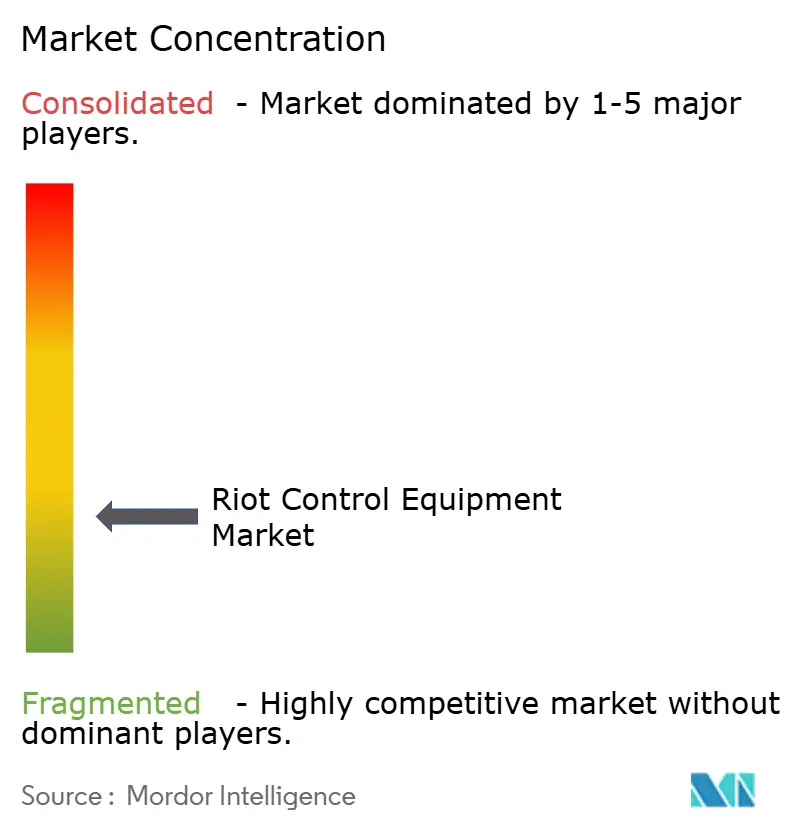
The riot control system market is moderately fragmented across individual equipment categories, because its product range includes munitions, protective equipment, acoustic systems, communications products, and armored vehicles. It is more consolidated among suppliers that combine hardware, software, and evidence-management capabilities. Axon and Safariland maintain positions in the premium US segment through connected platforms and established agency relationships. Axon’s product ecosystem includes conducted energy weapons, body cameras, and evidence tools. Safariland launched SafariMesh, a decentralized mesh communications system for tactical operations, in January 2026.[3] These offerings can strengthen customer retention when agencies seek integrated deployment and communications capabilities.
Genasys is expanding its international position in the riot control system market through LRAD systems for military, public safety, and critical infrastructure users, where long-range communication supports a range of operational settings. In September 2026, Genasys announced a USD 1.30 million follow-on order for mobile LRAD kits from the US National Guard. The company stated that National Guard orders had reached a cumulative USD 8.50 million. It also received a USD 2.40 million follow-on order for critical infrastructure protection in August 2026. These orders show how acoustic systems are being used beyond conventional crowd-control deployments.
Mid-tier suppliers compete in the riot control system market by offering specialized launchers, armored vehicles, and regional delivery capabilities to meet local preferences and shorter procurement timelines. Byrna agreed in July 2026 to acquire HERO Defense Systems assets. The transaction added compact PAVA-filled irritant launchers and pepper-gel devices to Byrna’s portfolio. Katmerciler and STREIT compete for armored riot-control vehicles, where procurement preferences may favor regional suppliers. Combined Systems remains an established less-lethal munitions supplier to US military and law enforcement customers. The riot control system industry remains difficult for new entrants because agencies value tested equipment, training support, and continuity of supply.
Riot Control System Industry Leaders
-
Axon Enterprise, Inc.
-
Safariland, LLC
-
EDGE Group PJSC
-
FN HERSTAL (FN Browning Group)
-
Combined Systems, Inc.
- *Disclaimer: Major Players sorted in no particular order
Recent Industry Developments
- September 2026: Genasys Inc. announced a USD 1.30 million follow-on order from the US National Guard for mobile Long Range Acoustic Device (LRAD) kits. This brings the National Guard's cumulative investment in LRAD systems and accessories to USD 8.50 million. With further orders anticipated, mobile LRAD kits remain integrated into National Guard inventories across every US state and territory for emergency and security operations.
- August 2026: Genasys secured a USD 2.40 million follow-on critical infrastructure protection (CIP) order from one of the largest utility companies in the US. The order builds upon a prior USD 2 million installation to deploy remotely operated LRAD systems at additional power substations.
Global Riot Control System Market Report Scope
The riot control system market encompasses equipment and solutions used by law enforcement agencies, special forces, border security units, and related public security organizations to manage crowds, maintain public order, and respond to civil unrest situations.
The riot control system market is segmented by product type, end-user, technology, and geography. By product type, the market is segmented into personal protective equipment and offensive equipment. By end-user, the market is segmented into law enforcement and special forces. By technology, the market is segmented into chemical agents, electronic and sonic weapons, kinetic impact weapons, and others. The report also covers the market sizes and forecasts for the riot control system market in major countries across different regions. For each segment, the market size is provided in terms of value (USD).
By Product Type
| Personal Protective Equipment | Vests | |
| Helmets | ||
| Gas Masks | ||
| Shields | ||
| Offensive Equipment | Area Denial | Anti-vehicle |
| Anti-personnel | ||
| Ammunition | Rubber Bullets | |
| Wax Bullets | ||
| Plastic Bullets | ||
| Bean Bag Rounds | ||
| Sponge Grenade | ||
| Explosives | Flash Bang Grenades | |
| Sting Grenades | ||
| Gases and Sprays | Water Cannons | |
| Scent-based Weapons | ||
| Tear Gas | ||
| Pepper Spray | ||
| Directed Energy Weapons | ||
| Electroshock Weapons | ||
| Other Offensive Equipment | ||
By End-User
| Law Enforcement |
| Special Forces |
By Technology
| Electronic and Sonic Weapons |
| Kinetic Impact Weapons |
| Chemical Agents |
| Others |
By Geography
| North America | United States | |
| Canada | ||
| Mexico | ||
| Europe | Germany | |
| United Kingdom | ||
| France | ||
| Italy | ||
| Russia | ||
| Rest of Europe | ||
| Asia-Pacific | China | |
| India | ||
| Japan | ||
| South Korea | ||
| Rest of Asia-Pacifc | ||
| South America | Brazil | |
| Argentina | ||
| Rest of South America | ||
| Middle East and Africa | Middle East | Saudi Arabia |
| United Arab Emirates | ||
| Israel | ||
| Rest of Middle East | ||
| Africa | South Africa | |
| Rest of Africa | ||
| By Product Type | Personal Protective Equipment | Vests | |
| Helmets | |||
| Gas Masks | |||
| Shields | |||
| Offensive Equipment | Area Denial | Anti-vehicle | |
| Anti-personnel | |||
| Ammunition | Rubber Bullets | ||
| Wax Bullets | |||
| Plastic Bullets | |||
| Bean Bag Rounds | |||
| Sponge Grenade | |||
| Explosives | Flash Bang Grenades | ||
| Sting Grenades | |||
| Gases and Sprays | Water Cannons | ||
| Scent-based Weapons | |||
| Tear Gas | |||
| Pepper Spray | |||
| Directed Energy Weapons | |||
| Electroshock Weapons | |||
| Other Offensive Equipment | |||
| By End-User | Law Enforcement | ||
| Special Forces | |||
| By Technology | Electronic and Sonic Weapons | ||
| Kinetic Impact Weapons | |||
| Chemical Agents | |||
| Others | |||
| By Geography | North America | United States | |
| Canada | |||
| Mexico | |||
| Europe | Germany | ||
| United Kingdom | |||
| France | |||
| Italy | |||
| Russia | |||
| Rest of Europe | |||
| Asia-Pacific | China | ||
| India | |||
| Japan | |||
| South Korea | |||
| Rest of Asia-Pacifc | |||
| South America | Brazil | ||
| Argentina | |||
| Rest of South America | |||
| Middle East and Africa | Middle East | Saudi Arabia | |
| United Arab Emirates | |||
| Israel | |||
| Rest of Middle East | |||
| Africa | South Africa | ||
| Rest of Africa | |||
Key Questions Answered in the Report
What is the projected size of the riot control system market by 2031?
The eiot control system market is forecast to reach USD 17.14 billion by 2031, after being valued at USD 13.26 billion in 2026 and growing at a 5.27% CAGR from 2026.
Which product category leads spending on riot control systems?
Offensive equipment held 69.74% of revenue in 2025. Its position reflects recurring replenishment demand for ammunition and launcher-related products, alongside agency inventories of kinetic and chemical systems.
Which end user is growing fastest through 2031?
Special forces units are forecast to grow at a 6.15% CAGR through 2031. Border security, counterinsurgency, and specialized operations are widening the use of less-lethal capabilities in this end-user group.
Which technology is growing fastest in riot control systems?
Electronic and sonic weapons are forecast to grow at a 6.52% CAGR through 2031. Long-range acoustic devices, conducted energy weapons, and drone-mounted electronic systems support this technology category.
Which region has the largest share of riot control demand?
North America held 29.01% of demand in 2025. Federal, state, and municipal procurement channels, together with a large base of less-lethal system suppliers, support its leading regional position.
What factors may limit adoption of riot control equipment?
Human-rights scrutiny, liability exposure, chemical-agent controls, and export restrictions can lengthen approval and delivery timelines. Agencies may then prefer systems with stronger documentation, product compatibility, and compliance support.