
Battlefield Management Systems Market Size and Share
Market Overview
| Study Period | 2020 - 2031 |
|---|---|
| Market Size (2026) | USD 12.45 Billion |
| Market Size (2031) | USD 15.38 Billion |
| Growth Rate (2026 - 2031) | 4.32 % |
| Fastest Growing Market | Asia Pacific |
| Largest Market | North America |
| Market Concentration | Medium |
Major Players *Disclaimer: Major Players sorted in no particular order Image © Mordor Intelligence. Reuse requires attribution under CC BY 4.0. | |
Battlefield Management Systems Market Analysis by Mordor Intelligence
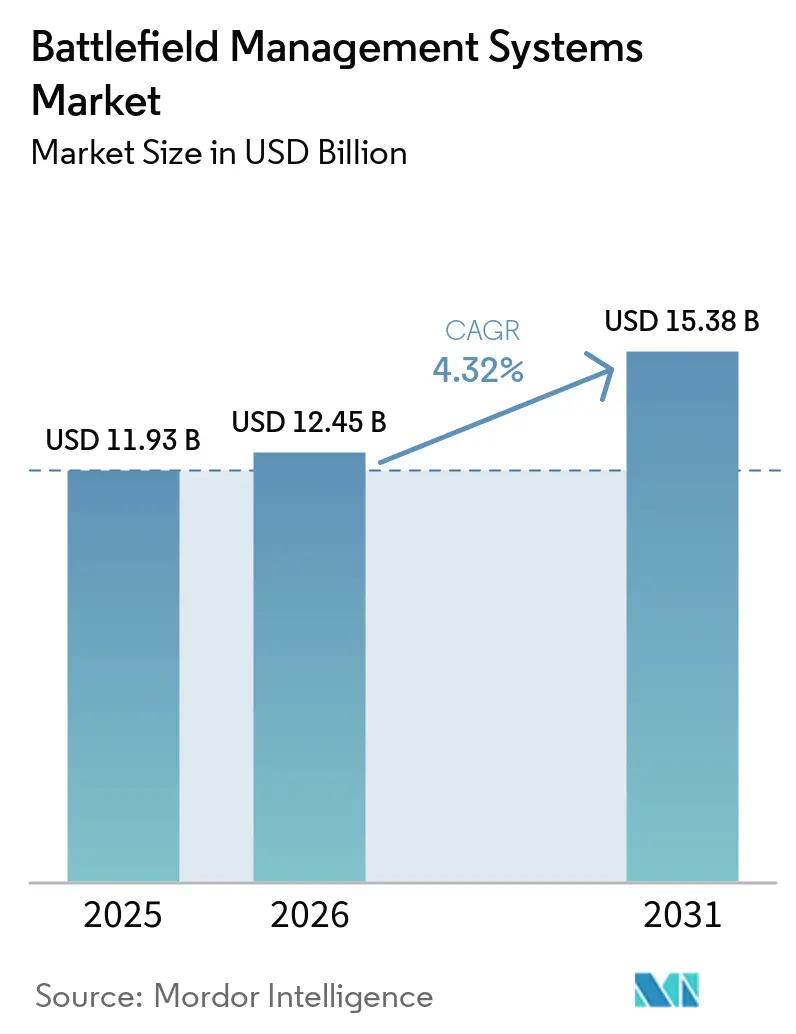
The battlefield management systems (BMS) market size was valued at USD 11.93 billion in 2025 and estimated to grow from USD 12.45 billion in 2026 to reach USD 15.38 billion by 2031, at a CAGR of 4.32% during the forecast period (2026-2031). The battlefield management systems market is expanding as defense forces embrace digital transformation to secure real-time situational awareness, enable faster decision loops, and coordinate multi-domain operations. Demand is strongest where military modernization programs are active, coalition interoperability is essential, and open-architecture mandates are formalized. Hardware still anchors most procurement budgets, yet the rapid rise of software-defined capabilities is repositioning value creation. Competitive activity centers on integrating sensors, platforms, and effectors through secure data fabrics while mitigating cybersecurity threats that inflate program costs and schedules.
Key Report Takeaways
- By geography, Asia-Pacific led with 29.05% of the battlefield management systems market share in 2025, while the Middle East and Africa are set to expand at a 9.23% CAGR to 2031.
- By system type, command and control systems accounted for 31.78% revenue share in 2025; communication and networking systems are advancing at an 8.34% CAGR through 2031.
- By component, hardware commanded a 50.62% share of the battlefield management systems market size in 2025, whereas software is projected to grow at an 8.84% CAGR between 2026 and 2031.
- By platform, armored fighting vehicles held a 38.07% share in 2025, while soldier (dismounted) systems are forecast to expand at a 7.09% CAGR.
- By installation type, vehicle-mounted systems captured a 54.68% share in 2025; hand-held and wearable systems are set to rise at an 8.36% CAGR.
- By end user, the army segment led with 62.89% share in 2025, while homeland security and special forces will grow fastest at a 7.69% CAGR.
Note: Market size and forecast figures in this report are generated using Mordor Intelligence’s proprietary estimation framework, updated with the latest available data and insights as of 2026.
Global Battlefield Management Systems Market Trends and Insights
Drivers Impact Analysis*
| Driver | (~) % Impact on CAGR Forecast | Geographic Relevance | Impact Timeline |
|---|---|---|---|
| Accelerating digital-transformation programs | +1.2% | Global, NATO and Asia-Pacific | Medium term (2-4 years) |
| Adoption of network-centric warfare doctrines | +0.9% | Global, especially NATO allies | Long term (≥ 4 years) |
| Shift to open, software-defined standards | +0.7% | North America, EU, Asia-Pacific | Medium term (2-4 years) |
| Soldier-worn augmented-reality BMS apps | +0.5% | North America, select Europe | Short term (≤ 2 years) |
| AI/ML-powered analytics and cloud-edge computing | +0.8% | Technologically advanced forces | Medium term (2-4 years) |
| Proliferation of unmanned and autonomous platforms | +0.6% | Global contested environments | Long term (≥ 4 years) |
| Source: Mordor Intelligence | |||
Digital transformation enables real-time decision superiority
Defense ministries are channeling record budgets into data-centric warfare programs that elevate the battlefield management systems market. The US FY 2025 budget assigns USD 21.1 billion to C4I systems, reflecting the shift toward information dominance.[1]US Department of Defense, “FY 2025 Weapons Procurement Programs,” defense.gov Ukraine’s Delta platform demonstrates how drone feeds, satellite imagery, and AI video analysis converge into a unified battlespace picture. Comparable initiatives across NATO and the Asia-Pacific are pressuring legacy forces to migrate toward software-defined architectures. As the Canadian Armed Forces Digital Campaign Plan underscored, organizational change can prove more challenging than technology integration. Therefore, the battlefield management systems market hinges on aligning culture, doctrine, and technology around sub-second data flows.
Network-centric warfare drives interoperability mandates
Modern battle networks rely on secure data links integrating land, air, maritime, space, and cyber assets. NATO assessments highlight capability gaps that have accelerated Joint All-Domain Command and Control frameworks. The UK's Morpheus and TRINITY programs illustrate the complexity of migrating to quantum-secure, AI-enabled networks. China’s April 2024 creation of the Information Support Force confirms that great-power competitors prioritize network-centric formations. Intensive exercises in the Indo-Pacific underscore how coalition partners must share data without exposing vulnerabilities. These trends propel the battlefield management systems market toward universal interoperability requirements.
Open standards revolution tackles vendor lock-in
The US Army’s CMOSS mandate, the SOSA Consortium’s technical releases, and STANAG-compliant waveforms are redefining acquisition models. More than 50 suppliers now offer CMOSS-ready products, shrinking technology refresh cycles and lowering life-cycle costs. Cisco’s Catalyst ESS9300 switch merges CMOSS and SOSA compliance within a rugged platform that satisfies NSA encryption standards blogs.cisco.com. Pacific Defense’s USD 17.4 million MOSA contract proves smaller firms can compete when open architectures level the field. Therefore, the battlefield management systems market revolves around modularity, interoperability, and rapid upgrade paths.
Augmented-reality soldier applications reshape dismounted operations
Programs like the Integrated Visual Augmentation System push immersive displays and mixed-reality interfaces to the squad level. The US Army’s decision to pivot IVAS management to Anduril shows how agile commercial practices are penetrating defense procurement. Nokia and Blackened’s 5G-enabled tactical suite integrates Rheinmetall’s Battlesuite software to support low-latency soldier applications. As wearable computing power rises, the battlefield management systems market extends beyond vehicles and command posts to every warfighter.
Restraints Impact Analysis*
| Restraint | (~) % Impact on CAGR Forecast | Geographic Relevance | Impact Timeline |
|---|---|---|---|
| Escalating cybersecurity and electronic-warfare threats driving costly hardening | -0.8% | Global, highest in contested theaters | Short term (≤2 years) |
| Complex integration with heterogeneous legacy platforms and data formats | -0.6% | Established militaries with large legacy fleets | Medium term (2-4 years) |
| Export controls on advanced computing items and AI model weights | -0.4% | Global, most acute for US partners | Short term (≤2 years) |
| Organizational and cultural barriers that slow digital-transformation adoption | -0.3% | Global, varying by service culture | Long term (≥4 years) |
| Source: Mordor Intelligence | |||
Cybersecurity escalation strains budgets and schedules
The Defense Industrial Base Cybersecurity Strategy 2024 mandates tighter controls across supply chains. Cybersecurity Maturity Model Certification 2.0 requires contractors to fund continuous monitoring, which inflates program costs. Adversaries target data integrity, prompting the US Navy to field decentralized certificate-key servers that operate in disrupted networks. New export controls on AI model weights add compliance burdens for allied projects. As a result, acquisition timelines stretch, moderating battlefield management systems market growth.
Legacy system integration complexity inflates customization costs
The GAO’s 2025 Weapon Systems Assessment links delays to software integration challenges across multibillion-dollar programs.[2]US Government Accountability Office, “Weapon Systems Annual Assessment 2025,” gao.gov The US Air Force’s 2025 budget shift from standalone platforms toward integrated architectures highlights the sheer effort required to connect heterogeneous assets. Leonardo DRS's 100,000th Mounted Family of Computer Systems delivery underscores the fleet-wide modernization scale. Industry 4.0 data-collection hurdles further limit the direct transfer of commercial solutions into defense settings. These factors temper the battlefield management systems market tempo until integration frameworks mature.
*Our forecasts treat driver/restraint impacts as directional, not additive. The impact forecasts reflect baseline growth, mix effects, and variable interactions.
Segment Analysis
By System: Communication networks advance interoperability demands
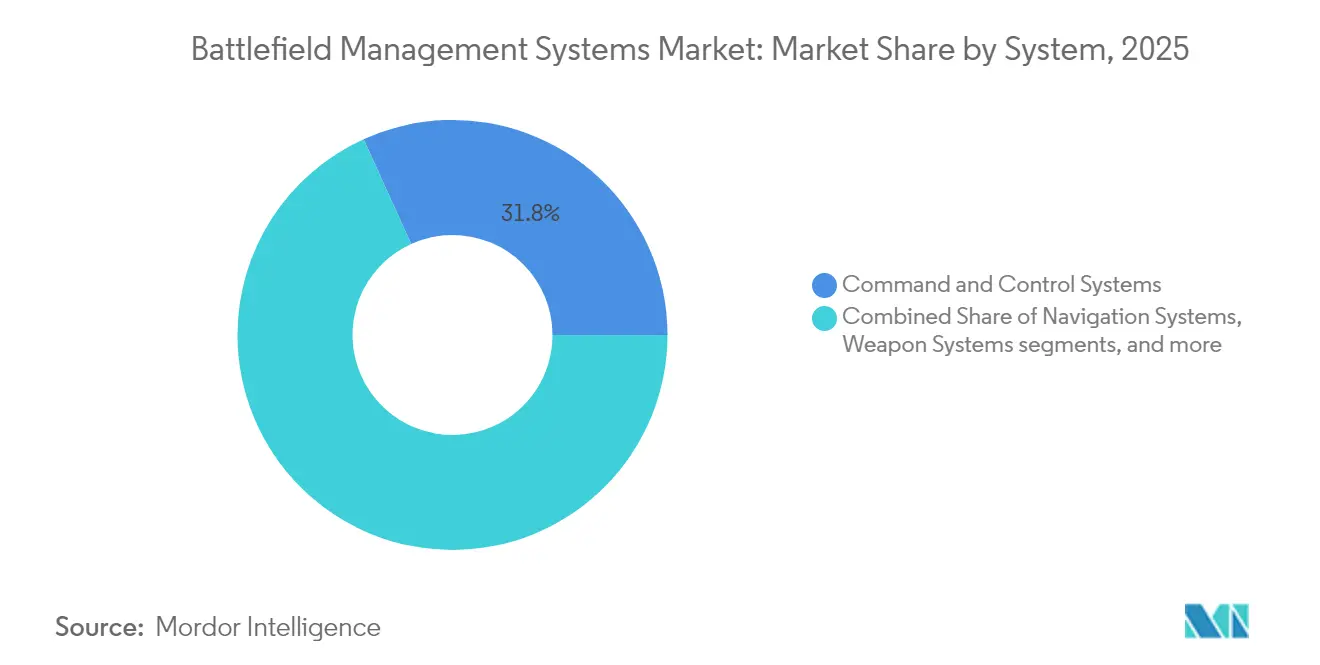
The battlefield management systems market size for communication and networking systems is expanding at an 8.34% CAGR by 2031 as militaries prioritize seamless data exchange. Command and control retains the largest slice with 31.78% revenue in 2025, reflecting enduring centralized decision authority. Navigation subsystems are upgrading with assured positioning, navigation, and timing to counter GPS denial. Weapon system integration is shifting to software-defined payloads that accelerate engagement cycles. Memoranda such as the Nokia-blackened agreement illustrate how 5G and defense expertise merge to deploy tactical meshes. The US Air Force's prototypes for Indo-Pacific Command confirm that resilient comms networks underpin multi-domain operations. As mesh architectures standardize, the battlefield management systems market deepens coalition interoperability.
Communications growth draws new entrants that leverage open APIs and virtualized network functions. Link 16 augmentation with mesh topologies sustains connectivity when satellites or line-of-sight radios fail. Governments direct funds toward spectrum agility and anti-jamming, reinforcing long-term communication investment. Meanwhile, command and control vendors adapt by embedding AI decision aides and cloud-native microservices. The widening capability gap between software-defined networks and legacy stovepipes underscores why the battlefield management systems market will continue rewarding agile communicators.



By Component: Software acceleration reshapes value creation
Hardware delivered 50.62% of the battlefield management systems market revenue in 2025, led by rugged computers, radios, and sensors that withstand extreme environments. Yet software is outpacing at an 8.84% CAGR, propelled by mapping, predictive logistics, and digital-twin applications. Services—including integration, cyber hardening, and training—benefit from rising complexity and mission-specific customization requirements. Anduril’s collaboration with Meta on mixed-reality interfaces exemplifies how software innovation redefines human-machine interaction. The Army’s Digital Transformation Challenge drew 64 submissions, revealing industry focus on open data models and DevSecOps pipelines. The Battlefield Management Systems market favors suppliers who separate hardware refresh rates from software upgrade cycles as update velocity increases.
Communication devices evolve into multi-waveform, software-defined radios that host waveform apps on common hardware. Imaging systems integrate augmented reality overlays to display sensor feeds and tactical data simultaneously. Meanwhile, service providers cultivate advanced simulation environments that model entire theaters of operation. Investors, therefore, view the battlefield management systems market as shifting toward subscription-like software and service revenue streams layered atop durable hardware baselines.
By Platform: Soldier systems become growth catalyst
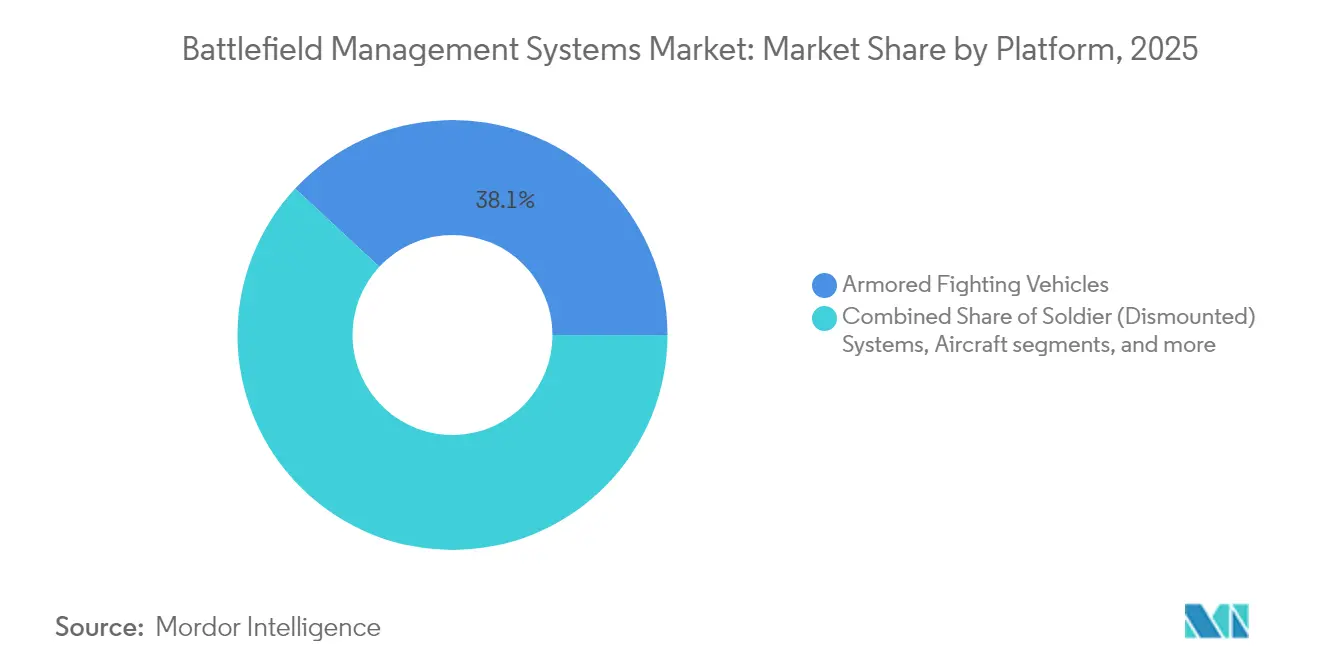
Armored fighting vehicles account for 38.07% of the battlefield management systems market share in 2025 by acting as mobile command nodes. Soldier systems are rising fastest at a 7.09% CAGR as defense planners connect each warfighter to the digital battlespace. IoT-enabled helmets and boots monitor biometrics, hazardous gases, and stress levels, funneling data back to command posts. Command headquarters migrate toward deployable cloud clusters that create pop-up networks in austere areas. Unmanned systems, including swarming UAVs, require seamless handoffs between human controllers and autonomous flight software. Elbit Systems’ USD 46 million TORCH-X integration on 6x6 APCs in Asia-Pacific showcases multi-domain command suites on legacy vehicles. As wearable sensors proliferate, the battlefield management systems market elevates dismounted users from data consumers to networked producers.
Aircraft-based battle managers extend coverage, while naval vessels synchronize sea-based assets with joint forces. The convergence of manned platforms, dismounted troops, and autonomous systems demands uniform data schemas and resilient links. Resulting procurement priorities create opportunities for vendors delivering platform-agnostic software that orchestrates diverse nodes across domains.
By Installation Type: Wearable technology transforms soldier capability
Vehicle-mounted systems held 54.68% of revenue in 2025, reflecting armored platforms' power and cooling advantages. Hand-held and wearable devices are projected to climb 8.36% annually, buoyed by battery innovations and weight reductions. The Battlefield Management Systems market size for wearable solutions is set to expand as combat units demand heads-up displays, voice-controlled apps, and biometric monitoring. The IVAS program's transfer to Anduril signals a pivot toward nimble development cycles, integrating commercial AR advances. Mixed-reality interfaces let operators control unmanned systems, visualize sensor feeds, and access decision aids without removing their eyes from the fight.
Stationary command centers continue to anchor large-scale operations, yet shift toward cloud-hosted microservices deployable on demand. Portable server racks, edge AI appliances, and satellite backhauls compress what once required hardened bunkers into expeditionary kits. Consequently, the Battlefield Management Systems market rewards suppliers that compress compute, storage, and networking into soldier-carried form factors without sacrificing resilience.
By End User: Special forces accelerate innovation uptake
The army commanded 62.89% of adoption in 2025, yet Homeland Security and Special Forces needs are expanding at a 7.69% CAGR. Specialized units value rapidly deployable systems, lightweight form factors, and high autonomy to operate in denied areas. French Special Operations Command investments in digital intelligence tools illustrate early adoption patterns. L3Harris’s joint venture with Saudi Arabian Military Industries on tactical airborne surveillance demonstrates customization for homeland security missions. The US Army plans to field 1,000 drones per division and AI-driven command tools by 2027, which indicates how mainstream forces are adopting once-niche innovations.
The global air forces focus on integrated air battle management that fuses space and airborne sensors with ground fire control, while navies demand maritime domain awareness and joint integration. Each customer segment shapes procurement criteria, ensuring the battlefield management systems market remains segmented by mission profiles even as common standards improve interoperability.
Geography Analysis
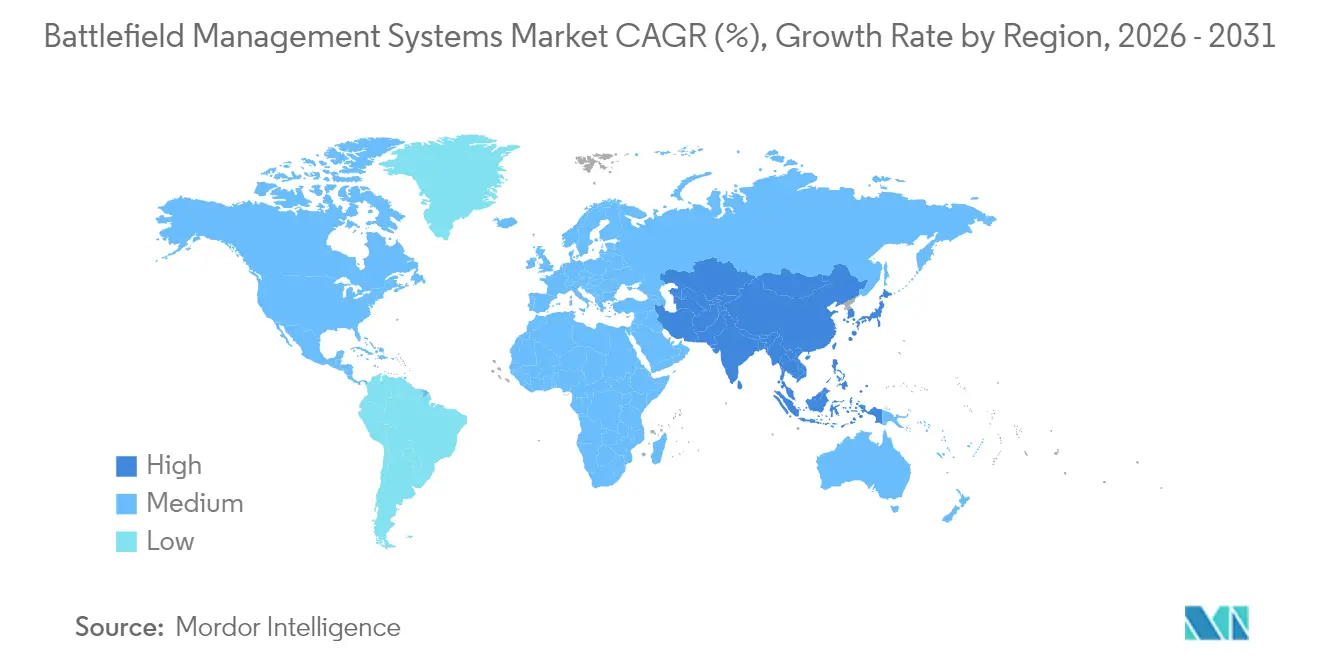
Asia-Pacific generated 29.05% of the battlefield management systems market revenue in 2025, driven by China’s formation of the Information Support Force and India’s edge-AI partnerships that embed indigenous technology into C4ISR programs. The US Indo-Pacific Command’s emphasis on technology integration and intensive joint exercises accelerates regional demand for interoperable systems. Japan’s invitation for India to join the Global Combat Air Program further binds regional supply chains to open-architecture mandates.
The Middle East and Africa are forecast to post the fastest growth at 9.23% CAGR, catalyzed by surging military expenditures that reached USD 693 billion in 2024. Saudi Arabia’s partnerships with L3Harris for EO/IR payloads and Lockheed Martin for integrated missile defense systems exemplify regional appetite for advanced command suites. The US–UAE defense agreement opens new avenues for joint technology development and transfer.
North America maintains a robust demand through sustained US Department of Defense investment. The FY 2025 allocation of USD 21.1 billion for C4I keeps the Battlefield Management Systems market dynamic. European modernization centers on NATO interoperability, with the European Defence Fund’s 2025 call financing autonomous triage systems and secure distribution networks. NATO gap assessments in AI-enabled C4ISR infrastructure amplify funding for cross-border projects. Collectively, these regional dynamics ensure steady global revenue streams, even as open standards ease technology sharing among allies.

Regulatory Landscape
Battlefield management systems procurements are being shaped by open-architecture and interoperability mandates, led by the United States MOSA requirements codified in 10 U.S.C. 4401-4403 for major acquisition programs. A US Tri-Service memorandum signed on December 17, 2024 reinforced acquisition execution around five MOSA pillars, including the use of consensus-based open standards and certification of conformance. This approach is pushing BMS suppliers toward modular interfaces, documented data models, and testable compliance artifacts.
Across allies, interoperability requirements narrow acceptable technical baselines. NATO alignment is governed through the NATO Interoperability Standards and Profiles (NISP) used with the NATO Defence Planning Process, while the United Kingdoms STICS guidance formalizes a federated standards approach for integrated C5ISR/EW, explicitly leveraging US frameworks such as SOSA and CMOSS. For cross-border transfers, EU controls anchored in Council Common Position 2008/944/CFSP and Regulation (EU) 2021/821 add licensing and compliance overhead for dual-use computing, communications, and related BMS-enabling technologies.
Value Chain Analysis
The BMS value chain begins with electronics, compute, and RF component suppliers feeding ruggedized radios, edge servers, displays, and sensors, then moves to platform-level integration on vehicles, command posts, and dismounted kits. Prime contractors and specialist subsystem vendors assemble mission hardware and software stacks, while standards bodies and government architecture offices influence interface choices through MOSA/SOSA/CMOSS and NATO profiles, shaping upstream design and qualification. The downstream chain centers on program-level integrators and in-theater deployment teams that harden systems for cyber and electronic-warfare resilience, followed by training, sustainment, and periodic tech refresh tied to rapid software releases.
Recent programs show how integration and supplier ecosystems drive delivery. Northrop Grumman has described a nationwide network of more than 120 US suppliers supporting Integrated Battle Command System throughput, highlighting the scale of domestic sourcing and QA requirements for assured delivery. The chain is also extending into commercial connectivity and software partners, such as Nokia Defense working with KNDS to bring deployable 5G connectivity into armored vehicles for dismounted and unmanned nodes. Major modernization efforts, such as Australias LAND 4140 with Boeing Defence Australia as systems integrator, put a similar emphasis on middleware, data fabrics, and interfaces as the handoff between OEM platforms and mission applications.
Competitive Landscape
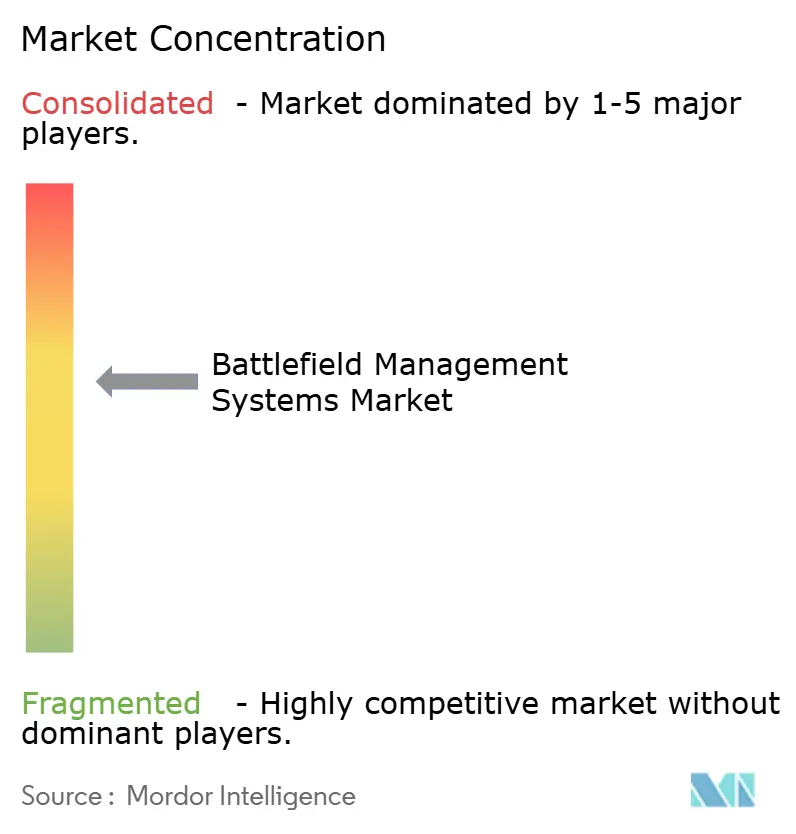
The battlefield management systems market exhibits moderate concentration. Incumbents like BAE Systems plc, RTX Corporation, and Elbit Systems Ltd. leverage end-to-end integration experience and multi-domain portfolios. Emerging firms, including Palantir, Anduril, and Scale AI, inject commercial software speed and AI prowess, often partnering with traditional primes to accelerate delivery. Open architectures undermine proprietary lock-in, evidenced by Booz Allen and Shield AI’s alliance for autonomous solutions. Vendors increasingly form joint ventures to combine rugged hardware with cloud-native software, as seen in Nokia Corporation-blackened GmbH and Curtiss-Wright-Cisco collaborations.
White-space opportunities cluster around edge AI processing, quantum-secure communications, and autonomous teaming. Programs like the US Missile Defense Agency’s five-year solicitation for AI-enabled command systems attract non-traditional suppliers. The Digital Transformation Challenge reveals the rising influence of small and medium enterprises offering microservice-based solutions. Competitive intensity will heighten as open standards lower entry barriers and governments demand faster technology refresh.
Battlefield Management Systems Industry Leaders
BAE Systems plc
RTX Corporation
Elbit Systems Ltd.
Thales Group
General Dynamics Corporation
- *Disclaimer: Major Players sorted in no particular order

Market Opportunities and Future Outlook
Procurement is concentrating around software-defined integration layers that unify sensor-to-decision-to-effector workflows, creating whitespace for suppliers that can productize common data layers, edge-to-cloud data fabrics, and rapidly updatable mission apps under open-architecture constraints. The US Army moving Next Generation Command and Control from prototyping toward delivery, and selecting Anduril to lead the common data layer baseline, is a concrete demand signal for interoperable software stacks that can ingest heterogeneous data and expose standardized interfaces to multiple mission applications. Parallel modernization pathways such as Australias LAND 4140, with Boeing Defence Australia as systems integrator, reinforce opportunities for platform-agnostic BMS middleware, integration services, and secure networking that can be adapted across armored fleets and joint-force nodes.
Interoperability demonstrations are also widening the addressable integration scope beyond traditional ground BMS boundaries into air and missile defense and joint exercises. US Army live-fire events showcasing Integrated Battle Command System interoperability with IFPC and LTAMDS, along with exercises such as Lightning Surge 3, highlight the operational value of unified data platforms that connect sensors, fires, and airspace management in contested environments. These shifts lift the payoff for cybersecurity hardening, conformance testing, and coalition-ready standards alignment (NATO NISP, SOSA/CMOSS, and national frameworks such as UK STICS), supporting vendors that can deliver certifiable compliance alongside rapid software iteration.
Recent Industry Developments
- May 2026: Ondas Holdings announced it would acquire Omnisys Ltd., an Israeli developer of AI-powered Battle Resource Optimization software used for multi-domain defense planning. The transaction advances Ondas' position in decision-support software that complements battlefield management workflows across sensors, platforms, and mission planning. The acquisition intensifies competitive pressure on incumbent BMS vendors to pair hardware integration with scalable software analytics.
- December 2025: BAE Systems, Inc. launched OneArc, combining the capabilities of Bohemia Interactive Simulations, TerraSim, and Pitch Technologies under a single defense technology organization focused on synthetic training, simulation, and AI-driven battlespace solutions. The integration strengthens BAE Systems' ability to link operational BMS concepts with digital environments used for development, rehearsal, and mission preparation. It also supports faster iteration cycles by tightening feedback loops between operational users and software teams.
- July 2024: RTX, through Collins Aerospace, tested AI/ML-enabled mobile battle management concepts during the INDOPACOM Valiant Shield exercise. Demonstrations in a large joint setting validate how deployable software can fuse data and support mission command under coalition conditions. Exercise-proven capabilities help vendors position offerings for interoperability-driven procurements where field validation influences requirements and downselect decisions.


Research Methodology Framework and Report Scope
Market Definition and Coverage
This market covers yearly spending on battlefield management systems that help defense users plan, share, and act on a common operating picture across connected units in real time, including the software, hardware, and integration work needed to deploy and operate the capability.
Scope exclusions: Strategic level C4ISR network programs, satellite bandwidth leasing, and standalone training simulators are not counted in this market size.
Segmentation Overview
- By System
- Navigation Systems
- Communication and Networking Systems
- Command and Control Systems
- Weapon Systems
- By Component
- Hardware
- Communication Devices
- Imaging and Display Devices
- Computing and Data Servers
- Software
- Logistics Management Software
- Mapping and Navigation Applications
- Services
- Integration and Maintenance
- Training and Simulation
- Hardware
- By Platform
- Armored Fighting Vehicles
- Soldier (Dismounted) Systems
- Command Headquarters
- Unmanned Systems
- Naval Vessels
- Aircraft
- By Installation Type
- Vehicle-Mounted
- Hand-held and Wearable
- Stationary Command Centers
- By End User
- Army
- Air Force
- Navy
- Homeland Security and Special Forces
- By Geography
- North America
- United States
- Canada
- Europe
- United Kingdom
- Germany
- France
- Russia
- Rest of Europe
- Asia-Pacific
- China
- India
- Japan
- South Korea
- Rest of Asia-Pacific
- South America
- Brazil
- Rest of South America
- Middle East and Africa
- Middle East
- Saudi Arabia
- United Arab Emirates
- Israel
- Rest of Middle East
- Africa
- South Africa
- Rest of Africa
- Middle East
- North America
Data Sources, Market Sizing, and Validation
Desk Research
Desk research starts with public defense budget documents and procurement releases, because they show where spending is planned and which programs are actually being funded. We also refer to sources such as SIPRI defense expenditure datasets, NATO defense spending reports, and selected national defense ministry modernization roadmaps to frame the demand context behind adoption.
To make the model more measurable, we cross-check platform delivery and upgrade signals using sources such as government contract award portals, parliamentary or congressional budget justifications, and customs and trade statistics where hardware import patterns are visible. Company filings, investor decks, and reputable defense press are used to confirm the timing of upgrades and the integration work tied to them. Where available, a paid subscription for company financials and a contracts and tenders database help standardize revenue and award values across countries. These desk sources are not exhaustive, and we also use other public references for data collection, validation, and clarification.
Primary Interviews and Surveys
Primary work is used to test what was learned from public documents, especially around what is counted as a battlefield management system versus adjacent command networks. We speak with a mix of solution suppliers, system integrators, and defense-side stakeholders across major regions to validate deployment pace, typical upgrade cycles, and how programs are packaged into fieldable bundles before the model is finalized.
Distribution of primary research fieldwork respondents
| Company type | Respondent position | Region |
|---|---|---|
| Top tier: 30% | CXOs: 16% | APAC: 50% |
| Mid tier: 48% | Functional/Unit leaders: 32% | EMEA: 31% |
| Smaller Players: 22% | Managers: 52% | Americas: 19% |
Market-Sizing & Forecasting
Sizing is built using top-down logic where defense procurement and modernization allocations are reconstructed into a realistic demand pool for tactical level battle management capability, and then mapped to system and platform adoption patterns. We then corroborate results with selective bottom-up approximations, such as sampled program values, a limited roll-up of supplier revenues, and ASP times unit checks for rugged terminals and tactical networking elements, which are used to adjust totals if they drift.
Key inputs include defense spending direction, the pace of digitization programs, land platform upgrade cycles (especially armored vehicle and command post refresh), integration and sustainment shares in program bundles, and regional procurement timing that creates lumpy award years. Since deliveries and integration often lag approvals, we track typical program lead time and the split between upgrades and new installations to avoid overstating near-term revenue.
For forecasting, scenario analysis is used because defense budgets and fielding plans can shift with elections, procurement reviews, or conflict-led urgency. The scenarios are anchored on variables that respondents most often agree on, such as multi-year budget intent, platform modernization schedules, and the expected cadence of software releases, and then a central case is taken forward into the final forecast.
Data Validation & Update Cycle
Validation is done by checking whether modeled values stay consistent with independent signals, such as procurement award volumes, known platform upgrade counts, and observed integration intensity by region. When a country-level total looks unusual, we review the assumptions behind timing, currency conversion, and what was included in the program bundle, and re-contact experts if the variance remains hard to explain.
Before sign-off, the full model goes through a multi-step analyst review so calculation logic, year-to-year movements, and input sources remain consistent. The study is refreshed annually, and interim updates are completed when material events occur, such as large contract wins, budget revisions, or major program delays. Right before delivery, we run a final pass to ensure the latest updated view is provided to clients.
Mordor Intelligence's Battlefield Management Systems Market Size Versus Other Published Estimates
Published values for this market can differ across sources, even when they use similar language, because the included spend lines and the timing of recognition are not always treated the same way. Differences usually come from what each study counts as a battlefield management system, which year is treated as the base, and how upgrades and sustainment are carried into the totals.
The main gap comes from whether broader strategic C4ISR networks and satellite connectivity spend are bundled into the same number. Mordor Intelligence counts battlefield management systems only when the spend is tied to tactical level hardware, software, and integration for a shared operating picture, and it leaves out satellite bandwidth leases and standalone training simulators.
Benchmark comparison
| Source | Market Size | Gaps in Research Methodology |
|---|---|---|
| Mordor Intelligence | USD 12.45 B (2026) | |
| Global Consultancy A | USD 12.22 B (2024) | Uses an earlier base year and can pull some adjacent command-and-control spending into the same bucket, which shifts the market level when tactical-only coverage is intended. |
| Trade Publisher B | USD 13.04 B (2025) | Treats the market as a broader integrated digital platform set and may include connectivity and subsystem bundles more widely, which can raise totals versus a stricter tactical BMS definition. |
Taken together, the spread is mostly explained by scope choices and base-year timing, rather than a disagreement on overall defense digitization direction. By keeping inclusions traceable to tactical BMS spend items and then checking totals against procurement and upgrade signals, the estimate stays more repeatable when clients update assumptions year over year.


Key Questions Answered in the Report
What is the current size of the battlefield management systems market?
The market stands at USD 12.45 billion in 2026 and is projected to reach USD 15.38 billion by 2031.
How fast is the battlefield management systems market expected to grow?
It is forecast to expand at a 4.32% compound annual growth rate between 2026 and 2031.
Which region holds the largest battlefield management systems market share today?
Asia-Pacific leads with 29.05% of global revenue, driven by Chinese and Indian modernization spending.
What system category is growing the quickest?
Communication and networking systems are advancing at a 8.34% CAGR as militaries demand secure, interoperable data links.
Why are soldier-dismounted solutions attracting attention?
Wearable and hand-held platforms show a 8.36% CAGR because they connect every warfighter to real-time command networks.
What are the main challenges facing battlefield management system adoption?
Rising cybersecurity threats and legacy‐platform integration complexity add cost and delay new deployments.
Page last updated on:


 Your data is secure and never sold or shared.


