
Airborne Electronic Warfare Market Size and Share
Market Overview
| Study Period | 2019 - 2031 |
|---|---|
| Market Size (2026) | USD 6.12 Billion |
| Market Size (2031) | USD 8.79 Billion |
| Growth Rate (2026 - 2031) | 7.52 % |
| Fastest Growing Market | Asia-Pacific |
| Largest Market | North America |
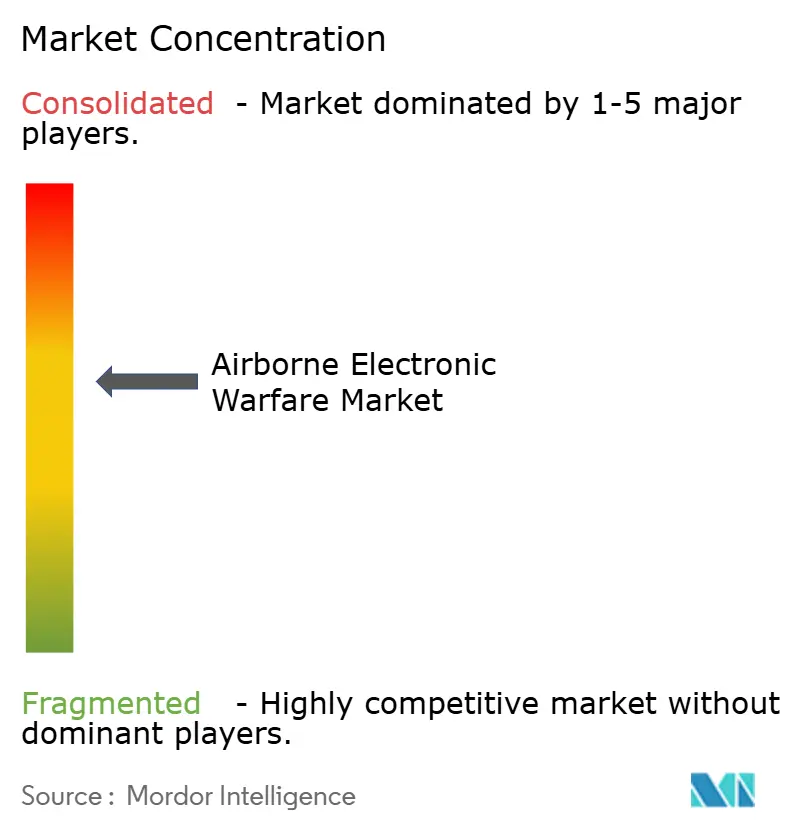
| Market Concentration | Medium |
Major Players *Disclaimer: Major Players sorted in no particular order Image © Mordor Intelligence. Reuse requires attribution under CC BY 4.0. | |
Airborne Electronic Warfare Market Analysis by Mordor Intelligence
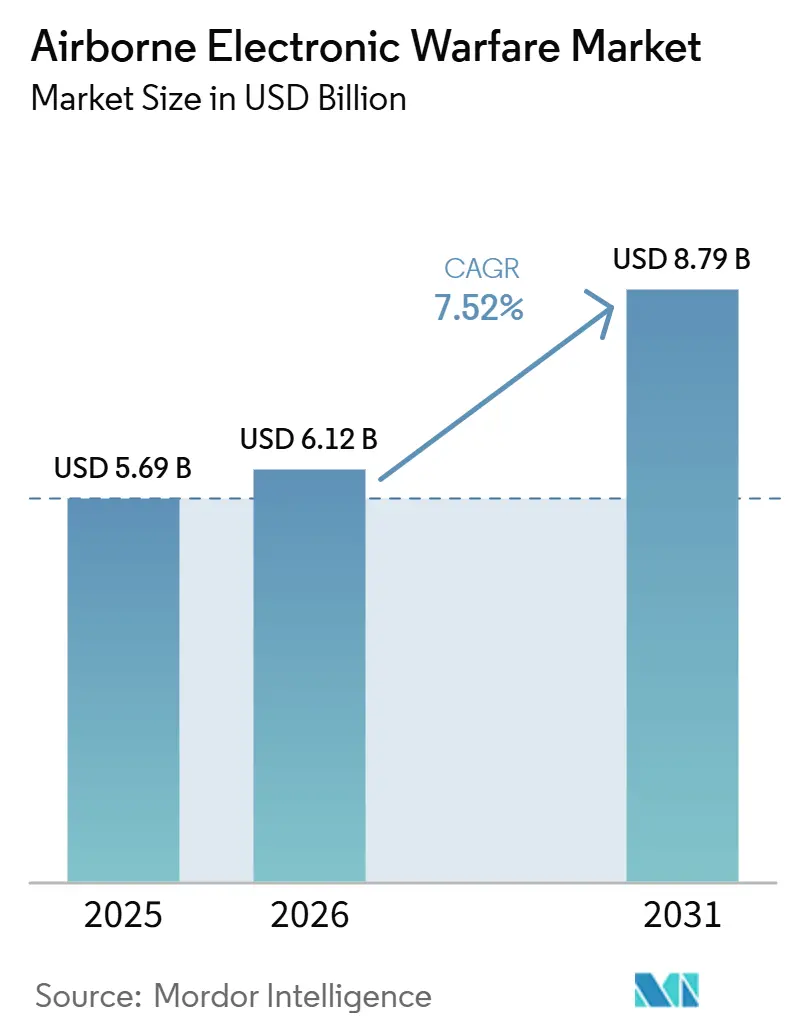
The airborne electronic warfare market size is expected to grow from USD 5.69 billion in 2025 to USD 6.12 billion in 2026, and is forecast to reach USD 8.79 billion by 2031, at a 7.52% CAGR over 2026-2031. This expansion reflects the priority militaries place on dominating the electromagnetic spectrum as advanced multi-band surface-to-air missile (SAM) systems proliferate and cognitive jamming becomes indispensable. Recent budget approvals, such as the US setting aside USD 5 billion for electronic warfare (EW) programs in 2024, have reinforced demand for next-generation airborne EW suites. North America captured 45.21% of the airborne electronic warfare market share in 2024, yet Asia-Pacific is growing faster as China, Japan, and Australia acquire sophisticated EW capabilities. Platforms remain dominated by manned aircraft, but unmanned systems are outpacing in growth because ultra-lightweight payloads now fit Group 1-3 drones without compromising endurance. Consolidation continues: BAE Systems’ acquisition of Kirintec and RTX’s investments in AI/ML-enabled receivers illustrate how primes expand portfolios while securing intellectual property.[1]
Key Report Takeaways
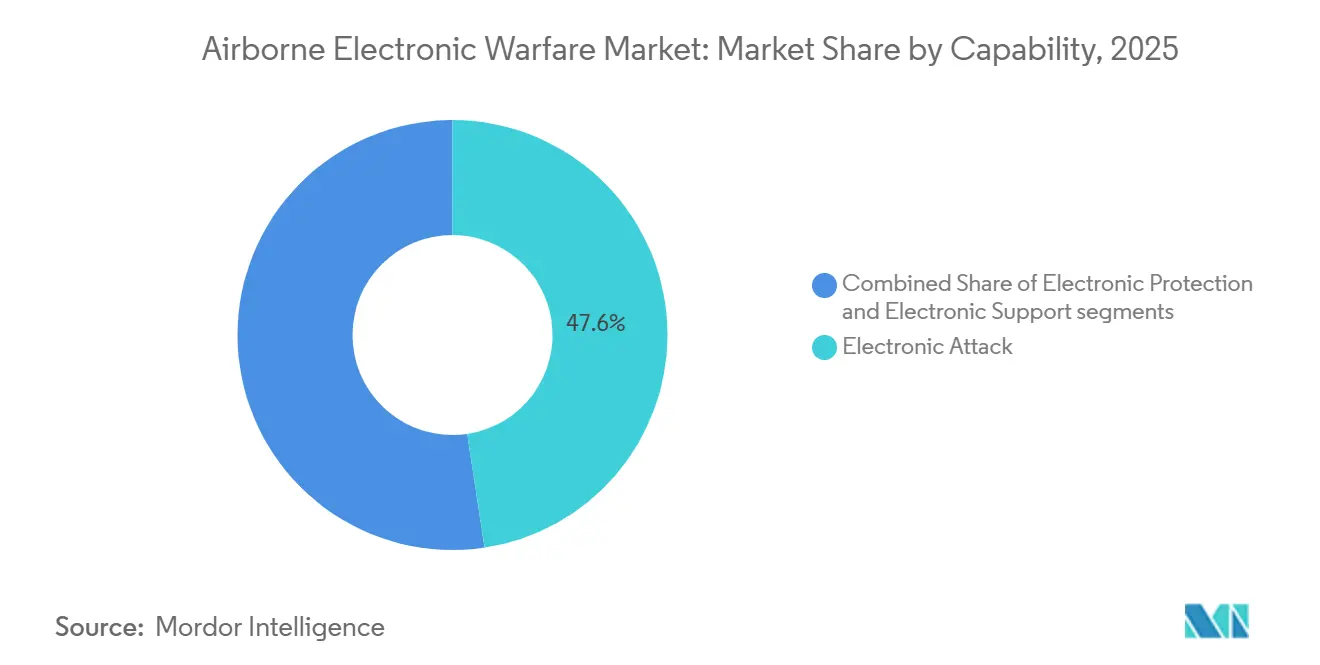
- By capability, electronic attacks accounted for 47.63% of the airborne electronic warfare market share in 2025; electronic support is forecast to expand at a 9.72% CAGR by 2031.
- By platform, manned aircraft held a 73.92% share of the airborne electronic warfare market size in 2025; unmanned aircraft are projected to grow at an 11.08% CAGR through 2031.
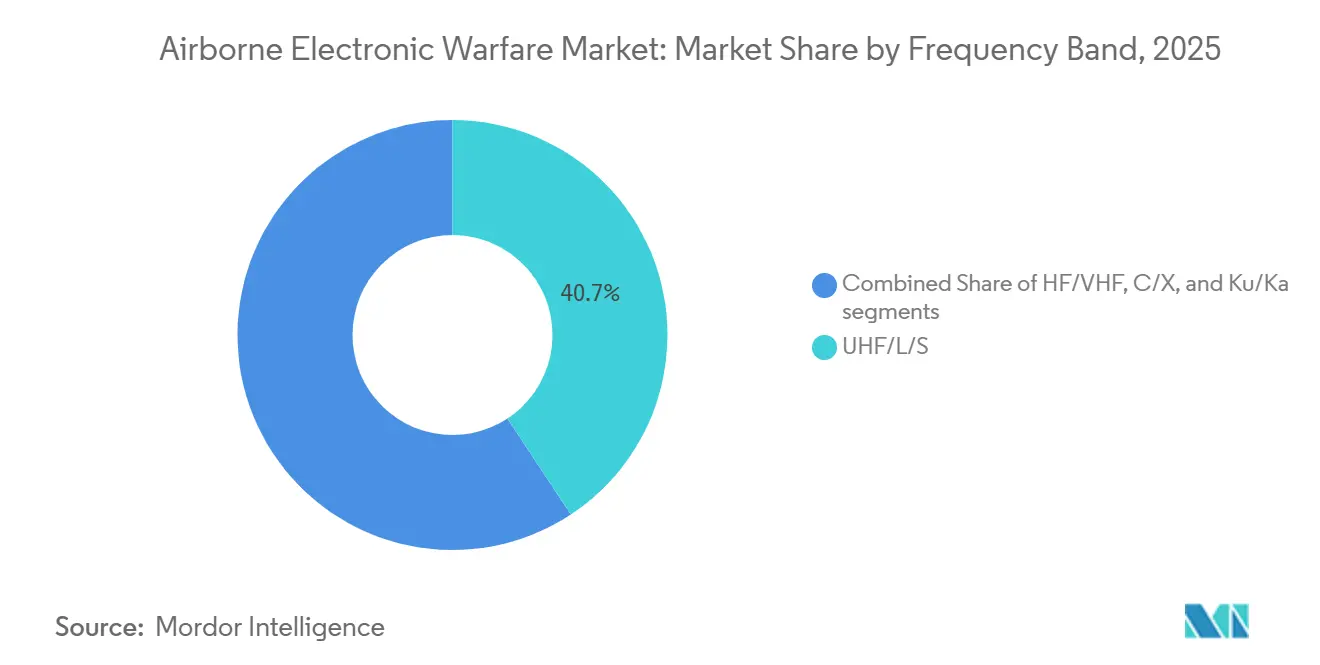
- By frequency band, the UHF/L/S bands accounted for 40.74% of the airborne electronic warfare market size in 2025; the Ku/Ka bands are forecast to grow at a 9.31% CAGR through 2031.
- By architecture, pod-mounted solutions accounted for 57.12% of revenue in 2025; payload/pod solutions for UAVs are forecast to grow at an 11.22% CAGR through 2031.
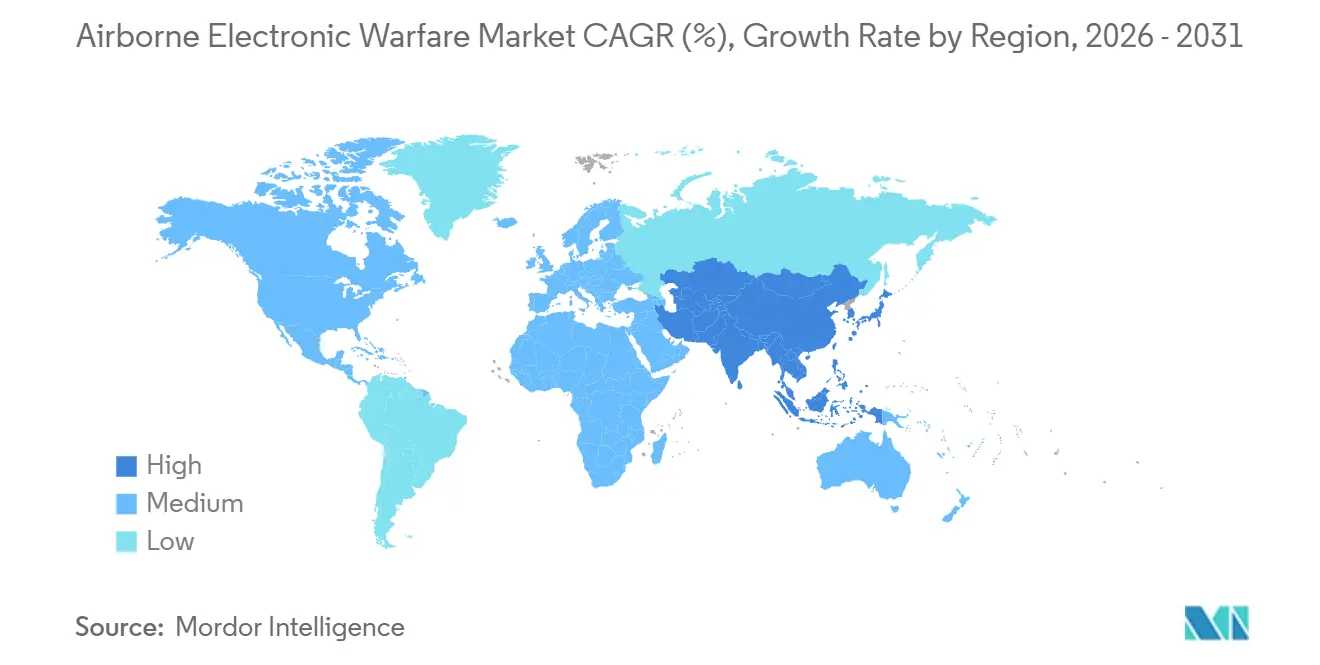
- By geography, North America commanded 44.78% of the airborne electronic warfare market share in 2025, while Asia-Pacific is forecast to grow at an 9.58% CAGR through 2031.
Note: Market size and forecast figures in this report are generated using Mordor Intelligence’s proprietary estimation framework, updated with the latest available data and insights as of January 2026.
Market Trends and Insights
Drivers Impact Analysis of Airborne Electronic Warfare Market*
| DRIVER | (~) % IMPACT ON CAGR FORECAST | GEOGRAPHIC RELEVANCE | IMPACT TIMELINE |
|---|---|---|---|
| Rising defense budgets and recapitalization cycles | 2.10% | Global; early gains in North America, Europe, Asia-Pacific | Medium term (2-4 years) |
| Growing threat of advanced multi-band SAM and radar systems | 1.80% | Global; most acute in contested regions | Short term (≤ 2 years) |
| Fighter recapitalization programmes integrating organic EW suites | 1.50% | North America, Europe, Asia-Pacific | Long term (≥ 4 years) |
| UAV fleet expansion requiring ultra-lightweight EW payloads | 1.30% | Global; spillover to emerging markets | Medium term (2-4 years) |
| AI-enabled cognitive EW for adaptive jamming | 0.90% | Advanced military markets worldwide | Medium term (2-4 years) |
| Shift toward SOSA-aligned open EW architectures | 0.70% | North America and EU; adoption by allied partners | Long term (≥ 4 years) |
| Source: Mordor Intelligence | |||
Rising Defense Budgets and Recapitalization Cycles
Accelerated defense spending boosted procurement of next-generation electronic warfare suites. The US Department of Defense (DoD) planned at least USD 21 billion for EW development over five years, a 40% uplift versus the previous cycle.[2] European states formed a multinational coalition to pool EW resources to achieve lower unit costs and greater interoperability. Saudi Arabia and other Gulf nations have mirrored the trend, investing in fully integrated radar, missile, and EW solutions to counter Russian anti-access systems. Across regions, higher budgets shortened replacement cycles, pushing more orders for pod-mounted and embedded EW architectures that comply with open-system standards.
Growing Threat of Advanced Multi-Band SAM and Radar Systems
The spread of adaptable SAMs has forced air forces to adopt cognitive EW and reprogram within milliseconds. PLA prototypes demonstrated jammers capable of creating 3,600 false radar targets, accelerating US and NATO interest in wideband Active Electronically Scanned Array (AESA) countermeasures. Digital Radio Frequency Memory (DRFM) technology capable of simultaneous multi-band deception is now central to acquisition roadmaps, as evidenced by RTX’s Next Generation Jammer Mid-Band contract, which covers requirements for the US Navy and the Royal Australian Air Force.
Fighter Recapitalization Programmes Integrating Organic EW Suites
Modern combat aircraft tend to stipulate internal EW, increasingly displacing legacy pod-only solutions. The Eurofighter Typhoon EK variant adopted Saab’s Arexis suite under a EUR 1.5 billion (USD 1.72 billion) award to guarantee relevance through 2060. The F-16 Viper Shield retrofit reached first flight in February 2025, enabling customers in Europe and the Middle East to field integrated digital receivers and processing blocks. Such organic approaches mitigate drag, align threat libraries with primary sensors, and cut support costs over the aircraft life cycle.
UAV Fleet Expansion Requiring Ultra-Lightweight EW Payloads
Persistent airborne coverage without risking crews has led to robust demand for miniaturized EW. The MQ-1C Gray Eagle completed a 32-hour flight with the NERO jammer, validating low-SWaP solutions for long-endurance platforms. Curtiss-Wright introduced small-form-factor mission computers optimized for Group 1-3 drones, supporting AI-enabled detection and response within a few cubic inches of volume. Elbit’s Micro Spear sensor demonstrated radar-site detection beyond 6 km when launched from an expendable air-launched platform, underscoring how distributed unmanned nodes multiply the reach of manned assets.
Restraints Impact Analysis of Airborne Electronic Warfare Market*
| RESTRAINT | (~) % IMPACT ON CAGR FORECAST | GEOGRAPHIC RELEVANCE | IMPACT TIMELINE |
|---|---|---|---|
| Acquisition and life-cycle cost overruns of next-gen EW pods | -1.20% | Global, particularly complex procurement systems | Medium term (2-4 years) |
| Electromagnetic-spectrum congestion and deconfliction hurdles | -0.80% | Contested regions and dense electromagnetic environments | Short term (≤ 2 years) |
| Export-control regimes (ITAR/ML5) throttling cross-border deals | -0.60% | International markets, excluding domestic US programs | Long term (≥ 4 years) |
| SWaP limits when integrating EW on Group 1–3 drones | -0.40% | Global UAV markets, particularly small drone applications | Medium term (2-4 years) |
| Source: Mordor Intelligence | |||
Acquisition and Life-Cycle Cost Overruns of Next-Gen EW Pods
Pod programs such as the NGJ-Mid Band experienced multiple contract modifications that expanded cost profiles and delayed milestones, placing pressure on already stretched defense budgets. Integrating AI/ML algorithms into legacy fighters raised unforeseen technical risks, pushing schedules to the right as developers worked through electromagnetic compatibility issues across avionics suites. Extended test campaigns are now mandatory to demonstrate reliability against adaptive threats, inflating support costs throughout product life cycles.
Electromagnetic-Spectrum Congestion and Deconfliction Hurdles
Coalition operations often involve dozens of national emitters competing for spectrum, raising the risk of fratricide and degraded performance. Hudson Institute studies showed that current deconfliction tools cannot cope with simultaneous S-band through K-band transmissions in high-density operations.[3] Adversaries exploit this congestion by saturating bands with noise, compelling investments in real-time spectrum management software and dynamic allocation algorithms that add complexity and cost to airborne EW architectures.
*Our forecasts treat driver/restraint impacts as directional, not additive. The impact forecasts reflect baseline growth, mix effects, and variable interactions.
Airborne Electronic Warfare Market Segment Analysis
By Capability:
Electronic Attack Maintained Strategic PrimacyElectronic attack accounted for 47.63% of the airborne electronic warfare market share in 2025, underscoring the premium placed on striking adversary radar and communications before kinetic weapons launch. Demand for wideband escort jamming and stand-off decoys kept the airborne electronic warfare market size for offensive payloads above USD 2.90 billion in 2026. Electronic support grew the fastest, at a 9.72% CAGR, as the armed services invested in real-time threat libraries and direction-finding sensors that feed into cognitive jammers. Electronic protection maintained steady budgets to harden satellite links and precision navigation signals, particularly in joint operations where the loss of GPS could cripple maneuver. Integrated suites that merge these three missions into a single processing stack became standard on new fighter and bomber programs, enhancing situational awareness while lowering sustainment costs.
Historical investments in electronic attack matured into exportable solutions, enabling NATO partners to field common waveforms and coordinate strike packages with minimal data latency. The airborne electronic warfare market now favors systems that deliver simultaneous detect-classify-jam capabilities within a single aperture. This trend reduces the need for multiple line-replaceable units and streamlines maintenance. Growth is also fueled by training ranges adopting high-fidelity threat emitters, enabling aircrews to rehearse against realistic multi-band radar clusters.

By Platform Type:
Unmanned Growth Complemented, Not Replaced, Manned AssetsManned aircraft continued to account for 73.92% of the airborne electronic warfare market in 2025 because recapitalization programs for the F-16, F-35, Typhoon, and EA-18G fleets maintained thousands of active electronic warfare aircraft worldwide. The growth is driven by embedded architectures such as AN/ASQ-239 on the F-35. Unmanned systems, however, achieved an 11.08% CAGR through 2031 thanks to successful MQ-20 Avenger autonomous jamming trials by GA-ASI. Reduced risk to crews and lower operating costs supported the procurement of attritable air-launched effects that distribute EW nodes across the battlespace. Doctrinally, unmanned platforms increasingly act as decoys to draw out threat emitters, allowing crewed aircraft to preserve stealth while orchestrating coordinated attack sequences.
UAV producers focused on open-systems payload bays to enable end users to quickly swap EW cartridges. The market welcomed lightweight gallium nitride transmitters that reduced power draw by 20%, extending loiter to beyond 24 hours on MALE UAVs. In parallel, manned platforms integrated autonomous decision aids developed for unmanned craft, illustrating cross-pollination of hardware and software that elevates the entire fleet’s resilience.
By Frequency Band:
Wideband Adoption Challenged Traditional Band PreferencesUHF/L/S bands remained in the lead, accounting for 40.74% of the airborne electronic warfare market in 2025, reflecting their central role in degrading early-warning radar and military communications. The airborne electronic warfare market recorded 9.31% CAGR in the Ku/Ka segment as satellite communications became a critical target, especially for expeditionary forces. C/X bands sustained relevance in anti-ship missions where naval radars operate, whereas HF/VHF bands retained niche value for long-range propaganda and navigation signal disruption. Programs such as the NGJ-Mid Band highlighted future directions, showing a single pod could jam or deceive across S, C, and X bands concurrently.
The growing need for adaptive coverage drove investment in tunable filters and digital beamforming, which let operators retask frequencies within seconds. As a result, procurement specifications now emphasize instantaneous bandwidth and spectral purity over single-band peak power, signaling a paradigm shift toward fluid, software-defined operations across the spectrum.
By Architecture:
External Pods Retained Lead While Embedded Systems AdvancedPod-mounted solutions led spending with a 57.12% share in 2025 due to their ability to modernize legacy fighters without structural rework. The US Air Force’s “Angry Kitten” pod exemplified agile prototyping, transitioning from a test asset to a fielded capability across the F-16 and C-130 within 24 months. Payload-pod solutions for UAVs achieved the highest CAGR of 11.22% because operators prioritized endurance and mission-specific, plug-and-play modules for attritable drones. Internally integrated suites received higher funding in new-build programs such as the F-15EX, where stealth shaping and weight distribution mandated the use of embedded antennas and receivers.
Hybrid configurations also emerged: Some advanced fighters use internal receivers paired with expendable decoy jammers that extend the strike package's footprint forward. Suppliers responded by offering scalable back-end processors that fit podded and internal designs, allowing customers to harmonize software baselines and threat libraries.
Geography Analysis
North America Airborne Electronic Warfare Market
North America generated 44.78% of the airborne electronic warfare market revenue in 2025, anchored by multi-year US contracts, including Boeing’s USD 615 million award for a next-generation Air Force EW system. The region's airborne electronic warfare market size is projected to grow at a 6.37% CAGR through 2031, supported by the modernization of the F-15, F-16, and EA-18G fleets and the ongoing development of the B-21 bomber's defensive suites. Canada’s defense policy update earmarked funds for escort jammers on its future fighter, further strengthening regional demand.
APAC Airborne Electronic Warfare Market
Asia-Pacific is expected to post the fastest growth at 9.58% CAGR, reflecting China’s 6G-enabled jamming trials and Japan’s policy revisions that accelerated EW procurement for F-35 and next-generation fighter programs. Indigenous manufacturing centers in South Korea and India secured technology-transfer deals to assemble podded systems locally, reducing cost and building sovereign maintenance capacity. The airborne electronic warfare market thus benefited from both import acquisitions and emergent domestic production lines.
EMEA Airborne Electronic Warfare Market
Europe remained resilient, buoyed by multinational initiatives to harmonize EW doctrines, including Germany’s Eurofighter EK and the UK’s Tempest future combat air system. Cooperative funding streams improved economies of scale and encouraged adoption of open-architecture standards, aligning with US SOSA profiles to guarantee coalition interoperability. Meanwhile, the Middle East and Africa saw spending concentrated among a smaller set of buyers. Yet, Saudi Arabia’s integrated radar-EW roadmap and the UAE EDGE Group’s export push highlighted a strategic intent to field credible spectrum-dominance capabilities.
Competitive Landscape
The airborne electronic warfare market exhibited moderate concentration among leading contractors, including RTX Corporation, BAE Systems plc, Northrop Grumman Corporation, and L3Harris Technologies Inc. These firms leveraged scale and in-house semiconductor fabrication to deliver gallium nitride transmitters that support higher power density and longer mean time between failures—acquisitions consolidated capability breadth, such as BAE Systems' acquisition of Kirintec to strengthen cyber-electromagnetic offerings.
Strategic collaborations have proliferated. GA-ASI partnered with BAE Systems to integrate autonomous jamming on the MQ-20 Avenger, showcasing how unmanned platforms can host sophisticated Link-16-enabled EW payloads. Leonardo unveiled an AI-enabled Eurofighter suite that integrates cognitive electronic support and attack capabilities into a single array, demonstrating Europe’s push for sovereign technology. Smaller firms such as Southwest Research Institute won contracts valued at USD 6.4 million to advance cognitive EW algorithms, indicating room for niche innovators.
Competition increasingly revolves around software agility and open architectures rather than hardware alone. Vendors that certify Solutions on the Sensor Open Systems Architecture (SOSA) standard enhance upgrade cycles and reduce vendor lock-in, appealing to budget-minded customers. However, sustaining leading positions still requires vertically integrated engineering talent capable of designing custom RF front-ends that meet stringent airborne qualification standards.
Airborne Electronic Warfare Industry Leaders
-
Northrop Grumman Corporation
-
BAE Systems plc
-
Lockheed Martin Corporation
-
L3Harris Technologies, Inc.
-
RTX Corporation
- *Disclaimer: Major Players sorted in no particular order
Airborne Electronic Warfare Market Companies Covered in this Report
- RTX Corporation
- Northrop Grumman Corporation
- BAE Systems plc
- L3Harris Technologies, Inc.
- Lockheed Martin Corporation
- Saab AB
- Thales Group
- Leonardo S.p.A.
- Elbit Systems Ltd.
- Israel Aerospace Industries Ltd.
- Mercury Systems, Inc.
- HENSOLDT AG
- Rohde & Schwarz GmbH & Co. KG
- Terma A/S
- QinetiQ Group
- Rafael Advanced Defense Systems Ltd.
- Honeywell Aerospace Inc.
Recent Industry Developments in Airborne Electronic Warfare Market
- April 2026: Northrop Grumman Corporation received a USD 30.60 million contract modification from the US Air Force to expand flight test releases and software development requirements for the AN/ALQ-257 Integrated Viper Electronic Warfare Suite (IVEWS) on F-16 fighter aircraft.
- May 2025: RTX’s Corporation won a USD 580.60 million US Navy production contract for Next Generation Jammer Mid-Band systems, which will be shared with the Royal Australian Air Force.
- April 2025: Lockheed Martin Corporation received a USD 15.90 million contract to develop SOSA-aligned airborne EW software under the Ephemeral Paragon program.
Global Airborne Electronic Warfare Market Report Scope
Our study defines the airborne electronic warfare aircraft market as the annual value of new-build and retrofit manned and unmanned aircraft that integrate dedicated radio-frequency systems capable of detecting, deceiving, jamming, or shielding assets across the electromagnetic spectrum. According to Mordor Intelligence analysts, this covers pods, internally mounted suites, antennas, and mission software delivered through platform procurements and service-life upgrades for fighters, transports, and special-mission fleets.
The airborne electronic warfare market is segmented by capability, platform type, frequency band, architecture, and geography. By capability, the market is segmented into electronic attack, electronic protection, and electronic support. By platform type, the market is segmented into manned aircraft and unmanned aircraft. By frequency band, the market is segmented into HF/ VHF, UHF/L/S, C/X, and Ku/Ka. By architecture, the market is segmented into pod-mounted, internally integrated, and payload/pod for UAVs. The report also covers the market sizes and forecasts for the airborne electronic warfare market in major countries across different regions. For each segment, the market size is provided in terms of value (USD).
Scope Exclusions: Consumable expendables such as flares and chaff cartridges, ground or naval EW platforms, and standalone training simulators are outside the present scope.
| Electronic Attack |
| Electronic Protection |
| Electronic Support |
| Manned Aircraft |
| Unmanned Aircraft |
| HF/ VHF |
| UHF/L/S |
| C/X |
| Ku/Ka |
| Pod-mounted |
| Internally Integrated |
| Payload/Pod for UAVs |
| North America | United States | |
| Canada | ||
| Mexico | ||
| Europe | United Kingdom | |
| Germany | ||
| France | ||
| Russia | ||
| Rest of Europe | ||
| Asia-Pacific | China | |
| Japan | ||
| India | ||
| South Korea | ||
| Rest of Asia-Pacific | ||
| South America | Brazil | |
| Rest of South America | ||
| Middle East and Africa | Middle East | Saudi Arabia |
| United Arab Emirates | ||
| Israel | ||
| Rest of Middle East | ||
| Africa | South Africa | |
| Rest of Africa | ||
| By Capability | Electronic Attack | ||
| Electronic Protection | |||
| Electronic Support | |||
| By Platform Type | Manned Aircraft | ||
| Unmanned Aircraft | |||
| By Frequency Band | HF/ VHF | ||
| UHF/L/S | |||
| C/X | |||
| Ku/Ka | |||
| By Architecture | Pod-mounted | ||
| Internally Integrated | |||
| Payload/Pod for UAVs | |||
| By Geography | North America | United States | |
| Canada | |||
| Mexico | |||
| Europe | United Kingdom | ||
| Germany | |||
| France | |||
| Russia | |||
| Rest of Europe | |||
| Asia-Pacific | China | ||
| Japan | |||
| India | |||
| South Korea | |||
| Rest of Asia-Pacific | |||
| South America | Brazil | ||
| Rest of South America | |||
| Middle East and Africa | Middle East | Saudi Arabia | |
| United Arab Emirates | |||
| Israel | |||
| Rest of Middle East | |||
| Africa | South Africa | ||
| Rest of Africa | |||
Key Questions Answered in the Report
What is the current size of the airborne electronic warfare market?
The airborne electronic warfare market size is expected to grow from USD 5.69 billion in 2025 to USD 6.12 billion in 2026, and is forecast to reach USD 8.79 billion by 2031, at a 7.52% CAGR over 2026-2031.
Which geographic region is growing fastest?
Asia-Pacific is forecast to expand at an 9.58% CAGR through 2031 as China, Japan, and Australia accelerate EW procurement.
Why are unmanned platforms important for airborne EW?
Unmanned aircraft deliver persistent jamming without risking pilots and now carry ultra-lightweight payloads that enable 24-hour missions, driving an 11.08% CAGR for the segment.
Which capability segment dominates spending?
Electronic attack remains the largest capability, accounting for 47.63% market share in 2025 thanks to investments in wideband escort and stand-off jamming.
How are open architectures affecting competition?
Standards such as SOSA let customers integrate best-of-breed components, reducing vendor lock-in and giving smaller firms access to programs previously controlled by large primes.
What restraint poses the greatest short-term risk?
Electromagnetic-spectrum congestion threatens near-term deployments by complicating deconfliction among coalition emitters and requires advanced spectrum management solutions.