
Market Overview
| Study Period | 2020 - 2030 |
|---|---|
| Forecast Data Period | 2025 - 2030 |
| Historical Data Period | 2020 - 2023 |
| Market Size (2025) | USD 2.78 Billion |
| Market Size (2030) | USD 3.58 Billion |
| Growth Rate (2025 - 2030) | 5.20 % |
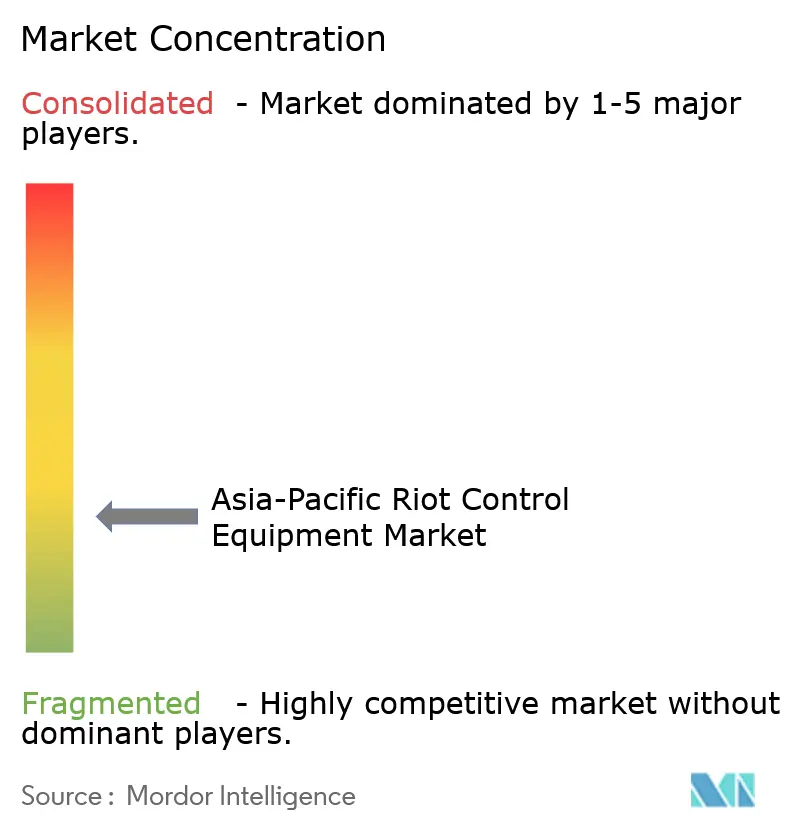
| Market Concentration | Low |
Major Players *Disclaimer: Major Players sorted in no particular order Image © Mordor Intelligence. Reuse requires attribution under CC BY 4.0. | |
Asia-Pacific Riot Control Equipment Market Analysis by Mordor Intelligence
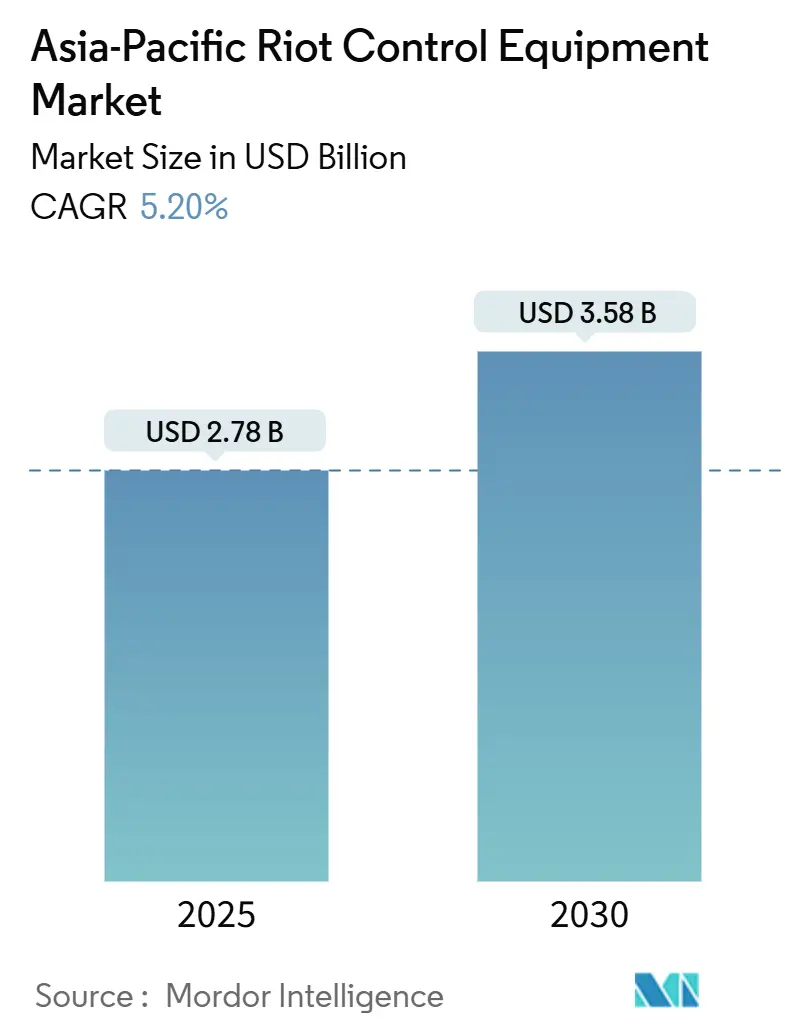
The Asia-Pacific Riot Control Equipment Market size is estimated at USD 2.78 billion in 2025, and is expected to reach USD 3.58 billion by 2030, at a CAGR of 5.20% during the forecast period (2025-2030).
- Although the COVID-19 pandemic affected the economies of all countries in the region, sales of riot control systems were not significantly impacted during and after 2020 in the Asia-Pacific region. The region witnessed several protests and riots in the same year and later, resulting in law enforcement agencies using riot-control equipment to handle the crowds.
- Increasing dissatisfaction with local governments in countries like Thailand, Japan, South Korea, Indonesia, and Malaysia is leading to a rise in major violence and riots, generating demand for the riot control equipment market in this region. Similarly, in India, communal violence often occurs, driving the demand for riot control equipment.
- Additionally, technological advancements in less-lethal weapons and unmanned aerial vehicles for surveillance and offensive purposes, such as the use of low-velocity ammunition and pepper sprays, are expected to provide growth opportunities for the market in the coming years.
- These factors are expected to continue driving demand for the market as law enforcement agencies strive to reduce fatalities and casualties in such events, which is likely to increase the demand for the Asia-Pacific riot control equipment market during the forecast period.
Asia-Pacific Riot Control Equipment Market Trends and Insights
Law Enforcement Segment to Dominate the Market
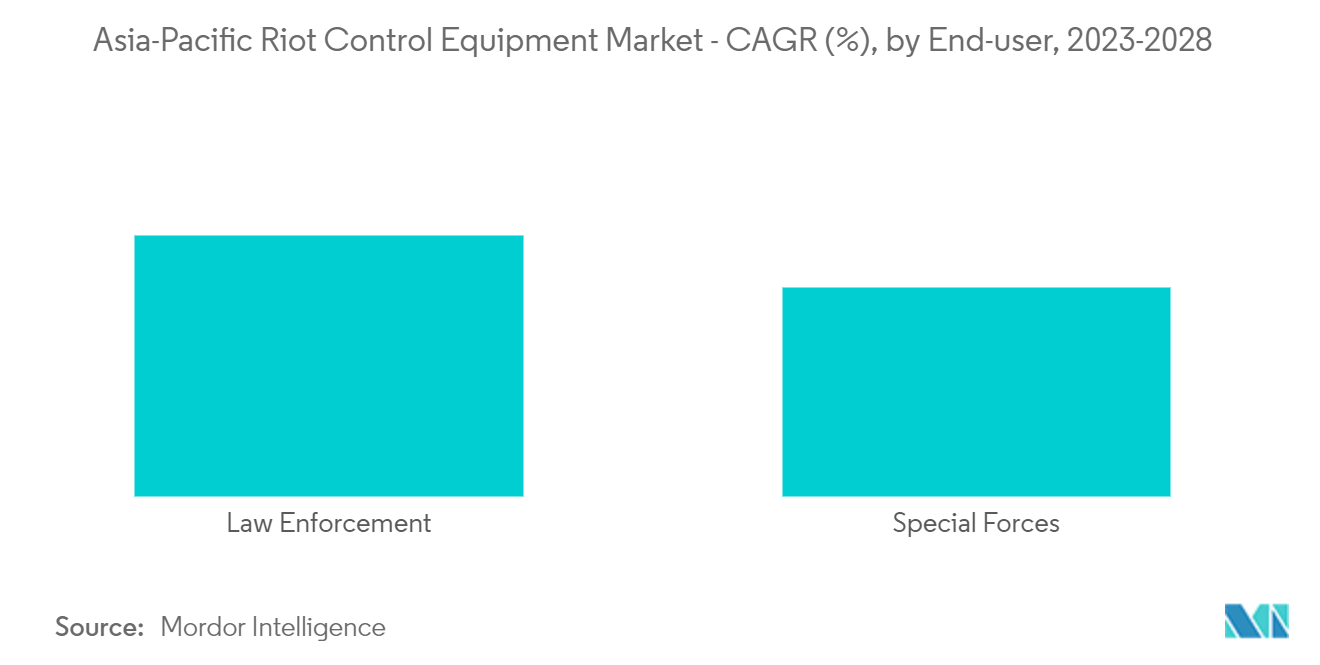
- The market for riot control equipment is currently experiencing significant growth, with the law enforcement segment leading the way and expected to maintain its dominance during the forecast period. This growth is being driven by geopolitical conflicts in various regions, which are encouraging law enforcement agencies to procure and deploy riot control systems. For example, escalating tensions in the Kashmir Valley and protests throughout India in recent years have led to an increase in demand for such systems.
- Additionally, sporadic riots and civil unrest, such as demonstrations and protests in cities in eastern China, have caused police forces to resort to the use of less-lethal weapons. This trend is expected to continue and will have a positive impact on the market's growth. Furthermore, governments have provided grants for the use of advanced non-lethal weapons in emergencies, and ongoing research and development of new crowd dispersal technologies are expected to create a favorable outlook for the market.
China to Dominate the Market
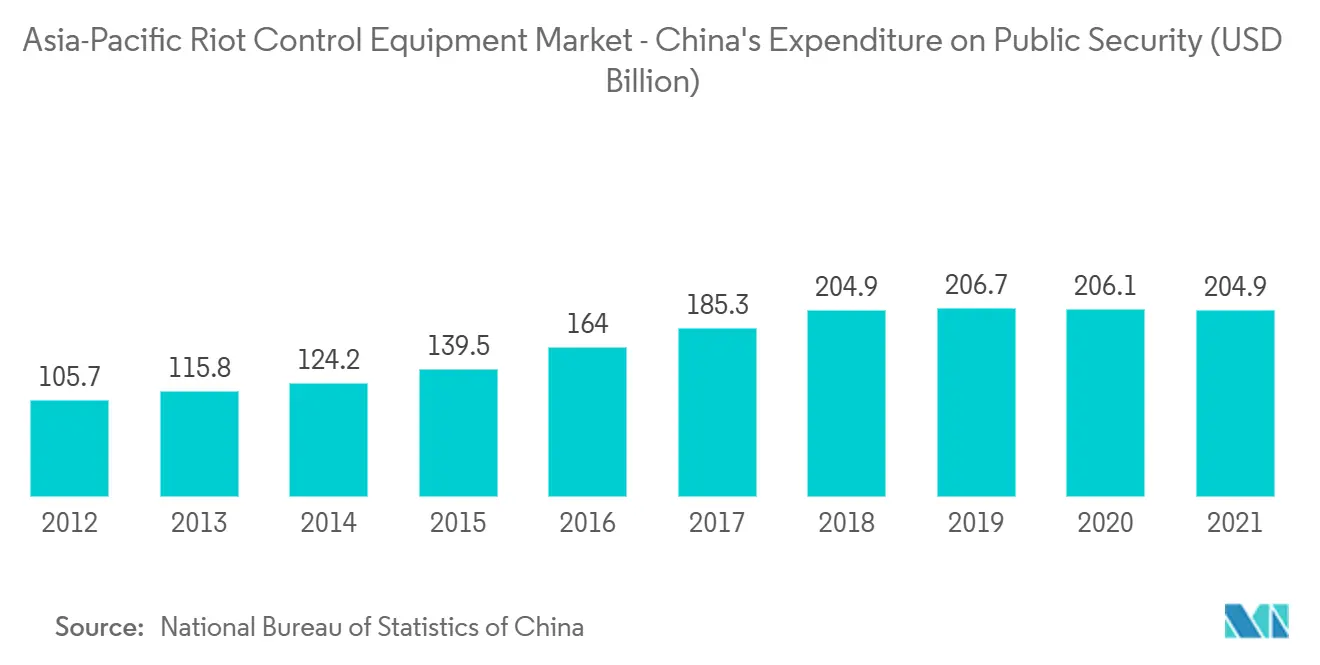
- China, one of the world's largest emerging economies, has been facing numerous protests and demonstrations that often turn violent and result in loss of life and property. The enforcement agencies in the country are usually under-equipped, which can sometimes result in unintended casualties. To mitigate such incidents, the Chinese government has been increasing its expenditure on public security, including state security, police, domestic surveillance, armed civil militia, and other measures aimed at addressing riots and public disturbances.
- The rise in public security expenditure in China has driven the market for riot control equipment in the country. China is also conducting extensive research and development (R&D) to develop a sophisticated riot control system that can effectively tackle large crowds without endangering the lives of law enforcement personnel.
- For example, in September 2019, China designed a sonic weapon that selectively targeted individuals or groups in a crowd, leaving them unable to control muscle movement and rendering them easy pickings for riot police to round up.
- The procurement of new weaponry and the ongoing R&D for developing a sophisticated riot control system are expected to drive the China segment of the market during the forecast period. This positive outlook of the market is due to the rising demand for riot control systems to address labor-related, environmental, and educational issues, among others, which have led to protests and demonstrations. The use of less-lethal ammunition has also contributed to the positive outlook of the market, which is expected to continue growing as China continues to invest in public security and research and development.
Competitive Landscape
The Asia-Pacific riot control equipment market is highly competitive, and several prominent players are operating in this market. Some of the major companies in this market include Combined Systems Inc., Condor Non-Lethal Technologies, Axon (Taser International Inc.), Safariland LLC, and Lamperd, Inc. To strengthen their market position, these companies are focusing on expanding their distribution network through strategic collaborations and partnerships.
For example, in February 2021, Lamperd, Inc. entered into a distribution agreement with Valentis, a provider of security logistics and risk management solutions. This collaboration enabled Valentis to integrate Lamperd Less Lethal products into its logistics and support network service, which is expected to benefit both companies through collective growth.
Asia-Pacific Riot Control Equipment Industry Leaders
-
Condor Non-Lethal Technologies
-
Axon (Taser International Inc.)
-
Safariland, LLC
-
Lamperd, Inc.
-
Combined Systems, Inc.
- *Disclaimer: Major Players sorted in no particular order
Recent Industry Developments
- January 2023: Safariland, a brand of The Safariland Group, launched three models of Hard Armor rifle plates exclusively designed for women, marking the first-ever NIJ 0101.06 compliant hard armor plate specifically tailored to the female form.
- January 2022: Safariland, a brand of the Safariland Group, collaborated with Busch Protective Germany GmbH & Co. KG. The two companies believe that the collaboration will bring advanced protection to a greater number of law enforcement agencies.
Asia-Pacific Riot Control Equipment Market Report Scope
Riot control equipment refers to any equipment used by police, military, or other security forces for controlling riots. The personnel protection equipment includes body armor, vehicles, riot shields, gas masks, and other related items. In contrast, the crowd dispersal equipment includes rubber bullets, wax bullets, plastic bullets, bean bag rounds, batons, tasers, and sponge grenades.
The Asia-Pacific riot control equipment market is segmented by product type and end user. By product type, the market is segmented into personnel protection equipment and crowd dispersal equipment. By end user, it is segmented into law enforcement and special forces. By geography, the market is segmented into India, China, South Korea, Thailand, Japan, and the Rest of the Asia-Pacific.
The report also offers the market size and forecast for the riot control equipment market in major countries in the region.
Product Type
| Personnel Protection Equipment |
| Crowd Dispersal Equipment |
End-user
| Law Enforcement |
| Special Forces |
Geography
| Asia-Pacific | India |
| China | |
| South Korea | |
| Thailand | |
| Japan | |
| Rest of Asia-Pacific |
| Product Type | Personnel Protection Equipment | |
| Crowd Dispersal Equipment | ||
| End-user | Law Enforcement | |
| Special Forces | ||
| Geography | Asia-Pacific | India |
| China | ||
| South Korea | ||
| Thailand | ||
| Japan | ||
| Rest of Asia-Pacific | ||
Key Questions Answered in the Report
What is the current Asia-Pacific Riot Control Equipment Market size?
The Asia-Pacific Riot Control Equipment Market is projected to register a CAGR of greater than 4% during the forecast period (2025-2030)
Who are the key players in Asia-Pacific Riot Control Equipment Market?
Condor Non-Lethal Technologies, Axon (Taser International Inc.), Safariland, LLC, Lamperd, Inc. and Combined Systems, Inc. are the major companies operating in the Asia-Pacific Riot Control Equipment Market.
What years does this Asia-Pacific Riot Control Equipment Market cover?
The report covers the Asia-Pacific Riot Control Equipment Market historical market size for years: 2020, 2021, 2022, 2023 and 2024. The report also forecasts the Asia-Pacific Riot Control Equipment Market size for years: 2025, 2026, 2027, 2028, 2029 and 2030.