
Market Overview
| Study Period | 2019 - 2031 |
|---|---|
| Forecast Data Period | 2026 - 2031 |
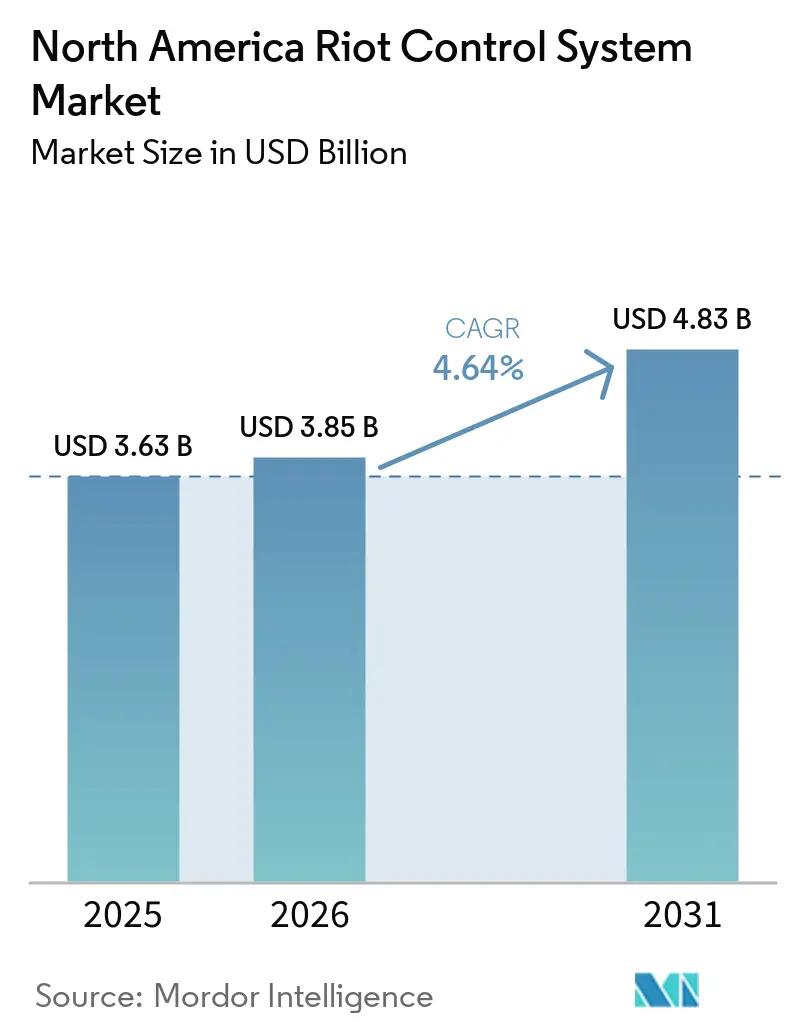
| Base Year Market Size (2025) | USD 3.63 Billion |
| Market Size (2026) | USD 3.85 Billion |
| Market Size (2031) | USD 4.83 Billion |
| Growth Rate (2026 - 2031) | 4.64 % |
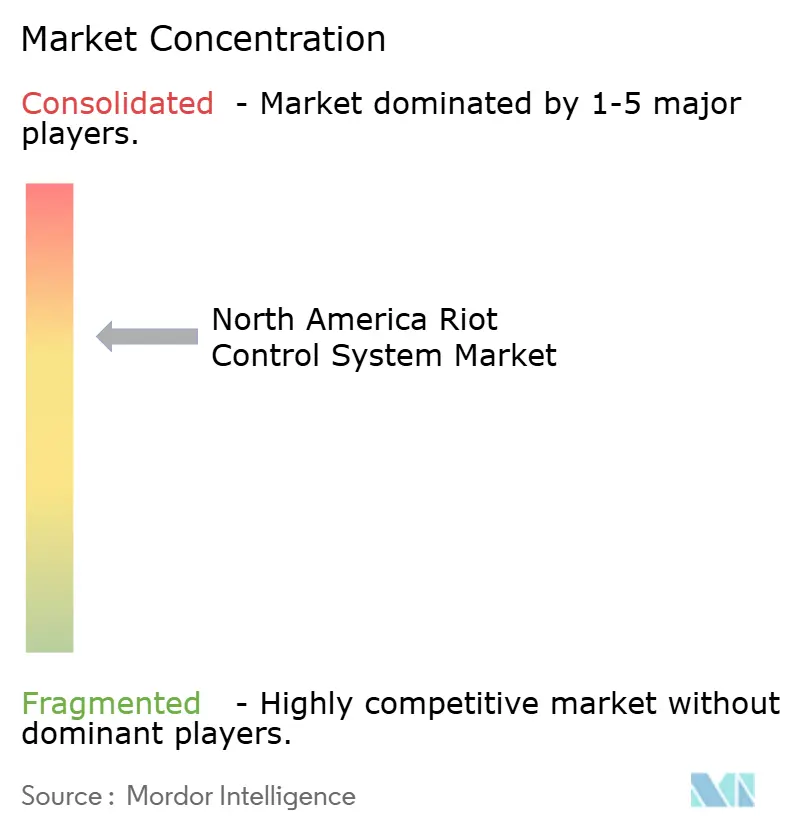
| Market Concentration | Medium |
Major Players *Disclaimer: Major Players sorted in no particular order Image © Mordor Intelligence. Reuse requires attribution under CC BY 4.0. | |
North America Riot Control System Market Analysis by Mordor Intelligence
The North America riot control system market size was valued at USD 3.85 billion in 2026 and is estimated to reach USD 4.83 billion by 2031, at a 4.64% CAGR during the forecast period (2026-2031). Rising protest activity is shortening replacement cycles for equipment that agencies had previously purchased less often. Federal criminal justice funding and the Department of Homeland Security (DHS) appropriation support spending by policing, border security, and federal enforcement bodies. Demand is shifting toward equipment that supports controlled use of force and clearer operational documentation. This favors suppliers that can combine compliant devices, protective equipment, training, and digital evidence tools. Legal scrutiny may limit selected ammunition and chemical-agent categories, even where overall demand for public-safety equipment remains firm.
Key Report Takeaways
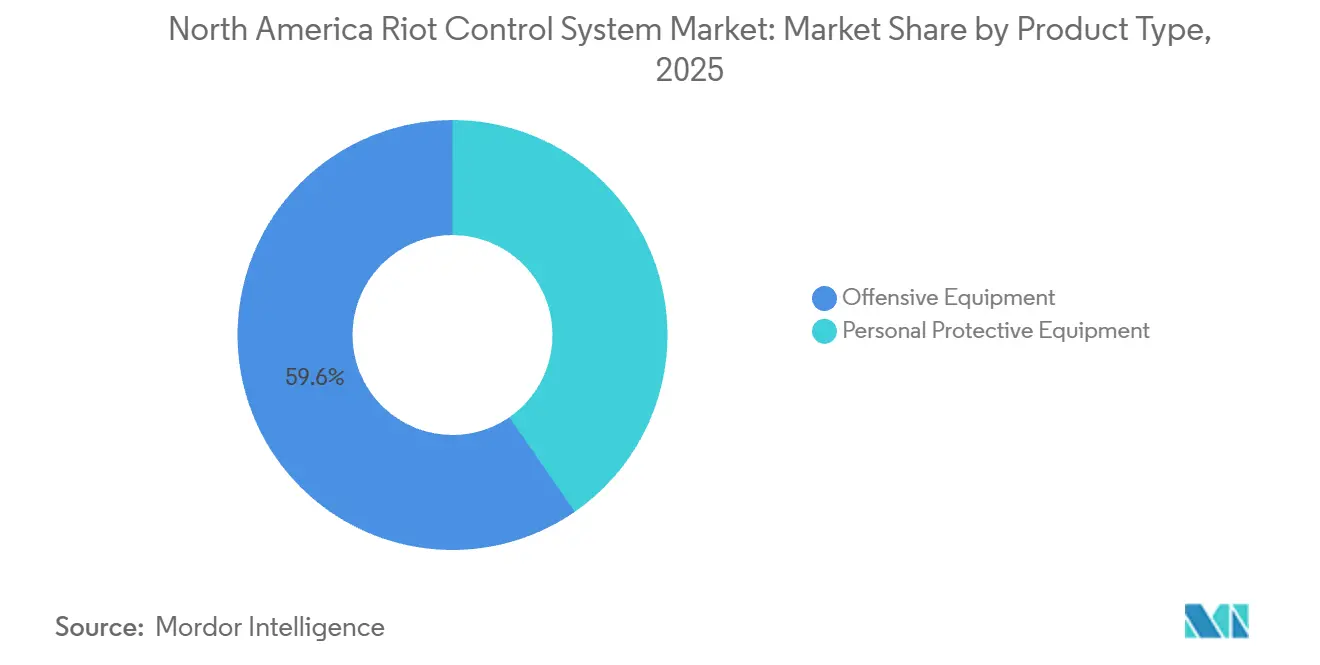
- By product type, offensive equipment held 59.63% of the North America riot control system market share in 2025, while personal protective equipment is forecast to grow at a 5.92% CAGR through 2031.
- By end-user, law enforcement held 89.94% of the North America riot control system market share in 2025, while special forces is forecast to grow at a 6.29% CAGR through 2031.
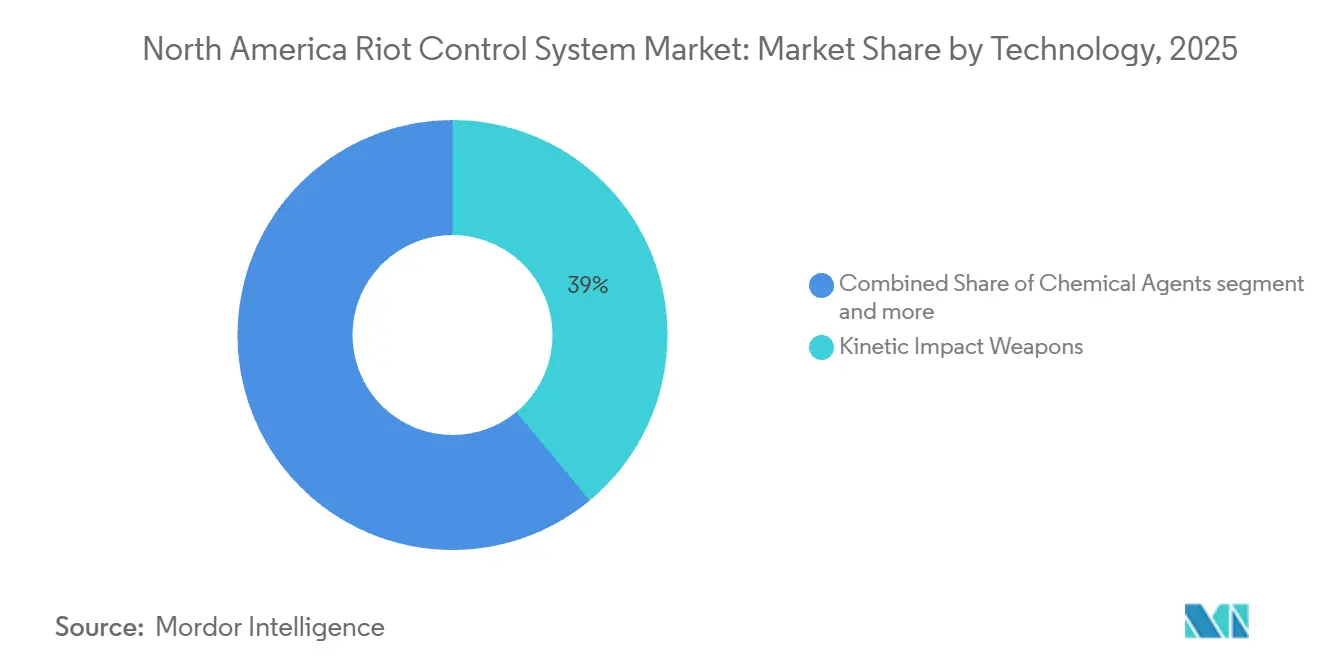
- By technology, kinetic impact weapons accounted for 38.98% revenue share in 2025, while electronic and sonic weapons are forecast to grow at a 6.32% CAGR through 2031.
- By geography, the US held 84.14% revenue share in 2025, while Canada is forecast to grow at a 5.78% CAGR through 2031.
Note: Market size and forecast figures in this report are generated using Mordor Intelligence’s proprietary estimation framework, updated with the latest available data and insights as of January 2026.
North America Riot Control System Market Trends and Insights
Drivers Impact Analysis*
| Driver | (~) % Impact on CAGR Forecast | Geographic Relevance | Impact Timeline |
|---|---|---|---|
| Escalating civil unrest and protest frequency | +1.80% | National, concentrated in US urban corridors and immigration-enforcement flash points | Short term (≤ 2 years) |
| Federal and provincial funding boosts for law-enforcement modernization | +1.00% | US through DOJ grants and DHS funding, Canada, through RCMP procurement reform | Medium term (2-4 years) |
| Preference for non-lethal options to reduce liability and fatalities | +0.70% | National, with early gains in high-litigation metropolitan areas | Medium term (2-4 years) |
| Border-security spill-over procurement for crowd-control gear | +0.50% | US border corridors and ICE and CBP operations | Short term (≤ 2 years) |
| AI-enabled situational-awareness platforms bundled with gear sales | +0.30% | Major US metropolitan police departments, expanding to mid-tier agencies | Long term (≥ 4 years) |
| Climate-protest surge creating demand spikes for mobile gear inventory | +0.15% | National, with early concentration in the Pacific Northwest and energy-transit corridors | Medium term (2-4 years) |
| Source: Mordor Intelligence | |||
Escalating Civil Unrest Reshapes Agency Procurement Timelines
The North America riot control system market is supported by a higher volume of demonstrations and a broader geographic spread of protest activity. The Crowd Counting Consortium recorded more than 10,700 protests in the US during 2025, 133% higher than the 4,588 it recorded in 2017. The Consortium also reported activity in more than 60% of US counties by June 2025. ACLED recorded more than 1,500 demonstration events during August 2025, with activity concentrated around immigration-enforcement operations in Los Angeles, Chicago, and Newark.[1] Heavy use of consumable munitions can exhaust inventories before a normal annual procurement cycle ends. Smaller suburban and rural agencies, therefore, face a need for entry-level protective equipment and less-lethal launchers for the first time when demonstrations expand beyond established metropolitan locations.
Federal and Provincial Funding Creates Multi-Year Procurement Runway
The North America riot control system market benefits when federal and provincial funding reduces delays in equipment renewal. Congress limited reductions in FY2026 DOJ grant funding to 1%, retaining USD 4.84 billion in criminal justice grants after an initial 15% reduction proposal. The COPS FY2026 Technology and Equipment Program provides USD 401.41 million in noncompetitive invitational grants for law-enforcement equipment and technology that meets National Institute of Standards and Technology requirements. Individual awards can reach USD 20 million, supporting integrated purchases rather than narrow product replacements. In Canada, the National Police Federation called in April 2026 for a Public Safety Procurement Strategy and Secretariat to address expired equipment and fragmented procurement overruns affecting the RCMP. A reform process could produce a concentrated replacement cycle as agencies address accumulated equipment needs.
Non-Lethal Preference Reshapes Procurement Doctrine
The market is also shaped by agencies seeking devices that support de-escalation during arrests, transport, and disturbances. ICE awarded Compliant Technologies a USD 16.70 million contract in August 2026 for 6,000 G.L.O.V.E. devices and described the equipment as a de-escalation option. Axon’s TASER platforms illustrate how established less-lethal systems can become embedded in agency purchasing arrangements. Agencies with documented non-lethal response options may reduce exposure to civil settlements and related liability costs. National Institute of Justice certification requirements also encourage replacing legacy products with compliant equipment that supports defensible use-of-force documentation. Suppliers with established certification, training, and service capabilities can benefit because an agency’s choice becomes part of a broader operational process.
Border-Security Spill-Over Expands the Addressable Market
The North America riot control system market gains an additional demand channel from border security and immigration enforcement operations. Public Law 119-21 provided USD 178 billion in supplemental appropriations to the DHS in July 2025, including funding for border security, immigration enforcement, and federal law enforcement modernization. ICE’s August 2026 glove contract shows that agencies operating in these settings are purchasing less-lethal equipment at scale. CBP procurement activity also points to the adoption of equipment categories that had been more closely associated with domestic policing. As border agencies use this equipment, their operational experience can inform later certification reviews and municipal purchasing decisions. This creates a route for products to move from federal border operations into wider law-enforcement use.
Restraints Impact Analysis*
| Restraint | (~) % Impact on CAGR Forecast | Geographic Relevance | Impact Timeline |
|---|---|---|---|
| Intensifying human-rights and legal scrutiny on use-of-force tools | -0.25% | National, concentrated in high-litigation metropolitan areas | Short term (≤ 2 years) |
| High up-front and lifecycle costs of next-gen equipment | -0.20% | National, with a greater effect on rural and underfunded agencies | Medium term (2-4 years) |
| Section 889 import restrictions limiting electronics sourcing | -0.10% | National, concentrated in technology-integrated product categories | Long term (≥ 4 years) |
| Advanced-composite material supply bottlenecks extending lead-times | -0.10% | National, affecting personal protective equipment and armor production | Medium term (2-4 years) |
| Source: Mordor Intelligence | |||
Human-Rights Scrutiny Constrains Specific Product Categories
The North America riot control system market faces tighter scrutiny when equipment is associated with preventable injuries or poorly controlled deployments. Physicians for Human Rights and the UC Berkeley Human Rights Center documented 412 verified incidents of crowd-control weapon misuse across 16 US cities from June 2025 through May 2026. The review documented 203 injuries, including blindings and traumatic brain injuries, and reported that DHS agencies accounted for 64% of incidents. Scattershot projectiles and concentrated chemical munitions face greater legislative and reputational exposure than electroshock or acoustic systems. PHR also found that nearly 100 journalists were shot with less-lethal weapons during Los Angeles anti-ICE protests in the summer of 2025. Manufacturers of precise, compliant products may be better placed as agencies move away from legacy bulk-dispersal tools.
High Costs and Lifecycle Economics Exclude Smaller Agencies
The market has uneven purchasing capacity because modern systems often require significant spending on equipment, software, training, and maintenance. Baltimore approved a USD 153.20 million Axon master services agreement in May 2026, covering TASER 10 devices, body cameras, virtual-reality headsets, and cloud evidence management through 2036. Agencies with fewer than 50 officers make up most US departments and often cannot support comparable levels of investment. Platform subscriptions, including Axon’s AI Era Plan, can increase total ownership costs compared with one-time hardware procurement. Ehmke Manufacturing reported in April 2026 that US aramid-fiber lead times had expanded from 2-6 weeks to 12-18+ weeks, adding delivery risk to protective-equipment contracts.[2] Section 889 restrictions can add compliance checks and cost pressure for federally funded technology-integrated systems.
*Our forecasts treat driver/restraint impacts as directional, not additive. The impact forecasts reflect baseline growth, mix effects, and variable interactions.
Segment Analysis
By Product Type: Offensive Equipment Leads While Protective Equipment Expands
Offensive equipment held 59.63% of the North America riot control system market share in 2025, supported by replenishment of kinetic munitions, area-denial systems, and electroshock devices. Federal agencies use these products at a high operational tempo, which creates repeat purchases of consumable equipment. CBP sought less-lethal specialty munitions across 123 product types, with projected volumes above 242,000 pyrotechnic canisters and 100,000 impact munitions. Directed-energy and electroshock platforms are the most active subcategories within offensive equipment. ICE’s G.L.O.V.E. purchase and the Navy’s non-lethal diversionary grenade procurement reflect institutional interest in lower-lethality tools. Gases and sprays face greater scrutiny after documented misuse incidents. This is directing product development toward more precise dispersal methods and clearer safety controls.
Personal protective equipment is the fastest-growing product category in the North America riot control system market and is projected to expand at a 5.92% CAGR from 2026 to 2031. Officer-safety mandates are extending into border-enforcement roles, while certification requirements require agencies to replace noncompliant equipment. The qualification process can take 18-24 months, which favors established US suppliers such as Point Blank Enterprises, Blackhawk, and United Tactical Supply. Extended aramid-fiber lead times divide suppliers into those with secure long-term fiber agreements and those with delayed order fulfillment. The July 2026 executive order on defense supply chains directs prime contractors to map critical supply chains from raw materials to finished products. This can strengthen domestic sourcing efforts for ballistic composites over the next 3-5 years.

By End-User: Law Enforcement Anchors Demand While Special Forces Accelerates
Law enforcement accounted for 89.94% of the North American riot control systems market share in 2025, reflecting the scale of the US law enforcement system and its recurring replacement needs. The US has more than 18,000 law enforcement agencies that maintain, replace, and upgrade equipment. Federal agencies are gaining weight within this group because DHS and DOJ funding moves through procurement channels that can operate faster than municipal budgets. Genasys received USD 3 million in US and international LRAD orders in September 2026. Its public-safety platform deployments across 14 US states show the wider use of acoustic and situational-awareness systems. ICE and CBP remain the fastest-growing subchannels within law enforcement as supplemental funding supports standardized equipment purchases. This makes border-related procurement more material to the riot control system industry.
The special forces end-user segment is projected to grow at a 6.29% CAGR through 2031. Counterterrorism and special operations doctrine is incorporating non-lethal capabilities into standard operational kits. Genasys received a USD 9 million order from the US Army for the CROWS II Technical Refresh program in September 2025. The order was the first production run of Acoustic Hailing Devices for CROWS. A Fort Drum TASER solicitation and Air Force M41A training-system procurement also reflect unit-level use of non-lethal platforms. Products adopted by special forces generate operational data that can later support review and broader adoption by law enforcement. This shortens the usual transfer period between military and civilian public-safety applications.
By Technology: Kinetic Weapons Retain Volume While Electronic and Sonic Systems Refresh
Kinetic Impact Weapons accounted for 38.98% of technology-segment revenue in 2025. The segment benefits from repeat purchasing of 40mm foam baton rounds, rubber ball grenades, bean bag rounds, and other direct-impact munitions. The Customs and Border Protection framework projected more than 100,000 impact munition rounds over a 5-year ordering period. The US Secret Service issued a new 5-year procurement in July 2026 for 40mm less-lethal and smoke munitions and FN303 ammunition, using brand-name compatibility requirements for Defense Technology and Combined Systems products. Winnipeg Police also procured 40mm foam-round launchers funded by provincial criminal-property-forfeiture proceeds. Chemical agents remain significant by volume, although Minnesota's chemical-irritant disclosure requirement became effective in August 2026.
Electronic and sonic weapons are forecast to grow at a 6.32% CAGR through 2031. The Congressional Research Service analysis found that 93.50% of US law enforcement agencies authorize full-time sworn officers to use conducted energy devices. Growth in the North America riot control system market, therefore, depends on device replacement, training ecosystems, and integration with cloud evidence platforms rather than first-time authorization. Genasys received a USD 1.30 million follow-on LRAD order from the National Guard in September 2026, bringing cumulative National Guard procurement to USD 8.50 million. Immigration and Customs Enforcement's G.L.O.V.E. contract and the Customs and Border Protection solicitation confirm the growing role of electronic systems in border enforcement. Section 889 requirements can lengthen sourcing for integrated electronic platforms by 3-6 months and favor compliant domestic suppliers.
Geography Analysis
The US held 84.14% market share in the North America riot control system market in 2025, supported by federal procurement streams unavailable on a comparable scale elsewhere in the region. Public Law 119-21 delivered USD 178 billion in supplemental DHS appropriations in July 2025 for border security, immigration enforcement, and related federal operations. The COPS FY2026 Technology and Equipment Program provides USD 401.41 million for qualifying law enforcement equipment and technology. Local Formula Grants also provide funding for equipment and technology used by local justice agencies.[3] These funding channels can support tactical gear as part of broader platform contracts that include technology and evidence-management functions.
Demonstration-intensive metropolitan areas, including Los Angeles, Chicago, Minneapolis, Newark, and Portland, combine operational demand with greater legal eACLED's. ACLED's August 2025 review identified concentrated demonstration activity around immigration enforcement. The same cities are more likely to face scrutiny over crowd-control deployment practices. Agencies in these areas are likely to favor precision tools and systems with recorded accountability features over bulk-dispersal products. The North America riot control system market, therefore, has different product needs across federal border operations, large urban departments, and smaller local agencies. These differences create room for suppliers offering both lower-cost entry systems and integrated premium platforms.
Canada is projected to grow at a 5.78% CAGR through 2031. The National Police Federation called for urgent procurement reform in April 2026, citing officers' use of expired equipment and the costs of fragmented purchasing. Rampart Corporation received a CAD 39 million (USD 28.30 million) contract to supply the RCMP with GLOCK 45 MOS 7 pistol systems and related equipment in May 2026. The standing offer for conducted-energy-weapon testing also indicates an upcoming capability refresh. Canadian bilingual procurement requirements and Indigenous Business Directory visibility rules favor suppliers with an established Canadian operating presence.
Competitive Landscape
The North America riot control system market is moderately consolidated because specialist non-lethal suppliers hold framework agreements and sole-source positions in key product areas. Large defense companies participate more selectively in the pyrotechnics, ballistic protection, and acoustic niches. Axon reported USD 15.10 billion in future contracted bookings in its mid-2026 Form 10-Q, a 41% year-over-year increase. Its filing also reported the largest individual TASER order in its history and 2 nine-figure contracts with major US cities. The company bundles TASER devices, body cameras, cloud evidence management, and AI analytics through its AI Era Plan. This integrated approach raises the cost of supplier replacement once an agency has adopted the platform.
Byrna reported FY2025 net revenue of USD 118.10 million, up 38% from USD 85.80 million in FY2024. In July 2026, Byrna entered a binding agreement to acquire HERO Defense Systems. The transaction broadens the company’s coverage across price points and everyday-carry formats. Genasys takes a different approach, positioning LRAD systems for both escalation-of-force communication and mass notification. Its software reached public-safety agencies in 14 US states during the summer of 2026. Its CROWS II order further moved acoustic equipment into vehicle-mounted military systems.
Compliant Technologies shows that alignment with stated use-of-force policy can support a major federal award without the scale of larger competitors. Its USD 16.70 million ICE contract was awarded without competitive bidding for 6,000 G.L.O.V.E. devices. Patent positions and National Institute of Justice certification form important barriers because compliance testing can take 18-24 months. Sole-source procurement has also protected differentiated products, including the Rheinmetall MK 25 Mod 0 grenade and Axon TASER 10 systems. Axon’s platform strategy, Byrna’s planned acquisition, and Genasys’s dual-use positioning show that suppliers are expanding either through bundled systems, broader product ranges, or new operating uses. The available information does not provide combined share data for the leading companies.
North America Riot Control System Industry Leaders
-
Axon Enterprise Inc.
-
Byrna Technologies Inc.
-
Genasys, Inc.
-
Combined Systems, Inc.
-
Point Blank Enterprises, Inc.
- *Disclaimer: Major Players sorted in no particular order
Recent Industry Developments
- September 2026: Genasys Inc. received USD 3 million in new and follow-on LRAD orders from US domestic agencies and international customers across military, law enforcement, critical infrastructure, and wildlife applications. The company cited higher global defense and homeland security budgets as the primary drivers of demand and expects this momentum to continue into 2027.
- August 2026: ICE awarded Compliant Technologies LLC a USD 16.70 million no-bid contract for 6,000 G.L.O.V.E. devices, funded from the One Big Beautiful Bill's DHS appropriation, with delivery required by February 2027. The contract positions the gloves as a de-escalation alternative during arrests, detainee transport, and facility disturbances.
North America Riot Control System Market Report Scope
The North America riot control system market covers equipment and solutions used by law enforcement agencies, special forces, border security units, and related public security organizations to manage crowds, maintain public order, and respond to civil unrest.
The North America riot control system market is segmented by product type, end-user, technology, and geography. By product type, the market is segmented into personal protective equipment and offensive equipment. By end-user, the market is segmented into law enforcement and special forces. By technology, the market is segmented into chemical agents, electronic and sonic weapons, kinetic impact weapons, and others. The report also covers the market sizes and forecasts for the North America riot control system market in three countries across the region. For each segment, the market size is provided in terms of value (USD).
By Product Type
| Personal Protective Equipment | Vests | |
| Helmets | ||
| Gas Masks | ||
| Shields | ||
| Offensive Equipment | Area Denial | Anti-vehicle |
| Anti-personnel | ||
| Ammunition | Rubber Bullets | |
| Wax Bullets | ||
| Plastic Bullets | ||
| Bean Bag Rounds | ||
| Sponge Grenades | ||
| Explosives | Flashbang Grenades | |
| Sting Grenades | ||
| Gases and Sprays | Water Cannons | |
| Scent-based Weapons | ||
| Tear Gas | ||
| Pepper Spray | ||
| Directed Energy Weapons | ||
| Electro-shock Weapons | ||
| Other Offensive Equipment | ||
By End-User
| Law Enforcement |
| Special Forces |
By Technology
| Electronic and Sonic Weapons |
| Kinetic Impact Weapons |
| Chemical Agents |
| Others |
By Geography
| United States |
| Canada |
| Mexico |
| By Product Type | Personal Protective Equipment | Vests | |
| Helmets | |||
| Gas Masks | |||
| Shields | |||
| Offensive Equipment | Area Denial | Anti-vehicle | |
| Anti-personnel | |||
| Ammunition | Rubber Bullets | ||
| Wax Bullets | |||
| Plastic Bullets | |||
| Bean Bag Rounds | |||
| Sponge Grenades | |||
| Explosives | Flashbang Grenades | ||
| Sting Grenades | |||
| Gases and Sprays | Water Cannons | ||
| Scent-based Weapons | |||
| Tear Gas | |||
| Pepper Spray | |||
| Directed Energy Weapons | |||
| Electro-shock Weapons | |||
| Other Offensive Equipment | |||
| By End-User | Law Enforcement | ||
| Special Forces | |||
| By Technology | Electronic and Sonic Weapons | ||
| Kinetic Impact Weapons | |||
| Chemical Agents | |||
| Others | |||
| By Geography | United States | ||
| Canada | |||
| Mexico | |||
Key Questions Answered in the Report
What is the projected value of the North America riot control system market by 2031?
The North America riot control system market is projected to reach USD 4.83 billion by 2031, growing at a 4.64% CAGR from 2026.
Which product category leads demand in North America?
Offensive equipment led product-type revenue with a 59.63% share in 2025, supported by repeat demand for consumable and less-lethal equipment.
Which end user is growing fastest through 2031?
Special forces end-users are projected to record the highest growth at a 6.29% CAGR through 2031 as non-lethal capabilities become more established in operations.
Why is Canada growing faster than the regional average?
Canada is projected to grow at a 5.78% CAGR, supported by procurement reform discussions and equipment renewal needs within the RCMP.
What factors may limit demand for certain riot-control products?
Human-rights scrutiny, legal restrictions, high ownership costs, electronics sourcing rules, and protective-material supply constraints may slow adoption in selected categories.
Which companies are active in the North America riot control system industry?
Axon Enterprise Inc., Byrna Technologies Inc,, Genasys, Inc., and Combined Systems, Inc. are some of the active companies that operate through integrated platforms, product-range expansion, acoustic systems, and less-lethal devices.