
Command And Control Systems Market Size and Share
Market Overview
| Study Period | 2020 - 2031 |
|---|---|
| Market Size (2026) | USD 45.5 Billion |
| Market Size (2031) | USD 57.01 Billion |
| Growth Rate (2026 - 2031) | 4.61 % |
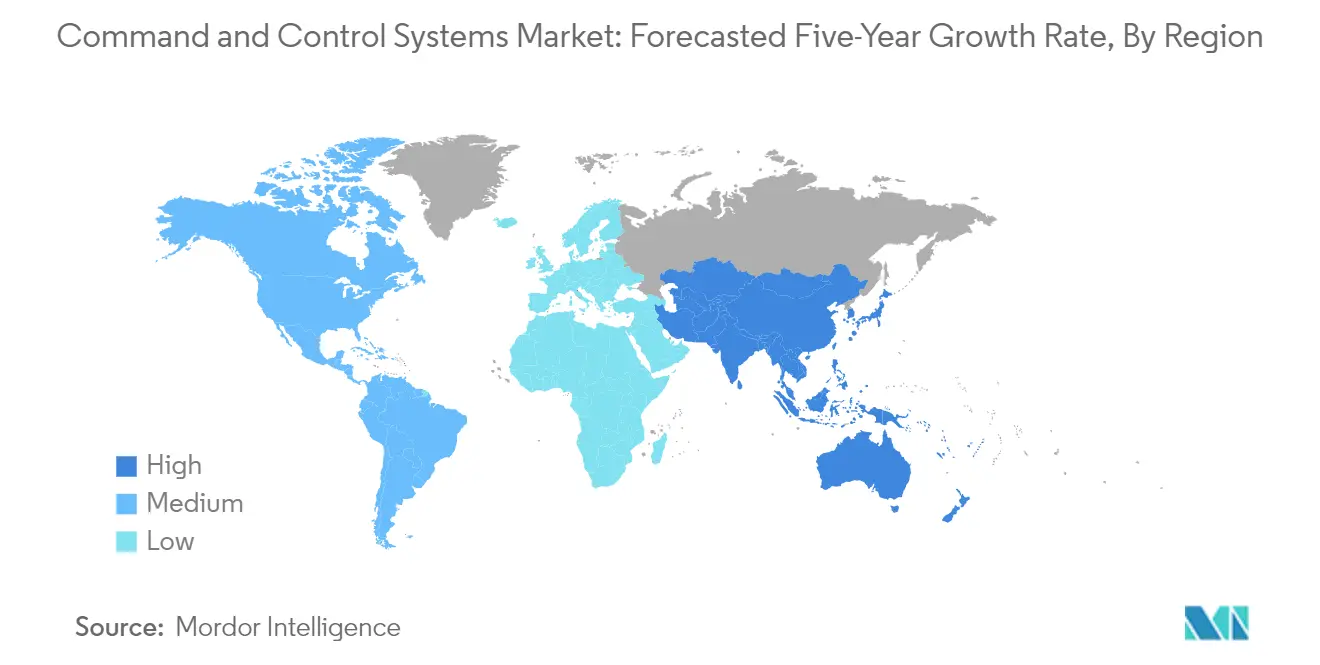
| Fastest Growing Market | Asia Pacific |
| Largest Market | North America |
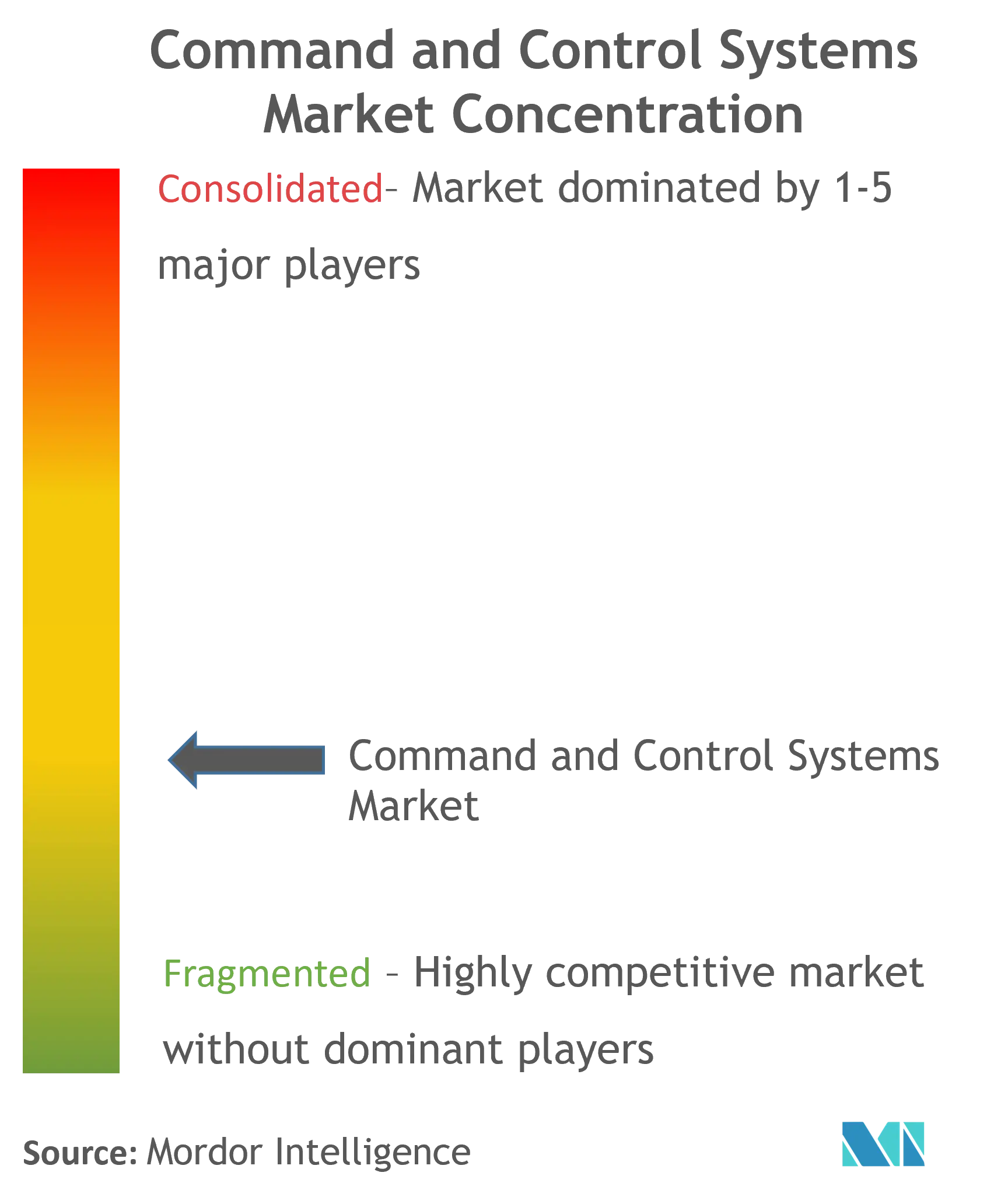
| Market Concentration | Low |
Major Players *Disclaimer: Major Players sorted in no particular order Image © Mordor Intelligence. Reuse requires attribution under CC BY 4.0. | |
Command And Control Systems Market Analysis by Mordor Intelligence
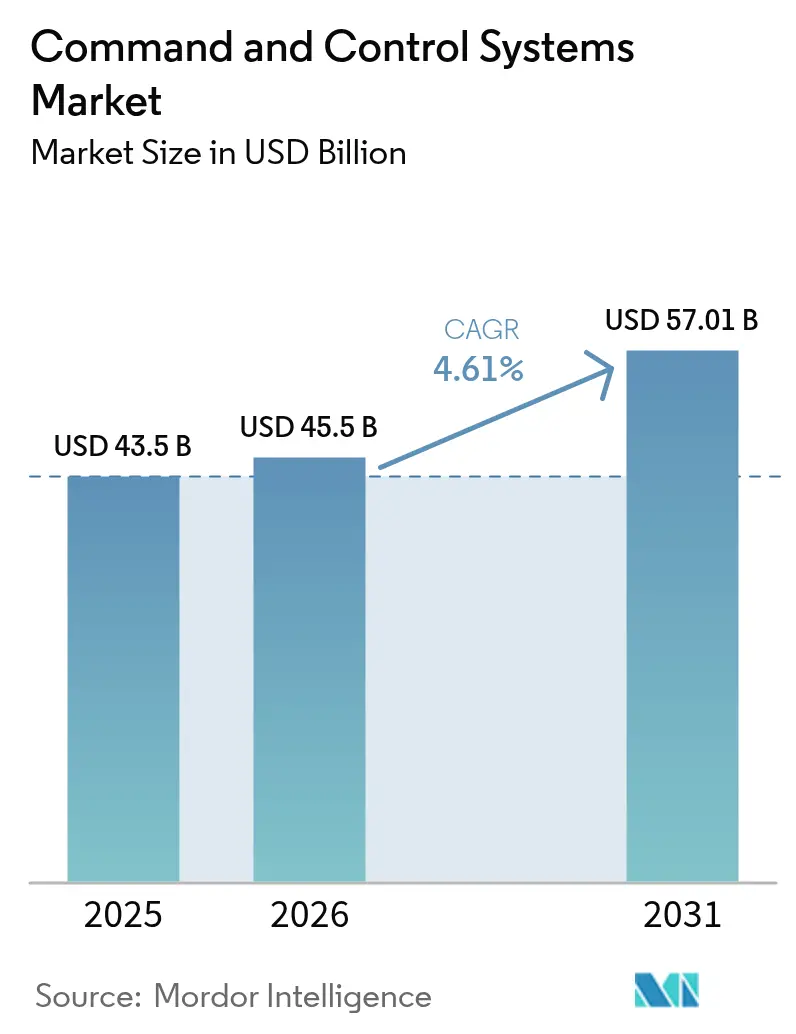
Command And Control Systems Market size in 2026 is estimated at USD 45.5 billion, growing from 2025 value of USD 43.50 billion with 2031 projections showing USD 57.01 billion, growing at 4.61% CAGR over 2026-2031.
The command and control systems industry continues to evolve amid increasing global security challenges and technological advancements. According to the International Institute for Strategic Studies (IISS), global defense expenditure reached USD 1.92 trillion in 2021, representing a 3.4% increase over previous levels, indicating strong investment in military capabilities, including command and control systems. The industry is witnessing a significant shift toward integrated solutions that can handle complex battlefield scenarios while providing enhanced situational awareness and decision-making capabilities. This transformation is particularly evident in the increasing adoption of network-centric warfare concepts, where interconnected systems enable real-time information sharing and coordinated responses across multiple platforms.
The integration of advanced technologies is reshaping the command and control systems landscape, with artificial intelligence, quantum communications, and big data analytics emerging as key enablers of next-generation capabilities. Military organizations are increasingly focusing on developing open architecture command and control systems that enable easy introduction of new interfaces and modes of interaction. This approach facilitates the seamless integration of emerging technologies while ensuring interoperability between different platforms and systems. The industry has witnessed significant developments in automation capabilities, with reports indicating that automation has helped reduce radar operator workload by as much as 50%, enabling operators to focus more on critical surveillance missions.
A notable trend in the market is the growing emphasis on multi-domain command and control operations, which enable military forces to conduct operations across multiple domains and contested spaces simultaneously. The industry is witnessing increased investment in systems that can integrate vast, diverse, and distributed forces of platforms, sensors, personnel, and networks. This evolution is particularly evident in the development of sophisticated battle management systems that can coordinate actions across land, air, sea, space, and cyber domains. Companies are focusing on developing solutions that enable forces to overcome adversary strengths through the combined employment of multi-domain formations and convergence of capabilities across domains.
The industry is experiencing a surge in collaborative development efforts and strategic partnerships aimed at enhancing command and control capabilities. In February 2022, Systematic released version 3.2 of its SitaWare Edge and SitaWare Frontline software, introducing enhanced mobile battle management capabilities for dismounted and mounted commanders. The market is also witnessing increased focus on developing protected technologies such as quantum cryptography protected communications, reflecting the growing importance of secure command and control systems in modern military operations. These developments are accompanied by efforts to standardize interfaces and protocols, ensuring seamless integration of new capabilities while maintaining backward compatibility with existing systems.
Note: Market size and forecast figures in this report are generated using Mordor Intelligence’s proprietary estimation framework, updated with the latest available data and insights as of 2026.
Market Trends and Insights
Growth in Defense Spending
The global defense expenditure has witnessed substantial growth in recent years, reaching USD 2.1 trillion in 2021, representing a significant increase from previous years. This surge in military spending is primarily attributed to profound changes in the international strategic landscape, where the configuration of international security systems has been undermined by growing hegemonism, unilateralism, and power politics. The increasing uncertainties in territorial rights, political tensions, and the quest for universal dominance among military powerhouses have emerged as major factors disturbing the geopolitical scenario, compelling nations to allocate substantial budgets toward military modernization and capability enhancement.
The robust defense spending has particularly manifested in the procurement of sophisticated command and control systems, as evidenced by recent major contracts and partnerships. For instance, in October 2023, Elbit Systems secured a significant contract worth USD 170 million to participate as an integration partner in the Swedish Army digitalization program LSS Mark, focusing on the integration and maintenance of advanced command and control systems across various platforms. Similarly, in January 2024, Northrop Grumman Corporation and Mitsubishi Electric Corporation established a strategic partnership to develop integrated air and missile defense capabilities for Japan's ground-based systems, demonstrating the continued investment in enhancing military command and control systems capabilities through international collaboration.
Increasing Focus on Modernization of Warfighting Capabilities
The modernization of warfighting capabilities has become imperative for militaries worldwide as they adapt to evolving threats and technological advancements. Military forces are increasingly focusing on conducting operations across multiple domains and contested spaces to overcome adversary strengths through the combined employment of multi-domain formations. This has led to significant investments in integrating vast, diverse, and distributed forces of platforms, sensors, personnel, and networks to meet the growing requirements of modern warfare. The emphasis on modernization is particularly evident in the integration of artificial intelligence and machine-to-machine communication, although managing information flows to ensure that information inputs do not slow down decision-making capabilities remains a crucial consideration.
Recent developments highlight the accelerating pace of military modernization efforts globally. For instance, Lockheed Martin Australia's partnership with the Royal Australian Air Force (RAAF) and Defence Science and Technology Group (DSTG) in August 2022 exemplifies the growing focus on leveraging artificial intelligence to support rapid decision-making at tactical levels of the command and control systems market across various domains. The modernization initiatives extend beyond traditional warfare domains, encompassing cyber capabilities and electronic warfare systems. Military organizations are increasingly investing in protective technologies such as quantum cryptography-protected communications and developing sophisticated command and control systems market that can effectively coordinate air defense activities while maintaining interoperability with various platforms and systems.
Command And Control Systems Market Segment Analysis
Land Segment in Command and Control Systems Market
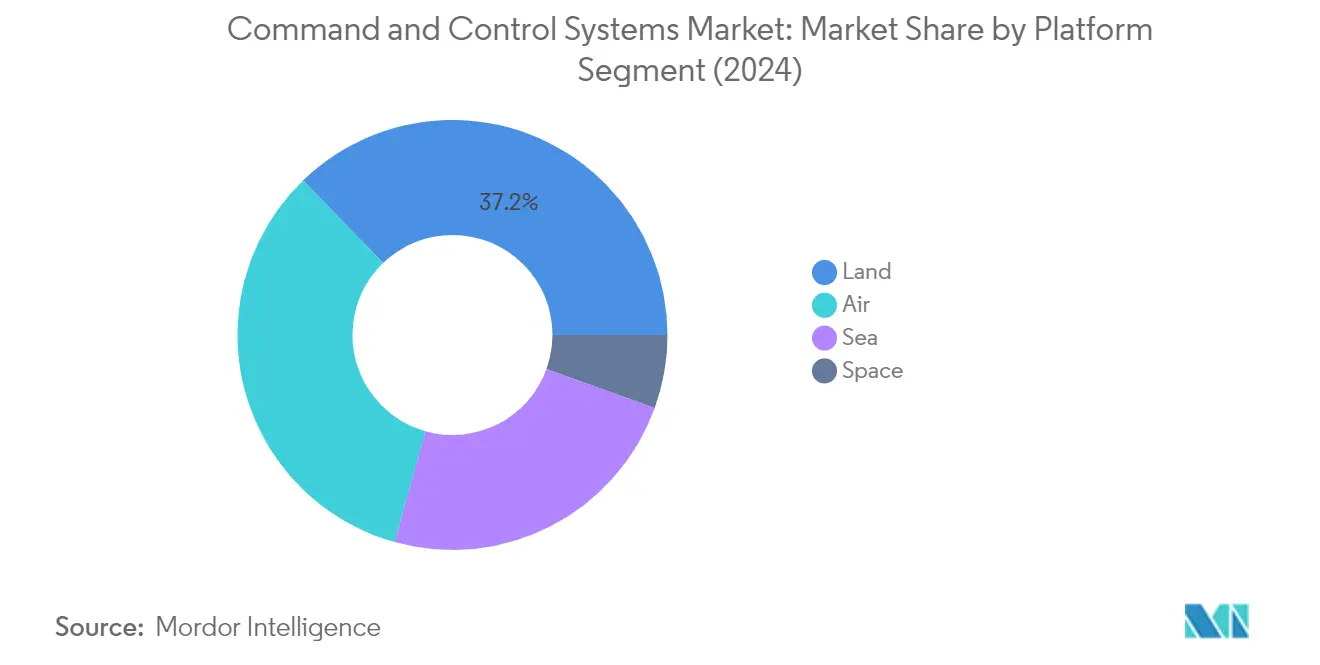
The Land segment dominates the Command and Control Systems Market, holding approximately 36.60% market share in 2025. This significant market position is driven by the increasing focus on modernizing ground-based command and control systems capabilities across various military forces globally. The segment's prominence is reinforced by substantial investments in battlefield management systems, tactical communications infrastructure, and the integration of advanced technologies for ground forces. Military organizations worldwide are implementing sophisticated land-based C2 systems to enhance situational awareness, improve coordination between ground units, and enable faster decision-making in complex battlefield scenarios. The integration of artificial intelligence and machine learning capabilities in land-based C2 systems has further strengthened this segment's market position, allowing for more efficient processing of battlefield data and enhanced tactical response capabilities.
Space Segment in Command and Control Systems Market
The Space segment is emerging as the fastest-growing sector in the Command and Control Systems Market, with an expected growth rate of approximately 6.88% during the forecast period 2026-2031. This remarkable growth is primarily driven by increasing investments in space-based defense capabilities and satellite communications systems. The segment is witnessing rapid technological advancements in satellite-based command and control systems, particularly in areas such as space situational awareness and orbital warfare capabilities. Military organizations are increasingly recognizing the strategic importance of space-based C2 systems in modern warfare, leading to enhanced investments in satellite communication networks, space surveillance systems, and integrated space-ground command architectures. The growing emphasis on developing resilient space-based C2 capabilities to counter emerging threats in the space domain is further accelerating the segment's growth.
Remaining Segments in Platform Segmentation
The Air and Sea segments continue to play crucial roles in the command and control systems market, each bringing unique capabilities and requirements to military operations. The Air segment focuses on advanced airborne early warning systems, tactical air control, and integrated air defense networks, while maintaining crucial links between aerial assets and ground control stations. The Sea segment emphasizes maritime domain awareness, naval combat management systems, and integrated fleet command capabilities, which are particularly important in maintaining maritime security and conducting naval operations. Both segments are experiencing continuous technological upgrades with the integration of advanced sensors, communication systems, and automated decision support tools, reflecting the evolving nature of modern military operations and the increasing need for interoperability across different platforms.
Command And Control Systems Market Geography Segment Analysis
APAC Command and Control Systems Market
The Asia-Pacific region represents a dynamic marketplace for the command and control systems market, characterized by diverse military modernization initiatives and growing security concerns. Countries like China, India, Japan, and South Korea are making significant investments in upgrading their military capabilities with advanced C2 systems. The region faces various security challenges, including territorial disputes, maritime security concerns, and evolving threat landscapes, driving the demand for sophisticated command and control systems. Many countries in the region are focusing on developing indigenous capabilities while maintaining strategic partnerships with global defense contractors.
China maintains its position as the dominant force in the Asia-Pacific command and control systems market, driven by its comprehensive military modernization program and increasing focus on network-centric warfare capabilities. The country has made substantial investments in developing indigenous C2 systems capabilities, particularly in areas such as artificial intelligence integration and multi-domain operations. With approximately 34.65% market share in 2025, China's command and control systems market is supported by a robust domestic defense industrial base and significant research and development initiatives. The country's focus on military modernization encompasses various domains, including land, air, sea, and space, with particular emphasis on integrated command and control networks.
Australia emerges as the fastest-growing market in the Asia-Pacific region, with a projected growth rate of approximately 6.82% during 2026-2031. The country's robust growth is driven by its comprehensive defense modernization initiatives and increasing focus on enhancing its military capabilities in response to regional security dynamics. Australia's strategic partnerships with key defense contractors and its commitment to developing advanced military capabilities have positioned it as a significant player in the regional command and control systems market. The country's investment in next-generation command and control systems spans across its army, navy, and air force, with particular emphasis on integrated battle management systems and joint operations capabilities.
LATAM Command and Control Systems Market
The Latin American command and control systems market is characterized by modernization efforts across several countries, with varying degrees of investment and technological advancement. The region's military forces are increasingly focusing on enhancing their command and control systems capabilities to address security challenges, including border control, counter-narcotics operations, and internal security. Countries such as Brazil, Mexico, and Chile are leading the regional modernization efforts, with significant investments in upgrading their military communication and control infrastructure.
Brazil stands as the largest market for command and control systems in Latin America, commanding approximately 27.70% of the regional market share in 2025. The country's dominant position is supported by its comprehensive military modernization programs and significant investments in indigenous defense capabilities. Brazil's focus on developing advanced command and control systems is evident through its various military programs, including the SISFRON border monitoring system and other strategic defense initiatives. The country's defense industry has established strong partnerships with international defense contractors while simultaneously developing local manufacturing capabilities.
Brazil continues to demonstrate strong growth potential, with a projected growth rate of approximately 4.88% during 2026-2031. The country's robust growth trajectory is supported by ongoing military modernization programs and an increasing focus on enhancing its command and control systems capabilities across all military branches. Brazil's investment in advanced technologies and its commitment to developing indigenous defense capabilities continue to drive market expansion. The country's strategic focus on improving its military communication and control infrastructure, coupled with increasing defense budget allocations, positions it for sustained growth in the command and control systems market.
Middle East Command and Control Systems Market
The Middle Eastern command and control systems market is characterized by significant investments in military modernization and the adoption of advanced defense technologies. The region's geopolitical dynamics and security challenges have led to an increased focus on enhancing military capabilities across all domains. Countries such as Saudi Arabia, Israel, and the UAE are making substantial investments in modernizing their command and control systems infrastructure, with particular emphasis on integrated air defense systems and network-centric warfare capabilities.
Saudi Arabia maintains its position as the largest market for command and control systems in the Middle East. The kingdom's dominant market position is driven by its comprehensive military modernization programs and significant investments in advanced defense technologies. Saudi Arabia's focus on developing robust command and control systems capabilities spans across its land, air, and naval forces, supported by strategic partnerships with international defense contractors and a growing emphasis on local manufacturing capabilities through its Vision 2030 initiative.
Israel emerges as the fastest-growing market in the Middle East region. The country's growth is driven by its strong focus on technological innovation and indigenous development of advanced military systems. Israel's robust defense industrial base and expertise in developing sophisticated command and control systems continue to strengthen its market position. The country's emphasis on developing cutting-edge military technologies and its experience in operational requirements have established it as a significant player in the regional market.
North Africa Command and Control Systems Market
The African command and control systems market is characterized by varying levels of military modernization across different regions, with North African countries generally leading in terms of defense investments. The market is driven by requirements for border security, counter-terrorism operations, and maritime surveillance capabilities. Algeria emerges as the largest market in the region, supported by its significant defense budget and comprehensive military modernization programs. Tunisia represents the fastest-growing market, driven by its increasing focus on enhancing military capabilities and modernizing its command and control systems infrastructure. The region's market dynamics are influenced by both internal security challenges and the need to protect maritime interests, particularly in coastal nations.
Competitive Landscape
Top Companies in Command and Control Systems Market
The command and control systems market features prominent players like IAI, L3Harris Technologies, Leonardo, Elbit Systems, and Kongsberg leading the industry through continuous innovation and strategic initiatives. Companies are heavily investing in artificial intelligence integration, multi-domain command capabilities, and network-centric warfare solutions to maintain a competitive advantage. The focus on developing sophisticated cyber warfare capabilities and quantum communications demonstrates the industry's commitment to technological advancement. Market leaders are expanding their geographical presence through strategic partnerships and collaborations, particularly in emerging defense markets across the Asia Pacific and Middle East regions. Companies are also emphasizing the development of modular and scalable C2 systems that can be integrated with existing military infrastructure while ensuring interoperability across different platforms and domains.
Fragmented Market with Strong Regional Players
The command and control systems market exhibits a fragmented structure with a mix of global defense conglomerates and specialized regional players competing for market share. Major defense contractors maintain their market positions through extensive R&D capabilities, established relationships with military organizations, and comprehensive product portfolios spanning multiple defense domains. Regional players, particularly in countries like Turkey, Israel, and South Korea, have carved out strong positions in their domestic markets through close alignment with national defense priorities and specialized technological expertise.
The industry is characterized by strategic partnerships and joint ventures rather than outright acquisitions, as companies seek to combine complementary capabilities and access new markets while managing technological sovereignty concerns. Defense contractors are increasingly focusing on developing indigenous capabilities through technology transfer agreements and local manufacturing partnerships, particularly in emerging markets with growing defense modernization programs. The market structure is further influenced by government policies promoting domestic defense industrial capabilities, leading to the emergence of new competitive dynamics and partnership models.
Innovation and Adaptability Drive Market Success
Success in the command and control systems market increasingly depends on companies' ability to deliver integrated solutions that address the evolving nature of modern warfare. Incumbent players must focus on developing flexible, scalable architectures that can accommodate rapid technological changes while maintaining robust cybersecurity features. Companies need to demonstrate expertise in emerging technologies like artificial intelligence, big data analytics, and quantum computing while maintaining strong relationships with military decision-makers and understanding evolving operational requirements.
Market contenders can gain ground by focusing on specialized capabilities in areas like cyber warfare, autonomous systems integration, or specific domain expertise while building strategic partnerships with established players. The highly regulated nature of the defense industry creates significant barriers to entry, making it essential for new entrants to develop unique technological capabilities or cost advantages. Success also depends on companies' ability to navigate complex procurement processes, maintain long-term customer relationships, and adapt to changing geopolitical dynamics that influence defense spending patterns and technological priorities.
Command And Control Systems Industry Leaders
Lockheed Martin Corporation
L3Harris Technologies Inc.
BAE Systems plc
RTX Corporation
THALES
- *Disclaimer: Major Players sorted in no particular order
Command And Control Systems Market Companies Covered in this Report
- RTX Corporation
- THALES
- General Dynamics Corporation
- L3Harris Technologies, Inc.
- BAE Systems plc
- Honeywell International Inc.
- Saab AB
- CACI International Inc
- Kratos Defense & Security Solutions, Inc.
- Leonardo S.p.A
- Lockheed Martin Corporation


Market Opportunities and Future Outlook
Modernization programs are moving command and control (C2) from platform-centric upgrades toward data-centric, open-architecture stacks that connect sensors, shooters, and decision tools across domains. A clear proof point is the US Army Next Generation Command and Control (NGC2) effort: in 2026 it selected Anduril to lead the common data layer baseline, and it publicly outlined a five-year window to field NGC2 capabilities across all 11 divisions. Budget planning also points to a production-representative full-stack ecosystem at the first-division level in fiscal year 2027. This shift opens space for vendors that can deliver and sustain interoperable data layers, edge-to-cloud data meshes, and AI-enabled decision support that integrate with incumbent prime-led subsystems rather than replacing them outright.
Opportunities also broaden where C2 requirements are being shaped by contested communications, rapid software iteration, and multi-mission integration needs across land and joint fires, as well as air and missile defense battle management. Recent activity points to demand for transport and gateway components that plug into larger C2 ecosystems, including US Army orders for NGC2 manpack systems to support the transport layer. Programs such as the UK Ministry of Defence Joint Command and Control Network (JCCN) offer another anchor for modular, standards-based network and C2 integration work, supporting supplier participation in upgrades, interoperability, and cybersecurity across coalition operating environments.
Recent Industry Developments in Command And Control Systems Market
- July 2026: Lockheed Martin demonstrated rapid, software-driven C2 integration during exercise Valiant Shield 2026, showcasing battle management for converged fires, integrated air and missile defense, and long-range targeting using its CommandIQ capability alongside systems such as Aegis Guam and the TPY-6 radar. The demonstration reflected a data-centric direction for connecting disparate sensors and effectors in time-critical scenarios.
- October 2025: L3Harris Technologies received a USD 24 million award from the US Army to deliver AN/PRC-158C NGC2 Gateway Manpack devices for the Next Generation Command and Control program. The award reinforces the role of resilient gateways and transport-layer connectivity as foundational building blocks for fieldable, modular C2 ecosystems.
- October 2024: BAE Systems signed a teaming agreement with Kongsberg Defence and Aerospace to bring the Integrated Combat Solution (ICS) situational awareness tool to the US defense market. The agreement aligns with procurement interest in open, partner-integrated C2 capabilities and expands options for operators seeking interoperable situational awareness across platforms.


Command And Control Systems Market Report Scope and Research Methodology
Market Definition and Coverage
This market covers command and control (C2) systems used to plan, direct, and coordinate operations by collecting information, sharing it securely, and supporting real-time decisions across land, air, sea, and space missions.
Scope exclusions: We exclude general purpose IT hardware and telecom services that are not procured as part of a defined C2 program.
Segments Covered in This Report
- Platform
- Land
- Air
- Sea
- Space
- Geography
- North America
- United States
- Canada
- Europe
- Germany
- United Kingdom
- France
- Russia
- Rest of Europe
- Asia-Pacific
- India
- China
- Japan
- South Korea
- Rest of Asia-Pacific
- Latin America
- Brazil
- Rest of Latin America
- Middle East and Africa
- United Arab Emirates
- South Africa
- Saudi Arabia
- Rest of Middle East and Africa
- North America
Data Sources, Market Sizing, and Validation
Desk Research
Desk research starts by building the demand context for defense and security programs where C2 systems are purchased and refreshed. We relied on public sources such as national defense budget documents and appropriation notes, parliamentary or congressional committee publications, defense procurement portals and contract award notices, NATO and UN reference material, and official trade statistics where relevant for electronics and subsystems.
The model is then anchored using supplier disclosures and program signals, including annual reports, investor presentations, and official press releases from ministries and program offices. Patent databases were also screened to understand where functionality is shifting, for example secure networking, sensor fusion, and decision support software. A paid subscription for company financials and intelligence was used to normalize business line splits when filings were not explicit.
The sources listed above are illustrative only, and many other public references were used to collect data, cross-check assumptions, and clarify open questions.
Primary Interviews and Surveys
Primary inputs were gathered through expert interviews and structured surveys with program stakeholders, system integrators, and component and software suppliers, so desk assumptions could be adjusted where program realities differ. Because this is a global market, we ensured coverage across the main buying regions, and we used these discussions to confirm platform demand trends, typical upgrade cycles, and how services are booked versus product revenue.
Distribution of primary research fieldwork respondents
| Company type | Respondent position | Region |
|---|---|---|
| Top tier: 26% | CXOs: 17% | APAC: 41% |
| Mid tier: 57% | Functional/Unit leaders: 30% | EMEA: 35% |
| Smaller Players: 17% | Managers: 53% | Americas: 24% |
Market-Sizing & Forecasting
Sizing was built using a top-down and bottom-up flow, where defense procurement signals and program-level spending patterns were first reconstructed by platform domain and then allocated to C2 relevant work packages. To keep the totals grounded, we also ran selective bottom-up approximations using a sampled set of supplier revenues, contract values, and typical ASP per system or node multiplied by expected deployment volumes, which are then used to adjust outliers.
In this market, defense modernization budgets, platform fleet expansion or refresh schedules, C2 upgrade and sustainment cycles, the share of software and integration within program spend, and the pace of joint interoperability requirements were the inputs that mattered most. Where public data was thin, gaps were handled through conservative proxy ratios from comparable programs, followed by primary checks to confirm whether the ratio holds for that geography and platform.
For the forecast, we leaned on scenario analysis because spending is affected by policy timing and procurement lead times, then we cross-checked scenarios with expert consensus on likely award pipelines. Each scenario includes explicit assumptions for budget growth, procurement pacing, and mix shift toward software and services, so the final trajectory can be re-run as new signals appear.
Data Validation & Update Cycle
Outputs were validated by comparing totals against independent signals such as announced program values, publicly stated procurement priorities, and platform-wise spending patterns, then investigating the variances before finalizing the numbers. If an assumption moved the model more than expected, we re-contacted relevant respondents to confirm whether the change was real or only a reporting artifact.
A multi-step internal review is done so the final tables and narratives match, and the model logic stays consistent across regions and platforms. Reports are refreshed annually, with interim updates when material events occur, for example major contract awards, conflicts affecting budgets, or new interoperability mandates. Before delivery, a final analyst pass is completed to ensure clients receive the latest updated view.
Mordor Intelligence's Command and Control Systems Market Size Measured Against Other Published Estimates
Published market sizes for command and control systems often differ because the scope is not uniform, and base years and platform coverage choices can shift totals even when the story sounds similar. Differences also come from how multi-year defense contracts are recognized, whether services are counted as part of the system, and how currency conversion timing is handled.
The table shows a noticeable spread across recent year estimates, and in Mordor Intelligence's model the total is organized by platform domain (land, air, sea, and space) with regional rollups, rather than mixing adjacent communications, broader C4ISR, or non-defense command center deployments into the same bucket.
Benchmark comparison
| Source | Market Size | Gaps in Research Methodology |
|---|---|---|
| Mordor Intelligence | USD 45.50 B (2026) | |
| Industry Research Desk A | USD 41.25 B (2024) | Anchored to an earlier year and a shorter horizon, and it is built around solution categories like analytics and services, which can shift what is counted as core C2 versus adjacent software. |
| Industry Research Desk B | USD 37.26 B (2025) | Uses a different base year and a broader end use lens that can mix civil emergency management command centers with defense-led C2 programs, which changes totals even before growth assumptions are applied. |
Across the three figures, the biggest drivers are the year used for anchoring and whether adjacent categories are bundled into the same revenue pool. By keeping the model tied to observable platform demand and procurement signals, we can explain the total with clear steps and re-check it when new budget or award information appears.


Key Questions Answered in the Report
How big is the Command And Control Systems Market?
The Command And Control Systems Market size is expected to reach USD 45.5 billion in 2026 and grow at a CAGR of 4.61% to reach USD 57.01 billion by 2031.
What is the current Command And Control Systems Market size?
In 2026, the Command And Control Systems Market size is expected to reach USD 45.5 billion.
Who are the key players in Command And Control Systems Market?
Lockheed Martin Corporation, L3Harris Technologies Inc., BAE Systems plc, RTX Corporation and THALES are the major companies operating in the Command And Control Systems Market.
Which is the fastest growing region in Command And Control Systems Market?
Asia Pacific is estimated to grow at the highest CAGR over the forecast period (2026-2031).
Which region has the biggest share in Command And Control Systems Market?
In 2026, the North America accounts for the largest market share in Command And Control Systems Market.
What years does this Command And Control Systems Market cover, and what was the market size in 2024?
In 2024, the Command And Control Systems Market size was estimated at USD 41.47 billion. The report covers the Command And Control Systems Market historical market size for years: 2019, 2020, 2021, 2022, 2023 and 2024. The report also forecasts the Command And Control Systems Market size for years: 2026, 2027, 2028, 2029, 2030 and 2031.
Page last updated on:





