
Retort Pouch Packaging Market Size and Share
Market Overview
| Study Period | 2020 - 2031 |
|---|---|
| Market Size (2026) | USD 5.73 Billion |
| Market Size (2031) | USD 6.97 Billion |
| Growth Rate (2026 - 2031) | 3.99 % |
| Fastest Growing Market | Middle East and Africa |
| Largest Market | Asia Pacific |
| Market Concentration | Medium |
Major Players *Disclaimer: Major Players sorted in no particular order Image © Mordor Intelligence. Reuse requires attribution under CC BY 4.0. | |
Retort Pouch Packaging Market Analysis by Mordor Intelligence
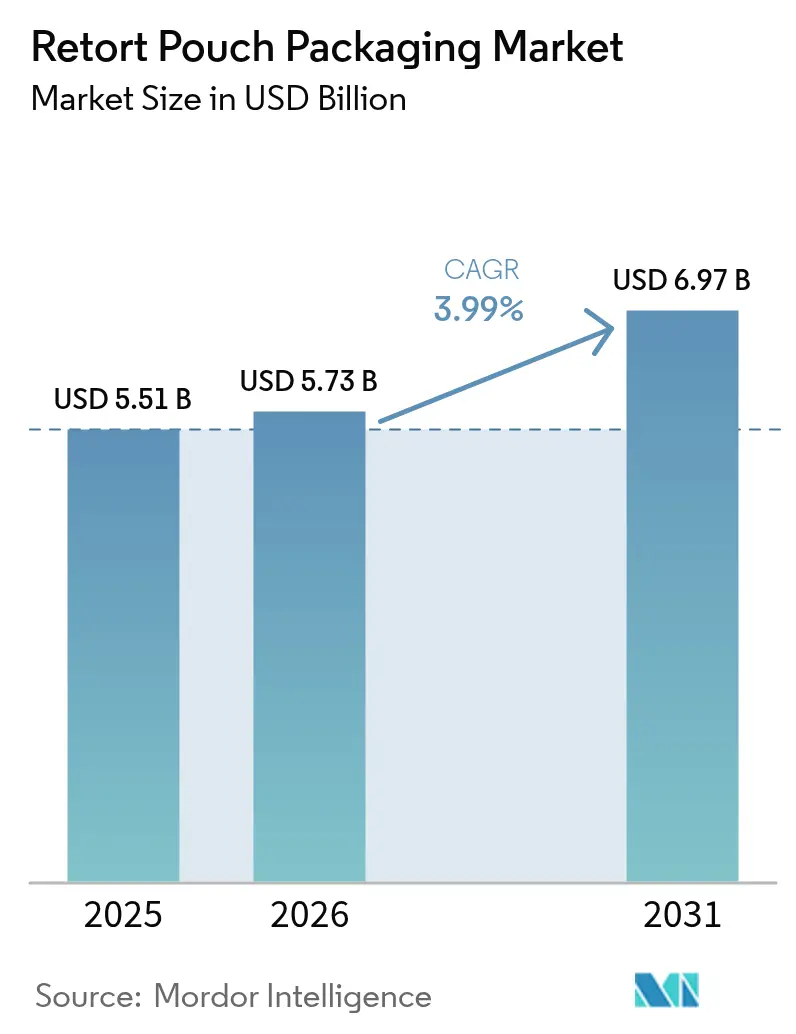
The retort pouch packaging market size was valued at USD 5.51 billion in 2025 and estimated to grow from USD 5.73 billion in 2026 to reach USD 6.97 billion by 2031, at a CAGR of 3.99% during the forecast period (2026-2031). Growth is fueled by rising demand for shelf-stable convenience foods, premium pet nutrition, and ongoing breakthroughs in high-barrier film technology that enable aluminum-free, recyclable constructions. At the same time, capital-intensive equipment, evolving recycling mandates, and fluctuations in foil supply temper new capacity additions, reinforcing the competitive edge of established converters. The Asia-Pacific region remains the volume anchor, thanks to urbanization and limited cold-chain coverage, while the Middle East and Africa show the quickest percentage expansion, as food import dependency and government procurement programs favor ambient formats.
Key Report Takeaways
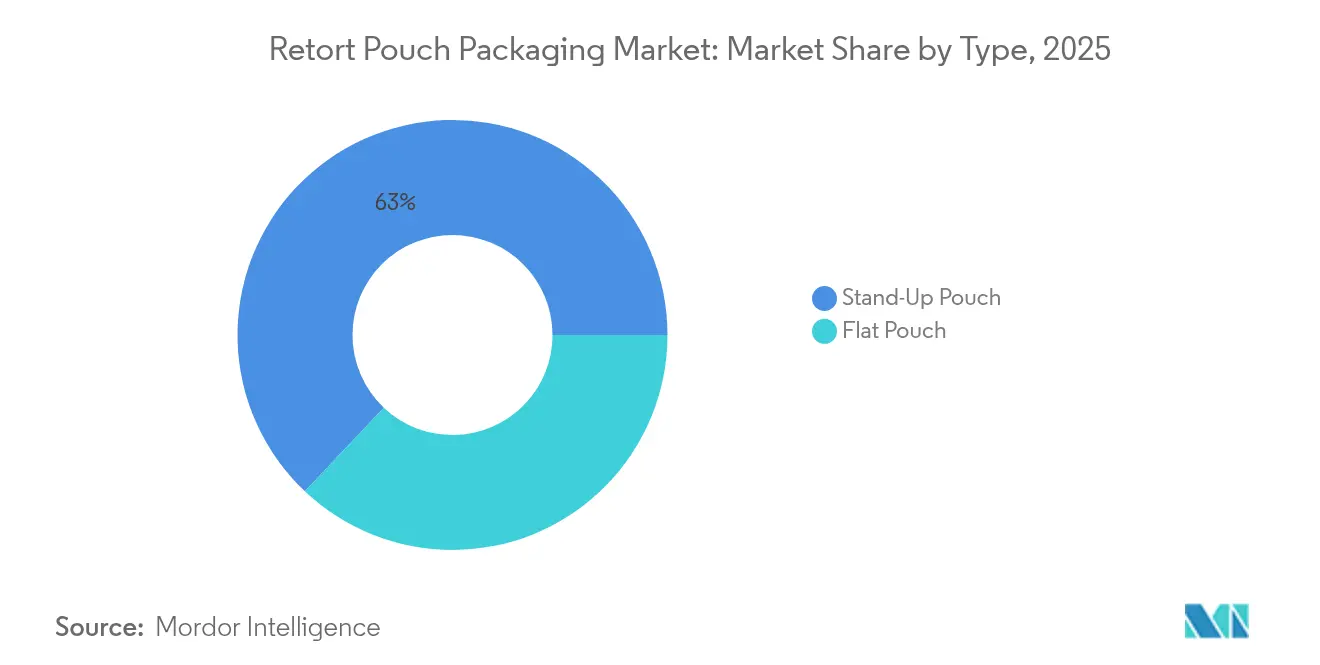
- By type, stand-up formats accounted for 62.95% of demand in 2025; flat pouches are projected to grow at a 5.42% rate from 2026 to 2031.
- By material, polypropylene accounted for 27.88% of the 2025 demand; paperboard is projected to advance at a 5.48% CAGR through 2031.
- By 2025, tear notches dominated the market with a 40.78% share; zipper closures are projected to grow at a 6.29% rate through 2031.
- By layer Structure, the 3-layer held 46.12% revenue share in 2025; the 5-layer is projected to grow at a 5.95% rate through 2031.
- By end-user, food applications led with a 58.25% revenue share in 2025; the pharmaceutical segment is projected to progress at a 5.61% CAGR through 2031.
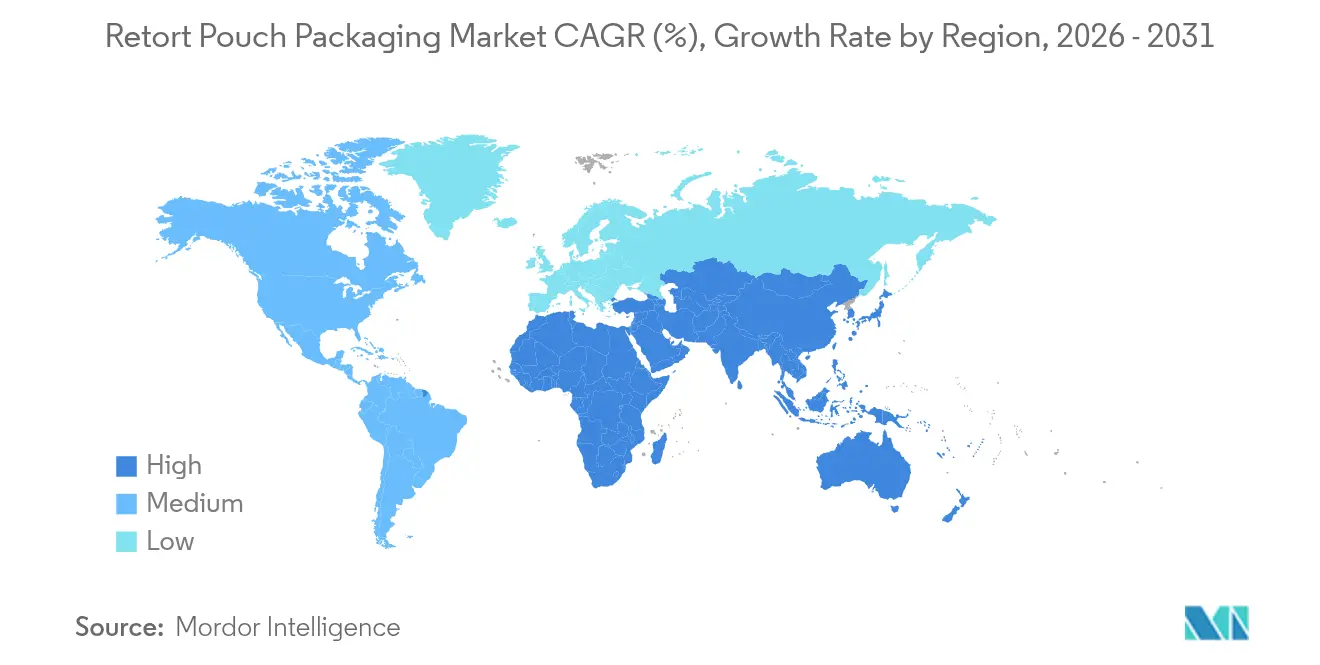
- By geography, Asia-Pacific captured 39.75% of 2025 revenue; the Middle East and Africa are forecast to expand at a 6.92% CAGR through 2031.
Note: Market size and forecast figures in this report are generated using Mordor Intelligence’s proprietary estimation framework, updated with the latest available data and insights as of 2026.
Global Retort Pouch Packaging Market Trends and Insights
Drivers Impact Analysis*
| Driver | (~) % Impact on CAGR Forecast | Geographic Relevance | Impact Timeline |
|---|---|---|---|
| Rising Demand for Ready-to-Eat Meals | +0.8% | North America, Europe, urban Asia-Pacific | Medium term (2-4 years) |
| Advancements in High-Barrier Film Technologies | +0.7% | Europe, Japan, global spillover | Long term (≥4 years) |
| Growing Focus on Lightweight Sustainable Packaging | +0.6% | Europe and North America, expanding to Asia-Pacific | Medium term (2-4 years) |
| Rapid Expansion of Pet Food Segment | +0.5% | North America and Europe, emerging Asia-Pacific | Short term (≤2 years) |
| Integration of Smart Packaging Features | +0.4% | Europe and North America, gradual Asia-Pacific uptake | Long term (≥4 years) |
| Expansion of Ambient Food Distribution Channels in Emerging Economies | +0.5% | Asia-Pacific, Middle East and Africa, Latin America | Medium term (2-4 years) |
| Source: Mordor Intelligence | |||
Rising Demand for Ready-to-Eat Meals
Time-pressed households are replacing traditional canned goods with premium retort pouches that heat in under five minutes. Brands now position ethnic recipes, organic ingredients, and chef collaborations in stand-up pouches that command price premiums of 40-60% over metal cans. Quick-commerce warehouses, which favor ambient SKUs to avoid refrigeration costs, accelerate this shift. Regulatory clarity, such as explicit recognition of retort pouches under U.S. low-acid canned food rules, reduces compliance uncertainty for smaller processors. Together, these factors enhance retail visibility, differentiate the brand, and expand ambient reach while maintaining safety standards.[1]U.S. Food and Drug Administration, “21 CFR Part 113,” fda.gov
Advancements in High-Barrier Film Technologies
Silicon-oxide coatings, oriented high-density polyethylene, and hybrid organic-inorganic layers now achieve oxygen transmission rates under 3 cc/m²-day, enabling aluminum-free designs. MultiNanoLayer technology stacks 256 layers of polypropylene and polyvinyl alcohol to deliver 2.46 cc/m²/day at 121 °C, lowering material costs by 20-25% and permitting microwave use.[2]MDPI Polymers, “MultiNanoLayer Films Study,” mdpi.comBorealis’ XPP enhanced polypropylene maintains seal strength above 130 °C, eliminating delamination in all-polyolefin pouches. These advances broaden applications from low-acid soups to high-acid sauces, cut rely on foil use, and simplify recycling.
Growing Focus on Lightweight Sustainable Packaging
Extended producer responsibility fees in the European Union penalize multi-material laminates at a rate of up to EUR 0.80/kg, encouraging brands to adopt mono-material or fiber-based alternatives. Amcor’s AmFiber pouch swaps the outer polyester layer for barrier-coated paperboard, reducing plastic content 60% while retaining 121 °C retort capability.[3]Amcor, “AmFiber Paper-Based Pouch,” amcor.com ProAmpac has validated 30% post-consumer recycled polyethylene terephthalate in a retort structure approved for direct food contact. Converters that retrofit decontamination lines and secure recycled-resin supply gain an edge with multinational customers setting 2030 recycled-content targets.
Rapid Expansion of Pet Food Segment
Pet humanization drives the adoption of single-serve retort pouches, which offer freshness cues, portion control, and easy-open features. Senior cat products with tear notches and resealable zippers illustrate the potential for micro-segmentation. Regulatory differences, looser testing requirements for pet food than for human food, speed up innovation cycles. Co-packers are installing dedicated lines to prevent cross-contamination, enabling smaller brands to leverage retort without the need for FDA-audited infrastructure.
Restraints Impact Analysis*
| Restraint | (~) % Impact on CAGR Forecast | Geographic Relevance | Impact Timeline |
|---|---|---|---|
| High Initial Capital Cost of Retort Equipment | -0.4% | Global, acute in emerging markets | Short term (≤2 years) |
| Recycling Challenges due to Multi-Layer Structures | -0.5% | Europe and North America, growing Asia-Pacific | Medium term (2-4 years) |
| Limited Thermal Resistance at Extreme Temperatures | -0.3% | Tropical and desert climates worldwide | Medium term (2-4 years) |
| Supply Chain Disruptions in Aluminum Foil | -0.3% | Europe, Asia-Pacific sourcing corridors | Short term (≤2 years) |
| Source: Mordor Intelligence | |||
High Initial Capital Cost of Retort Equipment
Automated pouch filling and sealing lines cost USD 180,000–280,000 for a modest output of 60 pouches per minute. Processors unable to finance such equipment often resort to co-packing agreements, which erode margins by up to 25%. Low-priced semi-automated Chinese systems (USD 9,800–12,800) reduce entry cost but deliver seal failure rates above 2%, disqualifying the product for multinational procurement. Capital barriers thus bifurcate the market between high-volume converters and niche premium players.
Recycling Challenges due to Multi-Layer Structures
Aluminum-polyolefin laminates resist mechanical and solvent-based separation, consigning most post-consumer pouches to landfill or incineration. Municipal sorters rarely detect thin foil layers, and only 5% of aluminum flexible packaging is recycled in Europe.[4]European Aluminium, “Recycling Rates and EPR Fees,” european-aluminium.eu Brands shifting toward silicon-oxide or ORMOCER coatings accept a 10-15% drop in barrier performance, shortening shelf life but avoiding high disposal fees. Technical breakthroughs, such as supercritical carbon-dioxide delamination, remain confined to post-industrial scrap, leaving a significant gap before achieving true circularity.
*Our forecasts treat driver/restraint impacts as directional, not additive. The impact forecasts reflect baseline growth, mix effects, and variable interactions.
Segment Analysis
By Type: Stand-Up Formats Drive Retail Visibility
Stand-up formats accounted for 62.95% of the demand in 2025. Retailers favor the format for customizable graphics and efficient facings, while brands leverage shaped panels for ergonomic grip and pour control. Flat pouches, which expand at 5.42% through 2031, serve institutional food service, military contracts, and humanitarian aid, where stackability and pallet density take precedence over shelf appeal. The U.S. Department of Defense now permits flat retort pouches in Meal Ready-to-Eat rations, increasing payload efficiency on transport flights. Converters typically dedicate separate lines to each format, as forming collars and sealing jaws are not interchangeable. Shaped pouches introduced for baby food in 2024 boosted sales 9% by minimizing spillage during one-handed feeding. Despite higher tooling costs, shaped designs command 20-30% price premiums, making them attractive at retail price points above USD 3.00. The retort pouch packaging market size for stand-up variants is projected to expand steadily as supermarkets allocate more space in their ambient aisles to premium ready meals. Flat configurations will remain crucial where logistics cost per calorie transported is the primary metric, underscoring a dual-format landscape.
Second-generation stand-ups feature transparent windows and matte varnishes that offset the “industrial” perception long associated with foil pouches. Advanced laminators integrate near-field communication antennas beneath print layers without compromising seal integrity, linking shoppers to recipe videos and sourcing data. These smart add-ons are costly today but are increasingly being adopted by premium private-label ranges aiming to match the presentation of national brands. Within the retort pouch packaging market, regional converters that install digital presses are capturing short-run orders for ethnic cuisines and limited-time flavors, a revenue pool previously served by rigid jars. Meanwhile, flat pouches retain a material advantage in high-altitude air drops for humanitarian relief, where aerodynamic stability and puncture resistance are critical.



By Material: Paperboard Ascends as Sustainability Reshapes Specifications
In the retort pouch packaging market, polypropylene held a 27.88% share in 2025, driven by its reliable sealing properties and consistent global resin supply. However, retailers are beginning to favor paperboard laminates, accepting an 18-month shelf life, as opposed to the 24-month standard for all-plastic pouches. This shift is largely driven by the fact that 67% of European shoppers prioritize recyclability over shelf life for ambient foods. Looking ahead, paperboard is set to grow at a robust 5.48% CAGR through 2031. Amcor’s innovative AmFiber design substitutes the traditional outer polyester layer with a barrier-coated paperboard. This change not only slashes plastic usage by 60% but also ensures durability, withstanding temperatures of 121 °C for up to 50 minutes – a feat ideal for packaging vegetable stews, pasta meals, and gravies for pet food.
Billerud’s 2024 water-based coating has made significant strides, curbing moisture transmission to just 5 g/m²-day. This advancement paves the way for fiber pouches to venture beyond just dry mixes. However, it's worth noting that retort cooling condensation poses a risk, potentially degrading the moisture barrier in fillings with very low moisture content. The financials are favorable; a 20-30% retail price premium on products priced above USD 4.00 translates to an absolute cost increase of under 10%. This strategy enables premium brands to attract sustainability-conscious shoppers while maintaining their profit margins.
By Closure Type: Zipper Resealability Redefines Convenience
Tear notches accounted for 40.78% of 2025 closures because they integrate seamlessly into filling lines at a negligible cost. Yet, zipper systems are expected to expand by 6.29% through 2031, as consumers equate resealability with freshness and portion control. Coveris’ high-temperature polyethylene terephthalate zipper withstands 121 °C without profile deformation, enabling multiple re-closures in wet retort products. Spouts capture liquid categories, such as soups, gravies, and energy gel, offering controlled dispensing and single-handed use. Child-resistant spouts compliant with Consumer Product Safety Commission standards unlock potential in concentrated cleaners and pediatric medications.
Flip-top caps serve premium sports nutrition and on-the-go meal replacements, but add USD 0.03-0.04 per pack, limiting uptake below USD 3.00 retail price points. The retort pouch packaging market size for zipper variants is expected to continue expanding as pet owners demand resealable single-serve gravies and senior consumers seek easy-to-open features. Equipment upgrades are essential; installing an inline zipper applicator can lower throughput by 8-10%, but converters offset the slowdown with price premiums and customer stickiness. Hybrid closures, tear-notched plus zipper, are emerging for institutional packs, allowing for quick opening in kitchens while preserving leftovers.
By Layer Structure: Five-Layer Configurations Balance Barrier and Cost
Three-layer laminates, polyester/aluminum foil/polypropylene- accounted for 46.12% of the 2025 volume, offering a cost-effective path to an 18-month shelf life. Five-layer constructions are advancing 5.95% through 2031 as brands pursue 24-month guarantees without foil. A typical five-layer design utilizes polyester for printing, a tie layer for adhesion, nylon-MXD6 for the barrier layer, a second tie layer, and cast polypropylene for sealing. Co-extrusion now combines these layers in a single pass, reducing lamination time by 30% and improving interlayer adhesion, but it demands a capital outlay of over USD 2 million.
Four-layer designs offer a middle ground, trading 10-15% barrier loss for material savings. Seven-layer and nine-layer structures are designed for pharmaceuticals and medical devices that require redundant barriers, as specified in ISO 11607. Each additional layer adds around USD 0.015 to the unit cost and reduces line speed by 8-12%, which is acceptable when retail prices exceed USD 5.00. Within the retort pouch packaging market, converters capable of multistation co-extrusion secure long-term contracts with multinational food companies that desire consistent global specs. Smaller regional players focus on three-layer formats for government tenders where price outweighs shelf-life maxima.

By End-User: Pharmaceutical Segment Accelerates on Sterile Barrier Demand
Food applications dominated 2025 with a 58.25% share, leveraging 40-50% weight savings over cans and eliminating metallic flavor transfer. The pharmaceutical category, which is expected to expand at 5.61% through 2031, utilizes retort pouches as sterile barrier systems for pre-filled syringes and implant kits. Converters validate oxygen and moisture barriers according to ISO 11607, leveraging their existing expertise in high-temperature sealing. Beverages such as shelf-stable coconut water and plant-based milks utilize spouted pouches for portability; however, the thin liquid viscosity requires Cryovac’s dual-seal design to ensure hermetic integrity during retort.
Pet food is migrating quickly, premium cat entrées in shaped, zipper-sealed pouches command premiums of 15-25% over cans. Industrial lubricants and agrochemicals utilize retorts for extreme-temperature logistics, while cosmetics employ shaped pouches for single-dose serums delivered in aircraft amenity kits. The retort pouch packaging market share for medical devices will remain niche but lucrative, due to compliance barriers and low tolerance for failure.
Geography Analysis
Asia-Pacific contributed 39.75% of 2025 revenue, anchored by China and India where urban lifestyles lift demand for convenient meals and limited refrigeration infrastructure favors ambient formats. Government-backed food parks cluster converters, equipment makers, and brand owners, slashing transport costs and enabling just-in-time runs. Japan’s aging population buys premium stand-up pouches with transparent windows and QR codes that deliver preparation tips, while South Korea’s mandatory military service sustains institutional flat-pouch consumption. Stringent Chinese migration limits on food-contact materials effective 2024 are consolidating the retort pouch packaging market toward certified suppliers that can invest in analytical equipment, elevating quality baselines.
The Middle East and Africa is forecast to grow at 6.92% through 2031, fastest worldwide. Gulf Cooperation Council countries spend over USD 45 billion annually on food imports and stockpile shelf-stable meals for strategic reserves. Mondi’s new barrier-film plant in Turkey supplies regional converters, trimming reliance on distant foil suppliers and enabling aluminum-free structures suitable for the desert climate. Sub-Saharan African school feeding initiatives mandate locally processed fortified foods in retort pouches, guaranteeing baseline demand under government tenders. Capital scarcity remains the main brake; semi-automated lines satisfy current volumes but constrain long-term unit-cost competitiveness.
North America maintains sizable volume through ready-to-eat meals, premium pet food, and Department of Defense rations. U.S. brands such as Campbell’s install high-barrier stand-up lines to serve the 23% of households prioritizing convenience over scratch cooking. Mexico, leveraging USMCA tariff advantages, emerges as a nearshoring hub feeding southwestern U.S. distribution centers. European growth slows under extended producer responsibility fees that penalize non-recyclable laminates; brands accept 18-month shelf life in mono-material pouches to avoid EUR 0.50-0.80/kg penalties. Italy and Spain develop olive oil and tomato sauce pouches for export, capitalizing on Mediterranean authenticity cues. South American progress centers on Brazil and Argentina where modern retail gains share, though currency volatility complicates imported film procurement.

Regulatory Landscape
Retort pouch packaging is primarily governed by food-contact safety requirements, with compliance anchored in frameworks such as EU Regulation (EC) No 1935/2004 and implementing measures for plastics, alongside national expectations for migration testing and documentation. In the European Union, Commission Regulations (EU) 2026/245 and (EU) 2026/250 were published in February 2026, tightening requirements that affect plastic layers, inks, adhesives, and specifically BPA restrictions for food contact applications. The BPA transition timetable includes a July 2026 milestone (end of a transitional period for certain single-use final food contact articles manufactured using BPA under prior rules), which prompts converters and brand owners to review inventories and re-qualify compliant retort structures.
In Asia, food-contact rule updates are also raising requirements for retort laminates. India updated the FSSAI Compendium of Packaging Regulations in April 2025, reinforcing food-grade requirements and migration limits relevant to multilayer packaging used in high-temperature processing. Japan is progressing its food contact controls under the Food Sanitation Act, with revised specifications for apparatus, containers, and packaging (Cabinet Office Notification 95/2025) taking effect in June 2026, increasing the need for substance-level documentation across retort pouch layers. China provides performance and test anchors for the category via GB/T 41168-2021, which sets requirements for plastics and aluminum foil laminated retort films and pouches across boiling, semi-high, and high-temperature cooking conditions.
Value Chain Analysis
The value chain starts with resin and barrier inputs (polypropylene, polyester, nylon, aluminum foil, and emerging SiOx or hybrid coatings), then moves through film extrusion and co-extrusion, metallization or coating, adhesive lamination, printing, and pouch converting (forming, fitment insertion for spouts and zippers, and sealing). Converters then supply brands and co-packers that run filling, sealing, and thermal sterilization, followed by distribution to retail, quick-commerce warehouses, institutional channels, and government procurement programs that favor ambient logistics. Equipment and process validation (retort equipment, seal integrity testing, migration testing, and ISO-driven packaging validation for medical applications) remain key control points that shape qualification cycles and supplier selection.
Recent supply-chain shifts show more collaboration and regionalization around recycle-ready retort structures. In October 2025, BOBST, Brueckner, and Mitsui Chemicals presented a monomaterial, metallized retort concept that combines opaque metallization and heat-resistant primers to retain barrier performance through sterilization, illustrating how materials suppliers and machinery providers are co-developing scalable solutions. Converters are also commercializing mono-material retort offerings, such as Mondi's mono-polypropylene retort pouch certified by DIN CERTCO for 121 C sterilization compatibility (November 2025). At the downstream end, capacity investments and localization strategies are visible, including Amcor's announced USD 120 million investment (January 2026) to add high-speed filling capability in Pune, India, aimed at shortening lead times for regional food and pet food customers after online orders.
Competitive Landscape
The retort pouch packaging market exhibits a moderate level of fragmentation. Amcor, Sealed Air, and Mondi leverage proprietary lamination chemistries, global technical support teams, and multi-year contracts with multinational food companies. Constantia Flexibles’ new Dubai plant signals regional localization strategies that skirt import duties and shorten lead times.
Technology differentiation is widening. Converters investing in digital presses win limited-edition orders that rigid formats once held. Near-field communication tags and time-temperature indicators extend functionality from passive containment to data-rich engagement, opening new revenue streams in loyalty marketing and cold-chain compliance. Patent data indicate a surge in aluminum-free barrier coatings, retort-compatible zippers, and shaped pouch-forming dies. Meanwhile, regional players in Southeast Asia and Latin America deploy Chinese equipment that costs 30-40% less than Western lines, targeting organic baby food and ethnic meal kits, where small batches command high margins. Their price agility keeps pressure on multinationals to accelerate cost-down programs while maintaining stringent seal-integrity targets.
Market participants increasingly measure success by progress toward 2030 recycled-content mandates. Those lacking decontamination capacity for food-grade recycled resin risk exclusion from brand tenders. Consequently, capital allocation is shifting from raw extrusion tonnage to advanced cleaning, deodorization, and additive-blending steps. Players capable of delivering mono-material pouches that pass Association of Plastic Recyclers sortation tests and still survive 121 °C sterilization will capture future volume as regulators tighten recyclability definitions.
Retort Pouch Packaging Industry Leaders
Amcor PLC
Constantia Flexibles
Tetra Pak International SA
Mondi PLC
Coveris Holdings SA
- *Disclaimer: Major Players sorted in no particular order


Market Opportunities and Future Outlook
A key opportunity area is substituting traditional foil-based retort laminates with recycle-ready mono-material structures that still meet retort performance, driven by tightening recyclability definitions and brand tender requirements. Commercial adoption moved beyond trials in 2026, as Thai Union launched a shelf-stable tuna product in a recyclable monomaterial polypropylene retort pouch for the John West Stir & Serve range, developed with Mondi, and positioned around an 18-month ambient shelf life without an aluminum foil layer. Alongside this, technology pathways such as advanced metallized mono-materials and high-barrier coatings are being pushed by machinery and materials providers, exemplified by the BOBST, Brueckner, and Mitsui Chemicals monomaterial metallized retort concept unveiled at K 2025.
Whitespace also exists in retort-compatible convenience features that preserve line efficiency, including high-temperature zippers, spouts, and easy-open systems for premium pet food, ready-to-eat meals, and select healthcare applications that rely on validated sterile barrier performance. Awarded and showcased solutions at major packaging events point to active productization: in June 2026, TOPPAN Group film manufacturer Irplast S.p.A. received a Silver Sustainability Design Award at interpack 2026 for a recycle-ready mono-polypropylene retort pouch using GL BARRIER technology, reflecting ongoing competition among converters to match oxygen protection and heat resistance without foil. Taken together, these moves keep the market pathway centered on qualifying mono-material retort packs at scale, building regional production hubs, and integrating functional closures and smart features while maintaining 121 C retort survivability.
Recent Industry Developments
- March 2026: Amcor expanded its flexible packaging operations at its Lugo di Vicenza facility in Italy, adding a new production line focused on high-barrier, recycle-ready films, including AmLite HeatFlex engineered for retort applications. The project also added a 7,000 square meter expansion with a quality control laboratory and an automated high-density warehouse. The added capability supports higher-volume supply of retort-capable recycle-ready structures in Europe as brands tighten sustainability specifications.
- March 2025: Constantia Flexibles completed the acquisition of a majority stake in Aluflexpack AG, strengthening its flexible packaging portfolio across food and pharmaceutical end uses. The transaction broadened Constantia's technological capabilities and manufacturing footprint relevant to high-barrier flexible packaging. The acquisition increased competitive pressure on incumbent retort pouch suppliers through expanded scale and access to additional converting know-how.
- February 2025: Amcor partnered with Insymmetry to develop a 2 oz retort polypropylene bottle using StormPanel technology, designed to withstand sterilization for shelf-stable products. The collaboration highlighted continued innovation in retort-capable packaging formats beyond pouches, targeting applications that benefit from lightweighting and improved consumer handling. It also underscored the growing emphasis on retort-ready mono-material packaging concepts aligned with recyclability goals.


Research Methodology Framework and Report Scope
Market Definition and Coverage
For this methodology, the market covers sales of retort pouches used as flexible packs that can handle thermal sterilization, mainly for shelf-stable food and beverages, pet food, and selected non-food products where retort performance is required.
Scope exclusions: We exclude non-retort flexible packs that do not require high-temperature sterilization performance, even if they look similar in shape or end use.
Segmentation Overview
- By Type
- Stand-Up Pouch
- Flat Pouch
- By Material
- Polypropylene
- Polyester
- Aluminum Foil
- Cast Polypropylene Film
- Paperboard
- Other Materials
- By Closure Type
- Spout
- Zipper
- Tear Notch
- Flip-Top Cap
- Other Closure Types
- By Layer Structure
- 3-Layer
- 4-Layer
- 5-Layer
- Above 5 Layer
- By End-User
- Food
- Beverages
- Pharmaceutical
- Pet Food
- Other End Users
- By Geography
- North America
- United States
- Canada
- Mexico
- Europe
- United Kingdom
- France
- Germany
- Italy
- Spain
- Rest of Europe
- Asia-Pacific
- China
- India
- Japan
- South Korea
- Rest of Asia-Pacific
- South America
- Brazil
- Argentina
- Rest of South America
- Middle East and Africa
- Middle East
- Saudi Arabia
- United Arab Emirates
- Turkey
- Rest of Middle East
- Africa
- South Africa
- Nigeria
- Rest of Africa
- Middle East
- North America
Data Sources, Market Sizing, and Validation
Desk Research
Desk research starts with mapping demand into practical end uses that typically adopt retort pouches, and then checking how fast those end uses are shifting from cans, jars, and other formats. We leaned on public sources such as the United States Census Bureau, UN Comtrade, the US International Trade Commission data tools, the World Bank macro series, and FAO food supply statistics to understand trade flows, packaging related materials movement, and consumption direction.
We also reviewed company annual reports, investor presentations, sustainability updates, and reputable press coverage to interpret capacity additions, material structure shifts (for example, foil versus foil-free trends), and adoption signals in pet food and ready meals. Where needed, we used paid subscriptions for company financials and intelligence, patent databases, and shipment-level trade views to cross-check timelines and avoid double counting across regions. These desk sources are illustrative and not exhaustive, and many other public references were used for data collection, validation, and clarification.
Primary Interviews and Surveys
Primary work focused on validating what gets counted as retort pouch packaging revenue and what stays outside, along with how pricing changes as structures and closures change. We spoke with a mix of packaging converters, material suppliers, and packaging buyers in food and pet food, and then used follow-up checks to confirm regional adoption differences and realistic volume growth assumptions across the forecast window.
Distribution of primary research fieldwork respondents
| Company type | Respondent position | Region |
|---|---|---|
| Top tier: 31% | CXOs: 12% | APAC: 49% |
| Mid tier: 51% | Functional/Unit leaders: 42% | EMEA: 31% |
| Smaller Players: 18% | Managers: 46% | Americas: 20% |
Market-Sizing & Forecasting
Sizing begins with a top-down build that reconstructs the addressable demand pool from packaged food and pet food activity, and then applies retort pouch penetration indicators by category and region, which are subsequently reconciled to packaging spend reality. Once that skeleton is in place, we corroborate totals using selective bottom-up approximations like converter revenue sampling, capacity and utilization references, and quick checks of average selling price (ASP) ranges by pouch type and closure.
A few inputs repeatedly used in the model include shelf-stable meal and sauce consumption direction, pet food wet format trends, the shift between stand-up versus flat pouches, foil versus non-foil structure movement, and changes in closure mix (such as spouts and zippers) that affect ASP. For forecasting, scenario analysis is used so the model can reflect different speeds of adoption tied to convenience food demand, material substitution, and regulatory pressure on recyclable structures. The selected scenario is then aligned to what industry respondents viewed as the most likely path. When a bottom-up signal is missing for a smaller geography, we use proxy ratios from similar markets and recheck the implied per-capita packaging spend for reasonableness.
Data Validation & Update Cycle
Validation happens through multi-step checks where outputs are compared against independent signals like trade movement for relevant packaging materials, announced capacity changes, and the implied unit economics behind pouch structures and closures. If a region shows an unusual jump, we reopen the driver analysis, review assumptions, and re-contact selected respondents so the variance can be explained or corrected before sign-off.
Reports are refreshed annually, and interim updates are triggered when material events occur such as major capacity additions, regulatory changes affecting laminate structures, or sharp resin and foil price moves that would shift ASPs. Before delivery, we do a fresh pass on the latest public disclosures and news flow so clients receive an updated view rather than an older snapshot.
Mordor Intelligence's Retort Pouch Packaging Market Size Versus Other Published Estimates
Published market values for retort pouch packaging can vary even when the topic name looks the same, because inclusion rules are not consistent and pricing assumptions are handled differently. Differences also come from what is treated as packaging revenue versus adjacent materials revenue, plus how often the numbers are refreshed when resin and aluminum costs move.
Stand-up and flat retort pouches remain inside Mordor Intelligence's scope, but adjacent non-retort pouches and broader retort packaging formats (like trays or cartons) sit outside it, which can widen the spread versus estimates that group these items together. The other gap drivers are how closures and multi-layer structures are priced over time, whether regional splits are converted at a spot rate or an averaged yearly rate, and whether adoption in pet food and ready meals is supported by checks beyond a single demand indicator.
Benchmark comparison
| Source | Market Size | Gaps in Research Methodology |
|---|---|---|
| Mordor Intelligence | USD 5.51 B (2025) | |
| Global Consultancy A | USD 6.20 B (2025) | This figure appears to bundle retort pouches with a wider set of retort packaging formats, and it can also treat some spouted and non-retort pouches as in-scope based on end use rather than sterilization requirement. |
| Industry Association B | USD 4.90 B (2025) | This estimate likely reflects a narrower revenue view, where only converter sales are counted and pricing is kept conservative by using older laminate structure assumptions and limited closure mix uplift. |
The table shows that the largest swings usually come from what gets included around the retort pouch definition, and then from how ASPs are updated as materials and closures shift. By keeping the demand pool tied to sterilization-suitable pouches and validating pricing through repeated checks, we arrive at a market value that can be traced back to clear, repeatable inputs.


Key Questions Answered in the Report
What is the projected value of the retort pouch packaging market by 2031?
The market is forecast to reach USD 6.97 billion by 2031.
Which region is expected to record the fastest growth in retort pouches through 2031?
The Middle East and Africa is projected to grow at a 6.92% CAGR, the highest of all regions.
Why are brands moving toward aluminum-free retort pouch structures?
Aluminum-free designs lower material costs, enable microwave use, and avoid high extended producer responsibility fees imposed on non-recyclable laminates.
How does nylon-MXD6 improve retort pouch performance?
When laminated with polypropylene, nylon-MXD6 delivers very low oxygen transmission rates that extend ambient shelf life to 24 months for oxidation-sensitive foods.
What factor limits small processors from installing retort pouch equipment?
Automated filling and sealing lines cost USD 180,000–280,000, posing a substantial capital barrier versus rigid-container lines.
Which closure type is gaining the most momentum in premium applications?
Zipper closures are expanding the quickest because resealability signals freshness and supports portion control.
Page last updated on:


 Your data is secure and never sold or shared.


