
Market Overview
| Study Period | 2022 - 2031 |
|---|---|
| Forecast Data Period | 2026 - 2031 |
| Base Year Market Size (2025) | USD 17.49 Billion |
| Market Size (2026) | USD 18.52 Billion |
| Market Size (2031) | USD 24.62 Billion |
| Growth Rate (2026 - 2031) | 5.86 % |
| Market Concentration | Medium |
Major Players *Disclaimer: Major Players sorted in no particular order Image © Mordor Intelligence. Reuse requires attribution under CC BY 4.0. | |
Southeast Asia Bakery Products Market Analysis by Mordor Intelligence
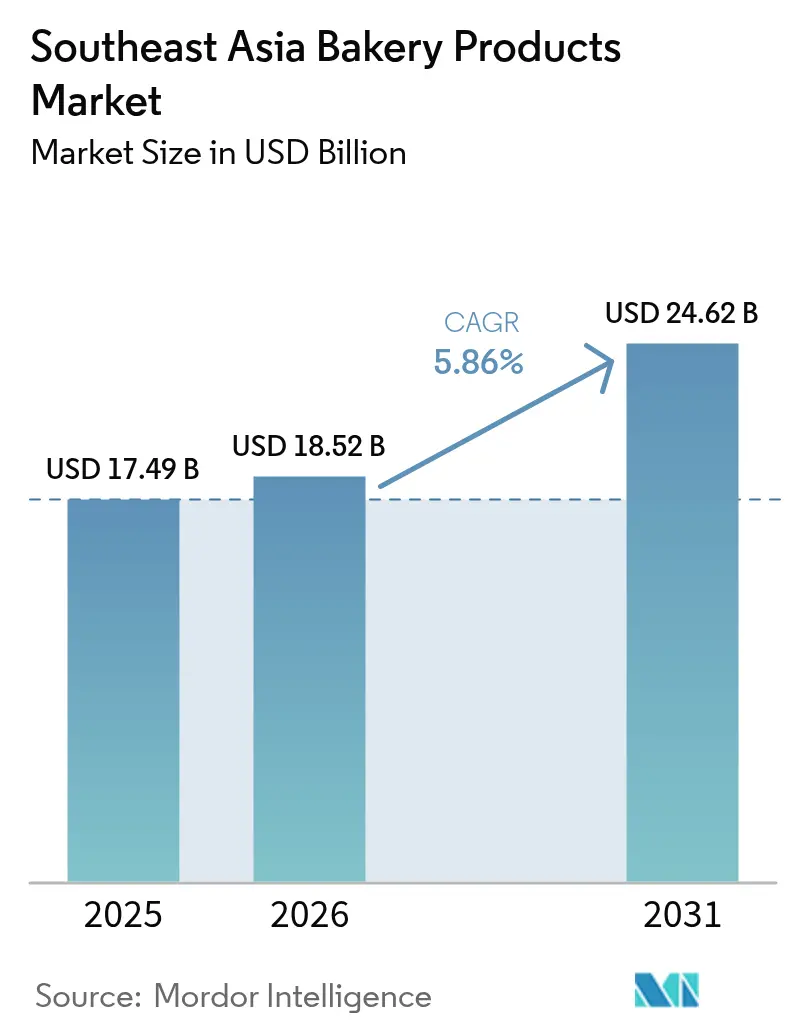
Southeast Asia bakery products market size in 2026 is estimated at USD 18.52 billion, growing from 2025 value of USD 17.49 billion with 2031 projections showing USD 24.62 billion, growing at 5.86% CAGR over 2026-2031. Demographic momentum, higher disposable incomes, and a visible tilt toward Western-style consumption in urban centers underpin this expansion. The market’s steady uptrend also mirrors the deepening middle-class footprint across Indonesia, Vietnam, and the Philippines, where consumers increasingly balance indulgence with wellness cues in daily food choices. Domestic baked-goods manufacturers are scaling production in step with modern retail rollouts, while global brands leverage franchising to accelerate store counts. At the same time, supply-side efficiencies from regional flour-milling investments and diversified wheat sourcing temper cost volatility and sharpen margins for large and mid-sized players.
Key Report Takeaways
- By product type, cakes, pastries, and sweet pies led with 42.10% of the Southeast Asia bakery products market share in 2025, followed by crackers and savory biscuits, which are forecast to advance at a 7.26% CAGR through 2031.
- By form, fresh bakery dominated 60.55% of the Southeast Asia bakery products market size in 2025. Frozen bakery is projected to expand fastest, supported by emerging cold-chain investments that unlock wider geographic reach.
- By distribution channel, specialty stores and artisanal bakeries accounted for 40.20% of sales in 2025, while online retailers are expected to record the highest forecast CAGR of 10.92% from 2026 to 2031.
- By geography, Indonesia accounted for 27.60% of the 2025 value, while Vietnam is set to grow at a 7.22% CAGR over 2026-2031.
Note: Market size and forecast figures in this report are generated using Mordor Intelligence’s proprietary estimation framework, updated with the latest available data and insights as of 2026.
Southeast Asia Bakery Products Market Trends and Insights
Drivers Impact Analysis*
| Driver | % Impact on CAGR Forecast | Geographic Relevance | Impact Timeline |
|---|---|---|---|
| Growing penetration of modern grocery retail formats | +1.2% | Indonesia, Philippines, Vietnam with spillover to Thailand | Medium term (2-4 years) |
| Rapid rise of video-commerce for impulse bakery purchases | +0.8% | Vietnam, Thailand, Singapore with early adoption in urban centers | Short term (≤ 2 years) |
| Flour-milling capacity expansions lowering input costs | +0.9% | Indonesia, Philippines, Malaysia with regional supply chain benefits | Long term (≥ 4 years) |
| Micro-retail digitalisation enabling rural reach | +0.7% | Indonesia, Vietnam, Myanmar with focus on tier 2-3 cities | Medium term (2-4 years) |
| Health-oriented reformulations (high-fibre, gut-health) | +0.6% | Singapore, Malaysia, Thailand with premium segment focus | Long term (≥ 4 years) |
| Government push for wheat import diversification | +0.4% | Regional, with primary impact in Indonesia, Philippines | Long term (≥ 4 years) |
| Source: Mordor Intelligence | |||


Growing Penetration of Modern Grocery Retail Formats
Supermarket and hypermarket footprints continue to widen across large metros and tier-2 cities, giving packaged bread and pastry brands premium shelf space and stable refrigeration. The modern-trade channel’s organized layout enhances product visibility, enables date-coded inventory rotation, and supports value-added features such as resealable packaging. As retail chains refine planograms, in-store bakeries flourish by coupling fresh aromas with impulse-driven displays. Large chains also extend private-label lines, offering affordability while standardizing quality benchmarks that smaller traditional outlets struggle to match. The broader retail formalization trend, therefore, remains a structural engine for the Southeast Asia bakery products market.
Rapid Rise of Video-Commerce for Impulse Bakery Purchases
Live-stream commerce blends entertainment with instant purchasing, allowing bakers to demonstrate product freshness and craftsmanship in real time. With smartphone penetration exceeding 80% in urban pockets, consumers gravitate to short, interactive sessions that showcase limited-edition cakes, seasonal cookies, or buy-one-get-one bundles. Integrated payment gateways eliminate checkout friction, while last-mile couriers deliver within hours, sustaining product integrity and spontaneous satisfaction. Brands that invest in charismatic hosts and on-screen baking theatrics capture new audiences at lower customer-acquisition costs compared with traditional advertising. Consequently, video-commerce’s experiential pull is enlarging the consumer base for the Southeast Asia bakery products market.
Flour-Milling Expansion and Wheat-Source Diversification
Indonesia’s Bogasari and the Philippines’ Universal Robina have recently expanded daily milling throughput, unlocking scale economies that compress per-unit costs. Parallel policy pushes to broaden wheat origins beyond historic suppliers buffer raw-material price swings and strengthen bargaining positions during global supply shocks. Together, higher milling capacity and diversified sourcing feed a steadier pipeline of competitively priced flour to downstream bakers, anchoring profit stability even when ocean-freight markets gyrate. Over the long term, these supply-chain gains translate into more predictable margins and calibrated price points for consumers, reinforcing demand growth across value tiers .
Digital Micro-Retail and Health-Focused Reformulations
Digitalization platforms now plug hundreds of thousands of warungs and sari-sari stores into real-time ordering systems, enabling bakeries to dispatch mixed loads efficiently to rural and peri-urban districts. Simultaneously, reformulation efforts introduce high-fiber, gut-health, and gluten-free breads that satisfy wellness-oriented shoppers without sacrificing taste. Ingredient innovators turn to green banana flour, resistant-starch-rich barley, and plant-based proteins to widen product repertoires. The dual thrust of expanded last-mile reach and clearly signaled functional benefits elevates penetration among households newly attuned to both convenience and nutrition. This synergy continues to lift value sales for the Southeast Asia bakery products market
Restraints Impact Analysis*
| Restraint | % Impact on CAGR Forecast | Geographic Relevance | Impact Timeline |
|---|---|---|---|
| Volatile wheat import prices amid El Niño freight spikes | -1.8% | Regional, with acute impact in Philippines, Indonesia, Vietnam | Short term (≤ 2 years) |
| Halal-certification bottlenecks for new SKUs | -0.9% | Indonesia, Malaysia, Brunei with spillover to Muslim consumer segments | Medium term (2-4 years) |
| Tight cold-chain infrastructure for frozen dough | -0.7% | Myanmar, Vietnam, rural areas across region | Long term (≥ 4 years) |
| Rising sugar-tax discussions in Thailand & Malaysia | -0.4% | Thailand, Malaysia with potential regional contagion effects | Medium term (2-4 years) |
| Source: Mordor Intelligence | |||
Volatile Wheat Import Prices Amid El Niño Freight Spikes
Shipping-lane disruptions have inflated container rates, adding unplanned cost layers to imported wheat destined for Indonesia, the Philippines, and Vietnam. Since local grain alternatives remain limited, millers pass on at least part of the burden to bakeries, pressuring the shelf prices of staple bread. Retail promotions and pack-downs mitigate volume erosion, yet margin squeeze persists for smaller manufacturers with thin working capital. Hedging strategies and diversified supplier contracts partly offset risk, but near-term volatility continues to weigh on the Southeast Asia bakery products market.
Certification, Logistics, and Fiscal Hurdles
Indonesia’s rigorous halal framework extends approval lead times to about four months per new SKU, raising compliance costs and delaying innovation pipelines. Concurrently, patchy cold-chain infrastructure hampers frozen-dough distribution to secondary cities, limiting assortment breadth outside major metros. On the fiscal front, Thailand and Malaysia have revived sugar-tax deliberations that would elevate ingredient costs for high-sucrose recipes, spurring reformulation but also stoking price increases. Together, these factors temper growth momentum, especially for SMEs seeking rapid across-border scale.
*Our forecasts treat driver/restraint impacts as directional, not additive. The impact forecasts reflect baseline growth, mix effects, and variable interactions.
Segment Analysis
By Product Type: Premiumization Meets Functional Demand
Cakes, pastries, and sweet pies commanded 42.10% of the Southeast Asia bakery products market in 2025, lifting celebratory sales around festivals and personal milestones. Local chains replicate European patisserie aesthetics while overlaying familiar flavors such as pandan and durian, keeping relevance high. Concurrently, crackers and savoury biscuits post the fastest volume gains, propelled by 7.26% CAGR expectations amid snack-on-the-go lifestyles and portion-control preferences. Manufacturers combine multigrain bases with reduced-sugar glazing to widen appeal, and e-commerce bundles encourage pantry stocking for remote work routines. Regional exporters also target halal-certified savoury biscuits to serve Muslim diaspora channels in the Middle East, reinforcing outbound opportunities for the Southeast Asia bakery products market.
Rising health consciousness steers reformulation toward high-fiber, gut-friendly inclusions such as beta-glucan-rich barley and inulin. Brands emphasize digestive comfort and blood-sugar moderation on front-of-pack labels to secure premium shelf prices. Gluten-free ranges, once niche, now attract mainstream curiosity, especially in Singapore and Thailand, where affluent consumers trial novel grains. Co-branding with specialty ingredient suppliers boosts perceived credibility. These dynamics suggest the crackers segment will keep outpacing the broader Southeast Asia bakery products market while indulgent cakes retain a stable, albeit slower, value base.
By Form: Fresh Dominance Despite Frozen Infrastructure Gaps
Fresh lines generated 60.55% of 2025 revenue, illustrating Southeast Asians’ cultural regard for morning-baked bread and pastries. Supermarket in-store bakeries, high-street artisan outlets, and café chains synchronize bake times with commuter peaks, maximizing aroma-driven footfall. Local grain blends and tropical fruit fillings offer flavor distinctiveness without sacrificing convenience. The Southeast Asia bakery products market size for fresh bread is expected to widen further as urban density favors walk-to retail clusters.
Frozen dough and par-baked offerings occupy 7.34%, constrained by fragmented cold-chain nodes. Urban quick-service restaurants nevertheless adopt freeze-thaw inventory to uphold 24-hour availability with lower labor inputs. Investment in reefer trucks and micro-fulfillment centers is accelerating, with logistics providers extending pay-as-use pallets to SME bakers. Such infrastructure, paired with rising preference for home-baking kits, positions the frozen segment to narrow the share gap over the long term, bolstering variety access across the Southeast Asia bakery products market
By Distribution Channel: Digital and Specialty Channels Reshape Access
Specialty stores and artisanal bakeries captured 40.20% distribution share in 2025, capitalizing on handcrafted positioning and immediate freshness. Interior design cues such as open kitchens and aroma vents reinforce experiential resonance, driving higher average tickets per visit. Café culture further entrenches pastry-plus-beverage bundles, sustaining store traffic beyond breakfast. Brick-and-mortar resonance earns ongoing loyalty even as digital options proliferate, anchoring a stable pillar in the Southeast Asia bakery products market.
Online retailers, projected at 10.92% CAGR, ride the expansion of food-delivery platforms and quick-commerce hubs. Flash-sale events and time-limited vouchers stimulate off-peak orders, smoothing production loads for bakeries. Subscription models supplying weekly bread boxes gain traction among young families seeking convenience and portion predictability. Meanwhile, supermarkets grow assortments of pre-packed loaves; convenience stores double down on ready-to-eat croissants that claim shelf visibility at eye level. This blend of traditional craft and digital ease drives omni-channel complexity yet unlocks broader consumption occasions.
Geography Analysis
In 2025, Indonesia, buoyed by its 270 million population and an expanding middle class, commanded a significant 27.60% share of the market's value. Urban consumers flock to chain-owned convenience stores, while their rural counterparts utilize digital "warung" platforms, paving the way for branded snacks. Bogasari, a leading domestic milling giant, adeptly manages wheat throughput, shielding against foreign-exchange fluctuations and ensuring price stability. With stringent regulatory oversight on halal compliance, multinationals are increasingly opting for local joint ventures, expediting their label approval processes. Consequently, Indonesia's bakery products market in Southeast Asia continues to thrive, both in volume and value. Vietnam, on track for a 7.22% CAGR, is riding the wave of its USD 79.3 billion food-processing industry, a vibrant café culture, and a surge in social commerce. Western bakery chains share the stage with local brands, infusing products with native ingredients like coffee and coconut. Gen-Z's strong brand loyalty drives limited-edition releases, often sold through live streams, bolstering premium pricing. Meanwhile, the government tightens food-safety protocols, notably aflatoxin limits in flour, elevating industry standards.
Singapore and Malaysia carve out distinct roles: Singapore as an innovation hub and Malaysia as a center for halal exports. Retailers in Singapore harness real-time analytics for category management, leading to micro-assortment tweaks that boost shelf efficiency. In Malaysia, state-sponsored halal grants promote automation, balancing compliance with cost reduction. Thailand's push for a sugar-reduction strategy accelerates the adoption of whole-grain bread, while Myanmar, with its limited local capacity, relies on imported mixes. Together, these national stories create a rich and interconnected demand landscape for Southeast Asia's bakery products market.
Regulatory Landscape
Food safety, labeling, and additives compliance shape bakery operations across Southeast Asia, with alignment anchored to Codex Alimentarius labeling guidance and ASEAN harmonization efforts intended to reduce technical barriers to trade. A key 2026 anchor is Singapore, where the Singapore Food Agency (SFA) implemented changes tied to the Food (Amendment) Regulations 2025, tightening requirements for prepacked foods, including updates such as country-of-origin declarations for products manufactured in Singapore.
Risk-based oversight is also becoming more visible in market access and day-to-day plant operations. Singapore began Phase 1 of its Safety Assurance for Food Establishments (SAFE) framework, covering bakeries under a structured food safety management and grading approach, which increases the emphasis on documented controls, traceability, and audit readiness for brands supplying modern retail and foodservice. Across ASEAN markets, requirements often distinguish between fresh bakery intended for near-immediate consumption and shelf-stable prepacked products, creating different compliance workloads for labeling, storage, and distribution.
Value Chain Analysis
The Southeast Asia bakery value chain begins with imported agricultural inputs, notably wheat, and moves through local flour milling, ingredient and packaging supply, manufacturing (industrial plants and artisanal production), and multi-channel distribution across modern trade, specialty bakeries, convenience outlets, and online delivery. Large players depend on scale flour millers and centralized baking facilities, such as PT Nippon Indosari Corpindo Tbk in Indonesia, while ingredient distributors help maintain product consistency and support SKU expansion across markets.
Execution risk concentrates around input-cost swings and operational continuity, with perishability and fragmented logistics amplifying losses when forecasting and scheduling are weak. Cold-chain gaps constrain frozen dough and par-baked distribution outside top metros, and archipelagic geographies, including Indonesia and the Philippines, increase last-mile cost and service complexity. The April 2025 disruption in Malaysia, where The Italian Baker (Massimo Bread) faced a temporary production halt after a gas pipeline incident disrupted supply to its plant, underscores how sensitive high-throughput bakeries are to utilities and transport resilience. In response, leading manufacturers increasingly combine FIFO and JIT practices with GPS-enabled logistics and more digital production-data capture to curb waste and stabilize availability.
Competitive Landscape
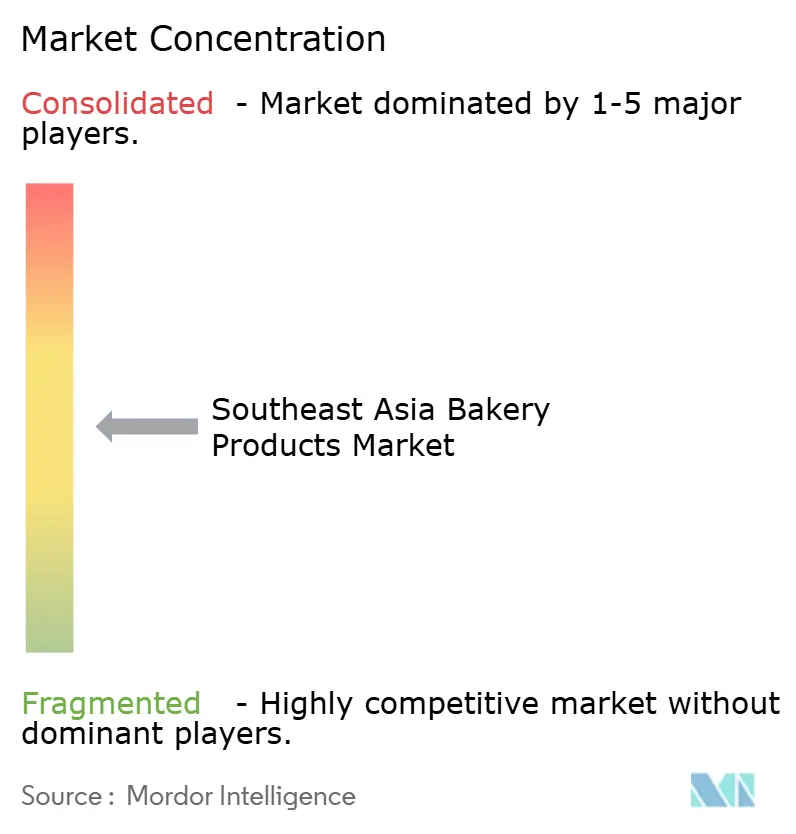
With a concentration score of 5/10, the Southeast Asia bakery products market is moderately fragmented. Domestic leaders like PT Nippon Indosari Corpindo, QAF Ltd, and Mayora Indah dominate the scene, utilizing integrated production, proprietary distribution, and aggressive brand-building campaigns. Meanwhile, international players such as Mondelez International and SPC Group are making their mark by franchising café-bakery formats, adapting global recipes to local tastes. Mid-tier challengers are shaking things up further by experimenting with cloud-kitchen models, effectively reducing rental overheads. Strategic investments in automation are evident: Monde Nissin has upgraded its Davao facility, and Universal Robina has expanded its Sariaya mill, both incorporating robotics for efficient dough handling and increased throughput. On the digital front, initiatives span from predictive ordering algorithms to QR-based traceability, catering to regulatory demands and the transparency sought by consumers. Cross-border mergers and acquisitions (M&A) are proving to be a strategic avenue for achieving regional scale, as highlighted by Lotus Bakeries’ establishment of a Thai production base for Biscoff exports. There's a noticeable uptick in intellectual-property filings, especially around plant-based texturizers and extended-shelf-life packaging, signaling a push for differentiated margins.
Brands are keenly exploring white spaces, particularly in functional snacks and rural micro-retail. They're customizing product sizes and pricing for tier-3 towns, while offering premium, low-GI cakes in affluent areas. Sustainability is emerging as a competitive edge, with pioneers in the market adopting recyclable packaging and ensuring palm-oil traceability. All these strategic moves underscore the dynamic and opportunity-laden landscape of the Southeast Asia bakery products market.
Southeast Asia Bakery Products Industry Leaders
QAF Limited
President Bakery Public Company Limited
PT Nippon Indosari Corpindo TBK
Mondelēz International, Inc
Mayora Indah Tbk
- *Disclaimer: Major Players sorted in no particular order

Market Opportunities and Future Outlook
Two opportunity areas stand out from current market actions: (1) halal-certified bakery scaling across borders and (2) greater vertical integration to control flour quality, costs, and supply continuity. In June 2026, HSS Holdings Bhd outlined an expansion push across Indonesia, the Philippines, and Thailand tied to demand for halal bakery products, reinforcing halal compliance and certification throughput as a commercial lever for multi-market growth. At the same time, operators are also planning bigger manufacturing footprints and OEM participation, illustrated by RT Pastry in June 2026, which detailed plans for a 60,000 to 80,000 sq ft production hub targeted for completion by Q4 2026 to support vertical integration and OEM operations.
Regulatory harmonization also creates whitespace for regional SKU rollouts with fewer formulation changes. In April 2026, ASEAN published an updated Annex I on maximum use levels of food additives, providing a clearer reference point for standardizing formulations across member states for categories that include bakery wares. This supports manufacturers that are building broader distribution and modern-trade listings, where consistent labeling, additives compliance, and traceability expectations are higher, and it complements visible investments in automation and digital quality control among multinational and scaled local producers.
Recent Industry Developments
- May 2026: QAF Limited subsidiary Gardenia Foods (S) Pte Ltd announced it will shift bakery production from Singapore to Johor Bahru, Malaysia, with the Pandan Loop facility scheduled to cease operations on June 30, 2026. The move consolidates manufacturing into a lower-cost regional hub while keeping Singapore positioned for brand, innovation, and oversight activities. It also reshapes lead times and distribution design for supplying Singapore and nearby export lanes.
- April 2026: President Bakery Public Company Limited (Farmhouse) announced a THB 1 billion (about USD 39 million) investment in a new flour mill in Chachoengsao province, with construction planned to start in mid-2026 and completion targeted for 2028. Adding milling capacity strengthens vertical integration and improves control over flour quality and cost volatility. The project also expands upstream capability that can support broader bakery and food manufacturing throughput.
- April 2026: PT Nippon Indosari Corpindo Tbk (Sari Roti) obtained shareholder approval at its April 7, 2026 AGM to amend its Articles of Association to add business activities aligned with Indonesia’s KBLI 2025 classification update. Broadening the formal scope of permitted activities supports the company’s Growth BEYOND Bread direction and enables adjacent moves beyond core packaged bread. The change increases flexibility for partnerships and investment in complementary food categories within Indonesia.


Research Methodology Framework and Report Scope
Market Definition and Coverage
For this study, the market covers the value of bakery products sold across Southeast Asia, including everyday staples and indulgent baked items that are produced commercially or through artisanal outlets and then purchased by consumers.
Scope exclusions: We exclude non-bakery snacks that are not baked goods, plus upstream commodities such as wheat and flour sold as ingredients rather than finished bakery products.
Segmentation Overview
- By Product Type
- Bread
- Sweet Biscuits
- Crackers & Savoury Biscuits
- Cakes, Pastries & Sweet Pies
- Morning Goods
- Others
- By Form
- Fresh
- Frozen
- By Distribution Channel
- Supermarkets / Hypermarkets
- Convenience / Grocery Stores
- Specialty Stores & Artisanal Bakeries
- Online Retail Stores
- Other Channels
- By Geography
- Indonesia
- Malaysia
- Philippines
- Singapore
- Thailand
- Vietnam
- Myanmar
- Rest of Southeast Asia
Data Sources, Market Sizing, and Validation
Desk Research
Desk work started with public data that helps explain demand and supply signals behind bakery consumption in Southeast Asia. We relied on national statistics offices and central bank releases for income, inflation, and retail trends, FAOSTAT food balance sheets for food availability signals, UN Comtrade trade flows for selected key inputs and processed food categories, and agriculture and food standards agencies where food labeling and safety rules are published.
To make the model practical, we also reviewed company annual reports, investor presentations, and press updates for capacity additions, brand expansion, and distribution footprints, followed by country level retail and foodservice commentary from trade associations. For hard to compile points like multi-country company financial snapshots, patent activity cues, and shipment level checks for selected flows, we used analyst subscriptions that consolidate company intelligence and trade records. The sources listed here are illustrative only, and we used additional public and internal references to cross-check figures and clarify assumptions.
Primary Interviews and Surveys
Primary conversations were used to pressure test what the desk inputs imply at ground level, especially on pricing behavior, channel mix shifts, and how fresh versus frozen is changing by country. We spoke with a mix of manufacturers, distributors, retail and bakery operators, and ingredient ecosystem participants across key Southeast Asian markets, so the assumptions could be adjusted to match observed buying frequency and pack size patterns.
Distribution of primary research fieldwork respondents
| Company type | Respondent position |
|---|---|
| Top tier: 34% | CXOs: 12% |
| Mid tier: 52% | Functional/Unit leaders: 29% |
| Smaller Players: 14% | Managers: 59% |
Market-Sizing & Forecasting
Market size was first reconstructed using a top-down approach where population, urbanization, and food spend signals were translated into a bakery demand pool, then filtered through country level channel structure and product mix. To keep it grounded, the totals were compared against selective bottom-up approximations built from sampled brand price points, observed pack sizes, and volume proxies taken from modern retail expansion and bakery outlet density.
A few inputs that mattered in this market were average unit price movement for core items like bread and biscuits, fresh versus frozen penetration by country, modern trade share versus traditional outlets, frequency of bakery purchase for on-the-go snacking, and inflation pass-through timing. Where direct bottom-up visibility was weak, gaps were handled by using ranges from interview feedback and anchoring them to visible signals like import intensity for certain categories and store count growth, before final values were normalized into one consistent USD series. For forecasting, scenario analysis was used around disposable income growth, commodity-driven cost pressure, and channel shifts, and then the chosen path was aligned to what primary respondents saw as realistic for price and volume growth over the next few years.
Data Validation & Update Cycle
Outputs were validated through cross-checks that compare implied per capita spend and category splits against independent indicators like retail food inflation, modern trade expansion, and trade signals where relevant. When a country level result looked unusually high or low, the assumption set was revisited, followed by a second pass review so the final series stays internally consistent across years and geographies.
The model and write-up go through multi-step analyst review before sign-off, and respondents are re-contacted when there is a major mismatch between interview inputs and the computed totals. The report is refreshed annually, with interim updates when material events occur, and a final data pass is completed close to delivery so clients receive the latest view.
Mordor Intelligence's Southeast Asia Bakery Products Market Size Compared With Other Published Estimates
Published values for this market can differ even when the title looks the same, since studies often use different product boundaries, country coverage, and the way they treat pricing for fresh bakery versus packaged items. Differences also show up when one publisher reports a single-year point estimate, while another uses a different base year and then projects forward using a separate macro view.
The main gap comes from how fresh in-store bakery and artisanal sales are treated across countries, where Mordor Intelligence counts them only when they fit the defined bakery products scope and can be tied back to observable channel and pricing checks by country.
Benchmark comparison
| Source | Market Size | Gaps in Research Methodology |
|---|---|---|
| Mordor Intelligence | USD 18.52 B (2026) | |
| Industry Data Provider A | USD 10.20 B (2024) | Uses an earlier base year and can undercount parts of the region depending on country set, and the pricing build may not consistently normalize fresh versus packaged mixes across Southeast Asia. |
| Strategy Advisory B | USD 14.00 B (2029) | Reported as a forward year opportunity figure that can blend bakery chains with broader bakery formats, and the growth path may assume faster premiumization without the same country-by-country channel reconciliation. |
The spread in the table is mainly explained by year selection and what gets included inside bakery, especially around fresh counter sales and chain-led formats. By keeping the scope rules explicit and tying pricing and channel assumptions back to repeatable checks, we end up with a number that is easier to audit and update as conditions change.


Key Questions Answered in the Report
How large is the Southeast Asia bakery products market in 2026?
The Southeast Asia bakery products market size stands at USD 18.52 billion in 2026, with expectations of reaching USD 24.62 billion by 2031.
Which product category leads regional sales?
Cakes, pastries, and sweet pies hold the top position, capturing 42.10% of 2025 revenue.
What growth rate is forecast for crackers and savoury biscuits?
Crackers and savoury biscuits are projected to post a 7.26% CAGR over 2026-2031, the fastest among all product types.
Which distribution channel is expanding most rapidly?
Online retailers record the strongest momentum with an 10.92% CAGR outlook, driven by food-delivery and quick-commerce adoption.
Page last updated on:




