
Animation and VFX Market Size and Share
Market Overview
| Study Period | 2020 - 2031 |
|---|---|
| Market Size (2026) | USD 220.69 Billion |
| Market Size (2031) | USD 386.34 Billion |
| Growth Rate (2026 - 2031) | 11.86 % |
| Fastest Growing Market | Asia Pacific |
| Largest Market | North America |
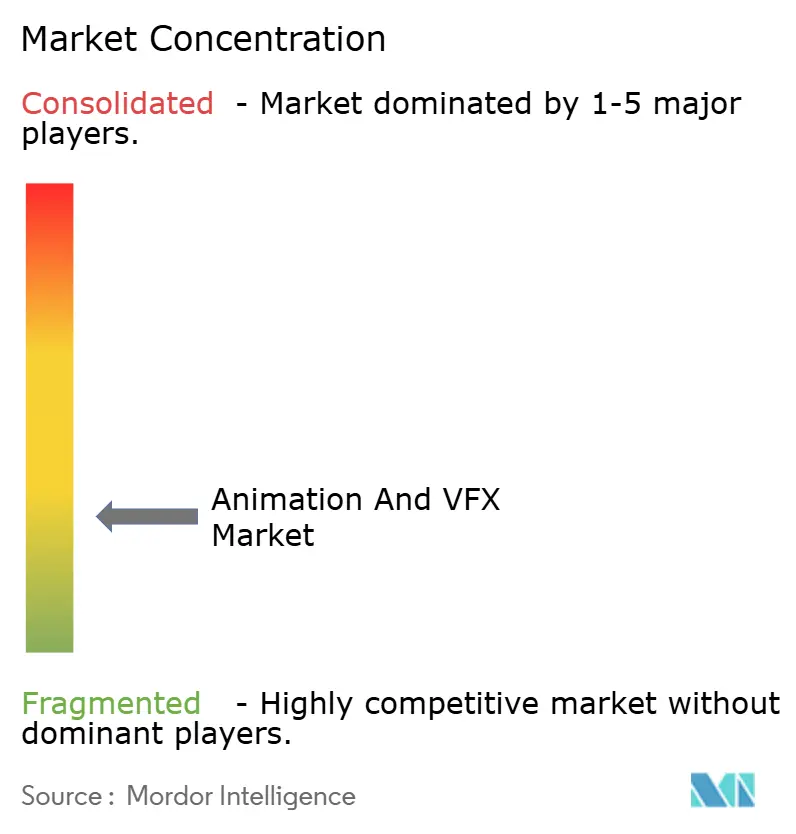
| Market Concentration | Low |
Major Players *Disclaimer: Major Players sorted in no particular order Image © Mordor Intelligence. Reuse requires attribution under CC BY 4.0. | |
Animation and VFX Market Analysis by Mordor Intelligence
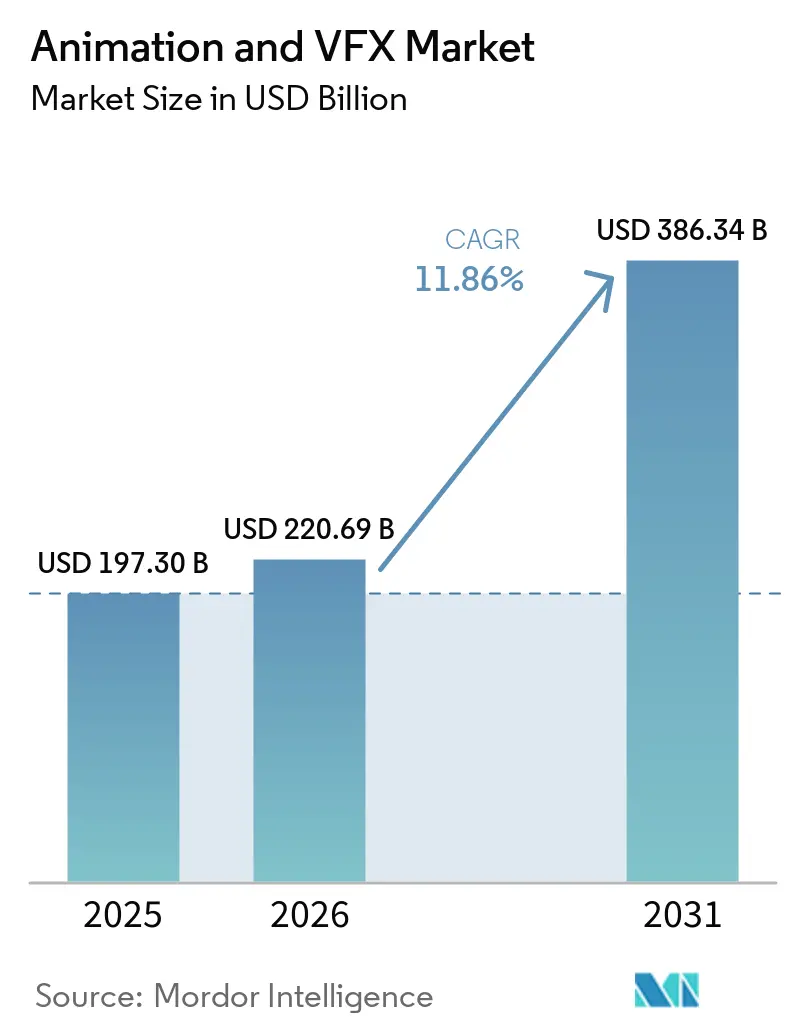
The Animation and VFX market size is expected to grow from USD 197.3 billion in 2025 to USD 220.69 billion in 2026 and is forecast to reach USD 386.34 billion by 2031 at 11.86% CAGR over 2026-2031. Streaming platform investment, the rapid shift to real-time virtual production, and cloud-native rendering stacks are accelerating demand across entertainment, gaming, and emerging professional visualization fields. Intensifying competition among subscription services is prompting record budgets for visually rich originals, while hardware advances and tax incentives broaden global production footprints. Studios are therefore re-engineering pipelines around distributed compute and AI-assisted tools, creating a fertile environment for specialized vendors that can deliver scalable capacity, cost efficiency, and quality assurance throughout the Animation and VFX market. Digital-native consumer behaviour, 3D-enabled devices, and immersive brand activism further reinforce long-term revenue visibility for vendors that align capabilities with these macro shifts.[1]Stephen Follows, “What Netflix’s patents reveal about the future of watching movies,” stephenfollows.com
Key Report Takeaways
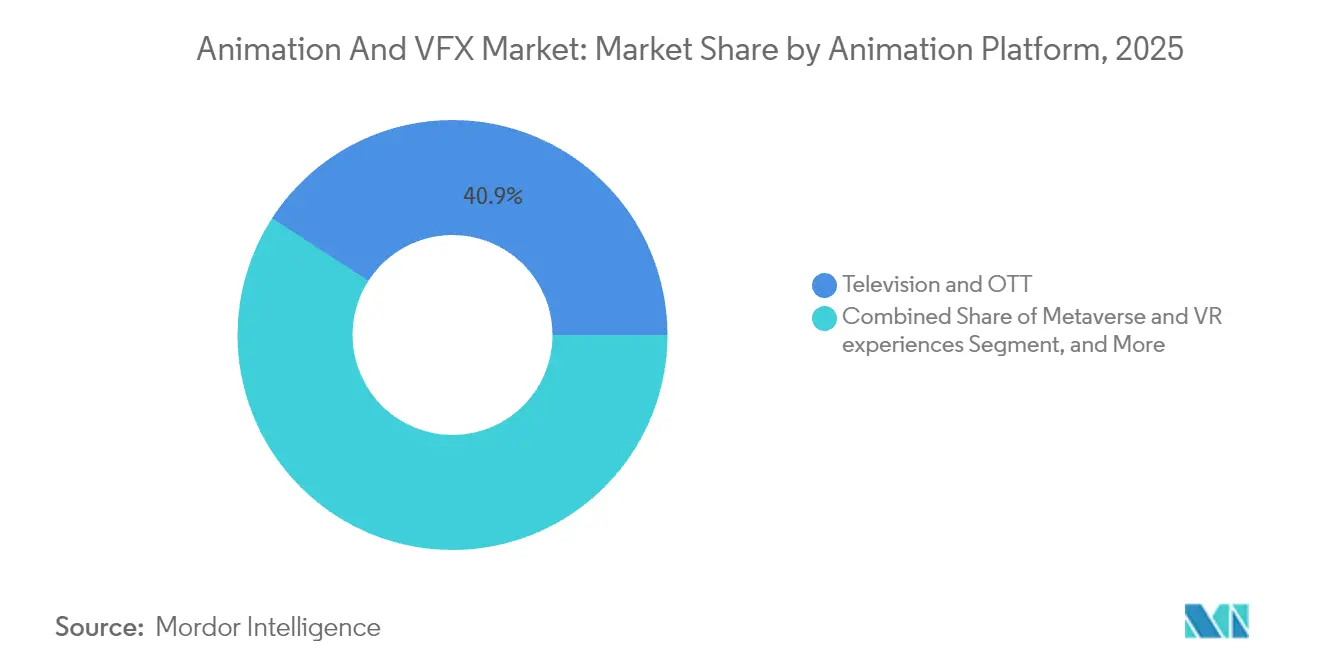
- By animation platform, television and OTT led with 40.86% revenue share in 2025, whereas metaverse and VR experiences are projected to advance at a 15.49% CAGR to 2031.
- By component, software solutions accounted for 48.05% of the Animation and VFX market share in 2025; cloud rendering platforms record the highest projected CAGR at 14.21% through 2031.
- By animation technique, 3D animation captured 43.62% share of the Animation and VFX market size in 2025 and is forecast to expand at 14.52% CAGR between 2026-2031.
- By end-user industry, media and entertainment held 53.71% revenue in 2025, while healthcare and scientific visualization are growing fastest at 14.88% CAGR during the same horizon.
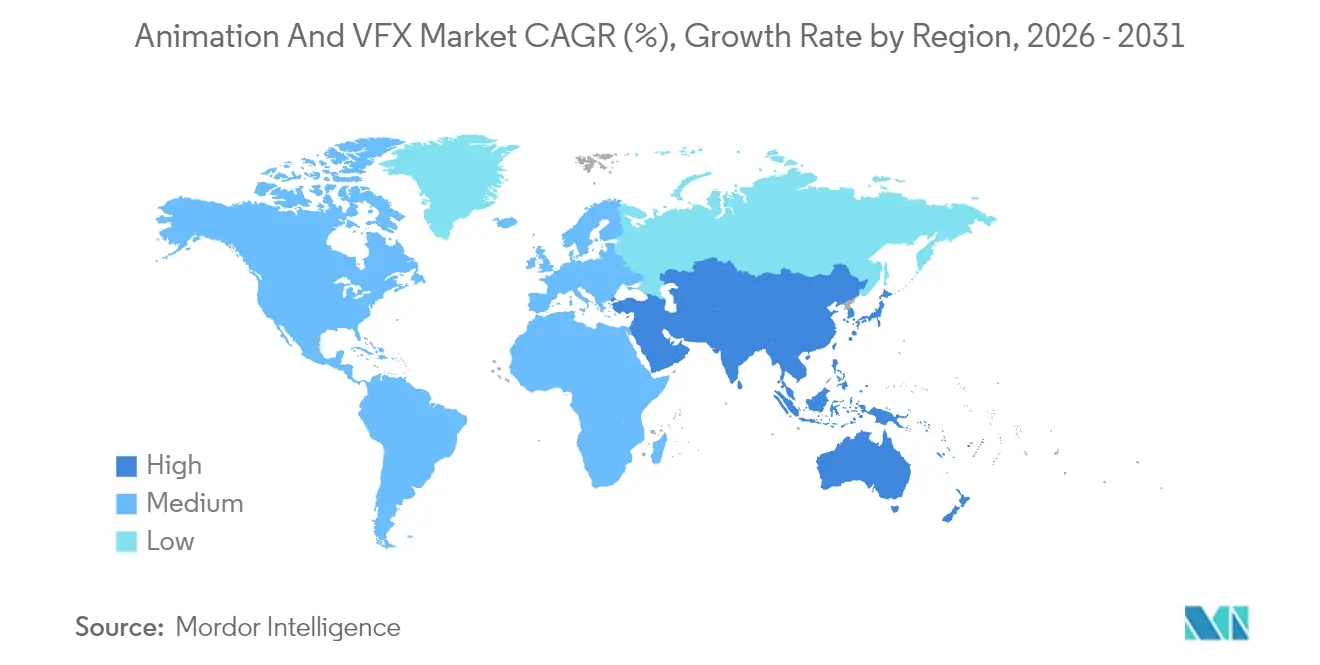
- By geography, North America commanded 37.92% of 2025 revenues; Asia-Pacific is set to climb at a 13.85% CAGR to 2031.
Note: Market size and forecast figures in this report are generated using Mordor Intelligence’s proprietary estimation framework, updated with the latest available data and insights as of 2026.
Market Trends and Insights
Drivers Impact Analysis of Animation and VFX Market*
| (~) Driver | (~) % Impact on CAGR Forecast | Geographic Relevance | Impact Timeline |
|---|---|---|---|
| Surge in streaming-platform content spend | +2.10% | Global, with concentration in North America and Asia-Pacific | Medium term (2-4 years) |
| Expansion of real-time virtual-production pipelines | +1.80% | North America, Europe, with spillover to Asia-Pacific | Long term (≥ 4 years) |
| Adoption of 3D-enabled consumer devices | +1.50% | Global, led by North America and Asia-Pacific markets | Medium term (2-4 years) |
| Escalating VFX intensity in AAA games | +1.20% | Global, with early gains in North America, Europe, Asia-Pacific | Short term (≤ 2 years) |
| Tax-incentive race among emerging production hubs | +0.90% | Asia-Pacific, Europe, select North American regions | Long term (≥ 4 years) |
| Rise of cloud-native distributed rendering | +0.80% | Global, with initial adoption in developed markets | Medium term (2-4 years) |
| Source: Mordor Intelligence | |||
Surge in Streaming-Platform Content Spend
Unprecedented capital deployment by subscription services is rewriting production economics, with Netflix allocating USD 18 billion and Disney USD 24 billion for originals in 2025. These budgets translate directly into higher frame counts, complex creature work, and sophisticated simulations that stretch traditional facility capacity, making animation outsourcing an increasingly strategic option. The strategic USD 1.5 billion Disney investment in Epic Games extends the mandate from episodic content into persistent virtual universes tied to Fortnite, amplifying downstream demand for cross-platform asset reuse.[2]Andrew Webster, “Disney invests USD 1.5 billion in Epic to create ‘persistent universe’ tied to Fortnite,” theverge.com Patents filed by Netflix around AI-driven editing and localization automation reveal a commitment to scale efficiencies that will funnel savings back into premium visuals. Competitive differentiation, therefore, hinges on access to state-of-the-art animation and VFX market resources capable of delivering cinematic spectacle at streamed-content cadence.
Expansion of Real-Time Virtual-Production Pipelines
The move from post-production VFX toward in-camera hybrid workflows is accelerating as LED walls, motion-capture rigs, and real-time engines mature. Epic Games’ Unreal Engine now underpins virtual stages for marquee features, enabling directors to iterate on lighting and environments live on set. UK-based Visualskies secured Innovate UK funding to allow operators to preview CGI elements through viewfinders, reducing costly reshoots.[3]James Tapper, “Hope that visual effects breakthrough can reanimate UK film industry,” theguardian.com By baking photoreal backgrounds during principal photography, studios shorten post cycles and lower location overheads, reinforcing adoption momentum across the Animation and VFX market. Long-term, real-time production also redistributes labour demand toward technical artists proficient in engine-level optimization and volumetric capture.
Adoption of 3D-Enabled Consumer Devices
Spatial-computing momentum from Apple Vision Pro, Meta Quest, and emergent AR wearables is multiplying distribution endpoints for immersive assets. Apple’s transparent display patent and Samsung’s real-time photorealistic AR rendering filings signal hardware roadmaps designed around volumetric content. Complementary ISO/IEC 5927:2024 guidelines formalize safety protocols, boosting enterprise and education confidence in head-mounted display deployments. As device installed bases scale, content suppliers must deliver stereo-ready, real-time optimized animation, expanding the Animation and VFX market addressable revenue streams beyond flat-screen entertainment.
Escalating VFX Intensity in AAA Games
Game studios now devote blockbuster-level budgets to environmental destruction, facial capture, and Hollywood-grade cinematics. Unity’s Vector AI demonstrated 15-20% uplift in installs and in-app purchases when titles integrate higher fidelity assets, linking VFX quality directly to monetization. Epic’s roadmap for Unreal Engine 6 promises democratized high-end features, lowering entry barriers for mid-tier developers yet simultaneously raising consumer expectations. This virtuous cycle drives constant refreshes of shader pipelines, particle systems, and character rigs, keeping the Animation and VFX market pipeline utilization near capacity.
Restraints Impact Analysis of Animation and VFX Market*
| Restraint | (~) % Impact on CAGR Forecast | Geographic Relevance | Impact Timeline |
|---|---|---|---|
| Global shortage of senior VFX talent | -1.40% | Global, with acute shortages in North America and Europe | Short term (≤ 2 years) |
| GPU supply-chain volatility | -0.70% | Global, with particular impact on hardware-dependent regions | Medium term (2-4 years) |
| Software and media piracy | -0.60% | Global, with higher impact in emerging markets | Long term (≥ 4 years) |
| Creative-guild strike disruptions | -0.40% | North America and Europe, with spillover to global productions | Short term (≤ 2 years) |
| Source: Mordor Intelligence | |||
Global Shortage of Senior VFX Talent
VFX Ireland recorded 326% revenue growth yet flagged critical skill gaps, underscoring the imbalance between project inflows and experienced supervision capacity. Parallel activism, such as the Marvel VFX unionization push, highlights workplace conditions that risk attrition. Although forecasts estimate 2 million new AVGC jobs over the next decade, training pipelines lag, especially in real-time engines and AI-assisted toolsets. This bottleneck constrains near-term delivery bandwidth and nudges studios toward automation or higher offshore utilization.
GPU Supply-Chain Volatility
RTX 5090 boards selling 30-50% above MSRP and wafer-fab disruptions after Taiwan seismic events expose the fragility of compute-dependent pipelines. NVIDIA’s gaming revenue dip despite product refreshes signals allocation shortfalls rather than demand weakness. As render and AI workloads intensify, any further semiconductor stocks could delay delivery schedules, forcing the Animation and VFX market toward cloud brokers with diversified hardware footprints.
*Our forecasts treat driver/restraint impacts as directional, not additive. The impact forecasts reflect baseline growth, mix effects, and variable interactions.
Animation and VFX Market Segment Analysis
By Animation Platform:
Streaming Drives Content DiversificationTelevision and OTT outlets dominated 40.86% of 2025 revenue, reflecting the platform’s precedence in commissioning serial content that requires continuous shot volumes. The Animation and VFX market size for this segment is projected to expand steadily as binge-watch demand incentivizes cinematic-quality episode pipelines. Conversely, metaverse and VR experiences register a 15.49% CAGR, the fastest among platforms, as consumer headsets normalize interactive worldbuilding. Libraries originally produced for flat screens are being retrofitted for spatial immersion, extending asset monetization windows. Advertising, film releases, and education collectively supply baseline occupancy, with ed tech adopting real-time rendered modules to lift remote engagement metrics.
A convergent ecosystem is emerging where IP traverses linear and interactive endpoints. Disney’s strategic Epic Games stake exemplifies how a single asset stack can underpin series episodes, live events, and persistent game worlds, compressing creative iteration loops. Studios agile in re-purposing rigs and textures across distribution modes will capture an outsized slice of incremental spend, reinforcing the growth of the Animation and VFX market.



By Component:
Software Solutions Lead Cloud MigrationSoftware solutions captured 48.05% revenue in 2025, owing to their indispensability across modelling, rigging, and compositing tasks. Autodesk’s 97% recurring revenue ratio illustrates the stickiness of subscription licensing in the Animation and VFX industry. Simultaneously, cloud rendering platforms, growing at 14.21% CAGR, allow facilities to sidestep capex-heavy farm expansions and absorb GPU price spikes. Hardware equipment sales see margin compression but remain vital for virtual-production capture floors and mocap volumes. Service providers exploit wage differentials, with Indian and Southeast Asian vendors scaling workforce counts to backfill global shortages.
AI-assisted plug-ins are proliferating across incumbent suites, automating rotoscoping, matte extraction, and crowd simulations. Vendors that integrate native cloud orchestration and pay-per-minute GPU allocation stand to anchor next-gen pipelines, pushing the Animation and VFX market toward usage-based economics.
By Animation Technique:
3D Animation Dominates Innovation3D animation held 43.62% share and leads growth at 14.52% CAGR, fuelled by immersive storytelling in film, AAA games, and VR. Neural rendering patents from Samsung and AI guidelines from the Academy underline a future where machine learning accelerates asset generation without undermining human creative credit. Motion graphics sustain brand storytelling, while stop-motion preserves niche artistic appeal despite slower throughput. Revived interest in stylized 2D series on streaming portals indicates that heritage techniques can still capture audience sentiment when paired with modern pipeline efficiencies, adding depth to the Animation and VFX market portfolio.

By End-User Industry:
Healthcare Visualization EmergesMedia and entertainment preserved its majority share at 53.71% in 2025, yet diversification is evident. Healthcare visualization’s 14.88% CAGR reflects hospitals deploying anatomical twins for surgical rehearsal and pharma marketers leveraging photoreal molecule animations. Architecture and real-estate teams now use real-time walkthroughs to secure approvals faster, converging with game-engine visualization standards. Education leverages XR simulations for vocational training, and advertisers embrace AR lenses for experiential campaigns, widening the Animation and VFX market client base beyond traditional studios.
Geography Analysis
North America Animation and VFX Market
North America accounts for the largest regional node of the Animation and VFX market, benefiting from a concentration of capital-intensive platforms, R&D labs, and unionized artistic talent. California’s tripling of annual incentive funding to USD 750 million signals determined retention of marquee tentpoles. The rollout of real-time virtual stages has further entrenched the region’s lead by compressing on-set to post-production cycles and keeping vendor ecosystems close to decision-making hubs.
APAC Animation and VFX Market
Asia-Pacific serves as the market’s velocity engine, with the Animation and VFX market size for regional vendors expanding faster than any other territory. South Korean and Japanese policymakers are nurturing end-to-end ecosystems, ensuring that local IP creation, render capacity, and distribution remain domestically anchored, thereby repatriating value historically exported to Western vendors. Chinese studios, invigorated by growing box-office quotas and streaming uptake, invest in proprietary rigs and AI accelerators, reducing dependency on imported middleware.
Europe Animation and VFX Market
Europe remains a resilient participant through cultural funding frameworks and pans-European co-production treaties that de-risk ambitious art-house ventures. The UK’s enhanced 39% VFX rebate and France’s TRIP program sustain competitive parity. Eastern European hubs capitalize on currency advantages and multilingual crews to absorb overspill from Western facilities. Collectively, diversified public policy scaffolding across continents moderates supply shocks and underpins steady 11%-plus CAGR for the Animation and VFX market through 2031.

Competitive Landscape
Fragmentation defines the current Animation and VFX market topology, even as consolidation underlines strategic positioning. The fall of Technicolor and subsequent asset acquisitions by Rodeo FX and Phantom FX signify an appetite for scale amid mounting capital demands of real-time pipelines. Legacy titans such as Industrial Light and Magic, Weta FX, and DNEG still command marquee sequences, yet their combined footprint falls below thresholds that would signal oligopolistic control, maintaining competitive room for independents.
Strategic plays revolve around proprietary AI IP, cloud infrastructure partnerships, and labour arbitrage. Autodesk’s Wonder Dynamics buyout aligns automated character insertion with its Maya user base, while NVIDIA’s RTX 50 Series launch locks studios deeper into GPU-centric toolchains. Samsung and Apple patents foreshadow vertical integration where hardware vendors could bypass traditional DCC software altogether through on-device neural rendering, potentially reshaping value capture within the Animation and VFX market.
Simultaneously, organized labour movements in North America spotlight the escalating importance of sustainable work practices. Studios that provide transparent scheduling and invest in upskilling stand to mitigate churn, retaining knowledge crucial for high complexity shows. Vendors capable of balancing automation with human artistry and ethical workforce management will likely secure premium client rosters as demand continues to outstrip senior talent supply.[4]Investing.com Transcript, “Unity Software Q1 2025 earnings call,” investing.com
Animation and VFX Industry Leaders
3D Matchmovers
Rocket Science VFX
Blue Bolt
Trixter GMBH
FX3X
- *Disclaimer: Major Players sorted in no particular order
Animation and VFX Market Companies Covered in this Report
- Industrial Light & Magic - The Walt Disney Co.
- Weta FX Ltd.
- DNEG Group
- Framestore Ltd.
- Sony Pictures Imageworks Inc.
- Pixar Animation Studios
- DreamWorks Animation LLC
- Epic Games Inc.
- Autodesk Inc.
- Adobe Inc.
- Animal Logic Pty Ltd
- Blur Studio, Inc.
- Cinesite VFX Limited
- Digital Domain Holdings Limited
- The Moving Picture Company Limited
- Rodeo FX Inc.
- Scanline VFX GmbH
- Luma Pictures, Inc.
- Method Studios, LLC
- Axis Studios Limited

Recent Industry Developments in Animation and VFX Market
- February 2025: Disney invested USD 1.5 billion in Epic Games to build a persistent universe linked to Fortnite, integrating Pixar, Marvel, and Star Wars IP.
- February 2025: Autodesk reported fiscal 2025 revenue of USD 6.13 billion and initiated a 9% workforce reorganization to prioritize cloud and AI.
- February 2025: NVIDIA unveiled RTX 50 Series cards and disclosed fiscal 2025 revenue of USD 39.3 billion, a 78% year-over-year jump.
- January 2025: Unity Software launched Unity 6 and Vector AI after closing 2024 at USD 1.813 billion in revenue.


Global Animation and VFX Market Report Scope
The animation and VFX market is defined based on the spending of various end users in the VFX and animation market. The said industry is treated as a subset of the broader creative industries. The animation and VFX industries encompass pre and post-production, technology, machine learning, outsourcing, software products, and sales. The study is structured to track the demand for animation, VFX, and post-production services rendered by various studios globally. The analysis is based on the market insights captured through secondary research and the primaries. The market also covers the major factors impacting the market’s growth in terms of drivers and restraints.
The animation and VFX market is segmented by animation platforms (television and OTT, films, advertisement, gaming, and other animation platforms (Ed-tech, etc.)) and geography (North America, Europe, Asia Pacific, and the Rest of the World). The report offers market forecasts and size in value (USD) for all the above segments.
| Television and OTT |
| Film |
| Advertising |
| Gaming |
| Education / Ed-tech |
| Metaverse and VR experiences |
| Software Solutions |
| Hardware Equipment |
| Services (Outsourcing and Post-production) |
| Cloud Rendering Platforms |
| 2D Animation |
| 3D Animation |
| Motion Graphics |
| Stop-motion |
| Media and Entertainment |
| Video Games |
| Advertising Agencies |
| Education and Training |
| Architecture and Real-estate Visualisation |
| Healthcare and Scientific Visualisation |
| North America | United States |
| Canada | |
| Mexico | |
| Europe | United Kingdom |
| Germany | |
| France | |
| Italy | |
| Rest of Europe | |
| Asia-Pacific | China |
| Japan | |
| India | |
| South Korea | |
| Rest of Asia | |
| Middle East | Israel |
| Saudi Arabia | |
| United Arab Emirates | |
| Turkey | |
| Rest of Middle East | |
| Africa | South Africa |
| Egypt | |
| Rest of Africa | |
| South America | Brazil |
| Argentina | |
| Rest of South America |
| By Animation Platform | Television and OTT | |
| Film | ||
| Advertising | ||
| Gaming | ||
| Education / Ed-tech | ||
| Metaverse and VR experiences | ||
| By Component | Software Solutions | |
| Hardware Equipment | ||
| Services (Outsourcing and Post-production) | ||
| Cloud Rendering Platforms | ||
| By Animation Technique | 2D Animation | |
| 3D Animation | ||
| Motion Graphics | ||
| Stop-motion | ||
| By End-User Industry | Media and Entertainment | |
| Video Games | ||
| Advertising Agencies | ||
| Education and Training | ||
| Architecture and Real-estate Visualisation | ||
| Healthcare and Scientific Visualisation | ||
| By Geography | North America | United States |
| Canada | ||
| Mexico | ||
| Europe | United Kingdom | |
| Germany | ||
| France | ||
| Italy | ||
| Rest of Europe | ||
| Asia-Pacific | China | |
| Japan | ||
| India | ||
| South Korea | ||
| Rest of Asia | ||
| Middle East | Israel | |
| Saudi Arabia | ||
| United Arab Emirates | ||
| Turkey | ||
| Rest of Middle East | ||
| Africa | South Africa | |
| Egypt | ||
| Rest of Africa | ||
| South America | Brazil | |
| Argentina | ||
| Rest of South America | ||


Key Questions Answered in the Report
How large is the Animation and VFX market in 2026?
The Animation and VFX market size reached USD 220.69 billion in 2026 and is forecast to hit USD 386.34 billion by 2031.
Which segment is growing fastest within the sector?
Metaverse and VR experiences lead growth at a 15.49% CAGR due to expanding spatial-computing device adoption.
Why are cloud rendering platforms gaining traction?
They deliver elastic compute that offsets GPU shortages and cuts capex, explaining their 14.21% projected CAGR.
Which geography offers the highest future growth?
Asia-Pacific is expected to grow at 13.85% CAGR, propelled by government incentives and rising domestic content demand.
What is the main challenge to industry expansion?
A global shortage of senior VFX talent could trim overall CAGR by 1.4% unless training and automation accelerate.
How will real-time virtual production impact costs?
By capturing final-pixel environments on set, virtual stages reduce location spending and compress post schedules, improving budget efficiency.
Page last updated on:




