
Quadricycles and Tricycles Market Size and Share
Market Overview
| Study Period | 2020 - 2031 |
|---|---|
| Market Size (2026) | USD 9.85 Billion |
| Market Size (2031) | USD 16.29 Billion |
| Growth Rate (2026 - 2031) | 10.58 % |
| Fastest Growing Market | Europe |
| Largest Market | Asia-Pacific |
| Market Concentration | Medium |
Major Players *Disclaimer: Major Players sorted in no particular order Image © Mordor Intelligence. Reuse requires attribution under CC BY 4.0. | |
Quadricycles and Tricycles Market Analysis by Mordor Intelligence
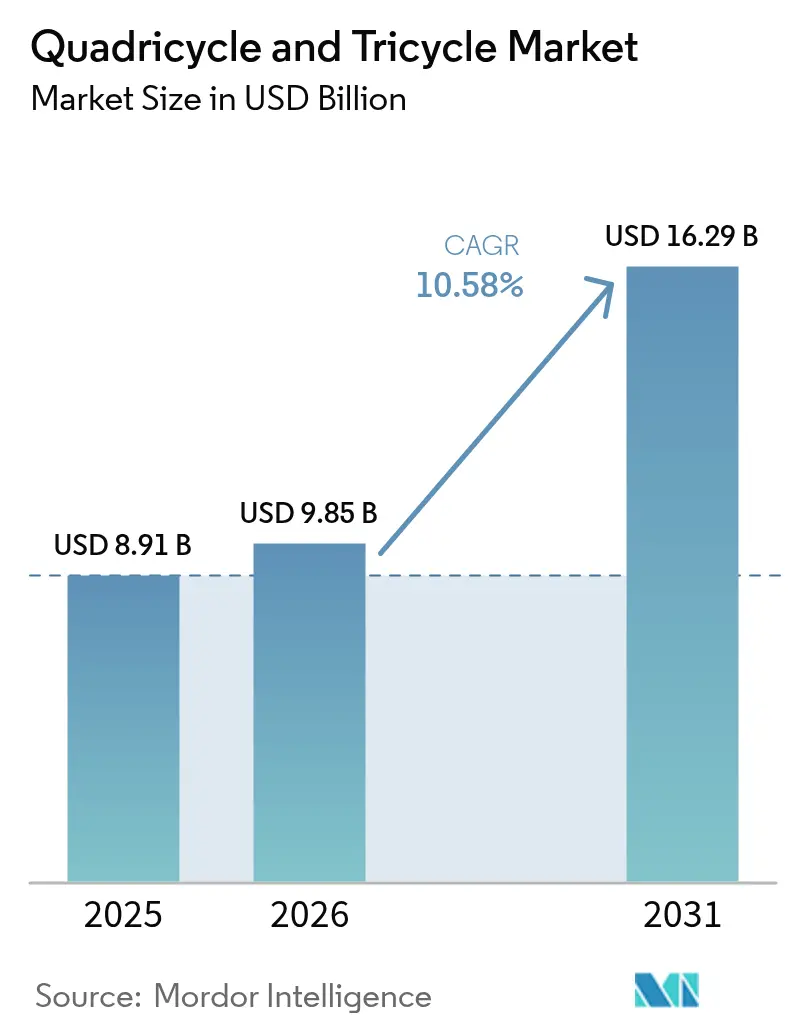
The Quadricycles and Tricycles Market size was valued at USD 8.91 billion in 2025 and estimated to grow from USD 9.85 billion in 2026 to reach USD 16.29 billion by 2031, at a CAGR of 10.58% during the forecast period (2026-2031). This growth is driven by increasing urban delivery density, national incentive programs that reduce the cost of electric-vehicle ownership, and regulatory frameworks that incentivize compact, low-emission transportation. Internal-combustion products currently dominate shipments, yet electric models are securing factory line time because battery costs continue to fall and swap networks reduce downtime. Tight emission limits in Europe and planned India BS7 rules reshape cost calculations, while Egypt’s tuk-tuk replacement scheme illustrates how formal recognition of four-wheel micro-EVs unlocks fresh demand. Major automakers now treat micro-mobility as an entry-level profit pool, prompting portfolio extensions that mirror regional policy cues. Together, these forces propel the Quadricycles and Tricycles Market onto a steep adoption curve across both freight and passenger niches.
Key Report Takeaways
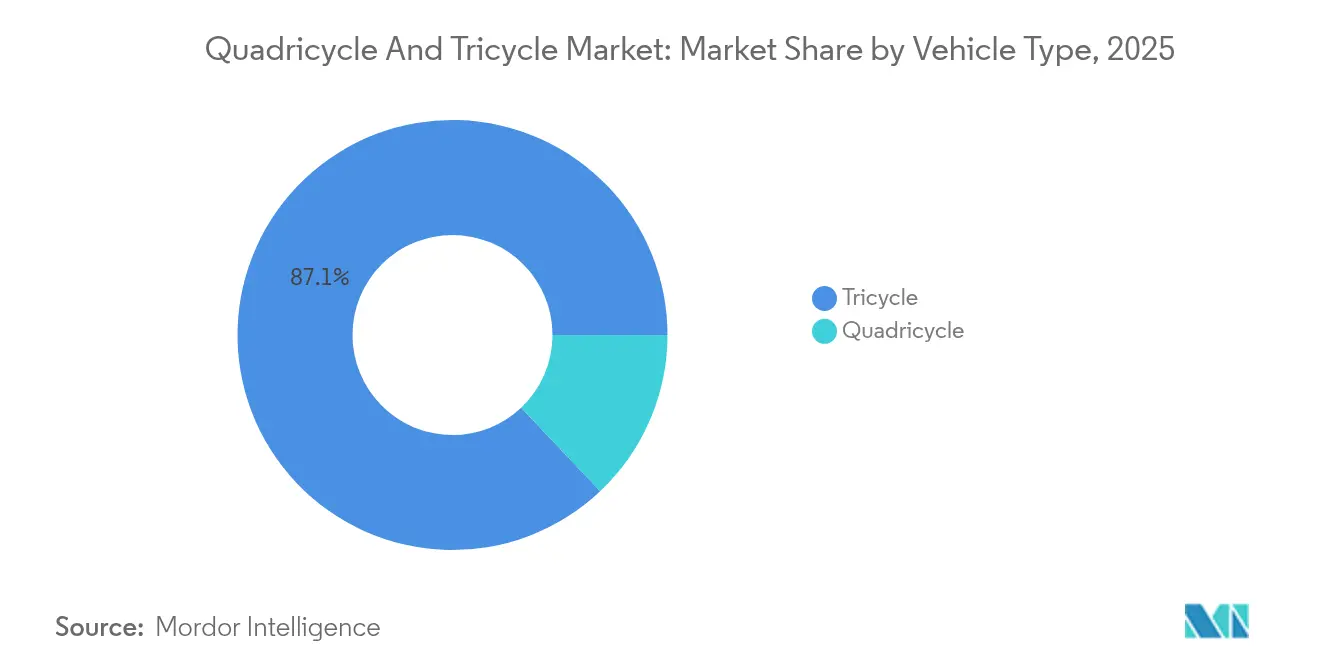
- By vehicle type, tricycles led with 87.05% of the Quadricycles and Tricycles Market share in 2025, whereas quadricycles recorded a 10.62% CAGR through 2031.
- By application type, commercial uses accounted for 73.10% of the Quadricycles and Tricycles Market size in 2025, and it is also expected to expand at a 10.7% CAGR through 2031.
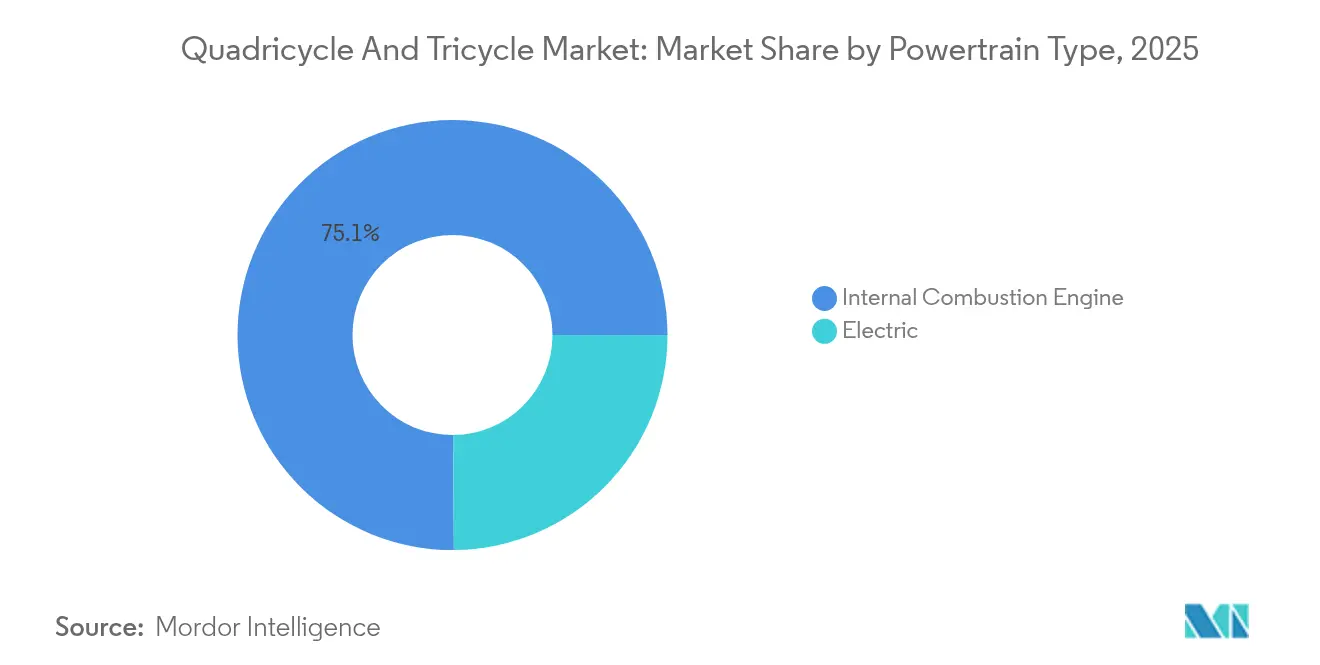
- By powertrain type, internal-combustion units controlled 75.10% of the Quadricycles and Tricycles Market share in 2025, while electric models are projected to post a 10.72% CAGR between 2026 and 2031.
- By design and configuration, passenger layouts captured 80.55% of the Quadricycles and Tricycles Market share in 2025; however, cargo layouts are projected to grow at a 10.66% CAGR through 2031.
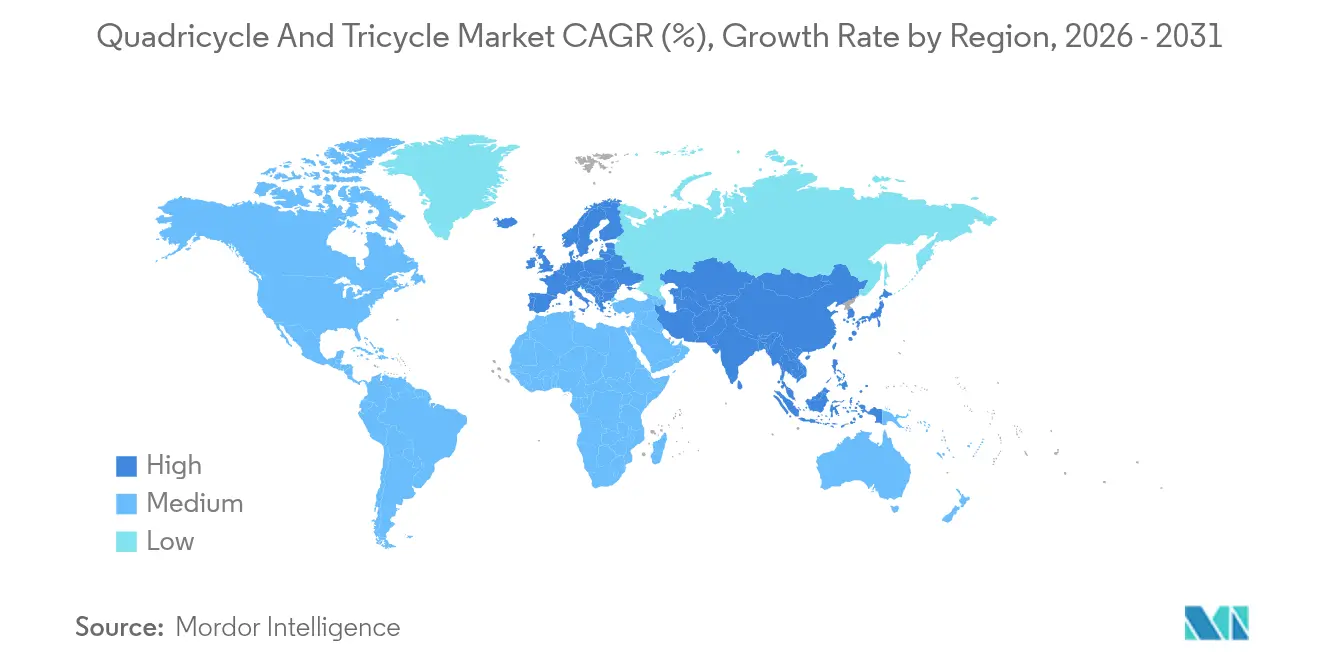
- By region, the Asia-Pacific held a 41.05% of the Quadricycles and Tricycles Market share in 2025, whereas Europe is expected to log the fastest growth rate of 10.65% through 2031.
Note: Market size and forecast figures in this report are generated using Mordor Intelligence’s proprietary estimation framework, updated with the latest available data and insights as of 2026.
Market Trends and Insights
Drivers Impact Analysis of Quadricycles and Tricycles Market*
| Driver | (~) % Impact on CAGR Forecast | Geographic Relevance | Impact Timeline |
|---|---|---|---|
| Government Subsidies and Incentives | +2.8% | Global, with concentration in India, China, EU, Thailand | Medium term (2-4 years) |
| Rising E-Commerce Last-Mile Delivery | +2.5% | Global, strongest in Asia Pacific and North America urban centers | Short term (≤ 2 years) |
| Emission Regulations | +2.1% | EU, India (BS7), China, select Latin American markets | Long term (≥ 4 years) |
| Urban Congestion and Parking Limits | +1.9% | Europe, North America metros, select Asia Pacific cities | Medium term (2-4 years) |
| Battery-Swap Business Models | +1.4% | India, China, Indonesia, select European pilot markets | Medium term (2-4 years) |
| Egypt Tuk-Tuk-To-Quadricycle Replacement Programme | +0.6% | Egypt, with spillover to North Africa and Middle East | Short term (≤ 2 years) |
| Source: Mordor Intelligence | |||
Government Subsidies & Incentives For E-3W / Micro-EVs
Incentive packages are increasingly bridging the price gap between electric and gasoline vehicles. India's Production Linked Incentive scheme is allocating significant funding to boost local component production and reduce unit costs. Under Thailand's EV 3.5 policy, firms assembling electric tricycles are eligible for substantial corporate tax relief. Meanwhile, Malta is incentivizing quadricycle purchases with notable financial grants. In a move underscoring its commitment, China has extended purchase-tax exemptions for smaller vehicles for several more years. These initiatives, coinciding with falling battery costs, aim to boost electric car sales. With these predictable incentives, manufacturers are ramping up capacity planning, seeing it as a way to mitigate risks in capital spending and enhance plant utilization.
Rising E-Commerce Last-Mile Delivery Demand
Urban fulfillment costs account for almost three-fifths of shipping expenses, so fleet managers seek vehicles that reduce parking time and congestion fees. Amazon pilots electric cargo tricycles in several European capitals, while Flipkart equips Indian city hubs with swap-enabled three-wheelers. Battery-as-a-service models from Gogoro and Sun Mobility maintain high asset uptime, enabling operators to run longer shifts without range anxiety. Combined with stricter low-emission zones, these economics tilt route planning toward compact, electric vehicles. Volume growth in parcel shipments, therefore, transmits directly to chassis orders, sustaining a virtuous cycle for component makers.
Emission Regulations Accelerating ICE-To-EV Shift
Euro 7 and future India BS7 standards tighten particulate caps for L-category vehicles, pushing compliance costs upward for gasoline platforms [1]. The International Energy Agency states that transport emissions must fall by one-fifth by 2030 to stay within climate goals. California now requires zero-emission delivery fleets by 2030, mirroring China’s commercial electrification targets. Each milestone locks in a date after which ICE technology faces escalating penalties, prompting OEMs to redirect R&D budgets toward battery platforms. Rising regulatory clarity thus reinforces the sales ramp for electric quadricycles and tricycles in the second half of the decade.
Urban Congestion & Parking Limits Favouring Quadricycles
Cities are monetizing road space through fees that micro-EVs often avoid. London’s Ultra Low Emission Zone raised a considerable amount in 2024, but exempts compliant quadricycles [2]. Paris plans to remove multiple curbside spaces by 2026, while Barcelona’s superblock grid reallocates lanes to pedestrians. EU Regulation 168/2013 lets L6E and L7E vehicles enter restricted areas and park in motorcycle bays, saving drivers daily costs. Singapore’s Certificate of Entitlement is highly for cars, making four-wheel micro-vehicles a pragmatic choice for commuters. As municipalities replicate these rules, the Quadricycles and Tricycles Market secures sustainable demand from cost-sensitive urban users.
Restraints Impact Analysis of Quadricycles and Tricycles Market*
| Restraint | (~) % Impact on CAGR Forecast | Geographic Relevance | Impact Timeline |
|---|---|---|---|
| Sparse Fast-Charging Infrastructure | -1.8% | Global, most acute in rural areas and emerging markets | Medium term (2-4 years) |
| High Li-Ion Battery Upfront Cost | -1.4% | Global, with higher sensitivity in price-conscious markets | Short term (≤ 2 years) |
| Consumer Shift To Improved Electric Two-Wheelers | -0.9% | Asia Pacific primarily, select urban markets globally | Medium term (2-4 years) |
| Pending EU Crash-Safety Rules | -0.7% | Europe, with potential spillover to markets adopting EU standards | Long term (≥ 4 years) |
| Source: Mordor Intelligence | |||
Sparse Fast-Charging / Swap Infrastructure
Station density remains below the International Energy Agency guideline of one charger per ten vehicles across most emerging markets. Private investors hesitate where utilization rates are uncertain, and public planners face budget constraints, especially in rural areas. In regions with unreliable electricity grids, operators struggle to guarantee uptime for commercial fleets. Some governments subsidize chargers, but the rollout speed still lags behind demand, slowing electric vehicle sales. Without predictable access to energy, fleet managers may continue to purchase internal-combustion models, thereby delaying the tipping point for full electrification.
High Li-Ion Battery Upfront Cost
Over the past decade, battery prices have significantly decreased. However, a typical battery pack still represents a substantial portion of a micro-EV's sticker price. In markets where average incomes restrict purchase budgets, price sensitivity remains high. Leasing and subscription models offer some relief from this financial burden, but their adoption varies widely. The instability of raw material costs, particularly for lithium and cobalt, creates planning challenges for OEMs and suppliers. Unless battery pack prices reach a more affordable level, some consumers may delay transitioning, which could slow the short-term growth of the Quadricycles and Tricycles Market.
*Our forecasts treat driver/restraint impacts as directional, not additive. The impact forecasts reflect baseline growth, mix effects, and variable interactions.
Quadricycles and Tricycles Market Segment Analysis
By Vehicle Type:
Diverging Paths For Three And Four WheelsTricycles accounted for a commanding 87.05% of the Quadricycles and Tricycles Market share in 2025, sustained by entrenched manufacturing clusters in India, Thailand, and Indonesia. The Quadricycles and Tricycles Market size for tricycles is projected to expand steadily, yet at a slower pace than four-wheel formats. Quadricycles, though smaller in absolute volume, are projected to register a 10.62% CAGR through 2031 as European and North African policies reward enclosed cabins for safety and weather protection. Bajaj Auto scales Qute production for Egypt’s replacement program, while Piaggio refines its Porter-based micro-EV platform for dense European cores. Regional adoption patterns, therefore, reflect a complex mix of cost priorities, climate conditions, and rulebooks that classify vehicle classes differently.
Tricycle platforms continue to evolve, integrating battery-swap compatibility and telematics to maintain their relevance. Quadricycle engineering now incorporates roof-mounted solar assistance and lightweight composites to offset the mass of the battery. OEMs thus tailor R&D pipelines to distinct user requirements rather than forcing a single platform across geographies. Competitive positioning relies on modular architectures that share components while allowing for local variations in compliance, thereby enabling flexibility and adaptability. The integration of advanced driver alerts and basic connectivity features also helps four-wheel models gain regulatory approval in cities targeting Zero-Accident safety outcomes. As funding pools align with zero-emission targets, the quadricycle and tricycle markets diversify, with both formats coexisting rather than fully converging.

By Application Type:
Cargo Expansion Outpaces Passenger LegacyCommercial operations controlled 73.10% of the Quadricycles and Tricycles Market size in 2025, a share expected to increase as parcel networks expand their coverage. Commercial operations are forecast to post a 10.7% CAGR through 2031, driven by predictable route density and fee exemptions in low-emission zones. Passenger formats still dominate ride-hailing and informal taxi services across South Asia; however, the introduction of new metro lines and bus rapid transit corridors is tempering incremental growth. Large e-commerce platforms offer volume guarantees that support dedicated assembly lines, allowing suppliers to secure multi-year contracts.
Fleet owners address driver retention by installing enclosed cabins and climate control systems, which enhance comfort while keeping the cost per kilometer low. Urban planners designate micro-logistics hubs near residential areas, shortening trip lengths and underscoring the suitability of compact cargo beds. Software providers are now integrating route planning specifically for three-wheel vehicles, which reduces fuel or battery consumption during peak congestion. Passenger units pivot toward tourism shuttles and campus transport where regulation permits. Over the forecast window, the Quadricycles and Tricycles Market therefore shifts from general people movement toward specialized freight ecosystems whose earnings justify faster asset turnover.
By Powertrain Type:
Electric Traction Gains Structural EdgeInternal-combustion engines held 75.10% of the Quadricycles and Tricycles Market share in 2025; however, their cost advantage is narrowing each year. The Quadricycles and Tricycles Market size for electric variants is projected to compound at a 10.72% annual growth rate through 2031, driven by declining pack prices and the expansion of fast-charging grids. Fuel-price volatility further undermines gasoline models in cost-of-ownership comparisons for high-use fleets. OEMs hedge by launching parallel lines that share body panels but differ underneath, thereby preserving economies of scale while allowing buyers to select their preferred propulsion.
Governments layer incentives on electric drivetrains; Thailand ties corporate tax relief to local cell assembly, while India’s PLI scheme subsidizes research and development in battery chemistry. Digital fleet-management suites now display live state-of-charge data, allowing dispatchers to swap batteries proactively. The residual-value gap favoring internal-combustion units narrows as secondary-market demand for used packs in stationary storage forms. By 2030, electric vehicle sales are likely to surpass gasoline sales in the commercial segment, solidifying the long-term transition narrative.
By Design & Configuration:
Cargo Beds Reinvent Space EfficiencyPassenger designs accounted for 80.55% of the Quadricycles and Tricycles Market share in 2025, reflecting the entrenched role of three-wheeler taxis in Asia’s mobility landscape. Yet cargo bodies present the highest incremental value, with a 10.66% CAGR expected through 2031. Parcel managers value side-loading rear boxes that speed curbside drops and minimize double-parking fines. Modular chassis allow builders to swap flatbeds for insulated lockers, depending on the duty cycle, thereby maximizing plant utilization.
Ergonomic dashboards borrowed from light vans upgrade driver comfort and boost productivity, while telematics record door-open events for proof-of-delivery audits. Passenger layouts respond by adding factory-fitted seat belts and roll-over structures to meet tightening safety norms in countries like Egypt. Weather-sealed doors, once a luxury, become standard as consumers equate enclosure with professionalism. Market leaders thus pursue a split strategy: volume passenger products for dense Asian corridors and higher-margin cargo models for regulated western cities. This dual pathway underscores the Quadricycles and Tricycles Market’s capacity to serve diverse use cases without diluting platform economics.
Geography Analysis
APAC Quadricycles and Tricycles Market
Asia-Pacific commanded 41.05% of the Quadricycles and Tricycles Market share in 2025, anchored by India’s expansive three-wheeler manufacturing base and China’s scale advantages in lithium-iron-phosphate chemistry. India's significant PLI initiative is reshaping supply chains, attracting both cell manufacturers and component vendors. Meanwhile, China has extended purchase-tax waivers for vehicles with lower power output, ensuring cost parity for micro-EVs. Thailand's EV program is positioning the nation as a regional export hub, seamlessly connecting its supply bases with those of Indonesia and the Philippines. This strategic alignment benefits the Quadricycles and Tricycles Market, as cross-border economies reduce lead times and streamline inventory cycles.
Europe Quadricycles and Tricycles Market
Europe, while smaller in current shipments, is projected to log a 10.65% CAGR through 2031 as city halls codify congestion fees and parking reductions. This growth is driven by city halls implementing congestion fees and parking reductions. London's Ultra Low Emission Zone offers exemptions for compliant quadricycles, while Paris is reducing curbside stalls, encouraging residents to opt for compact vehicles. Malta's incentive for quadricycles, combined with the standardized rules of Regulation 168/2013, streamlines the homologation process. Capitalizing on this clarity, manufacturers are orchestrating pan-EU launches, distributing R&D costs across multiple markets, and bolstering the region's stake in the Quadricycles and Tricycles Market.
The Americas and MEA Quadricycles and Tricycles Market
North America is treading cautiously yet picking up pace, harnessing state-level mandates, such as California's Advanced Clean Fleets Rule. In the Middle East and Africa, growth is driven by Egypt's official recognition of quadricycle taxis, which paves the way for export routes for Indian suppliers. South America faces challenges from macroeconomic issues and inconsistent infrastructure. Yet, with Brazil's Sao Paulo introducing a zero-emission zone and Argentina piloting micro-EVs, there's potential for growth once credit conditions stabilize. The varying regulatory timelines across regions suggest a dynamic shift in leadership roles over the decade, ensuring nimble supply chains.
Competitive Landscape
Market concentration remains moderate, with incumbent automakers sharing space with dedicated micro-mobility challengers. Bajaj Auto leverages its deep dealership coverage in South Asia to scale export programs to Africa. At the same time, Piaggio taps into its European heritage to position quadricycles as eco-friendly city runabouts [3]. Mahindra’s Last Mile Mobility unit invests in battery-swap readiness, collaborating with Sun Mobility on interoperable packs.
BYD deploys blade-battery modules in mini-EV formats, giving it a cost advantage in chemistry, while VinFast attempts rapid market entry through contract manufacturing in India. Component specialization is on the rise: firms like Bosch e-Bike Systems are pushing compact motors tailored for less than 20 kW classes.
OEMs deploy modular architectures that host both three-wheel and four-wheel bodies, enabling plants to adjust their mix in response to demand signals. Strategic alliances deepen: Kinetic Green co-develops a chassis with Aichi Steel to reduce frame weight, and Piaggio partners with Chinese cell suppliers to mitigate fluctuations in cobalt prices. Suppliers further down the chain stake claims by offering vertically integrated kits that bundle motor, controller, and telematics, reducing time-to-market for startups. The Quadricycles and Tricycles Market thus oscillates between economies of scale for incumbents and rapid iteration for entrants, maintaining a balanced contest that restrains price hikes and spurs feature upgrades.
Quadricycles and Tricycles Industry Leaders
-
Groupe Renault
-
Ligier Group
-
Bajaj Auto Ltd.
-
AIXAM MEGA SAS
-
Chatenet Automobiles
- *Disclaimer: Major Players sorted in no particular order

Quadricycles and Tricycles Market Companies Covered in this Report
- Bajaj Auto Ltd.
- Piaggio & C. SpA
- Mahindra & Mahindra Ltd. (Last Mile Mobility)
- YC Electric Vehicle Private Limited
- Groupe Renault
- TVS Motor Company Ltd.
- Atul Auto Ltd.
- Kinetic Green Energy & Power Solutions Ltd.
- Terra Motors Corp.
- Ligier Group
- AIXAM MEGA SAS
- Speego Vehicles Co. Pvt. Ltd.
- Saera Electric Auto Pvt. Ltd.
- E-Tuk Factory BV
- Polaris Inc. (Ranger LSV)
- Toyota Motor Corp. (C+Pod)
- BYD Co. Ltd. (mini-EV platforms)
Recent Industry Developments in Quadricycles and Tricycles Market
- October 2025: Viribus unveiled the FC1 and FC2 folding electric tricycles, each equipped with a 750-watt motor that peaks at 1,200 watts and produces 80 Nm of torque for 15-degree climbs.
- August 2024: Mooncool introduced the CG2 Electric Cargo Bike, the MC 350 Electric Trike, and the TK1 Fat Tire Electric Trike, broadening options for commercial and personal users.
Global Quadricycles and Tricycles Market Report Scope
A quadricycle vehicle is similar to a bicycle and tricycle but has four wheels. A tricycle is a 3-wheeled vehicle propelled by pedals or a motor. The scope of the report offers details on the latest developments and technologies across the market over the forecast period. The Quadricycles and Tricycles Market report is segmented by power source type, application type, vehicle type, and geography.
By power source type, the market is segmented into electric, gasoline, and solar. By application type, the market is segmented into personal and commercial. By vehicle type, the market is segmented into quadricycle and tricycle.
By geography, the market is segmented into North America, Europe, Asia-Pacific, and the Rest of the World. For each segment, market sizing and forecast have been done on the basis of value (USD).
Segmentation Overview
| Quadricycle |
| Tricycle (Three-Wheeler) |
| Personal |
| Commercial |
| Internal Combustion Engine |
| Electric |
| Passenger |
| Cargo |
| North America | United States |
| Canada | |
| Rest of North America | |
| South America | Brazil |
| Argentina | |
| Rest of South America | |
| Europe | Germany |
| United Kingdom | |
| France | |
| Italy | |
| Spain | |
| Rest of Europe | |
| Asia Pacific | China |
| India | |
| Japan | |
| South Korea | |
| Rest of Asia Pacific | |
| Middle East and Africa | United Arab Emirates |
| Saudi Arabia | |
| South Africa | |
| Turkey | |
| Rest of Middle East and Africa |
| By Vehicle Type | Quadricycle | |
| Tricycle (Three-Wheeler) | ||
| By Application Type | Personal | |
| Commercial | ||
| By Powertrain Type | Internal Combustion Engine | |
| Electric | ||
| By Design & Configuration | Passenger | |
| Cargo | ||
| Geography | North America | United States |
| Canada | ||
| Rest of North America | ||
| South America | Brazil | |
| Argentina | ||
| Rest of South America | ||
| Europe | Germany | |
| United Kingdom | ||
| France | ||
| Italy | ||
| Spain | ||
| Rest of Europe | ||
| Asia Pacific | China | |
| India | ||
| Japan | ||
| South Korea | ||
| Rest of Asia Pacific | ||
| Middle East and Africa | United Arab Emirates | |
| Saudi Arabia | ||
| South Africa | ||
| Turkey | ||
| Rest of Middle East and Africa | ||
Key Questions Answered in the Report
What share do commercial uses hold in quadricycle and tricycle deliveries?
Commercial configurations accounted for 73.10% of 2025 shipments, and their proportion continues to rise on the back of e-commerce growth.
Which region is expected to record the fastest growth rate through 2031?
Europe is projected to expand at a 10.65% CAGR, outpacing all other regions as congestion fees and emission limits tighten.
When are electric variants projected to achieve cost parity with gasoline counterparts?
Pack prices are trending toward USD 100 per kWh by 2030, the point at which total cost of ownership for electric models aligns with gasoline units.
What is the projected global shipment value by 2031?
The quadricycle and tricycle segment is forecast to reach USD 16.29 billion by 2031 under a 10.58% CAGR scenario.
Which powertrain currently leads in unit shipments?
Internal-combustion engines still dominate with 75.10% of 2025 deliveries, though electric models are growing fastest.
Which vehicle type shows the highest compound annual growth rate?
Quadricycles lead with a 10.62% CAGR, driven by policy support for enclosed micro-EVs in urban areas.