
Market Overview
| Study Period | 2020 - 2031 |
|---|---|
| Forecast Data Period | 2026 - 2031 |
| Base Year Market Size (2025) | USD 8.72 Billion |
| Market Size (2026) | USD 9.35 Billion |
| Market Size (2031) | USD 16.5 Billion |
| Growth Rate (2026 - 2031) | 12.02 % |
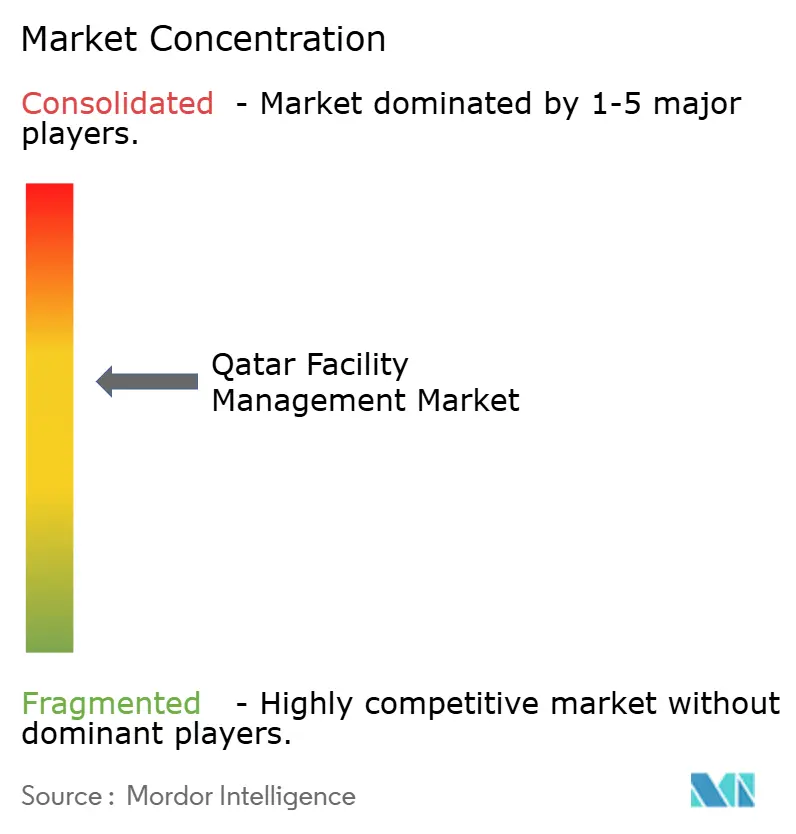
| Market Concentration | Medium |
Major Players *Disclaimer: Major Players sorted in no particular order Image © Mordor Intelligence. Reuse requires attribution under CC BY 4.0. | |
Qatar Facility Management Market Analysis by Mordor Intelligence
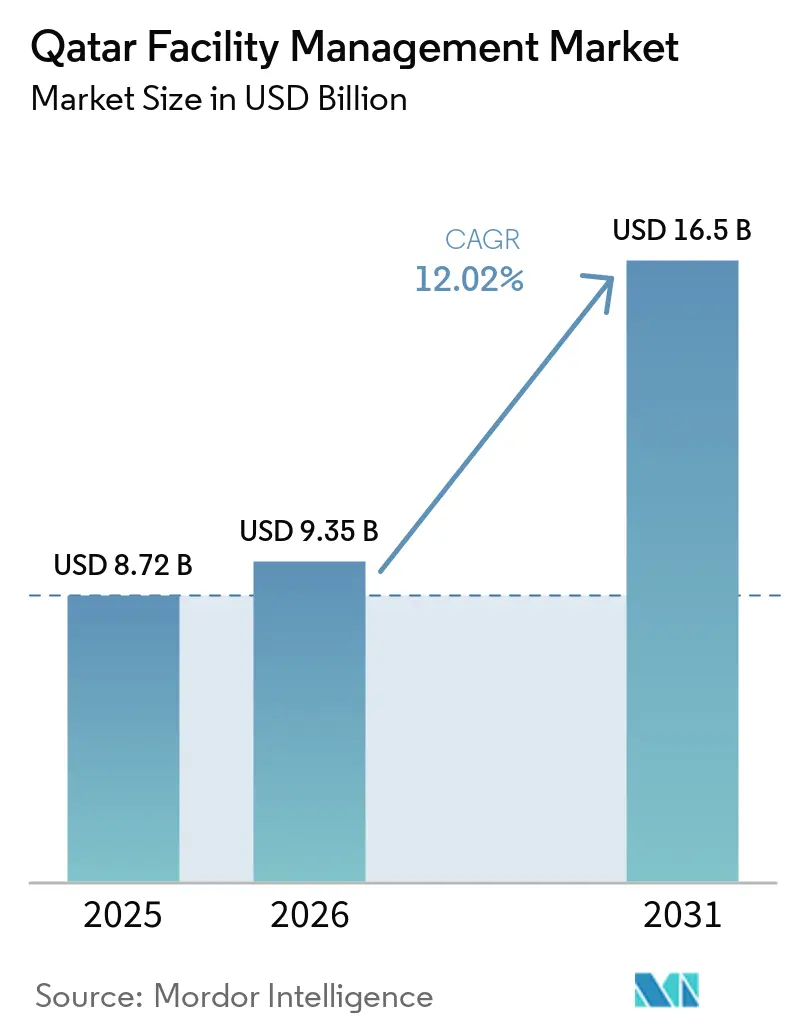
The Qatar Facility Management Market size was valued at USD 8.72 billion in 2025 and is estimated to grow from USD 9.35 billion in 2026 to reach USD 16.5 billion by 2031, at a CAGR of 12.02% during the forecast period (2026-2031).
Robust demand is shifting from World Cup-era construction toward long-term asset optimization, and the emphasis on outcome-based contracts is widening margins for providers that can deliver measurable energy savings. The Qatar National Vision 2030 framework is accelerating digital adoption, particularly Internet-of-Things sensors and computerized maintenance management platforms, which are now baseline requirements in most public tenders. Regulatory support for public-private partnerships is deepening the pipeline of 20-to-25-year concessions that bundle financing with operations, while district-cooling mandates are steering hard-service revenues away from chiller plants toward secondary distribution networks and metering. Labor-market reforms that favor skilled technicians over low-skill expatriate labor are raising operating costs but also opening opportunities for local upskilling alliances with vocational institutes.
Key Report Takeaways
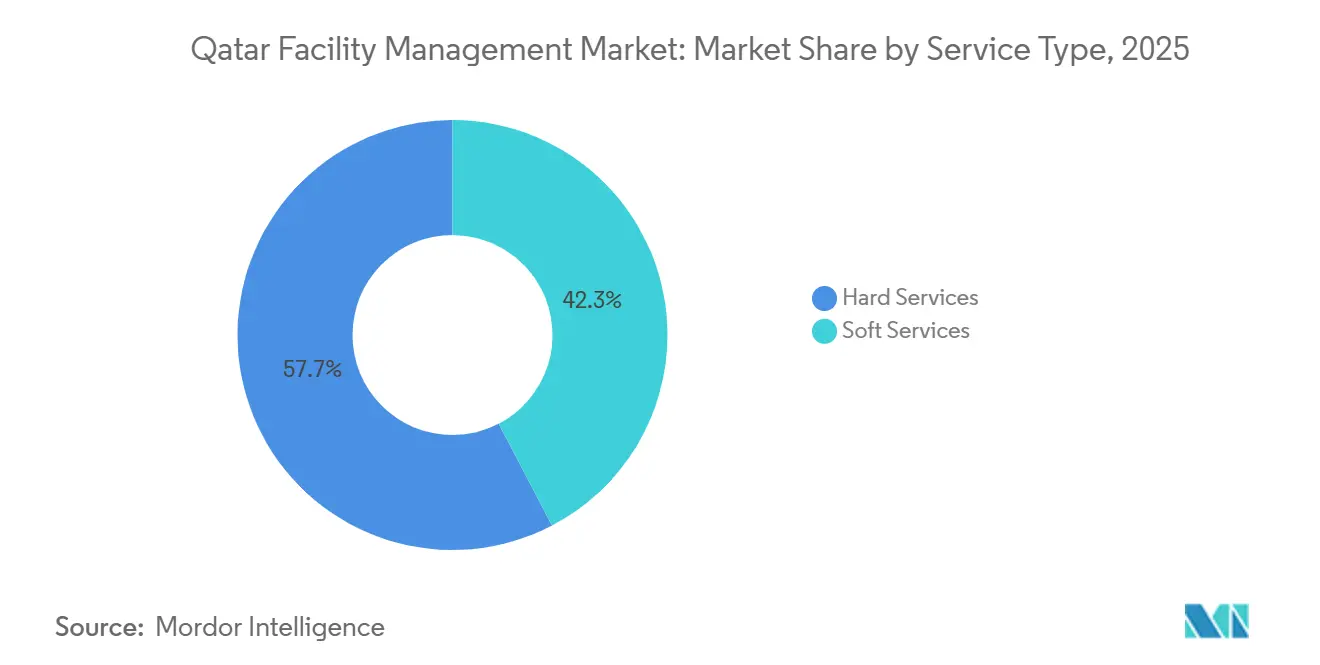
- By service type, hard services led with 57.66% of Qatar facility management market share in 2025, while Soft Services are forecast to post the fastest growth at a 12.97% CAGR through 2031.
- By offering type, outsourced models commanded 61.18% of the Qatar facility management market in 2025, and Integrated Facility Management within outsourced model sub-category is projected to register a 14.33% CAGR between 2026 and 2031.
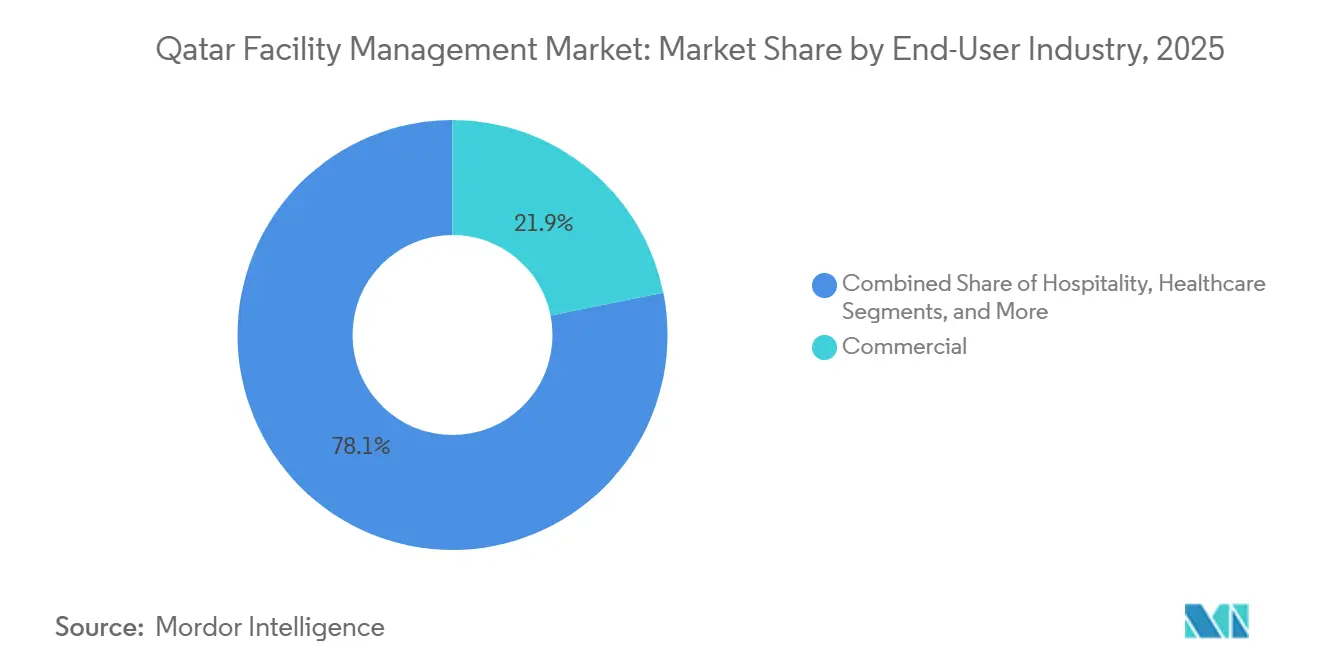
- By end-user industry, the Commercial segment contributed 21.86% of 2025 revenue, whereas the healthcare segment is expected to expand at a 13.62% CAGR to 2031.
Note: Market size and forecast figures in this report are generated using Mordor Intelligence’s proprietary estimation framework, updated with the latest available data and insights as of 2026.
Qatar Facility Management Market Trends and Insights
Drivers Impact Analysis*
| Driver | (~) % Impact On CAGR Forecast | Geographic Relevance | Impact Timeline |
|---|---|---|---|
| Post-World Cup Infrastructure Utilization | +2.8% | National, Doha-Lusail Corridor | Medium Term (2–4 Years) |
| Technological Innovation And Smart-City Integration | +2.3% | Lusail, Msheireb, Nationwide Roll-Out | Long Term (≥ 4 Years) |
| Regulatory Evolution And Labor-Market Transformation | +1.9% | National | Medium Term (2–4 Years) |
| Sustainability And Energy-Efficiency Imperatives | +1.7% | New-Build Districts Country-Wide | Long Term (≥ 4 Years) |
| Growth Of Hyperscale Data Centers And Critical-Infrastructure Requirements | +1.5% | Ras Laffan And Doha Clusters | Long Term (≥ 4 Years) |
| Rise Of PPP Models For Facility Operations In Special Economic Zones | +1.2% | Education, Healthcare, Hospitality Hubs | Medium Term (2–4 Years) |
| Source: Mordor Intelligence | |||
Post-World Cup Infrastructure Utilization
Seven permanent stadiums, a 76 km metro and more than 100 new hotels have shifted from event-mode to daily operation. These assets together add roughly 1.5 million m² that require continuous MEP upkeep, pitch care, crowd-flow management and soft services that can flex with tourism peaks. Metro ridership running near 60% of tournament highs is sustaining multi-year predictive-maintenance contracts, while Ashghal’s 2025-2029 program prioritizes lifecycle extension over new builds, locking in stable workloads for incumbent FM providers.[1]Supreme Committee for Delivery and Legacy, “World Cup Legacy Report 2023,” sc.qa
Technological Innovation and Smart-City Integration
Lusail’s city-wide operating platform aggregates data from some 10,000 IoT sensors, enabling central command centers to dispatch FM crews based on real-time energy, traffic and waste metrics. Msheireb Downtown achieved a 31% cut in cooling intensity after linking 100 buildings to a district-wide BMS, setting a benchmark now written into public procurement. Government Digital Agenda 2030 rules that all new public buildings comply with ISO 16484 are pushing bidders to show proven competence in analytics-driven maintenance and cyber-secure BMS deployment.[2]Lusail Real Estate Development Company, “Smart City Operating System,” lusail.com
Regulatory Evolution and Labor-Market Transformation
Law No. 12 of 2024 fixes Qatarization at 10% for firms with 50-plus staff, requiring FM contractors to recruit nationals into supervisory and technical roles historically filled by expatriates. Abolition of the kafala system has improved mobility, yet payment-cycle delays of up to 12 months are straining cash flow, accelerating consolidation among vendors able to absorb working-capital shocks.[3]Ministry of Labour, “Workforce Strategy 2024-2030,” mol.gov.qa Heat-stress regulations banning outdoor work in summer daylight hours further compress maintenance windows, increasing reliance on night operations and modular workshops.
Sustainability and Energy-Efficiency Imperatives
KAHRAMAA’s district-cooling mandate for projects above 10,000 m² is steering value toward secondary distribution and metering services bundled with energy-performance guarantees. New rules requiring 50% of makeup water to come from treated effluent saved 18.5 million m³ in 2024, lowering plant operating costs by 12%. National solar targets and the region’s first USD 2.5 billion green sukuk are stimulating demand for FM providers that can pair PV maintenance with traditional hard services under gain-share contracts.[4]Qatar Central Bank, “Green Sukuk Issuance Report 2024,” qcb.gov.qa
Restraints Impact Analysis*
| Restraint | (~) % Impact On CAGR Forecast | Geographic Relevance | Impact Timeline |
|---|---|---|---|
| Competitive Pricing Pressures | -1.4% | National | Short Term (≤ 2 Years) |
| Skilled Labor Shortages | -1.2% | National | Medium Term (2–4 Years) |
| Lengthy Payment Cycles In Government-Led FM Contracts | -0.9% | National | Short Term (≤ 2 Years) |
| Data Residency And Cybersecurity Constraints On Cloud-Based FM Solutions | -0.6% | National | Long Term (≥ 4 Years) |
| Source: Mordor Intelligence | |||
Competitive Pricing Pressures
The lowest-qualified-bidder rule on public tenders below QAR 5 million has commoditized routine cleaning and security. A 2024 news-agency tender drew 33 offers, with the winner priced 18% under the incumbent, exemplifying margin squeeze. Slower non-hydrocarbon GDP growth and fewer new builds narrow the contract pipeline, keeping renewal competition fierce and encouraging vendors to seek scale economies or transition into higher-margin hard services.
Skilled Labor Shortages
Only 20% of expatriate workers are classified as skilled, yet demand for certified HVAC, electrical and BMS technicians is rising alongside smart-building roll-outs. Wage premiums of 30% over general operatives, plus regional poaching by Saudi megaprojects, elevate direct labor costs. Visa-linked employment limits mobility and average technician tenure is just 3-4 years, challenging service consistency and inflating recruitment and training outlays.
*Our forecasts treat driver/restraint impacts as directional, not additive. The impact forecasts reflect baseline growth, mix effects, and variable interactions.
Segment Analysis
By Service Type: Hard Services Anchor Revenue, Soft Services Accelerate
Hard Services contributed 57.66% of 2025 revenue, confirming the capital intensity of MEP, HVAC, and fire-safety upkeep in critical facilities. Within this basket, MEP services benefit from the expansion of district cooling, shifting focus from chiller plants to energy-transfer stations and smart metering. Fire-system upgrades mandated for public schools in 2025 have further buoyed demand. Asset-management contracts now routinely stipulate ISO 55000-compliant computerized systems, evidencing the digital pivot. Soft Services are expected to outpace with a 12.97% CAGR to 2031, buoyed by hospitality and commercial landlords outsourcing cleaning, catering, and security to trim fixed payrolls. A crowded low-barrier vendor pool keeps price competition high, but differentiation through green cleaning and infection-control certifications is emerging.
The Qatar facility management market size for Soft Services is set to expand rapidly as hotels and malls rebound in visitor numbers, while Hard Services retain the largest Qatar facility management market share owing to mandatory technical compliance in hospitals, metros, and data centers. Catering gains tailwinds from offshore energy sites requiring cold-chain logistics, whereas security contracts increasingly bundle access-control technology with manned guarding. Market leaders are investing in robotics for floor care and drones for façade inspection to curb labor exposure and meet night-shift work windows imposed by heat-stress rules. The Qatar facility management industry, therefore, shows a clear bifurcation: volume remains in Hard Services, but growth momentum is tilting toward tech-enabled Soft Services.


By Offering Type: Outsourced Models Dominate, Integrated FM Gains Traction
Outsourced delivery held 61.18% share in 2025 as state entities and multinationals pursued risk transfer and variable‐cost structures. Single-service contracts prevail in retail and hospitality, yet bundled agreements are rising as procurement teams chase administrative simplicity. Integrated Facility Management, which couples hard and soft scopes under KPI-linked fees, is the fastest-growing niche, with a projected 14.33% CAGR. Recent large awards, such as the five-year Qatar Foundation deal covering 25,000 assets, underscore the pivot toward single-provider accountability.
Integrated contracts often tie remuneration to energy savings, uptime or occupant satisfaction, positioning vendors with IoT analytics capability to command premiums. PPP frameworks embed 20- to 25-year operate-maintain clauses that align the Qatar facility management market size for integrated services with asset-lifecycle horizons, enhancing revenue visibility. In-house models persist at critical security entities, yet even these organizations trial partial outsourcing for non-core tasks. Consequently, the Qatar facility management market is transitioning from transactional purchasing to partnership-oriented models that reward performance rather than headcount.
By End-User Industry: Commercial Leads, Industrial Accelerates
Commercial real estate generated 21.86% of 2025 turnover on the back of Doha’s 12 million ft² of Grade A offices and an extensive mall footprint. However, the healthcare segment is forecast to deliver the quickest growth at 13.62% CAGR through 2031. Hospitality remains the second-largest user base, though lower occupancy versus tournament peaks restrains price uplift for premium soft services.
Healthcare facilities call for infection-control expertise and continuous engineering presence, raising entry barriers and supporting price resilience. Industrial clusters at Ras Laffan and Mesaieed require NEBOSH-qualified teams, creating a moat for specialized providers. Data-center growth, led by projects scaling beyond 50 MW, blends mechanical, electrical and cybersecurity upkeep, forging a distinct sub-vertical within the Qatar facility management industry. Overall, the Qatar facility management market size attached to industrial users is expanding faster than commercial stock, altering the service-mix outlook toward high-reliability contracts.

Geography Analysis
Doha and its satellite municipalities account for roughly three-quarters of national revenue, anchoring the Qatar facility management market in a dense corridor of ministries, towers, hotels and World-Cup legacy venues. Lusail’s 38 km² smart-city grid serves as a live laboratory for IoT-driven FM, with successes expected to spill into older districts. Msheireb Downtown’s energy-intensity gains illustrate how district-wide BMS can command premium service fees.
Ras Laffan and Mesaieed host LNG and petrochemical assets that demand specialist industrial FM, including hazardous-material handling and emergency-response readiness. Hamad Port’s logistics zone, targeting 3 million TEU by 2030, is a growth pocket for temperature-controlled storage, pest control and security contracts that bundle electronic surveillance with perimeter patrols.
Al Khor municipality, centered on Al Bayt Stadium and adjacent mixed-use districts, is transitioning into a year-round events hub, sustaining pitch maintenance and crowd-flow services. Nationwide, Ashghal’s USD 22.2 billion plan to 2029 emphasizes maintenance over new build, widening the geographic footprint of recurring contracts and requiring vendors to demonstrate coverage across all eight municipalities.
Regulatory Landscape
Facility management contractors in Qatar work within a tightening digital and critical-infrastructure compliance environment shaped by the Ministry of Communications and Information Technology (MCIT) and the Communications Regulatory Authority (CRA). Digital Agenda 2030 and the MCIT IoT Adoption Policy are reinforcing tender requirements for connected building systems, while the CRA covers interoperability, connectivity, and spectrum considerations for IoT deployments used in smart buildings and asset monitoring.
On the technical and security side, the National ICS Security Standard v3.1 sets mandatory baseline controls for industrial control systems in critical environments, influencing FM delivery in energy, industrial, and other high-reliability sites. The CRA also launched updated In-Building Telecommunications Infrastructure Standards in September 2025, affecting how new and refurbished buildings provision in-building connectivity for BMS, CMMS/CAFM, and sensor networks. In February 2026, the CRA updated the Qatar National Frequency Allocation Plan (QNFAP) to align with World Radiocommunication Conference 2023 outcomes, shaping long-term planning for wireless technologies used across building operations and security systems.
Value Chain Analysis
The Qatar facility management value chain starts with asset owners and public entities (ministries, Ashghal-led infrastructure, education and healthcare operators, and large master developers such as Lusail and Msheireb), which define service outcomes and procurement terms, increasingly through multi-year outsourced and integrated FM models. Demand then moves to FM prime contractors and integrated FM providers that bundle hard services (MEP, HVAC, fire and life safety, district cooling interface, metering) with soft services (cleaning, security, catering), with specialist subcontractors supporting niche work such as façade access, testing and commissioning, and certified fire-system maintenance.
Upstream enablers are shifting from labor-only inputs toward digital platforms and connected infrastructure, including BMS/SCADA layers, CAFM/CMMS platforms, IoT sensors, and in-building telecom networks that enable predictive maintenance and KPI-based reporting. Recent large awards and partnerships point to this digital layer as part of core service delivery, including a five-year integrated FM contract covering QatarEnergy headquarters towers in West Bay (reported as ten towers spanning more than 700,000 square meters) and smart-district programs that bring large-scale sensor and CCTV estates into managed services. Key bottlenecks remain skilled technician availability for BMS, HVAC, and analytics workflows, plus the need to coordinate multiple vendors around cybersecurity and data-handling requirements when FM platforms connect to enterprise and city systems.
Competitive Landscape
The top five providers, Mannai (CBMFM), Elegancia Facility Management, G4S Qatar, Sodexo Qatar and Khidmah, collectively held about 35%-40% of 2025 revenue, indicating moderate fragmentation. Technology adoption is the primary differentiator: CBMFM’s deployment of enterprise asset-management software secured the Qatar Foundation contract, while other leaders invest in drones, robotics and real-time dashboards to evidence KPI compliance.
Outcome-based commercial models are gaining ground, tying fees to energy savings and uptime. Vendors capable of underwriting performance risk report margins 15%-20% higher than time-and-materials contracts. Qatarization quotas are prompting investments in training academies and digital upskilling to elevate national participation in technical roles. Regional expansion remains a growth lever, with Elegancia leveraging its domestic track record to secure airport and healthcare contracts across the Middle East and Central Asia.
Price competition in commoditized cleaning and security continues to squeeze smaller local firms, accelerating consolidation. Simultaneously, ISO 55000 asset-management requirements are raising entry barriers, favoring providers with mature computerized systems and data-analytics capacity. The strategic landscape therefore balances cost-driven rivalry in soft services against capability-led differentiation in integrated, technology-rich offerings.
Qatar Facility Management Industry Leaders
Mannai Corporation QPSC
G4S Qatar WLL
Elegancia Facility Management (Estithmar Holdings QPSC)
Mosanda Facilities Management Services
Cayan Facility Management
- *Disclaimer: Major Players sorted in no particular order

Market Opportunities and Future Outlook
Technology-led integrated FM is narrowing qualification criteria toward demonstrable capability in IoT instrumentation, AI-enabled diagnostics, and CAFM/CMMS execution, rather than headcount-based delivery. This is reinforced by Qatar’s Digital Agenda 2030 and MCIT’s IoT Adoption Policy, together with CRA oversight of smart-city connectivity and technical standards for in-building networks that underpin building automation, access control, and remote monitoring. Evidence for the shift is visible in smart-district initiatives that centralize operations across large sensor and CCTV footprints under managed services, alongside the growing role of predictive maintenance requirements for large urban projects.
A second opportunity area is outcome-based energy and sustainability services that link FM fees to measured savings and verified performance, aligning with Kahramaa-linked energy-efficiency mandates and sustainability certification practices such as GSAS. Providers that can connect BIM-enabled asset data with ongoing maintenance workflows have room to expand into lifecycle asset management and compliance reporting for public infrastructure and large mixed-use developments, where owners are standardizing on digital records, standardized service levels, and auditable maintenance outcomes. Workforce localization requirements also support training partnerships and technician upskilling programs that help FM vendors sustain service continuity while meeting evolving labor-market expectations.
Recent Industry Developments
- May 2026: Elegancia Facilities Management secured facilities management contracts covering QatarEnergy towers in West Bay and the Qatar University campus. The wins expand large-scale integrated scopes where providers must blend hard services with digitally managed operations across complex, multi-asset estates, raising the competitive bar for bundled delivery.
- April 2026: Mannai Energy signed a memorandum of understanding with the University of Doha for Science and Technology to support its Net Zero by 2030 program. The collaboration strengthens the company’s pipeline for sustainability-linked FM capabilities, including energy performance and skills development that align with outcome-based contracting trends.
- October 2025: Elegancia Facility Management won a PPP contract to manage 14 schools under integrated hard and soft services, aligned with the government’s broader school PPP program. The award reinforces long-duration, KPI-driven models in the public sector where providers combine lifecycle maintenance planning with service bundling.


Research Methodology Framework and Report Scope
Market Definition and Coverage
This market covers the revenue earned from facility management services delivered in Qatar to operate, maintain, and support buildings and sites, across routine and planned work. It includes hard services tied to physical assets and systems, and soft services that are labor-led and ongoing.
Scope exclusions: We exclude pure construction and fit-out project revenues, as well as standalone equipment sales where no recurring facility service is provided.
Segmentation Overview
- By Service Type
- Hard Services
- Asset Management
- MEP and HVAC Services
- Fire Systems and Safety
- Other Hard Facility Management Services
- Soft Services
- Office Support and Security
- Cleaning Services
- Catering Services
- Other Soft Facility Management Services
- Hard Services
- By Offering Type
- In-house
- Outsourced
- Single Facility Management
- Bundled Facility Management
- Integrated Facility Management
- By End-User Industry
- Commercial
- Hospitality
- Institutional and Public Infrastructure
- Healthcare
- Industrial and Process
- Other End-User Industries
Data Sources, Market Sizing, and Validation
Desk Research
Desk work starts by mapping demand from Qatar construction and real estate activity, public infrastructure pipelines, and the operating stock of buildings that need ongoing services. We typically refer to public sources such as Qatar Planning and Statistics Authority releases, Ministry of Municipality notices, Qatar Central Bank macro tables, and customs or trade statistics for relevant equipment categories.
To keep assumptions grounded, we also review annual reports and investor presentations of listed groups, public tender portals, and association or regulator websites that discuss building safety and maintenance practices. Where useful, a paid subscription is used for company financials and news screening, and sometimes for import-export shipment level checks and patent lookups for service-enabling technologies. These desk sources are not exhaustive, and many additional public materials are consulted to cross-check numbers and clarify open points.
Primary Interviews and Surveys
Primary inputs are collected from FM service providers, subcontractors, property and asset managers, and procurement teams that buy services for commercial, hospitality, institutional, healthcare, and industrial sites. These discussions are used to validate the service mix (hard versus soft), contract coverage (in-house versus outsourced), typical renewal patterns, and how pricing moves with wage costs, materials, and compliance requirements in Qatar.
Distribution of primary research fieldwork respondents
| Company type | Respondent position |
|---|---|
| Top tier: 25% | CXOs: 12% |
| Mid tier: 56% | Functional/Unit leaders: 43% |
| Smaller Players: 19% | Managers: 45% |
Market-Sizing & Forecasting
Market sizing is built using a top-down approach where the active building base and pipeline activity are translated into an annual service demand pool, and then converted to revenue using service coverage and pricing. In the Qatar FM context, the model is anchored on indicators such as occupied commercial and residential floor area, hotel keys and tourism-linked utilization, public infrastructure operations needs, and the share of sites that outsource hard and soft services.
Results are then corroborated with selective bottom-up approximations, using sampled contract values, service frequency norms (cleaning, security coverage, preventive maintenance cycles), and ASP ranges for common hard-service tasks like MEP and HVAC maintenance. When bottom-up checks surface a mismatch, we adjust for bundled contracting, in-house retention, and seasonality in staffing and service intensity.
For forecasting, scenario analysis is used, since the market is sensitive to project handovers, occupancy recovery, labor cost movement, and compliance-driven maintenance. Assumptions are aligned with what we hear from practitioners, and they are kept traceable so the model can be repeated with updated inputs.
Data Validation & Update Cycle
Validation is done through multiple checks that compare outputs against independent signals, such as tender activity, major site handovers, and observable pricing movement in recurring service contracts. If a number looks out of range, the assumptions are reviewed, and follow-up calls are triggered to retest contract coverage, service mix, and currency conversion timing.
Before sign-off, the model goes through step-by-step analyst review, followed by a final pass to ensure the latest events are reflected. Reports are refreshed annually, and interim updates are made when material changes occur, so clients receive a current view rather than an older snapshot.
Mordor Intelligence's Qatar Facility Management Market Estimate Compared With Other Published Estimates
Published market sizes for Qatar facility management do not always match, even when they sound like they cover similar services. The spread usually comes from how each study treats in-house activity versus outsourced contracts, how hard and soft services are bundled, and which end-user sites are assumed to be under formal FM coverage.
A second driver is timing. Differences in currency conversion month, how pricing is rolled forward for multi-year contracts, and whether model outputs are refreshed after wage and input cost changes can move the total by a visible amount, which is why the 2025 USD 7.96 B figure is held to a consistent FX and ASP update cadence in Mordor Intelligence.
Benchmark comparison
| Source | Market Size | Gaps in Research Methodology |
|---|---|---|
| Mordor Intelligence | USD 7.96 B (2025) | |
| Industry Research Publisher A | USD 8.47 B (2025) | Uses a higher implied outsourcing and service-coverage rate, and the pricing step-up appears to assume faster contract repricing, which can lift totals versus a contract-cycle based ASP treatment. |
| Industry Research Publisher B | USD 7.49 B (2024) | Anchors on a different base year and longer horizon, and does not clearly state how bundled contracts and in-house delivery are separated, which can shift the starting value when converted to a common year. |
Taken together, the table suggests that coverage assumptions and the timing of price and currency updates explain most of the gap, more than any single demand driver. Our approach stays practical by tying the market to observable building use indicators, contract behavior, and repeatable ASP logic, and then rechecking the result against what providers and buyers report in the field.


Key Questions Answered in the Report
What is the projected value of the Qatar facility management market by 2031?
It is forecast to reach USD 16.50 billion by 2031 under a 12.02% CAGR.
Which service type currently leads spending in Qatari facilities?
Hard Services led with 57.66% revenue share in 2025 thanks to MEP, HVAC, and fire-safety work.
Which end-user group is expanding the fastest in facility management demand?
Healthcare segment is expected to grow at a 13.62% CAGR through 2031, outpacing all other sectors.
How significant are outsourced delivery models in Qatar?
Outsourced contracts held 61.18% of 2025 revenue and remain the dominant service model.
What key regulation is shaping the FM labor market?
Law No. 12 of 2024 imposes a 10% Qatarization quota for firms with at least 50 employees.
Why are smart-city districts important for FM providers?
Projects such as Lusail and Msheireb embed district-wide IoT and BMS platforms, creating premium opportunities for technology-driven facility managers.
Page last updated on:


 Your data is secure and never sold or shared.


