
Pharmacovigilance Market Size and Share
Market Overview
| Study Period | 2020 - 2031 |
|---|---|
| Market Size (2026) | USD 10.45 Billion |
| Market Size (2031) | USD 18.26 Billion |
| Growth Rate (2026 - 2031) | 11.78 % |
| Fastest Growing Market | Asia Pacific |
| Largest Market | North America |
| Market Concentration | Medium |
Major Players *Disclaimer: Major Players sorted in no particular order Image © Mordor Intelligence. Reuse requires attribution under CC BY 4.0. | |
Pharmacovigilance Market Analysis by Mordor Intelligence
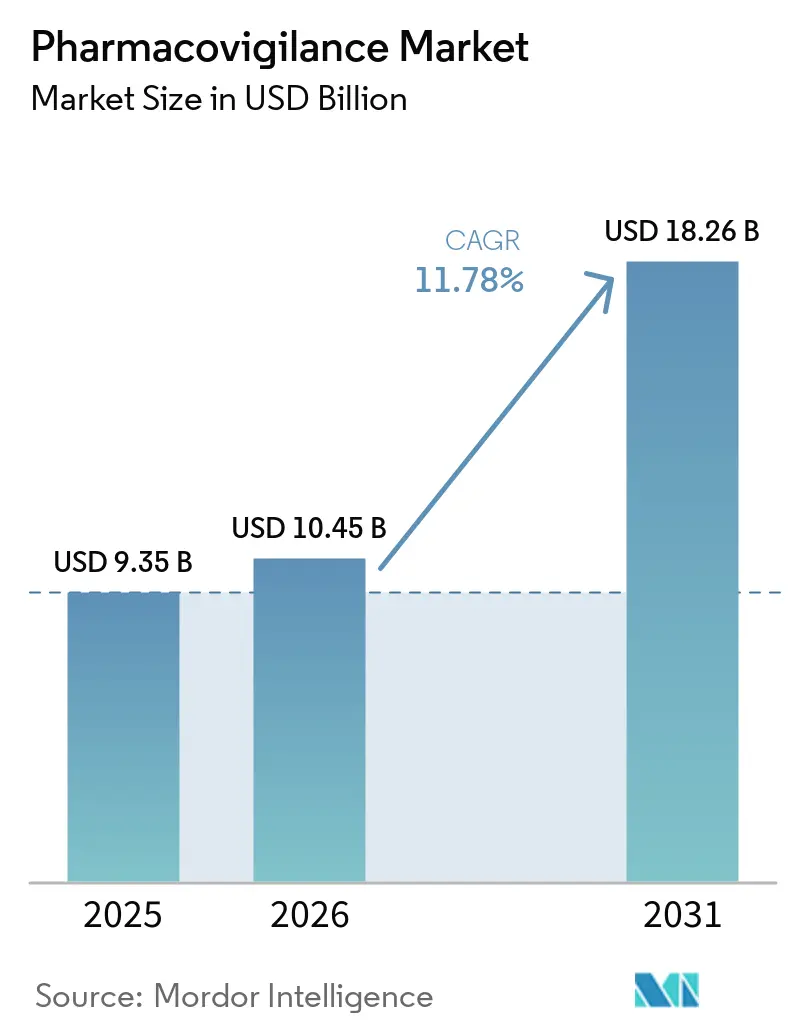
The pharmacovigilance market size was valued at USD 9.35 billion in 2025 and estimated to grow from USD 10.45 billion in 2026 to reach USD 18.26 billion by 2031, at a CAGR of 11.78% during the forecast period (2026-2031). Expanding drug pipelines, stricter post-marketing surveillance rules and rapid adoption of artificial intelligence (AI) across safety-monitoring workflows sustain this momentum.[1]European Medicines Agency, “Guidance on the Application of the Amended Variations Regulation,” ema.europa.eu Pharmaceutical companies are redirecting resources toward proactive safety management as biologics, gene therapies and other complex modalities enter commercial use. Contract research organizations (CROs) equipped with cloud-based AI platforms offer cost-efficient compliance, accelerating the outsourcing shift. Post-marketing surveillance obligations enlarge data volumes, making electronic health record (EHR) mining the fastest-growing reporting method. North America retains leadership owing to mature regulatory science, but harmonization initiatives in Asia-Pacific (APAC) propel that region’s double-digit growth.[2]Food and Drug Administration, “International Regulatory Harmonization,” fda.gov
Key Report Takeaways
- By service provider, contract outsourcing led with 54.88% revenue share in 2025; the segment is expanding at a 13.48% CAGR to 2031.
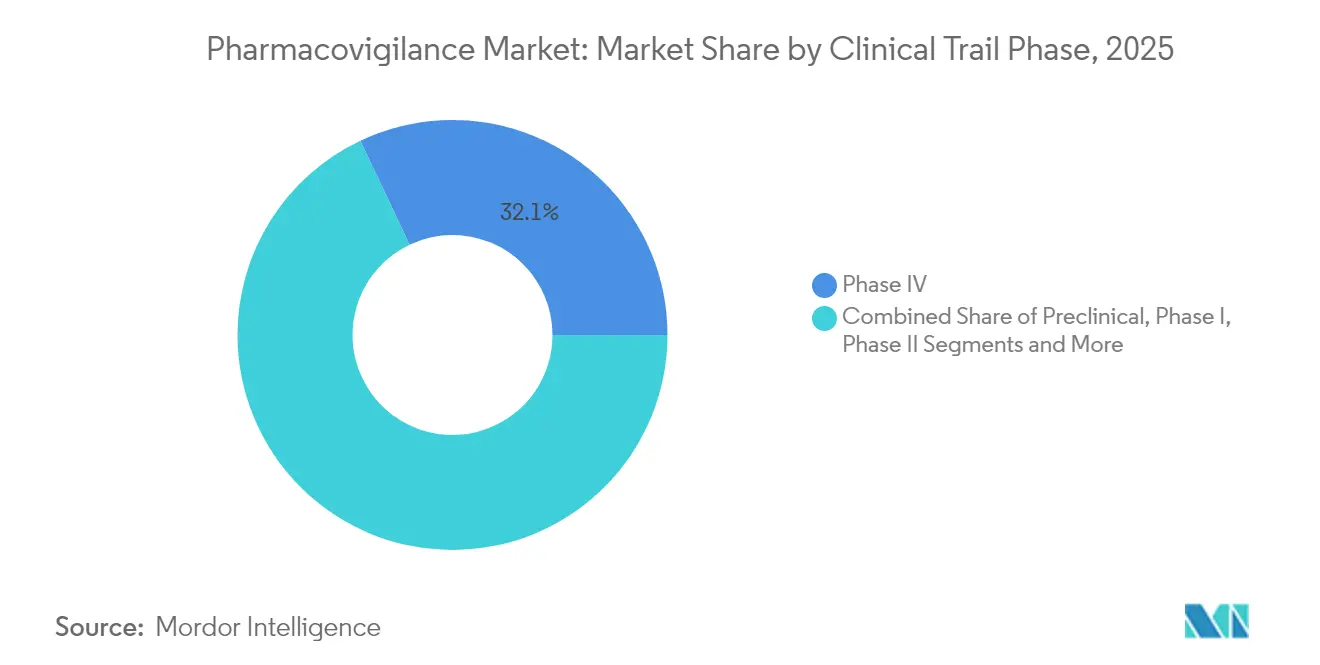
- By clinical trial phase, Phase IV post-marketing studies held 32.05% of pharmacovigilance market share in 2025, while pre-clinical activities post the highest 12.88% CAGR through 2031.
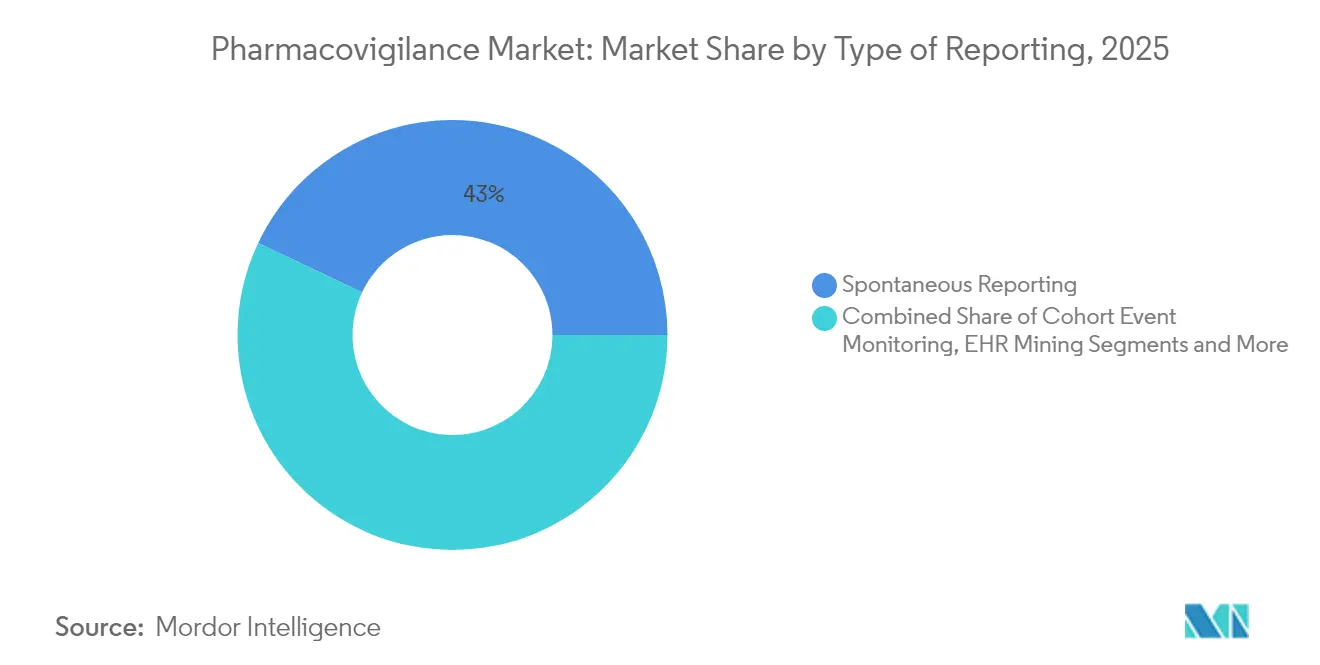
- By type of reporting, spontaneous reporting commanded 42.96% share of the pharmacovigilance market size in 2025; EHR mining is projected to grow at a 14.12% CAGR between 2026-2031.
- By end-user, pharmaceutical companies accounted for 58.91% share of the pharmacovigilance market size in 2025 and hospitals are advancing at a 14.18% CAGR through 2031.
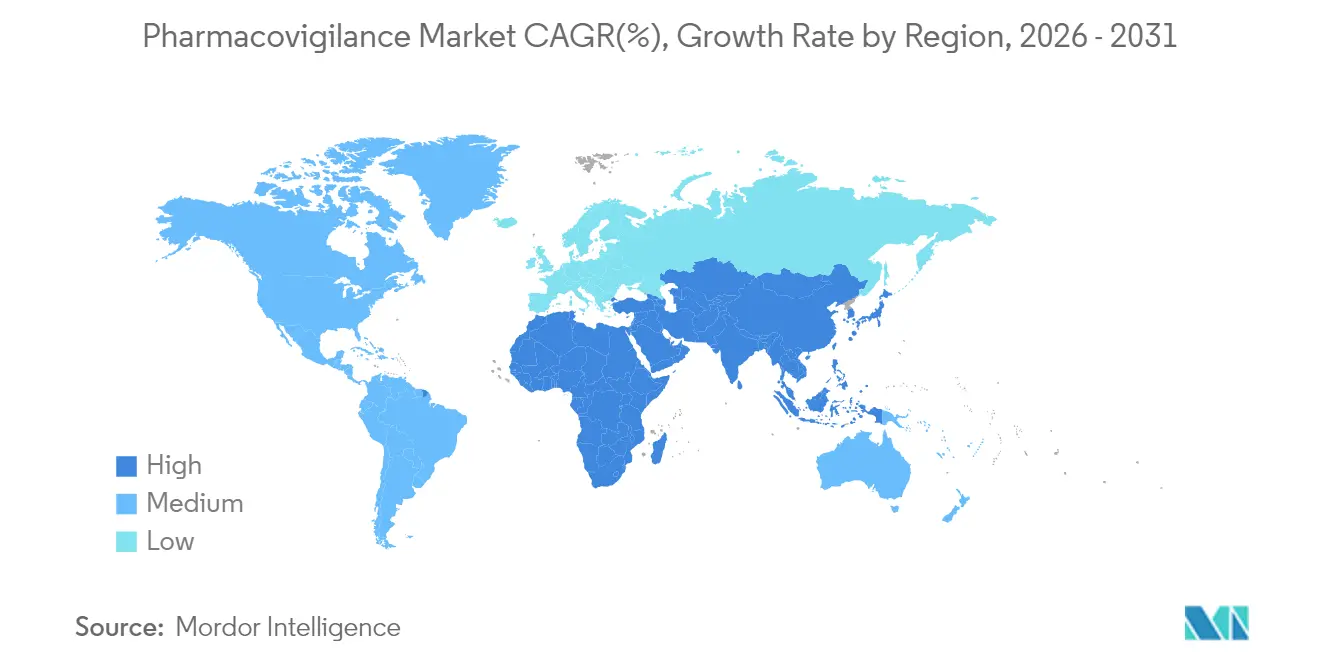
- By geography, North America held 43.62% of the pharmacovigilance market share in 2025, while APAC records the fastest 13.12% CAGR to 2031.
Note: Market size and forecast figures in this report are generated using Mordor Intelligence’s proprietary estimation framework, updated with the latest available data and insights as of 2026.
Market Trends and Insights
Drivers Impact Analysis of Pharmacovigilance Market*
| Driver | (~) % Impact on CAGR Forecast | Geographic Relevance | Impact Timeline |
|---|---|---|---|
| Escalating drug consumption & development pipeline | +2.1% | Global | Long term (≥ 4 years) |
| Growing incidence of adverse drug reactions (ADRs) | +1.8% | Global, aging populations | Medium term (2-4 years) |
| Outsourcing of PV services to CRO/BPO vendors | +2.3% | North America & EU, rising in APAC | Short term (≤ 2 years) |
| AI-enabled signal detection & predictive analytics | +1.9% | North America & EU core, spill-over APAC | Medium term (2-4 years) |
| Expansion of real-world evidence (RWE) platforms | +1.7% | US & EU lead, global spread | Long term (≥ 4 years) |
| Stringent regulatory mandates for proactive post-marketing safety | +2.0% | Global | Long term (≥ 4 years) |
| Source: Mordor Intelligence | |||
Increasing Drug Consumption & Development Pipeline
The FDA cleared 50 new molecular entities in 2024, underscoring how breakthrough approvals widen post-marketing safety duties for every sponsor.[3]Food and Drug Administration, “Drug and Biologic Approvals,” fda.gov Gene therapies, CAR-T treatments and combination products pose unique risk profiles that require vigilant monitoring throughout the product life cycle. Conditional approvals further heighten real-world evidence (RWE) expectations, redirecting budgets toward continuous surveillance infrastructures. These dynamics lock pharmacovigilance teams into a long-term expansion cycle that sustains workload growth beyond clinical development.
Growing Incidence Of Adverse Drug Reactions (ADRs)
The European Medicines Agency (EMA) Pharmacovigilance Risk Assessment Committee (PRAC) recently emphasized lifelong monitoring for CAR-T recipients after observing potential secondary malignancies.[4]European Medicines Agency, “PRAC Meeting Highlights,” ema.europa.eu Polypharmacy in elderly populations multiplies drug–drug interactions, pushing ADR case volumes higher. The pandemic-era vaccine rollout validated the importance of large-scale signal-detection networks capable of processing millions of safety reports within weeks.
Outsourcing Of PV Services To CRO/BPO Vendors
Sponsors are increasingly transferring full pharmacovigilance operations to CROs that maintain global compliance hubs and purpose-built AI engines. Such providers scale seamlessly across jurisdictions, enabling mid-sized biotechnology firms to meet complex rules without sustaining heavy fixed costs. Labor-arbitrage models in India and Eastern Europe also hold appeal, yet differentiation now rests on automated intake and predictive signal detection rather than pure cost savings.
AI-Enabled Signal Detection & Predictive Analytics
IQVIA targets a 50% reduction in routine case-processing spend by integrating large-language-model (LLM) copilots into daily workflows. Meanwhile, Oracle embedded advanced machine-learning features in its safety platform to triage literature alerts and automate narrative writing. Regulators have responded with draft guidance that sets validation expectations for AI use in safety management.
Restraints Impact Analysis of Pharmacovigilance Market*
| Restraint | (~) % Impact on CAGR Forecast | Geographic Relevance | Impact Timeline |
|---|---|---|---|
| Cyber-security & data-privacy risks | -1.4% | Global, high in EU & US | Short term (≤ 2 years) |
| Lack of global regulatory harmonisation & data standards | -1.2% | Global, emerging markets hardest hit | Long term (≥ 4 years) |
| Shortage of specialised PV talent & high turnover | -1.6% | North America & EU acute | Medium term (2-4 years) |
| Complexity of combination & ATMP therapies | -1.1% | North America & EU, widening | Long term (≥ 4 years) |
| Source: Mordor Intelligence | |||
Cyber-Security & Data-Privacy Risks
Cloud deployment of sensitive patient data exposes safety systems to ransomware and nation-state intrusions. Recent healthcare breaches forced several sponsors to suspend EHR integrations while audits ensured no safety signal manipulation occurred. General Data Protection Regulation (GDPR) and similar laws mandate data-minimization and localization strategies that sometimes conflict with global analytics ambitions.
Shortage Of Specialised PV Talent & High Staff Turnover
Industry surveys project a 35% shortage of qualified pharmacovigilance professionals by 2030 as AI skills, regulatory knowledge and therapeutic specialization converge into a single profile. Organizations respond with apprenticeship programs and internal academies, yet ramp-up times can exceed two years, creating near-term bottlenecks.
*Our forecasts treat driver/restraint impacts as directional, not additive. The impact forecasts reflect baseline growth, mix effects, and variable interactions.
Pharmacovigilance Market Segment Analysis
By Clinical Trial Phase:
Post-Marketing Surveillance Drives GrowthPhase IV studies held 32.05% of pharmacovigilance market share in 2025, reflecting regulators’ demand for life-long monitoring of innovative therapies. The pharmacovigilance market size attached to pre-clinical safety assessments is projected to expand at a 12.88% CAGR thanks to risk-based early-phase analytics. Adaptive trial designs shorten Phases II and III, but heighten the importance of high-fidelity signal detection once products reach broad populations. Updated ICH E6(R3) guidelines compel sponsors to embed quality-by-design metrics across all phases, ensuring traceable safety data capture from first-in-human dosing.
The pharmacovigilance market responds by integrating decentralized trials with direct-to-patient sampling and wearable sensors. AI models simulate off-target effects before first-patient dosing, giving companies a head start in risk-management planning. As conditional approvals rise, Post-Authorization Safety Studies (PASS) budgets eclipse traditional Phase III spends, locking Phase IV dominance into the long-term outlook.



By Service Provider:
Outsourcing Accelerates Through Technology IntegrationContract pharmacovigilance outsourcing controlled 54.88% of overall revenue in 2025 and is forecast to grow at 13.48% through 2031, sustaining the largest slice of the pharmacovigilance market. In-house units retain critical decision-making but increasingly rely on hybrid models where CRO platforms process routine tasks. Strategic alliances such as Parexel’s multi-year AI pact with Palantir exemplify how tech-enhanced CROs cultivate competitive edge.
The pharmacovigilance industry now values scalable data lakes, natural language processing (NLP) for scientific literature and robotic process automation in intake. As a result, even large pharmaceutical companies migrate workloads to external hubs in India, Ireland and Eastern Europe, consolidating fragmented vendor lists into master service agreements that guarantee AI investment roadmaps.
By Type of Reporting:
EHR Mining Emerges as Technology DisruptorSpontaneous reporting remained the backbone at 42.96% in 2025, yet the pharmacovigilance market size tied to EHR mining is expected to post the fastest 14.12% CAGR. Final FDA guidance on RWE opens the door for automated extraction of structured and unstructured clinical data to augment traditional case submissions.
AI algorithms parse physician notes, lab results and imaging repositories to reveal hidden safety trends weeks earlier than spontaneous reports. Projects such as Sanofi’s ARTEMIS process more than 700,000 cases annually with NLP engines, freeing human experts for root-cause analysis. Standardization hurdles persist, particularly around data provenance, but the trajectory toward automated RWE ingestion is clear.
By End-User:
Hospital Integration Transforms Safety MonitoringPharmaceutical companies held 58.91% of 2025 spending, yet hospital systems register the highest 14.18% CAGR as decentralized and pragmatic trials place safety responsibilities closer to the point of care. The pharmacovigilance market size associated with integrated delivery networks rises as hospitals deploy RWE platforms that feed near-real-time safety data to sponsors.
BARDA’s five-year pact with Allucent illustrates how government funding accelerates hospital participation in countermeasure trials. Yet interoperability gaps and privacy regulations still slow cross-border data exchange, prolonging the transition period.
Geography Analysis
North America Pharmacovigilance Market
North America captured 43.62% of the pharmacovigilance market in 2025 due to high R&D intensity, advanced EHR penetration and clear regulatory expectations. AI pilots gain rapid acceptance as the FDA publishes step-wise validation frameworks, positioning the region as the global reference for digital pharmacovigilance.
Europe Pharmacovigilance Market
Europe follows with mature legislation underpinning the EudraVigilance network and new AI reflection papers that encourage innovation while demanding algorithm transparency. Focus on Advanced Therapy Medicinal Products brings specialized monitoring needs, sustaining investment through 2030. The pharmacovigilance market size for EU-based PASS grows alongside orphan-drug approvals.
APAC, MEA and South America Pharmacovigilance Market
Asia-Pacific is projected to log a 13.12% CAGR, the fastest worldwide, as China’s regulatory reforms and India’s expanded clinical-trial landscape converge. ASEAN nations align labeling and electronic submission standards, simplifying multi-country safety campaigns. Investments in domestic biotech manufacturing stimulate demand for localized case-processing hubs. Middle East & Africa and South America add incremental growth where pharmacovigilance infrastructure scales with pharmaceutical import volumes and emerging manufacturing clusters.

Regulatory Landscape
Pharmacovigilance requirements continue to tighten around structured post-approval safety data management, electronic reporting formats, and signal management governance across major agencies. In the United States, the FDA reinforced postmarketing safety-reporting expectations through 2026 actions, including an April 2026 Federal Register update that mandates electronic submissions of postmarketing individual case safety reports (ICSRs) using ICH E2B(R3) data standards from 1 October 2026. This change brings forward system validation, data mapping, and gateway readiness for sponsors and service providers.
Internationally, ICH guideline adoption is reshaping operating procedures for global case processing and signal detection. The ICH E2D(R1) guideline on post-approval safety data management entered into effect in the European Union on 18 March 2026, and EU pharmacovigilance practice continues to anchor to EMA Good Pharmacovigilance Practices (GVP) modules and EudraVigilance reporting. Commission Implementing Regulation (EU) 2025/1466 (effective from August 2025) shifted expectations for how marketing authorisation holders monitor EudraVigilance and manage signals, prompting updates to internal SOPs and governance as workflows move beyond prior pilot-era approaches.
Value Chain Analysis
The pharmacovigilance value chain begins with safety-data generation and capture across pre-clinical and clinical programs, post-marketing spontaneous reports, scientific literature surveillance, and expanding real-world data feeds such as EHR mining. Data is then standardized and validated through intake, case triage, medical review, coding, narrative authoring, and signal detection workflows, before being packaged into regulatory outputs (ICSRs, periodic reports, and risk-management deliverables) for submission to authorities such as the FDA and EMA, as well as for internal benefit-risk decisioning.
Execution runs through sponsors (pharmaceutical and biotech companies), hospitals and trial sites, and specialized CRO/BPO and technology-enabled service providers such as IQVIA, ICON, Parexel, Cognizant, Accenture, Capgemini, and Wipro. A recurring bottleneck is interoperability and compliance change management as rules evolve, including the EU shift under Implementing Regulation (EU) 2025/1466 and the US movement toward ICH E2B(R3) for postmarketing ICSR submissions. Differentiation is concentrating in platform-based operations where automation and AI support higher-volume case processing and literature monitoring while keeping audit-ready traceability.
Competitive Landscape
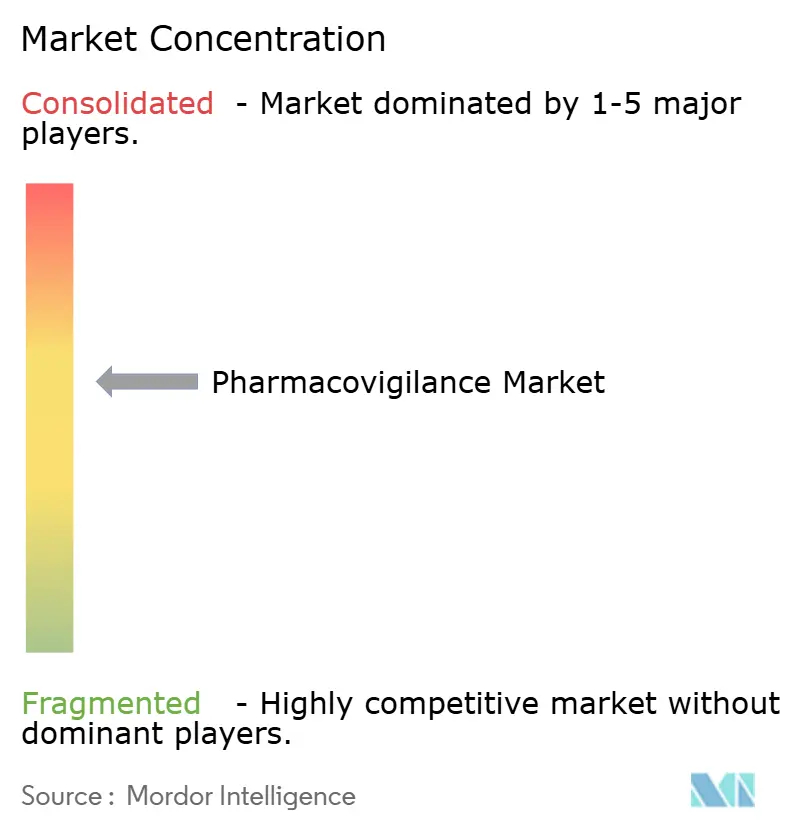
The pharmacovigilance market shows moderate fragmentation. IQVIA, ICON and Parexel maintain sizable global footprints, yet software-first providers such as ArisGlobal and Oracle are narrowing the gap through AI-centric offerings. ArisGlobal upgraded its LifeSphere suite with LLM-powered triage and saw a record wave of new customers in 2024.
Strategic deals define the competitive narrative. ICON’s acquisition of PRA Health Sciences consolidated two full-service CROs under one AI platform, increasing scale in both post-marketing and real-world studies. Sanofi’s collaboration with OpenAI and Formation Bio signals big-pharma interest in vertically integrating AI software development.
White-space niches persist in advanced cell-and-gene therapy surveillance, pediatric drug safety and NLP solutions for Japanese and Mandarin source documents. New entrants offering plug-and-play safety clouds or token-based data-exchange models could capture share from incumbents slow to modernize legacy platforms.
Pharmacovigilance Industry Leaders
Cognizant
Capgemini
Accenture
Wipro Limited
IBM
- *Disclaimer: Major Players sorted in no particular order
Pharmacovigilance Market Companies Covered in this Report
- Accenture
- Aris Global
- BioClinica (NOW Clario)
- Capgemini
- Cognizant
- IBM
- ICON
- IQVIA
- ITClinical
- LabCorp
- Linical Accelovance
- Parexel International
- UBC (United BioSource)
- TAKE Solutions (Navitas Life Sciences)
- Wipro
- Oracle Health Sciences
- Ennov
- Extedo
- Clarivate (Drug Safety Triager)
- SGS Life Sciences

Market Opportunities and Future Outlook
Compliance-driven system upgrades and operating-model changes are creating near-term whitespace in safety operations modernization, particularly where organizations need to align internal processes to evolving standards such as ICH E2D(R1) (effective in the EU from March 2026) and build electronic postmarketing ICSR submission workflows for ICH E2B(R3) requirements in the United States from 1 October 2026. These changes favor vendors and service partners that can deliver validated data models, configurable workflows, and controlled automation across intake, processing, and reporting, without sacrificing inspection-ready traceability.
AI-native patient-safety delivery is moving beyond pilots into scaled deployments, expanding opportunity across both outsourcing and hybrid in-house models. In April 2026, Parexel acquired Vitrana to integrate an AI-enabled end-to-end pharmacovigilance platform into patient safety services. In June 2026, ArisGlobal announced two global pharmaceutical organizations selected NavaX AI to automate processing of structured and unstructured safety and clinical data, indicating continued procurement momentum for unified AI platforms. Newer distribution pathways also widen access for smaller sponsors and emerging-market operators, illustrated by June 2026 availability of Graph AI's Graph Safety Suite on Google Cloud Marketplace, which reduces friction for adopting PV tooling in cloud environments where data governance and validation requirements can be standardized.
Recent Industry Developments in Pharmacovigilance Market
- June 2026: ArisGlobal announced two global pharmaceutical organizations selected its NavaX AI to automate processing of structured and unstructured safety and clinical data. The selections point to accelerating buyer demand for AI-native pharmacovigilance workflows that can handle higher case volumes while maintaining compliance controls across intake, processing, and analytics.
- April 2026: Parexel acquired Vitrana to integrate an AI-enabled end-to-end pharmacovigilance platform into its patient safety services. The acquisition strengthens Parexel's ability to bundle technology with outsourced operations, raising competitive pressure on CRO-led, platform-based safety delivery models.
- May 2024: Sanofi, Formation Bio, and OpenAI unveiled an AI partnership aimed at shortening drug-development and safety timelines. The collaboration signaled big-pharma intent to industrialize AI across safety-related workflows, reinforcing a broader shift toward automation-supported signal detection and case processing.


Pharmacovigilance Market Report Scope and Research Methodology
Market Definition and Coverage
This market is defined as the value of pharmacovigilance work used to monitor, assess, and prevent adverse drug reactions across the product life cycle, from development through post marketing. It covers the service effort behind safety case handling, signal work, and risk management activities.
Scope exclusions: Drug safety software license revenue (standalone platforms and tools) is excluded when it is not bundled into pharmacovigilance service delivery.
Segments Covered in This Report
- By Clinical Trial Phase
- Pre-clinical
- Phase I
- Phase II
- Phase III
- Phase IV
- By Service Provider
- In-house
- Contract Outsourcing
- By Type of Reporting
- Spontaneous Reporting
- Intensified ADR Reporting
- Targeted Spontaneous Reporting
- Cohort Event Monitoring
- EHR Mining
- By End-User
- Hospitals
- Pharmaceutical Companies
- CROs & Other End-Users
- By Geography
- North America
- United States
- Canada
- Mexico
- Europe
- Germany
- United Kingdom
- France
- Italy
- Spain
- Rest of Europe
- Asia-Pacific
- China
- Japan
- India
- Australia
- South Korea
- Rest of Asia-Pacific
- Middle East and Africa
- GCC
- South Africa
- Rest of Middle East and Africa
- South America
- Brazil
- Argentina
- Rest of South America
- North America
Data Sources, Market Sizing, and Validation
Desk Research
Desk work starts with public safety and regulatory signals that show how much PV activity is happening and how it is changing year to year. We refer to sources such as FDA FAERS dashboards and guidance pages, EMA pharmacovigilance and EudraVigilance materials, WHO Uppsala Monitoring Centre publications, and ICH guidelines that shape reporting expectations. To understand demand creation, we also review clinical trial registries such as ClinicalTrials.gov and the EU Clinical Trials Register, and we use peer reviewed safety and pharmacoepidemiology journals for workflow and volume context.
On the supply side, company annual reports, SEC filings, and investor decks are reviewed to map service portfolios, delivery footprints, and revenue exposure to drug safety work. Press releases and association websites are used to confirm contracts, partnerships, and delivery expansions that can shift share between providers. Select paid subscriptions for company financials and intelligence, patent search, and tender tracking are used to cross check what is disclosed publicly and to reduce missing items in the provider mapping. These desk sources are not exhaustive, and we also relied on other public references for data collection, validation, and clarification.
Primary Interviews and Surveys
Primary work is used to pressure test the desk assumptions around PV service scope, typical pricing progression, and the share of work staying in house versus being contracted out. We speak with a mix of sponsor side safety leaders, service providers, and supporting experts across APAC, EMEA, and the Americas, so the assumptions reflect differences in reporting load, regulatory expectations, and delivery models by geography.
Distribution of primary research fieldwork respondents
| Company type | Respondent position | Region |
|---|---|---|
| Top tier: 30% | CXOs: 13% | APAC: 41% |
| Mid tier: 52% | Functional/Unit leaders: 39% | EMEA: 36% |
| Smaller Players: 18% | Managers: 48% | Americas: 23% |
Market-Sizing & Forecasting
Sizing is built using a top-down approach where the demand pool is reconstructed from PV workload and compliance intensity across the drug life cycle, and then converted into service value using typical effort and pricing ranges. For this market, the model tracks signals that directly drive PV activity, such as adverse event case volumes, the mix of clinical and post marketing reporting, the size of active drug development pipelines, and the level of regulatory scrutiny tied to safety reporting timelines. Because outsourced delivery is common, we also factor in observed outsourcing penetration by sponsor type and geography, followed by adjustments for complexity drivers like biologics share and multi country trial activity.
Results are then corroborated with selective bottom-up approximations, including a roll up of sampled provider revenues tied to PV services, channel checks on average pricing per case or per FTE, and spot checks on capacity expansion announcements. Where company reporting does not split PV cleanly, gaps are handled using service mix ratios validated through interviews and compared against public descriptions of delivery scope.
For forecasting, scenario analysis is used, supported by consensus views from primary respondents on how quickly reporting volumes, regulatory inspection focus, and automation assisted processing will evolve. The forward path is shaped through variables like new product approvals, clinical trial starts, post marketing surveillance expectations, and cost pressure that can change the in house versus outsourced balance.
Data Validation & Update Cycle
Validation is done through multiple checks so the final number stays tied to real market signals. We compare model outputs against independent indicators like safety database activity trends, pipeline changes, and disclosed outsourcing movements, and then variances are investigated before sign off. If an assumption creates an unusual jump, the input is re checked against the desk evidence, and experts are re contacted when the mismatch cannot be explained cleanly.
Reviews are done in steps, starting with analyst level logic checks and moving to a separate review of calculations, scope boundaries, and regional splits. Reports are refreshed annually, and interim updates are made when material events occur, such as major regulatory changes or large service contract shifts. Before delivery, a fresh pass is completed so clients receive an updated view aligned to the latest available evidence.
Mordor Intelligence's Pharmacovigilance PV Market Size Measured Against Other Published Estimates
Published market sizes for pharmacovigilance often do not match because each publisher draws the boundary around services in a different way, and they also vary on which year is treated as the anchor. Differences also show up when the model leans more on pipeline expectations versus observed workload, or when currency timing and inflation assumptions are applied inconsistently.
The key gap drivers in this market are usually whether software revenues are counted inside PV, how much in house PV is valued versus only outsourced fees, and how case volumes and pricing are projected forward. Adverse event reporting intensity and the shift from clinical to post marketing work also change the weighting of activities, so estimates can spread if these drivers are not validated and refreshed regularly.
Benchmark comparison
| Source | Market Size | Gaps in Research Methodology |
|---|---|---|
| Mordor Intelligence | USD 9.35 B (2025) | |
| Industry Analytics Firm A | USD 8.34 B (2024) | Uses an earlier anchor year and does not clearly separate in house PV value from outsourced service fees, which can compress the current year market size when workloads are rising. |
| Global Research Publisher B | USD 8.20 B (2024) | Includes PV software as an explicit segment alongside services, so the scope can drift depending on how platform license revenue and implementation work are counted inside PV totals. |
Adverse event case volume signals and life cycle safety workload checks are the evidence that tie Mordor Intelligence's estimate to the PV service demand pool, which also keeps software only revenue from being mixed into the total. When you line the numbers up by year and scope, the remaining spread mostly comes from how each publisher values in house work and how aggressively pricing and workload growth are carried into the forecast.


Key Questions Answered in the Report
What is the current value of the pharmacovigilance market?
The pharmacovigilance market is valued at USD 10.45 billion in 2026.
How fast will the pharmacovigilance market grow through 2031?
It is projected to expand at an 11.78% CAGR, reaching USD 18.26 billion by 2031.
Which service model holds the largest pharmacovigilance market share?
Contract outsourcing leads with 54.88% of 2025 revenue.
Why is Asia-Pacific the fastest-growing region?
Regulatory harmonization across China, India and ASEAN nations plus large manufacturing investments drive APAC’s 13.12% CAGR.
Page last updated on:


 Your data is secure and never sold or shared.


