
RFID In Pharmaceuticals Market Size and Share
Market Overview
| Study Period | 2020 - 2031 |
|---|---|
| Market Size (2026) | USD 4.81 Billion |
| Market Size (2031) | USD 6.96 Billion |
| Growth Rate (2026 - 2031) | 7.66 % |
| Fastest Growing Market | Asia-Pacific |
| Largest Market | North America |
| Market Concentration | Medium |
Major Players *Disclaimer: Major Players sorted in no particular order Image © Mordor Intelligence. Reuse requires attribution under CC BY 4.0. | |
RFID In Pharmaceuticals Market Analysis by Mordor Intelligence
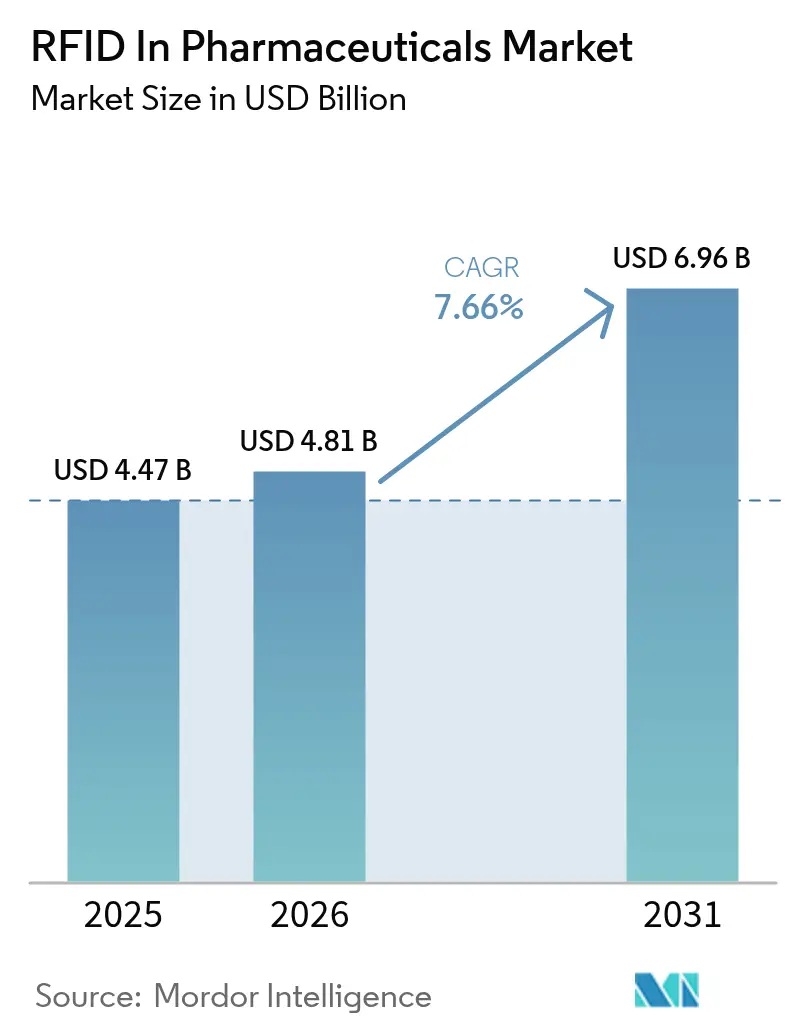
RFID In Pharmaceuticals market size in 2026 is estimated at USD 4.81 billion, growing from 2025 value of USD 4.47 billion with 2031 projections showing USD 6.96 billion, growing at 7.66% CAGR over 2026-2031. Strong demand for end-to-end traceability, enforcement of the Drug Supply Chain Security Act (DSCSA) in the United States, and wider adoption of serialization in the European Union are pushing pharmaceutical companies to move beyond barcodes toward real-time item-level data capture. Capital spending has shifted toward integrated platforms that convert raw tag reads into predictive supply-chain intelligence, while falling tag costs reduce the payback period on new deployments. Temperature-controlled biologics, omnichannel retail pharmacies, and next-generation biologic therapies add further urgency for continuous environmental monitoring. Competitive rivalry remains moderate because legacy auto-ID vendors, enterprise software leaders, and specialist healthcare start-ups each own distinctive pieces of the value chain, creating room for niche innovators.
Key Report Takeaways
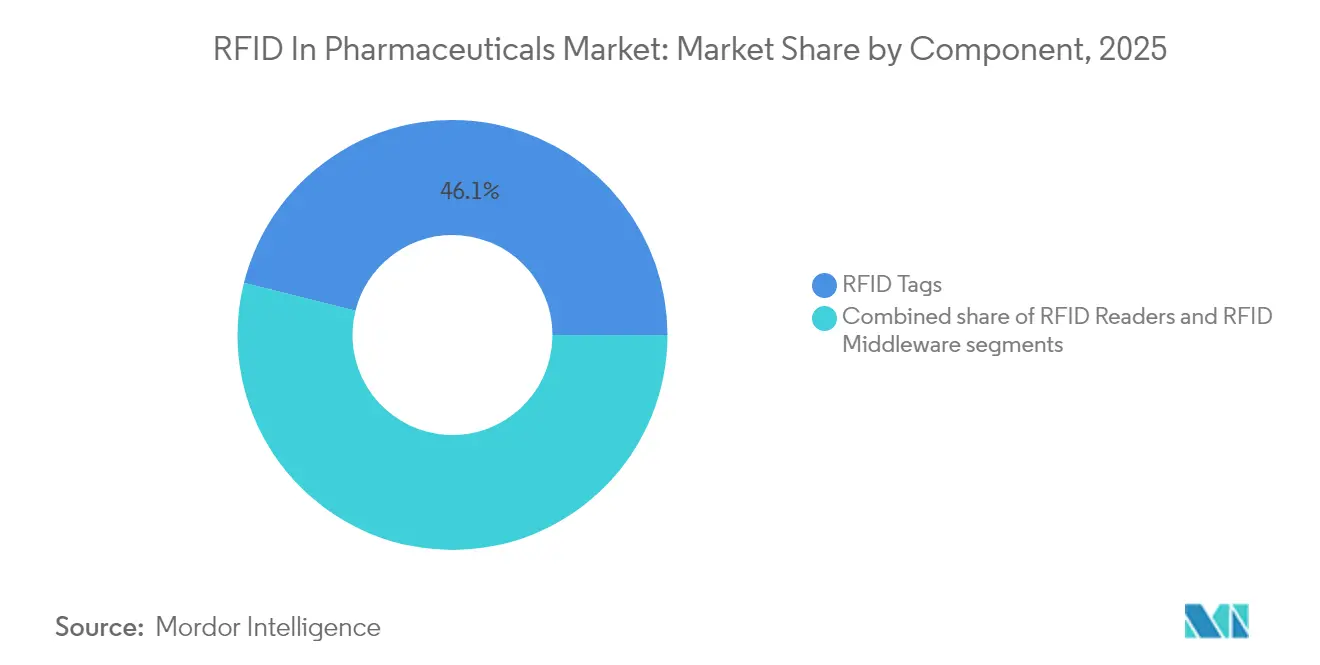
- By component, RFID Tags led with 46.10% revenue share in 2025, whereas RFID Middleware is projected to log the fastest 9.22% CAGR through 2031.
- By type, chipped RFID held 70.85% of the RFID In Pharmaceuticals market share in 2025; chipless RFID is forecast to grow at 9.31% CAGR to 2031.
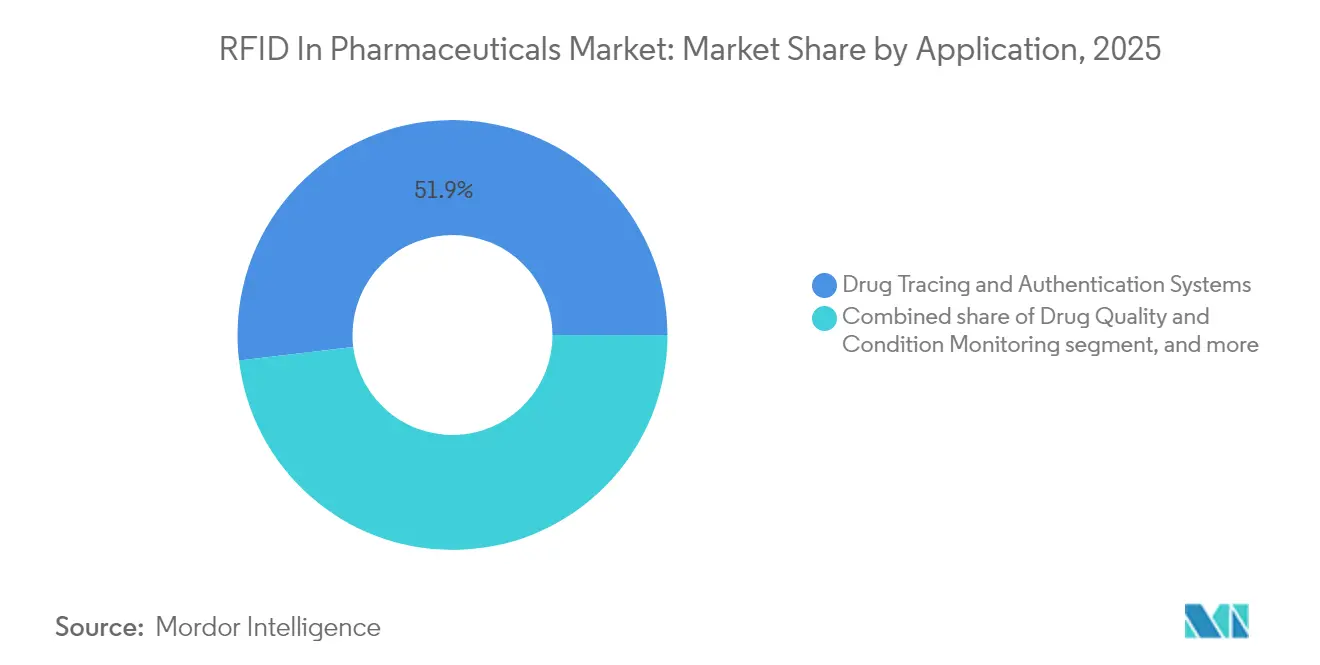
- By application, Drug Tracing & Authentication Systems accounted for 51.90% share of the RFID In Pharmaceuticals market size in 2025, while Temperature-Controlled Logistics is rising at 10.35% CAGR.
- By end user, Drug Manufacturers commanded 49.10% revenue share in 2025; Retail & e-Pharmacies are advancing at 9.88% CAGR through 2031.
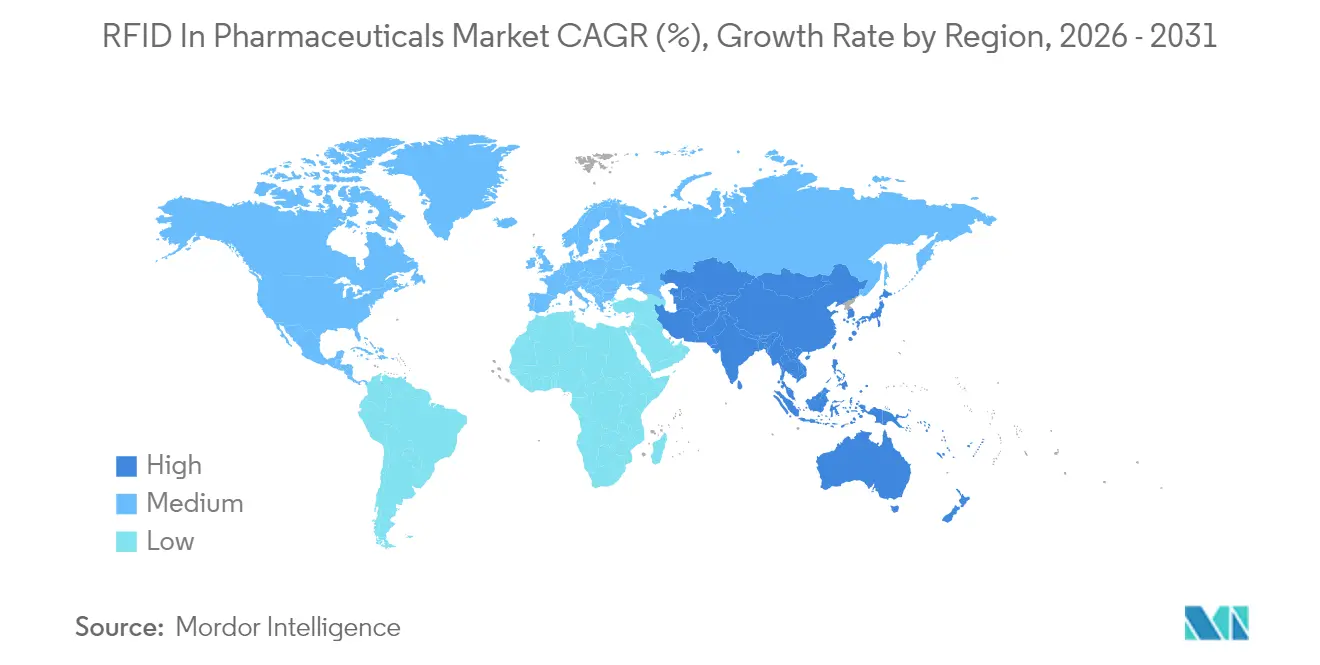
- Geographically, North America captured 43.10% revenue in 2025; Asia-Pacific is the fastest-expanding region at 8.31% CAGR.
Note: Market size and forecast figures in this report are generated using Mordor Intelligence’s proprietary estimation framework, updated with the latest available data and insights as of 2026.
Market Trends and Insights
Drivers Impact Analysis of RFID In Pharmaceuticals Market*
| Driver | % Impact on CAGR Forecast | Geographic Relevance | Impact Timeline |
|---|---|---|---|
| Increasing global pharmaceutical supply chain complexity | +1.8% | Global, concentrated in North America and EU | Medium term (2-4 years) |
| Stringent drug safety and anti-counterfeiting regulations | +2.1% | North America and EU primary, APAC emerging | Short term (≤ 2 years) |
| Expansion of cold-chain biologics and specialty therapies | +1.5% | Global, led by North America and EU | Long term (≥ 4 years) |
| Growing hospital automation and inventory visibility demands | +1.2% | North America and EU core, APAC accelerating | Medium term (2-4 years) |
| Falling RFID tag costs and improved read accuracy | +0.9% | Global | Short term (≤ 2 years) |
| Rise of omni-channel pharmacies and direct-to-patient delivery | +1.1% | North America and EU primary, urban APAC | Medium term (2-4 years) |
| Source: Mordor Intelligence | |||
Increasing Global Pharmaceutical Supply Chain Complexity
Modern drug supply chains span 15–20 hand-offs that include contract manufacturing and logistics partners. In 2024 these intermediaries represented 49.56% of end-user deployments, underscoring how visibility gaps expose companies to compliance and counterfeiting risks. RFID enables automatic capture at every node, avoiding human error that barcode workflows create in high-volume hubs. The FDA’s June 2024 guidance calls for interoperable systems able to exchange granular movement events, positioning RFID as the practical route to meet such data hand-shaking demands[1]. Early adopters benefit from fewer stock-outs and lower recall costs, prompting peers to accelerate programs. High-value specialty drugs heighten urgency because temperature excursions or delays can spoil an entire lot, turning real-time monitoring from a luxury into a necessity.
Stringent Drug Safety and Anti-Counterfeiting Regulations
Full DSCSA enforcement in November 2024 and earlier EU Falsified Medicines Directive mandates have converted serialization from best practice to legal requirement. Industry executives now target automated verification rather than manual line-side scanning, a preference that favors RFID’s near-zero read latency. Analyst commentary from TraceLink projects end-to-end digitalization to dominate 2025 budgets. The FDA’s September 2024 draft on innovative manufacturing highlights real-time data proofs as a route to quicker regulatory reviews. Authentication stakes are high because counterfeit drugs account for an estimated 10% of global supply. RFID tags that embed tamper indicators satisfy emerging compliance audits and lower investigation time when anomalies appear.
Expansion of Cold-Chain Biologics and Specialty Therapies
Biologics now exceed 40% of global pharmaceutical revenue. Spoilage costs touch USD 35 billion per year when shipments stray outside allowable temperatures. RFID tags with embedded sensors deliver continuous readings that barcodes cannot produce, providing immediate alerts across transit legs. Avery Dennison’s Saga Card, launched with Controlant, blends passive RFID, cellular connectivity, and cloud analytics to give an unbroken cold-chain record. Predictive models are beginning to use weather forecasts and route data to reroute shipments proactively. As cell- and gene-therapy volumes rise, item-level custody chains become critical, and RFID offers the only practical toolset for personalized payloads.
Growing Hospital Automation and Inventory Visibility Demands
Hospitals are automating pharmacy operations to curb labor shortages and expiry waste. Bluesight’s KitCheck platform documents 96% faster inventory counts and 91.6% fewer expired medications after RFID rollout. Oracle’s Fusion Cloud now embeds RFID signals in replenishment workflows, letting nurses consume drugs at point-of-care while the back-office triggers reorder lines automatically. Capital tied up in stock drops once real-time data exposes slow-moving items. Workflow gains depend on cross-department coordination; pilot programs that include nursing, pharmacy, and IT leaders achieve the quickest payback.
Restraints Impact Analysis of RFID In Pharmaceuticals Market*
| Restraints Impact Analysis | (~) % Impact on CAGR Forecast | Geographic Relevance | Impact Timeline |
|---|---|---|---|
| High initial system integration and validation expenses | -1.4% | Global, especially small and mid-size firms | Short term (≤ 2 years) |
| Limited radio-frequency performance in metal and liquid environments | -0.8% | Global, impacting manufacturing floors | Medium term (2-4 years) |
| Data security, privacy, and regulatory compliance concerns | -0.7% | Global, heightened in EU and North America | Short term (≤ 2 years) |
| Fragmented global standards and interoperability issues | -0.6% | Global, pronounced across emerging markets | Medium term (2-4 years) |
| Source: Mordor Intelligence | |||
High Initial System Integration and Validation Expenses
Full-scale pharmaceutical RFID deployments range from USD 500,000 to USD 5 million when factoring enterprise resource planning links, 21 CFR Part 11 validation, and staff training. Annual support often equals 25–30% of capital outlay, a hurdle for mid-sized firms. Cloud-hosted SaaS pricing models are easing entry barriers by spreading costs over subscription periods, yet validation burdens remain because regulators scrutinize electronic records and audit trails with the same rigor as production equipment.
Limited Radio Frequency Performance in Metal and Liquid Environments
Read rates fall 40–60% in cleanrooms packed with stainless-steel vessels or liquid-filled vials. Specialized antenna geometries and pharmaceutical-grade tags mitigate but do not eliminate dead zones. Alternative frequencies and chipless materials improve reliability while raising unit costs 30–50% over standard retail tags. Hybrid solutions that overlay 2D codes with RFID chips are gaining attention because they work even when RF reflections degrade.
*Our forecasts treat driver/restraint impacts as directional, not additive. The impact forecasts reflect baseline growth, mix effects, and variable interactions.
RFID In Pharmaceuticals Market Segment Analysis
By Component:
Middleware Drives Integration InnovationRFID Tags captured 46.10% revenue in 2025, confirming their indispensable role as the serialized identifier anchoring every data record within the RFID In Pharmaceuticals market. However, Middleware is accelerating at a 9.22% CAGR because decision-makers want dashboards and predictive analytics rather than raw tag reads. Oracle embedded RFID pipelines inside its Fusion Cloud Supply Chain suite in September 2024, illustrating how enterprise platforms position themselves as the compliance nerve center. Middleware converts tag pings into exception alerts, recall triggers, and automated Electronic Product Code Information Services (EPCIS) messages that regulators demand. Handheld and fixed Readers bridge physical capture with these analytic layers, ensuring closed-loop visibility from factory to bedside. Continuous investment spotlighting software underscores how the RFID In Pharmaceuticals market is shifting from discrete hardware projects to integrated digital ecosystems.
RFID In Pharmaceuticals market implementations increasingly pair low-cost passive tags with cloud analytics to keep lifetime ownership costs predictable. HF, UHF, and NFC variants dominate daily operations, while specialty biologic shipments justify battery-assisted tags able to stream temperature data every few minutes. Middleware’s rise signals a maturity phase where companies regard RFID data as a strategic asset feeding demand forecasts, quality dashboards, and automatic DSCSA compliance reports rather than a siloed inventory tool. This transition cements the RFID In Pharmaceuticals market’s role in broader pharmaceutical digitalization roadmaps.

By Type:
Chipless Innovation Challenges Traditional DominanceChipped tags retained 70.85% share in 2025 because silicon-based UHF products enjoy global certification and reliable performance in regulated spaces. Yet Chipless RFID is expanding at 9.31% CAGR on the strength of lower material costs and resilience around metal surfaces. Pharmaceutical production suites filled with stainless equipment create radio reflections that impair conventional labels. Chipless substrates transmit unique electromagnetic signatures without integrated circuits, cutting per-tag costs up to 60%. Zebra Technologies’ M-Trust prototype with Merck KGaA merges traditional scanners with covert chipless pigments to prove authenticity in seconds. Such hybrid designs show how incumbents protect installed bases while easing customers toward next-generation labels.
Early chipless rollouts support items that are hard to tag, including foil blister packs and vial stoppers. Regulation still favors deterministic serial numbers, so pilots often append a human-readable code to satisfy inspectors. Nonetheless, as labs validate that spectral fingerprints cannot be counterfeited easily, chipless adoption will climb, especially in emerging markets where unit economics dominate vendor selection. The evolution reaffirms that the RFID In Pharmaceuticals market rewards solutions that tackle both cost and performance hurdles.
By Application:
Temperature Monitoring Drives Specialized GrowthDrug Tracing & Authentication Systems owned 51.90% revenue in 2025 as serialization compliance pushed every manufacturer to embed unique identities on saleable units. Yet Temperature-Controlled Logistics is rising fastest at 10.35% CAGR, mirroring the boom in monoclonal antibodies and cell therapies that must remain within narrow temperature bands. Passive sensors attached to vials now store excursion data for auditors, while active trackers broadcast continuous feeds to cloud dashboards that logistics planners monitor in real time. The RFID In Pharmaceuticals market size for temperature-control sub-applications is projected to widen steadily as biologics expand their share of the global drug pipeline.
Cold-chain failures destroy product worth billions; therefore stakeholders now budget proactively for in-transit analytics. Avery Dennison and Controlant co-developed the Saga Card to overlay cellular telemetry on RFID check-points, adding redundancy that regulators appreciate. Drug Quality & Condition Monitoring tags that sense shock or humidity are also penetrating vaccine programs, providing a holistic view of product integrity. These niche innovations demonstrate that the RFID In Pharmaceuticals industry evolves in lock-step with therapeutic science.
By End User:
Retail Transformation Accelerates AdoptionDrug Manufacturers accounted for 49.10% revenue in 2025 by embedding tags on packaging lines to satisfy DSCSA and EU FMD rules. Retail & e-Pharmacies, however, will post the quickest 9.88% CAGR through 2031 because last-mile delivery verification and home-based therapies necessitate item-level status confirmation. The RFID In Pharmaceuticals market size tied to retail channels is scaling as consumers demand assured authenticity for high-value prescriptions delivered directly to residences.
Hospitals & Clinics adopt RFID to automate crash-cart replenishment and reduce controlled-substance discrepancies, while Wholesale & Distribution Centres invest to secure their central role amid direct-to-patient shifts. Contract manufacturers and CROs view RFID as a differentiator when courting sponsors; verified custody data help win outsourcing bids. This end-user mosaic confirms that the RFID In Pharmaceuticals market grows whenever traceability moves downstream toward patients.
Geography Analysis
North America RFID in Pharmaceuticals Market
North America controlled 43.10% of 2025 revenue after DSCSA’s final compliance date forced complete serialization and event capture across supply chains. The RFID In Pharmaceuticals market gained critical mass as Pfizer, Johnson & Johnson, and Merck retrofitted production and distribution assets, catalyzing uptake across contract partners. Oracle, Zebra Technologies, and TraceLink capitalized by positioning cloud analytics as an out-of-the-box route to FDA audit readiness. Canada and Mexico ride the same regulatory wave by aligning exports with U.S. handling codes, making North American supply networks an interoperable RFID corridor.
APAC RFID in Pharmaceuticals Market
Asia-Pacific is expanding at an 8.31% CAGR, the fastest regional pace in the RFID In Pharmaceuticals market. China and India, as leading generic suppliers, tag bulk product to assure western buyers of pedigree, while Japan and South Korea deploy RFID for biologic cold chains. Singapore’s biologics cluster and Australia’s domestic vaccine programs adopt item-level tracking to meet Good Distribution Practice audits. Regional regulators are coordinating under PIC/S GMP, creating a harmonized compliance baseline that encourages cross-border implementations.
Europe RFID in Pharmaceuticals Market
Europe registers steady uptake because the EU Falsified Medicines Directive obliges pharmacy-level verification. Germany, Switzerland, and Ireland—home to many high-value manufacturing sites—leverage RFID to satisfy both FMD and forthcoming Digital Product Passport rules. Sustainability directives add another pull, as RFID-enabled reuse programs help reduce packaging waste. The consistent momentum affirms that every major geography now embeds RFID as a standard defensive line against counterfeit drugs.
Regulatory Landscape
In the United States, the Drug Supply Chain Security Act (DSCSA) is the primary driver of serialized, interoperable traceability and verification for prescription drugs. Following the DSCSA stabilization approach, enforcement emphasis shifted toward enhanced drug distribution security and electronic data exchange, with the stabilization period tracked as ending on May 27, 2026 in industry guidance. This timing has accelerated the need for systems that can support unit-level verification workflows and EPCIS-based event sharing. While DSCSA does not mandate RFID as the data carrier, RFID is used as a compliant, high-throughput data capture method when aligned to GS1 identification and EPC standards.
In Europe, the EU Falsified Medicines Directive framework (Directive 2011/62/EU and Delegated Regulation (EU) 2016/161) requires safety features, including a unique identifier carried on a 2D barcode and an anti-tampering device for most prescription medicines. This keeps serialization infrastructure in place while leaving room to complement barcode-based processes with RFID for operational automation. Separately, identification and master-data harmonization initiatives under ISO IDMP are progressing through the European Medicines Agency (EMA) SPOR program, including a June 2026 public Product Management Services (PMS) API beta milestone that supports structured medicinal product identification and cross-party data exchange relevant to end-to-end traceability architectures.
Value Chain Analysis
The value chain covers tag and inlay design and conversion (including specialized materials for pharmaceutical packaging and sterilization environments), reader and printer hardware, middleware and repositories that create and exchange EPCIS events, and implementation services that validate systems under regulated quality and electronic-record controls. Upstream, RFID component suppliers and label converters provide passive and sensor-enabled tags. Midstream, reader and printer vendors and system integrators deploy fixed and handheld capture across packaging lines, warehouses, and hospital pharmacies. Downstream, manufacturers, wholesalers, distributors, and dispensers operationalize verification, returns processing, and exception handling through interoperable data exchange.
Recent activity points to a shift toward embedded unit-level identity and purpose-built labeling for difficult-to-tag formats such as vials and syringes. p-Chip Corporation, with Choice One Rx and RxERP, ran a January 2026 trial for end-to-end digital traceability (co-sponsored by Avantor), and followed it with a February 2026 licensing agreement to integrate p-Chip Light Activated Microtransponders into the RxERP platform for DSCSA-aligned chain-of-identity controls. On packaging execution, Schreiner MediPharm and HERMA announced an integrated RFID labeling solution for pharmaceutical vials (May 2026), highlighting where bottlenecks persist, including maintaining read performance on curved, liquid-filled containers and ensuring consistent data interoperability across mixed-maturity trading partner networks.
Competitive Landscape
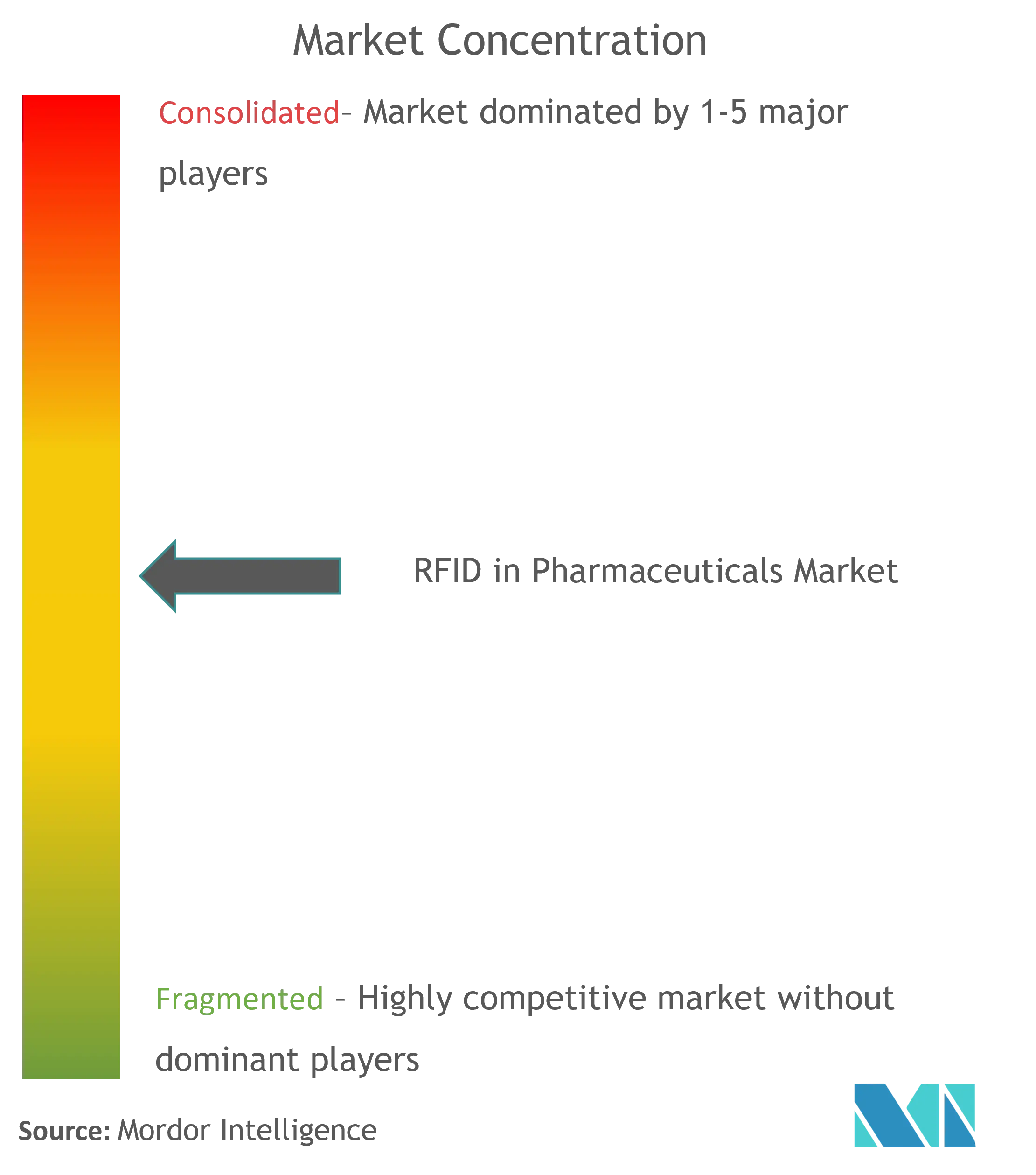
The industry shows moderate fragmentation. Hardware specialists such as Zebra Technologies and Impinj dominate reader platforms, but software and analytics are rapidly concentrating around players like Oracle and TraceLink that offer validated compliance workflows[3]. Avery Dennison extends into cloud networks through its Controlant tie-up, signaling that former label suppliers now evolve into end-to-end visibility providers. Bluesight’s acquisition by Thoma Bravo highlights growing private-equity activity as investors seek scale advantages in hospital automation tools.
Strategic collaborations increasingly bundle authentication pigments, AI analytics, and connectivity in single offerings. Identiv-Novanta’s 2025 healthcare OEM pact exemplifies a push to shorten device makers’ design cycles by embedding complete RFID modules. Ambient IoT entrants such as Wiliot approach the sector with battery-free sensors, yet regulatory acceptance remains cautious. Overall, data analytics rather than tag manufacture is shaping durable advantages, pushing vendors to build pharmaceutical domain knowledge or partner with those who already have it.
RFID In Pharmaceuticals Industry Leaders
-
Avery Dennison Corporation
-
Zebra Technologies Corp.
-
Impinj Inc.
-
CCL Industries (Smartrac)
-
Fresenius Kabi
- *Disclaimer: Major Players sorted in no particular order
RFID In Pharmaceuticals Market Companies Covered in this Report
- Avery Dennison Corp.
- Zebra Technologies
- Impinj Inc.
- CCL Industries (Smartrac)
- Checkpoint Systems Inc.
- Fresenius
- Tageos SAS
- GAO RFID Inc.
- Invengo Technology Pte Ltd
- Blue Vector (Now Ventiv)
- Intermec By Honeywell
- NXP Semiconductors
- SATO Holdings Corp.
- Schreiner MediPharm
- RFiD Discovery (Paragon ID)
- Turck Vilant Systems
- Siemens (SIMATIC RFID)
- Bluesight (Kit Check)
Market Opportunities and Future Outlook
A near-term whitespace is converting DSCSA-driven serialization programs from barcode-only compliance into bulk, automated verification and data reconciliation at operational scale, especially for saleable returns and high-throughput distribution nodes. FDA DSCSA exemptions and enforcement sequencing have also left the dispenser ecosystem uneven, with small dispensers (25 or fewer FTEs) retaining an exemption until November 27, 2026. This supports demand for solutions that can bridge mixed readiness across trading partners while still supporting EPCIS-based exchange and rapid response verification workflows. Middleware and cloud repositories that package compliance workflows into validated, configurable modules remain a focal opportunity, since they reduce integration burden and support onboarding across heterogeneous ERP and WMS environments.
Cold-chain and specialty therapies expand the opportunity set beyond identity to condition monitoring. EPCIS 2.0 support for sensor data aligns with RFID sensor-tag architectures used in temperature-controlled logistics and audit-ready provenance records. Adoption signals include point-of-manufacture embedded RAIN RFID tagging to reduce downstream hospital tagging labor, supported by Fresenius Kabi tagging medications at manufacturing speed using RAIN RFID components and converter ecosystems. Material-science innovation is also widening use cases for RFID in harsh processes, including Avery Dennison introducing sterilization-compatible RFID inlays (March 2026) designed for autoclave and ethylene oxide environments, expanding RFID applicability for sterile packaging, device-adjacent pharma workflows, and unit-level traceability on formats that previously relied on manual scanning.
Recent Industry Developments in RFID In Pharmaceuticals Market
- April 2026: Zebra Technologies and Texas Children's Hospital publicized results from an RFID-enabled medication management deployment, with Texas Children's reporting USD 14 million in annual medication cost savings. The solution used RFID printing and UHF RFID mobile reading to reduce waste, improve inventory accuracy, and cut stockouts, reinforcing the hospital pharmacy ROI case for RFID at unit and cabinet levels.
- March 2026: Avery Dennison launched a sterilization-compatible RFID inlay portfolio, including AD Minidose U9 Steri, AD Accessory U9 Steri, and AD Shelter Steri, engineered to withstand autoclave and ethylene oxide sterilization. This expands tagging feasibility for sterile and device-adjacent pharmaceutical workflows where conventional labels can fail, supporting broader item-level traceability in controlled environments.
- October 2024: BD and ten23 health partnered on RFID-enabled prefillable syringes to streamline aseptic manufacturing and improve traceability through fill-and-finish processes. The collaboration highlighted growing demand for RFID designs that work on challenging primary containers and integrate with regulated manufacturing documentation.
RFID In Pharmaceuticals Market Report Scope and Research Methodology
Market Definition and Coverage
For this report, the market covers spending tied to using RFID to identify, track, and verify pharmaceutical items across packaging, warehousing, distribution, and care settings. It includes RFID tags, readers, and middleware used to enable traceability, authentication, and inventory visibility for pharma products.
Scope exclusions: We exclude non-pharma RFID use cases and general barcoding-only solutions. We also do not count unrelated IT services that are not directly tied to RFID deployment and ongoing operations.
Segments Covered in This Report
- By Component
- RFID Readers
- Handheld Readers
- Fixed Readers
- RFID Tags
- Passive (HF, UHF, NFC)
- Active & BAP (Battery-Assisted Passive)
- RFID Middleware
- RFID Readers
- By Type
- Chipped RFID
- Chipless RFID
- By Application
- Drug Tracing & Authentication Systems
- Drug Quality & Condition Monitoring
- Other Applications
- By End User
- Drug Manufacturers
- Wholesale & Distribution Centres
- Hospitals & Clinics
- Retail & E-Pharmacies
- Contract Research / Manufacturing Organisations (CROs/CMOs)
- Geography
- North America
- United States
- Canada
- Mexico
- Europe
- Germany
- United Kingdom
- France
- Italy
- Spain
- Rest of Europe
- Asia-Pacific
- China
- Japan
- India
- Australia
- South Korea
- Rest of Asia-Pacific
- Middle East & Africa
- GCC
- South Africa
- Rest of Middle East & Africa
- South America
- Brazil
- Argentina
- Rest of South America
- North America
Data Sources, Market Sizing, and Validation
Desk Research
Desk research starts by grounding the model in real-world pharma production, trade flows, and compliance requirements that typically drive RFID adoption. We reviewed public materials from sources such as the US FDA (DSCSA guidance and updates), the European Commission and EMA publications on medicine supply chain controls, and WHO work on substandard and falsified medical products to identify where track-and-trace investment is being pushed.
To keep assumptions realistic, we pull supporting context from sources such as UN Comtrade trade statistics, World Bank macro indicators, and peer-reviewed articles that discuss RFID performance and adoption patterns in healthcare logistics. We also use company filings, product documentation, and investor presentations to understand offering mix across tags, readers, and middleware, plus reputable press coverage for timing of deployments and expansions. Where needed, a paid subscription covering company financials and news is used to validate revenue ranges and sanity check adoption narratives. These desk sources are not exhaustive, and many other references were used for data collection, validation, and clarification.
Primary Interviews and Surveys
Primary work focuses on interviews and short surveys with RFID solution providers, packaging and labeling ecosystem participants, pharma manufacturing and distribution teams, and hospital or pharmacy operations leaders who describe day-to-day scanning and inventory processes. Inputs from APAC, EMEA, and the Americas are used to pressure test adoption drivers, typical deployment scale, replacement cycles, and realistic pricing movement, and then the final assumptions are aligned to what the market is actually buying and installing.
Distribution of primary research fieldwork respondents
| Company type | Respondent position | Region |
|---|---|---|
| Top tier: 26% | CXOs: 19% | APAC: 44% |
| Mid tier: 55% | Functional/Unit leaders: 38% | EMEA: 30% |
| Smaller Players: 19% | Managers: 43% | Americas: 26% |
Market-Sizing & Forecasting
Sizing is built using a top-down and bottom-up mix. The starting point is the addressable RFID demand pool created by pharma traceability and inventory workflows, then the result is reconciled with supplier-side reality checks. On the top-down side, we map where item-level identification is required or economically justified, then translate that into demand for tags, readers, and middleware using adoption rates by end user and application.
To keep the model tied to actual purchasing behavior, selective bottom-up approximations are used, such as sampled ASP ranges for tags and readers, typical reader density by facility type, and roll-ups from public revenue disclosures where RFID exposure is described. Key variables include tag consumption intensity (by packaging and logistics unit), reader installed-base growth and refresh cycles, middleware attach rates per deployment, compliance timing signals (for serialization and traceability), and the pace of pharma cold-chain and biologics growth which tends to increase monitoring needs. Forecasts are produced using scenario analysis, where base, conservative, and accelerated adoption paths are shaped by what interviewees expect for compliance enforcement, capital budgets, and unit price trends. The final line uses the scenario that is most consistent with observed deployments. When data is missing for smaller markets, assumptions are bridged using proxy indicators like pharma output and trade intensity, then expert checks are applied before the assumptions are accepted.
Data Validation & Update Cycle
Validation is done by checking model outputs against independent signals that should move in the same direction, such as pharma production and distribution activity, public compliance milestones, and observable rollout announcements. Outliers are flagged when a country, end user, or component line grows faster than practical deployment capacity suggests. Inputs are then re-checked, and primary contacts are re-engaged when it appears something has materially changed.
Before sign-off, the dataset and calculations go through a multi-step review so unit conversions, currency timing, and component definitions remain consistent across regions. Reports are refreshed annually, and interim updates are made when material events occur, such as a major regulatory change or a clear shift in tag or reader pricing. Right before delivery, we do a final update pass so the numbers reflect the latest available public releases and market signals.
Mordor Intelligence's Pharmaceuticals Global Rfid Market Estimate Compared With Other Published Estimates
Published market values for RFID in pharmaceuticals do not always match because the market boundary can shift depending on what is counted as RFID spending and how fast adoption is assumed to scale across pharma nodes. Differences can also come from currency timing, the chosen base year, and whether estimates rely more on supply-side revenue roll-ups or on demand-side deployment calculations.
The biggest gaps usually show up around scope choices, especially whether software and broader traceability platforms are counted beyond RFID middleware, and whether adjacent healthcare RFID use is mixed into pharma-only totals. Pricing logic can also swing results, since tag ASP erosion and reader replacement cycles can be modeled in different ways, and some estimates assume faster penetration into hospitals and retail channels without sufficient validation.
Benchmark comparison
| Source | Market Size | Gaps in Research Methodology |
|---|---|---|
| Mordor Intelligence | USD 4.81 B (2026) | |
| Global Consultancy A | USD 5.62 B (2026) | This estimate appears to blend pharma RFID with broader healthcare asset and patient tracking spend, which can inflate reader and software totals beyond pharma supply chain needs. |
| Industry Association B | USD 3.95 B (2026) | This figure looks closer to a hardware-led view that limits value to tags and readers and applies conservative adoption in hospitals and pharmacies, which reduces middleware and application-layer spending. |
The table shows a noticeable spread around the 2026 value, and in Mordor Intelligence's model the market is counted only when RFID tags, readers, or RFID middleware are used for pharmaceutical traceability and related workflows, rather than bundling in broader healthcare RFID programs. Once that scope is held steady, the remaining differences largely come from how quickly item-level tagging scales and how tag price declines are applied year by year, which are assumptions that can be checked and updated as deployments progress.
Key Questions Answered in the Report
What is the current size of the RFID In Pharmaceuticals market?
The RFID In Pharmaceuticals market stands at USD 4.81 billion in 2026.
How fast is the RFID In Pharmaceuticals market expected to grow?
The market is forecast to rise at a 7.66% CAGR, reaching USD 6.96 billion by 2031.
Which component segment is growing the quickest?
RFID Middleware is the fastest-advancing component, expanding at 9.22% CAGR as companies seek integrated analytics.
Why is Asia-Pacific the fastest-growing region?
Manufacturing expansion in China and India, coupled with regulatory harmonization across ASEAN, drives an 8.31% CAGR in Asia-Pacific.
What regulatory changes are driving adoption in North America?
Full enforcement of the DSCSA in November 2024 now requires end-to-end traceability, making RFID implementations effectively mandatory.
Which application area shows the highest growth?
Temperature-Controlled Logistics leads application growth at 10.35% CAGR due to the surge in biologics and other cold-chain therapies.