
People Analytics In BFSI Market Size and Share
Market Overview
| Study Period | 2020 - 2031 |
|---|---|
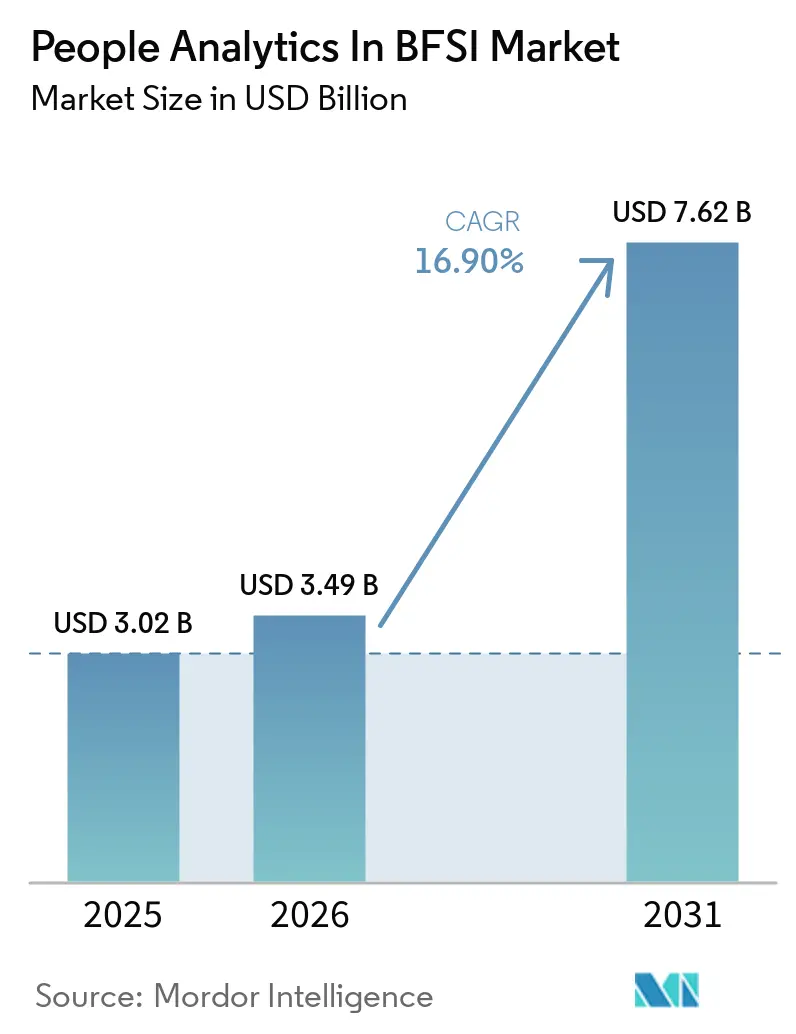
| Market Size (2026) | USD 3.49 Billion |
| Market Size (2031) | USD 7.62 Billion |
| Growth Rate (2026 - 2031) | 16.90 % |
| Fastest Growing Market | Asia-Pacific |
| Largest Market | North America |
| Market Concentration | Low |
Major Players *Disclaimer: Major Players sorted in no particular order Image © Mordor Intelligence. Reuse requires attribution under CC BY 4.0. | |
People Analytics In BFSI Market Analysis by Mordor Intelligence
The people analytics in BFSI market size is projected to expand from USD 3.02 billion in 2025 and USD 3.49 billion in 2026 to USD 7.62 billion by 2031, registering a CAGR of 16.90% between 2026 to 2031. The people analytics in BFSI market is moving beyond headcount reporting as banks, insurers, and other financial institutions shift toward predictive workforce intelligence that ties talent decisions to operating performance. High turnover risk, growing digital hiring pressure, and tighter governance around workforce data are making these platforms part of daily operating infrastructure rather than optional HR software. Demand is being shaped most clearly by predictive attrition modeling, cloud HR modernization, skills-based workforce planning, and stronger expectations for auditability across workforce decisions. The people analytics in BFSI market is also being influenced by sovereign AI rules and data residency requirements that are changing vendor architecture, especially where institutions need local control over sensitive employee data alongside scalable analytics capabilities. As the boundary between HR decision support and automated employment decisions narrows, the strongest opening is for vendors that can combine explainable AI, compliant deployment models, and measurable workforce outcomes inside a single platform.
Key Report Takeaways
- By component, software led with 64.37% share in the people analytics in BFSI market space in 2025, while services are projected to expand at a 16.93% CAGR through 2031.
- By deployment mode, cloud held 69.41% share in 2025, while hybrid is projected to record the fastest CAGR of 17.63% between 2026 and 2031.
- By enterprise size, large enterprises accounted for 61.29% of the people analytics in the BFSI market in 2025, while small and medium enterprises are projected to expand at a 18.21% CAGR through 2031.
- By application, workforce planning held 24.87% share of the people analytics in BFSI market in 2025, while retention and attrition analytics are projected to advance at a 19.17% CAGR through 2031.
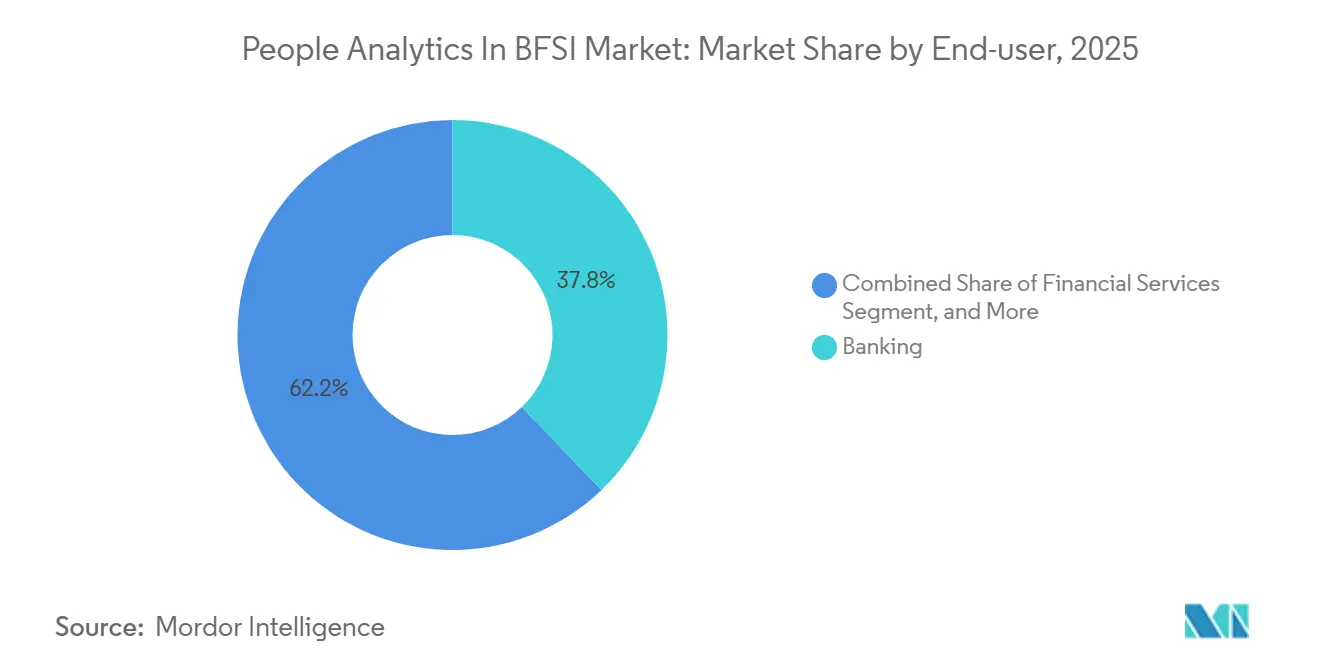
- By end user, banking accounted for 37.82% of the people analytics market in BFSI sector in 2025, while financial services is projected to grow at a 20.12% CAGR through 2031.
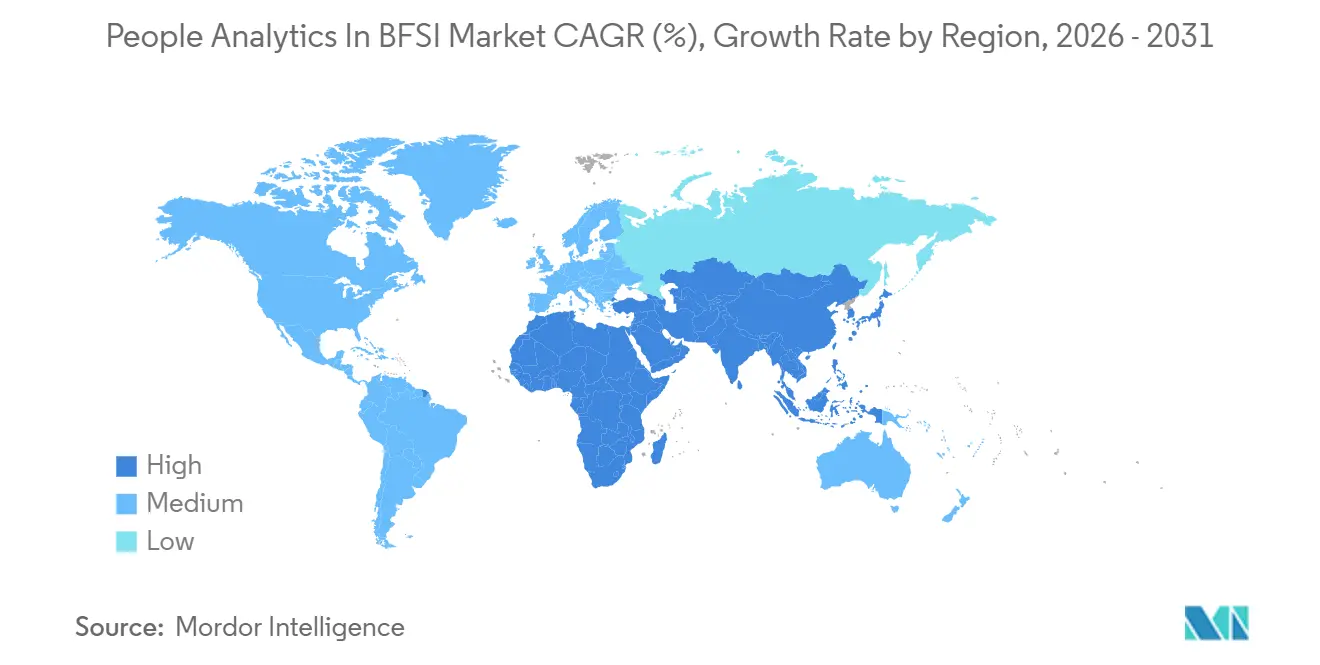
- By geography, North America led with 38.43% share of the people analytics in the BFSI market in 2025, while Asia-Pacific is projected to expand at a 17.89% CAGR through 2031.
Note: Market size and forecast figures in this report are generated using Mordor Intelligence’s proprietary estimation framework, updated with the latest available data and insights as of January 2026.
Market Trends and Insights
Drivers Impact Analysis of People Analytics In BFSI Market*
| Driver | (~) % Impact on CAGR Forecast | Geographic Relevance | Impact Timeline |
|---|---|---|---|
| AI-Powered Talent Intelligence And Predictive Attrition Modeling | +4.2% | Global, concentrated in North America, United Kingdom, Singapore, India | Short term (= 2 years) |
| Rising Regulatory Complexity In Workforce Data And Auditability | +3.0% | North America and EU core, spillover to Asia-Pacific and Middle East | Medium term (2-4 years) |
| Cloud HR Modernization Across Banks And Insurers | +2.6% | Global, with near-term gains in North America and Western Europe | Short term (= 2 years) |
| Skills-Based Workforce Planning For Digital And AI Roles | +2.0% | Global, most acute in United Kingdom, Singapore, India, Australia and New Zealand | Medium term (2-4 years) |
| Behavioral-Risk Monitoring For Front-Line Conduct And Compliance | +1.6% | North America, United Kingdom, Hong Kong, Singapore | Medium term (2-4 years) |
| Pay Transparency And Human Capital Disclosure Mandates | +1.2% | EU-27 primary, United States, Australia secondary | Medium term (2-4 years) |
| Source: Mordor Intelligence | |||
AI-Powered Talent Intelligence And Predictive Attrition Modeling
The people analytics in BFSI market is being driven by a clear shift from backward-looking reporting to real-time decision support within talent functions. Adoption in financial services talent teams still trails other business functions, which leaves a meaningful runway for further deployment rather than signaling saturation. The practical change is that HR teams are no longer expected to pull dashboards after a problem appears, because AI models can now flag workforce anomalies and potential flight-risk clusters earlier in the cycle. In large institutions, this matters because internal productivity gains and higher internal fill rates make workforce analytics relevant to both operating efficiency and retention. The commercial case is stronger now because peer-reviewed research on financial-sector datasets showed that GAN-Transformer attrition models achieved 92% to 96.95% accuracy, moving predictive retention analytics out of the experimental stage for people analytics in the BFSI market.[1]İrem Tanyıldızı Baydili and Burak Tasci, “Predicting Employee Attrition: XAI-Powered Models for Managerial Decision-Making,” Systems, mdpi.com
Rising Regulatory Complexity In Workforce Data And Auditability
The people analytics in BFSI market is also gaining support as workforce data governance is folded into broader operational resilience and AI compliance frameworks. DORA has raised the need to document third-party service dependencies, which increases demand for platforms that can maintain durable logs and traceable controls across HR workflows. The EU AI Act has treated employee performance evaluation, attrition prediction, and task allocation systems as high-risk AI uses, making governance oversight and worker transparency more central in vendor selection. A May 2026 EU Digital Omnibus agreement delayed the full employment AI compliance deadline to December 2027, but that extra time favors institutions that start building compliant operating models early. In the people analytics market in the BFSI, this setup is likely to produce stepwise adoption waves as firms move closer to enforcement rather than a smooth, gradual uptake path.
Cloud HR Modernization Across Banks And Insurers
Cloud HR modernization remains a basic condition for scaling the people analytics in BFSI market, as advanced analytics depends on clean connections across HR, payroll, and finance data. A Strada survey released in 2025 showed that nearly 40% of organizations were still dependent on aging HR systems, while integration complexity was the main obstacle for 42% of respondents. That integration burden is heavier in BFSI because legacy core platforms often lack modern APIs, forcing institutions to spend more time and money on custom middleware before analytics can operate at scale. SAP strengthened this direction in May 2026 by introducing autonomous HCM capabilities across payroll, recruiting, and workforce planning, while also noting that 62% of C-suite executives were dissatisfied with how people data connects to business performance. People analytics in the BFSI market is therefore advancing fastest, with cloud upgrades and analytics deployment happening together rather than as separate phases.[2]Dan Beck, “SAP SuccessFactors Innovations Define a New Era of Autonomous HCM,” SAP News Center, sap.com
Skills-Based Workforce Planning For Digital And AI Roles
The people analytics in BFSI market is increasingly tied to skills intelligence because banks, insurers, and other financial firms need to organize talent around capabilities rather than fixed job titles.[3]Artificial Intelligence and Human Resources in the EU, a 2026 Legal Overview,” Crowell and Moring LLP, crowell.com Research from the Financial Services Skills Commission showed a 35 percentage-point gap between AI-related skill demand and available talent in UK financial services, while demand for conversational AI skills had risen 17-fold since 2021. Accenture also found that AI-related BFSI job postings tripled between late 2023 and 2026, which shows how strongly this talent contest has intensified. The CFA Institute noted in January 2026 that firms such as HSBC were using skills architectures with as many as 3,000 competencies, providing institutions with a much clearer view of internal mobility and capability gaps. For the people analytics in the BFSI market, this makes workforce planning modules with embedded skills engines more important because annual role frameworks no longer move as quickly as the underlying skill demand.
Restraints Impact Analysis of People Analytics In BFSI Market*
| Restraint | (~) % Impact on CAGR Forecast | Geographic Relevance | Impact Timeline |
|---|---|---|---|
| Data Privacy, Data Residency, And Cross-Border Employee Data Friction | -2.1% | EU-27, China, India, Russia, Indonesia, Middle East | Long term (= 4 years) |
| Algorithmic Bias And Explainability Risk In Employment Decisions | -1.4% | Global, most acute in North America and EU-27 | Medium term (2-4 years) |
| Legacy HR And Core System Integration Complexity | -1.0% | Global, concentrated in North America and Europe | Medium term (2-4 years) |
| AI Readiness Gaps Across Regulated BFSI Workforces | -0.7% | Asia-Pacific core, South America, Africa | Long term (= 4 years) |
| Source: Mordor Intelligence | |||
Data Privacy, Data Residency, And Cross-Border Employee Data Friction
Data sovereignty remains one of the clearest constraints on people analytics in the BFSI market because employee records often carry local labor, privacy, and compensation sensitivities that are harder to standardize across borders. China and Russia require local storage of employee data, which pushes multinational firms toward parallel HR environments and weakens the unified workforce models that advanced analytics needs. India added another layer in late 2025 through DPDP-related cross-border compliance obligations, which increased the need to align privacy management with labor and tax structures rather than treating it as a stand-alone exercise. Some firms were reported in May 2026 to be moving human capital AI activity back on-premises or into tightly controlled internal networks to retain direct control over compensation, succession, and disciplinary data. That pattern slows platform rollouts in the people analytics market in BFSI sector, especially for smaller regional institutions that lack the technical capacity to operate local deployments across multiple jurisdictions.
Algorithmic Bias And Explainability Risk In Employment Decisions
Bias and explainability issues continue to limit how far the people analytics in BFSI market can move into individual employee decisioning because labor risk and reputational risk sit close together in regulated financial environments. The EU AI Act has already narrowed acceptable use cases by banning certain workplace AI practices and tightening transparency and human oversight requirements for employment-related systems.[4]Why Skills Taxonomies and Architectures Are Critical to Navigating the Financial Industry's Future,” CFA Institute, cfainstitute.org Historical workforce datasets in BFSI can reproduce older hiring and promotion patterns, so predictive models may carry hidden bias if institutions do not carefully review their training data and outputs. Explainability frameworks such as SHAP and LIME help address this issue, but they also add cost and require stronger data science capability inside HR analytics teams than many firms currently possess. As a result, many buyers in the people analytics market in the BFSI still limit these models to aggregate risk monitoring rather than using them as direct scoring tools for individual employment decisions.
*Our forecasts treat driver/restraint impacts as directional, not additive. The impact forecasts reflect baseline growth, mix effects, and variable interactions.
People Analytics In BFSI Market Segment Analysis
By Component:
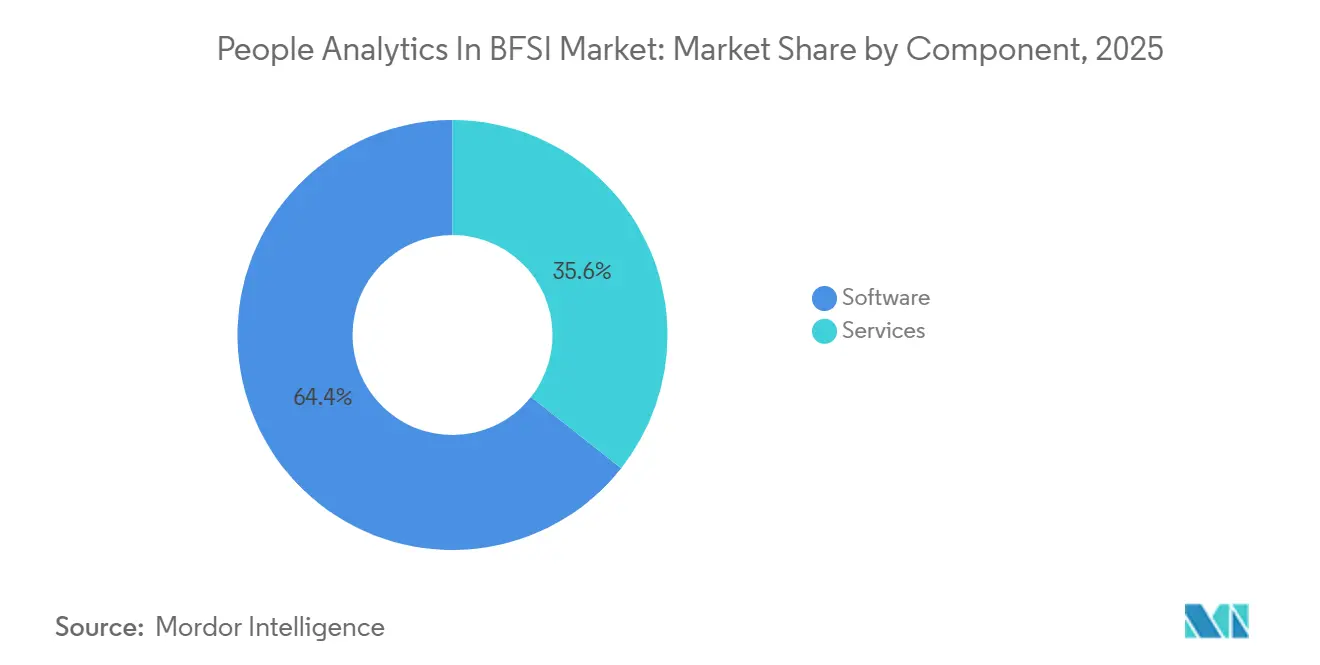
Software Leads, Services Accelerate As Analytics MaturesSoftware accounted for 64.37% of the people analytics in BFSI market share in 2025, confirming that platforms, not services, remain the core spending line in this category. The largest share lies with software, as BFSI institutions prefer predictable licensing structures and direct product capabilities over open-ended, services-heavy engagements. That preference has strengthened as vendors embed attrition scoring, pay equity review, skills inference, and workforce planning features into standard product releases rather than packaging them as custom projects. In people analytics in the BFSI industry, this pattern favors SaaS-native vendors that can embed analytics directly into managers' and HR workflows, rather than treating insights as a separate reporting layer.
Services are projected to grow at a 16.93% CAGR through 2031, indicating that implementation complexity is rising as platforms become more sophisticated. Institutions still need advisory, integration, configuration, and managed support because workforce data often sits across fragmented HRIS environments and legacy banking systems. Only 18% of financial services executives were implementing generative AI in their talent functions in early 2025, suggesting a gap between the potential of the platform and enterprise readiness. HR-AI budgets rose sharply for 2026, which helps explain why services demand is growing alongside software rather than being displaced by it. The people analytics in the BFSI market, therefore, keeps software in the lead, while services expand as the execution layer required to make those platforms work under real operating constraints.


By Deployment Mode:
Cloud Dominates, Hybrid Emerges As Compliance ArchitectureCloud accounted for 69.41% of the people analytics in BFSI market size in 2025, reflecting the strong position of large HCM ecosystems that now package analytics as part of broader suite adoption. This lead is grounded in the scale advantages of cloud delivery, especially where institutions want faster updates, easier integration across HR and finance workflows, and lower infrastructure overhead. Workday, SAP SuccessFactors, and Oracle HCM Cloud have helped normalize embedded analytics, which has pulled many BFSI buyers toward suite-led deployment models rather than stand-alone tools. People analytics in the BFSI market has therefore treated cloud as the default operating model, even though data sensitivity makes the deployment discussion more complex than in many other software categories.
Hybrid deployment is projected to grow at a 17.63% CAGR through 2031, the fastest among deployment models, as institutions increasingly seek analytics flexibility without sacrificing local control over sensitive employee records. This is not a return to legacy thinking, but a deliberate architecture choice shaped by data residency, privacy, and regulated oversight. Some firms were reported in May 2026 to be moving human capital AI workloads back into controlled networks where necessary, which aligns with the rise of hybrid models in the sector. Sovereign cloud investments are also expanding compliant options, with AWS and Google Cloud committing to major in-country data center investments in Indonesia after the April 2026 localization rules. In the people analytics market in the BFSI, hybrid is becoming a compliance architecture rather than a temporary bridge.
By Enterprise Size:
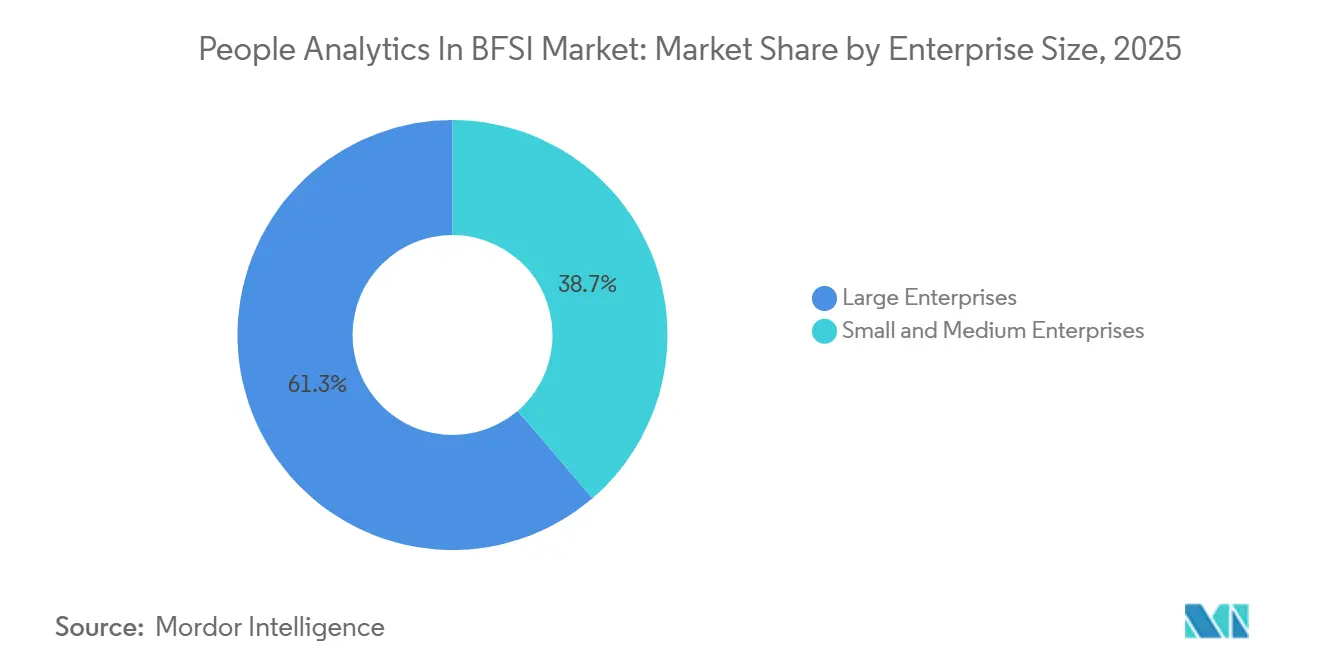
Large Enterprises Anchor Revenue, SMEs Shift The Growth PatternLarge enterprises accounted for 61.29% of the market share in 2025, reflecting the fact that major banks and multinational insurers have the highest organizational complexity and the strongest case for enterprise-wide workforce intelligence. These firms operate across several jurisdictions, manage layered role structures, and face broader governance demands around talent, compensation, and disclosure. That makes centralized analytics more valuable because the cost of fragmented people data rises quickly at scale. The people analytics in BFSI market has therefore drawn most of its current revenue from large institutions that can justify deeper platform rollouts and longer deployment programs.
Small and medium enterprises are projected to expand at a 18.21% CAGR through 2031, giving them the fastest growth profile in this segment. That change reflects the spread of modular SaaS pricing and lighter deployment models that reduce the cost barrier for regional banks, NBFCs, specialty insurers, and mid-market fintechs. These firms face the same retention pressures and skill shortages as larger institutions, but they usually operate with leaner HR teams, enabling AI-assisted decision support to deliver more visible gains per analyst or manager. Organizations using AI-driven analytics to improve skills visibility were 7.2 times more likely to fill roles internally, which is especially relevant for smaller BFSI employers with tighter external hiring budgets. People analytics in the BFSI industry is therefore seeing a shift, with large enterprises still anchoring current revenue, while SMEs are becoming a stronger design and product priority for future expansion.
By Application:
Workforce Planning Holds The Lead, Attrition Analytics Expands FastestWorkforce planning accounted for 24.87% of applications in 2025, making it the largest application, as banking and insurance institutions need longer-term visibility into role demand, skill gaps, and succession risk. This lead fits the planning cycles of regulated financial institutions, where talent decisions often need to align with multiyear business and control frameworks. Strategic workforce planning still has substantial room to deepen, as many organizations have not extended their planning horizons far enough into future capability needs. The people analytics market in the BFSI sector for retention and attrition analytics is projected to expand at a 19.17% CAGR through 2031, making it the fastest-growing application as firms treat turnover risk as a direct financial exposure.
Attrition analytics is gaining momentum because replacement costs are high in financial services and because lost talent can weaken control quality, customer continuity, and digital execution. The value of this application has increased as predictive models improve and as institutions become more willing to intervene earlier in the employee lifecycle. Other application areas, including talent acquisition and onboarding, employee engagement and development, payroll and compensation analytics, and compliance and risk workforce analytics, continue to broaden the role of people analytics in BFSI market across the talent stack. The EU Pay Transparency Directive has also increased interest in payroll and compensation analytics by pushing firms toward clearer job architecture, pay grading, and gap-reporting workflows. In practical terms, workforce planning remains the anchor application, while attrition analytics is emerging as the most urgent operational use case in the people analytics market in BFSI.
By End-User:
Banking Leads, Financial Services Posts The Fastest GrowthBanking accounted for 37.82% of the people analytics market share in the BFSI sector in 2025, making it the largest end-user segment in the category. The sector has the deepest institutional history with workforce data, the broadest employee base, and some of the strongest incentives to monitor productivity and retention in digitizing functions. Thirteen major listed Chinese banks employed 1,854,400 people at the end of 2025 and invested CNY 180 billion (USD 24.8 billion) in financial technology during the same year. The scale of AI deployment in banking operations supports the view that workforce intelligence is already closely tied to enterprise productivity management in the people analytics market in BFSI.
Financial services, including asset managers, payment processors, and independent wealth managers, are projected to grow at a 20.12% CAGR through 2031, the fastest among end users. That outperformance reflects a sharper fight for digital, data, and AI talent, especially where traditional firms compete against fintechs and technology-led employers for the same skills. In this segment, internal mobility analytics and skills-based career pathing have become increasingly important because compensation alone cannot fully address retention pressures. Insurance, capital markets, and fintech also remain important contributors, with insurers focusing on actuarial and GenAI upskilling, capital markets firms emphasizing conduct monitoring, and fintechs using more granular analytics because smaller teams make each hiring and exit decision more visible. The people analytics in BFSI market is therefore led by banking on current scale, while the broader financial services segment is setting the pace for future expansion.
Geography Analysis
North America People Analytics in BFSI Market
North America accounted for 38.43% of the people analytics market in the BFSI market in 2025, making it the largest regional market. This position reflects mature cloud HR adoption, larger software budgets, and a deep pool of specialized vendors serving financial institutions. The SEC human capital disclosure framework under Regulation S-K has made retention, talent development, and compensation more visible at the board and investor level, which supports steady demand for auditable workforce data systems. State-level pay transparency measures in Virginia and Maine in 2026, followed by Connecticut later in the year, added another layer of reporting pressure for regional banks and insurers. The people analytics in the BFSI market in North America, therefore, benefits from a mix of mature technology adoption and a disclosure environment that keeps workforce data close to enterprise governance priorities.
APAC People Analytics in BFSI Market
Asia-Pacific is projected to grow at a 17.89% CAGR through 2031, making it the fastest-growing region in the people analytics market in BFSI. The region stands out because large BFSI workforces are being digitized quickly across India, China, South Korea, Australia, and Singapore. India is seeing stronger compliance and greater workforce monitoring needs following the Reserve Bank of India's outsourcing directions issued in November 2025, which raised expectations for essential personnel tracking, background verification, and incident reporting discipline. In China, an analysis of major listed banks in 2026 showed that institutions were categorizing roles by AI substitutability, creating a more formal basis for redeployment planning and internal workforce segmentation. Singapore also adds a regional template through industry-led skilling programs, which supports broader adoption of skills analytics and workforce planning tools across the people analytics in BFSI market.
EMEA and South America People Analytics in BFSI Market
Europe follows a regulatory-first adoption path, while South America, the Middle East, and Africa represent earlier-stage but meaningful expansion opportunities for people analytics in the BFSI market. The June 2026 transposition deadline for the EU Pay Transparency Directive prompted banks in several European countries to improve their job architecture, pay grading, and compensation analytics capabilities. France showed particularly visible activity, with BPCE signing an employment accord around generative AI in 2025 and the French Banking Federation studying the impact of GenAI across nine banking professions. In South America, digital banking expansion and HR modernization are opening the door to cloud-led adoption, while Saudi Arabia, the UAE, and South Africa are driving demand for workforce planning, localization programs, and digital talent retention.

Competitive Landscape
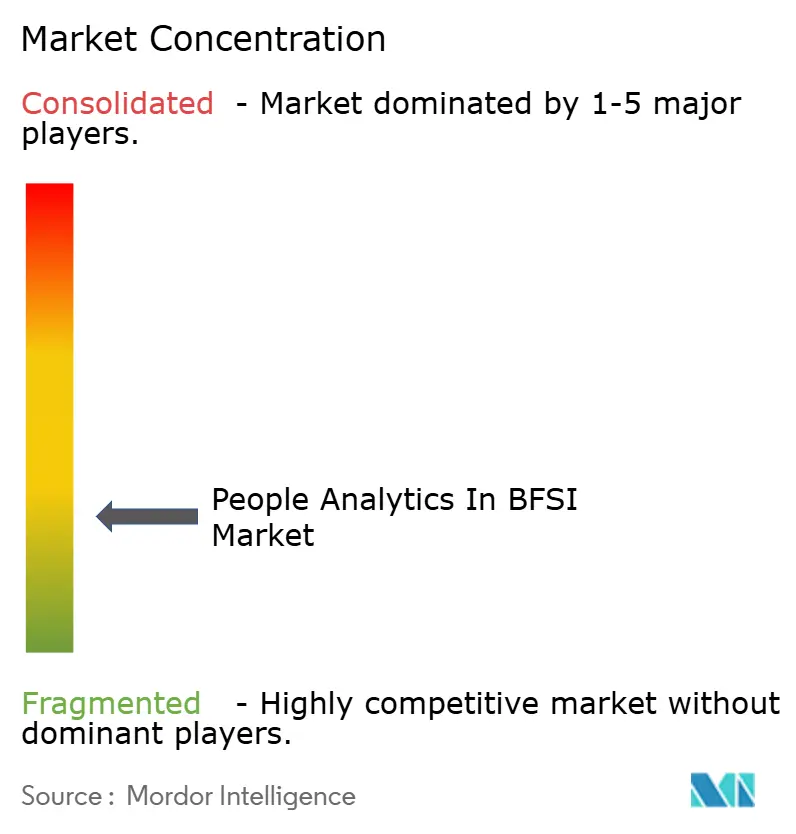
The people analytics market in BFSI remained moderately fragmented, with specialist vendors in attrition prediction, pay equity, conduct monitoring, and skills intelligence competing alongside broader HCM suite providers. The central competitive race is moving toward agentic AI, where vendors are trying to automate multi-step HR work inside governed enterprise environments rather than offering analytics as a static dashboard layer. Visier expanded in this direction through its Workforce AI platform and Model Context Protocol integrations with Glean and Amazon Quick in 2026, which enabled leaders to query live workforce data within existing AI workspaces. Gloat also launched its Agentic HR Platform in March 2026 with embedded agents for redeployment, career development, internal talent sourcing, succession planning, and learning workflows. In the people analytics in BFSI market, this means competitive strength is increasingly tied to how well vendors combine automation, interoperability, and governed access to workforce context.
Trust signals are becoming more important as buyers weigh model governance and auditability. Eightfold AI strengthened its position in May 2026 through TalentForge and new AI Interviewing and Workforce Readiness capabilities, while also deepening integration with Oracle Fusion Cloud Recruiting. Culture Amp expanded AI Coach across its platform in October 2025 and linked that capability to ISO42001-certified governance across 1.5 billion workplace data points. These moves show that product breadth alone is not enough in the people analytics market in BFSI, because buyers also want evidence that models can be governed and explained under scrutiny. The same pressure is raising the value of certification, secure integration, and strong enterprise ecosystems.\\
White space remains strongest where compliance risk and people data overlap, especially in conduct analytics and pay equity governance. BNY completed the implementation of Behavox Quantum AI in April 2025 across more than 50,000 employees and 16+ communication languages, signaling that conduct analytics is becoming increasingly relevant to broader workforce oversight in banking. Smaller specialists such as Syndio, Worklytics, and Praisidio can still defend niches by integrating into existing payroll and HRIS environments at a lower ownership cost than larger platforms. Consolidation risk is rising, however, as shown by Perceptyx’s March 2026 acquisition of Lyceum AI, which expanded its reach from listening and activation into skill development and learning validation. People analytics in the BFSI market is therefore likely to remain fragmented in the near term, but vendors without a clear adjacency path may find it harder to hold their position as platforms broaden.
People Analytics In BFSI Industry Leaders
Visier, Inc.
Eightfold AI Inc.
One Model Inc.
ChartHop, Inc.
Culture Amp Pty Ltd.
- *Disclaimer: Major Players sorted in no particular order
People Analytics In BFSI Market Companies Covered in this Report
- Visier, Inc.
- Eightfold AI Inc.
- One Model Inc.
- ChartHop, Inc.
- Culture Amp Pty Ltd
- Orgvue Limited
- Panalyt Inc.
- TalentNeuron, LLC
- Syndio Solutions, Inc.
- Praisidio, Inc.
- Worklytics Co.
- Aura Intelligence, Inc.
- Sapience Analytics Corporation
- Prohance Inc.
- Gloat Ltd.
- Perceptyx, Inc.
- Betterworks System Inc.
- Leapsome GmbH
- Hi Bob, Inc.
- Knoetic, Inc.

Recent Industry Developments in People Analytics In BFSI Market
- May 2026: Eightfold AI launched TalentForge, a platform enabling enterprises to build custom HR software with embedded talent intelligence, and simultaneously unveiled next-generation AI Interviewing (360 Interview) and Workforce Readiness capabilities; the company was named a Visionary in the 2026 Gartner Magic Quadrant for Talent Acquisition (Recruiting) Suites, reinforcing its standing among global BFSI talent technology buyers.
- May 2026: Betterworks unveiled AI-Powered Talent Intelligence capabilities, including Unified Talent Profiles, Skills Intelligence, Calibration, and Succession Planning, transforming its performance management platform into a business execution analytics engine that captures workforce signals in real time.
- May 2026: Syndio launched "Decisions," an AI-powered product delivering real-time pay intelligence at the point of hiring and compensation decisions, and defined a new market category called "Decision Intelligence for Pay"; separately, Syndio formalized a strategic alliance with Mercer to integrate advisory expertise with its pay governance platform, addressing the USD 31 million to USD 62 million per year in recoverable value that ungoverned pay decisions cost large employers.
- May 2026: Leapsome launched Performance and 360 Reviews 2.0, featuring bias-mitigation tools, AI-generated summaries, and combined performance and engagement analytics, alongside the introduction of its first people-centric HRIS platform, consolidating its position as an all-in-one people enablement provider.


Global People Analytics In BFSI Market Report Scope
The people analytics in the BFSI market refers to technology solutions and services that enable banks, insurers, fintechs, and investment firms to collect, analyze, and interpret workforce data for strategic human capital management. These platforms support applications such as workforce planning, talent acquisition and onboarding, employee engagement and development, retention and attrition analytics, payroll and compensation analysis, and compliance with workforce risk regulations. Delivered through cloud, on-premises, or hybrid models, they serve both large enterprises and SMEs across the BFSI ecosystem. The core purpose of this market is to help financial institutions optimize workforce productivity, reduce attrition, ensure pay equity, and align employee strategies with organizational performance and regulatory requirements.
The people analytics in BFSI market is segmented by Component (Software, and Services), Deployment Mode (Cloud, On-Premises, and Hybrid), Enterprise Size (Large Enterprises and Small and Medium Enterprises), Application (Workforce Planning, Talent Acquisition and Onboarding, Employee Engagement and Development, Retention and Attrition Analytics, Payroll and Compensation Analytics, and Compliance and Risk Workforce Analytics), End-user (Banking, Insurance, Financial Services, FinTech, and Capital Markets and Investment Firms), and Geography (North America, South America, Europe, Asia-Pacific, Middle East, and Africa). The Market Forecasts are Provided in Terms of Value (USD).
| Software |
| Services |
| Cloud |
| On-premises |
| Hybrid |
| Large Enterprises |
| Small and Medium Enterprises |
| Workforce Planning |
| Talent Acquisition and Onboarding |
| Employee Engagement and Development |
| Retention and Attrition Analytics |
| Payroll and Compensation Analytics |
| Compliance and Risk Workforce Analytics |
| Banking |
| Insurance |
| Financial Services |
| FinTech |
| Capital Markets and Investment Firms |
| North America | United States |
| Canada | |
| Mexico | |
| South America | Brazil |
| Argentina | |
| Rest of South America | |
| Europe | Germany |
| United Kingdom | |
| France | |
| Italy | |
| Spain | |
| Russia | |
| Netherlands | |
| Rest of Europe | |
| Asia-Pacific | China |
| Japan | |
| India | |
| South Korea | |
| Australia and New Zealand | |
| Rest of Asia-Pacific | |
| Middle East | Saudi Arabia |
| United Arab Emirates | |
| Rest of Middle East | |
| Africa | South Africa |
| Nigeria | |
| Rest of Africa |
| By Component | Software | |
| Services | ||
| By Deployment Mode | Cloud | |
| On-premises | ||
| Hybrid | ||
| Enterprise Size | Large Enterprises | |
| Small and Medium Enterprises | ||
| By Application | Workforce Planning | |
| Talent Acquisition and Onboarding | ||
| Employee Engagement and Development | ||
| Retention and Attrition Analytics | ||
| Payroll and Compensation Analytics | ||
| Compliance and Risk Workforce Analytics | ||
| By End-user | Banking | |
| Insurance | ||
| Financial Services | ||
| FinTech | ||
| Capital Markets and Investment Firms | ||
| By Geography | North America | United States |
| Canada | ||
| Mexico | ||
| South America | Brazil | |
| Argentina | ||
| Rest of South America | ||
| Europe | Germany | |
| United Kingdom | ||
| France | ||
| Italy | ||
| Spain | ||
| Russia | ||
| Netherlands | ||
| Rest of Europe | ||
| Asia-Pacific | China | |
| Japan | ||
| India | ||
| South Korea | ||
| Australia and New Zealand | ||
| Rest of Asia-Pacific | ||
| Middle East | Saudi Arabia | |
| United Arab Emirates | ||
| Rest of Middle East | ||
| Africa | South Africa | |
| Nigeria | ||
| Rest of Africa | ||


Key Questions Answered in the Report
What is the current and future size of the people analytics in BFSI market?
It stood at USD 3.49 billion in 2026 and is projected to reach USD 7.62 billion by 2031, growing at a 16.90% CAGR over 2026-2031.
Which component contributes the most revenue?
Software led the category with a 64.37% share in 2025 because BFSI buyers continue to favor platform-led deployment over services-heavy delivery models.
Which deployment model is growing the fastest?
Hybrid deployment is projected to grow at a 17.63% CAGR through 2031 as firms balance cloud scalability with data residency and internal control requirements.
Why are banks investing more in workforce intelligence tools?
Banks are using these tools to improve workforce planning, manage retention risk, support compliance, and connect people decisions more closely to productivity and control outcomes.
Which application area is expanding the fastest?
Retention and attrition analytics is projected to advance at a 19.17% CAGR through 2031 because turnover risk is increasingly treated as a measurable financial exposure.
Which region offers the strongest growth outlook?
Asia-Pacific is projected to expand at a 17.89% CAGR through 2031 as large BFSI workforces across India, China, South Korea, Australia, and Singapore undergo rapid digitization.
Page last updated on:





