
Patch Management Market Size and Share
Market Overview
| Study Period | 2020 - 2031 |
|---|---|
| Market Size (2026) | USD 3.01 Billion |
| Market Size (2031) | USD 4.54 Billion |
| Growth Rate (2026 - 2031) | 8.57 % |
| Fastest Growing Market | Asia-Pacific |
| Largest Market | North America |
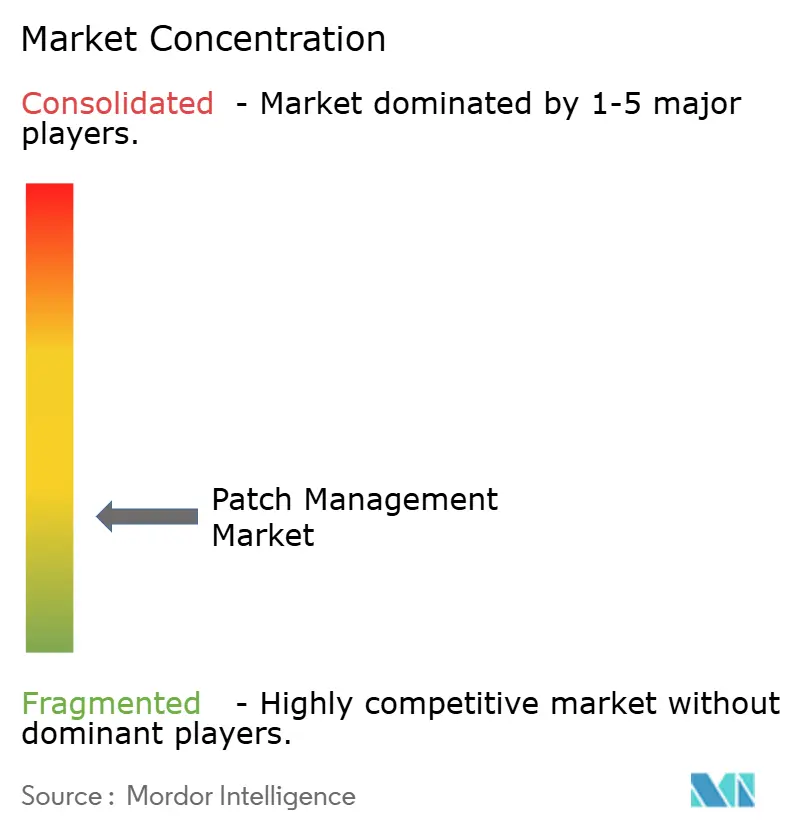
| Market Concentration | Low |
Major Players *Disclaimer: Major Players sorted in no particular order Image © Mordor Intelligence. Reuse requires attribution under CC BY 4.0. | |
Patch Management Market Analysis by Mordor Intelligence
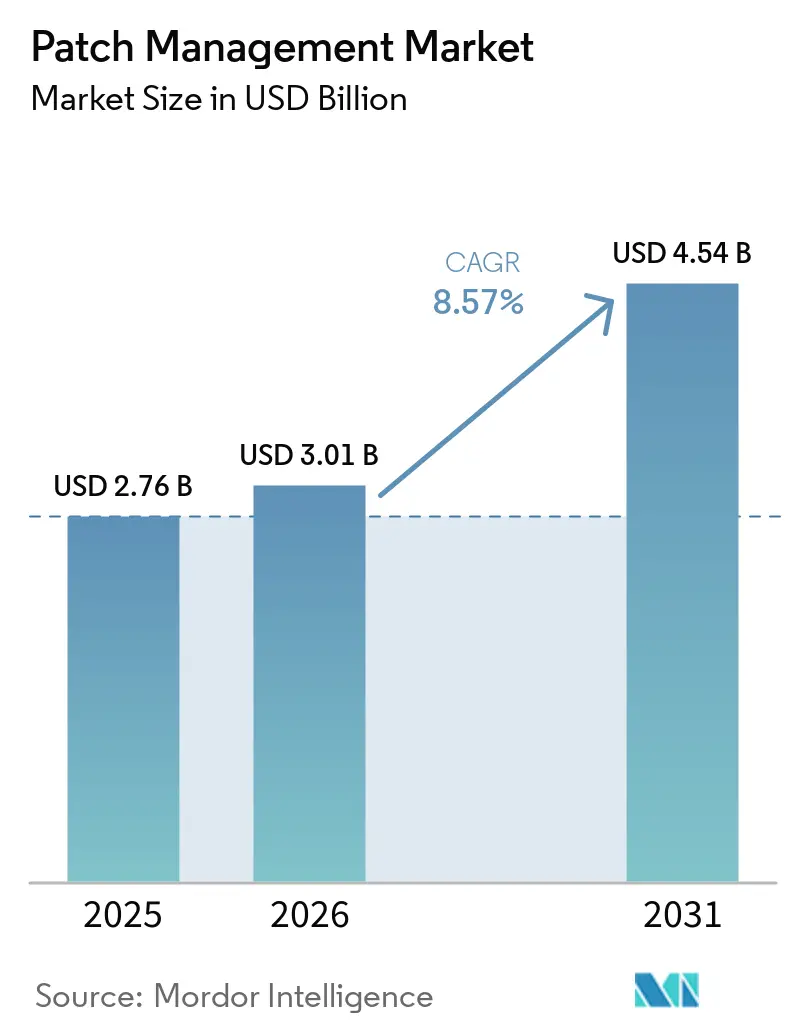
The patch management market size is projected to expand from USD 2.76 billion in 2025 and USD 3.01 billion in 2026 to USD 4.54 billion by 2031, registering a CAGR of 8.57% between 2026 and 2031. The patch management market is being shaped by the speed at which disclosed vulnerabilities are turned into active attack paths, making remediation timing more important than raw patch volume. Compliance pressure is also raising the floor for spending, because enterprises now need stronger audit trails, clearer patch policies, and documented rollback processes across business-critical systems. The patch management market is also moving toward cloud-delivered and automated models as remote endpoints, mixed device estates, and smaller security teams make manual workflows harder to sustain. Competitive activity shows that vendors are no longer selling patching as a stand-alone utility; instead, they are tying it to exposure management, endpoint operations, and policy-based automation. This shift is creating room for vendors that can shorten remediation cycles, support hybrid environments, and align technical execution with regulatory reporting.
Key Report Takeaways
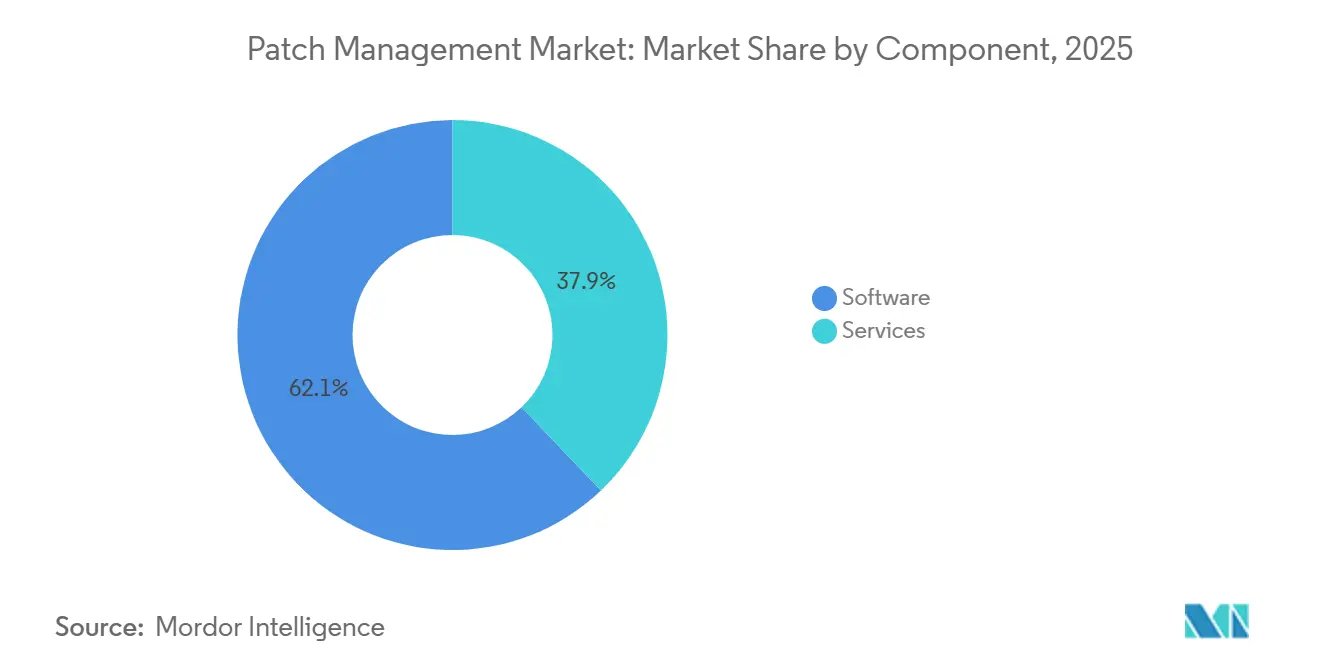
- By component, software held 62.13% share in 2025, while services are forecast to grow at 8.97% CAGR through 2031.
- By deployment mode, cloud-based deployment accounted for 55.89% of the market share in 2025 and also recorded the highest projected CAGR at 8.92% through 2031.
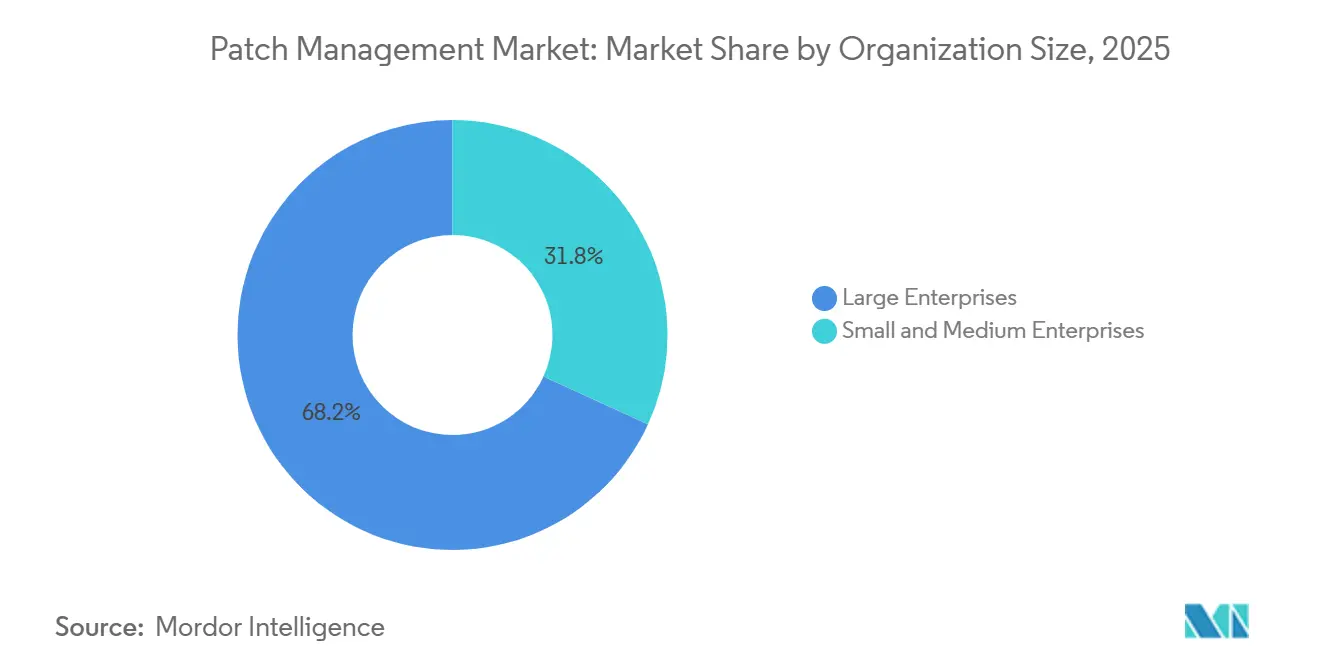
- By organization size, large enterprises held 68.18% share in 2025, while SMEs are projected to expand at an 8.78% CAGR through 2031.
- By industry vertical, BFSI accounted for 22.47% share in 2025, while healthcare and life sciences are advancing at a 10.37% CAGR through 2031.
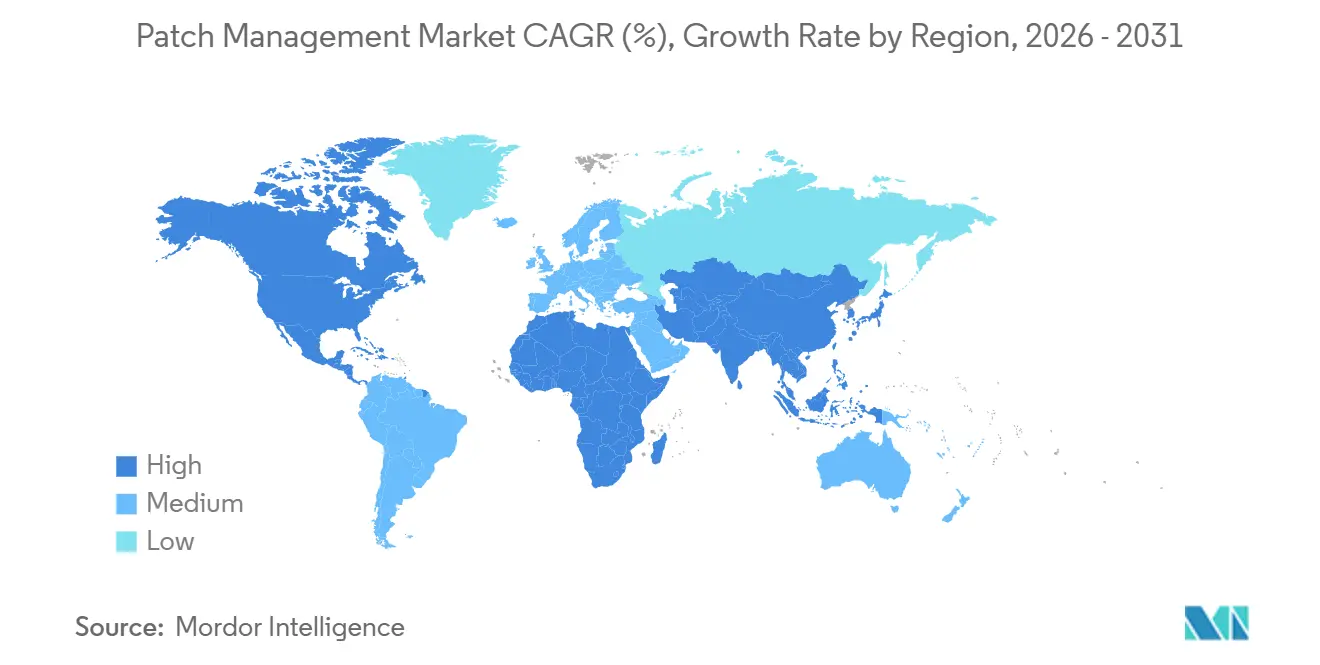
- By geography, North America held 41.84% share in 2025, while Asia-Pacific is projected to grow at a 9.57% CAGR through 2031.
Note: Market size and forecast figures in this report are generated using Mordor Intelligence’s proprietary estimation framework, updated with the latest available data and insights as of January 2026.
Market Trends and Insights
Drivers Impact Analysis of Patch Management Market*
| Driver | (~) % Impact on CAGR Forecast | Geographic Relevance | Impact Timeline |
|---|---|---|---|
| State-Mandated Critical Infrastructure Protection Law Boosts Compliance Spending | +1.8% | Qatar-wide, with concentrated effect in Doha government and energy clusters | Long term (≥ 4 years) |
| Surge In OT Attacks On LNG Facilities Driving ICS And SCADA Security Demand | +1.5% | Primarily Ras Laffan Industrial City and offshore LNG platforms | Medium term (2-4 years) |
| FIFA 2022 Legacy Smart-City Assets Require Robust Cyber Safeguards | +0.9% | Doha city core, Lusail, and stadium districts | Short term (≤ 2 years) |
| TASMU Cloud-First Program Accelerating Cloud-Native Security Adoption | +0.7% | Qatar-wide, led by MCIT-governed entities and digital service operators | Medium term (2-4 years) |
| Fintech And Open-Banking Rules Expanding IAM And Payment Security Budgets | +0.6% | Financial district, QFC-registered firms, and fintech hubs | Medium term (2-4 years) |
| Mandatory Personal Data Law Raising Encryption And DLP Uptake | +0.4% | National, with early compliance gains among healthcare and public-sector data processors | Long term (≥ 4 years) |
| Source: Mordor Intelligence | |||
Escalating Exploitation of Known Vulnerabilities
The strongest near-term force behind patch management market demand is the continued rise in actively exploited vulnerabilities. CISA's Known Exploited Vulnerabilities catalog had reached 1,592 entries by May 2026, providing security teams with a clear signal that a large and growing set of flaws is already tied to real-world attacks.[1]Cybersecurity and Infrastructure Security Agency, “Known Exploited Vulnerabilities Catalog,” CISA, cisa.gov That environment changes how patching budgets are prioritized, because organizations cannot rely on broad severity queues when a narrower set of known-exploited issues requires immediate action. It also pushes the patch management market toward tools that can ingest KEV intelligence quickly and map it directly to affected assets and patch workflows. Vendors that can cut the time between external threat intelligence and internal remediation execution are therefore gaining a clearer value proposition in enterprise buying cycles.
Tightening Cyber Resilience and Compliance Mandates
Compliance is now a direct spending driver for the patch management market, especially where vulnerability handling is tied to legal accountability and formal supervisory review. The European Commission states that NIS2 requires covered entities to address vulnerability management, and penalties can reach EUR 10 million (USD 10.8 million) or 2% of global annual turnover for non-compliance. This is raising demand for platforms that can document prioritization logic, remediation timing, approvals, and rollback procedures in a form that internal audit and regulators can review. ENISA reported that 70% of EU organizations named regulatory compliance as their main cybersecurity investment driver in 2024, and 50% identified patch management as the most difficult NIS2 requirement to address. As these rules mature, the patch management market is likely to favor vendors that combine automation with deep reporting rather than those that focus solely on deployment mechanics.
Growth in Hybrid Work and Distributed Endpoints
The spread of remote work and distributed devices continues to expand the operational scope of the patch management market. Rapid7 reported in July 2025 that 77% of organizations needed more than 1 week to deploy patches across their environments, showing how mixed fleets and remote endpoints continue to slow execution. ENISA also found that 76% of EU organizations struggled to attract cybersecurity personnel, and 94% of SMEs had difficulty recruiting security staff, which means technology adoption alone does not solve patch delays. The same ENISA report showed that 51% of SMEs took more than 3 months to patch critical vulnerabilities, compared with 28% of larger organizations. These conditions are expanding the role of managed patching and cloud delivery, as the patch management market increasingly has to address limited staff, uneven device visibility, and endpoint reach beyond the office network.
Shift Toward Cloud-Native and Automated Patching
Cloud-native delivery and policy-based automation are becoming central to how the patch management market improves remediation speed across large endpoint estates. Kaseya stated in April 2026 that its Agentic IT Management Platform operates across more than 17 million endpoints, which shows the scale at which vendors are now framing autonomous patch decisions and low-touch execution. Tanium and ServiceNow also reported in May 2026 that their joint autonomous IT solution reduced mean time to resolution by 60% in hybrid environments. These examples matter because buyers are increasingly comparing patch tools on execution outcomes rather than on basic scheduling or catalog breadth alone. As a result, the patch management market is moving toward platforms that integrate endpoint telemetry, policy controls, and automated remediation into a single operating model.
Restraints Impact Analysis of Patch Management Market*
| Restraint | (~) % Impact on CAGR Forecast | Geographic Relevance | Impact Timeline |
|---|---|---|---|
| Scarcity Of Arabic-Speaking Cyber Talent Inflates MSSP Costs | -1.5% | Qatar-wide, most acute in government and BFSI segments requiring bilingual compliance officers | Long term (≥ 4 years) |
| Legacy OT Assets In Gas Terminals Complicate Security Integration | -1.2% | Ras Laffan Industrial City and onshore gas processing infrastructure | Medium term (2-4 years) |
| Fragmented Procurement Across Semi-Government Firms Slows Project Cycles | -0.6% | Qatar-wide, concentrated in state-linked holding companies and sovereign entities | Medium term (2-4 years) |
| Data Sovereignty Concerns Over Foreign Cloud SOC Hosting | -0.4% | National, with highest sensitivity in defense, intelligence-adjacent, and financial-sector entities | Long term (≥ 4 years) |
| Source: Mordor Intelligence | |||
Patch Compatibility and Business Downtime Risk
Patch-related service disruptions remain a significant brake on the patch management market, as many organizations still weigh outage risk against exploit risk when scheduling deployment windows. This issue is most pronounced in environments where downtime has direct operational or safety consequences, including healthcare, manufacturing, and financial infrastructure. In these settings, automated rollout is often limited by the need for validation, testing, and rollback planning before production deployment can proceed. The result is that even when patch intelligence improves, execution speed can still slow down if teams lack confidence that updates will not interrupt core workflows. This restraint keeps demand high for platforms that can improve pre-deployment testing, staged rollout design, and change control visibility.
Legacy Systems and Fragmented Endpoint Estates
Legacy infrastructure and incomplete asset visibility also limit how far the patch management market can move toward full automation. Older systems, unsupported software, and mixed operating environments create blind spots where modern tools cannot apply the same level of coverage or policy consistency. The problem is more severe in operational technology and industrial settings, where maintenance windows follow plant schedules instead of weekly IT cycles. Fragmented estates also reduce the effectiveness of automation because policy engines cannot reliably act on devices that lack version data, ownership data, or current patch status. This keeps the patch management market tied to broader modernization programs, since better patching outcomes often depend on asset rationalization and lifecycle replacement as much as on the patch tool itself.
*Our forecasts treat driver/restraint impacts as directional, not additive. The impact forecasts reflect baseline growth, mix effects, and variable interactions.
Patch Management Market Segment Analysis
By Component:
Services Growth Outpaces The Core Software SegmentSoftware accounted for 62.13% of the patch management market in 2025, making it the largest component. Revenue still centers on operating system patching, third-party application updates, and cross-platform automation layers that help enterprises manage large and mixed device fleets. Product investment in 2025 and 2026 has been moving toward broader platform coverage, because buyers accounted for 62.13% of the patch management market in 2025, making it the largest components want fewer tools and a more unified remediation workflow. Action1 expanded to Linux in November 2025 across Ubuntu, Debian, Red Hat Enterprise Linux, and SUSE, which reflects the wider shift toward heterogeneous fleet coverage rather than single-OS patch execution.
Compliance needs are also strengthening the software case in the patch management industry, as organizations need records showing whether managed applications are patched on time and tracked across the estate. Adaptiva said in December 2025 that its platform catalog covered more than 250,000 patches across more than 20,000 products, which supports the demand for deeper third-party application coverage and stronger audit readiness. Services is the fastest-growing component, and the patch management market size for this segment is projected to grow at 8.97% CAGR through 2031. Managed services are capturing most of that incremental demand, as enterprises and SMEs increasingly want external teams to handle policy execution, exception handling, and reporting. ENISA's finding that 76% of EU organizations struggled to attract cybersecurity staff supports the structural shift toward service-led delivery.[2]European Network and Information Security Agency, “NIS Investments 2025 - Main Report,” ENISA, enisa.europa.eu


By Deployment Mode:
Cloud-Based Deployment Consolidates Its LeadCloud-based deployment captured 55.89% of the patch management market in 2025 and is also the fastest-growing deployment mode, with an 8.92% CAGR through 2031. That lead reflects a clear advantage in remote and hybrid environments, where cloud-based agents can enforce patch policy without depending on on-premises relay infrastructure or VPN connectivity. The model also supports faster central policy updates and broader reach across distributed devices, both of which are core needs in the patch management market. Adaptiva reported 70% growth in new customer acquisition in 2025 and a 75% increase in co-sell wins, indicating sustained customer interest in cloud-native patch and endpoint architectures.
On-premises deployment still matters in air-gapped environments, classified networks, and industrial settings where data residency or network isolation limits cloud use. Ivanti introduced ISA6500 and ISA8500 sovereign appliances in April 2026, which shows that vendors still see demand for local form factors tied to cloud-managed policy orchestration and regional data controls. This means the on-premises segment is narrowing rather than disappearing, and the patch management market is serving a smaller but durable specialist tier of customers that cannot fully move to shared cloud delivery. The broader direction remains clear, as cloud platforms better fit distributed endpoints, leaner IT teams, and the push for faster remediation cycles.
By Organization Size:
SME Adoption Accelerates On MSP-Driven EconomicsLarge enterprises held 68.18% of the patch management market share in 2025, which reflects the heavier spending power and larger endpoint footprints that still define this part of the patch management market. Their environments often include operating systems, firmware, containerized workloads, third-party applications, and regional compliance needs in the same estate. Adaptiva reported in March 2025 that 64% of enterprises identified coordination between detection and remediation as their main operational challenge, which explains why large buyers are prioritizing connected workflows over stand-alone tools. Tanium and ServiceNow said in May 2026 that their joint offering reduced mean time to resolution by 60%, demonstrating the type of operational improvement large organizations are funding.
SMEs are the fastest-growing segment, and the patch management market for SMEs is projected to grow at a 8.78% CAGR through 2031. ENISA found that 51% of SMEs took more than 3 months to patch critical vulnerabilities, indicating that smaller organizations are particularly affected by staffing and process constraints. That is why the patch management industry is seeing stronger MSP-led adoption, because smaller buyers can shift from up-front tooling and limited internal labor to recurring service-based execution. The European Commission notes that NIS2 expands the scope of organizations, adding compliance pressure to the economic case for externalized patch operations among smaller covered entities.
By Industry Vertical:
Healthcare Becomes The Fastest-Growing Demand CenterBFSI accounted for 22.47% of the patch management market share in 2025, making it the largest vertical. Demand in this segment is supported by overlapping obligations under DORA, PCI DSS, and SEC cybersecurity rules, which make patch classification, remediation timelines, and rollback planning part of normal operating control. That has made audit-ready reporting a baseline procurement requirement rather than an optional feature in financial environments. Other verticals, including IT and telecom, government and defense, manufacturing, energy and utilities, retail and e-commerce, education, and others, continue to add demand, though some face slower rollout cycles due to operational technology dependencies and procurement complexity.
Healthcare and life sciences are the fastest-growing verticals, and the patch management market size for this segment is forecast to grow at 10.37% CAGR through 2031. HHS stated in January 2026 that the proposed HIPAA Security Rule update would require critical vulnerabilities to be remediated within 15 days, thereby directly reshaping patch workflows across covered entities and business associates. ManageEngine reported in November 2025 that 46% of ransomware incidents in healthcare involved third-party gateways, reinforcing the need for broad application coverage rather than relying solely on operating system patching. That combination of regulatory pressure and weak baseline hygiene is turning healthcare into one of the clearest growth centers in the patch management industry.
Geography Analysis
North America Patch Management Market
North America accounted for 41.84% of the patch management market in 2025, making it the largest regional contributor. The United States accounts for most regional demand because large enterprise budgets, a mature managed services ecosystem, and strict internal governance all support higher patching spend. CISA's continued expansion of the KEV catalog and its active vulnerability coordination role give organizations in the region a practical intelligence feed that sharpens prioritization and speeds execution. Canada and Mexico add demand through cross-border enterprise networks and growing MSP coverage in mid-market accounts. The region also benefits from a dense vendor base, which keeps the patch management market highly competitive and pushes product capabilities upward.
APAC Patch Management Market
Asia-Pacific is the fastest-growing region, with the patch management market advancing at a 9.57% CAGR through 2031. Larger endpoint estates, stronger cybersecurity frameworks, and a continuing move toward cloud-delivered operations across enterprise IT are supporting growth. Trend Micro reported in March 2025 that Japan had a mean time to patch of 36.4 days, which was 1.2 times slower than the global average, indicating a clear automation gap in a major regional market. Action1 committed to India data residency effective April 1, 2026, which shows that vendors now see local compliance alignment as part of their expansion strategy in the region.[3]Action1, “Action1 Advances Innovation in Enterprise-Grade Autonomous Endpoint Management with New Platform Capabilities,” Action1, action1.com Australia and other Asia-Pacific markets are also giving patch governance a firmer place inside national cyber programs, which supports longer-term adoption.
EMEA and South America Patch Management Market
Europe held the second-largest share in 2025, with the United Kingdom, Germany, and France leading demand across enterprise and mid-market users. ENISA reported that 70% of EU organizations identified regulatory compliance as their primary cybersecurity investment driver in 2024, and organizations newly entering the NIS2 scope saw an average 22% increase in cybersecurity budgets. This keeps the patch management market closely tied to formal compliance programs, documented control design, and procurement cycles shaped by regulatory review. South America, the Middle East, and Africa remain early-stage regions, where Brazil and the UAE lead demand as cloud adoption rises and MSP penetration improves across smaller organizations.

Competitive Landscape
The patch management market is fragmented, with no single vendor controlling demand across all deployment model, customer sizes, and regions. Pure-play vendors such as Automox, Action1, Qualys, and Vicarius compete by improving patch intelligence, remediation speed, and integration depth across endpoint and security stacks. Broader platform vendors such as Ivanti and Kaseya compete by embedding patching into larger IT operations, endpoint management, and remote monitoring suites. Kaseya said in April 2026 that its Agentic IT Management Platform supports more than 17 million endpoints, signaling how aggressively the market is shifting toward low-touch, policy-driven execution at scale. Qualys introduced AI Fabric in August 2025, featuring agentic functions for Patch Tuesday analysis and self-healing remediation, demonstrating how autonomous orchestration has become a central product theme in the patch management market.[4]Qualys, “From Exposure Whack-a-Mole to Autonomous Cyber Risk Management, Meet Agentic AI on the Qualys Platform,” Qualys, qualys.com
Strategic moves over the last year show that patching is being pulled into broader exposure and operations workflows. Action1 expanded its ecosystem at RSAC 2026 with connectors for Rapid7 InsightVM, Tenable Vulnerability Management, CrowdStrike Falcon, and Microsoft Defender for Endpoint, enabling faster data sharing between the detection and execution layers. Rapid7 launched Active Patching, powered by Automox, in July 2025, tying vulnerability exposure management more closely to active remediation within a single workflow. ConnectWise also signed a definitive agreement in January 2026 to acquire zofiQsignalingto continued consolidatioinnd AI-driven automation and full-stack MSP operations.
Open space exists in the patch management market, especially in OT and industrial control settings, for compatibility prediction before deployment and for compliance-ready reporting for SME-focused MSPs. Vendors such as Baramundi Software and Heimdal Security are building positions in European mid-market accounts by pairing patching with broader endpoint security and cyber hygiene functions. Ivanti's April 2026 launch of sovereign appliances for regulated and air-gapped environments shows how product design is now responding to regional compliance needs as much as to technical requirements. This means regulatory complexity is starting to work as a product moat for vendors that can support both cloud-native delivery and controlled local deployment.
Patch Management Industry Leaders
Ivanti, Inc.
Qualys, Inc.
Automox Inc.
Tanium Inc.
Action1 Corporation
- *Disclaimer: Major Players sorted in no particular order
Patch Management Market Companies Covered in this Report
- Action1 Corporation
- Addigy, Inc.
- Acronis International GmbH
- Adaptive Protocols, Inc.
- Atera Networks Ltd.
- Automox Inc.
- baramundi software GmbH
- ConnectWise, LLC
- GFI USA, LLC
- Heimdal Security A/S
- Ivanti, Inc.
- NinjaOne
- Kaseya Inc.
- N-able Technologies Ltd.
- PDQ.com Corporation
- Qualys, Inc.
- SecPod Technologies Private Limited
- Tanium Inc.
- Vicarius Ltd.

Recent Industry Developments in Patch Management Market
- May 2026: Tanium and ServiceNow launched a joint Autonomous IT Solution integrating ITOM AI Prime with Tanium's real-time endpoint data, delivering a reported 60% reduction in mean time to resolution and enabling zero-touch automated patching across hybrid enterprise environments. The integration targets IT operations consolidation budgets in large enterprises by combining endpoint telemetry with AI-driven workflow orchestration in a single commercial offering.
- April 2026: Kaseya unveiled the first Agentic IT Management Platform, drawing on more than 1 billion processed tickets, 3 exabytes of backup data, and 17 million endpoints under management to enable autonomous, policy-driven remediation without human authorization for low-risk patch deployments. The platform directly targets MSPs serving SME customers seeking to operationalize AI-driven patch governance at per-endpoint unit economics.
- April 2026: Ivanti enhanced its Neurons platform with Continuous Compliance capabilities, Sovereign MDM for EU data residency, and ISA6500 and ISA8500 appliances designed for air-gapped or regulated network environments, addressing compliance requirements under NIS2 and DORA that prevent certain organizations from migrating fully to multi-tenant cloud delivery.
- March 2026: Action1 expanded its enterprise ecosystem integrations at RSAC 2026, adding certified connectors for Rapid7 InsightVM, Tenable Vulnerability Management, CrowdStrike Falcon, and Microsoft Defender for Endpoint, enabling bidirectional risk context sharing between vulnerability detection and patch execution within unified security workflows.


Global Patch Management Market Report Scope
The Patch Management Market comprises software platforms and related services designed to identify, prioritize, test, deploy, monitor, and manage software patches and updates across enterprise IT environments. These solutions help organizations remediate security vulnerabilities, maintain regulatory compliance, improve system performance, and automate update management across operating systems, applications, endpoints, servers, cloud workloads, and network-connected devices.
The Patch Management Market is Segmented by Component (Software, and Services), Deployment Mode (Cloud-Based, and On-Premises), Organization Size (Large Enterprises, and Small and Medium Enterprises), Industry Vertical (BFSI, IT and Telecom, Healthcare and Life Sciences, Government and Defense, Retail and E-commerce, Manufacturing, Energy and Utilities, Education, and Other Industry Veerticals), and Geography (North America, South America, Europe, Asia-Pacific, and Middle East and Africa). The Market Forecasts are Provided in Terms of Value (USD).
| Software | Operating System Patch Management |
| Third-Party Application Patch Management | |
| Cross-Platform Patch Automation and Analytics | |
| Services | Professional Services |
| Managed Services |
| Cloud-Based |
| On-Premises |
| Large Enterprises |
| Small and Medium Enterprises |
| BFSI |
| IT and Telecom |
| Healthcare and Life Sciences |
| Government and Defense |
| Retail and E-commerce |
| Manufacturing |
| Energy and Utilities |
| Education |
| Other Industry Verticals |
| North America | United States | |
| Canada | ||
| Mexico | ||
| South America | Brazil | |
| Argentina | ||
| Rest of South America | ||
| Europe | United Kingdom | |
| Germany | ||
| France | ||
| Italy | ||
| Spain | ||
| Rest of Europe | ||
| Asia-Pacific | China | |
| Japan | ||
| India | ||
| South Korea | ||
| Rest of Asia-Pacific | ||
| Middle East and Africa | Middle East | United Arab Emirates |
| Saudi Arabia | ||
| Rest of Middle East | ||
| Africa | South Africa | |
| Egypt | ||
| Rest of Africa | ||
| By Component | Software | Operating System Patch Management | |
| Third-Party Application Patch Management | |||
| Cross-Platform Patch Automation and Analytics | |||
| Services | Professional Services | ||
| Managed Services | |||
| By Deployment Mode | Cloud-Based | ||
| On-Premises | |||
| By Organization Size | Large Enterprises | ||
| Small and Medium Enterprises | |||
| By Industry Vertical | BFSI | ||
| IT and Telecom | |||
| Healthcare and Life Sciences | |||
| Government and Defense | |||
| Retail and E-commerce | |||
| Manufacturing | |||
| Energy and Utilities | |||
| Education | |||
| Other Industry Verticals | |||
| By Geography | North America | United States | |
| Canada | |||
| Mexico | |||
| South America | Brazil | ||
| Argentina | |||
| Rest of South America | |||
| Europe | United Kingdom | ||
| Germany | |||
| France | |||
| Italy | |||
| Spain | |||
| Rest of Europe | |||
| Asia-Pacific | China | ||
| Japan | |||
| India | |||
| South Korea | |||
| Rest of Asia-Pacific | |||
| Middle East and Africa | Middle East | United Arab Emirates | |
| Saudi Arabia | |||
| Rest of Middle East | |||
| Africa | South Africa | ||
| Egypt | |||
| Rest of Africa | |||


Key Questions Answered in the Report
What is the patch management market size in 2026 and where is it headed by 2031?
The patch management market stands at USD 3.01 billion in 2026 and is projected to reach USD 4.54 billion by 2031 at an 8.57% CAGR.
Which deployment model leads patch management spending?
Cloud-based deployment leads with a 55.89% share in 2025 and is also the fastest-growing deployment mode at an 8.92% CAGR through 2031.
Why are SMEs becoming a faster-growth customer group for patching platforms?
SMEs are growing at an 8.78% CAGR because MSP-led delivery makes patching more affordable and easier to run for teams with limited internal security staff.
Which end-user segment is expanding the fastest?
Healthcare and life sciences is the fastest-growing vertical at a 10.37% CAGR, supported by stronger compliance requirements and the need to close long-standing patch hygiene gaps.
Which region is growing the fastest for patch management adoption?
Asia-Pacific is the fastest-growing region with a 9.57% CAGR, driven by larger endpoint estates, stronger cyber frameworks, and expanding cloud adoption.
How are vendors differentiating their patching platforms in 2026?
Vendors are focusing on autonomous remediation, stronger integration with exposure management tools, cloud-native delivery, and compliance-ready reporting for regulated environments.
Page last updated on:





