
Organic Peroxide Market Size and Share
Market Overview
| Study Period | 2020 - 2031 |
|---|---|
| Market Size (2026) | USD 2.58 Billion |
| Market Size (2031) | USD 3.23 Billion |
| Growth Rate (2026 - 2031) | 4.55 % |
| Fastest Growing Market | Asia Pacific |
| Largest Market | Asia Pacific |
| Market Concentration | Medium |
Major Players *Disclaimer: Major Players sorted in no particular order Image © Mordor Intelligence. Reuse requires attribution under CC BY 4.0. | |
Organic Peroxide Market Analysis by Mordor Intelligence
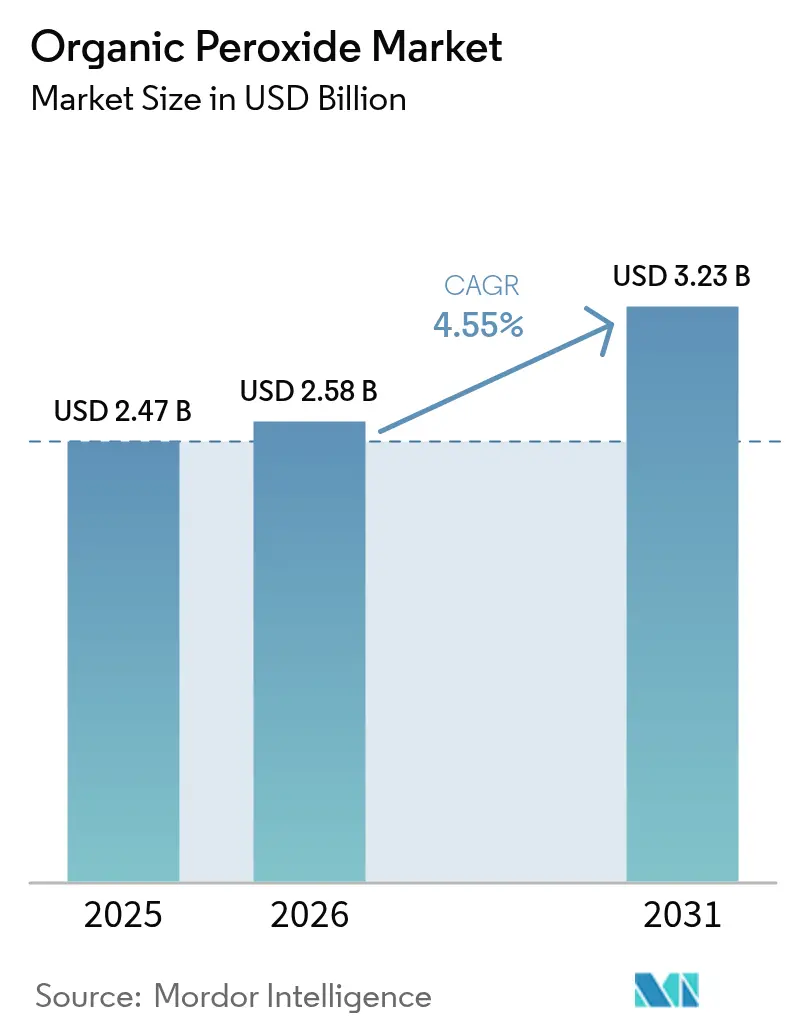
The Organic Peroxide market size is expected to grow from USD 2.47 billion in 2025 to USD 2.58 billion in 2026 and is forecast to reach USD 3.23 billion by 2031 at 4.55% CAGR over 2026-2031. The rising use of advanced polyethylene and polypropylene grades, rapid uptake of EVA solar encapsulants, and the shift toward VOC-free powder coating systems underpin demand growth. Producers are scaling capacity in Asia Pacific to serve polymer and composites customers that require tight specification control, while safety-focused paste and emulsion formats gain wider acceptance. At the same time, volatile feedstock pricing and higher insurance premiums for storage facilities continue to pressure margins, steering manufacturers toward renewable feedstocks and safer handling solutions. Asia Pacific anchors both volume and incremental demand, followed by steady but more specialized growth in North America and Europe, where sustainability regulations accelerate product substitution.
Key Report Takeaways
- By type, benzoyl peroxide led with a 23.70% revenue share in 2025; percarbonates are projected to grow at a 4.68% CAGR to 2031.
- By function, polymerization initiators accounted for 64.45% of the organic peroxide market size in 2025, while the same segment records the highest projected CAGR at 5.14% between 2026-2031.
- By form, liquid grades held 59.55% share of the organic peroxide market size in 2025; paste/emulsion formats are set to expand at a 5.41% CAGR to 2031.
- By application, polymers and rubber commanded 32.75% of the organic peroxide market share in 2025 and are advancing at a 4.55% CAGR through 2031.
- By geography, Asia Pacific captured 38.85% of the organic peroxide market share in 2025 and is forecast to rise at a 4.83% CAGR through 2031.
Note: Market size and forecast figures in this report are generated using Mordor Intelligence’s proprietary estimation framework, updated with the latest available data and insights as of 2026.
Global Organic Peroxide Market Trends and Insights
Drivers Impact Analysis*
| Drivers | (~) % Impact on CAGR Forecast | Geographic Relevance | Impact Timeline |
|---|---|---|---|
| Shift toward advanced PE and PP grades | +1.2% | Asia Pacific, Europe | Medium term (2-4 years) |
| Adoption in EVA solar encapsulants | +0.8% | China, Europe, Global | Short term (≤ 2 years) |
| Growth of VOC-free powder coatings | +0.7% | Europe, North America | Medium term (2-4 years) |
| Automotive lightweighting composites | +1.0% | Europe, North America, Global | Medium term (2-4 years) |
| Utilization in coating applications | +0.6% | Global | Short term (≤2 yrs) |
| Source: Mordor Intelligence | |||
Shift Toward Advanced PE and PP Grades
Rising requirements for controlled rheology polypropylene and high-melt-strength PP in packaging and automotive parts lift organic peroxide consumption across Asia Pacific. LyondellBasell raised recycled and renewable-based polymer output by 65% in 2024 to more than 200,000 t, with a target of 2 million t annually by 2030, increasing the need for organic peroxides that fine-tune molecular weight and branching. Processors report an 18% jump in PP processing efficiency when dicumyl peroxide is applied as a chain breaker, while branched PP made with Perkadox and Trigonox® grades delivers 30% better foam properties. As regional resin producers expand specialty capacity, the organic peroxide market gains a stable demand base.
Adoption of Organic Peroxides in EVA Solar Encapsulants
Fast-growing photovoltaic installations rely on EVA encapsulation sheets cross-linked with peroxides such as Luperox TBEC to reach gel contents above 75%, thereby enhancing module durability. China dominates EVA sheet output, and European module makers are also upgrading to higher-purity peroxide systems to curb power loss. These trends translate into steady incremental volumes for the organic peroxide market in the near term, especially for high-pressure polymerization grades that offer narrow decomposition profiles.
Growth of VOC-Free Powder Coatings in Europe
Bio-based UV-curable powder coatings that replace solvent-borne systems are gathering pace under tightening emission rules. New binder chemistries, including bio-alkyd and poly(limonene carbonate) resins, cure at lower oven temperatures and leverage peroxide initiators to build robust networks. As coaters pivot to energy-efficient processes, peroxide producers benefit from new, differentiated demand beyond traditional thermosets.
Automotive Lightweighting Drives Composite Applications
OEMs reinforce bumpers, pillars, and interior panels with fiber-reinforced plastics that require peroxide curing to achieve fast cycle times and superior mechanical properties. Studies show that dicumyl peroxide and 2,5-dimethyl-2,5-di(tert-butyl-peroxy)hexane raise composite tensile strength and modulus by up to 30%. As electric-vehicle platforms proliferate, demand for peroxide-cured composites supports robust growth across Europe and North America.
Restraints Impact Analysis*
| Restraints | (~) % Impact on CAGR Forecast | Geographic Relevance | Impact Timeline |
|---|---|---|---|
| Rising insurance premiums for storage | -0.5% | Europe, Global spillover | Short term (≤ 2 years) |
| Feedstock supply tightness | -0.8% | Asia, Global | Short term (≤ 2 years) |
| Rising cost of inhibitors for transit | -0.3% | Global, particularly affecting international trade routes | Medium term (≈3-4 yrs) |
| Source: Mordor Intelligence | |||
Insurance Premiums for Storage Facilities
Implementation of the revised ADR framework on 1 January 2025 elevates classification and inspection rigor for organic peroxide warehousing. European underwriters have lifted premiums for large-volume sites, raising operating costs and delaying expansion projects[1]United Nations UNECE, “ADR 2025 Framework,” unece.org. Producers are responding by optimizing inventory levels and investing in smaller satellite depots, yet higher fixed costs constrain margin expansion for the organic peroxide market.
Feedstock Supply Tightness
Prices for propylene oxide, a key precursor, slid 17% between October 2024 and May 2025 amid new capacity startups but weak downstream demand, increasing cost volatility for certain peroxide families. Concurrently, logistics bottlenecks in Asia limit raw-material availability, prompting sporadic production curtailments. This imbalance lifts inventory risk and tempers near-term growth expectations for the organic peroxide market.
*Our forecasts treat driver/restraint impacts as directional, not additive. The impact forecasts reflect baseline growth, mix effects, and variable interactions.
Segment Analysis
By Type: Benzoyl Peroxide Holds Lead as Percarbonates Gain Steam
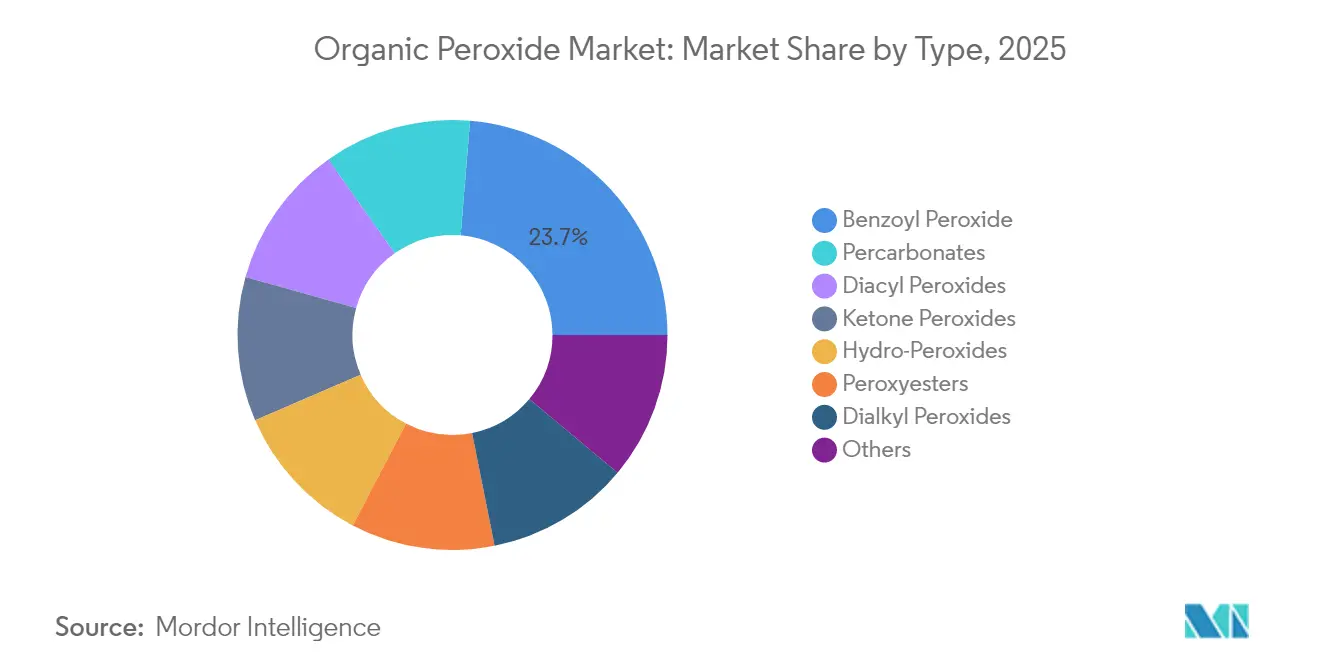
Benzoyl peroxide retained a 23.70% revenue share of the organic peroxide market in 2025, reflecting its dual usage in polymer initiation and topical dermatology. Industrial grade volumes dominate because free-radical polymerization remains a high-throughput route for styrenics and acrylics. Nevertheless, concerns over benzene contamination in certain consumer products have raised scrutiny, spurring product reformulation.
Percarbonates, propelled by eco-friendly credentials and broad cleaning-agent appeal, are the fastest-growing sub-segment at a 4.68% CAGR. Commercialization of percarbonate-based advanced oxidation processes for wastewater remediation broadens the customer mix and supports future share gains.



By Function: Polymerization Initiators Dominate, Cross-Linkers Follow
Polymerization initiators captured 64.45% of the organic peroxide market share in 2025 and are forecast to post a 5.14% CAGR to 2031. High throughput LDPE and PP facilities favor well-characterized initiators such as tert-butyl peroxy-2-ethylhexanoate owing to predictable decomposition kinetics. Cross-linking agents are the next-largest category, used in wire-and-cable jacketing, foam insulation, and composite parts that need dimensional stability at elevated temperatures. Curing and hardening agents, though smaller in volume, gain importance in advanced resin chemistries for 3D printing and high-pressure RTM composites.
By Form: Liquids Lead, Paste/Emulsion Formats Accelerate
Liquid grades held 59.55% of the organic peroxide market in 2025 thanks to simple pumping, quick dissolution, and broad compatibility with continuous polymer reactors. Nonetheless, paste and emulsion forms represent the fastest-growing category at 5.41% CAGR because they mitigate shipping and handling hazards. Nouryon’s Perkadox 16-40XPS illustrates how pumpable pastes reduce worker exposure and deliver uniform dispersion in bulk polyester resin formulations.
Growth in pultrusion, filament winding, and closed-mold composite processes accentuates demand for low-volatility pastes that allow precise metering at ambient temperatures. Liquid products will retain relevance in high-volume polymerization, but regulatory momentum favoring safer transport categories gives paste and emulsion suppliers a strategic opening to expand their share in the organic peroxide market.
By Application: Polymers and Rubber Remain Cornerstone of Demand
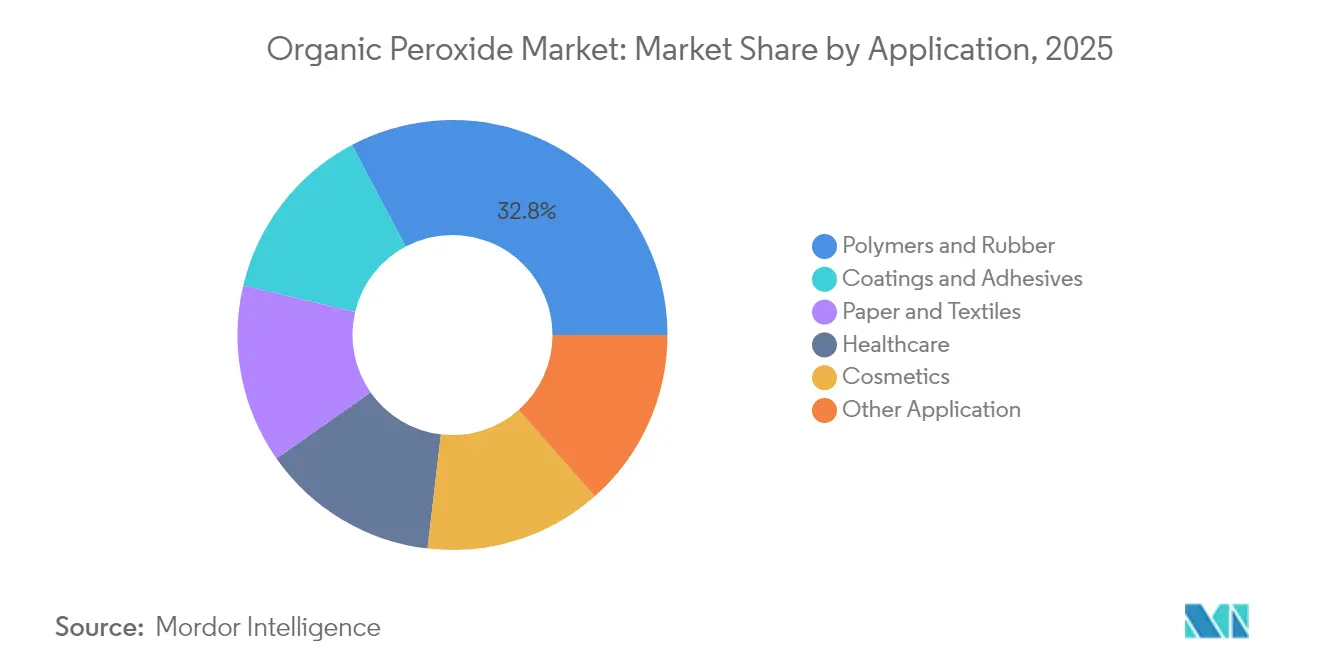
Polymer and rubber processing accounted for 32.75% of the organic peroxide market size in 2025 and is projected to grow at 4.55% through 2031. Cross-linking of thermoplastics with dicumyl peroxide is widely adopted to improve heat resistance in piping and cable insulation. Coatings and adhesives form the second-largest application group, where UV-curable formulations and powder coatings benefit from low-temperature peroxide initiators compatible with bio-based resins. Healthcare volumes, mostly benzoyl peroxide acne treatments, remain steady but could be influenced by ongoing toxicology reviews
Geography Analysis
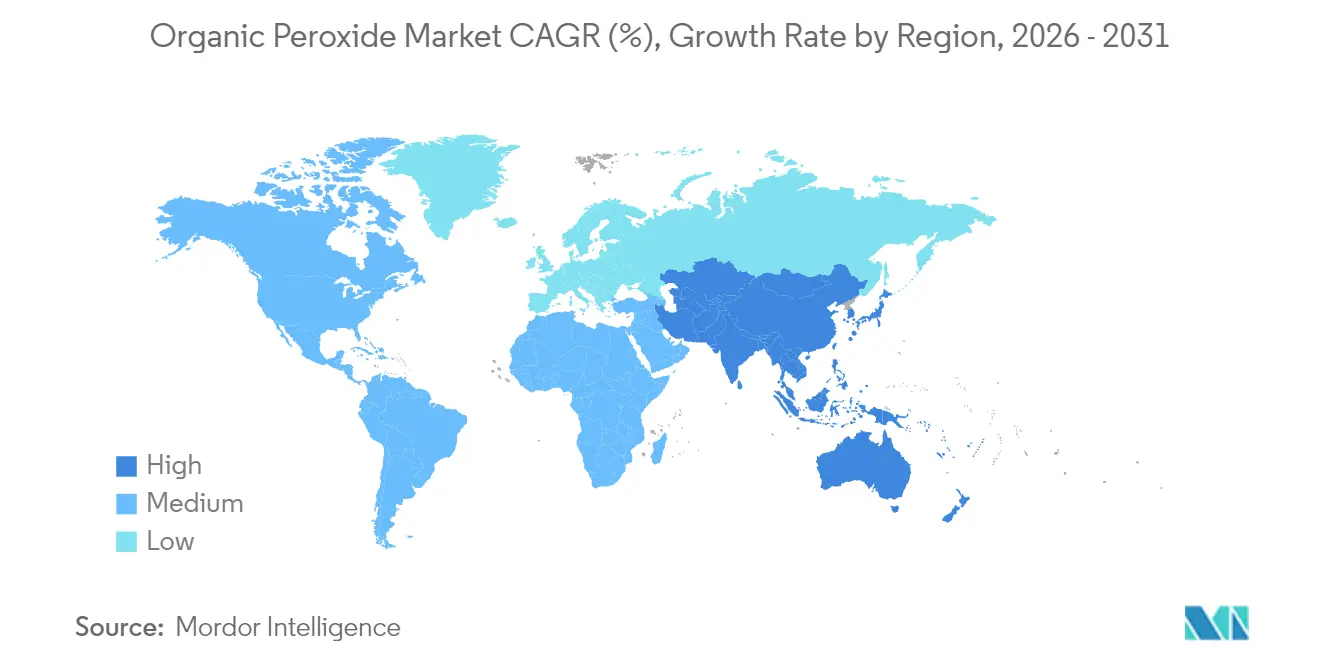
Asia Pacific held 38.85% of the organic peroxide market in 2025 and is growing at a 4.83% CAGR, supported by robust downstream plastics and elastomer capacity additions. China dominates regional demand, and Nouryon’s November 2024 expansion in Ningbo doubled the output of Perkadox 14 and Trigonox 101 to 6,000 tons, underscoring local appetite for controlled rheology modifiers.
North America is characterized by mature but value-added demand in automotive composites, healthcare, and high-purity semiconductor polymers. Producers emphasize safer formulations, and several have introduced emulsion-based initiators that align with stricter Department of Transportation guidelines on bulk peroxide transport.
Europe trails closely, with growth driven by environmental legislation that restricts VOC emissions and mandates safer carriage of dangerous goods. The ADR update, effective in 2025, imposes tighter storage segregation and training requirements, increasing operating costs but encouraging the adoption of paste and polymer-bound forms.

Value Chain Analysis
The organic peroxide value chain starts with petrochemical-derived feedstocks and intermediates, including propylene oxide-linked chemistries for certain families, as well as specialty acids and alcohols. Producers then carry out synthesis and stabilization before formulating into liquids, solids, or paste/emulsion grades designed for safer handling.
In practice, production is concentrated among established players such as Nouryon, Arkema, United Initiators, PERGAN GmbH, and NOF Corporation, where process safety, quality control, and consistent decomposition profiles are key differentiators for polymerization initiators and curing agents used in polyolefins, unsaturated polyester resins, and elastomers. Distribution is shaped by hazardous-goods requirements (UN Division 5.2) and temperature-managed logistics, which typically favor regional supply chains and local stocking points near polymer and composites clusters. Industry safety bodies including the European Organic Peroxide Safety Group (EOPSG), the American Chemistry Council Organic Peroxide Producers Safety Division (OPPSD), and the Japan Organic Peroxide Association (JOPA) influence handling practices and transport-and-storage guidance. Capacity additions close to demand centers, including Nouryon's November 2024 expansion in Ningbo, China (Perkadox 14 and Trigonox 101), show how supply assurance and compliance capability operate as barriers to entry and as levers in customer qualification with large polymer producers.
Competitive Landscape
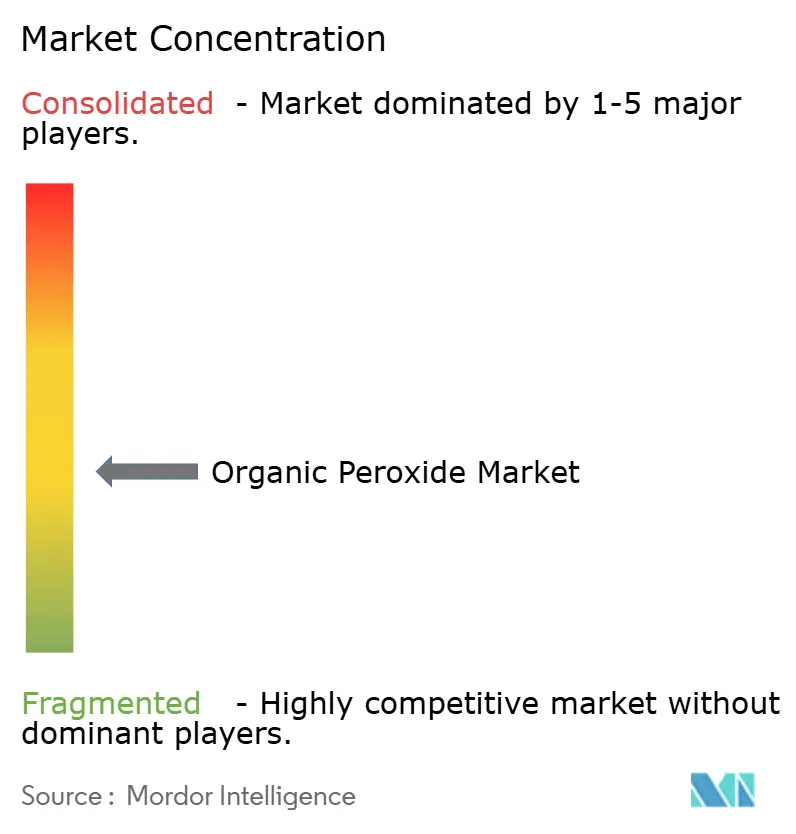
The organic peroxide market is moderately fragmented, with Nouryon, Arkema, United Initiators, and NOF Corporation holding a meaningful combined share. These players emphasize capacity builds in high-growth geographies. Strategic priorities center on safer, more sustainable formulations. Leading suppliers commercialize water-based emulsions and pumpable pastes that meet stricter transport classifications while improving dosing accuracy.
Organic Peroxide Industry Leaders
Nouryon
Arkema
NOF CORPORATION
PERGAN GmbH
United Initiators GmbH
- *Disclaimer: Major Players sorted in no particular order

Market Opportunities and Future Outlook
Circular-plastics upgrading is emerging as a focused opportunity where organic peroxides extend beyond conventional initiation and curing, supporting performance restoration for recycled polymers. In May 2026, Nouryon launched Perkadox PM-60ST-GR, positioned to restore recycled polypropylene performance in packaging, automotive, and consumer goods. This creates a clearer route for peroxide suppliers to expand with recycler and compounder accounts that require consistent melt and mechanical properties. In parallel, the April 2026 expansion of Nouryon and Safic-Alcan's pan-European distribution partnership to include organic peroxide solutions for plastic recycling reduces go-to-market friction by pairing application support with established specialty-chemical distribution reach.
Supply resilience and application-driven localization are also likely to matter most in Asia Pacific, where demand and qualification cycles track closely with regional polymer and composites manufacturing. The completed Nouryon Ningbo expansion (6,000 tons for Perkadox 14 and 6,000 tons for Trigonox 101) and Innovexar commencing commercial production of Perovion MEKP L38 at a new China manufacturing base in June 2026 broaden local sourcing options for resin curing systems. With tighter safety and carriage requirements, and continued scrutiny of storage-related costs, product formats that reduce handling risk, including pastes, emulsions, and other safer formulations, alongside supplier investments in application development infrastructure, such as Nouryon's planned organic peroxides innovation center in Tianjin announced in October 2025, offer a practical pathway for capturing value across advanced polyolefins, EVA solar encapsulants, and composites.
Recent Industry Developments
- May 2026: Nouryon launched Perkadox PM-60ST-GR, a commercially available organic peroxide solution aimed at restoring recycled polypropylene performance in packaging, automotive, and consumer goods. The launch brings organic peroxides more directly into circular plastics value chains, shifting demand pull toward recycler and compounder applications that require tighter property control.
- October 2025: Nouryon announced a new organic peroxides innovation center in Tianjin, China, scheduled for 2026 as part of its polymer specialties expansion program. The announcement supports local technical service and formulation development, which can shorten customer qualification timelines for advanced polyolefins and composites in Asia.
- November 2024: Nouryon completed a major capacity expansion for organic peroxides at its Ningbo, China site, doubling output to 6,000 tons for Perkadox 14 and 6,000 tons for Trigonox 101. The added capacity improves regional supply availability for controlled rheology modifiers and polymerization initiators used by high-volume polymer processors.


Research Methodology Framework and Report Scope
Market Definition and Coverage
This market covers the sales value of organic peroxides used as chemical initiators and curing or cross-linking agents across industrial applications. Figures are tracked at the product level across major producing and consuming regions, reported in current USD.
Scope exclusions: downstream polymer and rubber sales are not included, in-plant captive transfers without an observable market price are excluded, and services tied to handling and storage are not counted.
Segmentation Overview
- By Type
- Diacyl Peroxides
- Dialkyl Peroxides
- Ketone Peroxides
- Hydro-Peroxides
- Percarbonates
- Benzoyl Peroxide
- Peroxyesters
- Others
- By Function
- Polymerization Initiators
- Cross-Linking Agents
- Curing/Hardening Agents
- By Form
- Liquid
- Solid
- Paste/Emulsion
- By Application
- Polymers and Rubber
- Coatings and Adhesives
- Paper and Textiles
- Cosmetics
- Healthcare
- Other Application
- By Geography
- Asia-Pacific
- China
- India
- Japan
- South Korea
- ASEAN
- Rest of Asia-Pacific
- North America
- United States
- Canada
- Mexico
- Europe
- Germany
- United Kingdom
- France
- Italy
- Spain
- Nordics
- Rest of Europe
- South America
- Brazil
- Argentina
- Rest of South America
- Middle-East and Africa
- Saudi Arabia
- South Africa
- Rest of Middle-East and Africa
- Asia-Pacific
Data Sources, Market Sizing, and Validation
Desk Research
Desk work starts by anchoring the market to visible chemical production and trade signals, then mapping those signals into organic peroxide demand pockets by region. Public sources used here include UN Comtrade trade statistics, national customs and tariff schedules, the US International Trade Commission data tools, and Eurostat, which are checked together to confirm import and export patterns.
On supply and compliance, sources such as the European Chemicals Agency, the US Environmental Protection Agency, and peer-reviewed polymer and process-safety journals are used to verify product classifications, handling constraints, and end-use linkages. We also review company annual reports, investor presentations, and reputable press coverage to track capacity moves, plant outages, and any price or margin commentary. When needed, paid database subscriptions are used for company financials and intelligence, patent landscaping, and shipment-level import and export checks. The sources listed here are not exhaustive, and other public references were used to collect, validate, and clarify inputs.
Primary Interviews and Surveys
Primary work is used to validate the demand pool and price assumptions by speaking with producers, distributors, and large end users that consume organic peroxides in polymers, rubber, coatings, and adjacent uses. We also test region-level differences across APAC, EMEA, and the Americas so conversion factors, grade mix, and safety-driven logistics costs are reflected in the final conversion to market value.
Distribution of primary research fieldwork respondents
| Company type | Respondent position | Region |
|---|---|---|
| Top tier: 32% | CXOs: 18% | APAC: 43% |
| Mid tier: 50% | Functional/Unit leaders: 39% | EMEA: 35% |
| Smaller Players: 18% | Managers: 43% | Americas: 22% |
Market-Sizing & Forecasting
Sizing is built using a top-down approach. We use production, trade, and end-use demand indicators to reconstruct the addressable consumption of organic peroxides by region, then convert this into market value using typical pricing bands by form and grade. To keep totals realistic, we run selective bottom-up checks, including sampled supplier revenue ranges, distributor channel feedback, and ASP times volume sanity checks for a few high-use applications.
The model is shaped by polymer and elastomer output trends, initiator loading rates used in common processes, regional import dependence, typical price spread between solid and liquid forms, and plant utilization changes when new capacity is announced or when safety-related shutdowns occur. For forecasting, scenario analysis is used to reflect different paths for polymer demand, feedstock-linked pricing, and regulatory pressure on storage and transport, then the scenario is narrowed based on what industry participants view as the most likely planning case. When a direct bottom-up datapoint is missing for a small country or niche use, we use proxy indicators such as industrial output and trade intensity, and then re-check the implied per-capita consumption against comparable markets.
Data Validation & Update Cycle
Outputs are validated through multiple checks, including comparing modeled consumption to independent trade balances, checking price assumptions against recent contract and spot commentary, and flagging sharp year-to-year swings for review. If a variance cannot be explained by capacity shifts, regulation changes, or end-use cycles, we re-contact selected respondents and revise the input that is driving the mismatch.
Before sign-off, the model is reviewed in more than one analyst pass to keep assumptions, units, and currency conversions consistent across regions. The report is refreshed annually, and interim updates are made when material events occur, such as major plant expansions, prolonged outages, or sudden feedstock shocks. Right before delivery, a final update pass is completed so clients receive the most current view available.
Mordor Intelligence's Organic Peroxide Market Size Compared Against Other Published Estimates
Published market sizes for organic peroxide can differ widely, even when the topic name is the same. One driver is how each author draws the boundary and how the evidence is assembled for the product market. Differences often come from included product groups, the price points assumed, and how trade flows and local production are treated consistently.
Import and export balances, polymer output indicators, and reported capacity movements are used as evidence checks to keep Mordor Intelligence's estimate aligned to the tradable organic peroxide demand pool, rather than drifting into downstream polymer value or broader peroxide categories. The spread can widen when some publishers apply a single global ASP curve, use older currency timings, or do not re-check safety-driven logistics impacts that can shift delivered prices by region.
Benchmark comparison
| Source | Market Size | Gaps in Research Methodology |
|---|---|---|
| Mordor Intelligence | USD 2.58 B (2026) | |
| Trade Publisher A | USD 1.30 B (2024) | Uses an earlier base year and a narrower value pool, which can occur when only selected commercial grades or limited end uses are counted and trade-based cross-checks are not clearly reconciled. |
| Global Consultancy B | USD 2.13 B (2024) | Keeps a closer total, but the difference can be driven by base year timing and by applying broad regional averages for pricing and mix, which may not fully reflect form-level price spread and regional handling constraints. |
The table indicates that the largest gaps come from year selection and from how tightly the scope is tied to organic peroxide as a product market. By keeping the price and volume logic traceable to observable trade, capacity, and end-use signals, we produce an estimate that can be rechecked and updated without relying on unstated assumptions.


Key Questions Answered in the Report
What is driving growth in the organic peroxide market?
Steady expansion of advanced polyolefin production, rising use of composites in automotive lightweighting, and the need for high-performance solar encapsulants underpin demand.
Which region holds the largest organic peroxide market share?
Asia Pacific leads owing to substantial polymer manufacturing capacity and ongoing investments in local peroxide plants.
Why are paste and emulsion peroxide formulations gaining popularity?
They offer improved storage stability and lower handling hazards, aligning with stricter global safety regulations.
How do organic peroxides support sustainability goals?
They enable recycling-friendly polymer modification, facilitate low-VOC coatings, and assist in wastewater treatment via advanced oxidation processes.
What challenges does the organic peroxide industry face?
Feedstock price volatility, rising insurance premiums for hazardous-chemical storage in Europe, and evolving safety standards increase cost and compliance complexity.
What is the current size of the organic peroxide market?
The Organic Peroxide Market size is estimated at USD 2.58 billion in 2026, and is expected to reach USD 3.23 billion by 2031, at a CAGR of 4.55% during the forecast period (2026-2031).
Page last updated on:


 Your data is secure and never sold or shared.


