
North Carolina Self-Storage Market Size and Share
Market Overview
| Study Period | 2020 - 2031 |
|---|---|
| Forecast Data Period | 2026 - 2031 |
| Historical Data Period | 2020 - 2024 |
| Growth Rate | 4.91 % |
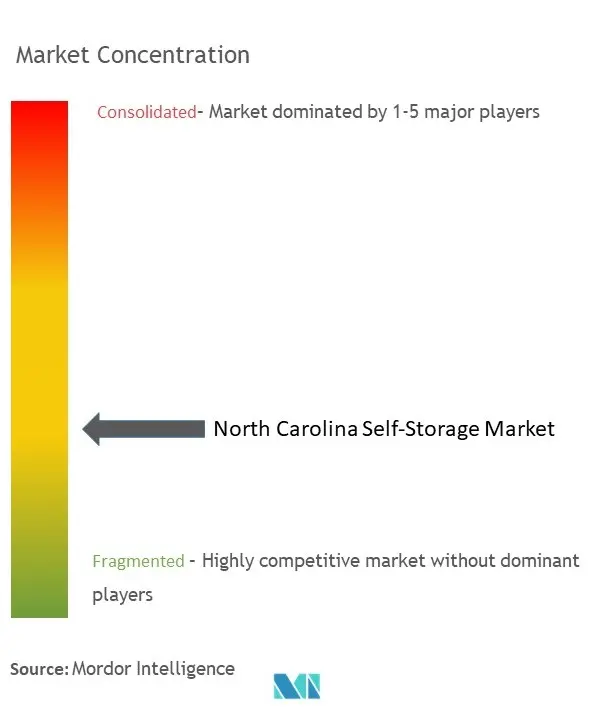
| Market Concentration | Medium |
Major Players *Disclaimer: Major Players sorted in no particular order Image © Mordor Intelligence. Reuse requires attribution under CC BY 4.0. | |
North Carolina Self-Storage Market Analysis by Mordor Intelligence
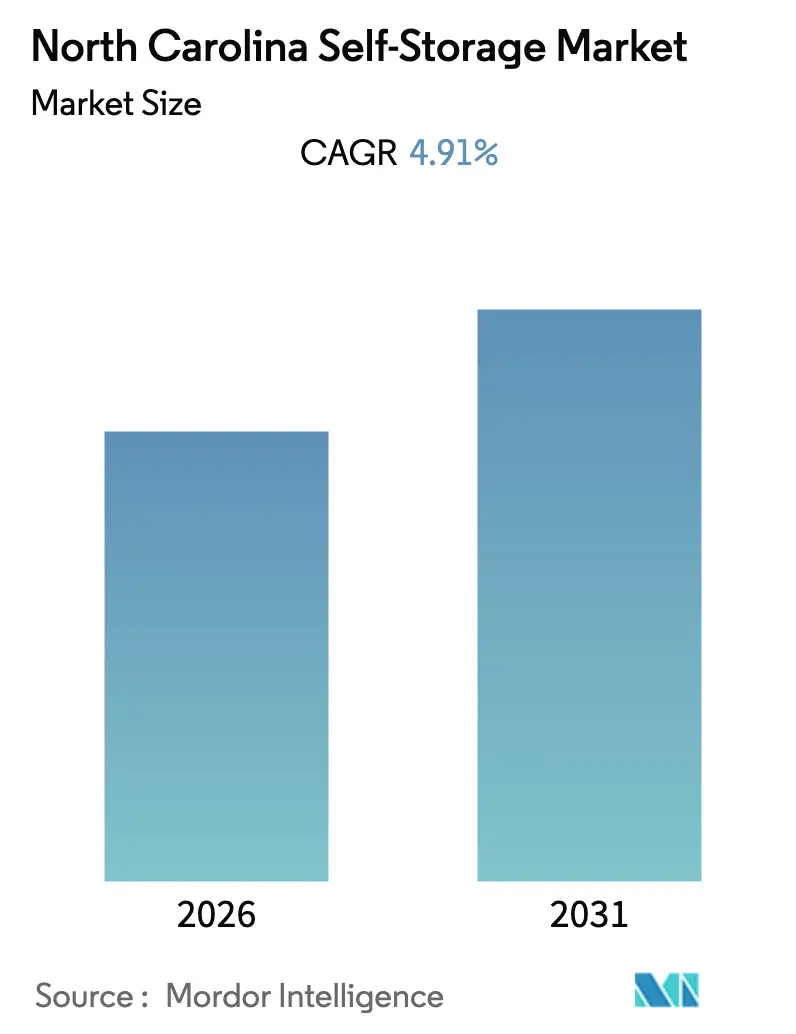
The North Carolina Self-Storage Market size is expected to register a CAGR of 4.91% during the forecast period 2026-2031.
The North Carolina self-storage industry is experiencing significant consolidation through strategic acquisitions and facility expansions, reflecting the sector's maturation and increasing institutional interest. According to the Self-Storage Association, the state currently hosts approximately 1,900 facilities encompassing 5.9 million square feet of storage space, demonstrating the robust infrastructure supporting this industry. This consolidation trend is exemplified by recent major transactions, such as Rosewood Property Company's acquisition of an 814-unit facility in Chapel Hill and VanWest's strategic expansion through its third fund targeting self-storage acquisitions across multiple states.
The industry is witnessing a technological transformation as operators increasingly embrace digital solutions to enhance operational efficiency and customer experience. Modern facilities are incorporating advanced features such as smart locks, automated access systems, and comprehensive security solutions. This technological evolution is particularly evident in new developments, such as the ModBox storage expansion in Mint Hill, North Carolina, approved in March 2023, which integrates modern security systems and digital management platforms across its planned 52,500 square feet facility with 200 storage units.
Real estate market dynamics continue to shape the self-storage landscape, with facilities strategically positioning themselves near high-traffic corridors and population centers. A prime example is the new storage facility development on U.S. Highway 501, which captures exposure to approximately 28,500 motorists daily, demonstrating the industry's focus on accessibility and visibility. The sector is responding to changing real estate patterns by offering flexible storage solutions that complement both residential and commercial storage requirements, particularly in urban areas where property costs are escalating.
The business model of self-storage facilities is evolving to accommodate diverse customer needs, with operators expanding their service offerings beyond traditional storage units. This evolution includes the integration of climate-controlled storage spaces, specialized business storage solutions, and enhanced security features. For instance, MV's new development in Fayetteville, North Carolina, completed in 2023, exemplifies this trend with its 105,000 square feet facility offering 808 units with various specialized storage options, reflecting the industry's adaptation to changing market demands and customer preferences.
Note: Market size and forecast figures in this report are generated using Mordor Intelligence’s proprietary estimation framework, updated with the latest available data and insights as of 2026.
North Carolina Self-Storage Market Trends and Insights
Increased Urbanization, Coupled with Smaller Living Spaces
The rapid urbanization trend in North Carolina's major cities is creating significant demand for self-storage facilities as residents adapt to smaller living spaces. This is particularly evident in Charlotte, which recorded a population of 2.2 million in 2022, representing a 3.38% growth from the previous year. The shift toward urban living has led to more people occupying apartments and smaller homes, with many residents seeking additional storage-unit solutions to complement their limited living spaces. The trend is further amplified by the rise in remote work, with Charlotte ranking as the sixth-best place for remote work among 100 major US cities, and 34.6% of its workforce operating remotely in 2022, necessitating home office spaces and creating additional storage-rental needs.
The increasing cost of urban real estate has made self-storage an economically viable solution for residents dealing with space constraints. This is reflected in the varying storage-unit rates across different neighborhoods, with prices ranging from $94 per month in Oakhurst to $207 per month in Rockwell Park - Hemphill Heights for standard units. The market has responded to this demand by offering diverse unit sizes, from 5x5 units at $45 per month to larger 10x20 units at $169 per month, providing flexible solutions for urban dwellers. The trend is further supported by North Carolina's robust construction activity, ranking third nationally in residential building permits issued, indicating continued urban development and the associated need for additional storage-rental solutions.
Improved Economic Outlook and Innovative Trends
North Carolina's strong and diverse economy has been steadily expanding, driving increased consumer spending and creating new opportunities in the self-storage sector. The market has embraced technological innovation, with providers implementing advanced features such as smart locks, online booking systems, and automated access controls to enhance customer experience. These technological advancements are particularly appealing to the growing younger, more diverse resident population, who have different preferences and expectations for storage-unit services. The integration of technology has made self-storage facilities more accessible and user-friendly, with features like 24-hour video surveillance, climate-controlled storage, and digital payment systems becoming standard offerings.
The market's evolution is also characterized by the introduction of value-added services and innovative storage solutions. Storage facilities are increasingly offering climate-controlled storage units, drive-through access, and enhanced security features to meet diverse customer needs. The industry has adapted to changing lifestyle trends, including the rise of digital nomadism and RV travel preferences, by providing specialized remote-storage solutions. Modern facilities now commonly feature amenities such as reception services, delivery acceptance, and flexible contract terms, making them more attractive to both personal storage and business users. These improvements in service offerings and facility features reflect the market's response to changing consumer demands and its ability to leverage economic growth for service enhancement.
Segment Analysis: By User Type
Personal Segment in North Carolina Self-Storage Market
The personal storage segment dominates the North Carolina self-storage market, commanding approximately 76.35% of the total market share in 2025. This significant market position is driven by the increasing demand from individuals requiring self-storage solutions for various life events such as relocating, downsizing, home renovations, and seasonal storage needs. The segment's strength is further bolstered by North Carolina's robust population growth, particularly in urban areas where living spaces are becoming more compact. The rising proportion of renters in American homes across North Carolina has also contributed to increased demand for personal storage solutions. Climate-controlled storage units and enhanced security features have become standard offerings in this segment, catering to customers storing valuable personal belongings, furniture, and household items. The segment's growth is also supported by the state's strong economic indicators, including improved employment rates and rising consumer spending power.

Business Segment in North Carolina Self-Storage Market
The business storage segment is emerging as the fastest-growing segment in the North Carolina self-storage market, projected to grow at approximately 6.88% during the forecast period 2026-2031. This accelerated growth is primarily attributed to North Carolina's business-friendly environment, characterized by lower tax burdens and a skilled workforce. The segment is witnessing increased adoption from small and medium-sized enterprises looking to optimize their operational costs by utilizing storage facility options instead of expanding office or retail space. Modern self-storage facilities are increasingly incorporating business storage amenities such as climate-controlled units, 24/7 access, enhanced security systems, and flexible rental terms to cater to commercial clients. The trend of businesses downsizing their physical office spaces while maintaining operations has created new opportunities for commercial storage providers, particularly in major business hubs across the state. Additionally, the integration of advanced technologies like online booking systems and automated access controls has made self-storage solutions more attractive to business customers seeking efficient and secure storage options.
Regulatory Landscape
Self-storage operations in North Carolina are primarily governed by lien and disposition requirements under North Carolina General Statutes Chapter 44A (self-service storage facility liens). G.S. 44A-43 lays out the process for enforcing a facility lien when rent is unpaid, including required notice and the ability to conduct a public sale or other commercially reasonable disposition of stored property after the statutory non-payment period, which shapes operators' collections workflows and auction practices. Separately, North Carolina insurance rules affect ancillary revenue, as G.S. 58-33-18 allows the North Carolina Commissioner of Insurance to issue limited licenses to self-service storage businesses or franchisees so they can offer insurance in connection with rental agreements.
Development and day-to-day facility operations are also shaped by local land-use controls and workplace safety requirements. Municipal zoning ordinances can restrict where self-service storage is permitted and how sites are designed. For example, the City of Raleigh Unified Development Ordinance includes specific use standards (such as limits on outdoor storage and other siting constraints) that influence feasibility and site selection in urban submarkets. On the operational side, facilities fall under applicable North Carolina Department of Labor OSH oversight for warehousing and storage activities, including OSHA-aligned standards for material handling and emergency planning, which drives compliance needs around safety procedures, training, and incident readiness.
Competitive Landscape
Top Companies in North Carolina Self-Storage Market
The North Carolina self-storage market features established players like Life Storage Inc., CubeSmart LP, NC Self Storage, Compass Self Storage, and Go Store It, among other prominent operators. Companies are increasingly focusing on technological innovation through the implementation of automated systems, mobile apps, and digital payment solutions to enhance customer experience and operational efficiency. Operational agility is being achieved through contactless rental processes, smart security systems, and climate-controlled storage units that cater to diverse storage needs. Strategic moves in the market include partnerships with moving companies, real estate agencies, and universities to expand service offerings and customer reach. Market players are actively pursuing expansion through new storage facility development and acquisitions, particularly in high-growth areas like Charlotte, Raleigh, and Durham, while also incorporating sustainable practices such as energy-efficient systems and renewable energy solutions to maintain a competitive advantage.
Dynamic Market with Strong Growth Potential
The North Carolina self-storage market exhibits a mix of national operators and local specialists, with larger companies like Life Storage and CubeSmart maintaining significant market presence through their extensive facility networks and technological capabilities. The market shows moderate consolidation with ongoing merger and acquisition activities, as demonstrated by companies like Rosewood Property Company and VanWest Partners actively acquiring facilities across the state. Regional players like Morningstar Storage and NC Self Storage maintain competitive positions through their deep local market knowledge and customer relationships, while national operators leverage their economies of scale and advanced operational systems.
The market is characterized by increasing investment activity from institutional players and real estate investment trusts (REITs), who are attracted by the sector's resilience and steady cash flows. Companies are differentiating themselves through value-added services such as wine storage, business storage solutions, and specialized military and student storage options. The competitive landscape is evolving with the entry of technology-driven operators who are challenging traditional storage models through innovative solutions and enhanced customer service offerings, while established players are responding by upgrading their facilities and service capabilities.
Innovation and Adaptability Drive Market Success
Success in the North Carolina self-storage market increasingly depends on operators' ability to leverage technology, optimize pricing strategies, and deliver superior customer experience. Incumbent players are focusing on expanding their digital capabilities, implementing revenue management systems, and developing value-added services to maintain their market positions. Companies are also emphasizing sustainability initiatives and community engagement to strengthen their brand presence and appeal to environmentally conscious customers. The ability to identify and capitalize on strategic locations, particularly in growing urban areas and near universities, remains crucial for market success.
Market contenders can gain ground by focusing on underserved submarkets, developing specialized storage solutions, and building strong local partnerships. The relatively moderate threat of substitution is offset by the growing demand for storage rental solutions driven by urbanization and changing lifestyle patterns. Regulatory considerations, particularly regarding zoning and development restrictions, continue to influence market dynamics and entry barriers. Companies that can successfully navigate these challenges while maintaining operational efficiency and customer satisfaction are better positioned for long-term success in the market.
North Carolina Self-Storage Industry Leaders
Life Storage Inc.
Cubesmart LP
NC Self Storage
Compass Self Storage
Go Store It
- *Disclaimer: Major Players sorted in no particular order


Recent Industry Developments
- June 2026: Highline Storage Partners closed on the acquisition of a 102,340 NRSF, 706-unit self-storage facility in Richlands, North Carolina. The transaction expands the company's North Carolina presence in a growing market and increases its regional asset base for portfolio growth.
- May 2026: Andover Properties acquired a self-storage facility in Garner, North Carolina, marking its seventeenth location in the state under the Storage King brand. The acquisition expands geographic coverage and adds to the company's portfolio scale and management footprint across NC self-storage operations.
- January 2026: Andover Properties acquired a self-storage facility in Cary, North Carolina. The deal adds an additional North Carolina facility to the company's growing portfolio, supporting increased market concentration and regional capacity for Storage King USA.


Research Methodology Framework and Report Scope
Market Definition and Coverage
For this report, the North Carolina self-storage market is measured as the annual value of self-storage space rented to customers in the state, captured as facility rental revenue across major cities and the remaining areas.
Scope exclusions: We exclude moving and packing retail sales, portable container storage, and residential or industrial warehousing that is not operated as self-storage.
Segmentation Overview
- By User Type
- Personal
- Business
- By Geography
- Charlotte
- Raleigh
- Greensboro
- Durham
- Winston-Salem
- Rest of North Carolina
Data Sources, Market Sizing, and Validation
Desk Research
Desk research was used to build the basic demand and supply picture for self-storage in North Carolina, and to sanity check our assumptions before talking to market participants. We referred to public sources such as US Census Bureau population and housing series, Bureau of Labor Statistics employment and wage data, and BEA state economic accounts to understand household formation and small business activity.
To connect these signals to storage demand, we also used sources such as USPS change-of-address trends, local planning and permitting portals where available, and industry association materials that discuss occupancy and rent movements. Company filings, investor decks, and reputable local press were reviewed to spot new openings, expansions, and pricing commentary. Where needed, we used paid subscriptions for company financials and news screening, and patent databases when relevant to facility-level access control and automation themes. This list is not exhaustive, and we reviewed many other sources for data collection, validation, and research clarification.
Primary Interviews and Surveys
We interview operators, developers, brokers, and storage users in the United States, with emphasis on North Carolina operations. Surveys and expert calls clarify occupancy, unit mix, move-in patterns, street rates, concessions, and expansion plans. We compare these responses with desk data to address gaps and triangulate the final state estimate.
Distribution of primary research fieldwork respondents
| Company type | Respondent position |
|---|---|
| Top tier: 28% | CXOs: 15% |
| Mid tier: 47% | Functional/Unit leaders: 35% |
| Smaller Players: 25% | Managers: 50% |
Market-Sizing & Forecasting
The market size is built using a top-down approach where state level demand is reconstructed from a rent-paying storage customer pool, typical occupied area, and achieved rent per square foot, which is then allocated across key cities and the rest of the state. We corroborate this with selective bottom-up checks using facility counts in major corridors, sampled unit mix, and channel checks on move-in promotions and effective rents to adjust the total when the two views diverge.
Inputs in the model include household growth and mobility, apartment share and average living space constraints, small business formation, facility pipeline indicators from permits, and pricing signals such as street rent versus effective rent after incentives. Where a local data series is patchy, we use metro analogs inside the state, followed by interview-based normalization for occupancy and discount depth. Forecasts are produced using scenario analysis that links future revenue to migration and housing activity paths, while the final rent and occupancy trajectories are aligned to what operators and brokers expect in the near term.
Data Validation & Update Cycle
Validation is done by triangulating the model outputs against independent signals such as facility openings, advertised rent direction, and macro indicators tied to moves and household formation. Outliers are flagged when implied occupancy, rent growth, or revenue per facility drifts away from what interviews and desk research suggest, and those points are reworked before sign-off.
A multi-step analyst review is followed so assumptions, calculations, and city splits are checked by a second reviewer, and re-contacts are triggered when large variances remain unexplained. Reports are refreshed annually, and interim updates are made when material events occur, such as a major permitting surge, unusual rent resets, or clear shifts in occupancy. Before delivery, we complete a final pass so clients receive the latest updated view.
Mordor Intelligence's North Carolina Self Storage Market Size Compared With Other Published Estimates
Published market size numbers for North Carolina self-storage often differ because the revenue boundary is not the same across studies, and because rent and occupancy are not always treated consistently across cities. Differences also show up when one estimate is anchored to advertised street rents, while another tries to adjust for incentives and the share of units that are actually occupied.
Key gap drivers usually include what is counted as self-storage revenue, how metro versus non-metro supply is audited, the base case used for rent growth, and how fast assumptions are refreshed when new facilities open. Currency timing is rarely a driver here since this is a single-state USD market, but refresh cadence and the way effective rents are derived can still shift the final value by a noticeable amount.
Benchmark comparison
| Source | Market Size | Gaps in Research Methodology |
|---|---|---|
| Mordor Intelligence | USD 1.28 B (2024) | |
| Industry Association A | USD 1.12 B (2024) | Uses member-reported facility revenue only, which can undercount independents and smaller towns, and it applies a simplified occupancy assumption rather than city-level normalization. |
| Regional Consultancy B | USD 1.55 B (2024) | Builds totals from advertised street rents and broad unit-area assumptions, and it often includes adjacent services like tenant insurance and admin fees without adjusting for promotions. |
The table shows a meaningful spread, and in Mordor Intelligence's model the value is limited to self-storage rental revenue in North Carolina, with effective rent adjustments that reflect incentives and occupancy patterns by city and the rest of the state. When the scope is tightened and the rent math is aligned to what customers pay, the result is easier to reconcile to observable facility activity and repeatable inputs.


Key Questions Answered in the Report
What is the current North Carolina Self-Storage Market size?
The North Carolina Self-Storage Market is projected to register a CAGR of 4.91% during the forecast period (2026-2031)
Who are the key players in North Carolina Self-Storage Market?
Life Storage Inc., Cubesmart LP, NC Self Storage, Compass Self Storage and Go Store It are the major companies operating in the North Carolina Self-Storage Market.
What years does this North Carolina Self-Storage Market cover?
The report covers the North Carolina Self-Storage Market historical market size for years: 2019, 2020, 2021, 2022, 2023, 2024 and 2025. The report also forecasts the North Carolina Self-Storage Market size for years: 2026, 2027, 2028, 2029, 2030 and 2031.
Page last updated on:





