
Market Overview
| Study Period | 2020 - 2031 |
|---|---|
| Forecast Data Period | 2026 - 2031 |
| Base Year Market Size (2025) | USD 14.15 Billion |
| Market Size (2026) | USD 14.67 Billion |
| Market Size (2031) | USD 17.56 Billion |
| Growth Rate (2026 - 2031) | 3.67 % |
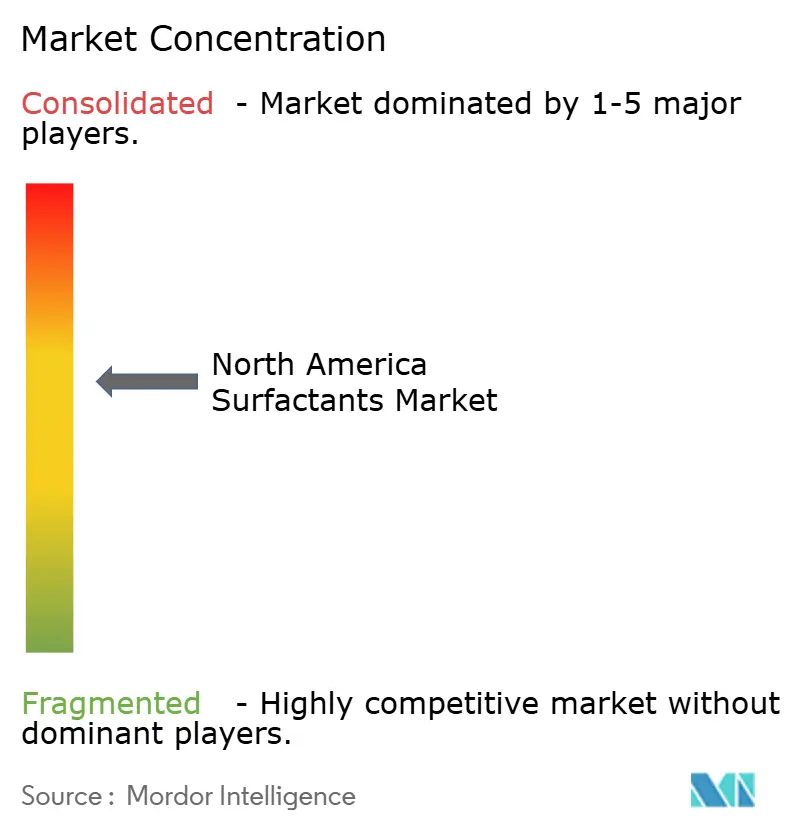
| Market Concentration | Medium |
Major Players *Disclaimer: Major Players sorted in no particular order Image © Mordor Intelligence. Reuse requires attribution under CC BY 4.0. | |
North America Surfactants Market Analysis by Mordor Intelligence
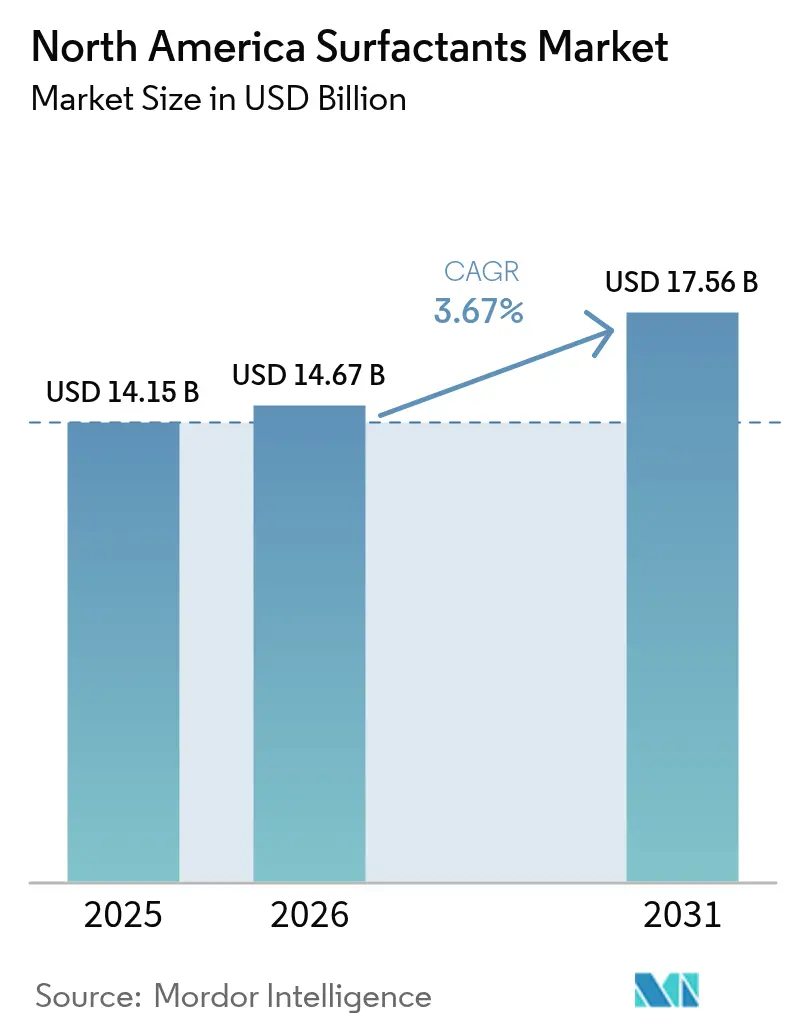
The North America surfactants market size in 2026 is estimated at USD 14.67 billion, growing from 2025 value of USD 14.15 billion with 2031 projections showing USD 17.56 billion, growing at 3.67% CAGR over 2026-2031. Growth stems from tightening U.S. and Canadian volatile-organic-compound rules, Mexico’s near-shoring–driven feedstock expansion, and formulators’ shift to bio-based grades that earn EPA Safer Choice and USDA BioPreferred labels. Non-ionic alcohol ethoxylates dominate high-efficacy household formats, while alpha-olefin sulfonates are enjoying renewed investment in concentrated laundry liquids. Enhanced-oil-recovery (EOR) projects in the Permian Basin now specify alkyl-propoxy-sulfate systems, which fetch premium pricing, partially offsetting slower growth in the personal-care sector. Supply security remains volatile because 20–30% quarter-to-quarter ethylene-oxide price swings compress margins for contract manufacturers lacking pass-through clauses.
Key Report Takeaways
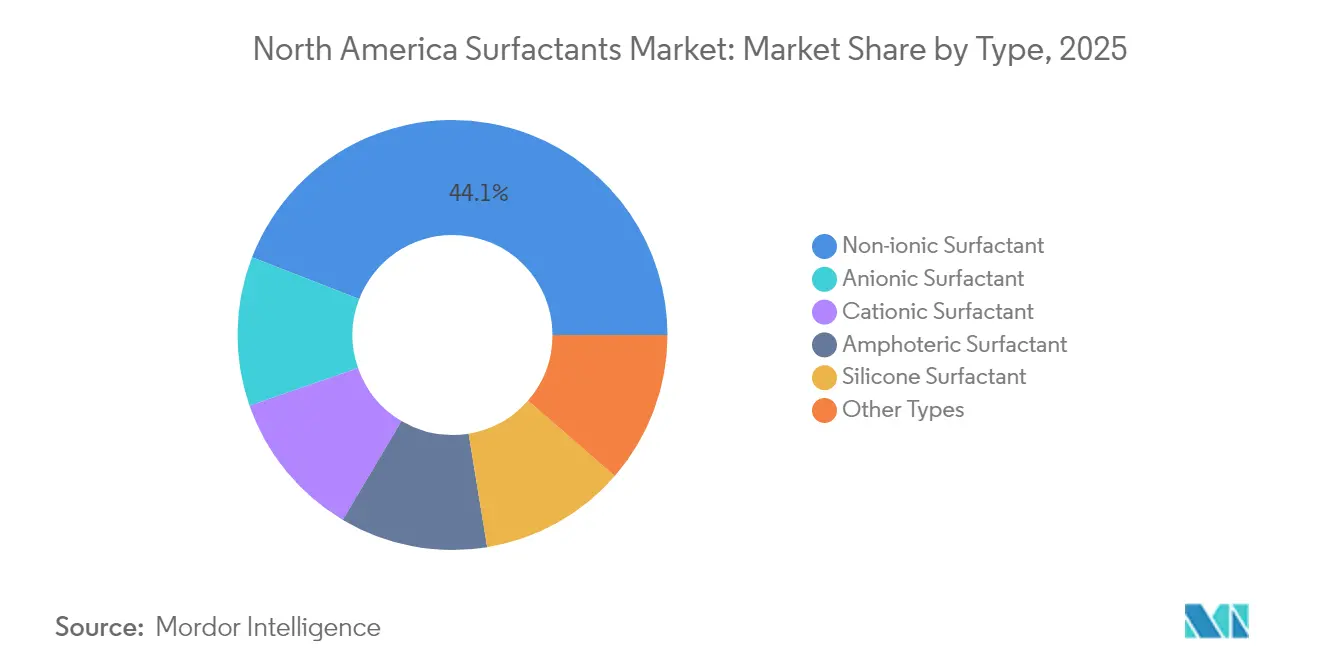
- By type, non-ionic surfactants accounted for 44.12% of the North America surfactants market share in 2025, while anionics led innovation pipelines with alpha-olefin-sulfonate debottlenecking.
- By origin, synthetics accounted for 76.05% of 2025 revenue; bio-based grades recorded the fastest growth rate of 3.92% through 2031.
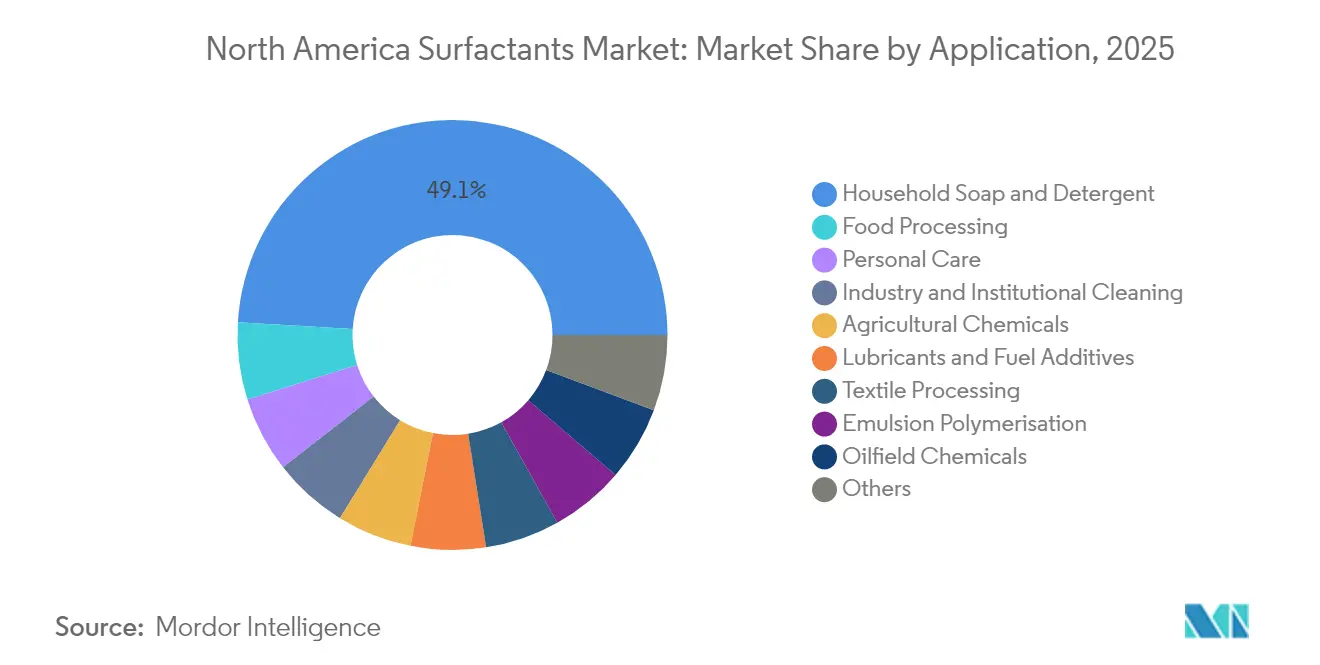
- By application, household soap and detergent accounted for 49.05% of volume in 2025; food processing is projected to register a 5.12% CAGR to 2031.
- By geography, the United States accounted for 78.70% of the 2025 value; Mexico represents the fastest-growing country at a 3.88% CAGR.
Note: Market size and forecast figures in this report are generated using Mordor Intelligence’s proprietary estimation framework, updated with the latest available data and insights as of 2026.
Market Trends and Insights
Drivers Impact Analysis of North America Surfactants Market*
| Drivers | (~) % Impact on CAGR Forecast | Geographic Relevance | Impact Timeline |
|---|---|---|---|
| Accelerating shift to bio-surfactants in home and personal-care formulations | + 0.9% | United States, Canada (EPA/CEPA compliance zones) | Medium term (2-4 years) |
| Growth of I&I and institutional cleaning post-COVID | + 0.7% | United States, Canada (commercial facilities, healthcare) | Short term (≤ 2 years) |
| Tightening U.S./Canadian VOC and toxicity regulations | + 0.8% | United States, Canada (federal and state-level enforcement) | Medium term (2-4 years) |
| Rising demand for high-performance surfactants in enhanced oil recovery | + 0.5% | United States (Permian Basin, Eagle Ford, Bakken) | Long term (≥ 4 years) |
| Commercialization of carbon-capture-derived feedstocks | + 0.4% | United States (Gulf Coast industrial corridors) | Long term (≥ 4 years) |
| Source: Mordor Intelligence | |||
Accelerating Shift to Bio-Surfactants in Home and Personal-Care Formulations
Brand owners embed minimum bio-content thresholds in supplier scorecards, shrinking the historic cost gap between petro-derived and renewable systems. Evonik commissioned a bio-succinic-acid line to service alkyl-polyglucoside demand, while Croda’s Atlas Point site rolled out 100% bio-based alcohol ethoxylates to secure USDA BioPreferred seals. California and New York bans on nonylphenol ethoxylates advance the transition as formulators pre-empt future restrictions. EPA’s August 2024 Safer Choice update allocates extra points for non-food-crop feedstocks such as camelina, guiding purchasing away from palm kernel[1]. Collectively, these measures accelerate the North America Surfactants market’s pivot to renewable inputs without compromising detergency targets.
Growth of I&I and Institutional Cleaning Post-COVID
Hospitals, restaurants, and office buildings locked higher cleaning frequencies into standard operating procedures after the pandemic, permanently lifting surfactant demand in sanitizers and floor cleaners. State rules that discourage quaternary ammonium compounds steer buyers toward anionic–nonionic blends that rinse cleanly and pose fewer residue concerns. Pilot Chemical and Innospec win share by offering pre-diluted concentrates that cut shipping weight and satisfy sustainability targets. Office occupancy stabilized in 2024, restoring janitorial budgets to pre-pandemic levels and boosting institutional volumes. Together these shifts lift I&I surfactant growth above household-care averages through 2027.
Tightening U.S. and Canadian VOC and Toxicity Regulations
Canada’s November 2024 CEPA amendments aligned aquatic-toxicity thresholds with EPA benchmarks, effectively banning products that contain more than 0.1% nonylphenol ethoxylates. The May 2025 Canada Biocides Regulations also capped residual 1,4-dioxane in alcohol ethoxysulfates at 10 parts per million, forcing upgrades at plants that lack vacuum stripping. In the United States, California proposes PFAS restrictions that would bar fluorinated surfactants in firefighting foams by 2027, compressing the reformulation window for industrial cleaners. This patchwork means a formula approved in Texas can be illegal in Ontario or California, raising compliance costs and rewarding suppliers with flexible production footprints. The rising bar on toxicity and VOCs keeps regulatory agility at the forefront for every regional producer.
Rising Demand for High-Performance Surfactants in Enhanced Oil Recovery
Chevron’s Permian pilots showed that alkyl-propoxy-sulfate packages unlock 8–12% extra crude from mature wells, proving the commercial value of premium EOR surfactants. These blends must tolerate high salinity and temperature while driving down interfacial tension, requirements that exclude most commodity grades and justify price premiums of 30–50%. The U.S. Energy Information Administration expects national crude production to plateau at around 13 million barrels per day through 2030, making EOR a key lever to extend field life without new drilling. BASF and Stepan tailor sulfonate and ethoxylate ratios to each reservoir, locking in multiyear supply contracts that protect margins from spot volatility. This niche, although small in volume, delivers outsized profitability and offsets slower growth in personal care.
Restraints Impact Analysis of North America Surfactants Market*
| Restraint | (~) % Impact on CAGR Forecast | Geographic Relevance | Impact Timeline |
|---|---|---|---|
| Petro-feedstock price volatility and supply shocks | -0.6% | United States, Canada, Mexico (petrochemical import-dependent regions) | Short term (≤ 2 years) |
| Aquatic-toxicity scrutiny of legacy LAS/NPE grades | -0.4% | United States, Canada (EPA/CEPA enforcement zones) | Medium term (2-4 years) |
| Limited regional capacity for specialized microbial strains | -0.3% | United States, Canada (biosurfactant fermentation hubs) | Long term (≥ 4 years) |
| Source: Mordor Intelligence | |||
Petro-Feedstock Price Volatility and Supply Shocks
WTI crude oscillated between USD 70 and USD 85 per barrel through 2024, resulting in 20–30% swings in ethylene oxide spot prices that compressed producer margins. Mexican ethane diversification eases some pressure, yet Braskem Idesa’s new import terminal also feeds polymers, limiting relief for surfactants. Import-dependent Canadian formulators face dual freight and currency risk because all ethylene oxide must cross borders. Such volatility discourages long-cycle capital projects, slowing capacity additions despite steady demand growth. The result is a fragile cost base for regional toll manufacturers serving the North America surfactants market.
Aquatic-Toxicity Scrutiny of Legacy LAS and NPE Grades
Peer-reviewed studies in 2024 showed nonylphenol ethoxylates persisting in river sediments and disrupting endocrine systems at just 5 µg L⁻¹, well below many discharge limits. California banned NPEs in consumer products beginning January 2025, prompting reformulation of laundry and dishwashing lines nationwide. Linear-alkylbenzene-sulfonates face softer but growing pressure as EPA aquatic benchmarks set a chronic limit of 35 µg L⁻¹ for freshwater invertebrates. Formulators migrate toward methyl-ester-sulfonates and alcohol-ethoxysulfates, which degrade faster and lack the aromatic ring linked to bioaccumulation. Switching chemistry demands new esterification and sulfonation equipment, raising capital costs and complicating supply chains.
*Our forecasts treat driver/restraint impacts as directional, not additive. The impact forecasts reflect baseline growth, mix effects, and variable interactions.
North America Surfactants Market Segment Analysis
By Type:
Non-Ionics Anchor Volume, Anionics Drive InnovationNon-ionic surfactants accounted for 44.12% of the 2025 volume, driven by the utility of alcohol-ethoxylates in concentrated pods that require high detergency at low doses. The North American surfactants market size for non-ionics is forecast to rise 3.78% annually as institutional sanitizers continue to shift to low-foam blends that expedite rinse cycles. California’s nonylphenol-ethoxylate ban pushes suppliers toward fatty-acid-ester and alkyl-polyglucoside substitutes, both of which qualify for EPA Safer Choice labels. Anionic surfactants remain the workhorse: Stepan’s 25% alpha-olefin-sulfonate expansion underscores confidence that sulfonate demand in laundry and dishwashing will hold even as biosurfactants scale. Regulatory scrutiny of linear-alkylbenzene sulfonates boosts secondary-alkane and methyl-ester sulfonates, especially for products exported to Europe under the EU Detergents Regulation.
Specialty cationic quats face headwinds because proposed California disinfectant limits reduce QAC inclusion, yet uses in fabric softeners and hair conditioners preserve modest growth. Amphoterics such as betaines gain popularity in sulfate-free shampoos that require mildness and stable foam. Silicone surfactants remain a niche market, primarily focused on agrochemical adjuvants and polyurethane foams, where their unique spreading properties justify premiums. Overall, non-ionics maintain baseline volume while anionics innovate, ensuring that type-level demand within the North America Surfactants market remains broad and defensible.

By Origin:
Synthetic Dominance Erodes as Bio-Based Chemistries ScaleThe synthetic surfactant segment accounted for 76.05% share of the North America surfactants market in 2025. However, the bio-based cohort expands at a 3.92% CAGR, combining feedstock retrofits at Dow and Croda with fermentation advances by Locus Bio-Energy. Chemically synthesized biosurfactants leverage existing alkoxylation assets, creating drop-in replacements that avoid the need for greenfield capital. True microbial rhamno- and sophorolipids deliver best-in-class biodegradability but remain capacity-constrained. Nonetheless, brand owners award shelf space to high-bio-content labels, incentivizing supply contracts that increase the North American Surfactants market's exposure to renewable pathways over the forecast horizon.
Carbon-capture-derived feedstocks offer a third route. LanzaTech and Twelve each pilot CO₂-to-ethylene flowsheets that could decouple ethylene supply from petrovolatility if tax credits and off-take agreements mature. Hybrid approaches, where 50% of the molecule originates from renewable carbon, dominate near-term launches because they strike a balance between cost and sustainability claims. As fermentation yields improve, the synthetic share will erode gradually, yet synthetics will still occupy the majority of the North America Surfactants market by 2031 because of cost, scale, and performance advantages.
By Application:
Household Detergents Hold Share, Food Processing SprintsHousehold soap and detergent commanded 49.05% of the 2025 volume. The North American surfactants market size for laundry liquids alone exceeded USD 6 billion, driven by cost-efficient linear alkylbenzene sulfonate systems and rising pod penetration. Unit volumes remain flat as consumers extend wash cycles, but surfactant grams per wash incrementally increase in ultra-concentrated formats. Personal-care demand edges up because sulfate-free claims trigger reformulations toward mild amphoterics. Procter & Gamble’s Tide Evo waterless cartridge system suggests a potential for longer-term volume displacement if solid-dose adoption accelerates.
Food processing is the fastest-growing end use, with a 5.12% CAGR, driven by plant-protein extraction, emulsified beverages, and fruit-washing systems that must comply with FDA food-contact regulations. Only surfactants listed in Title 21 CFR or holding GRAS status can be used in contact with food, funneling demand toward polysorbates and sorbitan esters while constraining the penetration of biosurfactants. Oilfield chemicals benefit from EOR pilots in the Permian, adding a niche but margin-rich outlet. Agricultural, textile, and emulsion-polymer segments round out the mix, each influenced by localized regulatory and performance requirements.
Geography Analysis
United States Surfactants Market
The United States generated 78.70% of 2025 revenue, thanks to Gulf Coast alkoxylation hubs, stringent EPA rules that discourage imports, and adjacency to household, institutional, and oilfield users. Dow increased regional alkoxylation capacity 70% since 2019, while BASF’s Geismar site integrated biomass-balance feedstocks to meet brand mandates without new builds. California and New York function as regulatory pacesetters, with bans on nonylphenol ethoxylates and pending quaternary-ammonium limits pushing nationwide reformulation. Though mature, the U.S. market sustains value growth through specialty grades and margin defense.
Canada Surfactants Market
Canada mirrors U.S. statutes yet lacks indigenous ethylene-oxide capacity, relying on imports from Dow’s Alberta plant or Gulf Coast shipments. In November 2024, CEPA amendments synchronized aquatic-toxicity limits with EPA benchmarks, effectively banning nonylphenol ethoxylates above 0.1% weight and restricting residual 1,4-dioxane. The market size is roughly one-tenth of the U.S. figure, curtailing dedicated capacity spending and encouraging cross-border tolling.
Mexico Surfactants Market
Mexico is the fastest-growing geography, with a 3.88% CAGR, driven by near-shoring of consumer-goods lines, Braskem Idesa’s USD 450 million ethane terminal, and rising detergent penetration. Stepan’s 50,000 tpa Mexican facility supplies a portion of local demand, but approximately 60% of surfactant feedstocks still cross the U.S. border, leaving producers vulnerable to logistics and tariff swings. Infrastructure under-investment limits capacity additions, suggesting continued import reliance even as domestic demand rises.
Regulatory Landscape
Regulation in North America is tightening around toxicity, persistence, and trace contaminants in surfactant systems, which is accelerating reformulation away from legacy chemistries and increasing documentation burdens across multi-country supply chains. In the United States, the U.S. Environmental Protection Agency finalized the first-ever National Primary Drinking Water Regulation for six PFAS in April 2024, which increases compliance pressure for upstream chemical stewardship and downstream wastewater and water-treatment performance. This can affect acceptance of fluorinated surfactants in industrial and specialty uses.
PFAS data transparency is also expanding under TSCA. EPA set the TSCA Section 8(a)(7) PFAS reporting submission window for April 13, 2026 through October 13, 2026, pushing manufacturers and importers to map PFAS content and historical volumes through distributors and tollers. In Canada, Environment and Climate Change Canada published its Chemicals Management Plan assessment for the Alkanolamines and Fatty Alkanolamides Group in the Canada Gazette in June 2026, which raises scrutiny of surfactant-relevant ingredients used across consumer and industrial formulations. Canada is also scheduled to repeal and replace the Prohibition of Certain Toxic Substances Regulations, 2012 on June 30, 2026, reinforcing the need for proactive compliance review by suppliers serving both CEPA- and EPA-aligned markets.
Value Chain Analysis
The North America surfactants value chain runs from petrochemical and oleochemical feedstocks into intermediate production (ethylene oxide, fatty alcohols, LAB/LAS precursors), then into core surfactant unit operations such as ethoxylation, sulfation/sulfonation, amidation, and blending. Large-scale output is concentrated near U.S. Gulf Coast petrochemical corridors to leverage ethylene and benzene availability. Mexico demand growth and near-shoring also increase cross-border movements of intermediates and finished blends, while price volatility in ethylene oxide and dual exposure to fatty-alcohol pricing remain key margin drivers for SLES/AES and related families.
Operationally, planned shutdown cycles and maintenance turnarounds, commonly clustered in the February to June window for EO and downstream surfactant assets, create periodic tightness that cascades into formulators' lead times and spot pricing. Producers respond through feedstock flexibility and brownfield debottlenecking. Application pull is increasingly supported by technology and formulation know-how, including the July 2026 technology licensing announcement from Chevron and ZL Chemicals for advanced chemical surfactant technology marketed under the Vantis brand for enhanced oil recovery, which illustrates how licensing and application engineering can complement manufacturing scale for higher-margin niches.
Competitive Landscape
The North America surfactants market is moderately fragmented. The larger companies, such as Evonik and Stepan, pursue three key levers: renewable feedstock integration, brownfield debottlenecking, and expansion of their Mexico-focused footprint. Biosurfactant specialists race to scale fermentation but remain capital-constrained; neither has locked multi-year offtake contracts to underwrite large plants. Integrated oil majors also push downstream. Meanwhile, large brand owners such as L’Oréal file in-house surfactant patents, signaling partial disintermediation. Success in this evolving landscape hinges on regulatory agility, feedstock flexibility, and the rapid commercialization of novel chemistries before capacity is locked in.
North America Surfactants Industry Leaders
-
Stepan Company
-
BASF
-
Dow
-
Solvay
-
Kao Corporation
- *Disclaimer: Major Players sorted in no particular order
North America Surfactants Market Companies Covered in this Report
- 3M
- Ashland
- BASF
- CLARIANT
- Croda International Plc
- Dow
- Evonik Industries AG
- GALAXY
- Godrej Industries Limited
- Henkel Corporation
- Innospec
- Kao Corporation
- MITSUI CHEMICALS AMERICA, INC.
- Nouryon
- Procter & Gamble
- Sasol
- Solvay
- Stepan Company
Market Opportunities and Future Outlook
Premiumization through reformulation and compliance-ready portfolios is an investable opportunity as scrutiny rises on fluorinated chemistries, residual contaminants, and aquatic-toxicity profiles. EPA Safer Choice and USDA BioPreferred-aligned product design supports higher-bio-content substitutions. Supply-side movement is already visible: in April 2026, Kensing introduced the Regenyl and Revolis upcycled, fermentation-derived biosurfactant platform for personal and home care, and in May 2026 Dispersa launched commercial-scale production of upcycled sophorolipid biosurfactants at 100 tonnes per year, expanding options for formulators seeking renewable claims beyond conventional oleochemical routes.
Capacity and process investment in anionics and specialty chemistries is another practical lever, particularly for concentrated household formats, I&I cleaning, and performance-demanding industrial uses, with the additional goal of improving domestic supply resilience. Stepan lifted North American AOS capacity by 25% in June 2025, and Colonial Chemical announced a 15% capacity expansion in amphoteric and imidazoline chemistries via two new reactors at its South Pittsburg, Tennessee site in September 2025. In parallel, oilfield chemicals continues to offer a margin-rich outlet where application specificity matters, with the July 2026 technology licensing agreement between Chevron and ZL Chemicals for advanced chemical surfactant technology for enhanced oil recovery reinforcing whitespace for suppliers that can combine reservoir-tailored packages with dependable regional manufacturing and technical service.
Recent Industry Developments in North America Surfactants Market
- July 2026: Chevron and ZL Chemicals announced a technology licensing agreement for advanced chemical surfactant technology that ZL Chemicals plans to market under the Vantis brand for enhanced oil recovery. The agreement broadens access to specialized EOR surfactant know-how and strengthens the role of licensing and application engineering in capturing value beyond commodity surfactant supply.
- June 2025: Stepan completed capital investments and process enhancements that increased North American alpha olefin sulfonates (AOS) production capacity by 25% across its Millsdale, Illinois, Anaheim, California, and Winder, Georgia facilities. The added output supports domestic anionic availability for concentrated laundry and dish formats and reduces reliance on tighter spot markets during feedstock disruptions.
- January 2025: Croda unveiled 100% bio-based ECO alcohol ethoxylates at its Atlas Point site to address demand tied to USDA BioPreferred-aligned formulations. The launch expanded commercial supply of renewable non-ionic options for home and personal care, helping brand owners meet bio-content targets without sacrificing performance in high-efficacy formats.
North America Surfactants Market Report Scope and Research Methodology
Market Definition and Coverage
For this study, the market is defined as the revenue generated from surfactants sold in North America, counted at the point of sale of the surfactant product across key end-use formulations and industrial applications.
Scope exclusions: We exclude soap-only products and we do not count downstream finished-goods retail sales values (for example, detergent or shampoo retail revenue).
Segments Covered in This Report
- By Type
- Anionic Surfactant
- Linear Alkylbenzene Sulfolane (LAS or LABS)
- Alcohol Ethoxysulfates (AES)
- Alpha Olefin Sulfonates (AOS)
- Secondary Alkane Sulfonate (SAS)
- Methyl Ester Sulfonates (MES)
- Sulfosuccinates
- Others
- Cationic Surfactant
- Quaternary ammonium compound
- Others
- Non-ionic Surfactant
- Alcohol ethoxylate
- Alkylphenol ethoxylate
- Fatty acid ester
- Others
- Amphoteric Surfactant
- Silicone Surfactant
- Other Types
- Anionic Surfactant
- By Origin
- Synthetic Surfactant
- Bio-based Surfactant
- Chemically-Synthesized Bio-Based Surfactants
- Biosurfactants
- By Application
- Household Soap and Detergent
- Personal Care
- Lubricants and Fuel Additives
- Industry and Institutional Cleaning
- Food Processing
- Oilfield Chemicals
- Agricultural Chemicals
- Textile Processing
- Emulsion Polymerisation
- Others
- By Geography
- United States
- Canada
- Mexico
Data Sources, Market Sizing, and Validation
Desk Research
Desk work starts with anchoring the demand pool and the supply context for surfactants in North America, and then mapping how that demand typically splits by end-use like home care, personal care, and industrial cleaning. We reference public sources such as the US Environmental Protection Agency (including Safer Choice), the US Department of Agriculture (including BioPreferred program information), Statistics Canada, and the US International Trade Commission trade statistics to sanity-check direction, not to force-fit a number.
We also review company annual reports, investor presentations, and product technical brochures to understand which surfactant chemistries are being pushed into which applications, then we scan reputed press coverage for capacity moves and major regulatory actions. Where it helps, a paid subscription for company financials and news intelligence is used to cross-check reported revenue exposure, and a patent database is used to see whether claims around bio-based and mild chemistries are translating into activity. The sources listed here are illustrative and not exhaustive, since many other public references are used during collection, validation, and clarification.
Primary Interviews and Surveys
Primary work is used to confirm what is actually being purchased and reformulated, especially when feedstock swings and compliance requirements change pricing and product mix mid-year. We speak with producers, distributors, formulators, and large end users across the United States, Canada, and Mexico so assumptions on application splits, pricing progression, and substitution between surfactant types can be pressure-tested before totals are finalized.
Distribution of primary research fieldwork respondents
| Company type | Respondent position |
|---|---|
| Top tier: 36% | CXOs: 15% |
| Mid tier: 43% | Functional/Unit leaders: 32% |
| Smaller Players: 21% | Managers: 53% |
Market-Sizing & Forecasting
Sizing is built using a top-down demand reconstruction, where end-use activity in home care, personal care, industrial and institutional cleaning, and selected industrial uses is converted into surfactant demand through penetration and formulation intensity assumptions, and then translated into revenue using average selling price (ASP) ranges by surfactant family. The totals are then checked using selective bottom-up approximations such as sampled supplier revenue exposure, distributor channel checks, and volume times ASP calculations for a few high-volume chemistries.
Inputs that meaningfully move the model include ethylene oxide and fatty alcohol cost direction (as a proxy for price pressure), mix shifts between anionic and non-ionic grades, the pace of bio-based substitution, the share of concentrated detergent formats, and activity in oilfield and industrial cleaning where usage can swing with cycles. For forecasting, we apply scenario analysis supported by expert consensus, because a single trend line often breaks when feedstocks move fast or when a regulatory change pulls forward reformulation. When bottom-up gaps exist, they are handled by using conservative coverage factors and then re-checking against import-export signals and application-level demand markers so the final number stays realistic.
Data Validation & Update Cycle
Validation is done in several passes so the model does not rely on one data stream. We compare outputs against independent signals like trade movement, major capacity announcements, and application demand direction, and then investigate large variances before analyst sign-off.
The model is reviewed internally for arithmetic integrity, assumption consistency, and year-on-year reasonableness, followed by re-contact triggers when a price shock, regulation, or a supply disruption creates a break from prior patterns. Reports are refreshed annually, with interim updates for material events, and a final pre-delivery scan is completed so clients receive the latest updated view.
Mordor Intelligence's North America Surfactants Market Size Compared With Other Published Estimates
Published market sizes for North America surfactants can look far apart because the timing and pricing choices behind the math differ, even when the topic name sounds the same. Differences usually come from which countries are counted in North America, whether the scope stays at surfactant sales value or drifts into downstream formulations, and how price escalation is handled during feedstock volatility.
A refresh-led gap is also common, since currency timing, inflation pass-through, and the month range used for ASPs can move the current-year value by a visible margin. By keeping the ASP window consistent with the base-year pricing cycle and re-checking assumptions close to publication when ethoxylate-linked costs swing, Mordor Intelligence ties the final number to a more comparable time stamp.
Benchmark comparison
| Source | Market Size | Gaps in Research Methodology |
|---|---|---|
| Mordor Intelligence | USD 14.15 B (2025) | |
| Regional Consultancy A | USD 15.97 B (2024) | Uses a different base year and limits geography to the United States and Canada, and the value can shift based on the specific months chosen to average ASPs during feedstock-driven moves. |
| Industry Association B | USD 18.51 B (2024) | Uses a broader geography that includes Latin America, so the total is not directly comparable to a North America-only definition even if application lists appear similar. |
Across the three figures, the biggest drivers are scope boundary and the year and price window used for conversion from volume to value. With clear geographic limits and repeatable checks tied to observable inputs, the final number stays traceable and can be refreshed without changing core assumptions.
Key Questions Answered in the Report
How big is the North America Surfactants market in 2026?
The North America Surfactants market is valued at USD 14.67 billion in 2026.
What is the expected CAGR for surfactants across North America through 2031?
The compound annual growth rate is projected at 3.67%.
Which surfactant type holds the largest share region-wide?
Non-ionic alcohol-ethoxylate systems account for 44.12% of the 2025 volume.
Which application segment is growing fastest?
Food processing is expected to lead with a 5.12% CAGR through 2031.
Which country offers the quickest demand upside?
Mexico records the highest 3.88% CAGR, fueled by near-shoring and feedstock investment.