
Market Overview
| Study Period | 2021 - 2031 |
|---|---|
| Forecast Data Period | 2026 - 2031 |
| Base Year Market Size (2025) | USD 1.57 Billion |
| Market Size (2026) | USD 1.65 Billion |
| Market Size (2031) | USD 1.97 Billion |
| Growth Rate (2026 - 2031) | 3.59 % |
| Market Concentration | Low |
Major Players *Disclaimer: Major Players sorted in no particular order Image © Mordor Intelligence. Reuse requires attribution under CC BY 4.0. | |
North America Sour Cream Market Analysis by Mordor Intelligence
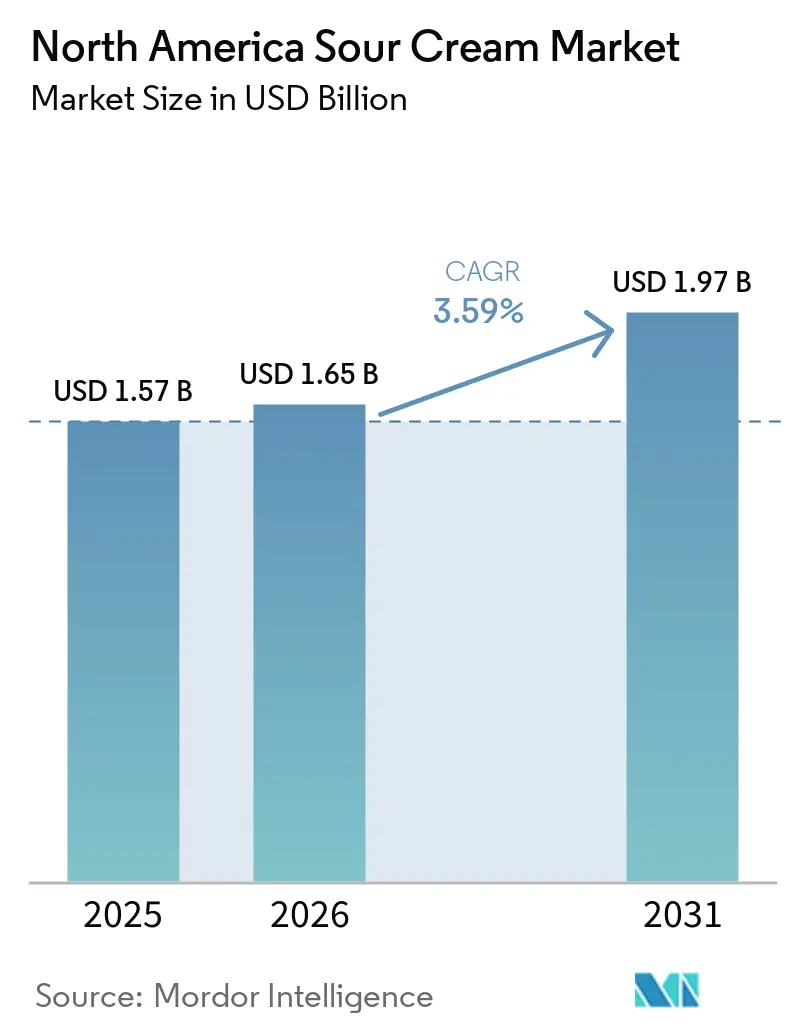
The North America sour cream market size is projected to expand from USD 1.65 billion in 2026, up from USD 1.57 billion in 2025, to USD 1.97 billion by 2031, registering a CAGR of 3.59% between 2026 and 2031. Mexican and Tex-Mex food remains an important source of demand because sour cream is used in both home cooking and restaurant meals. Foodservice buyers are also increasing demand for consistent products that work as toppings, dips, and recipe ingredients. Producers are extending their lines with reduced-fat, probiotic, and plant-based options to address changing dietary needs. Packaging innovation is making the product easier to use, while established dairy brands continue to invest in capacity, distribution, and product development. These conditions support measured growth in the North America sour cream market, although lactose sensitivity and competition from substitutes remain important constraints.
Key Report Takeaways
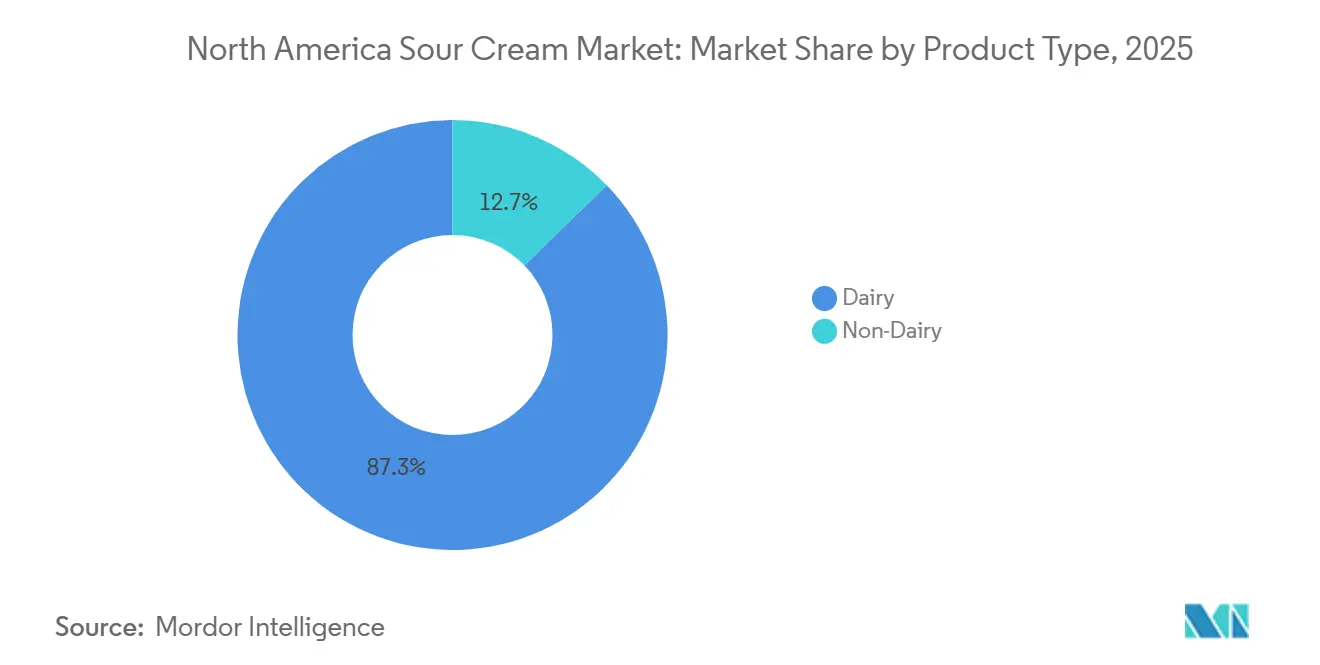
- By product type, dairy sour cream held 87.26% of the North America sour cream market share in 2025, while non-dairy sour cream is projected to grow at a 5.11% CAGR through 2031.
- By packaging type, tubs and cups accounted for 65.32% of the North America sour cream market size in 2025, while squeeze bottles are projected to expand at a 5.48% CAGR through 2031.
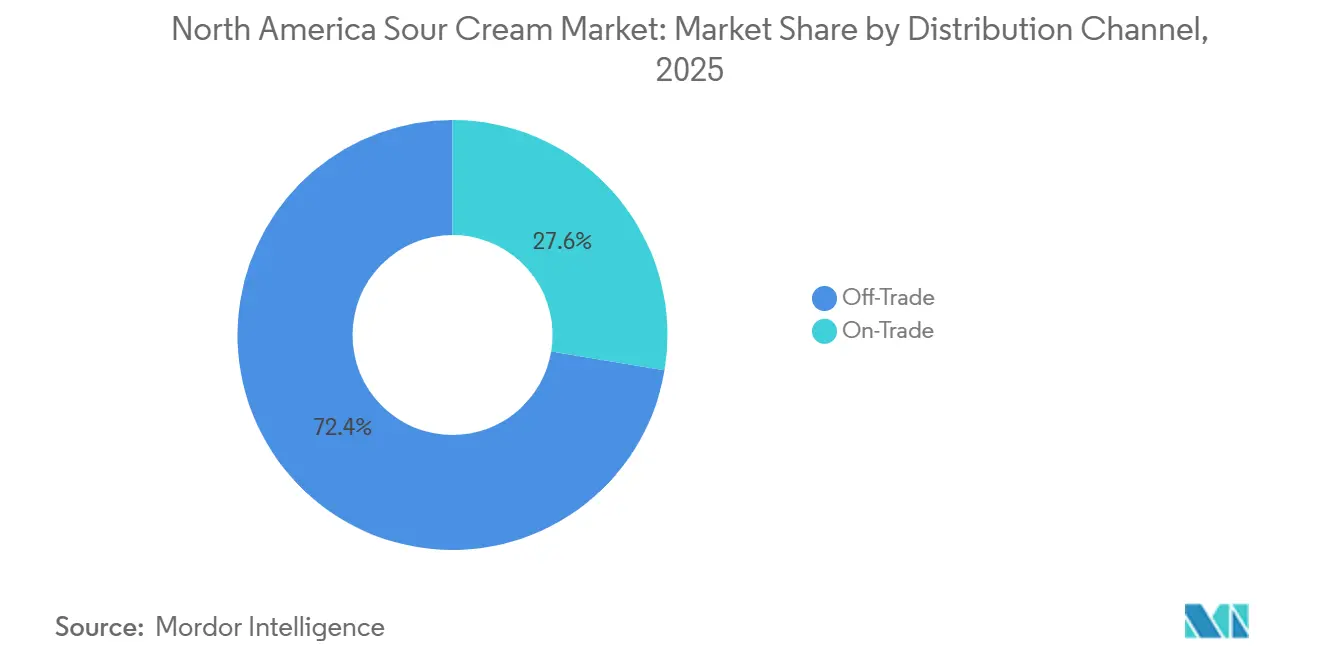
- By distribution channel, off-trade accounted for 72.38% of the North America sour cream market size in 2025, while on-trade is forecast to grow at a 5.38% CAGR through 2031.
- By geography, the United States held 56.48% of the North America sour cream market share in 2025, while Canada is forecast to grow at a 5.53% CAGR through 2031.
Note: Market size and forecast figures in this report are generated using Mordor Intelligence’s proprietary estimation framework, updated with the latest available data and insights as of January 2026.
Market Trends and Insights
Drivers Impact Analysis of North America Sour Cream Market*
| Driver | (~) % Impact on CAGR Forecasts | Geographic Relevance | Impact Timeline |
|---|---|---|---|
| Growing popularity of Mexican and Tex-Mex cuisine | +0.9% | United States, with spillover to Canada and Mexico | Medium term (2-4 years) |
| Increasing demand for convenient and ready-to-use condiments | +0.7% | United States and Canada | Short term (≤ 2 years) |
| Product innovation and flavored sour cream offerings | +0.6% | United States and Canada | Medium term (2-4 years) |
| Rising demand for reduced-fat and lower-calorie products | +0.5% | United States and Canada | Short term (≤ 2 years) |
| Expansion of organic and clean-label dairy products | +0.5% | United States and Canada | Medium term (2-4 years) |
| Versatile applications in household cooking | +0.4% | United States and Canada | Short term (≤ 2 years) |
| Source: Mordor Intelligence | |||
Growing Popularity of Mexican and Tex-Mex Cuisine
Mexican cuisine has a broad restaurant presence in the United States, with 11.00% of U.S. restaurants serving Mexican food. Sour cream benefits when Mexican and Tex-Mex dishes move from occasional restaurant choices into regular household meals. It is used as a topping, a dip base, and an ingredient in recipes such as enchiladas, tacos, and burrito bowls. This variety of uses helps the North America sour cream market maintain demand across retail and foodservice channels. Restaurant operators also use sour cream or crema in dishes where it is part of the finished recipe rather than an optional garnish. That role can support regular foodservice purchasing as Mexican menu options expand.
Demand for Convenient and Ready-to-Use Condiments
Convenient formats are changing how households use sour cream during everyday meal preparation. Daisy Brand states that its squeeze sour cream format is designed for easy dispensing and controlled use. The format removes the need for a spoon and makes sour cream easier to apply to tacos, baked potatoes, snacks, and prepared meals. This can increase use occasions compared with a conventional tub that is commonly opened for cooking or serving. Packaging suppliers have also developed flow-control solutions for sour cream applications, showing that dispensing performance has become a product feature. The North America sour cream market therefore has an opportunity to gain value from packaging that improves convenience without changing the familiar product.
Product Innovation and Flavored Sour Cream Offerings
Product innovation gives established dairy producers a way to defend shelf space and attract consumers seeking variety. New formats can combine familiar sour cream with flavor, easier dispensing, or a cleaner ingredient list. Aptar recognized its packaging work with Daisy Brand as part of a supplier relationship that supports sour cream product development. Plant-based suppliers are also using packaging and ingredient claims to distinguish their alternatives. Elmhurst 1925 markets a dairy-free sour cream in a squeezable pouch, which places its product in the same convenience space as mainstream dairy formats. These developments broaden the choices available in the North America sour cream market without changing the product’s central role as a chilled condiment.
Demand for Reduced-Fat and Lower-Calorie Products
Reduced-fat sour cream addresses consumers who want familiar dairy foods with lower fat or calorie content. This need is especially relevant for shoppers who read nutrition labels or manage portion sizes. Producers can respond through light products, smaller packs, and formulations that maintain a creamy texture. The North America sour cream industry also has room to position reduced-fat products alongside protein and probiotic attributes when those features are supported by the product formulation. Clear labeling is important because it allows consumers to compare full-fat and reduced-fat options at the shelf. A broader range of nutritional profiles can help producers retain consumers who might otherwise switch to yogurt or plant-based substitutes.
Restraints Impact Analysis of North America Sour Cream Market*
| Restraint | (~) % Impact on CAGR Forecasts | Geographic Relevance | Impact Timeline |
|---|---|---|---|
| Health concerns regarding saturated fat and calorie content | -0.6% | United States and Canada | Short term (≤ 2 years) |
| Rising prevalence of lactose intolerance and dairy sensitivities | -0.5% | United States, Canada, and Mexico | Long term (≥ 4 years) |
| Competition from substitute dairy products | -0.4% | United States and Canada | Medium term (2-4 years) |
| Stringent food safety and regulatory requirements | -0.3% | United States and Canada | Long term (≥ 4 years) |
| Source: Mordor Intelligence | |||
Health Concerns Regarding Saturated Fat and Calorie Content
Traditional sour cream can face pressure from consumers who monitor saturated fat, calories, or serving sizes. Nutrition labels make these product attributes visible at the point of purchase under U.S. food-labeling rules[1]. Some consumers may use sour cream less frequently, choose smaller portions, or select reduced-fat alternatives. Greek yogurt, crème fraîche, and plant-based cultured products can compete for the same topping and dip occasions. This pressure is stronger in urban and higher-income areas where ingredient information and wellness claims can shape food choices. The North America sour cream market must therefore offer clear choices for consumers who want indulgence, portion control, or lower-fat options.
Rising Prevalence of Lactose Intolerance and Dairy Sensitivities
Lactose malabsorption limits the potential consumer base for conventional dairy sour cream. The National Institute of Diabetes and Digestive and Kidney Diseases states that lactose malabsorption affects an estimated 36.00% of people in the United States[2]. This creates a practical need for lactose-free dairy and non-dairy products that can deliver a similar taste and texture. The limitation is important because Mexican cuisine can drive sour cream use while several consumer groups that value this cuisine may also seek dairy-free options. Canadian consumers also have access to information and support on lactose intolerance through the Canadian Digestive Health Foundation. Producers that offer credible lactose-free products through mainstream retail can reduce the volume risk associated with dairy sensitivity.
*Our forecasts treat driver/restraint impacts as directional, not additive. The impact forecasts reflect baseline growth, mix effects, and variable interactions.
North America Sour Cream Market Segment Analysis
By Product Type:
Dairy Maintains Scale While Non-Dairy Options Gain AcceptanceDairy sour cream held 87.26% of the North America sour cream market share in 2025, reflecting established retail distribution, recognized brands, and its use in cooking applications. It remains well suited to baked potatoes, soups, dips, and many prepared foods where consumers expect a familiar dairy flavor. Dairy producers benefit from refrigerated distribution systems that already serve supermarkets, club stores, and foodservice customers. Their main task is to keep the category relevant for consumers who seek simple ingredients, reduced fat, or lactose-free choices. These needs make product renovation as important as basic availability in the North America sour cream market.
Non-dairy sour cream is forecast to grow at a 5.11% CAGR through 2031, outpacing the overall category. Elmhurst 1925 sells a dairy-free sour cream in a BPA-free squeezable pouch, which links a plant-based product with convenient application. Products based on oats, cashews, or almonds can appeal to consumers who avoid lactose or prefer plant-based foods. Their retail progress depends on taste, texture, ingredient transparency, and placement beside established dairy products. The North America sour cream industry is likely to see dairy and non-dairy products compete for the same meal occasions rather than operate as separate categories.


By Packaging Type:
Tubs Lead While Squeeze Bottles Improve Everyday UseTubs and cups held 65.32% of the North America sour cream market size in 2025 because consumers know the format and retailers have established refrigerated shelf space for it. The format works well for cooking, baking, family meals, and recipes that use larger portions. It also gives producers a familiar and cost-effective way to sell both standard and reduced-fat products. Tubs remain relevant because many households use sour cream as an ingredient rather than only as a topping. Their position is therefore supported by routine use in home kitchens and food preparation.
Squeeze bottles are projected to grow at a 5.48% CAGR through 2031, the fastest rate among packaging formats. Daisy Brand’s squeeze products show how controlled dispensing can reduce mess and make single-use applications easier. Aptar has highlighted its work with Daisy Brand on packaging designed for sour cream dispensing. Pouches also give plant-based suppliers a packaging choice that supports a simple, portable product presentation. The North America sour cream market can use packaging innovation to encourage use across snacks, meals, and restaurant-style dishes prepared at home.
By Distribution Channel:
Off-Trade Provides Scale While On-Trade Gains MomentumOff-trade channels accounted for 72.38% of the North America sour cream market share in 2025, supported by supermarkets, hypermarkets, specialty stores, and other retail outlets. Retailers provide the refrigerated shelf space and promotional activity needed for sour cream to remain a household staple. Supermarkets can offer a wide choice of standard, reduced-fat, organic, lactose-free, and plant-based products. Convenience stores play a smaller role but can serve immediate meal and snack occasions. Online grocery platforms may also support multipacks and smaller formats that fit household ordering patterns.
On-trade sales are projected to expand at a 5.38% CAGR through 2031, reflecting demand from restaurants, quick-service operators, caterers, and institutions. Foodservice buyers require reliable supply, standardized consistency, and packaging suited to high-volume preparation. U.S. food safety rules require food businesses to follow current good manufacturing practice requirements for food production and handling. This can raise the operating requirements for suppliers seeking institutional accounts. The North America sour cream industry can benefit when producers develop formats and service arrangements that meet restaurant and institutional needs.

Geography Analysis
United States Sour Cream Market
The United States held 56.48% of the North America sour cream market share in 2025, supported by its large retail base and widespread restaurant demand. Mexican food has an extensive presence across U.S. restaurants, which supports frequent use of sour cream and related products. Daisy Brand broke ground in May 2025 on a USD 1.20 billion manufacturing facility in Boone, Iowa, which is expected to produce sour cream and cottage cheese. The investment shows that the United States remains central to production capacity and branded competition. Lactose sensitivity nonetheless creates demand for dairy-free and lactose-free formulations in this large consumer base.
Canada Sour Cream Market
Canada is projected to grow at a 5.53% CAGR through 2031, the fastest rate among the covered geographies. Its diverse population, growing online food retail activity, and health-focused purchasing create opportunities for conventional and alternative products. Consumers who manage lactose intolerance may favor lactose-free dairy or plant-based options, a need recognized by the Canadian Digestive Health Foundation[3]. Producers serving Canada must balance product innovation with dependable refrigerated distribution. The North America sour cream market can use Canada as an important outlet for differentiated products and convenient formats.
Mexico Sour Cream Market
Mexico and the Rest of North America account for a smaller share of the regional category but remain strategically relevant because crema and related dairy toppings are part of many local dishes. Demand is tied to home cooking, street food, restaurant meals, and the broader popularity of Mexican cuisine across the region. Cross-border dairy supply relationships connect producers, processors, retailers, and foodservice buyers across North America. The North America sour cream industry has an opportunity to adapt products for local taste preferences while managing lactose-related demand barriers.
Competitive Landscape
Market Concentration
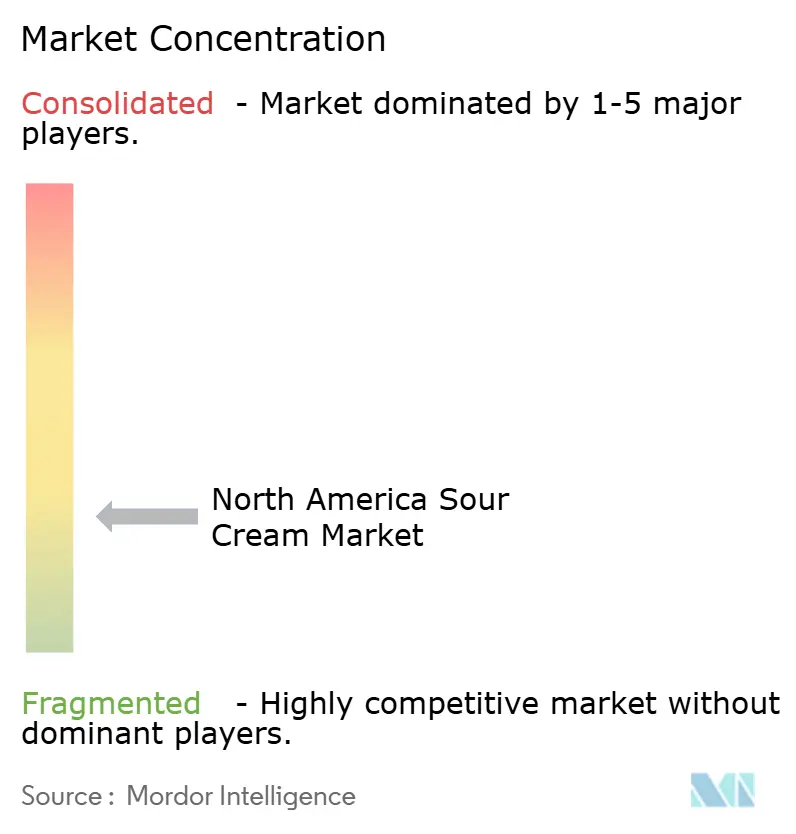
The North America sour cream market is fragmented, with one large domestic brand, regional dairy cooperatives, and a group of specialty and plant-based companies. A leading brand held an estimated 60.00% share of the U.S. sour cream category in 2026. Scale supports broad retail placement, production efficiency, and the ability to invest in packaging and new product development. Smaller competitors use organic claims, regional distribution, dairy-free formulations, or culturally targeted products to gain attention. The North America sour cream market therefore combines a clear scale leader with several focused competitors serving specific needs.
Daisy Brand’s May 2025 groundbreaking for its USD 1.20 billion Iowa facility is a major capacity investment tied directly to sour cream and cottage cheese production. The company also announced a USD 24.00 million innovation center in Garland, Texas, designed to expand research and development capabilities. Organic Valley expanded its certified organic cheese product range in March 2025, reflecting the cooperative’s continued investment in organic dairy offerings. These moves show how capacity, research, and organic product development can shape competitive positions. Producers with broad distribution can use these investments to defend shelf space as alternatives become more visible.
Plant-based brands compete through dairy-free ingredients, convenient formats, and clean-label positioning. Elmhurst 1925’s pouch product is an example of a supplier pairing dairy-free sour cream with a familiar squeeze format. Natural Grocers expanded its private-label organic yogurt offerings in 2025, indicating continued retailer interest in certified organic dairy choices. Companies in the North America sour cream industry must therefore compete not only on flavor and distribution but also on format, ingredient claims, and nutritional fit.
North America Sour Cream Industry Leaders
-
Daisy Brand LLC
-
Dean Foods
-
Kraft Heinz Company
-
Organic Valley
-
Lactalis Group
- *Disclaimer: Major Players sorted in no particular order
North America Sour Cream Market Companies Covered in this Report
- Daisy Brand LLC
- Dean Foods Company
- The Kraft Heinz Company
- Organic Valley
- Groupe Lactalis
- Saputo Inc.
- HP HOOD LLC
- Dairy Farmers of America, Inc.
- Tillamook County Creamery Association
- Prairie Farms Dairy, Inc.
- Green Valley Creamery
- Hiland Dairy Foods
- LALA U.S., Inc.
- V&V Supremo Foods, Inc.
- Fonterra Co-operative Group Limited
- Danone S.A.
- Unilever PLC
- Meiji Holdings Co., Ltd.
- Redwood Hill Farm & Creamery, Inc.
- Klondike Cheese Co.
Recent Industry Developments in North America Sour Cream Market
- May 2025: Daisy Brand broke ground on a USD 1.20 billion, 1 million-square-foot manufacturing facility in Boone, Iowa. The plant, expected to open in Q3 2028, will initially produce sour cream and cottage cheese, create 255 jobs averaging USD 34.75/hour, and require milk from approximately 43,000 cows daily. The investment signals the market leader's intent to preemptively expand capacity ahead of category volume growth.
- March 2025: Utz Brands, Inc. introduced a Sour Cream & Onion flavor to its Mixed Minis Pretzel line, expanding its portfolio of flavored snacks. Available in 12-ounce packages, the bite-sized pretzels combine tangy sour cream and savory onion flavors and are offered in three shapes: twists, rings, and waffles.
- January 2024: Elmhurst 1925 launched a plant-based sour cream, expanding its product portfolio beyond dairy-free beverages into plant-based food products. Made with oat milk and hemp protein, the product is designed as a one-to-one alternative to traditional dairy sour cream, offering a creamy texture and tangy flavor without added gums, fillers, or emulsifiers.
North America Sour Cream Market Report Scope
The North America sour cream market report provides a comprehensive analysis of the market, segmented by product type, packaging type, distribution channel, and geography. By product type, the market is categorized into dairy sour cream and non-dairy sour cream. Based on packaging type, the market is segmented into tubs and cups, squeeze bottles, pouches, jars, and portion packs. By distribution channel, the market is divided into on-trade and off-trade channels, with the off-trade segment further categorized into supermarkets and hypermarkets, convenience stores, online retail channels, and other distribution channels. Geographically, the report covers the United States, Canada, Mexico, and the rest of North America. The Market Forecasts are Provided in Terms of Value (USD).
Segmentation Overview
By Product Type
| Dairy Sour Cream |
| Non-Dairy Sour Cream |
By Packaging Type
| Tubs and Cups |
| Squeeze Bottles |
| Pouches |
| Jars and Portion Packs |
By Distribution Channels
| On-Trade | |
| Off-Trade | Supermarkets/Hypermarkets |
| Convenience Stores | |
| Onine Retail Channels | |
| Other Distribution Channels |
By Geography
| United States |
| Canada |
| Mexico |
| Rest of North America |
| By Product Type | Dairy Sour Cream | |
| Non-Dairy Sour Cream | ||
| By Packaging Type | Tubs and Cups | |
| Squeeze Bottles | ||
| Pouches | ||
| Jars and Portion Packs | ||
| By Distribution Channels | On-Trade | |
| Off-Trade | Supermarkets/Hypermarkets | |
| Convenience Stores | ||
| Onine Retail Channels | ||
| Other Distribution Channels | ||
| By Geography | United States | |
| Canada | ||
| Mexico | ||
| Rest of North America | ||
Key Questions Answered in the Report
What is the forecast growth rate for North America sour cream through 2031?
The category is forecast to grow at a 3.59% CAGR from 2026 to 2031, reaching USD 1.97 billion in 2031.
Which product type leads sour cream sales in North America?
Dairy sour cream leads with 87.26% share in 2026, supported by established brands, retail distribution, and everyday cooking use.
Why are non-dairy sour cream products growing?
Non-dairy products are projected to grow at a 5.11% CAGR through 2031 because they serve lactose-sensitive and plant-based consumers
Which sour cream packaging format is growing fastest?
Squeeze bottles are the fastest-growing packaging format, with a projected 5.48% CAGR through 2031