
Market Overview
| Study Period | 2020 - 2031 |
|---|---|
| Forecast Data Period | 2026 - 2031 |
| Base Year Market Size (2025) | USD 3.46 Billion |
| Market Size (2026) | USD 3.69 Billion |
| Market Size (2031) | USD 5.06 Billion |
| Growth Rate (2026 - 2031) | 6.52 % |
| Market Concentration | Medium |
Major Players *Disclaimer: Major Players sorted in no particular order Image © Mordor Intelligence. Reuse requires attribution under CC BY 4.0. | |
India Adhesives And Sealants Market Analysis by Mordor Intelligence
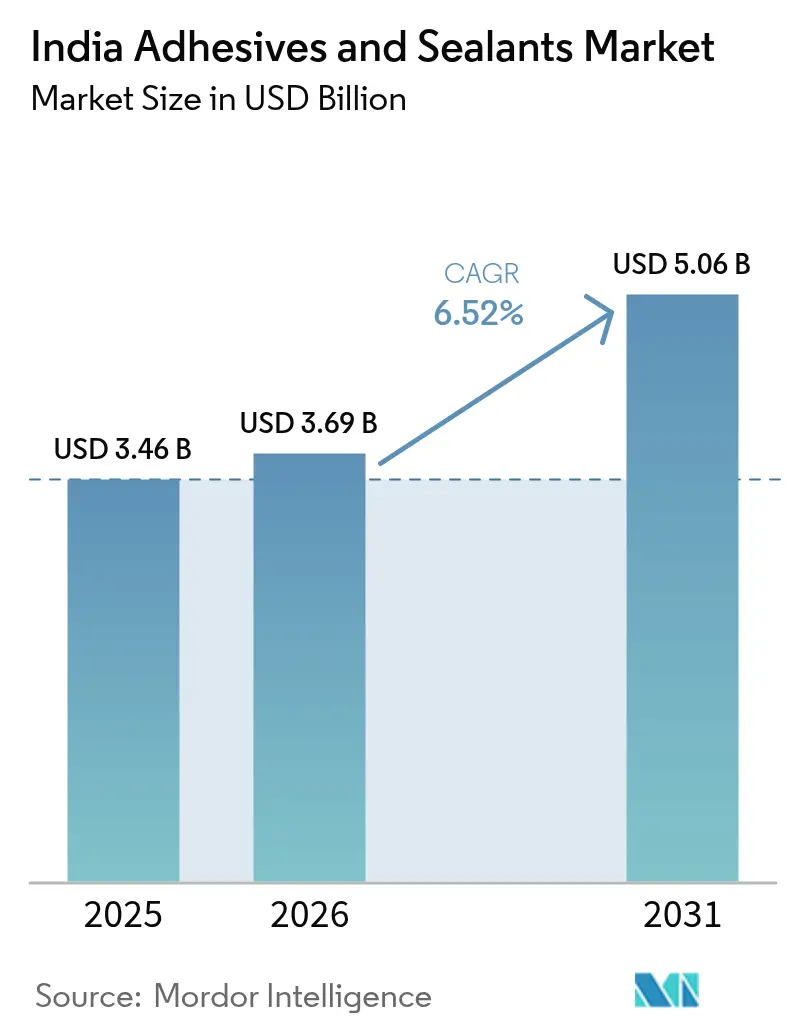
The India Adhesives and Sealants Market size is expected to grow from USD 3.46 billion in 2025 to USD 3.69 billion in 2026 and is forecast to reach USD 5.06 billion by 2031 at 6.52% CAGR over 2026-2031. This growth reflects a decisive shift from commodity‐grade bonding agents toward engineered solutions driven by performance specifications and regulatory compliance. Construction spending under the National Infrastructure Pipeline, fast-rising e-commerce packaging volumes, and expanding automotive and aerospace assembly lines are lifting demand for high-strength, low-emission formulations. Domestic chemical capacity upgrades shorten supply chains for key resins, while government incentives for local manufacturing favor producers with Indian production footprints. Technology adoption trends show hot-melt, water-borne, and reactive chemistries steadily replacing solvent-borne legacy products as environmental rules tighten[1].
Key Report Takeaways
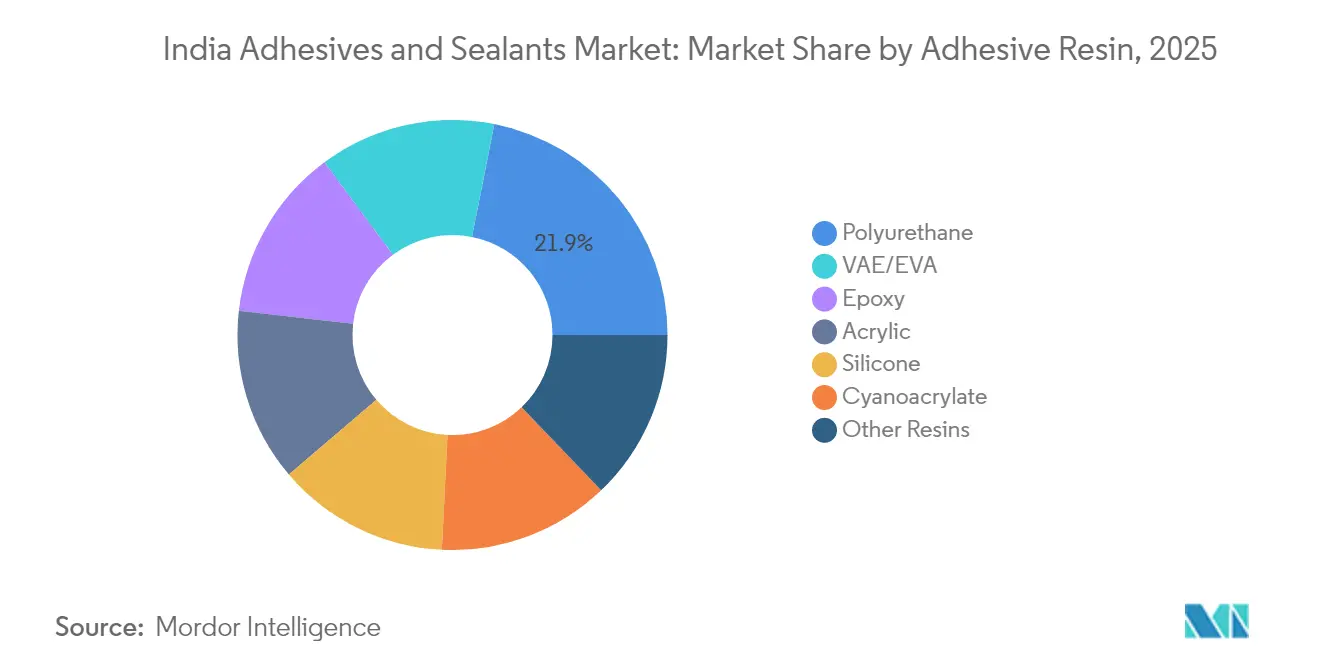
- By adhesive resin, polyurethane led with 21.88% of the India adhesives and sealants market share in 2025; VAE/EVA is projected to grow at a 7.42% CAGR to 2031.
- By adhesive technology, hot-melt captured 36.62% of the India adhesives and sealants market size in 2025 and is forecast to expand at a 6.88% CAGR through 2031.
- By sealant resin, silicone held 44.96% revenue share in 2025, while polyurethane sealants are expected to advance at a 6.63% CAGR by 2031.
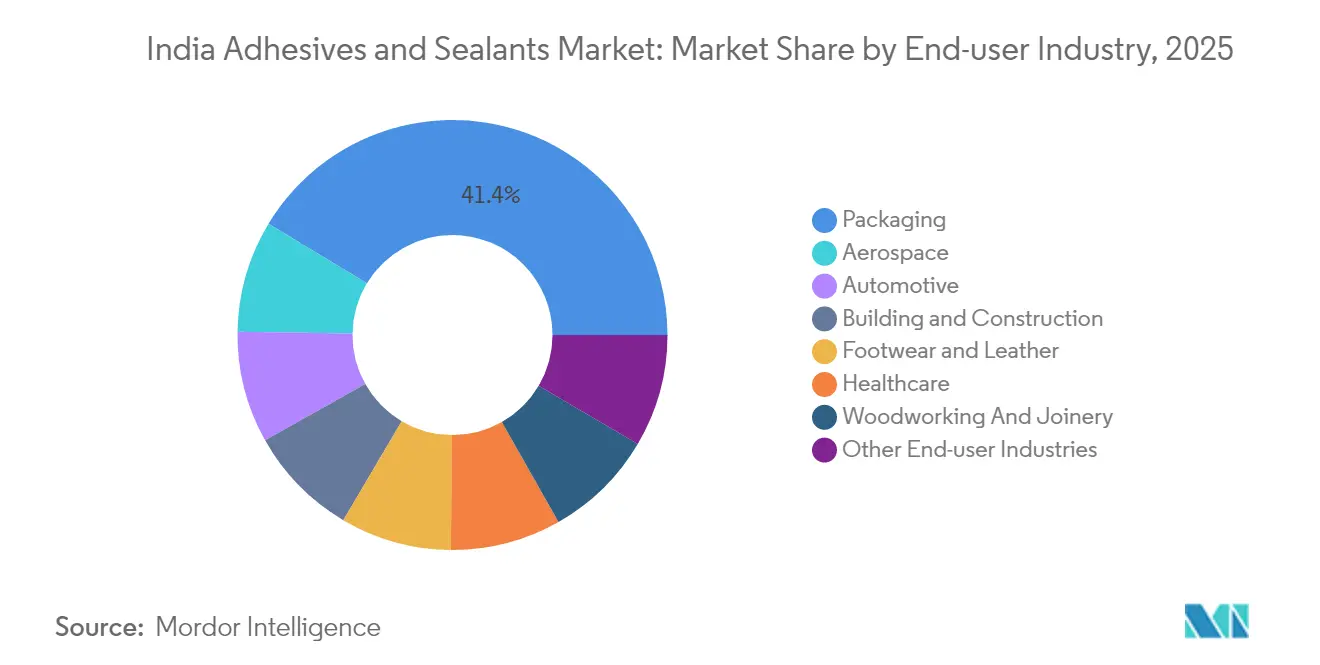
- By end-user industry, packaging accounted for 41.35% share of the India adhesives and sealants market size in 2025; aerospace applications are set to post a 7.01% CAGR between 2026 and 2031.
Note: Market size and forecast figures in this report are generated using Mordor Intelligence’s proprietary estimation framework, updated with the latest available data and insights as of 2026.
India Adhesives And Sealants Market Trends and Insights
Drivers Impact Analysis*
| Drivers | (~) % Impact on CAGR Forecast | Geographic Relevance | Impact Timeline |
|---|---|---|---|
| Rising residential and infrastructure construction demand | +2.1% | National, with concentration in tier-1 and tier-2 cities | Medium term (2-4 years) |
| Booming e-commerce-led packaging requirements | +1.8% | National, with early gains in Mumbai, Delhi, Bangalore | Short term (≤ 2 years) |
| Automotive lightweighting and localisation push | +1.4% | Western and Southern India manufacturing hubs | Medium term (2-4 years) |
| Woodworking and modular furniture uptake | +0.9% | National, with concentration in Punjab, Karnataka, Tamil Nadu | Long term (≥ 4 years) |
| Make-in-India defence/aerospace offsets fuel high-spec bonding | +0.7% | Bangalore, Hyderabad, Pune aerospace corridors | Long term (≥ 4 years) |
| Source: Mordor Intelligence | |||
Rising Residential and Infrastructure Construction Demand
Infrastructure programs worth USD 120 billion allocated to housing and urban development in 2024 are triggering a spike in construction chemical usage, including structural adhesives, sealants for façade glazing, and energy-efficient building envelope solutions. Modular and prefabricated techniques that rely on factory-applied bonding are gaining favor because they slash on-site labor and accelerate project schedules. Builders also face stricter Bureau of Indian Standards (BIS) requirements, which encourage the adoption of certified, low-VOC bonding systems. Manufacturers with BIS-compliant polyurethane and silicone lines win share by offering on-site technical audits and training services. Demand is particularly strong for weather-resistant sealants that tolerate India’s temperature swings, pushing suppliers to expand research and development centers near major construction hubs in Delhi-NCR and Hyderabad.
Booming E-Commerce-Led Packaging Requirements
Double-digit online retail growth has changed packaging from a cost-center to a brand-protection tool requiring tamper evidence, heat resistance, and recyclability. Flexible packaging converters are scaling up water-borne and solvent-free laminating adhesives, such as UFlex’s pigmented white and wet-lamination systems, to service monthly order runs exceeding 5,000 tonnes. Food-grade migration limits and Extended Producer Responsibility rules favor low-VOC chemistries validated under global food-contact tests. Cold-chain expansion drives the need for sealants that maintain bond strength from –20 °C to 50 °C, while direct-to-consumer shipments fuel the uptake of fast-setting hot-melts that keep corrugated boxes intact over last-mile cycles. Suppliers winning in this space bundle online viscosity monitoring and adhesive usage analytics that cut waste by 8-10%.
Automotive Lightweighting and Localisation Push
Production-Linked Incentive schemes and the Automotive Mission Plan 2047 are localizing electric-vehicle and component lines, spurring demand for structural bonding agents that can join aluminum, magnesium, and carbon-fiber parts without adding weld weight. Henkel’s development of CO₂-based polyurethane polyols shows how sustainability and performance are converging in under-hood and battery applications. Tier-1 suppliers now source silicone gap-fillers and thermally conductive epoxies locally to ensure just-in-time delivery; this trend supports regional adhesive plants in Pune and Chennai. Vehicle makers also specify crash-durable adhesives to meet Bharat NCAP safety targets, raising the bar on shear strength and fatigue life. The India adhesives and sealants market benefits from rising domestic sourcing ratios as OEMs shift from imported to locally certified chemistries.
Woodworking and Modular Furniture Uptake
Urban consumers favor flat-pack and modular furniture that must withstand humidity swings from 30% to 90% without joint failure. BIS emission standards, in force since February 2025, limit formaldehyde release and push plywood and MDF factories to adopt water-borne or hybrid polyurethane dispersions approved for E0 and E1 ratings. Regional clusters in Punjab, Karnataka, and Tamil Nadu provide scale efficiencies, allowing adhesive vendors to run application labs that test bond strength on indigenous hardwood veneers. Export-focused furniture makers demand bio-based additives that help them qualify for eco-label programs in the European Union, creating a premium segment that grows at nearly twice the overall India adhesives and sealants market rate. Suppliers counter price sensitivity by offering bulk-pack hot-melts that cut per-unit cost 12% while reducing downtime.
Restraints Impact Analysis*
| Restraints | (~) % Impact on CAGR Forecast | Geographic Relevance | Impact Timeline |
|---|---|---|---|
| Stringent VOC and EHS regulations | -1.2% | National, with stricter enforcement in metropolitan areas | Short term (≤ 2 years) |
| Petro-feedstock price volatility | -0.8% | National, affecting all manufacturers | Short term (≤ 2 years) |
| Import-dependency for specialty monomers | -0.6% | National, with higher impact on specialty adhesive manufacturers | Medium term (2-4 years) |
| Source: Mordor Intelligence | |||
Stringent VOC and EHS Regulations
The Central Pollution Control Board has lowered allowable VOC thresholds, compelling producers to retrofit lines with regenerative thermal oxidizers and to shift portfolio mix toward water-borne and hot-melt grades. Capital outlays for small firms can reach USD 1 million, reducing operating margins in the near term. Aerospace formulations containing methylene chloride are under global phase-out, creating requalification costs and temporary shortages. Plants in Mumbai and Bangalore have introduced closed-loop solvent recovery to stay compliant, but the added complexity favors multinationals with established environmental engineering teams. End-users meanwhile insist on Safety Data Sheets aligned with GHS version 8, adding further documentation overhead.
Petro-Feedstock Price Volatility
Quarterly swings of 15–20% in isocyanate and acrylic monomer prices undermine cost forecasts and weaken bargaining power with downstream customers. While large producers hedge with long-term naphtha contracts and currency swaps, many mid-tier firms maintain 60-day inventory coverage, tying up working capital and warehouse space. H.B. Fuller noted double-digit raw-material inflation during its 2025 earnings call, leading to price‐rise notifications across multiple adhesive families. Volatility also impacts freight as bunker surcharges pass through to imported feedstocks, widening landed-cost differences between domestic and overseas alternatives. Consequently, procurement teams are collaborating more closely with research and development to design formulations that can tolerate wider feedstock substitutions without performance loss.
*Our forecasts treat driver/restraint impacts as directional, not additive. The impact forecasts reflect baseline growth, mix effects, and variable interactions.
Segment Analysis
By Adhesive Resin: Polyurethane Leadership Faces Bio-Based Disruption
Polyurethane accounted for 21.88% of India's adhesives and sealants market share in 2025, underpinned by its ability to bond dissimilar substrates and resist chemicals in construction and automotive joints. Epoxy and acrylic systems follow for applications that demand high-temperature endurance or UV stability. VAE/EVA, though smaller in base, is registering the fastest 7.42% CAGR through 2031 as flexible packaging converters switch to recyclable mono-material films. Market leaders are improving green credentials by incorporating CO₂-captured polyols and plant-oil intermediates, moves that align with brand-owner sustainability scorecards.
Over the forecast window, India's adhesives and sealants market demand shifts toward hybrid polyurethane-silicone blends that combine paintability with weatherability, especially in high-rise glazing. Cyanoacrylates retain niches in electronics, fast repair, and consumer DIY kits owing to instant bonding speeds. Suppliers scaling bio-based feedstocks compete on total cost of ownership by highlighting lower hazardous-waste fees and possible carbon-credit offsets. Formulators that earn BIS certification for their new chemistries are expected to gain quicker specification approvals from real estate and automotive OEMs.

By Adhesive Technology: Hot-Melt Dominance Reflects Sustainability Shift
Hot-melt held 36.62% of India adhesives and sealants market size in 2025 and continues to outpace other platforms with a 6.88% CAGR through 2031. Zero-solvent content, fast set times, and low energy curing make hot-melts ideal for corrugated packaging and hygiene disposables processed at up to 600 units-per-minute. Water-borne emulsions stand second as formulators tune particle size and surfactant systems to approach solvent-borne tack while remaining under 5 g/L VOC.
Solvent-borne volumes decline annually as metro governments tighten plant-air permits, yet remain relevant for leather bonding and certain metal pretreatments requiring deep substrate penetration. Reactive polyurethanes gain traction in windshield bonding, where open time and cure-on-demand deliver assembly flexibility. UV-curable acrylates capture more electronics lines as mini-LED and OLED display makers prioritize precision bonding. Equipment manufacturers responding toIndia'sa adhesives and sealants market trends now bundle melter systems with Industry 4.0 sensors that feed viscosity and temperature data to cloud dashboards, cutting glue consumption 8–12% per shift.
By Sealant Resin: Silicone Supremacy Challenged by Polyurethane Growth
Silicone maintained 44.96% share in 2025 because its weather-proof elasticity protects curtain-wall facades across humid coastal and arid inland climates. New low-modulus formulations reduce stress on laminated glass edges, extending façade life cycles well beyond 25 years. Polyurethane sealants, projected at a 6.63% CAGR, appeal to contractors seeking paintable seams for expansion joints and precast panels. Acrylic latex lines serve interior drywall joints where cost and paintability override extreme weather resistance.
Hybrid silyl-terminated polyether (STP) systems are emerging in the India adhesives and sealants market as they merge silicone elasticity with polyurethane adhesion, eliminating the need for primers on porous concrete. Epoxy-based sealants hold niche usage in chemical bund linings where contact with aggressive solvents is likely. BIS-driven durability tests are elevating minimum performance benchmarks, prompting regional formulators to license European and Japanese hybrid technologies to meet 25% movement capability without losing adhesion under cyclic thermal loads.
By End-User Industry: Packaging Dominance Amid Aerospace Acceleration
Packaging represented 41.35% of India adhesives and sealants market demand in 2025, spanning laminates, carton closing, labels, and specialty flexible pouches. Growth stems from consumer-goods manufacturing clusters in Gujarat and Uttar Pradesh that need FDA-compliant, migration-safe chemistries for food contact. Automated filling lines running 24/7 rely on hot-melts with open times below 1 second, reducing machine stoppages.
Aerospace registers the highest 7.01% CAGR through 2031 as Make-in-India offsets push local assembly of nacelles, radomes, and interiors. Epoxy film adhesives qualified to MIL-specs secure structural panels, while silicone potting compounds insulate avionics. Construction, the second-largest volume user, absorbs moisture-curing polyurethane sealants for joint filling and hybrid adhesives for AAC block installation. Healthcare and hygiene adopters demand low-odor chemistries that clear ISO 10993 cytotoxicity tests, whereas woodworking upgrades to no added formaldehyde adhesives to meet European import rules.
Geography Analysis
Western states led the India adhesives and sealants market in 2024 due to integrated petrochemical complexes in Gujarat and the automotive cluster surrounding Pune. Ready access to isocyanates, acrylics, and silicones shortens supply chains and trims landed costs by about 5% compared with inland regions. Maharashtra’s highway expansion pipeline boosts consumption of pavement joint sealants, while port logistics in Kandla and Mundra ease bulk import of specialty monomers.
Southern India is buoyed by aerospace corridors in Bangalore and Hyderabad that require film and paste adhesives validated to global aviation standards. Electronics exporters in Tamil Nadu raise demand for UV-curable coatings used on printed-circuit boards. Furniture factories in Mysuru and Tiruchirappalli purchase water-borne PVAc at container-load scale, pulling distributors to set up just-in-time depots. The India-UK Free Trade Agreement, ratified in May 2025, reduces tariffs on adhesive products, encouraging producers in Andhra Pradesh’s SEZs to target the UK for private-label hot-melts.
Northern and eastern zones exhibit growth as smart-city and mass-housing schemes take shape in Lucknow, Patna, and Bhubaneswar. Cold-chain warehouses under the PM GatiShakti plan spawn localized demand for polyurethane foam sealants that minimize thermal leakage. Inland players face higher freight on bulk chemicals, yet compensate through lower labor costs and state tax incentives that can trim capital expenditure by 10-12%.
Regulatory Landscape
India adhesives and sealants manufacturers operate under a tightening quality and environmental compliance framework that increasingly references Bureau of Indian Standards (BIS) product standards and certification routes such as BIS Scheme-I (ISI Mark). For synthetic resin adhesives used in plywood, Indian Standard IS 848:2006 is a key reference point, and BIS also carried a newer revision (IS 848:2025) in its standards database (effective November 2025), reinforcing the direction of travel toward updated product specifications and conformity assessment.
On the chemicals side, the Department of Chemicals and Petrochemicals (DCPC) and the broader Government of India quality-control approach under the BIS Act, 2016 (including Section 16 provisions for making standards mandatory for select chemicals/petrochemicals) raises the importance of local testing, audits, and documentation for both domestic production and imports. In June 2026, DPIIT notified the Transition Facilitation (Quality Control) Order, 2026, adding an additional layer to how regulated products and industrial transitions are managed in practice, which interacts with adhesives makers through resin and monomer supply chains and the need to maintain compliant input materials.
Value Chain Analysis
The India adhesives and sealants value chain starts with upstream petrochemical and specialty chemical inputs (for example, acrylic monomers and isocyanates used across acrylic, PU, and reactive systems), where import dependence persists for several specialty monomers even as domestic sourcing improves in western and southern chemical corridors. The midstream includes resin synthesis and compounding or formulation into water-borne, hot-melt, reactive, and solvent-borne products, followed by packaging into retail packs (DIY and consumer) and bulk formats for converters and industrial users.
Downstream routes differ by end use. Packaging converters and OEM supply chains rely more on direct key-account supply and application engineering support, while construction and woodworking volumes move through multi-tier distribution and contractor networks. Compliance and testing capabilities have become a visible node in the chain, as BIS-linked product standards (including IS 848 references for plywood adhesives and the BIS certification ecosystem) and quality control orders affecting chemical inputs can add lead times for licensing, lab testing, and batch release, shaping supplier selection toward firms with established compliance processes and local technical service footprints.
Competitive Landscape
The India adhesives and sealants market is moderately fragmented. Pidilite remains the domestic frontrunner by leveraging a 680,000-outlet dealer network and multi-tier branding that ranges from Fevicol for carpentry to Roff for tile installation. Sika invests in new polyurethane and acrylic sealant lines attached to its Jhagadia complex to serve modular construction clients switching from imported mastics. Competitive strategies center on sustainability, technical service, and digital engagement. Firms publish carbon footprints and offer bio-based options to win OEM scorecard points. Application labs in Mumbai and Bangalore test bond performance on customer substrates within 72 hours, speeding design-in.
India Adhesives And Sealants Industry Leaders
-
3M
-
H.B. Fuller Company
-
Henkel AG & Co. KGaA
-
Pidilite Industries Ltd.
-
Sika AG
- *Disclaimer: Major Players sorted in no particular order

Market Opportunities and Future Outlook
Capacity additions and localization programs underway in India create whitespace for suppliers that can deliver consistent, compliant volumes of water-borne, hot-melt, and other low-emission systems at scale. Evidence of active investment includes Pidilite Industries announcing a new manufacturing plant in Rajpura, Punjab (investment of Rs 300 crore) for water-based adhesives and waterproofing products, and Henkel Adhesive Technologies India proposing an expansion at MIDC Kurkumbh, Maharashtra (estimated project value of Rs 186.25 crore). These moves align with market pull from packaging and construction users that specify lower-VOC solutions and tightened quality documentation.
A second opportunity area sits around industrial and electronics-focused technical service, where faster design-in and application troubleshooting can differentiate suppliers beyond price. Henkel inaugurated a customer application center in Bengaluru focused on electronics solutions, and Jubilant Agri and Consumer Products Limited signaled new polymer and industrial adhesive capacity through partial commencement of production at Savli, Vadodara following a Rs 50 crore investment. Alongside ongoing volatility in crude-linked inputs such as Vinyl Acetate Monomer (VAM), the operating environment favors players that can qualify alternative raw material sources, improve formulation resilience, and shorten delivery cycles through regional manufacturing and warehousing nodes in Maharashtra, Gujarat, and northern consumption centers.
Recent Industry Developments
- June 2026: Henkel achieved carbon-neutral production (Scope 1 and 2) at its Kurkumbh adhesives manufacturing site in India. The step links operational decarbonization directly to local output of high-performance grades and supports customer procurement requirements that increasingly track supplier emissions and site sustainability credentials.
- July 2025: Henkel inaugurated a specialized automotive warehouse in Chakan, Pune, to support Just-in-Time deliveries and prototype material management. The facility strengthens service levels for automotive and mobility customers by improving responsiveness and inventory availability for time-critical adhesive and sealant programs.
- July 2024: Henkel invested further in its Kurkumbh, Maharashtra manufacturing facility, expanding capabilities for Loctite adhesives with an Industry 4.0-enabled setup. The expansion increased local supply of higher-performance products and reinforced India as a key production base for serving domestic demand with shorter lead times.
Research Methodology Framework and Report Scope
Market Definition and Coverage
This market covers the value of adhesives and sealants consumed in India across key industrial and consumer end uses, counted at the level where these materials are sold into applications and projects.
Scope exclusions: Excludes downstream converted goods where adhesives or sealants are only an embedded cost (such as finished furniture or packaged food).
Segmentation Overview
- By Adhesives Resin
- Polyurethane
- Epoxy
- Acrylic
- Silicone
- Cyanoacrylate
- VAE / EVA
- Other Resins
- By Adhesives Technology
- Water-borne
- Solvent-borne
- Reactive
- Hot-Melt
- UV Cured
- By Sealants Resin
- Silicone
- Polyurethane
- Acrylic
- Epoxy
- Other Resins
- By End-user Industry
- Aerospace
- Automotive
- Building and Construction
- Footwear and Leather
- Healthcare
- Packaging
- Woodworking And Joinery
- Other End-user Industries
Data Sources, Market Sizing, and Validation
Desk Research
Desk research was used to set the core demand context for adhesives and sealants in India, and to build a clean set of cross-checks before modeling. We relied on public building and infrastructure indicators, manufacturing output signals, and trade statistics to understand where consumption is concentrated and how it is shifting year to year.
Key references included non-paywalled sources such as the Ministry of Statistics and Programme Implementation for industrial production and use-side trends, the Department for Promotion of Industry and Internal Trade for sector level investment signals, the Ministry of Road Transport and Highways and other public infrastructure dashboards for project flow, India Customs aligned trade statistics for import and export direction, and standards and technical notes from bodies such as BIS. In parallel, company filings, investor presentations, reputable press, patents coverage, and selectively, paid databases focused on company financials, news, and shipment-level import-export records were used to fill gaps on pricing ranges and activity levels. These examples are not exhaustive, and many other public and subscription sources were also referred to for data collection, validation, and research clarification.
Primary Interviews and Surveys
Primary work focused on interviews and structured surveys with manufacturers, formulators, distributors, and large end users across construction, packaging, automotive, woodworking, and footwear. We used these inputs to confirm mix shifts by resin and technology, to sanity check price movements, and to understand how demand tracks housing starts, infrastructure awards, and manufacturing cycles across India.
Distribution of primary research fieldwork respondents
| Company type | Respondent position |
|---|---|
| Top tier: 39% | CXOs: 14% |
| Mid tier: 41% | Functional/Unit leaders: 33% |
| Smaller Players: 20% | Managers: 53% |
Market-Sizing & Forecasting
Sizing started with a top-down reconstruction of the India demand pool by linking end-use activity to adhesives and sealants intensity, and then converting that demand into value using observed price bands. To keep the totals realistic, the output was corroborated with selective bottom-up approximations, where sampled supplier revenues, channel checks, and volume by application multiplied by typical ASPs were used to adjust the totals.
Inputs that mattered most included new construction and repair activity, infrastructure awards and execution pace, packaging output and e-commerce linked conversion trends, automotive and component production, woodworking and furniture throughput, and reported movements in key resin and feedstock pricing that influence selling prices. Forecasts were built using scenario analysis, where the forward path of construction, infrastructure, and manufacturing indicators was stress tested with primary feedback on passthrough timing and demand softness or strength. Where bottom-up visibility was weaker for smaller end uses, gaps were handled by applying conservative penetration and intensity ranges that were rechecked with respondents before finalizing the model.
Data Validation & Update Cycle
Validation was done in layers so that one data point did not drive the final number. We checked the modeled totals against independent signals like import intensity, construction and manufacturing trend lines, and reported pricing movements, and then flagged any unusual jumps for a second review.
Before sign-off, variance checks were run across resin types, technologies, and end-use splits to ensure shares stayed consistent with how participants describe the market. Reports are refreshed annually, with interim updates when material events occur, and a final pre-delivery pass is completed so clients receive the latest updated view.
Mordor Intelligence's India Adhesives and Sealants Market Sizing Compared With Other Published Estimates
Published market numbers for India adhesives and sealants can differ even when the headline label looks the same, because the included product basket, value point in the chain, and the timing of price assumptions vary across studies. Differences also show up when some estimates lean on higher demand growth in construction or packaging, or when currency conversion timing and inflation passthrough are handled in a simpler way.
Finished goods that merely contain an adhesive or sealant as a small cost item, such as packaged foods and completed furniture, sit outside Mordor Intelligence's scope, which keeps the total tied to material sales rather than double counting downstream value. Other gaps usually come from whether volumes are anchored to end-use output (housing, infrastructure execution, packaging conversion) versus broad chemical market ratios, and how often ASP bands are refreshed when feedstocks move quickly.
Benchmark comparison
| Source | Market Size | Gaps in Research Methodology |
|---|---|---|
| Mordor Intelligence | USD 3.46 B (2025) | |
| Industry Publisher A | USD 3.43 B (2025) | Uses a similar headline definition but provides limited clarity on whether values are tracked at material selling price levels across resins and technologies, which can shift totals when ASP assumptions are refreshed. |
| Global Consultancy B | USD 2.16 B (2023) | Anchors the starting point to an earlier base year and a different forecast window, and the lower value can reflect older price levels and a narrower captured demand pool for high volume applications such as construction and packaging. |
Across the three figures, the spread is mainly explained by what is counted in the value chain, which year is used as the base, and how fast price updates are applied when resin costs move. By keeping inputs traceable to end-use activity and rechecking price bands and mix with market participants, the estimate stays easier to reproduce and to track over time.
Key Questions Answered in the Report
What is the expected value of the India adhesives and sealants market in 2031?
It is forecast to reach USD 5.06 billion by 2031.
Which resin type currently leads demand?
Polyurethane holds the top spot with a 21.88% share in 2025.
Which technology shows the fastest growth?
Hot-melt adhesives are projected to grow at a 6.88% CAGR through 2031.
How will packaging demand influence the sector?
Packaging remains the largest end-user, representing 41.35% of 2025 demand and expanding with e-commerce logistics.
What is a key restraint facing producers?
Stricter VOC regulations that push manufacturers toward water-borne and hot-melt solutions.
Where are most new adhesive plants being built?
Western and Southern India attract the bulk of recent capacity additions, particularly around Pune and Bangalore.