
Market Overview
| Study Period | 2020 - 2031 |
|---|---|
| Forecast Data Period | 2026 - 2031 |
| Base Year Market Size (2025) | 399.26 Billion units |
| Market Volume (2026) | 413.03 Billion units |
| Market Volume (2031) | 488.36 Billion units |
| Growth Rate (2026 - 2031) | 3.41 % |
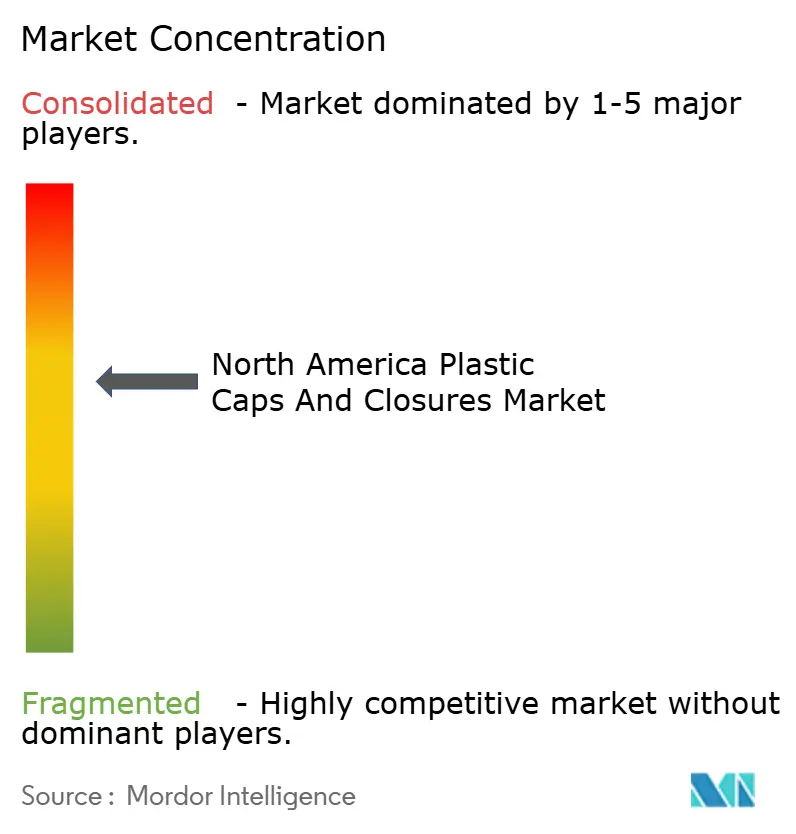
| Market Concentration | Medium |
Major Players *Disclaimer: Major Players sorted in no particular order Image © Mordor Intelligence. Reuse requires attribution under CC BY 4.0. | |
North America Plastic Caps and Closures Market Analysis by Mordor Intelligence
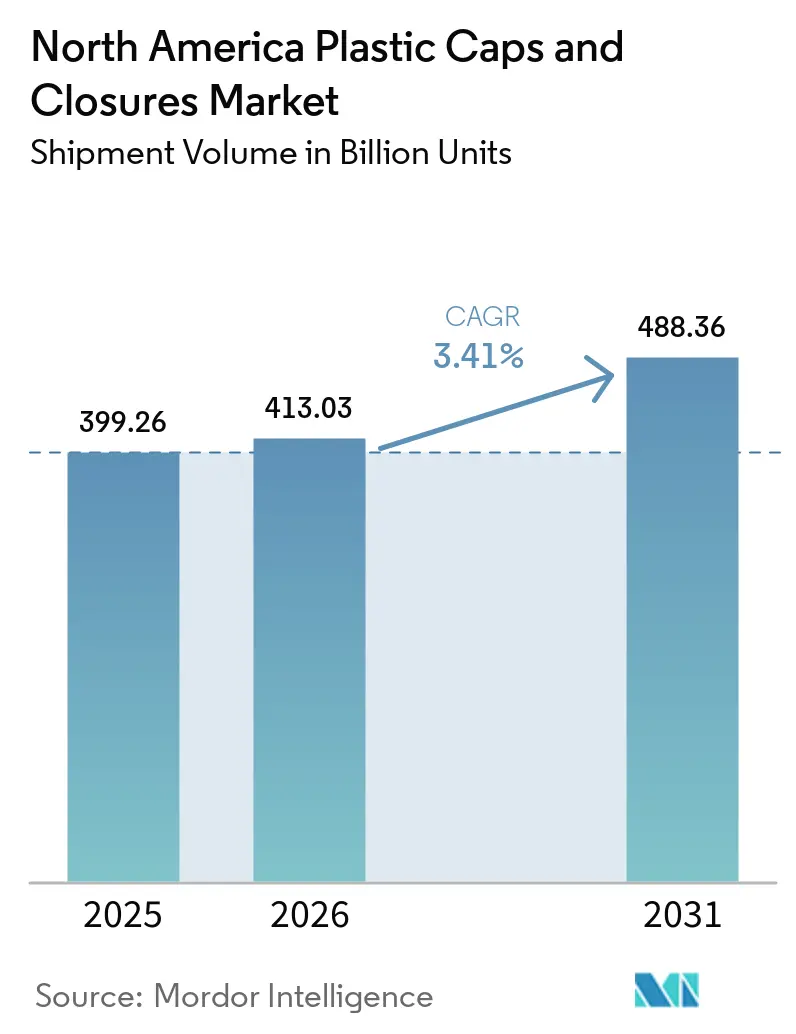
The North America plastic caps and closures market size is projected to expand from 399.26 billion units in 2025 and 413.03 billion units in 2026 to 488.36 billion units by 2031, registering a CAGR of 3.41% between 2026 and 2031. Beverage portfolios are pivoting toward polypropylene mono-material designs that accommodate California’s 50% recycled-content mandate, while child-resistant formats for online pharmaceutical shipments are scaling at nearly double the market baseline. Extended Producer Responsibility (EPR) fees of USD 0.02-0.04 per virgin-resin closure in nine U.S. states and four Canadian provinces are pressuring converter margins, intensifying procurement races for post-consumer recyclate. Compression molding retains cost leadership because new presses now cycle in sub-3 seconds for standard 28-millimeter beverage closures, while 3-D printing is being adopted for tethered-hinge prototypes ahead of California’s proposed 2027 tethered-cap rule. Competitive audits by brand owners now score suppliers on recycled-content percentage, carbon footprint per thousand units, and end-of-life recyclability, reshaping contract awards across the North America plastic caps and closures market.
Key Report Takeaways
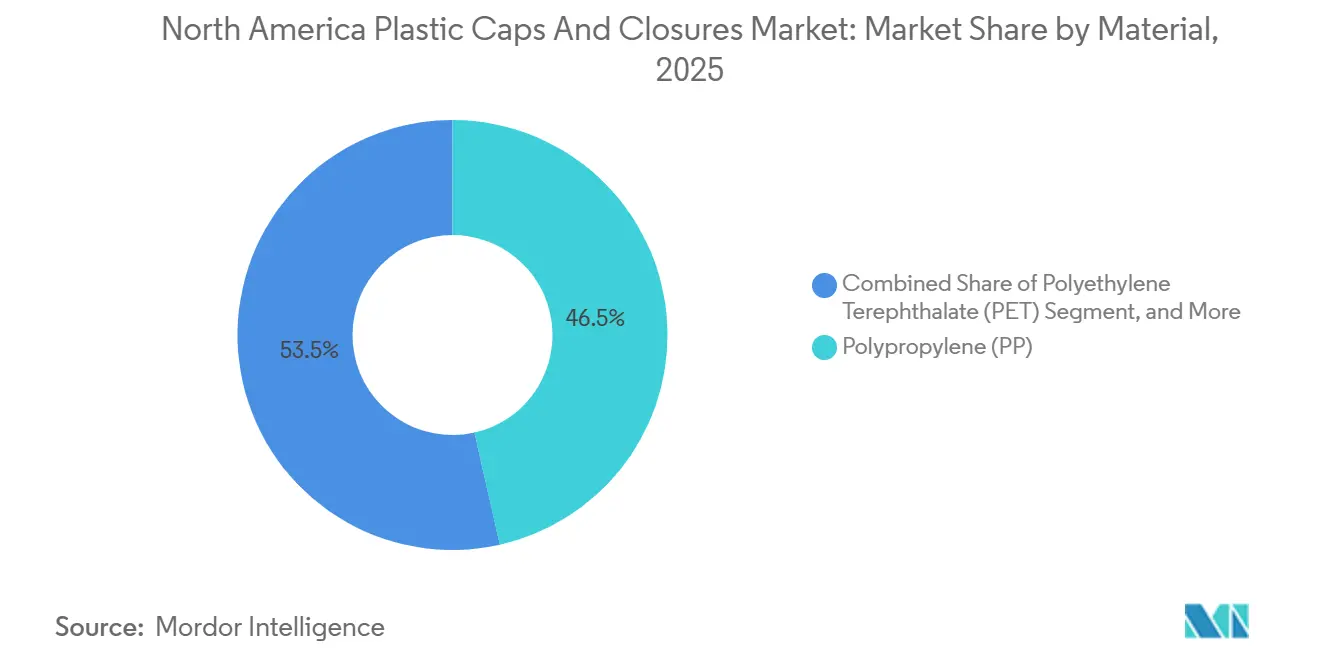
- By material, polypropylene held 46.47% of the North America plastic caps and closures market share in 2025, whereas polyethylene terephthalate closures are forecast to grow at a 4.31% CAGR through 2031.
- By type, threaded closures led the North America plastic caps and closures market with 48.83% of the market share in 2025, while child-resistant formats are projected to grow at 4.02% over 2026–2031.
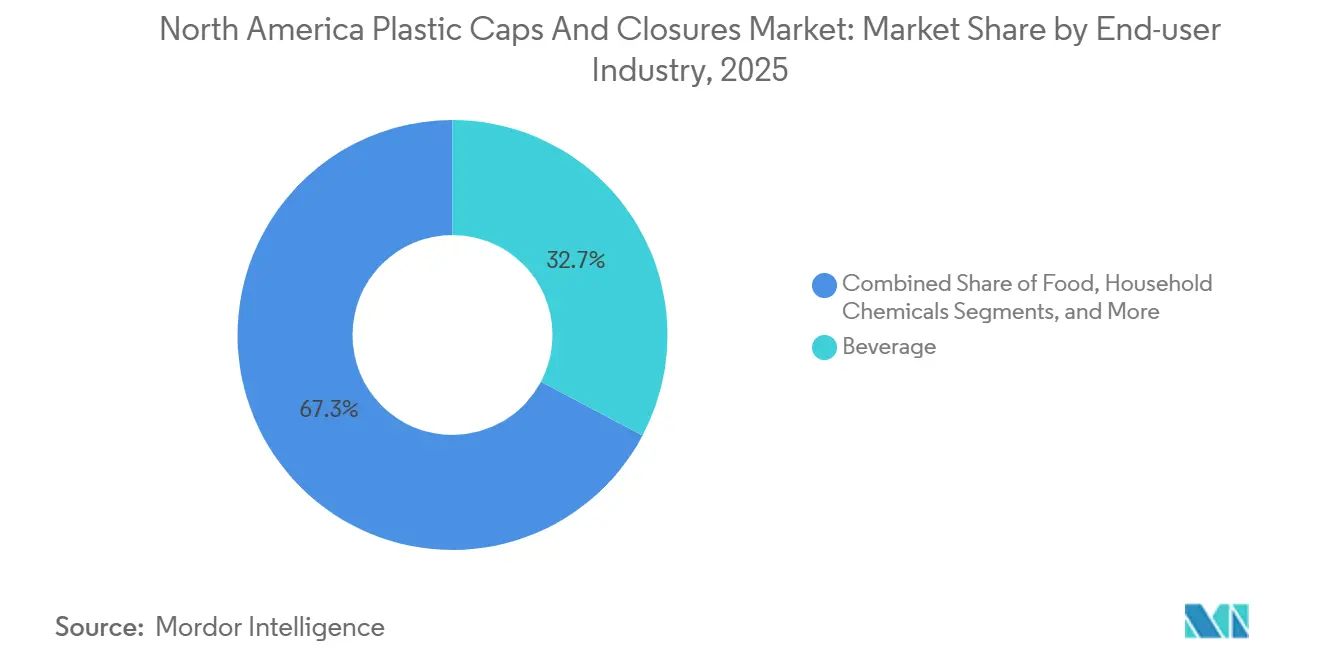
- By end-user, beverages commanded 32.74% of 2025 demand, whereas pharmaceutical and healthcare closures are pacing ahead at a 3.86% CAGR to 2031.
- By process, compression molding accounted for 53.81% of 2025 shipments, but 3-D printing for rapid prototyping is expanding at 3.66% annually.
- By geography, the United States represented 70.92% of 2025 volume, and Mexico is the fastest-growing country at 6.33% through 2031.
Note: Market size and forecast figures in this report are generated using Mordor Intelligence’s proprietary estimation framework, updated with the latest available data and insights as of 2026.
Market Trends and Insights
Drivers Impact Analysis of North America Plastic Caps and Closures Market*
| Driver | (~) % Impact on CAGR Forecast | Geographic Relevance | Impact Timeline |
|---|---|---|---|
| Demand Surge for Bottled and Functional Beverages | +0.8% | United States and Canada, with spillover to Mexico urban centers | Medium term (2-4 years) |
| Brand-owner Push for Tethered and E-commerce-ready Closures | +0.6% | United States (California, Oregon, Washington), Canada (British Columbia, Quebec) | Long term (≥ 4 years) |
| Shift Toward PP Mono-material Caps for Easier Recycling | +0.5% | North America, with early adoption in California and Northeast US states | Medium term (2-4 years) |
| On-line Pharma and Nutraceutical Boom Fuels CRC Demand | +0.7% | United States and Canada, concentrated in metropolitan e-commerce fulfillment zones | Short term (≤ 2 years) |
| AI-enabled In-line Vision Lowers Defect Rates and Costs | +0.3% | United States and Mexico manufacturing corridors | Medium term (2-4 years) |
| Smart Caps with Embedded NFC and QR Authentication | +0.2% | United States (spirits and pharmaceutical segments), Canada (cannabis edibles) | Long term (≥ 4 years) |
| Source: Mordor Intelligence | |||
Demand Surge for Bottled and Functional Beverages
Functional beverage launches jumped 23% year-over-year in 2025, accelerating demand for tamper-evident 28- and 38-millimeter closures that hold 15 psi seal integrity.[1] Single-serve bottled water now captures 62% of category sales, pushing brands to specify lighter closures that trim material costs by USD 0.003 each. Sports-nutrition players are standardizing flip-top dispensers with silicone check valves that prevent backflow contamination. In the United States, per-capita intake of enhanced water climbed to 14.7 gallons in 2025, more than 50% higher than Canada, highlighting the country’s outsized pull on closure volumes. The convergence of portability preferences and health-centric product launches keeps beverages at the core of the North America plastic caps and closures market.
On-line Pharma and Nutraceutical Boom Fuels CRC Demand
U.S. online pharmacy revenue reached USD 92 billion in 2025, channeling 38% of prescription bottles through mail order fulfillment.[2] The Poison Prevention Packaging Act requires child-resistant closures, and nutraceutical sellers now apply senior-friendly squeeze-and-turn designs that meet ASTM D3475 Protocol E, improving adult-opening success to 85% while retaining child safety. AptarGroup recorded a 22% lift in pharmaceutical closure shipments in Q3 2025 as GLP-1 drug packaging volumes surged. Growth clusters in Florida, Arizona, and California, where aging populations intersect with broadband penetration, underpin near-term upside. These dynamics reinforce the premium positioning of child-resistant offerings within the North America plastic caps and closures market.
Brand-Owner Push for Tethered and E-commerce-Ready Closures
California’s proposed SB 45 mandates tethered caps by 2027, mirroring Europe’s Single-Use Plastics Directive. Coca-Cola and PepsiCo pledged in January 2025 to migrate 80% of U.S. bottled water and carbonated soft drink portfolios to hinged-tether closures by December 2026. E-commerce leakage studies show torque-optimized closures cut parcel failure rates from 2.1% to 0.4%, a critical metric as beverage e-tail volumes grew 19% in 2025. Oregon beach cleanup data indicate 34% fewer loose caps where tethered formats are prevalent. High tooling costs, ranging from USD 45,000–80,000 per cavity, tighten supplier pools and sharpen differentiation in the North America plastic caps and closures market.
Shift Toward PP Mono-Material Caps for Easier Recycling
California’s SB 1013 stipulates that beverage containers contain 50% recycled content by 2030 and explicitly covers closures. Mono-material polypropylene eliminates the traditional PE liner, but maintaining hermetic seals demands sub-0.05 mm molding tolerances. Guala Closures validated an all-PP spirits cap that kept oxygen ingress below 0.3 cc/day over 12-month aging tests. Recycled PP trades at a USD 150-200 per-ton premium over virgin, incentivizing converters to lock multi-year contracts. Brand audits now reference ISO 14021 self-declaration standards, deterring greenwashing and accelerating the mono-material shift across the North America plastic caps and closures market.
Restraints Impact Analysis of North America Plastic Caps and Closures Market*
| Restraint | (~) % Impact on CAGR Forecast | Geographic Relevance | Impact Timeline |
|---|---|---|---|
| Extended Producer Responsibility Fees on Virgin Resin | -0.4% | United States (California, Maine, Oregon, Colorado), Canada (British Columbia, Quebec) | Short term (≤ 2 years) |
| Rise of Stand-up Pouches with Fitments Replacing Screw Caps | -0.3% | United States and Canada, concentrated in sauces, beverages, and household chemicals | Medium term (2-4 years) |
| US and Canada rPET Content Mandates Squeeze Virgin PP Demand | -0.2% | United States (California, Washington), Canada (federal mandate) | Long term (≥ 4 years) |
| Beverage Brand Trials of Aluminium Crown Re-seals | -0.1% | United States craft beer and premium spirits segments | Long term (≥ 4 years) |
| Source: Mordor Intelligence | |||
Extended Producer Responsibility Fees on Virgin Resin
Since 2025, nine U.S. states and four Canadian provinces have levied EPR fees of USD 0.02–0.04 per virgin-resin closure to finance recycling upgrades.[3] Maine’s program waives fees for 100% recycled content, conferring a USD 80-120 per-ton cost edge, yet the North American supply of food-grade recycled PP meets just 56% of demand. British Columbia’s scheme adds USD 0.015 per unit to fund improvements to curbside collection. Fragmented statutes compel converters to juggle SKUs and inventory, raising overhead across the North America plastic caps and closures market.
Rise of Stand-Up Pouches with Fitments Replacing Screw Caps
Regional shipments of flexible stand-up pouches grew 11% in 2025, displacing rigid bottles in condiments and detergents. Pouches with spout fitments reduce transport weight by 85% and cut logistics costs by USD 0.12 per unit on cross-country lanes. Heinz and Unilever eliminated 120 million rigid closures after switching ketchup and detergent SKUs in 2024. Carbonated beverages remain insulated because pouch spouts cannot withstand 45 psi pressure, but still-drink categories will continue eroding closure volumes, tempering expansion of the North America plastic caps and closures market.
*Our forecasts treat driver/restraint impacts as directional, not additive. The impact forecasts reflect baseline growth, mix effects, and variable interactions.
North America Plastic Caps and Closures Market Segment Analysis
By Material:
PET Closures Gain as Mono-Material Mandates TightenPolyethylene terephthalate closures, although only 12% of 2025 shipments, are growing at 4.31% through 2031 as bottled-water producers convert to liner-free PET caps that improve recycling yields. Polypropylene still dominates with 46.47% share because its barrier properties keep oxygen ingress below 0.5 cc/day for carbonated drinks. California’s AB 793, which counts closures in recycled-content targets, has prompted Silgan to re-tool three Texas lines for recycled PET, adding 60 million units of annual capacity.
Converters that secure long-term contracts for food-grade recycled PET at USD 200-per-ton premiums are safeguarding supply. In contrast, Mexico remains 78% virgin PP, reflecting limited recycling infrastructure, although the 2025 National Recycling Strategy targets 30% recycled content by 2030. Material transitions therefore proceed unevenly across the North America plastic caps and closures market.

By Type:
Child-Resistant Formats Outpace Threaded StandardsThreaded closures led with 48.83% of 2025 volume, vital for pressure retention in soft drinks. Child-resistant designs are advancing at 4.02%, aided by Health Canada’s torque threshold rules for cannabis edibles and U.S. e-pharmacy growth. Aptar’s squeeze-and-turn CRC raised adult-opening success to 92% without compromising child resistance, capturing early adopter interest.
Dispensing caps, 18% of shipments, are gaining popularity in sports beverages where flip-tops support one-hand use, particularly in Mexico, where single-serve sports drinks grow 14% annually. Unthreaded snap-on variants remain niche because leakage during e-commerce transit limits broader acceptance. These patterns underscore product-specific performance needs that sustain segment diversity within the North America plastic caps and closures market.
By End-User Industry:
Pharmaceutical Closures Accelerate Past Beverage BaselineBeverage caps and closures accounted for 32.74% of 2025 units, but pharmaceutical and healthcare closures are rising by 3.86%, aided by a USD 92 billion U.S. online pharmacy sector. Bottled-water launches with electrolyte and adaptogenic claims lifted associated closure demand by 3.9% in 2025, whereas spirit brands are embedding NFC chips to deter counterfeits, expanding closure revenue per unit.
Food closures, 22% of volume, feel substitution pressure from flexible pouches. Cosmetics and toiletries account for 11% of shipments as airless pumps help preserve serum shelf life. Household chemicals lag at 2.8% CAGR due to concentrated formulas requiring fewer closures. The pharmaceutical upswing therefore offsets slower segments, stabilizing growth across the North America plastic caps and closures market.
By Manufacturing Process:
Compression Molding Retains Speed Edge While 3-D Printing Scales PrototypingCompression molding delivered 53.81% of 2025 output, favored for sub-3-second cycles that yield over 1,200 units per cavity per hour. Injection molding, 38% of volume, remains indispensable for complex child-resistant geometry. Hybrid systems that combine compression speed with injection versatility debuted in October 2025, targeting pharma converters that require dimensional accuracy under ISO 15378 certification.
Rapid prototyping via 3-D printing accounts for only 2% of shipments but is growing at 3.66% because design cycles have halved to 9 months. Brands accept the USD 2.50 prototype cost to avoid USD 100,000 steel-tool missteps. Mexican facilities stay 89% compression-molded, reflecting a focus on high-volume beverage caps for export. Process choice thus aligns with end-user demands within the North America plastic caps and closures market.
Geography Analysis
United States and Mexico Plastic Caps and Closures Market
The United States generated 70.92% of 2025 shipments, underpinned by 44.7 gallons per capita beverage consumption and a USD 580 billion pharmaceutical sector. California converters produced 42% of their 2025 output with post-consumer resin, outpacing the 28% national average due to SB 1013 incentives. EPR fee mosaics inflate administrative overhead by up to USD 0.012 per unit. Nearshored Mexican imports delivered to Texas now undercut domestic prices by 8-12%, narrowing margins in the North America plastic caps and closures market.
Canada and United States Plastic Caps and Closures Market
Canada contributed 18% of regional volume and grew 3.5% in 2025, buoyed by child-resistant demand for cannabis edibles and British Columbia’s 75% collection mandate that lifted recycled-resin availability. Quebec achieved an 82% closure collection rate through deposit refunds, securing feedstock for local converters. Market concentration is higher than in the U.S.; the top four suppliers control 68% of Canadian volume versus 52% stateside.
Mexico Plastic Caps and Closures Market
Mexico, while only 11% of 2025 shipments, is expanding at 6.33% through 2031 on the back of USD 420 million in nearshoring investments. Silgan’s Monterrey plant opened in April 2025, adding 800 million units of beverage-closure capacity. Labor at USD 3.80 per hour enables landed prices 10–14% below U.S. production. Urban consumption in Mexico City, Guadalajara, and Monterrey is rising 9% annually, giving domestic demand a double-digit tailwind.
Regulatory Landscape
Regulation affecting plastic caps and closures in North America is tightening around circularity, reporting, and food-contact safety. In the United States, the EPA finalized its National Strategy to Prevent Plastic Pollution in 2024, signaling a coordinated federal direction across the plastics lifecycle, alongside increasingly prominent state-level packaging EPR frameworks that shape closure design choices and PCR sourcing strategies.
Food and beverage closure materials remain governed by US FDA food-contact rules and the Food Contact Substance (FCS) framework, including requirements under 21 CFR 177.1210 for certain sealing gaskets. In Canada, Environment and Climate Change Canada established the Federal Plastics Registry under CEPA (Section 46), with Phase 1 reporting beginning in 2025 for 2024 data and expanded reporting categories phased in during 2026. This increases the compliance burden for producers and importers placing plastic packaging, including closures, on the Canadian market.
Value Chain Analysis
The value chain spans resin and PCR supply, closure design and tooling, high-speed manufacturing (compression and injection molding), quality and traceability systems, distribution to brand owners and contract packers, and end-of-life collection and recycling channels that determine PCR availability and EPR fee outcomes. Key market participants include Silgan Holdings, Amcor, AptarGroup, Closure Systems International, TriMas, and equipment suppliers such as Husky Technologies, while brand owners increasingly use supplier scorecards tied to recycled content, defect rates, and recyclability.
Upstream constraints center on securing food-grade recycled PP and recycled PET at scale. Downstream complexity is also rising as producers align SKUs to differing EPR and recycled-content requirements by jurisdiction. California SB 54 is a major operational anchor in the region: CalRecycle permanent regulations were approved by the Office of Administrative Law on May 1, 2026, with an initial producer registration deadline in June 2026, which pushes more structured data collection, packaging attribute documentation, and coordination across converters, distributors, and producer responsibility organizations. Industry collaboratives such as the U.S. Plastics Pact connect resin suppliers, converters, and brands around recycled-content scaling and reuse design workstreams, reinforcing the shift toward mono-material caps, tethered formats, and tighter quality control when using PCR.
Competitive Landscape
Market concentration is moderate, the five largest suppliers-Silgan Holdings, Amcor, AptarGroup, Closure Systems International, and Berry Global-held a considerable share of the 2025 volume. Technology is the pivot point. Silgan invested in Texas PET reclamation to lock 25,000 tons of feedstock, while Amcor commercialized mono-material PP caps that maintain 3.8 volumes CO₂ for 12 months. AptarGroup filed 14 NFC-closure patents during 2024–2025, cementing smart-cap leadership.
White-space opportunities are emerging in senior-friendly child-resistant designs that balance ASTM D3475 compliance with arthritis-friendly ergonomics, a segment where incumbent suppliers have underinvested despite the US population aged 65-plus reaching 58 million in 2025. Mid-tier converters such as Phoenix Closures and Mold-Rite Plastics are adopting AI-enabled inspection to drive defect escape rates below 0.3%, winning zero-defect contracts from pharmaceutical buyers.
ISO 15378 has become table stakes; 62% of pharma bids required certification in 2025. Industry 4.0 upgrades costing USD 1.2–2.8 million per line are now differentiating suppliers by changeover speed and overall equipment effectiveness. These arms-race investments define the competitive tempo of the North America plastic caps and closures market.
North America Plastic Caps and Closures Industry Leaders
-
Silgan Holdings Inc.
-
Amcor PLC
-
Closure Systems International Inc.
-
AptarGroup Inc.
-
Trimas Corporation
- *Disclaimer: Major Players sorted in no particular order
North America Plastic Caps and Closures Market Companies Covered in this Report
- Silgan Holdings Inc.
- Amcor plc
- AptarGroup Inc.
- Closure Systems International Inc.
- TriMas Corporation
- Guala Closures SpA
- Tetra Pak Group
- O.Berk Company LLC
- BERICAP Holding GmbH
- Pano Cap Canada Ltd
- Erie Molded Plastics Inc.
- Crown Holdings Inc.
- Phoenix Closures Inc.
- Mold-Rite Plastics LLC
- Comar LLC
- Husky Technologies
- SACMI Imola S.C.
- Sonoco Products Company
- Plastipak Holdings Inc.
- Albea Group
Market Opportunities and Future Outlook
Design-for-recyclability and mono-material migration are creating whitespace in PET and PP closure platforms that fit emerging guidance and brand audit criteria. In February 2026, the Association of Plastic Recyclers (APR) issued PET cap design guidance for cap color and recyclability testing, giving converters and brands a clearer target and supporting PET cap adoption where bottles are already PET and where recovery systems prioritize PET recycling yields.
Capacity and capability repositioning by leading suppliers is also creating near-term sourcing and qualification opportunities for beverage and adjacent categories. Closure Systems International acquired two North American manufacturing facilities from Amcor in May 2026 (Erie, Pennsylvania and Hattiesburg, Mississippi), signaling renewed investment in regional beverage-closure output and shortening lead times for high-volume programs. In March 2026, Southeastern Container announced a USD 31 million expansion in North Carolina that adds closure manufacturing capability, indicating continued integration by bottle suppliers and co-located packaging campuses. On the policy and cost-to-serve side, producer engagement in EPR fee-setting is becoming more organized, with Circular Action Alliance initiating a consultation process in June 2026, which increases the value of closure designs that can document recyclability attributes and recycled content for eco-modulated fee structures.
Recent Industry Developments in North America Plastic Caps and Closures Market
- May 2026: Closure Systems International acquired two North American manufacturing facilities from Amcor in Erie, Pennsylvania and Hattiesburg, Mississippi. The transaction strengthened CSI's regional beverage-closure footprint and supports faster supply response for high-volume compression-molded programs across the United States.
- October 2025: Closure Systems International introduced the Asepti-Lok 47 38mm closure for aseptic beverage filling and launched the Sport Flip Top 38mm closure aimed at active, on-the-go beverages. These launches broadened CSI's beverage portfolio across aseptic and hot-fill applications and raised performance differentiation beyond standard threaded formats.
- July 2024: Origin Materials and Reed City Group commenced a strategic partnership to mass-produce PET caps and closures in Michigan using virgin or recycled PET, with production scheduled for late 2024. The partnership reflected growing interest in PET-closure supply aligned with mono-material recycling streams and created an additional North American pathway for PET cap capacity.
North America Plastic Caps and Closures Market Report Scope and Research Methodology
Market Definition and Coverage
This market covers plastic caps and closures sold for sealing and dispensing packaged products across North America, measured at the point of manufacture and sale into packaging supply chains.
Scope exclusions: Metal closures, glass stoppers, and paper-based or cork closure formats are excluded from this sizing.
Segments Covered in This Report
- By Material
- Polyethylene (PE)
- Polyethylene Terephthalate (PET)
- Polypropylene (PP)
- Other Materials
- By Type
- Threaded
- Dispensing
- Unthreaded
- Child-Resistant
- By End-user Industry
- Beverage
- Bottled Water
- Soft Drinks
- Spirits
- Other Beverages
- Food
- Pharmaceutical and Healthcare
- Cosmetics and Toiletries
- Household Chemicals
- Other Industries
- Beverage
- By Manufacturing Process
- Injection Molding
- Compression Molding
- 3-D Printing / Rapid Prototyping
- Other Manufacturing Process
- By Country
- United States
- Canada
- Mexico
Data Sources, Market Sizing, and Validation
Desk Research
Desk research was used to set clear boundaries for what counts as a plastic cap or closure and to build the demand map by end-use packaging. We typically rely on public sources such as US Census Bureau manufacturing data, US International Trade Commission trade statistics, Statistics Canada releases, and Mexico INEGI industrial indicators, which help anchor packaging output trends.
To pressure-test the direction of the model, we also used sources such as packaging and plastics association publications, regulatory and standards updates on packaging and contact materials, peer-reviewed polymer and packaging journals, and company annual reports and investor presentations. In addition, paid subscriptions that cover company financials and intelligence, patent databases, and shipment-level import and export records were referenced selectively to fill gaps on product mix and cross-border flows. The sources noted above are illustrative only, and many additional public and proprietary references were reviewed for data collection, validation, and clarification.
Primary Interviews and Surveys
Primary work focused on validating closure volumes, price bands, and mix shifts across beverage, food, home care, and healthcare packaging. We spoke with packaging converters, resin-linked stakeholders, brand procurement contacts, and distribution-side participants across the United States, Canada, and Mexico, and then used their inputs to confirm assumptions that could not be read directly from public datasets.
Distribution of primary research fieldwork respondents
| Company type | Respondent position |
|---|---|
| Top tier: 26% | CXOs: 13% |
| Mid tier: 60% | Functional/Unit leaders: 42% |
| Smaller Players: 14% | Managers: 45% |
Market-Sizing & Forecasting
Sizing was built using a top-down demand reconstruction, where packaged-product output and filling activity were translated into closure needs using usage rates and typical closures-per-pack. The model was then corroborated through selective bottom-up approximations using sampled supplier volumes, channel checks on closure shipments, and price band checks by major closure formats, which helped us adjust totals when the first pass looked off.
Inputs that matter in this market include packaged beverage and food volumes, the share of PET and HDPE containers that use plastic closures, lightweighting and tethered-closure adoption timing, resin price direction that influences conversion costs, and the mix shift between dispensing and threaded formats. For forecasts, scenario analysis was applied around packaging demand growth and adoption speed of newer closure designs, and then the scenario ranges were narrowed using expert consensus from interviews. Where bottom-up signals were incomplete, gaps were handled by using conservative penetration assumptions and then rebalancing at the country level so totals stayed consistent with broader packaging output indicators.
Data Validation & Update Cycle
Estimates were checked through triangulation across independent signals, and outliers were flagged when volume, mix, and implied unit economics did not line up. Before sign-off, the model goes through step-by-step analyst reviews, and follow-up calls are triggered when a key assumption changes, such as resin-linked pricing, a major packaging format shift, or a regulatory-driven design change.
Reports are refreshed annually, and interim updates are made when material events occur that can move demand or pricing. Before delivery, a final review pass is completed so clients receive the latest updated view consistent with the defined scope and measurement approach.
Mordor Intelligence's North America Plastic Caps and Closures Market Size Versus Other Published Estimates
Published estimates for this market can differ more than buyers expect because some studies size value in USD and others size physical volume in units, and the underlying price and mix assumptions can move totals quickly. Differences also show up when the study boundary is set differently across end uses and closure formats.
Trade-based packaging flow signals and end-use packaging output checks are the evidence that keep Mordor Intelligence's estimate tied to a unit-defined demand pool (399.26 billion units in 2025), instead of being driven mainly by assumed average selling prices that can vary by format and by year.
Benchmark comparison
| Source | Market Size | Gaps in Research Methodology |
|---|---|---|
| Mordor Intelligence | USD 399.26 B (2025) | |
| Trade Journal A | USD 8.30 B (2022) | Uses USD value with a 2022 base year, so results depend heavily on price-per-closure assumptions and mix, rather than a unit-based closure demand build tied to packaging output. |
| Regional Consultancy B | USD 14.58 B (2025) | Reports a value figure for 2025, which can expand or compress based on how dispensing formats, specialty closures, and price escalation are treated, even if underlying unit demand is similar. |
The spread in the table mostly comes from mixing unit-based sizing with USD-based sizing and from using different base years that face different price environments. By keeping the model traceable to packaging activity indicators and then using interviews to sanity-check mix and pricing, the final view stays repeatable and easier to audit when assumptions change.
Key Questions Answered in the Report
How large will unit shipments be by 2031 in the North America plastic caps and closures market?
Volume is forecast to reach 488.36 billion units by 2031, advancing at a 3.41% CAGR from 2026 to 2031.
Which closure material is growing the fastest?
Polyethylene terephthalate caps are expanding at 4.31% annually as brands adopt liner-free mono-material designs.
Why are child-resistant closures gaining share?
Online pharmacy and nutraceutical channels demand ASTM-compliant child-resistant designs, lifting the segment at 4.02% CAGR.
How are EPR fees affecting suppliers?
Virgin-resin fees of USD 0.02–0.04 per closure raise costs unless converters secure recycled feedstock, spurring material transitions to PP and PET recyclate.
Which country is the fastest-growing market in the region?
Mexico is posting a 6.33% CAGR through 2031, supported by nearshoring investments and rising urban beverage consumption.
What technologies are differentiating leading converters?
Investments in AI vision inspection, NFC-enabled smart caps, and hybrid compression-injection presses are setting suppliers apart on quality and compliance.oving responsiveness.