
Market Overview
| Study Period | 2020 - 2031 |
|---|---|
| Forecast Data Period | 2026 - 2031 |
| Base Year Market Size (2025) | USD 31.12 Billion |
| Market Size (2026) | USD 33.22 Billion |
| Market Size (2031) | USD 48.66 Billion |
| Growth Rate (2026 - 2031) | 7.93 % |
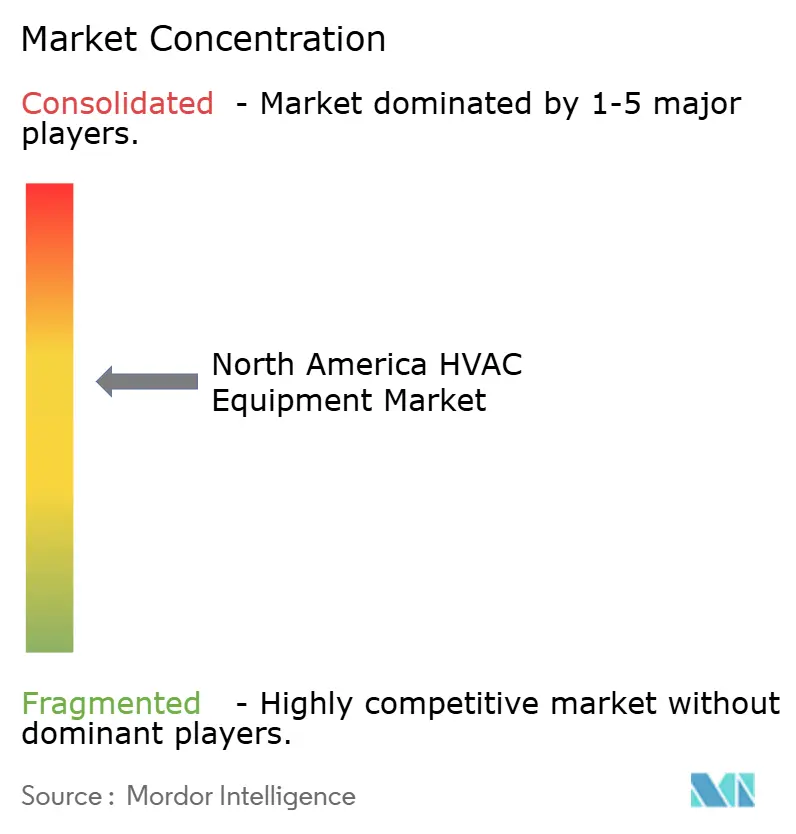
| Market Concentration | Medium |
Major Players
*Disclaimer: Major Players sorted in no particular order Image © Mordor Intelligence. Reuse requires attribution under CC BY 4.0. |
|
North America HVAC Equipment Market Analysis by Mordor Intelligence
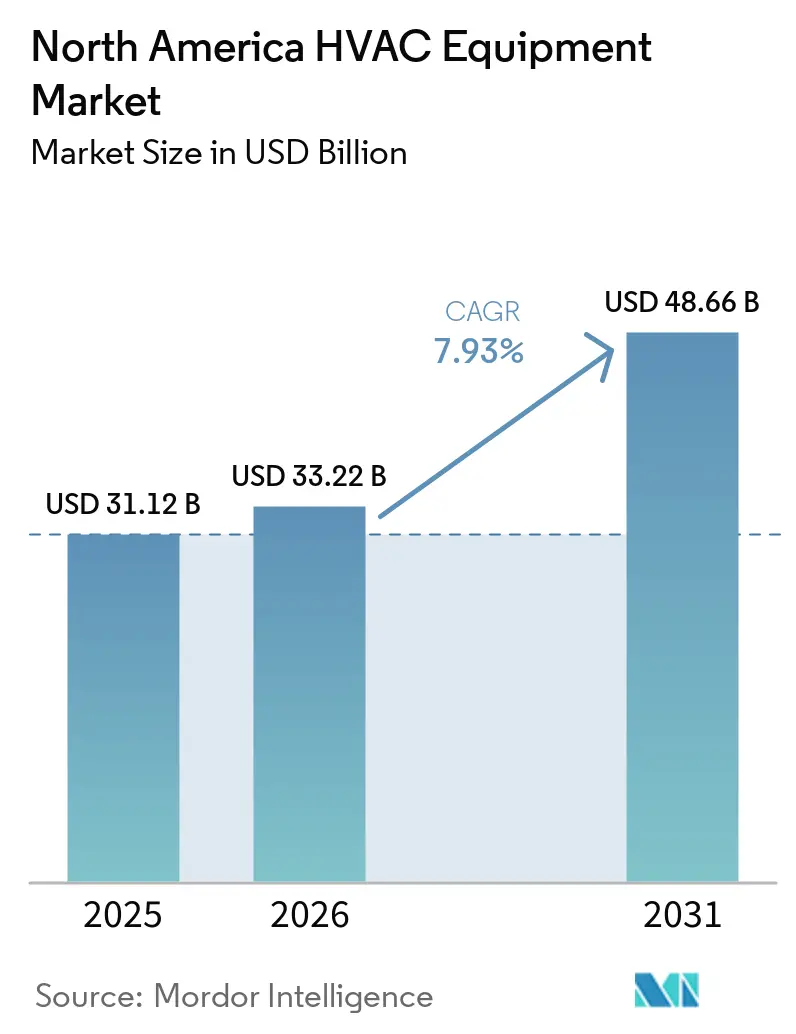
The North America HVAC equipment market size is expected to grow from USD 31.12 billion in 2025 to USD 33.22 billion in 2026 and is forecast to reach USD 48.66 billion by 2031 at 7.93% CAGR over 2026-2031. Replacement cycles tied to new A2L-refrigerant mandates, accelerating heat-pump adoption, and a shift toward connected, demand-response-ready systems are sustaining momentum despite supply-chain volatility. Retrofit activity accounts for a dominant share of spending, as building owners move quickly to lock in federal tax credits before they phase down, while commercial buyers upgrade ventilation and controls to meet stricter indoor-air-quality codes. Competitive intensity remains high; incumbents are protecting installed-base service revenues through predictive-maintenance contracts, while Asian brands erode price points in the fast-growing ductless segment. Near-term tailwinds from U.S. semiconductor re-shoring and Mexican nearshoring offset headwinds from installer labor shortages and higher liability premiums for A2L systems.
Key Report Takeaways
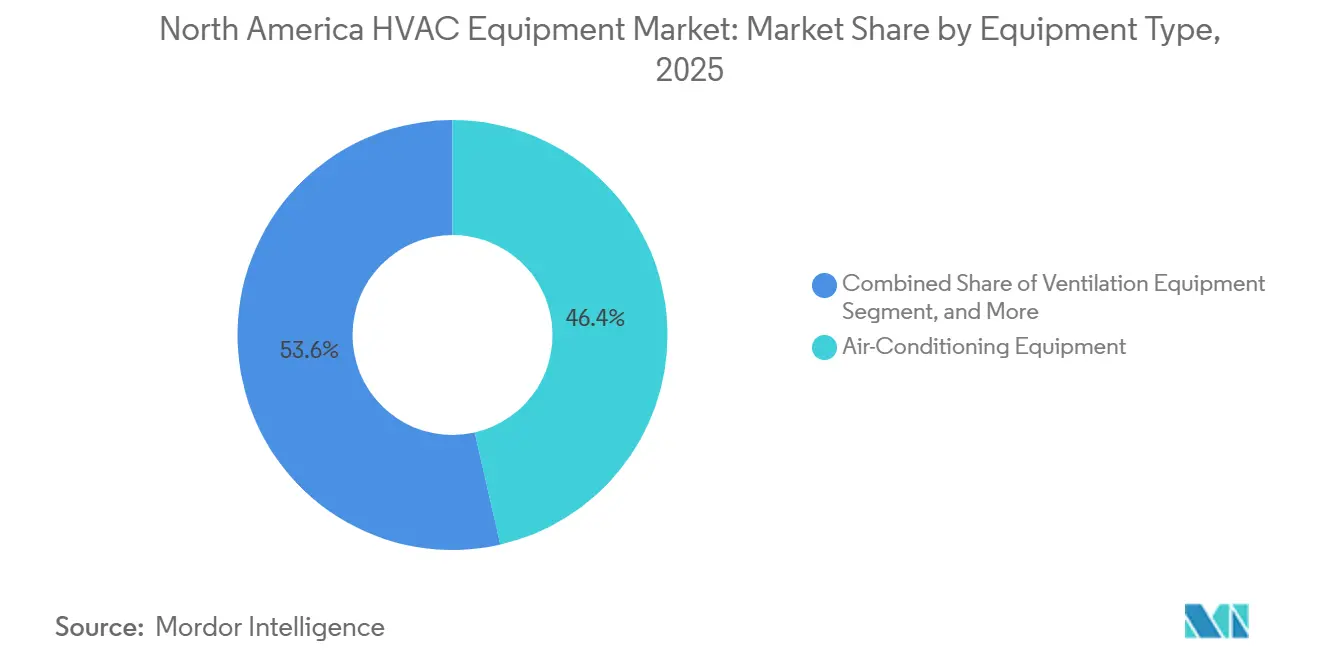
- By equipment type, air-conditioning systems led with 46.43% revenue share in 2025, and the subsegment is expanding at an 8.64% CAGR through 2031.
- By installation type, retrofit and replacement accounted for 60.84% of demand in 2025, while new construction is projected to grow at an 8.29% CAGR through 2031.
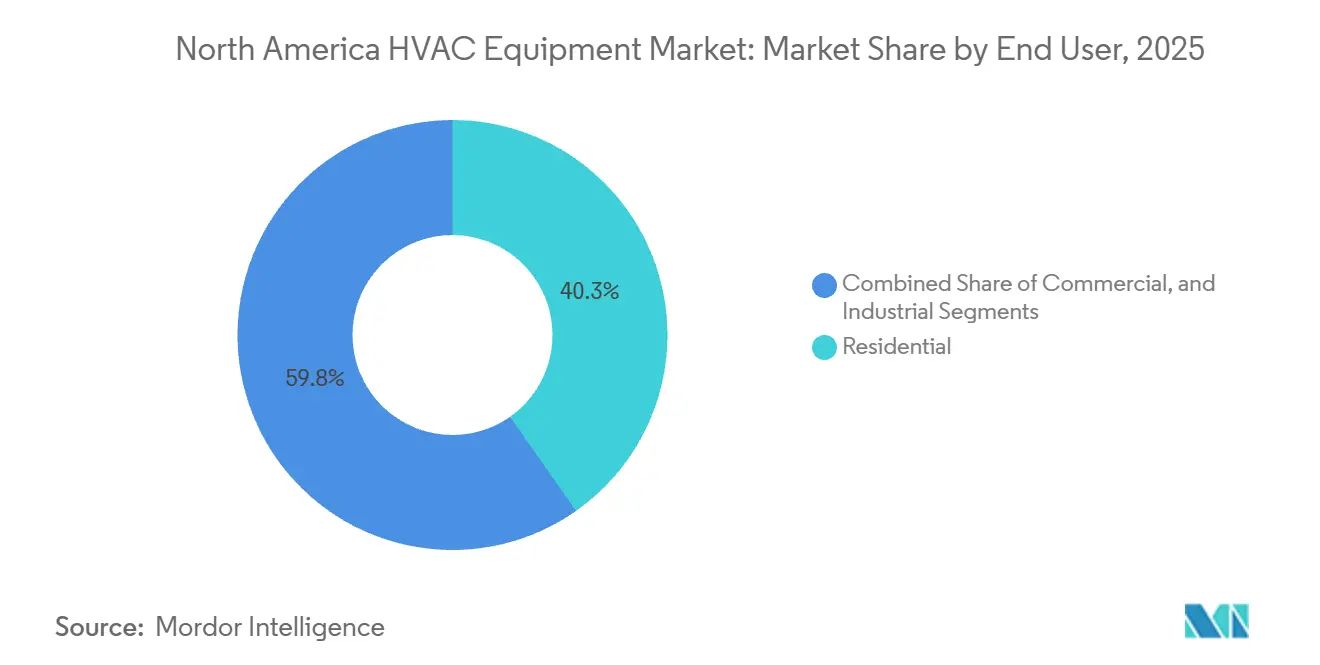
- By end user, the commercial segment accounted for 59.75% of spend in 2025 and is growing at an 8.81% CAGR through 2031.
- By building type, office buildings commanded a 32.62% share of commercial HVAC demand in 2025, whereas data centers are forecast to post the fastest 9.12% CAGR through 2031.
- By country, the United States maintained a dominant 79.82% share in 2025, while Mexico is projected to register the fastest 8.78% CAGR through 2031.
Note: Market size and forecast figures in this report are generated using Mordor Intelligence’s proprietary estimation framework, updated with the latest available data and insights as of January 2026.
Market Trends and Insights
Drivers Impact Analysis of North America HVAC Equipment Market*
| Driver | (~) % Impact on CAGR Forecast | Geographic Relevance | Impact Timeline |
|---|---|---|---|
| Rapid Adoption of Heat Pumps and Electrification of Heating | +1.80% | United States and Canada (Pacific Northwest, Northeast) | Medium term (2-4 years) |
| Accelerating Adoption of Low-GWP A2L Refrigerants Creating Replacement Wave | +1.50% | United States, Canada, Mexico | Short term (≤ 2 years) |
| Growing Demand for Smart and Connected HVAC Systems | +1.20% | U.S. commercial and high-end residential, Canadian urban centers | Medium term (2-4 years) |
| Stringent Energy-Efficiency Regulations and Incentives | +1.10% | United States, Canada, Mexico | Long term (≥ 4 years) |
| Rising Residential and Non-residential Construction Activity | +0.90% | Mexico nearshoring corridors, U.S. Sunbelt, Canadian infill | Medium term (2-4 years) |
| Emergence of Prefabricated Modular HVAC Units for Quick Retrofits | +0.60% | U.S. commercial retrofits, Canadian healthcare pilots | Long term (≥ 4 years) |
| Source: Mordor Intelligence | |||


Rapid Adoption of Heat Pumps and Electrification of Heating
Federal tax credits of up to USD 2,000 per unit, combined with state bans on new natural-gas hookups, have propelled heat-pump shipments beyond gas furnaces for the first time in U.S. history.[1]U.S. Department of Energy, “Heat Pump Shipments Surpass Gas Furnaces for First Time,” Energy.gov Cold-climate units capable of delivering full capacity at −15 °F, backed by CAD 5,000 (USD 3,950) in utility rebates, are taking hold in Canada. Variable-speed compressors now routinely achieve seasonal COPs of 3.5, reducing payback periods to fewer than 6 years in many Northeast markets. As regional gas utilities pivot toward electrification incentives, dual-fuel systems pairing heat pumps with backup resistance heaters are gaining traction in retrofit projects. This structural shift is expected to re-weight the North America HVAC equipment market toward electrically driven heating across the forecast horizon.
Accelerating Adoption of Low-GWP A2L Refrigerants Creating Replacement Wave
The American Innovation and Manufacturing Act triggered a 40% cut in hydrofluorocarbon quotas by 2024, lifting R-410A prices 60% and pushing OEMs to R-454B and R-32 formulations.[2]U.S. Environmental Protection Agency, “Phasedown of Hydrofluorocarbons Under the AIM Act,” Epa.gov Revised ASHRAE 15 and NFPA 1 codes now require integrated leak detection and enhanced ventilation, encouraging factory-charged equipment that minimizes field refrigerant handling. Building owners are pre-emptively retiring 10- to 12-year-old systems ahead of further quota cuts, accelerating a replacement wave that benefits brands with deep distributor networks. Shorter product life cycles increase aftermarket parts revenue and favor manufacturers able to quickly pivot design platforms.
Growing Demand for Smart and Connected HVAC Systems
FERC Order 2222 opened wholesale markets to distributed energy resources, allowing networked rooftop units to earn USD 50-150 per kW of peak load curtailed. Wi-Fi thermostats surpassed 40% penetration in new U.S. homes in 2025, fueled by voice-assistant integration and utility demand-response rebates. OEMs are converting raw equipment data into subscription-based predictive-maintenance offers, diversifying cash flows away from hardware margins. Convergence with BACnet and Modbus allows lighting, shading, and ventilation to coordinate, lowering total energy use while maintaining ASHRAE 62.1 indoor-air-quality thresholds.[3]ASHRAE, “Standard 62.1 Ventilation for Acceptable Indoor Air Quality,” Ashrae.org
Stringent Energy-Efficiency Regulations and Incentives
New SEER2 baselines of 14.3 in the North and 15.0 in the South eliminated the lowest-cost tiers in 2023, steering buyers toward variable-speed compressors and electronically commutated motors. The Inflation Reduction Act’s Section 179D offers up to USD 5 per ft² for 50% reductions in energy use, jump-starting large-scale rooftop and chiller retrofits. Canada’s paused Greener Homes Grant previously rebated up to CAD 5,600 (USD 4,100), creating pipeline uncertainty but signaling long-term policy support. Together, these measures lock in a higher baseline of efficiency across the North America HVAC equipment market.
Restraints Impact Analysis of North America HVAC Equipment Market*
| Restraint | (~) % Impact on CAGR Forecast | Geographic Relevance | Impact Timeline | |
|---|---|---|---|---|
| Transition to A2L Refrigerants Increasing Liability Insurance Costs | -0.70% | United States contractor networks (California, Northeast) | Short term (≤ 2 years) | |
| Supply-Chain Vulnerability Due to Critical Electronics and Sensor Shortages | -0.60% | United States and Canada | Short term (≤ 2 years) | |
| High Initial Capital Cost of High-Efficiency Systems | -0.50% | U.S. residential retrofits, Canadian provinces with limited rebates | Medium term (2-4 years) | |
| Skilled Labor Shortage for Installation and Maintenance | -0.40% | United States and Canada rural markets | Long term (≥ 4 years) | |
| Source: Mordor Intelligence | ||||
Transition to A2L Refrigerants Increasing Liability Insurance Costs
Contractor insurance premiums rose 15-25% in 2025 as underwriters priced in leak-related fire risk, with compliance upgrades adding USD 500-1,500 per mechanical room. Smaller installers unable to fund training and detection equipment are exiting, consolidating channels, and raising labor costs. Multifamily property managers face insurer scrutiny, slowing approvals for heat-pump retrofits that would displace legacy furnaces. In the near term, elevated liability costs suppress penetration of A2L systems among price-sensitive residential buyers.
Supply-Chain Vulnerability Due to Critical Electronics and Sensor Shortages
Microcontroller lead times hit 26 weeks in early 2025, delaying variable-speed product launches and prompting costly redesigns. Spot prices for pressure and humidity sensors climbed 40-60%, slashing margins on fixed-price distributor contracts. While new U.S. fab capacity is slated to open by late 2026, the timing gap keeps OEMs exposed to chip shortages, tempering shipment forecasts for connected equipment across the North America HVAC equipment market.
*Our forecasts treat driver/restraint impacts as directional, not additive. The impact forecasts reflect baseline growth, mix effects, and variable interactions.
North America HVAC Equipment Market Segment Analysis
By Equipment Type:
Air-Conditioning Leads as Heat Pumps SurgeAir-conditioning equipment represented 46.43% of the overall North America HVAC equipment market share in 2025 and is scaling at an 8.64% CAGR, supported by rising cooling-degree days and the retirement of R-410A systems. The subsegment’s revenue of the North America HVAC equipment market reflects its entrenched role in both residential and light-commercial buildings. Ductless mini-splits stand out by capturing retrofit demand where duct installation is impractical, while variable refrigerant flow platforms enable simultaneous heating and cooling across large commercial footprints.
Heat pumps, classified within heating equipment, are closing the gap fast. Electrification mandates and rebate stacks narrow the installed-cost delta versus gas furnaces, redirecting share within the North America HVAC equipment market toward electrically driven solutions. Ventilation gear such as energy-recovery ventilators and humidifiers rides the wave of IAQ compliance, while packaged terminal units return to multifamily design specs due to simplified billing and space savings.


By Installation Type:
Retrofit Dominates as Builders Embrace Factory PackagesRetrofit and replacement installations accounted for 60.84% of the North America HVAC equipment market share in 2025 and continue to drive near-term sales as owners accelerate system retirements ahead of tighter refrigerant caps. Financing promotions and seasonal replacement campaigns encourage homeowners to act before costly midsummer failures. Meanwhile, the North America HVAC equipment market size attached to new construction grows at an 8.29% CAGR, propelled by industrial plants in Mexico and multifamily projects across the U.S. Sunbelt.
Builders increasingly specify pre-packaged mechanical rooms that arrive fully wired and charged, trimming onsite labor by up to 50%. Electrification simplifies floor plans by eliminating gas piping but pushes panel upgrades that add USD 2,000-4,000 per dwelling. The balance between retrofit and new construction will narrow only modestly through 2031, keeping replacement spend a dominant thread in the overall growth story.
By End User:
Commercial Upgrades Outpace Residential UpkeepCommercial accounts commanded 59.75% of the North America HVAC equipment market revenue in 2025 and are expanding at an 8.81% CAGR, thanks to IAQ retrofits, energy-cost-reduction mandates, and monetization of demand response, supporting continued demand for commercial HVAC systems. Office portfolios are installing energy-recovery ventilators to comply with ASHRAE 62.1, while malls are swapping fixed-speed rooftop units for variable-speed models that modulate load in response to real-time occupancy.
Residential spend holds 40.25%, but adoption hurdles persist because heat-pump premiums and A2L insurance costs can deter budget-constrained homeowners. Integration with rooftop solar and home batteries is emerging as a selling point, signaling how the North America HVAC equipment market will intertwine with distributed energy investments. Industrial users remain a niche, focusing on process chillers and high-tonnage handlers where uptime is mission-critical.
By Building Type (Commercial):
Data Centers Dominate Growth PipelineAmong commercial end users, data centers posted the fastest 9.12% CAGR, as hyperscalers race to cool AI-accelerator racks with densities exceeding 100 kW. This niche represents a rapidly expanding slice of the North America HVAC equipment market, with operators pivoting to liquid cooling and modular deployments that compress project timelines from 18 months to 6 months.
Office buildings still account for 32.62% of the 2025 spend but battle hybrid-work-induced underutilization. Healthcare facilities invest in HEPA filtration and UV germicidal add-ons, boosting per-square-foot HVAC spend. Hospitality conversions to ductless mini-splits favor granular room control, and retail shifts toward sensor-driven conditioning that aligns energy use with foot traffic.
Geography Analysis
United States HVAC Equipment Market
The United States held 79.82% of 2025 revenues, giving it the lion’s share of the North America HVAC equipment market. Population inflows and higher cooling-degree days fuel sunbelt demand, while Northern states pivot to cold-climate heat pumps backed by state electrification credits. Fragmented state codes complicate national product rollouts but reward agile regional players. Federal Section 25C and 179D incentives remain pivotal, although their scheduled phase-downs pull some demand forward into the 2026-2028 window.
Mexico HVAC Equipment Market
Mexico is the fastest-growing geography, with an 8.78% CAGR through 2031, as nearshoring sparks industrial construction. Automotive and electronics plants in Nuevo León and Guanajuato specify large-tonnage handlers and process chillers, inflating the North America HVAC equipment market size attributable to the country. Residential demand concentrates in Mexico City and Monterrey, skewing toward ductless units due to price sensitivity and smaller living spaces. Gradually tightening CONUEE efficiency labels are raising minimum specification levels, albeit unevenly.
Canada HVAC Equipment Market
Canada, though the smallest contributor, is quickly electrifying heating due to carbon pricing in British Columbia, Quebec, and Nova Scotia. Cold-climate heat pumps qualify for CAD 5,600 (USD 4,100) in rebates, though program pauses inject volatility into contractor pipelines. Urban density in Toronto and Vancouver encourages district energy, tempering unitary equipment sales but opening service opportunities around central-plant optimization.
Regulatory Landscape
The United States is tightening both efficiency and refrigerant rules, pushing OEM redesigns and replacement timing. Federal energy conservation standards under the U.S. Department of Energy cover a wide range of HVAC equipment, including updated efficiency requirements for certain commercial package air conditioning and heating equipment effective January 1, 2025, while the U.S. Environmental Protection Agency is implementing Technology Transitions restrictions under the American Innovation and Manufacturing (AIM) Act that limit higher-GWP HFCs in HVAC product subsectors, with broad manufacturing and import restrictions generally effective January 1, 2025.
Canada is also raising minimum performance requirements through Natural Resources Canada (NRCan) Energy Efficiency Regulations, including new standards that apply to large air conditioners and large heat pumps (19 kW to <223 kW) effective January 1, 2026. Across the region, updated safety and installation practices tied to lower-GWP refrigerants (including A2L transitions reflected in revised ASHRAE 15 and NFPA 1 adoption) are reshaping product specifications, jobsite procedures, and contractor training requirements, affecting equipment design (integrated detection and controls) and channel readiness for compliant retrofits and replacements.
Value Chain Analysis
The value chain spans component suppliers (compressors, heat exchangers, electronics and sensors, and refrigerants), OEM design and assembly, wholesaler-distributors, installing contractors, and aftermarket service and parts. Recent constraints have centered on electronics and sensing (variable-speed drives and controls) and refrigerant transition logistics, including 2025 disruptions tied to limited availability of R-454B cylinders even when bulk refrigerant was available, which affected distributor fulfillment and contractor conversion work.
Distribution and localized manufacturing remain key levers for lead-time control in North America, particularly as retrofit and replacement activity dominates unit volumes. Channel consolidation and footprint expansion are visible, including Watsco closing the acquisition of Jackson Supply Company in June 2026 to expand distribution coverage in the U.S. Sunbelt, while OEMs have been adding or repositioning capacity for specialized commercial cooling and faster-ship programs. Installer labor availability remains a structural pinch point for both new construction and retrofit execution, increasing the importance of prefabricated packages, factory-charged equipment, and OEM-backed training and service networks to support compliant A2L installations and dependable commissioning.
Competitive Landscape
Competition in the North America HVAC equipment market remains moderately fragmented. Carrier, Trane Technologies, and Daikin monetize massive installed bases through IoT-driven service contracts that predict failures and proactively schedule parts, turning lumpy hardware revenue into steady cash flows. Johnson Controls and Lennox follow suit, layering cloud analytics onto legacy controls to differentiate service offerings.
Asian brands such as Gree, Midea, and LG undercut prices in the ductless mini-split category and leverage variable refrigerant flow expertise to win light-commercial bids. The incumbent response centers on warranty extensions, rapid-ship programs, and tighter integration with building-automation protocols. Emerging white space includes prefabricated modular HVAC units for quick retrofits, and AAON’s customizable rooftop line offers 8- to 12-week delivery, beating larger competitors’ 16-plus-week timelines.
The A2L transition rewards OEMs that can pivot quickly, distributors that must clear legacy R-410A stock, and service organizations that capture refrigerant conversion work, locking in recurring revenue. Data-center cooling shifts toward liquid loops present opportunities for industrial cooling specialists to gain footholds, challenging traditional HVAC incumbents to add complementary technologies or form partnerships.
North America HVAC Equipment Industry Leaders
-
Johnson Controls International PLC
-
Daikin Industries Ltd
-
Lennox International Inc.
-
Electrolux AB
-
Emerson Electric Co.
- *Disclaimer: Major Players sorted in no particular order
North America HVAC Equipment Market Companies Covered in this Report
- Carrier Global Corporation
- Daikin Industries Ltd.
- Johnson Controls International PLC
- Trane Technologies PLC
- Lennox International Inc.
- Rheem Manufacturing Company, Inc.
- Goodman Manufacturing Company, L.P.
- Nortek Global HVAC LLC
- Emerson Electric Co.
- Honeywell International Inc.
- LG Electronics Inc.
- Mitsubishi Electric Corporation
- Panasonic Corporation
- Bosch Thermotechnology Corp.
- Danfoss A/S
- Electrolux AB
- Uponor Corporation
- Gree Electric Appliances Inc.
- AAON Inc.
- Fujitsu General Ltd.

Market Opportunities and Future Outlook
Mission-critical and high-density cooling is opening product and service whitespace beyond traditional unitary replacement, especially where data center operators and large commercial owners want packaged, scalable thermal solutions. Modine Manufacturing Companys Airedale business disclosed a USD 4 billion long-term capacity agreement (announced May 2026) with a strategic data center customer covering calendar years 2027 through 2029, and STULZ USA announced a new 300,000-square-foot manufacturing and innovation facility in Denton, Texas (May 2026) for air-cooled and liquid-cooled mission-critical systems. These moves point to near-term opportunity in modular, high-efficiency, and liquid-adjacent cooling platforms, alongside controls, monitoring, and service contracts that support uptime and energy optimization.
Regulation-driven redesign cycles continue to create upgrade demand and differentiated offerings across room AC, large unitary, and commercial equipment classes. U.S. DOE compliance deadlines (including room air conditioner standards effective May 26, 2026) and NRCan efficiency requirements for large air conditioners and large heat pumps effective January 1, 2026 are lifting minimum specifications, pulling higher-efficiency motors, variable-speed drives, and advanced controls further into the mainstream. Parallel EPA Technology Transitions actions under the AIM Act and practical adoption of A2L-ready equipment are expanding opportunities for distributors and contractors that can supply compliant systems, refrigerant management, leak detection, and commissioning capabilities at scale, while reducing friction for multi-site owners standardizing equipment across the United States, Canada, and Mexico.
Recent Industry Developments in North America HVAC Equipment Market
- June 2026: Johnson Controls launched Metasys 16.0, updating its building automation platform with enhanced cybersecurity and resiliency capabilities. The release strengthens the controls layer that ties HVAC equipment into enterprise building operations, supporting connected service models and demand-response-ready system management across commercial portfolios.
- June 2026: Lennox signed a definitive agreement to acquire Heat Controller, expanding its portfolio with the Comfort-Aire and Century brands. The transaction supports broader channel coverage and product breadth in North America, reinforcing distribution leverage for retrofit and light-commercial replacement demand.
- May 2026: Daikin introduced the Daikin VRV EMERION commercial heat pump and heat recovery systems using low-GWP R-32 refrigerant. The launch expands A2L-aligned commercial options for VRF projects and helps contractors and building owners transition away from higher-GWP refrigerants while maintaining performance in multi-zone applications.


North America HVAC Equipment Market Report Scope and Research Methodology
Market Definition and Coverage
This market covers factory-gate and channel sales of HVAC equipment used to heat, cool, ventilate, and condition indoor air across North America, reported in USD value terms for the study period and forecast window.
Scope exclusions: HVAC installation labor, repair and maintenance services, ductwork and on-site fabrication, and building-automation-only software are excluded from this sizing.
Segments Covered in This Report
-
By Equipment Type
-
Heating Equipment
- Boilers and Furnaces
- Heat Pumps
- Unitary Heaters
-
Ventilation Equipment
- Air Handling Units (AHUs)
- Air Filters
- Fan Coil Units
- Humidifiers and Dehumidifiers
-
Air-Conditioning Equipment
-
Unitary Air Conditioners
- Ducted Splits
- Ductless Mini-Splits
- Packaged Rooftops
- Variable Refrigerant Flow (VRF) Systems
- Room Air Conditioners
- Packaged Terminal Air Conditioners
- Chillers
-
Unitary Air Conditioners
-
Heating Equipment
-
By Installation Type
- New Construction
- Retrofit / Replacement
-
By End User
- Residential
- Commercial
- Industrial
-
By Building Type (Commercial)
- Office Buildings
- Healthcare Facilities
- Hospitality and Leisure
- Retail Stores and Malls
- Educational Institutions
- Data Centers
-
By Country
- United States
- Canada
- Mexico
Data Sources, Market Sizing, and Validation
Desk Research
Desk research is used to anchor the model to real-world construction and equipment demand signals, then it is revisited to cross-check country splits and price direction. We referenced public sources such as the US Census Bureau (construction spending and housing starts), Statistics Canada (building and investment series), US Energy Information Administration (heating fuel use and efficiency trends), ASHRAE publications and standards updates, and US EPA refrigerant transition guidance where it impacts replacement timing.
To translate these indicators into a market number, we also reviewed company annual reports, investor presentations, and credible industry press to understand mix shifts, channel structure, and typical price movements. When needed, our team supplemented with paid subscriptions for company financials and intelligence, news and financials, patent databases, and shipment-level import and export records to sanity-check volumes and country-level flows. These examples are not exhaustive, and many other public sources were also reviewed for data collection, validation, and research clarification.
Primary Interviews and Surveys
Primary work was used to test what the secondary indicators could not fully explain, especially replacement intensity, contractor stocking patterns, and price realization by equipment class. We spoke with a mix of OEM-side stakeholders, distributors, contractors, large facility operators, and engineering consultants across the United States, Canada, and Mexico so key assumptions could be corrected before final sizing.
Distribution of primary research fieldwork respondents
| Company type | Respondent position |
|---|---|
| Top tier: 39% | CXOs: 21% |
| Mid tier: 40% | Functional/Unit leaders: 19% |
| Smaller Players: 21% | Managers: 60% |
Market-Sizing & Forecasting
The core model uses a top-down build that reconstructs demand from construction activity and replacement cycles, then translates it into equipment value using observed pricing and mix. In practice, we start from country-level building activity indicators, layer in HVAC penetration by building type, and then apply replacement timing assumptions that reflect equipment life and refrigerant-related upgrade waves.
To keep the numbers practical, the model is driven by market fingerprints such as residential housing starts and permits, commercial floor-space additions and retrofit intensity, heat pump adoption rates, replacement share versus new construction installs, and average selling price movement by major equipment group. Because these inputs can move differently by country, the United States, Canada, and Mexico are modeled separately and then rolled up.
Forecasts are derived using scenario analysis supported by interview-based consensus on the outlook for construction, retrofit spending, and pricing. Bottom-up approximations are used as a cross-check, including selective supplier revenue roll-ups, sampled ASP times volume checks by equipment category, and distributor channel checks. Gaps are handled with conservative proxies tied to the closest observable indicator before totals are finalized.
Data Validation & Update Cycle
Validation is done in several passes so outliers are not carried forward into the forecast. We compare outputs against independent signals such as macro construction series, country trade patterns for key equipment categories, and publicly discussed price and mix trends, then re-check any variance that looks too large for a given year.
Before sign-off, the model and assumptions are reviewed by another analyst, and follow-up calls are triggered when interview feedback conflicts with the data trail. The report is refreshed annually, and interim updates are added when material events shift demand, pricing, or regulation timelines. Right before delivery, a fresh review pass is completed so clients receive the most current view available.
Mordor Intelligence's North America Hvac Equipment Market Sizing Compared With Other Published Estimates
Published market sizes for North America HVAC equipment do not always line up because the scope, pricing point in the channel, and the country set are not consistent. Differences also show up when one estimate leans more on trade flows, while another leans more on construction indicators and replacement timing.
Installation services sit outside Mordor Intelligence's scope, and this alone can widen the spread versus estimates that blend equipment revenue with service-heavy HVAC spending, especially in retrofit-heavy years. Other common gap drivers are whether Mexico is included with the United States and Canada, how replacement versus new build is split, how average selling prices are updated when efficiency rules and refrigerant transitions shift the mix, and whether currency conversion uses annual averages or spot rates.
Benchmark comparison
| Source | Market Size | Gaps in Research Methodology |
|---|---|---|
| Mordor Intelligence | USD 31.12 B (2025) | |
| Regional Consultancy A | USD 29.05 B (2024) | Uses a different base year and may blend equipment with adjacent channel activities, and the period-to-period bridge is not clearly tied to replacement intensity and country-level mix shifts. |
| Trade Journal B | USD 19.70 B (2024) | Often aligns to producer and importer revenues for a narrower geography and may exclude downstream margins and parts of the distribution layer, which can understate the total market value seen by end buyers. |
Taken together, the comparison points to two repeatable reasons for the gap, which are channel price point and what is counted as equipment versus services. By keeping the model tied to clear construction and replacement indicators and then checking the result with selective roll-ups and trade signals, the final number stays transparent enough to be re-built and tested by a reader.


Key Questions Answered in the Report
How large will North American HVAC equipment spending be by 2031?
It is projected that total outlays will reach USD 48.66 billion, up from USD 33.22 billion in 2026, equating to a 7.93% CAGR.
Which product group is expanding the fastest?
Air-conditioning systems, particularly ductless mini-splits and variable refrigerant flow platforms, are advancing at an 8.64% CAGR through 2031.
Why is the commercial buyer segment outpacing residential demand?
Commercial owners seek indoor-air-quality compliance and utility demand-response revenue, pushing the segment to an 8.81% CAGR versus slower residential growth.
What role does Mexico play in regional growth?
Nearshoring of manufacturing is propelling Mexico to an 8.78% CAGR, the fastest among the three countries, with strong demand for industrial chillers and handlers.
How are A2L refrigerants changing replacement cycles?
Rising R-410A prices and new safety codes shorten equipment life cycles from 15 years to roughly 12 years, accelerating replacement sales.
Which companies command the largest share?
Carrier, Trane Technologies, Daikin, Johnson Controls, and Lennox together hold about 55-60% of regional revenue, indicating a moderately concentrated landscape.
Page last updated on:


 Your data is secure and never sold or shared.



